Before They Knew Who He
Part I — A Seat No One Wanted Him to Keep
By the time the woman in the black blazer told him to leave, the old man had eaten only two bites of pizza.
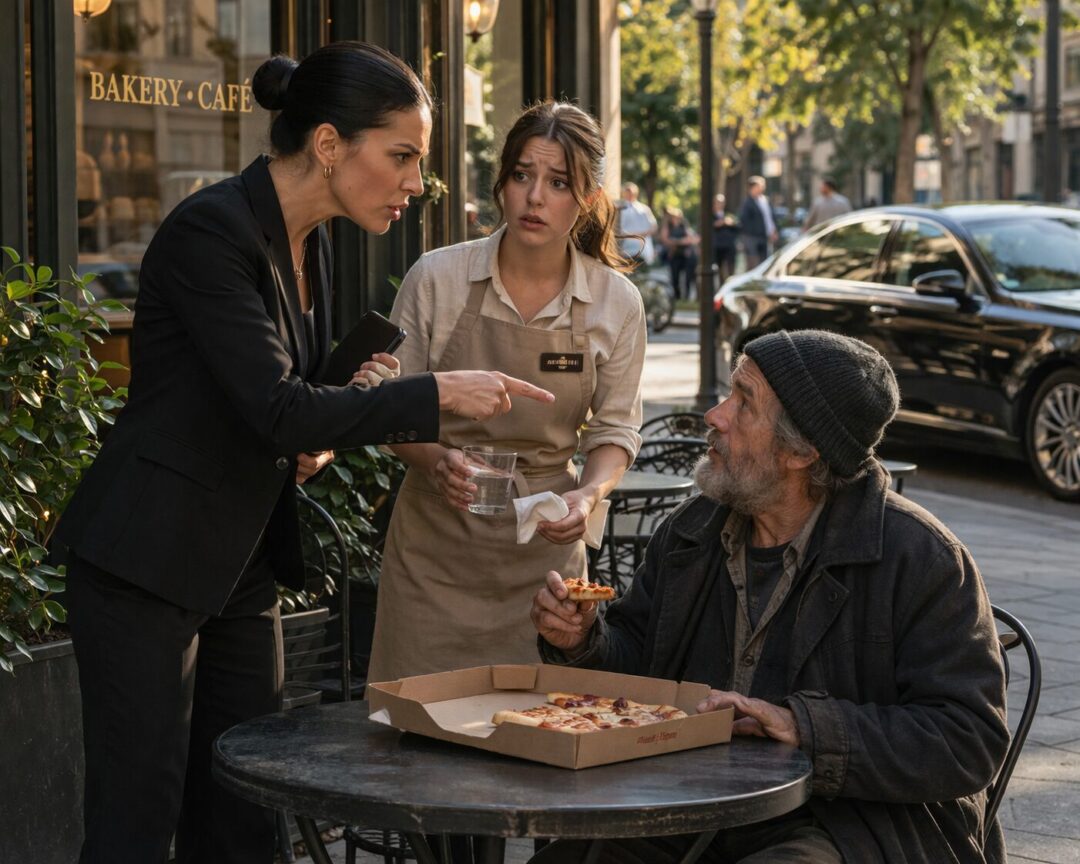
The slice trembled slightly in his hand, not because he was afraid, but because the late afternoon wind kept slipping between the buildings and catching the paper plate balanced beside the open box. Around him, the sidewalk bakery glowed with the kind of polished warmth that made strangers feel they were trespassing even before anyone spoke. The brass-framed windows reflected honey-colored light. Fresh loaves sat behind the glass in careful rows. The little iron tables outside were meant for people who looked like they belonged there.
The man did not.
His knit cap was pulled low over short gray hair. His coat was dark with wear and a little too heavy for the season. Gray stubble roughened his face, and his hands looked like they had known both cold and labor. He sat with the quiet economy of someone who had spent years learning not to take up too much space.
“Take that and go,” the manager said.
Her voice was not loud enough to turn the whole street, but it was sharp enough to cut the air in front of their table. She stood over him with one hand wrapped around a tablet, her dark blazer crisp, her posture rigid, her face made severe by the sleek bun drawn tight at the back of her head. She did not look angry in the wild, careless way people sometimes do. She looked offended. As if his presence were a stain she had personally discovered.
A few feet away, a young server froze with a glass of water in one hand and a folded napkin in the other. Her apron was the color of light coffee, her ponytail loose enough for wisps of brown hair to escape around her face. She had the expression of someone who had spent most of her life trying not to make trouble and was suddenly standing in the middle of it anyway.
The old man looked up.
His eyes were calm. That was the first thing that unsettled the girl. He did not look humiliated yet. He looked as if he were noticing details.
The polished shoes of the manager.
The little tremor in the young server’s fingers.
The half-glance from a couple seated near the corner, both of them pretending not to listen.
“I bought the pizza,” he said mildly.
The manager’s jaw tightened. “Then eat it somewhere else.”
The server stepped forward before she could stop herself. “He was eating quietly.”
The manager turned so fast the girl almost flinched backward.
“Serve customers,” she said. “Not strangers.”
Color rose to the girl’s face. She lowered her eyes, but she did not move away. The glass in her hand caught the light and shook once. It would have been easier to step back inside, to disappear into the smell of cinnamon and warm bread, to leave the old man to whatever came next.
Instead, when the manager looked away for one second—just one—she took the remaining two steps to the table and set down the water and napkin.
The old man rose slowly. No sudden indignation. No pleading. No scene. He looked at the girl, really looked at her, and for the first time something shifted in his face. Not softness exactly. Recognition.
“Thank you,” he said.
The words were simple. They landed harder than an argument would have.
The girl swallowed. “I’m sorry,” she whispered, though she was not the one who owed him the apology.
He gathered the pizza box, gave the manager nothing—not anger, not shame, not even a parting glare—and walked away down the sidewalk toward the street.
The manager exhaled as though order had been restored.
But the girl, whose name was Maren, could not shake the feeling that something unfinished had just passed between them like a hand over a flame.
She watched the old man move toward the black sedan parked at the curb.
At first, it meant nothing. Cities were full of expensive cars no one around them could afford. Then he stopped beside it, and the driver’s side unlocked with a quiet flash.
Maren frowned.
The manager saw it a moment later and stiffened.
The old man set the pizza box on the hood, removed the knit cap, and stood very still.
Even from where Maren stood, she could feel the scene changing.
It happened in details. The straightening of his shoulders. The deliberate shrug out of the worn coat. The smooth line of a camel overcoat lifted from the car. The pale cuff at his wrist. The glint of a watch that looked as if it cost more than Maren made in half a year.
The same man.
And yet not the same man at all.
He combed one hand through his gray hair, now neat and swept back, then turned toward the bakery with the unhurried certainty of someone walking into a room he already owned.
The manager’s fingers locked around her tablet.
Maren forgot to breathe.
Part II — The Man by the Sedan
His name was Corin Vale, though no one at the bakery had ever heard it spoken aloud.
For three months, the staff had been told that new ownership was coming. Not a rumor exactly, but not a fact with shape either. The parent company had sold three boutique bakery locations to a private investor who wanted to “reimagine community hospitality.” That was how the memo had phrased it. The old owner had retired to Florida. The district manager had come twice, spoken in circles, and left. No one had met the buyer.
The staff filled the emptiness with guesses.
Maren thought the new owner would be young, or worse, young enough to call himself disruptive. She imagined bright white sneakers, words like culture and performance, a smile that could sharpen without warning. She knew what management usually meant in places like that. More pressure. Less patience. Gentler words used to excuse harsher decisions.
Evelyn Hart, the bakery’s manager, had responded to the news differently.
She became stricter.
The napkins had to be folded sharper, corners aligned. The outdoor tables had to be wiped between customers even if no one could see a mark. Loiterers were to be discouraged. Street musicians were “not the brand.” Delivery drivers waiting too long at the curb made the storefront look messy. Evelyn had a gift for dressing disdain in the language of standards.
Maren understood that gift because she had spent her life on the receiving end of it.
She was twenty-three, living with her younger brother in a narrow apartment above a hardware store six blocks away. Their mother had died three winters earlier after an illness that had devoured savings faster than anyone could earn them. Their father had disappeared long before that, leaving behind an old duffel bag, a collection of unpaid tickets, and a silence no one in the family had found a useful name for. Maren had left community college halfway through a nursing program, promising herself it was temporary. Temporary had stretched into two years of dawn shifts, doubled aprons, sore feet, and careful arithmetic done at kitchen tables.
She knew what it was to be inspected and found lacking before she opened her mouth.
That was why the old man at the patio table had unsettled her so deeply. Evelyn had looked at him and made a complete story out of a coat, a beard, and a cheap pizza box. She had looked at him the way people sometimes looked at Maren’s mother in the last year of her illness—too tired, too worn, too obviously in need, and therefore somehow less worthy of gentleness.
Now the old man was crossing the sidewalk toward them in a camel overcoat so perfectly cut it seemed to correct the lines of the air around him.
He stopped at the edge of the patio.
“Now,” he said, his voice quiet and exact, “let’s try again.”
Evelyn opened her mouth, closed it, then found another version of herself to wear.
“Sir,” she said. “I didn’t know.”
Corin’s face did not change. “That was the problem.”
The words were not loud. They didn’t need to be. Maren felt them like a weight settling onto the little metal tables, onto the glass storefront, onto every second that had just passed.
Behind Evelyn’s shoulder, a customer coming toward the door hesitated and stepped back. Inside, one of the bakers was pretending to rearrange a display that did not need rearranging. The whole place seemed to understand that something irreversible had arrived.
Evelyn tried again. “If I had realized—”
“No,” Corin said.
He did not raise his voice. That made it worse.
“You realized exactly what you wanted to realize. You saw a man you thought you could dismiss.”
For a beat, no one moved. The street noise continued beyond them—traffic, a siren far away, the thin bark of a dog—but inside the circle of the patio it all seemed muffled.
Maren had expected fury from him. Or triumph. Some visible satisfaction in turning the humiliation back where it had come from.
Instead, what she saw in Corin’s expression looked almost like disappointment.
And somehow that was harder to bear.
Part III — What Kindness Sees
Corin turned away from Evelyn and looked at Maren.
She wished, absurdly, that she had fixed the loose strand of hair falling near her cheek. She wished her apron didn’t look suddenly childish. She wished she understood why he was looking at her as if she had been part of something larger than one glass of water and one folded napkin.
“I came to meet my staff,” he said.
At first Maren thought she had heard him wrong.
Evelyn stared at him. “Your—?”
He held out a hand.
Evelyn hesitated.
For the first time since Maren had known her, she looked unsure what obedience might cost.
“The tablet,” Corin said.
The pause lasted only a second, but Maren saw the whole of Evelyn in it—her pride, her fear, her frantic calculation, the years of mastering rooms by speaking first and hardest. Then she placed the tablet in his hand.
Corin turned and extended it toward Maren.
She did not take it.
Not because she didn’t want to. Because her mind had not caught up to the image in front of her: the old man from the patio table, the man who had thanked her for a napkin, holding out the symbol of authority that had just been used to push him out.
“Maren,” Evelyn said sharply, instinct forcing her toward the old hierarchy. “Take it.”
Corin’s eyes flicked to Evelyn. One look. Nothing more.
The rest of Evelyn’s sentence died in her throat.
Maren reached out, fingertips trembling, and accepted the tablet with both hands.
Its weight surprised her.
That was what she remembered later—not the drama of the moment, not even the silence. The simple fact that the thing felt heavier than it looked.
“Kindness looks better in charge,” Corin said.
Something in Maren’s chest gave way.
It was not exactly joy. Joy was too light a word for it. This was relief sharpened by disbelief, gratitude tangled with grief for all the times kindness had cost someone more than they could afford to give.
She blinked quickly, but her eyes still filled.
“I won’t forget this,” she said.
Corin studied her for a moment, and what Maren saw in his expression then was not sentimentality. It was certainty. As if he had been measuring all afternoon which kind of person could be trusted with a room, a team, a threshold. As if the answer had been visible before any title entered it.
He did not dismiss Evelyn on the spot. That might have made a cleaner scene, but life did not always offer the satisfying cruelty of instant reversals. Instead, he asked the district manager to come at once. He requested employee records. He walked the bakery floor himself, speaking to the baker in the back, the dishwasher near the sink, the prep cook frosting miniature cakes. He asked questions no owner Maren had ever imagined would ask.
Who closes most nights?
Who trained the newest hire?
Who covers when someone is sick?
Who knows the regulars by name?
By the time the district manager arrived flushed and apologetic, the truth had already rearranged the building.
Evelyn’s authority had depended on distance. Corin dissolved it in an hour.
He did not fire her in front of everyone. He did something more devastating: he asked her to stay late for a formal review, then spent the rest of the evening listening to the staff she had trained to stay silent.
Maren did not hear everything that was said behind the office door. She heard enough.
Enough to understand that this was not the first complaint. Enough to learn that two promising employees had quit that winter. Enough to realize that standards, in Evelyn’s mouth, had often meant convenience for the powerful and pressure for everyone else.
When the office door finally opened, Evelyn came out without the tablet, without the hard certainty she wore like armor. She did not look at anyone as she gathered her coat. She left through the back.
The bakery exhaled.
Corin stayed.
He did not declare Maren manager that night. He said that would be irresponsible—to her, to the staff, to the business. Instead, he offered her a training path: assistant lead first, paid management courses, schedule authority, a raise effective immediately, and a seat in every operational meeting he would hold over the next three weeks.
“It should be earned,” he said.
Maren nodded, wiping at her face with the heel of her hand. “I know.”
He tilted his head slightly. “You already did the important part.”
Part IV — The Kind of Warmth That Stays
In the weeks that followed, the bakery changed in ways that were visible and ways that were not.
The visible changes came first. The break room got a new refrigerator that actually sealed. Schedules were posted earlier. Shift-swapping no longer felt like pleading. Outdoor seating remained open unless someone was actively causing harm. Leftover bread at day’s end was boxed and routed to a neighborhood fridge instead of thrown away for appearance’s sake.
The invisible changes took longer.
People began speaking in complete sentences around one another.
The bakers laughed more in the early morning.
A dishwasher named Tomas, who had barely looked anyone in the eye for months, started singing under his breath while stacking racks by the sink. A regular customer who came in every Thursday with a cane and terrible puns admitted, in an offhand way, that the place felt friendlier now. Even the light through the front windows seemed less decorative, more earned.
Maren worked like she was building something with her bare hands.
She learned inventory systems and vendor disputes and payroll approvals. She learned which suppliers padded invoices and which delivery windows could never be trusted in bad weather. She learned how to correct someone without shaming them, how to ask questions without making them sound like accusations, how to hold standards without using them as a weapon.
Some evenings, after closing, Corin would sit at one of the patio tables with a coffee gone cold and ask her what she had noticed that day.
Not what went wrong.
What she had noticed.
At first the question confused her. Then she began answering.
That Tomas moved more slowly on Wednesdays because he spent Tuesday nights caring for his mother.
That the younger barista rushed when she was anxious and spilled less when someone gave her one calm instruction instead of three fast ones.
That the regular with the cane always ordered two cinnamon rolls, not one, because he brought the second to the woman at the flower stand across the street.
Corin listened as if these details mattered as much as invoices.
Maybe more.
One rainy evening, nearly a month after the day on the patio, Maren found him standing by the window where the brass trim caught the gray light. He was dressed simply that night, no overcoat, no watch visible, only a dark sweater and the unmistakable stillness that had first struck her when he was sitting at the table with pizza.
She had wanted to ask him for weeks.
“Why did you do it like that?” she said.
He glanced at her. “Like what?”
“The disguise. The test.”
Corin looked out at the rain for a long moment.
Then he said, “Because money edits the truth too quickly.”
Maren said nothing.
“When people know who you are,” he went on, “they often rush to become the kind of person they think you want to see. I needed to know who worked here before titles entered the room.”
She thought of the water she had set down. The napkin. The tiny, trembling act of disobedience that had felt too small to matter.
“And if I hadn’t done anything?”
Corin turned back toward her. There was no performance in his face now. Only honesty.
“Then I would have known something else.”
The answer stayed with her.
It did not make her proud exactly. It made her careful. It reminded her that character was not a spotlight moment reserved for dramatic afternoons. More often, it was the smallest choice available when no reward had been promised.
By autumn, Maren was running the café floor with a steadiness she could scarcely recognize as her own. Not because she had become harder. Because she had stopped confusing authority with distance.
One cold afternoon, as the first real wind of the season rattled the chairs outside, she noticed an older woman in a worn coat standing uncertainly near the patio gate. The woman looked at the menu board, then at the prices, then down at the paper cup in her hand as if calculating whether she should keep moving.
Maren walked outside before the hesitation could harden into shame.
“Can I get you something warm?” she asked.
The woman looked startled. “Oh, no, I was just—”
“It’s cold,” Maren said gently. “Please.”
A few minutes later, the woman sat at the corner table with a bowl of soup and half a loaf wrapped in paper. Maren placed a napkin beside her without thinking, and as she did, memory moved through her so quickly it was almost physical: the metal table, the open pizza box, the quiet thank-you, the black sedan at the curb.
Inside, the staff moved through the afternoon rush. The windows glowed. Bread steamed when it was cut. Someone laughed near the espresso machine.
At the far end of the room, Corin stood speaking to a supplier. He caught Maren’s eye through the glass.
She didn’t smile broadly. Neither did he.
But something passed between them anyway—an understanding old as kindness and new as every moment someone chooses it again.
Later, after the woman had gone and the streetlights had come on, Maren stepped outside to stack the chairs. The city had turned silver-blue in the evening. Cars slid by in ribbons of reflected light. The table near the window held the last warmth of the day.
She rested a hand on its edge for a moment.
That was where it had begun.
Not with the humiliation, though that had lit the fuse.
Not with the reveal, though that had changed the story.
It had begun with a single refusal to let another human being be made smaller in front of her.
The world had not transformed because a powerful man had chosen to reward her.
It had transformed because, for one thin second in the middle of an ordinary workday, dignity had been offered before it was earned, before it was useful, before anyone knew what it might return.
Maren looked through the bakery window at the warm light, the moving hands, the faces no longer afraid to lift toward one another.
Then she picked up the last chair and carried it inside.