The Medal in the Drawer
The Medal in the Drawer
Part I — The Thing He Couldn’t Sell
The click of the drawer sounded louder than it should have.
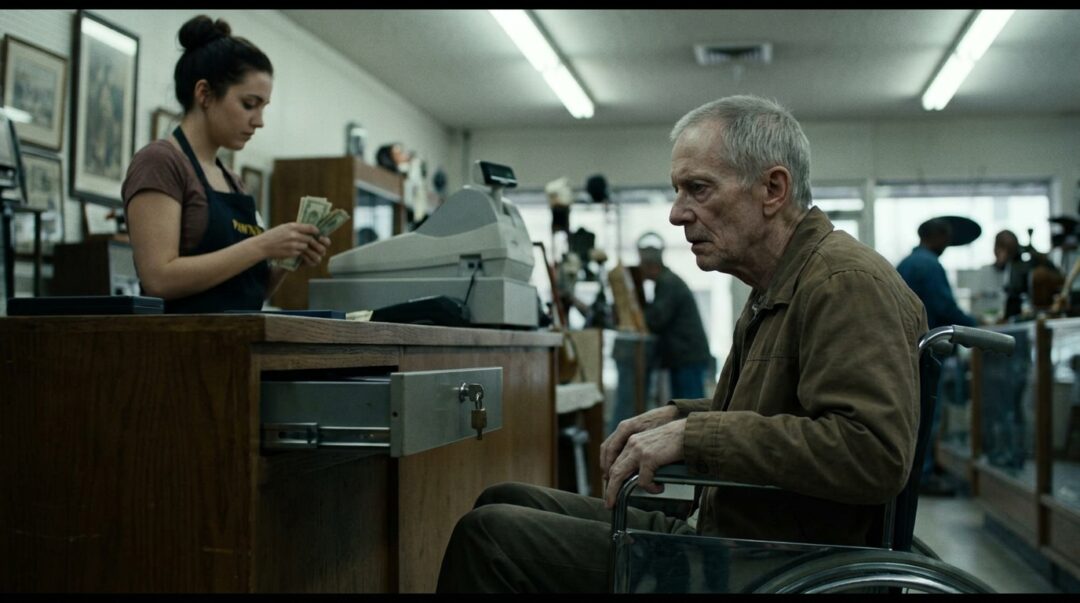
Wesley Hart stared at the narrow strip of metal disappearing behind the pawnshop counter and felt something inside him go cold. It was not just the medal. It was the way the young clerk had taken it from his hand, studied it once, and slid it into the locked drawer without a word, as if she had sealed up the last decent thing left of him.
For a moment, the entire shop seemed to pause with him.
The fluorescent lights hummed overhead. A television mounted in the corner played a muted daytime talk show no one was watching. Behind the glass counters lay gold chains, old watches, gaming consoles, cracked phones, and power tools with faded stickers. Around him, two customers pretended not to look, which only made their looking feel worse.
Wesley’s hand tightened on the wheel of his chair.
“Please,” he said, and hated how rough his voice sounded. “Not that.”
The clerk lifted her eyes to him then. She was younger than his daughter would have been if life had arranged itself differently. Mid-twenties, maybe. Dark hair pulled into a tight knot. Store apron. Alert face. The kind of face people wore when their job taught them to expect lies before truth.
But there had been something else in her expression when she saw the medal.
Not suspicion. Not exactly.
Recognition, maybe.
Or pity, which Wesley could not bear.
Her name tag read Nora. She glanced toward the back office, then toward the register, then back to him. “Just wait a second.”
Wesley looked at the drawer again.
He had promised himself for fifteen years that he would never do this.
Not the ring his wife left him. Not the watch he got on his fortieth birthday. Not the old fishing rods in the garage. Not the television. Not the spare heater. All of that had gone before he let his hand touch the medal case tucked inside the top drawer of his dresser.
But this morning the landlord’s final notice had sat on the kitchen table like a sentence. The pharmacy had refused to extend his prescription again. His chair battery had been failing for weeks. Pride did not pay rent. Pride did not keep the lights on. Pride did not stop pain from reaching up his spine when the weather changed.
So he had opened the case.
The ribbon was still neat. The metal still carried the dull shine of being polished by fingers more than cloth. He had earned it in another lifetime, when his body still answered him and his name sounded solid in his own head. He had not looked at it for long. Looking too long would have turned the act into betrayal before he even left the apartment.
Now it was gone from sight.
Nora counted bills from the register—twenties, a ten, two fives. More than he expected. More than the shop would probably have offered on a good day for anything sentimental and difficult to resell.
She laid the money on the counter.
Wesley did not touch it. “And the medal?”
Her jaw tightened almost invisibly. “Take this first.”
People always thought dignity vanished all at once. It did not. It came apart in small, humiliating negotiations. A form signed here. A call made there. A promise broken quietly in the morning when no one was around to hear it.
He took the money because he had come for money. Because his body hurt. Because the landlord would not wait. Because people who said some things were priceless had usually never reached the point where they had to test that belief.
Still, when he picked up the folded bills, his hand shook.
Nora did not offer a receipt. She did not say the transaction was complete. She only watched him with a look he could not read, and Wesley no longer had the strength to ask for what should have been his.
He turned his chair toward the door.
Every movement out of the shop felt heavier than the one before it.
The glass door pushed open with a rubbery groan, and hot daylight struck his face. Outside, the strip mall parking lot shimmered in the noon sun. A dented sedan idled near the curb. Somewhere farther down, someone laughed outside a discount nail salon. Life went on around him with the casual cruelty of ordinary afternoons.
Wesley stopped beside the curb and stared down at the money in his lap.
It was enough to buy him a little time.
It should have felt like relief.
Instead, it felt like he had traded the last proof of who he used to be for a stack of bills that would vanish by evening.
He closed his fingers around the cash and tried not to think about the drawer.
Part II — Before the Counter
Three years earlier, Wesley had still been the kind of man who ironed his shirts even if no one was coming over.
His apartment had not been much—a one-bedroom above a laundromat, with windows that rattled every time trucks rolled down the avenue—but he had kept it orderly. Shoes lined up by the wall. Dishes washed before bed. Bills stacked in precise piles. The routine mattered. Routine was structure, and structure was the scaffolding that kept certain men standing after life had already taken too much.
His injuries had taught him discipline first, then endurance, then the slower lesson that dignity sometimes survived only through habit.
He had lost both legs below the knee in the final year of his service. The story people preferred was courage under fire. The real memory was louder, messier, and full of details no medal could clean up: dirt in his mouth, heat in the air, the strange silence after impact, the impossible realization that pain could arrive before understanding.
The medal had come months later in a ceremony full of polished shoes and careful words. His wife had cried. Wesley had stood straight on his prosthetics and accepted the ribbon because refusing it would have embarrassed the men around him. Afterward he tucked it away and did what men like him were trained to do. He moved on. He found work. He learned balance. He kept appointments. He went home every night and pretended the cost of survival could be itemized and filed away.
For a while, that had almost been true.
Then work gave out. Then his wife got tired of a life measured by prescriptions, repairs, and bad sleeps. Then she was gone. Then the small savings disappeared into larger emergencies. The prosthetics wore on him differently with age. The chair became more practical, then necessary. Pride remained, but its uses grew limited.
Wesley never asked for much. That was part of the problem.
He was too proud for charity, too tired for bureaucracy, and too old to turn hardship into a performance. He paid what he could, delayed what he could not, and kept telling himself next month would be easier. It never was.
The landlord’s letter that morning had changed something.
Final notice.
Not warning. Not reminder. Final.
He had read it once, set it down, and stared at the apartment around him as if it already belonged to someone else.
On the dresser sat the empty space where his watch used to be. In the hall closet, the fishing rods were gone. The old television had been sold two weeks before. Even the framed photograph from his service days had been taken out of its glass and stored away because the frame itself had fetched eight dollars.
Only the medal remained untouched.
He had known there was a pawnshop four blocks away. He had passed it a hundred times. Its red sign promised CASH TODAY, the kind of phrase meant for desperation because desperation disliked complexity.
Wesley had sat on the edge of his bed with the medal case in his hand for nearly ten minutes before leaving.
He told himself it was only an object.
Then he laughed once, bitterly, because that was the lie people told when they needed permission to betray themselves.
By the time he rolled through the pawnshop door, he had already exhausted every argument except necessity.
That should have made the moment easier.
It did not.
Part III — The Locked Drawer
Nora Bell had worked the counter for eleven months, and in that time she had learned to recognize the categories.
There were people unloading stolen tools and people pawning wedding rings after bad weekends in casinos. There were teenagers trading consoles for quick cash and men insisting some dusty guitar was worth three times what sentiment made them believe. Desperation had accents. It had uniforms. It had smells and rhythms and practiced lines.
Wesley did not fit any of them.
From the second he rolled in, Nora knew he had almost turned around outside.
She had seen it in the stiff way he held himself. In the care with which he placed the old case on the glass. In the fact that he did not start talking immediately, as liars often did. He only opened the case and let her see what was inside.
The medal caught the overhead light.
She was not an expert in military honors, but she knew enough to understand this was not costume junk or a trinket from a flea market. More than that, she saw his face when he laid it down.
Some items came with stories people tried to sell along with them. This one came with silence.
“You’re selling this?” she asked.
“I need cash today,” he said.
That was all.
It should have remained simple. The shop bought things. The register produced money. Rules existed because employees were not paid to make moral philosophy out of every transaction.
But there were rules, and there was what it felt like to take something from a man who looked as if he would rather hand over part of his own skin.
Nora picked up the medal, buying herself a second to think.
The office door at the back was ajar. If her manager saw it, he would appraise it, log it, tag it, and put it in the safe with everything else. By tomorrow it would be an item number. By next week it would be inventory. Maybe a collector would buy it. Maybe someone would hang it in a den and tell guests a story that belonged to another man.
The idea made her stomach twist.
So she did the first thing she could think of.
She slid it into the drawer and turned the key.
Wesley’s face changed so suddenly that she nearly stopped breathing.
There it was—that raw, involuntary look of someone watching the line between need and self-betrayal disappear. His hand clenched. His voice dropped into something jagged.
“Please. Not that.”
The words struck harder than if he had shouted.
Nora had heard pleading before. This was different. This man was not begging for a better price. He was begging not to lose what he had just forced himself to surrender.
She should have explained immediately.
But the manager’s footsteps sounded faintly in the back office, and instinct took over. She moved to the register, counted out cash from what she knew she could cover before the end of her shift, and set it down.
“Take this first,” she said, because she still had no clean way to tell him what she was doing without risking the medal being seen.
He looked at the money as if it insulted him.
Then he took it.
Nora watched him leave and felt the pressure in her chest tighten.
If she let him go too far, the gesture would curdle into cruelty. The whole point was not to help him and then leave him with the wound.
The bell over the door stopped vibrating.
Nora reached into the drawer, took out the medal, and hurried after him.
Part IV — What Belonged to Him
Wesley heard the door behind him and almost kept rolling.
He did not want witnesses to whatever came next. Another correction. A receipt. A rule. Some final indignity dressed up as procedure.
But then Nora called, “Sir—wait.”
He stopped.
She came toward him quickly across the heat-shimmered parking lot, one hand curled around something small. Without the counter between them, she looked younger and less guarded. More uncertain, too, which unsettled him in a different way.
When she reached him, she crouched slightly so she was at eye level.
For a second neither of them spoke.
Then she opened her hand.
The medal lay in her palm.
Wesley stared at it, unable to make sense of what he was seeing. The blue ribbon. The familiar metal. The small worn edge where his thumb had rubbed it years ago after the ceremony, back when he still had no idea how long a single object could carry a man.
“I couldn’t let them process it,” Nora said softly. “That’s why I locked it up.”
He looked from the medal to the money in his lap and back again.
“I don’t understand.”
“The money’s yours,” she said. “The medal isn’t for sale.”
Something in him resisted the words at first. He had spent too long expecting hidden conditions. Too long learning that kindness, when it appeared, usually came with a form to sign or a debt to remember.
“Why?” he asked.
Nora exhaled. “Because some things shouldn’t end up in a display case.”
The answer was simple enough to be true.
Wesley felt the world tilt, just slightly. Not into sentiment. Not into easy relief. Into something stranger and harder to absorb: the fact that a person who owed him nothing had looked at the worst moment of his day and refused to let it become permanent.
His throat worked once before any sound came out.
“That’s not store policy.”
A faint, tired smile touched her mouth. “Good thing we’re outside.”
He let out a breath that almost became a laugh and almost became a sob. He had not expected either. Tears embarrassed him less now than they would have years ago, but that did not mean he welcomed them.
Nora held the medal a little higher. “May I?”
He nodded.
Her hands were careful as she fastened it back onto the front of his jacket, just above the pocket seam. Not like a salesperson returning merchandise. Like someone restoring an order that had nearly been broken.
The small weight settled against his chest.
Wesley looked down at it, then covered it with his palm.
He had thought the thing he feared most was losing the medal. Standing there in the heat, he realized it had been something even worse: losing it willingly and then having to live with the knowledge that desperation had rewritten the meaning of his own life.
Nora had not solved everything. The rent was still due. The pain in his back would still be there tonight. The pharmacy would still want payment. Tomorrow would still arrive with all its ordinary demands.
But the medal was back where it belonged.
And somehow that changed the shape of everything.
“I was going to buy it back,” Wesley said after a moment, surprising himself with the confession. “Soon as I could.”
“I know,” Nora said.
He looked at her. “How?”
She shrugged lightly. “You’re the kind of man who was already ashamed of walking in. Men like that don’t come here to let things go forever.”
Something in that nearly undid him.
No grand speech followed. No swelling music, no crowd gathering to applaud, no miracle descending from the sky to tidy the rough edges of real life. Just a young woman in a store apron, an old man in a wheelchair, the afternoon heat, and a simple refusal to turn honor into merchandise.
Wesley folded the money carefully and slipped it into his jacket.
“Thank you,” he said.
The words felt too small, but they were what he had.
Nora stood. “Take care of yourself, Mr. Hart.”
He blinked. “I didn’t tell you my name.”
She glanced toward the counter inside the shop. “It was on the final notice sticking out of your pocket.”
For the first time that day, Wesley smiled without effort.
“Sharp eyes.”
“Comes with the job.”
He started to turn his chair, then paused. “You’ll be short in the register.”
“I’ll figure it out.”
He wanted to protest. To tell her he couldn’t take money she might need herself. But he also knew the insult hidden inside refusing an act of grace after someone had already chosen it.
So he nodded once.
As he rolled away, the parking lot looked the same as before—faded lines, bright sun, the discount stores stitched together by concrete and necessity. Yet the day no longer felt stripped bare. The money in his pocket was temporary. The medal on his chest was not. Between those two truths, something steadier returned.
That evening he paid part of what he owed, enough to stop the final notice from becoming an eviction notice. He picked up the prescription that had been waiting at the pharmacy. When he got home, he sat in the quiet apartment and did not remove the medal right away.
He left it there while the room darkened around him.
Not because he needed to remember the worst of the day.
Because he needed to remember the end of it.
Weeks later, when the crisis had loosened just enough for him to breathe again, Wesley went back to the shop. He carried an envelope with every dollar Nora had given him, repaid in careful bills.
She looked up when he came in and recognized him at once.
Without a word, he set the envelope on the counter.
“What’s this?” she asked.
“Store policy,” he said.
She laughed then—a clear, surprised laugh that brightened the whole tired room. Wesley found himself smiling with her.
This time, when he rolled back out into the daylight, he did not feel like a man leaving pieces of himself behind.
The medal rested against his chest beneath his jacket, light as ever, and heavier than anything money could buy.