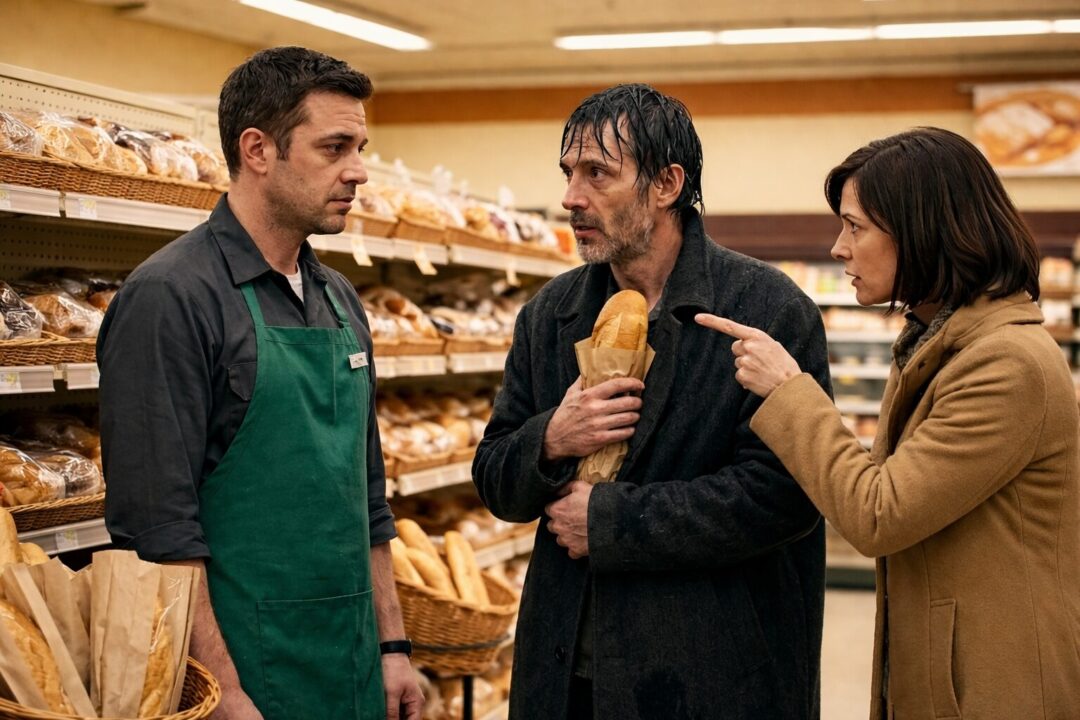
The Mitten in His Pocket
The Mitten in His Pocket
Part I — The Bread He Couldn’t Leave Behind
The bread was still warm when the man tried to hide it.
That was what struck Nolan first. Not the theft itself, though that should have been enough. Not the sharp voice of the woman by the display. Not even the way every head in the bakery aisle seemed to turn at once, as if hunger were something offensive when seen too clearly.
It was the warmth of the loaf, half concealed beneath a soaked coat, and the way the man’s hand trembled around it as though he were holding the last live thing in the world.
“He hid that bread,” the woman said again.
Her name, Nolan would later learn from the receipt at the register, was Renee. At that moment she was simply a voice cutting through the buttery smell of fresh rolls and sugar glaze. She stood with one hand clenched around her phone, her tan winter coat buttoned neatly to the throat, looking at the thin man in front of the shelves as if she had caught him doing something filthy.
The man looked like the opposite of the store around him.
The supermarket bakery glowed in soft yellow light. Loaves were stacked in clean rows. Baskets overflowed with rolls dusted in flour. Behind the glass, cakes shone under bright lamps, finished with swirls of cream that seemed almost theatrical in their perfection. Everything in that corner of the store suggested comfort, routine, and enough.
The man brought none of that with him.
He was gaunt, his cheeks hollow beneath rough gray stubble. Wet black hair clung to his forehead. His coat, once dark, had faded to the color of old pavement, and it hung too large on his body as if it had belonged to someone broader and stronger. Water dripped from the hem onto the polished floor.
He looked at Nolan, then at the bread, then at the floor.
“Take your hand out,” Nolan said.
He kept his tone level. Calm had its own authority, and after seventeen years of working retail, he had learned that a steady voice could do more than a loud one ever managed. Still, he could feel the eyes on him. People waiting to see what kind of man he would be.
The stranger swallowed and slowly pulled his hand free.
A torn paper sleeve slipped with the motion. The bread almost fell, but he caught it against his ribs, as if instinct had moved faster than shame.
“So you did steal,” Renee said.
Nolan did not answer her. His attention remained on the man. There was no defiance in him. No swagger, no calculation, no muttered excuse prepared in advance. The man was not angry at being caught. He looked crushed by it. As if this moment had happened many times before in his mind and had ended badly every time.
“Put it back,” Nolan said.
For a second, the man didn’t move.
Then he whispered, “Please, not here.”
The words were soft enough that Nolan almost missed them. But what stopped him wasn’t the plea alone. It was something tucked against the seam of the man’s coat pocket: a small pink mitten, damp and dirty, barely visible beneath the fold of fabric.
Not a decoration. Not trash.
A child’s mitten.
Nolan’s eyes lingered on it for half a heartbeat. When he looked back up, the man had seen that he’d been seen.
The whole aisle seemed to tighten.
“I just need food,” the man said.
“For who?” Nolan asked.
The man shut his eyes briefly, and when he opened them, whatever pride he had left was gone.
“My kids.”
It was the kind of answer people gave sometimes because they knew it sounded like the right key for pity. Nolan had heard every version. Sick mother. No paycheck. Hungry children. Bus fare home. Dead battery. Lost wallet. Usually the story unraveled if you tugged at it.
But the mitten in the pocket remained.
Renee let out a breath through her nose, unimpressed. “That’s what they all say.”
Nolan should have taken the bread and called it done. Maybe written a report. Maybe told the man not to come back. That was the clean version. The one management preferred. The one strangers approved of because it preserved the idea that the world still had edges.
Instead he said, “Put it back. Now.”
The man obeyed. His fingers moved reluctantly, placing the loaf back among the others with a care that felt almost painful. He did not argue again. He did not make a scene. He simply lowered his head and walked toward the side exit with the slow, defeated steps of someone leaving more than a store behind.
Renee watched him go and turned to Nolan as though waiting for applause.
“You’re just letting him walk?”
Nolan kept his eyes on the door.
“For now,” he said.
Then he followed him.
Part II — The Alley Behind the Light
Outside, the wind hit like a slap.
The store’s warmth vanished the moment Nolan stepped into the service lane beside the loading dock. Rain had turned to a sharp, needling sleet, and the evening sky had sunk into that grim colorless dark that made everything look abandoned before night had even fully arrived.
At the far end of the alley, the man was already moving fast, one hand pressed inside his coat. Not running. Just hurrying with the purpose of someone late to an emergency no one else could see.
The alley behind the supermarket was the part customers never imagined. Stacked milk crates. Rusting carts. Damp cardboard collapsing into itself. Steam coughing from a wall vent. Trash bags crowded against cinder block. The smell of wet concrete and spoiled produce. It was a place for things the polished front of the store had no use for.
The man cut past the loading bay and disappeared into a wedge of shadow between two pallet towers.
Nolan slowed.
There, half-hidden against the wall, was a shelter built from scraps: flattened boxes on the ground, a broken pallet propped like a frame, clear plastic sheeting tied off with frayed cord and weighed down with stones. It was barely a shelter at all. A refusal, more than anything. A refusal to lie down in the rain and call it finished.
The man dropped to one knee beside it.
Two children were inside.
Nolan stopped so abruptly his shoes scraped concrete.
The older child, maybe seven, was wrapped in a thin blanket that had once been blue. The younger one could not have been more than four. She sat with her knees pulled to her chest, one bare hand tucked under her arm, the other reaching immediately toward the man’s coat. Not asking. Expecting. That, more than anything, made Nolan’s throat tighten. This was ritual. They had waited like this before.
The man drew out what remained of the bread.
He must have torn off part of it before returning the loaf inside. Nolan hadn’t seen him do it.
The girl reached for it with the same hand that should have been wearing the pink mitten.
Very gently, the man broke the bread into the smallest pieces possible, as though he were trying to stretch mercy by force. He gave the first piece to the younger child. The second to the older one. Only after both children had something in their hands did he keep the smallest piece for himself.
Neither child spoke.
They just ate.
The older one didn’t even chew right away. He held the piece beneath his nose first, eyes half-closing, breathing it in like proof.
Nolan felt, with a kind of shame, the bakery’s abundance rising in his memory. Towers of bread. Racks full of rolls. Cakes no one needed. Fruit arranged to look beautiful. Enough everywhere. And here, in the dark behind the building, a man was dividing half a loaf like it was medicine.
The man finally looked up and saw Nolan standing there.
For a long moment, neither of them moved.
There was fear in the man’s face now, but not for himself. That was what made it unbearable. He shifted slightly, angling his body toward the children as though he could shield them from whatever came next.
“I put it back,” he said. “I did what you said.”
Nolan nodded once.
The younger child leaned against the man’s shoulder, chewing slowly. Her hand was red from the cold.
“What’s her name?” Nolan asked before he could stop himself.
The man hesitated, as if names were a kind of risk.
“Lia,” he said quietly. He touched the older child’s blanket. “And Owen.”
The names made them more real than Nolan was prepared for. Not symbols. Not cautionary images. Just children, wet and cold and trying not to look hungry while clearly starving.
Nolan’s gaze went to the pink mitten tucked in the man’s pocket.
“She lost the other one two days ago,” the man said, following his eyes. “I couldn’t find it.”
His voice had changed. It held no defense now. Only exhaustion. “I was trying to get something in them before it got worse tonight.”
Nolan glanced upward. The sleet was thickening. The wind threaded through the alley hard enough to rattle the plastic sheet.
“Stay here,” he said.
The man gave a small, humorless laugh. “Where else would we go?”
Nolan turned and walked back to the store before the answer could settle in him for good.
Part III — What a Door Can Become
He moved through the store differently on the way back.
Not as a supervisor. Not as a man solving a problem.
As someone who had seen behind a wall and could no longer pretend the wall was solid.
The bakery assistant looked up when Nolan came behind the counter, but one glance at his face was enough. She asked no questions. Nolan took a cardboard produce box from the back and began filling it.
Two loaves of bread. Bananas. Apples. Crackers. Peanut butter. Shelf-stable soup. Instant oatmeal cups. Granola bars. Two bottles of water. A carton of milk. He paused, then crossed into prepared foods and returned with a thermos from the staff cupboard and filled it with hot soup from the deli station.
At the last second, he added a package of socks from seasonal stock.
One of the cashiers saw him and opened her mouth, then closed it. News traveled quickly in a store, but so did silence when people sensed something larger than rules was moving through the aisles.
From the lost-and-found shelf in the office, Nolan took a wool blanket no customer had claimed in weeks. He left a note beside the empty spot out of habit, though the handwriting looked absurdly formal under the circumstances.
As he headed for the side door, Renee was still near the front registers, repacking her groceries.
She saw the box.
Her expression changed in stages: curiosity, recognition, discomfort.
“You found him,” she said.
Nolan adjusted his grip. “I found his kids.”
Whatever answer she might have given stayed behind her lips. For once, she had nothing sharp enough to survive the truth.
The alley felt darker the second time, but less hidden. Nolan knew where to look now.
The children saw the box before the man did.
Lia straightened first. Owen pushed the blanket off his shoulders and rose halfway, his eyes fixed on the food with the startled caution of someone who has learned that hope can humiliate you if you move too quickly.
The man stood when Nolan came close.
He looked as if he did not trust his own eyes.
Nolan set the box down at the edge of the pallet shelter. The smell of soup rose in a warm cloud. Lia’s face changed instantly. It wasn’t joy, not yet. Joy was too expensive. It was disbelief trying very hard not to break.
“Take the box,” Nolan said.
The man stared at him. Rain shone in his stubble. “You came back.”
Nolan almost said something simple. Of course I did. It’s nothing. Here. But those would have been lies in different forms. It was not nothing. And the man deserved better than a kindness disguised as inconvenience.
So Nolan just nodded.
The children moved first. Owen crouched by the box and touched the side of the bread bag as though checking whether it was real. Lia clutched the pink mitten in one hand and reached for the thermos with the other until her father gently guided it away from the heat.
His father.
That was how Nolan thought of him now, before anything else.
“My name’s Silas,” the man said suddenly, as if he owed a proper introduction in exchange for what had been given.
Nolan had not asked, but he was glad to know it.
“Nolan,” he said.
Silas looked down at the food, then back toward the store’s lit rear door. His shoulders were shaking, though whether from cold or something else Nolan couldn’t tell.
“I’ll pay it back,” Silas said.
Nolan did not answer that. Some promises came from pride, not possibility.
Instead he looked at the children’s hands, the slick pavement, the plastic roof rattling overhead, and the wind cutting through every gap in the alley. Then he glanced at the loading bay just beyond the service entrance—a plain concrete space with stacked pallets, a humming heater near the wall, and enough shelter from the weather to make survival easier for one night.
He made the decision in the space of a breath.
“Come inside tonight,” he said.
Silas blinked. “What?”
“The loading bay,” Nolan said. “Only till morning. Out of the wind.”
Silas did not move. The offer seemed too large, perhaps more frightening than the box had been. Mercy often was. It required trust in a world that had rarely rewarded it.
“You don’t have to be grateful,” Nolan said quietly. “Just get them warm.”
That did it.
Silas bowed his head once, hard, as though fighting to keep himself upright. Then he gathered the box, Owen grabbed the blanket, and Lia tucked her hand into the crook of her father’s coat where the lost mitten belonged.
The service door opened with a groan.
Warm air spilled out across the alley.
Part IV — The Night After Judgment
The loading bay was ugly in the way useful places often were.
Bare concrete. Metal shelves. A humming heater. Stray pallets stacked against the wall. Fluorescent lights that made everything look slightly tired. But to Lia and Owen it might as well have been a palace. They sat close to the heater, wrapped in the wool blanket, eating bread and slices of banana with a quiet concentration that made Nolan turn away more than once.
Silas fed them first again.
Every time.
That detail lodged in Nolan more deeply than anything said out loud.
One of the night stockers came through around ten, saw the family, saw Nolan, and simply dipped his chin before changing direction. The deli clerk brought over paper cups and plastic spoons without being asked. Someone from produce left a bag of clementines by the door. No one announced themselves generous. No one made a spectacle of decency. It happened in fragments, the way real mercy often did.
Near midnight, when the children had fallen asleep against their father’s sides, Nolan sat on an overturned crate several feet away and handed Silas a cup of coffee.
Silas held it between both hands for a long time before drinking.
“I had work,” he said eventually, staring into the black surface. “Construction clean-up. Day jobs mostly. Then I got hurt. Missed a week. Missed rent. After that…” He shrugged with one shoulder. “After that everything gets fast.”
Nolan knew what he meant. How one missed payment became an avalanche. How dignity could vanish in forms and deadlines and closed doors and phone calls no one returned.
“Their mother?” Nolan asked carefully.
Silas’s face tightened, but not with anger. More like an old bruise being pressed.
“Gone,” he said. “A long while now.”
The heater clicked. Somewhere deeper in the store, a pallet jack squealed.
Nolan looked at Owen, asleep with one hand still resting on the cardboard box as if guarding it, and at Lia curled beneath the blanket with the single pink mitten beside her cheek.
A child should not have to sleep like that, Nolan thought. Like she had to keep hold of the proof that warmth had once found her.
When dawn began to pale the high loading windows, the store was waking up again. Deliveries. Shift changes. Clean floors. Fresh bread soon to be stacked in warm neat lines.
Silas stood before the children did. He folded the blanket carefully. He broke down the empty boxes. He moved as if trying to erase the trouble of having existed there at all.
Nolan hated that instinct because he understood it.
At the door, Silas stopped.
“I don’t know what I’m supposed to say.”
Nolan looked at him for a moment.
“You don’t have to say anything.”
But Silas did.
“Yesterday I thought getting caught was the worst thing that could happen.” He glanced down at the children. “Turns out being seen was.”
Nolan felt that settle somewhere deep.
By the time they stepped back into the cold morning, the sleet had stopped. The alley was still ugly. The city was still hard. Nothing essential had been magically fixed. But Owen wore dry socks. Lia had warm soup in her stomach and half a loaf tucked under one arm. Silas walked straighter than he had the night before, as if dignity, once returned even a little, changed the shape of a man’s spine.
Nolan watched them go until they disappeared past the corner of the building.
Then he looked down and saw something near the threshold.
A child’s mitten.
Pink. Damp no longer. Small enough to fit in one hand.
Lia must have dropped it on the way out.
He bent, picked it up, and stood for a moment with the mitten resting in his palm while the bakery ovens warmed behind him and the morning shift began inside the bright front of the store.
The day would go on. Customers would come in for bread they never had to think twice about. Rules would still exist. Reports would still be filed. The world would still ask, again and again, for easy judgments.
But Nolan knew now how little a person could understand from a single aisle, a single glance, a single accusation.
Sometimes the truth was waiting in the alley behind the light.
He tucked the mitten carefully into his coat pocket and stepped back inside, carrying with him the small, stubborn proof that what looked like theft from one doorway could look like love from another.