The Promise Her Father Tried To Keep In A Crowded Room
Part I — The Room Went Quiet
The first thing Rebecca noticed was not the glass breaking.
It was the way everyone stopped smiling.
One second, the reception hall was full of clapping hands, forks against plates, cousins laughing too loudly near the bar, the DJ leaning over his laptop with one headphone pressed to his ear. The next, the whole room seemed to inhale and forget how to breathe.
Rebecca looked down.
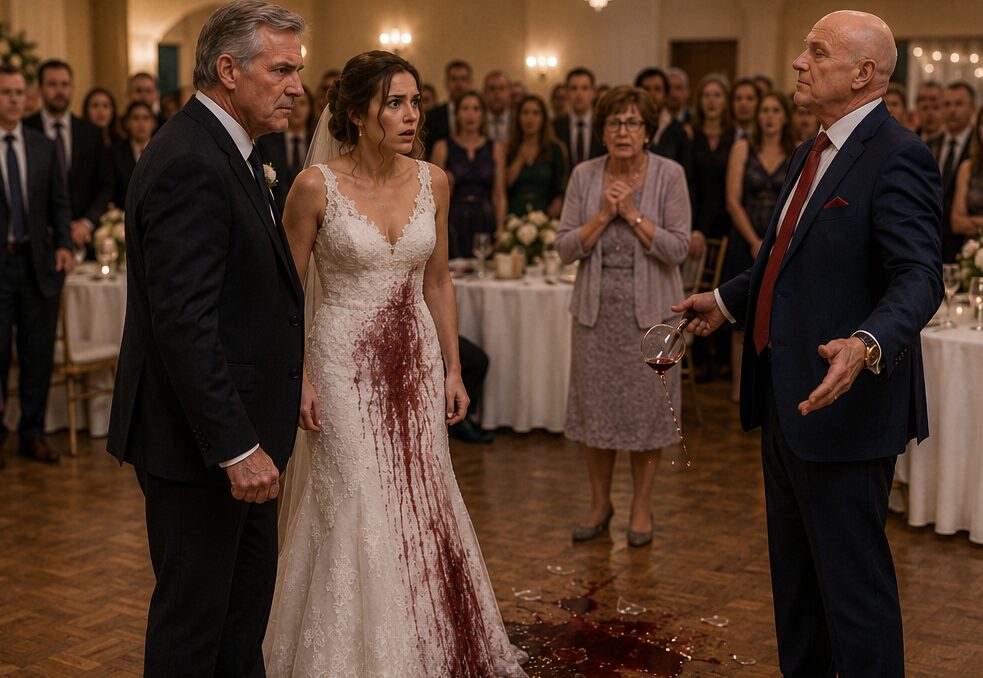
Red wine was spreading across the front of her wedding dress.
It moved through the white lace in thin, branching lines, darkening the fabric just below her waist, dripping toward the hem. A broken wineglass lay near her shoe. Two bright shards had slid under the edge of her train.
Across from her, Raymond stood with his hand still lifted, his fingers loose around nothing.
He smiled like he had just told a joke.
Not a good joke. Not even a kind one. The kind of joke a man told when he already knew no one was brave enough to stop him.
Then Rebecca saw her father.
Steven had been standing near the dance floor, stiff and quiet all evening, his gray hair combed flat, his dark suit buttoned though the room was warm. He had looked tired but proud. A little older than he had at the ceremony. A little smaller than she remembered him from childhood.
Now he did not look small at all.
He was walking toward Raymond.
“Dad,” Rebecca said.
Her voice barely made it past her throat.
Raymond tilted his head, still smiling. His red tie had shifted sideways. His expensive watch caught the ceiling lights. The wine he had spilled across her dress was also on his cuff, a careless purple smear.
“Steven,” he said, too loudly. “Come on. Let’s not turn this into—”
Steven hit him before he could finish.
The sound was sharp and plain. Not cinematic. Not clean. Just skin against bone and a room full of people hearing something they would pretend later not to describe.
Raymond stumbled backward into the spilled wine and broken glass. His heel slipped. He dropped hard into a seated position, one hand flying to his face, the other bracing against the floor.
A woman gasped.
Someone said, “Oh my God.”
Steven stood over him with his chest rising and falling. His right hand hung at his side, already swelling at the knuckles. He did not look triumphant. He looked like a man who had held a door shut for years and finally let the whole storm into the house.
Rebecca did not move.
Behind her, someone started clapping.
It was only one person at first. A soft, uncertain sound from the back of the room.
Then another.
Then more.
The applause spread across the reception hall like people deciding together that silence had made them guilty.
Rebecca turned and saw Pamela near the gift table, her hands coming together slowly, tears shining behind her glasses. Pamela had known Rebecca since before Rebecca could ride a bike. She had helped pin the veil that morning. She had also spent the entire reception watching Raymond like she expected him to break something.
Now he had.
And somehow her father had broken something worse.
Rebecca looked at Raymond on the floor. Then at the wine on her dress. Then at Steven, who still had not looked back at her.
The DJ killed the music too late.
The last note faded in a room full of clapping.
Part II — Other People’s Money
Earlier that evening, before everyone saw the dress, Steven had stood near the florist’s arrangements and counted envelopes in his head.
Not actual envelopes. He knew better than to touch the gift cards before the night was over. But numbers had been following him all day, tapping at the back of his skull.
Final venue balance.
Caterer adjustment.
Extra chair covers because Aunt Brenda had decided at noon she was bringing a man no one knew.
DJ overtime if they ran past ten.
Hotel room for Rebecca and her husband because Steven had insisted.
The photographer’s second payment, due Monday.
He had smiled through all of it.
He had shaken hands. He had thanked the bartender. He had told the venue manager, twice, that everything was perfect. He had slipped a twenty-dollar bill to a teenage busboy who looked overwhelmed and then remembered, with a small inward drop, that twenties were not weightless anymore.
When Rebecca asked if he had eaten, he said, “Plenty.”
He had not.
She touched his sleeve with both hands, careful not to wrinkle his jacket. “You’ve been running around since six this morning.”
“That’s what fathers do.”
“You’re allowed to sit down.”
“In this suit? I may never get back up.”
She laughed because he wanted her to. That was one of Rebecca’s gifts and one of his failures: she could hear what people needed from her before they asked.
She looked beautiful in a way that hurt him.
The lace dress had been chosen on a rainy Saturday in Columbus, in a bridal shop that smelled like perfume and new carpet. Steven had sat under soft lighting with three other mothers and tried not to stare at the empty chair beside him. Rebecca had stepped out in the third dress and immediately looked toward that chair too.
Neither of them said Maria’s name.
They did not have to.
Steven had bought the dress that day with a credit card he told himself he would pay off after the insurance mess cleared, after the medical bills settled, after the house stopped needing repairs, after life became reasonable again.
Life had not become reasonable.
Raymond had.
Raymond appeared at the reception with his polished shoes, his navy suit, his red tie, and a look of ownership that made Steven’s jaw tighten before the man had spoken a word.
“Beautiful spread,” Raymond said near the bar, lifting a glass of red wine. “You really went all out.”
“Rebecca deserved a nice day,” Steven said.
“Oh, I agree.” Raymond looked around the room, approving the white linens, the rented centerpieces, the little candles Rebecca had tied with blue ribbon herself. “I just hope everybody appreciates how much went into it.”
Steven did not answer.
Raymond leaned closer. His breath already carried wine. “Some people don’t understand what things cost.”
“Not tonight.”
“I’m saying something nice.”
“You’re saying it too loud.”
Raymond smiled. “Still touchy.”
Across the room, Rebecca was talking to an elderly neighbor from Steven’s street. She kept glancing over, not worried yet, just aware. Steven made himself smile at her.
She smiled back, relieved.
That was the point of the whole day, he reminded himself. Relief. One clean room in the long dirty hallway of grief.
Maria had died two years before, after eighteen months of appointments, medications, bills, hope, and then bills without hope attached. By the end, Steven had learned that mail could feel cruel. Every envelope had a window. Every window showed a number.
Rebecca knew some of it. Not all.
Not the payment plan he had stretched until it snapped.
Not the loan he had taken from Raymond when the caterer demanded the final deposit two weeks before the wedding.
Not the way Raymond had written the check with a sigh and said, “For my sister’s girl, of course,” as if Steven had not been Rebecca’s father for twenty-nine years.
“Open bar?” Raymond asked later, loud enough for two cousins to hear.
Steven kept his eyes on the dance floor. “Beer and wine.”
“Smart. Let the rich folks do liquor. People like us stay practical.”
One cousin laughed because it sounded like a joke.
Raymond looked at him and added, “Well, some of us stay practical until other people’s money shows up.”
The cousin stopped laughing.
Steven’s fingers tightened around his water glass.
Pamela, standing by the guest book, looked up sharply. She knew enough. Not the whole shape of it, maybe, but enough to know Raymond never brought a knife into a room unless he intended to use it.
“Raymond,” she said, gentle but firm. “Come help me find the card box.”
“I can see it from here.”
“Then come pretend with me.”
He laughed and went, but not before looking back at Steven.
That was how the evening moved: music, flowers, polite conversations, and Raymond pressing small bruises where no one else could see.
He corrected the DJ when the entrance song started three seconds late.
He told the bartender the pours were “generous for a rented hall.”
He told one of Steven’s neighbors that Rebecca looked “expensive tonight,” then turned it into praise so smoothly the woman looked ashamed for noticing the insult.
Rebecca kept floating from table to table, smiling harder each time she passed them.
When she came near her father, she whispered, “Is he okay?”
Steven looked at Raymond, who was showing someone his watch while balancing another glass of red wine.
“He’s Raymond,” Steven said.
“That’s not an answer.”
“It’s the safest one I’ve got.”
Rebecca studied his face.
For a second, she was not a bride. She was ten years old again, standing in the kitchen after overhearing a whispered argument, asking if everything was okay because she already knew it was not.
Steven touched her cheek.
“Today is good,” he said.
She searched him.
Then she nodded, because she wanted to believe him as badly as he wanted to be believed.
Part III — The Gift Table
The gift table stood near the hallway under a framed print of Lake Erie that belonged to the venue and had probably watched a hundred families pretend money did not matter.
Steven had gone there to straighten cards that did not need straightening.
Raymond followed him.
“You can avoid me all night,” Raymond said, “but numbers don’t disappear because people are dancing.”
Steven kept arranging envelopes. “Lower your voice.”
“That’s your whole philosophy, isn’t it?”
“Raymond.”
“Lower your voice. Don’t worry her. Don’t tell anybody. Keep smiling.” Raymond lifted his glass. “Very noble. Very Midwestern.”
A woman at the nearest table turned slightly, then pretended to adjust her necklace.
Steven saw it.
Raymond saw him see it.
That seemed to please him.
“Does Rebecca know?” Raymond asked.
Steven’s hand stopped over a pale blue envelope.
“Know what?”
“That the man giving her away had to borrow from the man she barely invited?”
Steven turned slowly. “You were invited because Maria loved you.”
Raymond’s face changed for half a second. The name struck where nothing else had.
Then he recovered.
“My sister also loved honesty.”
“Do not use her name for this.”
“I wrote the check.”
“And I’ll pay you back.”
“On what? Pride?”
The woman at the table froze. Her husband suddenly became fascinated with his salad plate.
Steven stepped closer. He did not raise his voice. That made it worse.
“Not tonight,” he said.
Raymond’s smile returned. “Family shouldn’t keep secrets on a wedding day.”
Steven looked past him and saw Rebecca.
She stood at the edge of the dance floor, bouquet in one hand, her new husband’s mother beside her. Her smile had thinned. She was watching the bodies, not the mouths. Watching how people leaned away from the gift table. Watching Pamela stand too still.
Rebecca had inherited that from her mother: the ability to read a room by its corners.
She came over as soon as the next song started.
“Dad,” she said, “can I talk to you?”
Raymond bowed slightly, ridiculous and pleased. “Bride’s orders.”
Steven wanted to tell him to leave. Wanted to take his daughter by the hand and walk her out to the parking lot, drive her somewhere quiet, buy her gas station coffee like they used to after late hospital visits, and tell her everything without witnesses.
Instead he followed her into the hallway.
The reception noise dulled behind the door. The hallway smelled like floor polish and the lemon cleaner they used in the bathrooms. A red EXIT sign glowed at the far end near the service entrance.
Rebecca turned before he was ready.
“What is he talking about?”
Steven adjusted his cuff. “He’s had too much wine.”
“That’s not what I asked.”
“No.”
“No, he hasn’t had too much wine? Or no, you won’t answer me?”
Steven looked toward the reception door.
“Rebecca, this is not the time.”
Her face tightened. “That usually means it is exactly the time.”
He rubbed his forehead with two fingers. “I borrowed a little.”
The words landed between them like a plate set down too hard.
“How little?”
“Enough to cover some final things.”
“What final things?”
“Caterer. A few venue charges. Nothing you need to—”
“Dad.”
He stopped.
She took one step back from him, and he hated Raymond more for that one step than for every insult that had come before.
“You told me you had it handled,” she said.
“I did handle it.”
“Borrowing money from Uncle Raymond and letting him throw it around the reception is not handling it.”
“He wasn’t supposed to throw it around.”
“But you knew he could.”
Steven said nothing.
Her eyes filled, but she blinked the tears away fast. She had makeup on. She had guests waiting. She had just been married. Even her anger had to be scheduled around other people’s comfort.
“I would have gone to the courthouse,” she said.
“No.”
“Yes. I would have worn a dress from the mall and eaten pizza after.”
“Your mother wanted you to have this.”
Her mouth trembled.
“Mom wanted us honest.”
That silenced him.
From inside the reception, laughter rose and fell. Someone had started the anniversary dance, calling couples to the floor by years married. The DJ’s voice came muffled through the door.
Steven remembered Maria squeezing his hand during Rebecca’s dress fitting. She had still been alive then, though thin enough that the word alive felt like something they were all trying not to drop.
Make it beautiful, she had whispered when Rebecca disappeared behind the curtain.
He had.
Or he had tried.
Rebecca looked at his face and softened before she wanted to. “How much is there?”
“Don’t.”
“Don’t what?”
“Don’t make that the thing you remember tonight.”
She laughed once, without humor. “You don’t get to decide what I remember.”
The door opened behind them.
Pamela slipped out, holding her cardigan closed though the hallway was warm.
“I’m sorry,” she said immediately. “I wasn’t listening.”
Both Rebecca and Steven looked at her.
Pamela sighed. “Fine. I was listening a little. Someone has to, apparently.”
Rebecca wiped under one eye with her ring finger. “Did you know?”
Pamela hesitated.
That was enough.
Rebecca turned away.
“Sweetheart,” Pamela said. “Your father was trying to—”
“Please don’t,” Rebecca said. “Not you too.”
The door opened again before Pamela could answer.
Raymond stood there with a fresh glass of wine.
He looked at all three of them in the hallway, took in Rebecca’s face, Steven’s clenched jaw, Pamela’s guilt, and understood that his work had already begun without him.
“Oh,” he said softly. “Did I interrupt a family moment?”
Steven moved toward him.
Pamela touched his sleeve. “Steven.”
Raymond lifted both hands in mock surrender. A little wine climbed the inside curve of the glass.
“I came to apologize,” he said.
Rebecca stared at him.
“To you,” Raymond added. “Not him.”
“I don’t want an apology from you.”
“Maybe not. But you deserve one.” His voice became smooth, almost tender. “You deserved to know what your father sacrificed. That’s all I was trying to say.”
Steven said, “Go back inside.”
Raymond ignored him.
“My sister would have hated seeing him carry everything alone. She would have hated the performance of it.”
Rebecca flinched.
Steven’s voice dropped. “Stop.”
Raymond looked at him then, and something old and bitter moved through his face.
“You used this wedding to prove you were still the head of a family that’s been holding itself together without you for two years.”
The hallway went still.
The cruelty of it was not that it was false.
It was that part of it was not.
Rebecca’s eyes moved to Steven.
That small movement was enough for Raymond.
He smiled sadly, as if he had only revealed a necessary truth.
Then the DJ’s voice came through the door.
“Can we get the bride and her father to the dance floor?”
Rebecca closed her eyes.
Steven wanted to say no. Wanted to tell the DJ to play anything else. Wanted to tell the whole room to wait while he figured out how to become a better man in the next ten seconds.
Rebecca opened her eyes and lifted her chin.
“We’re going in,” she said.
And she did.
Part IV — The Toast No One Asked For
The father-daughter dance began with a song Steven had chosen from a list Rebecca sent him months before.
He had listened to all twelve songs in his truck outside the grocery store and cried at the fourth one like a fool.
Now, under rented lights, with everyone watching, he placed one hand carefully at Rebecca’s back and held her other hand as if she were still small enough to stand on his shoes.
“You don’t have to forgive me tonight,” he said.
Her eyes stayed on his tie. “Good.”
A smile almost happened between them and then did not.
They moved slowly. Steven could feel the room watching them with the hungry tenderness people bring to other families’ grief. He hated that kind of tenderness. He needed it too.
Rebecca’s voice was low. “I’m not mad about the money.”
“I know.”
“I’m mad you made me feel happy on top of something you were carrying alone.”
That line got under his ribs.
“I wanted one day where you didn’t have to carry anything.”
“You don’t understand,” she said. “You made me carry not knowing.”
He looked down at her.
Around them, couples at the tables dabbed their eyes. Cameras lifted. A bridesmaid leaned into her boyfriend. Pamela stood near the edge of the floor with both hands clasped at her mouth.
Then Raymond tapped a knife against his wineglass.
Once.
Twice.
Three times.
The song was still playing.
At first, people laughed because they thought it was a mistake. Then Raymond stepped forward from the edge of the floor, glass raised.
“Just a few words,” he called.
The DJ looked confused.
Rebecca stopped moving.
Steven’s hand tightened around hers.
“Raymond,” Pamela said from the side. “Sit down.”
But Raymond had the room now, and having a room had always made him taller.
“I know I’m not on the official program,” he said, and a few people chuckled, relieved to be told how to react. “But family doesn’t always fit on a program.”
Steven released Rebecca’s hand.
“Don’t,” he said.
Raymond smiled at the guests. “That’s Steven. Always brief.”
A ripple of uneasy laughter.
“I just wanted to say something about love,” Raymond continued. “Real love. Not the kind you rent for a Saturday night with chair covers and chicken marsala.”
The room shifted.
Rebecca’s face went pale.
“Raymond,” Steven said again.
But Raymond lifted his glass higher. “Real love has a price. Sometimes that price is time. Sometimes it’s pride. Sometimes it’s a check written quietly because someone else couldn’t quite manage what he promised.”
No one laughed now.
The DJ lowered the music until it vanished.
Rebecca heard a fork drop somewhere behind her.
Raymond turned toward her, and his expression softened in a way that made her skin crawl.
“My dear Rebecca. Your mother would have been so proud of you tonight.”
The room absorbed Maria’s absence like a sudden draft.
“And she would have wanted you to know,” he continued, “that a beautiful day does not appear out of nowhere. It is paid for. One way or another.”
Steven stepped in front of Rebecca.
“That’s enough.”
Raymond looked at him over the rim of the glass. “I’m honoring my sister.”
“You’re embarrassing yourself.”
“No,” Raymond said. “I think I’m the only person in this room telling the truth.”
Rebecca spoke then.
It was not loud, but it carried.
“You’re not telling the truth. You’re enjoying it.”
That cut him.
For the first time all night, Raymond looked genuinely wounded.
Then the wound hardened.
“I helped give you this room,” he said.
Rebecca shook her head. “No. You helped buy it. That’s not the same thing.”
A murmur moved through the guests.
Raymond’s face flushed. He stepped closer, his glass still raised, the red wine trembling near the lip.
“Careful,” he said, trying to smile. “That dress is too pretty for family honesty.”
Steven moved.
Not fast. Just enough to put his body between Raymond and his daughter.
“Walk away,” Steven said.
Raymond looked at him, then at Rebecca over his shoulder.
“Here’s to the bride,” he said.
He leaned around Steven in an exaggerated little toast, too theatrical, too close. The glass tipped.
Maybe it slipped.
Maybe his hand shook.
Maybe, in the private place where a person chooses what kind of damage he is willing to cause, Raymond allowed it.
The wine poured down Rebecca’s dress.
Dark red across white lace.
A collective sound came from the room, not quite a gasp, not quite a groan. More like everyone had been handed the same terrible truth at once.
The glass fell and shattered.
Rebecca looked down.
For a moment, she was very still.
Steven saw the stain before he saw her face. He saw how it spread, how it touched the careful stitching she and Maria had chosen before the end, how it made every hidden bill and swallowed insult visible on the one thing he had wanted to keep untouched.
Raymond laughed once.
Too small. Too late.
“Oh, come on,” he said. “It’s just wine.”
Steven turned.
The room behind Raymond was full of people pretending they had not been pretending all night.
Raymond took half a step back.
“Steven,” he said, and his voice finally lost its polish. “Don’t be stupid.”
Steven looked at the broken glass. At the wine. At Rebecca’s hands hanging at her sides. At Pamela crying silently near the gift table.
For one second, he could have walked away.
He knew that.
He would remember that later.
Then Raymond muttered, “First thing you’ve paid for yourself tonight.”
Steven hit him.
Part V — Under the Sign
Raymond went down hard.
His shoes slid through the wine. His shoulder struck the floor first, then his hip. He ended up seated in the spill, one hand covering his face, his red tie crooked against his shirt.
Nobody moved.
Steven’s hand burned.
Rebecca stood behind him in her stained dress, breathing like she had forgotten how to do it quietly.
A man near the bar whispered, “Jesus.”
Then Pamela began to clap.
Slowly.
One clap. Then another.
Her face was wet, but her eyes were steady.
The sound made several people look at her, startled, as if she had broken another glass. She did not stop.
A neighbor joined in. Then one of Steven’s cousins. Then a table of Rebecca’s coworkers who had heard enough of the toast to understand what kind of cruelty hides inside formal shoes.
The applause grew until it filled the room Raymond had tried to own.
Steven did not look proud.
That was what Rebecca would remember.
Not the impact. Not Raymond on the floor. Not even the applause.
She would remember that her father looked almost ashamed the moment people approved of him.
Raymond lowered his hand from his face. His cheek was already reddening. He looked around for sympathy and found none waiting where he had expected it.
The DJ stood frozen.
The bartender leaned forward with a towel and no idea whom to offer it to.
Rebecca finally moved. She bent, picked up the edge of her dress, and stepped carefully around the broken glass.
“Dad,” she said.
Steven turned.
His face changed the second he saw her. The anger fell away, leaving only fear.
“I’m sorry,” he said.
Not to Raymond. Not to the room.
To her.
Rebecca looked at his hand. The knuckles were swelling, the skin split across one ridge. He had spent two years hiding bills, fear, grief, debt. Now the thing he could not hide was as plain as his fist.
Pamela reached them first.
“I’ll get ice,” she said.
“No,” Steven said. “I’m fine.”
Rebecca almost laughed. It came out broken.
“You are the least fine person I know.”
He looked down.
The applause began to falter. People realized the scene was not over just because they had chosen a side.
Rebecca heard her new husband ask someone to help Raymond up. Good. Let someone help him. Let the room take care of the man it had allowed to speak too long.
She took her father’s uninjured wrist.
“Come with me.”
“Rebecca—”
“Now.”
He followed her because she was his daughter, but also because she no longer sounded like someone asking permission.
They moved through the side door near the hallway, past the restrooms, past the framed picture of Lake Erie, past the coat rack where guests had left ordinary lives waiting on hangers.
At the end of the hallway, beneath the red EXIT sign, a metal service door led outside to a narrow concrete step behind the venue.
The night air was cool.
For the first time all day, no one was looking at them.
Steven sat on the step like his body had finally become too heavy to hold up.
Rebecca stood in front of him, the ruined lace gathered in one hand.
From inside, the reception continued in fragments. Muffled voices. A chair scraping. Someone laughing too sharply because they did not know what else to do.
Steven stared at his hand.
“I shouldn’t have done that.”
“No,” Rebecca said.
He swallowed.
“No, I shouldn’t have?”
“No, I’m not ready to make you feel better.”
He nodded once.
That hurt her more than if he had argued.
She sat beside him carefully, leaving a little space between them. The concrete was cold through the layers of her dress. The red wine had darkened almost to brown under the yellow service light.
For a while they listened to the building hum.
Then Steven said, “I wanted one room where nobody looked at us with pity.”
Rebecca closed her eyes.
There it was.
Not the money. Not the pride. Not even Raymond.
The room.
He had wanted a room where Maria was not an absence people stepped around. Where the bills were not stacked on the kitchen counter. Where Rebecca could be a bride and not a daughter calculating whether her happiness had come with an invoice.
“You should have told me,” she said.
“I know.”
“I would’ve changed things.”
“I know.”
“I would’ve helped.”
His voice broke on the smallest word.
“I know.”
That was worse than denial.
Rebecca looked at him then. Really looked.
He was not the man from her childhood, lifting her onto his shoulders at county fairs. He was not only the man who had sat beside her mother’s bed and said the brave things because someone had to. He was not only the man who had just struck another man in front of eighty people.
He was tired.
He was proud.
He had loved her badly in the exact shape of how he loved her best.
She reached for his injured hand.
He tried to pull it away.
“Don’t,” she said.
“It’s ugly.”
“So is my dress.”
He gave one shocked little breath that almost became a laugh.
She held his hand anyway, careful around the swelling. His fingers were cold. The split skin across his knuckle looked small compared to everything it had opened.
“I’m angry,” she said.
“I know.”
“I’m going to be angry tomorrow too.”
“I know.”
“And you’re going to show me everything. Bills. Loans. All of it.”
He looked at her, startled.
“Rebecca, you just got married.”
“And I didn’t stop being your daughter.”
His face folded then, not dramatically, not loudly. Just enough. The way a house gives when a beam finally cracks.
Inside, the reception door opened.
Pamela stepped halfway out with a clean white towel wrapped around ice from the bar. Her glasses had fogged slightly from the temperature change.
“I’m sorry,” she said. “I can leave it here.”
Rebecca held out her hand.
Pamela gave her the towel.
Then she looked at Steven.
“I should’ve stopped him sooner.”
Steven shook his head. “Not your job.”
Pamela’s mouth tightened. “That’s what we all tell ourselves until somebody spills something that can’t be put back.”
No one answered.
She slipped back inside.
Rebecca pressed the ice gently against Steven’s knuckles. He winced but did not pull away.
After a minute, he said, “Your mother really did want this day for you.”
“I know.”
“I heard her say it.”
“I know.”
“But I think I used that too.”
Rebecca looked toward the dark parking lot.
There were cars lined up under the venue lights. Her friends’ cars. Her family’s cars. Her new husband’s truck with tin cans tied badly to the bumper. A whole life waiting to move forward, even if she was not ready.
“Dad,” she said, “Mom isn’t here to want things for us anymore.”
He stared at the ground.
“We have to want them honestly now.”
Inside, someone restarted the music.
A slow song.
Not the one they had been dancing to before. Something softer, older, almost certainly chosen in panic by a DJ trying to rescue the night.
Rebecca stood.
Steven looked up at her. “You don’t have to go back in.”
“I know.”
She smoothed the front of her dress. The stain did not improve. It did not disappear under her hand. It stayed exactly where it was, dark and undeniable.
For one second, she hated it.
Then she thought of Raymond’s face when the room stopped protecting him.
She thought of her father saying he wanted one room without pity.
She thought of her mother in the bridal shop, thin and tired, smiling at the third dress like it was proof there would still be beautiful days after her.
Rebecca held out her hand.
Steven looked at it as though he did not deserve it.
“You don’t have to forgive me tonight,” he said.
“I know.”
He stood slowly.
They walked back down the hallway together.
Part VI — What Stayed Visible
When Rebecca and Steven returned, the reception had rearranged itself around the damage.
Raymond was gone from the center of the room. Someone had moved him to a chair near the far wall, where he sat with a towel against his face and no audience left to impress. His red tie had been loosened. He looked smaller without the room.
The broken glass had been swept up.
The wine on the floor had been blotted, though a faint shadow remained in the wood grain.
But Rebecca’s dress still carried everything.
People noticed. Of course they did.
Their eyes went down, then up, then away. Some looked sorry. Some looked proud of her for reasons she had not agreed to yet. Some looked embarrassed by their own earlier silence.
Her husband met her at the edge of the dance floor.
“You okay?” he asked.
“No,” she said.
He nodded. “What do you need?”
She looked at the DJ. At the guests. At Pamela, who stood near the gift table with her hands folded. At Raymond, who would remember this night differently than everyone else because people like him always found a way to be wronged by the consequences of their own choices.
Then she looked at her father.
“I need to finish my dance.”
Steven shook his head immediately. “Rebecca—”
“I’m not doing it for the pictures.”
The room seemed to hear that even though she had not said it loudly.
The DJ, bless him, understood enough. He lowered the song, waited, then started it again from the beginning.
Steven stepped onto the dance floor with her.
This time, nobody lifted a phone.
Or maybe they did and Rebecca did not care.
Her father’s injured hand stayed close to his side. She took his other hand. He placed his palm lightly at her back, nowhere near the stained lace.
“People are staring,” he said.
“Let them.”
He looked at her.
She almost smiled.
“Isn’t that what tonight was for?”
His laugh broke before it became sound.
They moved slowly.
Not like before, when the dance had been another planned moment to survive. This was uneven. Unphotogenic. Her dress dragged heavier where the wine had dried. His steps were careful because his body had finally admitted the day had hurt him.
Halfway through, Rebecca leaned closer.
“I’m still mad.”
“I know.”
“But I’m here.”
His eyes shone.
“That’s more than I earned.”
“No,” she said. “That’s what we’re starting with.”
Around them, the guests stayed quiet.
Pamela cried openly now. Not prettily. Not for show. She had one hand over her mouth and the other pressed to her chest, as if holding in every warning she had failed to speak.
At the far wall, Raymond watched for a moment, then looked away.
That was his final loss.
Not the fall. Not the applause. Not the swelling on his cheek.
It was that the room no longer needed him to explain what love cost.
The song ended.
No one clapped this time.
That was better.
Rebecca kissed her father’s cheek, then stepped back. The stain remained between them, visible in every light.
Steven looked at it, and she saw the old instinct rise in him: to apologize again, to fix it, to pay for cleaning, to make the mark vanish before anyone remembered it.
She squeezed his hand once.
“Leave it,” she said.
So he did.
Later, there would be calls. There would be envelopes opened at the kitchen table. There would be bills spread out under honest light. There would be anger that returned in waves, and forgiveness that did not arrive all at once. There would be conversations about Raymond, about Maria, about what help meant and what it did not.
But not yet.
For now, Rebecca crossed the room in her altered dress, no longer untouched, no longer pretending.
Steven watched her go, his injured hand wrapped in melting ice, his suit wrinkled, his perfect fatherhood gone.
And still, when she looked back at him from the doorway, he was standing.
Not spotless.
Not forgiven.
But finally seen.