The Night She Stopped Trying to Belong at Their Table
Part I — The Bucket Beside Her Shoes
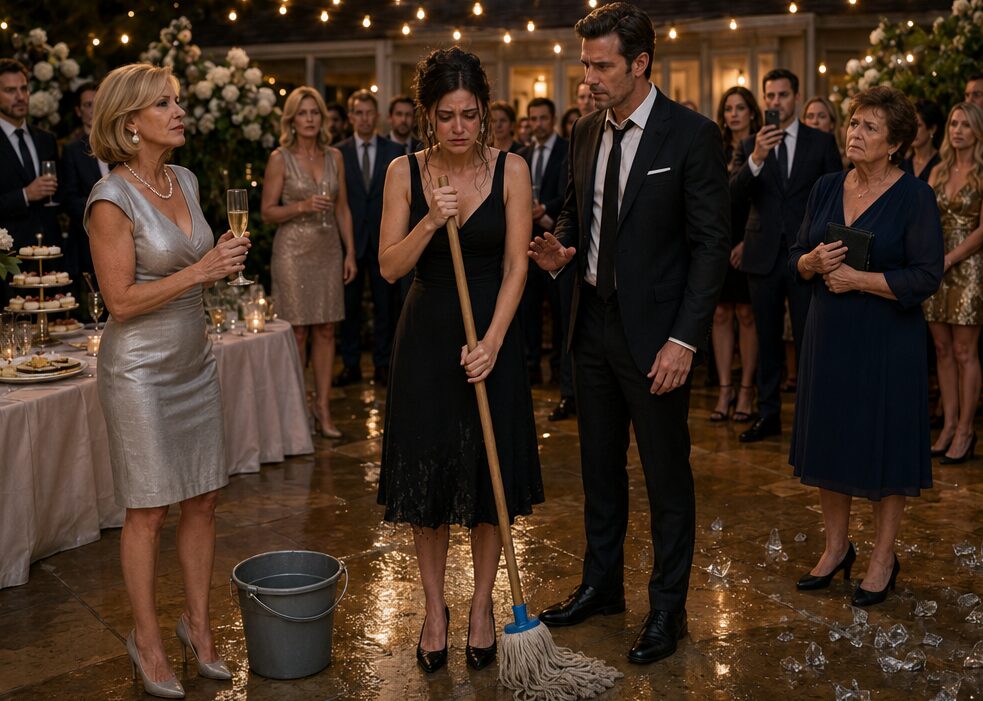
Lisa stood in the middle of the Hawthorne backyard in a black cocktail dress, both hands wrapped around a mop handle, while thirty-seven people pretended not to stare.
The gray bucket sat beside her heels.
Its water trembled every time her fingers shook.
Around her, the party had gone so quiet she could hear the fountain clicking in the far corner of the patio. Linen jackets. Pearl earrings. Gold bracelets. Champagne flutes frozen halfway to mouths. A long dessert table covered in white linen, macarons arranged by color, little lemon tarts shining under strings of warm lights.
And Lisa, damp at the hem, cheeks burning, standing with a mop like she had been hired for the evening.
Barbara Hawthorne stood three feet away in a silver dress that caught every light in the yard. Her blond bob was smooth enough to look sculpted. Her pearls rested at her throat like punctuation.
She smiled at the guests.
“There,” Barbara said, sweetly enough for everyone to hear. “Now everyone can relax.”
A few people gave the small laugh rich people used when they were deciding whether cruelty counted as humor.
Lisa looked at James.
Her fiancé stood beside her in his black suit, tall and clean and pale around the mouth. His tie had loosened, but the rest of him remained arranged. He had one hand lifted as if he meant to touch her shoulder, but it hovered there, useless.
Not comfort. Not defense.
A pause.
Lisa’s mother, Ruth, stood near the hydrangeas in the navy dress she had bought on clearance and steamed twice. Her purse was clutched in both hands. She did not look ashamed of Lisa.
That was worse.
She looked afraid for her.
A woman by the outdoor fireplace lowered her phone too late. The black screen reflected the party lights, but Lisa had already seen the red dot.
Someone was recording.
Barbara turned toward Lisa with a hostess’s patience.
“Sweetheart,” she said, “you missed a spot.”
The mop handle pressed into Lisa’s palm.
The whole afternoon seemed to narrow to that single sentence.
Sweetheart.
Missed.
Spot.
Lisa could feel everyone waiting to see whether she would obey.
She had spent the last four months trying not to be the kind of woman Barbara expected her to be. Too loud. Too blunt. Too practical. Too close to her mother. Too impressed by nothing. Too unimpressed by everything that was supposed to impress her.
She had smiled through corrections.
She had laughed through little jokes.
She had said thank you when Barbara offered help that felt like a leash.
She had told herself love required patience.
But standing there with a mop in her hands, under the lights of a party supposedly thrown for her, Lisa understood something with a clarity so sharp it almost steadied her.
Some people did not invite you in.
They placed you.
And then they called it welcome.
Part II — Where Everyone Could See
Two hours earlier, Lisa had been proud of the dress.
It was black satin, simple through the waist, with narrow straps and a hem that brushed just below her knees. She had found it in a resale shop wedged between a sequined bridesmaid dress and something with feathers. Ruth had hemmed it at the kitchen table, mouth full of pins, saying, “They’ll think it’s designer.”
Lisa had laughed. “They’ll know it isn’t.”
“So let them,” Ruth said. “You’ll still look better than them.”
For the first fifteen minutes of the party, Lisa almost believed that.
Barbara’s backyard looked like a magazine spread pretending to be a family gathering. The lawn had been cut into stripes. White flowers climbed the pergola. Valet cones borrowed from the country club stood at the curb, though everyone still parked along the street and walked up the driveway pretending that part had not happened.
At the gate, Barbara kissed Lisa on both cheeks without touching her.
“You look resourceful,” she said, eyes flicking down to the dress.
Lisa smiled because she had practiced smiling.
“Thank you.”
Barbara turned to the woman beside her. “Lisa is very good with that sort of thing. Finding treasures. Making things work.”
The woman looked Lisa over with interest, as if resourcefulness were a charming regional craft.
James squeezed Lisa’s hand.
“She means it as a compliment,” he murmured.
Lisa kept smiling.
That was the first cut.
The second came by the drinks table, when Barbara corrected how Lisa said dinner.
“Not din-er,” Barbara said lightly, drawing the word out as if smoothing a napkin. “Dinner. Two syllables, darling.”
James laughed too quickly.
“Mom,” he said, but softly, like a man tapping a glass to see if it might crack.
Barbara lifted both hands. “What? She’s about to join a family that hosts. These things matter.”
Lisa watched Ruth across the patio pretending to admire a planter.
Her mother had heard.
Of course she had heard.
Ruth heard everything people thought they were hiding.
By the dessert table, Barbara introduced Lisa to a neighbor from the charity board.
“This is James’s Lisa,” she said. “A little whirlwind, but we adore her.”
Lisa waited for James to say something like, She’s not a possession, Mom, or maybe even just, Her name is enough.
He was busy laughing with one of his coworkers.
The neighbor leaned close. “Barbara tells us you work in billing?”
“Insurance claims,” Lisa said.
“Oh,” the woman said, not unkindly. “That must be steady.”
Steady.
The word landed like a paper napkin over something they did not want to look at.
Ruth appeared at Lisa’s elbow a minute later with a glass of iced tea.
“You eating?” Ruth asked.
“Not yet.”
“You should.”
“I will.”
They stood side by side, watching Barbara move through the yard like she owned not only the house but the air inside it.
Ruth took a slow sip.
“She’s got a lot of teeth for someone smiling,” she said.
Lisa almost choked on a laugh.
That was the first time all afternoon her chest loosened.
Then Barbara found them.
“Ruth,” she said, bright and smooth. “How are you holding up?”
Ruth’s shoulders shifted back half an inch. “Fine, thank you.”
“I know the country club can feel a little overwhelming if you’re not used to it,” Barbara said. “For the wedding, I mean. But we’ll make sure you’re comfortable.”
Ruth’s smile did not move. “I’ve sat in rooms before.”
Lisa felt heat climb her neck.
Barbara blinked once.
Then she laughed.
“Of course. I only mean it’s a lot of logistics.”
James came up behind Lisa and slipped an arm around her waist.
“Everything okay?”
Lisa wanted to say no.
She wanted to say your mother just insulted mine in front of the begonias.
Instead she looked at his face, the hopeful panic in it, the boyish wish for everyone to be easy.
“Yes,” she said.
James kissed her temple. “That’s my girl.”
It should have warmed her.
Instead, she wondered when being loved had started to feel so much like being handled.
Part III — The Tray
The toast was supposed to happen at six.
Barbara had timed it for the light.
She said that three times.
“The light will be perfect at six.”
At five fifty-six, a server Lisa had seen all afternoon but whose name Barbara kept getting wrong came toward the patio with a silver tray of champagne flutes. Barbara intercepted him near the garage path.
Lisa was close enough to hear.
“No, no, put those down for one second,” Barbara said. “Let Lisa take them. She’s been wanting to help.”
Lisa turned.
“I’m sorry?”
Barbara beamed at her. “There you are. Would you mind bringing these around? Just to the first row. You’re family, not a guest. We all pitch in.”
The sentence was shaped like inclusion.
It felt like a collar.
James glanced over from the pergola, where he was talking to his old college roommate. Lisa looked at him. He smiled, confused, then mouthed, You okay?
Barbara had already lifted the tray and placed it in Lisa’s hands.
It was heavier than it looked.
“Careful,” Barbara said. “Those glasses are crystal.”
One of the women nearby smiled into her drink.
Lisa carried the tray.
She moved slowly between white chairs arranged on the stone patio. Guests took glasses and said thank you with the faint surprise people used when service spoke back. Ruth watched from the edge of the lawn, lips pressed thin.
Lisa told herself it was nothing.
A tray was nothing.
Helping was nothing.
But her fingers ached from holding it steady.
At the front row, James finally came to her.
“Babe, you don’t have to do that.”
Barbara appeared beside him as if she had been summoned by weakness.
“She offered,” Barbara said.
Lisa looked at her.
Barbara’s smile did not change.
Before Lisa could answer, a small boy in loafers shot between the chairs chasing a white napkin that had blown off the dessert table. His shoulder clipped Lisa’s elbow.
The tray tilted.
The glasses slid.
For one bright second, everything hung in the air.
Then champagne spilled across the polished patio stone in a glittering sheet.
Several glasses shattered.
A woman gasped.
The boy froze.
Lisa lowered the tray, heart pounding. “I’m so sorry.”
The boy’s mother rushed forward. “No, no, sweetheart, that was his fault.”
“It’s fine,” Lisa said quickly. “Really, it’s fine.”
Barbara looked at the puddle.
Then at Lisa.
Then at the guests.
“Oh, dear,” she said.
It was the kind of oh, dear that invited witnesses.
James stepped closer. “It was an accident.”
“Of course it was,” Barbara said. “Nobody said otherwise.”
But her eyes did.
The caterer hurried over with towels.
Barbara lifted a hand. “Careful. That stone stains if it sits.”
“We can get it,” the caterer said.
“Nonsense. You’re busy.” Barbara turned to Lisa. “Sweetheart, the mop is just inside the garage. Since you’re already right here.”
Lisa stared at her.
A silence opened.
Barbara laughed softly, as if Lisa had missed a joke.
“You’re more comfortable in a kitchen than in front of a crowd anyway, aren’t you? I mean that kindly.”
Someone made a sound that might have been a laugh.
Ruth took one step forward.
Lisa saw it and shook her head once.
Not here, Mom.
Not in front of them.
James rubbed the back of his neck. “Mom, come on.”
Barbara’s eyebrows lifted. “What? I’m saving the patio.”
The boy’s mother whispered another apology, but she had already retreated behind her husband.
Barbara touched James’s sleeve.
“Go get the mop, would you?”
He hesitated.
That hesitation was the moment Lisa would remember later.
Not the spill.
Not the glass.
Not even Barbara’s joke.
James looked at Lisa, then at his mother, then at the guests, and chose the shortest path to quiet.
“I’ll get it,” he said.
When he came back from the garage, he carried the mop and bucket like evidence he did not want to touch.
His face was apologetic.
Not angry.
Not horrified.
Just apologetic, as if all of this were weather.
He handed Lisa the mop.
“Just do it for one second,” he murmured. “Then it’s over.”
Lisa’s fingers closed around the handle.
That was when the first phone came up.
Not high. Not openly.
Just enough.
She saw herself in the black screen before the camera found focus: black dress, damp patio, mop in hand, guests in silk and linen around her.
A woman at her own engagement party, cleaning the floor.
Barbara’s voice floated over the patio.
“See? No drama. That’s what family does.”
Lisa bent the mop into the champagne.
The water spread under it.
Her face went hot, then cold.
She pushed the mop once.
Then again.
Crystal crunched under someone’s shoe.
The party resumed in pieces. A cough. A whisper. A nervous laugh. The clink of glass. Barbara saying something about resilience.
Lisa kept mopping.
Because if she stopped, she might scream.
And if she screamed, Barbara would win twice.
Part IV — Learning Where You Fit
In the powder room, Lisa locked the door and put both palms on the sink.
Her reflection looked too composed from far away.
Up close, her lower lip was shaking.
There was champagne on the side of her dress. A damp line marked the satin near her thigh. One of her earrings had twisted backward. The small silver pair Ruth had given her for the party.
Lisa fixed it with wet fingers.
A knock came.
“Lisa?”
Her mother’s voice.
Lisa opened the door.
Ruth slipped inside and shut it behind her. The little powder room was all wallpapered vines and expensive soap. There was a framed watercolor over the toilet and a candle that smelled like lemons trying too hard.
For a second neither of them spoke.
Then Ruth said, “We can leave.”
Lisa laughed once. It broke in the middle.
“And do what? Make a scene?”
“Baby, there is already a scene. You’re just the only one expected to clean it up.”
That almost undid her.
Lisa gripped the sink again.
Ruth reached toward her, then stopped. She had never been good at touching first when someone was trying not to cry. Years of hard work had taught her to wait until people asked for softness.
“Don’t give them the satisfaction of seeing you fall apart,” Ruth said quietly.
Lisa closed her eyes.
There it was.
The family rule.
Hold your head up. Smile at the landlord. Thank the boss. Don’t let the woman at the desk know she hurt you. Don’t give them anything they can use.
Lisa knew Ruth meant it as protection.
It still felt like a second mop placed in her hands.
“I’m so tired of being graceful,” Lisa whispered.
Ruth’s face changed.
Before she could answer, voices passed outside the powder room.
Barbara’s voice.
“…no, she means well. She gets overwhelmed. James has always had a soft spot for projects.”
Lisa’s hand froze on the sink.
Another woman replied, “She looked mortified.”
“Well,” Barbara said, lowering her voice but not enough, “that is why I told the staff to let her help only if she insisted. Some girls need to feel useful. It gives them footing.”
A pause.
Then Barbara added, “I did warn everyone there might be accidents. We had the mop right by the garage, thank goodness.”
The voices moved away.
Lisa stared at the door.
Ruth’s mouth had gone flat.
“She planned it,” Lisa said.
“Maybe not the spill.”
“No.” Lisa turned. “But the rest. The place for me. The role.”
Ruth said nothing.
That silence told Lisa enough.
She opened the powder-room door.
James was waiting near the hall with two glasses of water. His face softened when he saw her.
“Hey,” he said. “You okay?”
Lisa walked past him into the narrow side hall near the garage. She could see the patio through the glass doors. Barbara was back in the yard, laughing with one hand pressed to her pearls.
“Did you know?” Lisa asked.
James blinked. “Know what?”
“That your mother told the staff I wanted to help.”
His face shifted too slowly.
Lisa’s stomach dropped.
“James.”
“She said you were nervous,” he said. “That giving you something to do might make you feel included.”
Lisa stared at him.
Included.
The word had become obscene.
“And the mop?”
“What?”
“She had it ready.”
James sighed, not with disbelief but exhaustion. “My mom gets anxious hosting. She overprepares. That’s all.”
“That’s all?”
“She wants this to go well.” He lowered his voice. “She doesn’t know how to stop managing things.”
Lisa looked at the man she had planned to marry.
He was handsome. Kind in quiet places. He brought coffee to her apartment before early shifts. He remembered the date her father left, even though she had told him only once. He took her car to get new tires without making her ask.
He loved her when love was private.
But here, under his mother’s roof, with the neighbors watching, he became someone smaller.
“Do you think I belong in your family?” Lisa asked.
James opened his mouth.
Then closed it.
It took less than two seconds.
It answered everything.
“Lisa,” he said, reaching for her hand.
She pulled it back.
A murmur rose outside. Barbara clapped twice, bright and musical.
“Everyone,” she called. “Let’s try this toast again, shall we? I promise we can manage it without another little adventure.”
James glanced toward the patio.
Lisa watched him do it.
Even now, some part of him was counting witnesses.
“Please,” he said. “Just get through this.”
She looked at the mop leaning against the side of the garage door.
The bucket still sat on the patio where she had left it.
Barbara had not had anyone remove it.
Of course she hadn’t.
It was still useful.
Part V — The Redo
The guests returned to their places with the eager discomfort of people who had nearly seen something and hoped to see a little more.
Lisa stepped back onto the patio.
No one spoke directly to her.
That was how polite people made a wound bigger. They gave it room.
Barbara stood beneath the pergola, silver dress bright in the early evening light. A fresh champagne flute had appeared in her hand. Her lipstick was perfect. Her smile had recovered completely.
“Thank you all,” she said, “for your patience. Every family has its first little story, doesn’t it?”
A few laughs.
James moved to Lisa’s side.
Not close enough to stand with her.
Close enough to manage her.
Ruth stood near the hydrangeas again. Her purse was gone now; both hands were empty at her sides.
Barbara lifted her glass.
“When James told me he was bringing Lisa home,” she began, “I knew life was about to get more colorful.”
More laughter.
Lisa’s hands hung loose.
The mop leaned against the bucket beside her. She could smell champagne in the dirty water.
“Marriage,” Barbara continued, “is not only about love. Love is easy at the beginning. Marriage is about learning how a family works. Learning traditions. Learning expectations.”
Her eyes found Lisa.
“Learning where you fit.”
The yard stilled.
Barbara lowered her glass slightly and stepped closer, enough that the next words were for Lisa, James, and Ruth, though the shape of them reached farther.
“You could have made this easy by being gracious,” Barbara said.
Something inside Lisa stopped trembling.
Not because it had healed.
Because it had gone still.
She looked at Ruth.
Her mother’s face was tight with old training. Stand straight. Don’t react. Don’t feed them.
But beneath that was something else.
A plea.
Not don’t do it.
Not do it.
Just: come back to yourself.
James touched Lisa’s wrist.
“Lisa,” he murmured.
His fingers were gentle.
That was the worst part.
Gentle could still be a lock.
Barbara saw Lisa glance at the mop. For the first time all evening, uncertainty crossed her face.
“Sweetheart,” Barbara said, louder now, letting the guests hear her rescue the moment. “Put that down before you embarrass yourself.”
Lisa smiled.
It surprised her how easy it felt.
The yard seemed to inhale.
The woman by the outdoor fireplace raised her phone again. This time she did not pretend.
Lisa bent and took the mop.
It was heavier now, thick with champagne water and whatever the patio had given back. Her hands found their place on the handle as if they had been waiting.
James’s grip tightened around her wrist.
She looked at his hand.
Then at his face.
“Don’t,” he said.
Not, Are you okay?
Not, She was wrong.
Not, I’m sorry.
Just don’t.
Lisa pulled free.
The motion was small.
It broke something large.
Barbara’s smile flickered.
“Lisa,” she said.
The guests watched.
Ruth watched.
James watched.
For once, everyone was paying attention at the right time.
Lisa lifted the mop.
Barbara flinched too late.
The wet strands slapped across the front of her silver dress and swept up toward her shoulder. Champagne water splashed across her cheek and pearls. A few drops landed in her perfect hair. One pearl-colored bead of dirty water slid from her chin and fell onto the patio she loved enough to shame someone over.
The silence after was enormous.
Barbara stood with her mouth open, champagne flute tilted in one hand, silver fabric clinging dark against her ribs.
Someone gasped.
Someone else whispered, “Oh my God.”
The phone stayed up.
James looked as if language had left him.
Lisa held the mop upright beside her.
Her breath shook once.
Then steadied.
She looked at Barbara, at the guests, at the patio, at the bucket, at the family she had tried so hard to enter without leaving herself behind.
“There,” Lisa said. “Now everyone can relax.”
No one laughed.
That made it better.
She set the mop back in the bucket.
The sound was soft.
Final.
Then she walked toward her mother.
The guests parted without being asked.
Not because they respected her.
Because they did not know what she might do next.
Ruth met her halfway across the patio. For a second, her face held too many emotions to name. Fear. Pride. Disbelief. A mother’s instinct to scold. A woman’s instinct to cheer. The long grief of having swallowed too much for too many years.
She said only, “Come on.”
Together, they walked out through the side gate.
Behind them, Barbara’s voice returned in broken pieces.
“Someone get—this is—James, say something—”
James did not say anything.
Not until the driveway.
Part VI — What Was Left at the Curb
Lisa and Ruth were halfway down the stone path when James caught up.
The valet cones stood along the curb like props from a play no one wanted to finish. Neighboring houses glowed behind trimmed hedges. Somewhere down the street, sprinklers ticked over a lawn.
“Lisa.”
She stopped beside Ruth’s old sedan.
The car looked small among the polished SUVs and leased German sedans. Its bumper had a faded sticker from Ruth’s old union local. One hubcap did not match.
Lisa had been embarrassed by that car when she arrived.
Now it looked like mercy.
James stood at the end of the driveway, tie loosened, face pale.
For a wild second, Lisa wanted him to run to her. Not with explanations. Not with damage control. Just run to her like the choice had finally become simple.
Instead, he looked back once toward the backyard.
Then he said, “Do you know what you just did?”
Ruth made a sound under her breath.
Lisa almost laughed.
Of all the things he could have asked.
Are you okay?
How long has she made you feel this way?
What did I let happen?
But James was still standing in the doorway between her and them, trying to understand which side had become more dangerous.
Lisa looked past him.
Through the open gate, she could see the party lights and the white flowers and a bright flash of silver at the center of a tight little crowd. Barbara was surrounded by people who no longer knew where to put their admiration.
That was its own kind of silence.
Lisa turned back to James.
“Yes,” she said.
He swallowed.
“That video is going to go everywhere.”
“Maybe.”
“My mom is—”
“Wet?” Ruth said.
James looked at her, startled.
Ruth opened the driver’s door. “Sorry. Continue.”
For one second, Lisa loved her mother so much it hurt.
James stepped closer. “Lisa, I’m trying to fix this.”
“No,” Lisa said. “You’re trying to make it quiet.”
His face changed.
That sentence reached him. Not enough to move him, maybe. But enough to land.
“I love you,” he said.
Lisa nodded.
“I know.”
And she did know.
That was the part that made it ache.
He loved her in kitchens at midnight, when they ate cereal over the sink. He loved her on rainy Tuesdays, when he warmed her hands between his. He loved her when no one asked him what that love cost.
But love that disappeared in public left a person standing alone.
“I don’t know what happens now,” he said.
Lisa looked at the ring on her hand.
It was beautiful. Barbara had insisted on the jeweler. Family discount, she had said. Better quality than anything James would pick alone.
Lisa turned the ring once with her thumb.
Then she let her hand fall.
“Neither do I,” she said.
That was all she could honestly give him.
Ruth got into the car.
Lisa opened the passenger door, then paused.
Across the lawn, the woman with the phone was still at the gate, half-hidden behind a hedge, pretending to text.
Lisa met her eyes.
The woman lowered the phone.
Good, Lisa thought.
Let someone else feel seen.
She got in.
Ruth started the sedan on the second try. The engine coughed, then caught. For a moment they sat at the curb, both staring forward.
Neither of them moved to buckle their seat belts.
From the backyard came the faint sound of Barbara trying to regain the party. A brittle laugh. A sharp instruction. Someone saying, “No, no, water, not club soda.”
Ruth’s hands tightened on the steering wheel.
Lisa waited for the lecture.
It would have been fair. Maybe even deserved.
You shouldn’t have done that.
You went too far.
You made it worse.
Ruth inhaled.
Then she laughed.
It came out small and shocked, like something escaping a locked room.
Lisa turned to her.
Ruth pressed one hand over her mouth, but that only made it worse. Her shoulders shook. The laugh broke open, messy and helpless, until tears shone under her careful lipstick.
“Oh, baby,” Ruth said, half laughing, half crying. “Her face.”
Lisa stared.
Then the sound rose in her own chest.
Not joy exactly.
Not victory.
Something stranger. Relief with splinters in it. Grief with air inside. The first honest sound she had made all day.
She laughed until she cried.
Ruth reached across the console and took her hand.
For once, neither of them tried to stop falling apart.
The party lights blurred through the windshield. James remained in the driveway, smaller now, framed by the open gate and the world he had not managed to leave.
Lisa did not wave.
Ruth put the car in drive.
As they pulled away from the curb, Lisa looked once at the backyard disappearing behind the hedges. The flowers were still perfect. The glasses still shone. The house still glowed like something worth entering.
But Lisa’s hands were clean now.
Empty, shaking, and clean.
Ruth turned onto the quiet street.
After a while, she said, “You hungry?”
Lisa wiped her face with the back of her hand.
“Starving.”
“Good,” Ruth said. “We’re getting fries.”
Lisa laughed again, softer this time.
Behind them, the party kept shining.
Ahead, the road opened dark and ordinary, lined with mailboxes, porch lights, and houses where no one knew what had happened yet.
Lisa leaned back against the seat, the ring cool on her finger, her mother’s hand still holding hers between them.
She had no idea what she had lost.
She only knew what she had stopped carrying.