The Day the Alley Changed
The Day the Alley Changed
Part I — Where the Bread Hung
By the time the two officers turned into the alley, Joren had already decided that hunger was less frightening than humiliation.
It was a strange thought to have while arranging bread.
He had woken before dawn, as he always did, in the one-room flat above a shuttered repair shop where the pipes knocked all night and the ceiling flaked like old skin. He had counted his coins twice before leaving. Rent was overdue. Flour prices had climbed again. The old handcart he had once used had finally lost a wheel the week before, and now all he had left was a folding stool, a wooden rack, and a few plastic bags filled with rolls and round loaves that hung beside him like small pale lanterns.
He sat in the same alley almost every morning because it was close to foot traffic without being claimed by anyone bigger, louder, or richer. Delivery drivers passed through. Shop workers cut across. Boys on scooters stopped when they had change. Sometimes an old woman from the flower stand bought two buns and pressed his hand a second longer than necessary, as if kindness could be folded into payment.
But mostly people looked, calculated, and moved on.
Joren had grown used to that. What he had not grown used to was being seen as a problem.
The alley itself looked like it had given up years ago. Cracked walls. Rusted shutters. Loose cables hanging overhead. A green dumpster near the back wall, dented and streaked with old grime. The air smelled of warm dust, engine smoke, and the faint sweetness of bread cooling too quickly in cheap plastic.
He kept his back slightly bent even when he was sitting. Long days had shaped him into that posture. His jacket, once olive and sturdy, had faded into the color of tired leaves. Gray had begun to show at his temples, though he had never once had the vanity—or the money—to care about it.
He had just settled the last bag onto the rack when he noticed the officers.
They were walking side by side, dark uniforms cutting a clean line through the ugliness of the alley. One was broader, older, carrying his authority like something he had long ago stopped noticing. The other looked younger, quieter, though no less official for it. They moved with purpose.
Joren felt the bottom drop out of his stomach.
He had all the papers that mattered until they didn’t matter. He had paid the small fees that let people like him exist in the cracks of the city, except cities changed rules faster than poor men could keep up. He knew what uniforms meant when you sold things from a corner, a curb, or a borrowed patch of wall. Questions. Warnings. Fines. Removal. Hands taking hold of what little was yours as if it had always belonged to someone else.
He kept his eyes on the bread.
Maybe they would pass.
They did not.
The broader officer stopped directly in front of him. “Stand up,” he said. “Bring the bread.”
The voice was not loud. It did not need to be.
Joren looked up slowly, his fingers still around the edge of the stool. Up close, the man’s face was steady and unreadable, square-jawed, dark-haired, with a radio clipped near his shoulder. Behind him stood the second officer, narrower in the face, his expression less severe but no easier to understand.
Joren rose too quickly and nearly knocked the stool backward. “Wait,” he said, his voice catching before he could steady it. “What did I do?”
Neither officer answered the question.
The older one reached for one of the hanging bags and lifted it down. Not roughly. Not gently either. Just with the calm certainty of someone who expected to be obeyed.
In that moment, fear sharpened into something meaner.
It was not the bread itself. Not really. Bread could be baked again if there was flour, time, heat, money. It was what the gesture meant. It was being touched by authority in public. Being made smaller while standing inside your own shrinking life. Being told, without anyone saying it plainly, that survival was an inconvenience when poor people did it in view of others.
Joren took a step after the officer. “Please,” he said. “That’s all I have.”
The younger officer said nothing. He stayed half a pace back, watch glinting once at his wrist as the morning light shifted. Silent. Observing. Waiting.
The older officer kept walking.
Toward the dumpster.
Joren’s face went cold.
For one mad second he thought he understood. They were going to throw it out. The stale ones. The unsold ones. Maybe all of it. Maybe make an example out of him. Maybe tell him afterward that he should be grateful they weren’t writing him up.
He had known, all his life, that shame could happen in tiny movements before it ever reached words.
By the time he reached the dumpster, his chest felt tight enough to crack.
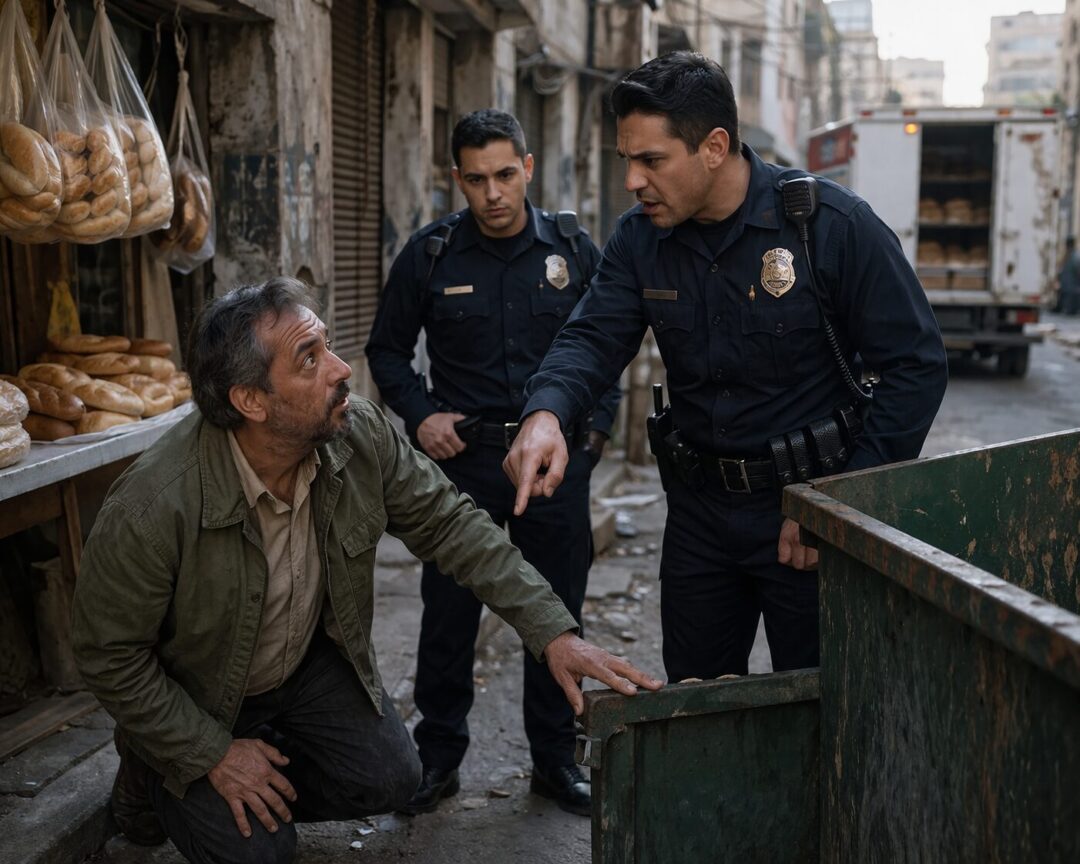
The officer pointed down.
“Check there.”
Joren stared at him.
“In the trash?” The question came out quieter than he intended, as if he were ashamed even to speak.
No answer. Only the steady look from the older man, and the younger one standing nearby, hands near his belt, giving away nothing.
Something burned in Joren’s throat. Anger, maybe. Or the thin last thread of dignity rubbing against fear.
But hunger had taught him that outrage was expensive. Pride was even more so.
So he knelt.
Part II — The Shape of Shame
The concrete was cold through his trousers.
Joren braced one hand against the metal edge of the dumpster and leaned in, not even sure what he was supposed to be looking for. A dropped loaf? A lost bag? Proof of something? The inside smelled of spoiled vegetables, wet cardboard, and a thousand small surrenders. He moved a broken crate. A torn sack. A bundle of black plastic.
His face went hot.
If anyone walked into the alley now, this was what they would see: a tired man on his knees beside a dumpster while two police officers stood over him. No explanation could outrun that image.
His breathing grew shallow. He was suddenly aware of his hands—how rough they looked, how dirty the nails were, how ridiculous it must seem to search garbage because someone in uniform had told him to.
He wanted to stop.
He wanted to ask again.
He wanted to stand and tell them no, that poverty had already taken enough from him.
Instead he kept moving things around, faster now, because speed was the only dignity left to him.
The older officer remained silent. But the younger one leaned a little closer and said, low and even, “Keep going.”
That was somehow worse.
Not the words themselves. The softness of them.
Cruelty was easier to bear when it came cleanly. Softness let hope slip in where it didn’t belong.
Joren swallowed. Somewhere behind him a truck engine idled, then cut off. A shutter rattled as someone opened a shop. The city was proceeding with its day while his own seemed to be collapsing into something absurd and unbearable.
He thought of the bakery where he had once worked before it was sold. The old ovens. The owner’s daughter wrapping pastries in paper. The years he had spent learning dough by touch because scales broke and recipes changed but hands remembered. He thought of his wife, gone six winters now, who used to laugh whenever he brought home the misshapen loaves and said ugly bread still filled a stomach. He thought of the promise he had made to himself after she died: that he would not beg, not if he could still stand, still work, still carry bread into the world with his own hands.
And now here he was, on his knees in an alley, searching a dumpster while two strangers watched.
He stopped moving.
The older officer said, “Turn around.”
Joren didn’t.
Not immediately.
Something in the officer’s tone had changed. Not softened. Not exactly. It was simply no longer pushing him downward. It was directing him elsewhere.
Joren lifted his head and looked over his shoulder.
At first he saw only light.
Then shape.
Then color.
Parked in the side lane beyond the alley mouth was a vehicle he knew, in the stunned animal way people know impossible things before they understand them. It was larger than any cart he had ever owned, cleaner than anything he had touched in years, painted in warm bakery colors that glowed against the grayness around it. Not luxurious. Not ridiculous. Just new. Whole. Ready.
A mobile bread truck.
His body did not rise all at once. It unfolded in pieces. One hand leaving the dumpster. One knee shifting. His back straightening as if the sight itself had reached inside him and pulled him upright.
The older officer pointed once, toward the vehicle.
“That’s yours.”
The alley went silent.
Not in truth. The city still breathed around them. Somewhere a horn sounded. Somewhere a man shouted from a loading dock. But to Joren, all sound seemed to recede, as though the world itself had stepped back to see what he would do.
He turned fully.
The truck waited at the edge of the lane like a door that had been there all along, hidden until someone taught him where to look.
“For me?” he asked, but the words barely survived the distance between his heart and his mouth.
Neither officer smiled broadly. They did not perform the moment for him. The older one only gave the smallest nod. The younger man looked away for half a second, as if out of respect for something private.
Joren crossed the alley in a daze.
When he reached the truck, he did not climb in. He did not pull at the handle. He did not inspect the tires or peer through the glass the way a practical man should have.
He placed his palm against the side.
That was when his breath broke.
The metal was warm from the morning sun. Real. Not imagined. Not borrowed. Not some cruel display to make him hope before someone laughed.
His shoulders shook once. Then again.
He closed his eyes.
In the darkness behind them he saw every year that had brought him here. Every dawn. Every carried bag. Every refusal to quit simply because quitting would have looked cleaner to people who had never counted coins in a half-lit room. He saw his wife tearing bread and handing half to a child from the next building. He heard her voice telling him, on the worst days, that being poor was not the same as being small.
When he opened his eyes, the truck was still there.
So were the officers.
And the alley—the same alley that had, moments before, become a theater of shame—now held something else entirely.
Not pity.
Not charity in the cheap public sense of it.
Something more dangerous, because it restored a person faster than humiliation could destroy him.
Respect.
Part III — The Men in Uniform
It was only later, much later, when the first rush of disbelief had settled enough for speech, that Joren learned how long the surprise had been in motion.
The older officer’s name was Ferran. The younger one was Mikael.
Weeks earlier, Ferran had seen Joren through the window of a patrol car while passing through the district at the end of a rain-heavy afternoon. The alley had been flooding near the gutters. Most people were running for cover. Joren had stayed where he was, one hand gripping a plastic sheet over the bread, body angled so the loaves took less water than he did.
Ferran had said nothing at the time.
But later he mentioned the bread seller to Mikael. Then he mentioned him to a woman whose brother repaired delivery vans. Then to a shop owner who sometimes bought buns from Joren and quietly added extra coins. Then to a bakery supplier who had a vehicle he could no longer use but had not yet sold.
What began as a passing remark turned into a small conspiracy of decency.
Paperwork had to be worked around. Repairs had to be done. Paint touched up. A serving counter fixed. Shelves secured. The vehicle could not become some fairy-tale miracle; it still had to be something practical, legal, durable. Ferran handled the official questions. Mikael did the softer work, asking around without making it obvious. Others donated parts, time, labor. One person covered registration. Another stocked the starter trays.
No one told Joren.
They had not wanted to risk his pride refusing what his need would have accepted.
That, Ferran said awkwardly later, had been the hardest part.
Joren listened in a silence deeper than surprise.
He did not know what to do with the knowledge that people had spoken of him when he was not there, and not with contempt. That they had noticed him not as a nuisance, not as alley scenery, but as a man still carrying his trade with what little he had left.
He was not used to being assembled into anyone else’s concern.
“You made me search the dumpster,” he said at last.
Mikael looked embarrassed. Ferran did not.
“It had to hold your attention,” Ferran said. “If we walked you straight to it, you’d have seen it too soon.”
Joren stared at him for a long moment, and then, unexpectedly, laughed.
It came out rough and unsteady, half choked by everything else he felt. But once it began, it loosened something inside him. Mikael laughed too, the relief in it obvious. Even Ferran’s mouth twitched.
The alley, which had nearly broken him ten minutes earlier, now felt absurdly bright.
There were still practical things to do. Keys changed hands. A stack of papers was explained in the blunt, simplified manner of men who preferred action to ceremony. The inside of the truck held more than Joren had hoped and less than he needed, which made it perfect. Not a fantasy, then. A beginning.
He stepped up into it slowly.
Shelves lined one side. A small prep surface. Storage beneath. Space enough to work without crouching. Space enough to be seen at street level as a vendor, not a man surviving on the mercy of a wall and a folding stool.
He ran his fingers over everything.
For the first time in years, he began to imagine tomorrow without flinching.
Part IV — What Came After
The city did what cities always do with kindness. It moved on faster than the people changed by it.
By the following week, the story had already become something others told in fragments. The bread seller in the alley. The officers. The truck. Depending on who was speaking, the details shifted. Some made it bigger. Some made it sweeter. Some stripped it down until it sounded like a rumor.
Joren did not try to correct them.
He had work to do.
He learned the truck the way he had once learned ovens—through repetition, error, attention. He adjusted his route. He found better corners. He sold out earlier. Children liked buying from the little side window. Office workers who would never have entered the alley now stopped on purpose. The old flower seller cried the first time she saw him parked in the square and then pretended it was dust in her eyes.
He still rose before dawn.
He still counted money carefully.
Life did not transform into ease because one good thing had happened.
But dignity changed the texture of hardship. That was what no one told you.
When struggle was all you knew, you began to believe exhaustion was your natural shape. Then something happened—something as simple as being seen correctly—and suddenly the burden weighed the same while your back learned a different language.
Months later, Joren returned to the alley.
Not because he needed to sell there anymore. Because he wanted to stand in the place where the world had seemed to end and remember that it had not.
The stool was gone. The old rack too. The dumpster remained, stubborn and ugly, exactly where it had always been. The walls were still cracked. The wires still sagged overhead. Nothing about the alley had improved.
And yet it had changed completely.
He stood there only a minute before hearing footsteps behind him.
Mikael.
Not in patrol rhythm this time. Just walking.
“You still come back?” the younger man asked.
“Sometimes,” Joren said.
Mikael glanced toward the lane, where the truck was parked at the curb in the late afternoon light. “To remember?”
Joren considered that.
“To compare,” he said.
Mikael smiled.
There were things Joren still could not say without feeling the words thin out under the weight of what they carried. Gratitude, when large enough, became almost clumsy in the mouth. It threatened to sound smaller than the thing itself.
So he said the truest version he had.
“That day,” he told him, “I thought you were taking the last thing I had.”
Mikael looked down at the cracked pavement. “I know.”
Joren followed his gaze to the ground where, months earlier, he had knelt and felt his shame rise like heat.
Then he looked toward the truck.
“You weren’t,” he said. “You were giving me back something older.”
Mikael did not ask what he meant. Maybe he understood.
Maybe he knew that bread had never been the whole story.
It had been work. Name. Memory. Habit. Love. The shape of a life continued after loss. The last trade Joren had left that still felt like himself.
The truck had not merely improved his business.
It had returned him to his own future.
Evening settled slowly over the district. Someone laughed from a nearby doorway. A scooter buzzed past. The city wore on, indifferent and alive.
Joren placed a hand in the pocket of his faded jacket, the one he still wore sometimes out of loyalty to the man he had been. Then he turned back toward the truck.
There would be dough to mix before dawn. Orders to fill. A school nearby had started asking for early deliveries. A café owner wanted to talk about buying from him regularly. He was tired, as he often was.
But it was no longer the tiredness of someone being erased.
At the truck door, he paused and looked once more toward the alley.
He could still see himself there if he let his mind tilt the right way: kneeling by the dumpster, certain the world had narrowed to humiliation. A man one breath away from believing that this, too, was all he deserved.
He wished he could reach back through time and tell that version of himself to wait one more minute.
To stand up.
To turn around.
Instead, he climbed into the truck and switched on the small interior light. Warmth filled the narrow workspace. Shelves gleamed softly. Trays waited.
Outside, dusk deepened. Inside, the future smelled faintly of yeast and metal and the first promise of morning.
Joren closed the door behind him and began to work.