
The Weight He Wouldn’t Let Go
The Weight He Wouldn’t Let Go
Part I — The Thing He Could Still Carry
The crutch slipped on the concrete with a dry, ugly scrape, and for one suspended second, Leamon Carter thought he was going down.
His hand tightened too late. The rubber tip, already worn almost smooth, skidded sideways. The world tilted. His bad leg buckled. The bench beside him blurred into a dark metal line.
Then another hand caught the crutch before it clattered away.
Leamon jerked back on instinct, chest burning with humiliation before pain even had time to arrive. He turned sharply, ready to yank the thing free, and found himself staring into the calm face of a young police officer in a navy uniform.
“Give that back,” Leamon snapped.
A couple walking past slowed for half a heartbeat before moving on. Somewhere across the lot, a car door slammed. The afternoon sun threw long bars of light across the pavement, making the whole moment feel more exposed than it already was.
The officer didn’t flinch. He was tall, broad-shouldered, his body camera catching a dull glint at the center of his chest. His hand stayed locked around the crutch, not forceful exactly, but firm in a way Leamon recognized from long-ago men who had already decided how something was going to go.
Leamon hated that look.
He hated needing anything from anybody. He hated being seen like this most of all.
For three years, the old forearm crutch had been enough. Not good. Not comfortable. Certainly not safe. But enough. Enough to get him from the apartment to the bus stop. Enough to get him into the grocery store if he took his time. Enough to let him keep the lie alive that he was still managing on his own.
That lie mattered more than people understood.
The officer lifted the lower half of the crutch slightly, turning it so the afternoon light hit the split near the shaft.
“This thing is hurting you,” he said.
Leamon looked away first.
The crack had been there for weeks. Maybe longer. The metal cuff was loose, the grip worn slick. The tip dragged on bad days. He knew all of that. He knew it every morning when he stood in his kitchen bracing himself for the first shift of weight. He knew it every night when his hands shook from the effort of getting home.
Knowing and admitting were not the same thing.
He sank onto the bench harder than he meant to, the breath leaving him in a rough burst. “It’s all I got.”
There it was. The truth in six words, dragged out into public where anybody could hear it.
The officer studied him quietly.
Leamon looked down at his own hands. They looked older than he felt inside. More spotted. More fragile. The hands of a stranger who had spent too many winters alone and too many years refusing to ask for help.
He had not always been this man on the bench outside the mobility clinic. Once, he had been twenty and impossible to scare. Once, he had run through heat and mud with a rifle thudding against his shoulder and other boys at his back. Once, pain had been something you swallowed whole and kept moving through because everybody around you was doing the same.
Even later—after the injury, after the hospitals, after the return to a country that looked at him too quickly and understood too little—he had still believed there was a kind of pride nobody could take from him unless he handed it over.
That belief had outlived jobs. It had outlived his marriage. It had outlived his daughter moving three states away with promises to call more often than she did. It had even outlived the first time a doctor suggested a better solution than the improvised life Leamon kept insisting was enough.
He had not gone back.
He told himself the truth in many versions. Too expensive. Too complicated. Too late. Too much trouble. But the deepest one was the simplest.
He could survive pain easier than pity.
The officer crouched in front of him then, not looming, not commanding. Just lowering himself until they were nearly eye level.
“Then use mine,” he said. “Come on.”
Leamon stared at the arm he offered.
Something inside him recoiled. Another part—smaller, quieter, exhausted—leaned toward it.
The officer was young enough to be his grandson. Young enough not to understand what it cost a man to accept help in broad daylight when strangers could see. Young enough, Leamon thought bitterly, to mistake kindness for ease.
But there was no impatience in the man’s face. No pity either. That unsettled Leamon more than either would have.
He took the offered arm because the alternative was standing there shaking.
The officer rose slowly with him, adjusting to his pace without making a performance of it. Together they took one careful step, then another, crossing the short stretch of pavement toward the building entrance Leamon had passed more than once and deliberately ignored every time.
He knew what kind of place it was. He knew without reading the signs.
That was why he stopped at the threshold.
“Why here?”
The question came out lower than his earlier anger, but more naked.
Why here. Why now. Why me. Why do you get to decide what I can no longer pretend not to need.
The officer turned his head.
His name tag read M. Rowan, though Leamon had not noticed it until that moment. Rowan. A plain, steady kind of name. It fit him.
“Because you deserve better,” Rowan said.
It was such a clean answer that Leamon almost hated him for it.
Not because it sounded false. Because it didn’t.
Part II — The Door He Had Been Avoiding
The first time someone told Leamon Carter he might walk easier, he was thirty-two years old and mean with grief.
The second time, he laughed in the doctor’s face.
The third time, he nodded politely and never came back.
By then he had become skilled at turning refusal into identity. He told people he was fine. Told them he had learned to live with pain. Told them some men were not interested in being remade by people who had never had to lose anything in the first place.
There was some truth in that. Enough truth to keep it alive.
But what Rowan’s words touched was the part beneath all of it—the part Leamon kept covered even from himself. It was not only fear of procedures or money or disappointment. It was the terrible possibility of hope. Hope was dangerous at his age. Hope asked things. Hope made a fool of a man if it failed.
So he had chosen the crutch.
The crutch was honest. It hurt. It slipped. It rubbed his arm raw in the summer and made his shoulder seize in the winter. But it never asked him to imagine more than he had.
Inside, the clinic smelled like antiseptic and warm dust and the clean fabric scent of a place where things were touched carefully. Leamon wanted to turn around immediately. The room was too bright. Too tidy. Too full of devices designed for people who had already surrendered to need.
Rowan must have felt the tension move through him, because he didn’t release his arm until Leamon found the nearest chair. Even then, he stepped back rather than hovering.
A woman from the front desk approached, then seemed to think better of speaking right away. She looked from Leamon to Rowan and then to the damaged crutch, now leaning against the wall like evidence. Her face settled into something professionally gentle.
No one hurried him. That turned out to matter.
Leamon sat there with his hat in his lap and his jaw locked so tightly it made his temples ache. Rowan spoke quietly to someone a few feet away, out of earshot. He did not point at Leamon. He did not explain him like a problem. He kept glancing over only long enough to make sure the old man had not bolted.
Which, Leamon had to admit, he was considering.
A younger version of himself would have left on principle.
But a younger version of himself had not spent the last winter calculating every icy curb like a battlefield map. A younger version had not woken at two in the morning because his hip had cramped so hard he nearly cried out. A younger version had not stared at the grocery store’s top shelf and changed dinner plans because reaching wrong might mean falling.
Pain shrinks a life in increments too small to notice until the walls are suddenly close around you.
An hour later, after measurements and questions and a series of indignities that somehow never tipped all the way into humiliation, Leamon stood between parallel bars with sweat gathering under his collar and disbelief making his vision oddly sharp.
The first attempt was ugly.
The second was worse.
By the third, something shifted.
Not magic. Not miracle. Just mechanics, training, support, adjustment—human skill meeting human need. But when weight moved where he had forgotten it could move, when balance answered in a way his body had not answered in years, the force of it stunned him more completely than pain ever had.
He gripped the bars and went still.
Across the room, Rowan waited by the door with his cap in his hands as though he understood that certain moments did not belong to witnesses.
Leamon took another step.
Then another.
Not graceful. Not strong. Not young.
But his.
Later, when the fitting was done as well as it could be for a first day and the staff had given him instructions he half heard and fully intended to memorize later, Rowan walked beside him back toward the exit.
The damaged crutch had disappeared. Leamon didn’t ask where. For the first time in months, maybe years, he did not feel the need to hold onto it just because it had once been the last thing keeping him upright.
Outside, the light had softened. Evening was coming.
Leamon paused on the concrete and tested his balance again, one hand lifting instinctively as if expecting the old wobble to return. It didn’t, not the same way. The new leg was strange. Demanding. Real. It would take practice. Patience. More appointments. More humility than he liked.
But beneath all that was a feeling so unfamiliar that it took him several seconds to name it.
Space.
His life had gained space again.
Rowan stood a few feet away, giving him room, his expression unreadable except for the small looseness around his eyes that suggested relief.
“You knew?” Leamon asked.
Rowan nodded once. “I saw the crack.”
Just that. No speech about service. No story about doing the right thing. No polished heroism.
Leamon looked down at the pavement.
“I didn’t want pity.”
The words embarrassed him more than the first outburst had. Maybe because they came from somewhere deeper. Maybe because they sounded too much like a plea.
Rowan’s answer came after a beat. Calm. Certain.
“Good.”
Leamon looked up.
“I brought respect.”
Something in Leamon’s chest gave way then—not dramatically, not all at once, but like a knot loosening after years of being pulled tight.
All afternoon he had been braced for kindness that made a man smaller. He knew that kind well. Knew the voices that softened too much, the eyes that slid toward sympathy before they ever reached understanding. He had spent years defending himself against being handled.
This was different.
Rowan had seen the danger, yes. But he had also seen the man still trying to carry it alone. He had not stepped in to rescue some broken stranger and feel noble about it. He had stepped in because he refused to let pride become another injury.
It was, Leamon realized, a kind of respect only another stubborn man could recognize.
Part III — The Shape of Standing
The first steady step mattered.
Not because it healed everything. It did not.
Leamon still had pain. He still had age. He still had an apartment on the third floor of a building with an elevator that worked when it felt like it. He still had years behind him that no device could restore. And whatever came next would require work he had spent a long time postponing.
But the first steady step redrew the future.
He took it just outside the clinic doors, the late sun touching one side of his face, the city carrying on around them as if this were not the most private miracle of his life.
Rowan did not clap. Did not grin too wide. Did not make the moment about triumph. He only watched, shoulders squared in that same composed way, as if holding the world still for one old man long enough to trust it again.
Leamon swallowed hard.
The simple truth of the day struck him with unbearable force: he had almost fallen in public, and the thing that saved him was not strength. It was being seen.
Seen clearly. Without contempt. Without indulgence. Without the flattening softness that turns a whole human life into a sad little story.
For years, people had looked at his missing limb, his uneven gait, his old cap, his hesitation at curbs, and thought they understood the shape of him. Some saw veteran before they saw man. Some saw disability before they saw will. Some saw age and assumed the rest.
Very few saw how much effort it took just to maintain a version of ordinary.
Rowan had.
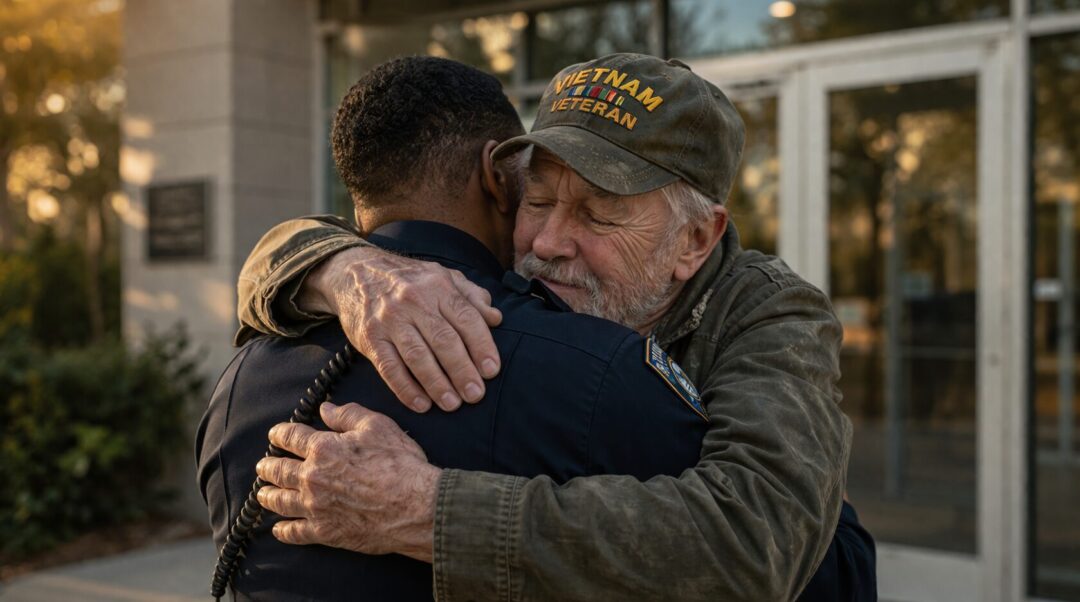
Leamon took another step, then turned toward him before he could think better of it. His hand found the officer’s forearm first, fingers gripping hard through the navy fabric. A thank-you would not be enough. Neither would a handshake. The old rules of masculinity that had governed most of Leamon’s life rose up for one second, warning him to keep himself contained.
Then age, pain, relief, and gratitude crushed those rules flat.
He pulled Rowan into a hug.
The younger man stiffened in surprise and then returned it, one arm wrapping around Leamon’s shoulders with careful force.
Leamon shut his eyes.
“Thank you for seeing me,” he said.
His voice broke on the last word.
When they parted, Rowan looked as though he understood better than to answer too quickly. He just gave one small nod.
Leamon laughed once under his breath, almost embarrassed by himself. “Don’t go making this a habit.”
Something like a smile touched Rowan’s mouth. “Then stop giving me reasons.”
It was the kind of line another man might have said with easy charm. Rowan said it dryly enough that it became what it needed to be: a bridge back to ordinary life, so the moment could keep its dignity.
The bus ride home felt different.
Not easier, exactly. His body was exhausted in new places. Every motion asked attention. But for the first time in a long while, strangers’ glances did not seem to scrape against him. He sat straighter. Not because no one was looking, but because their looking had lost some of its power.
That night, in his apartment, he stood in the kitchen without reaching automatically for the wall.
He looked around the small room where so many years of his life had narrowed themselves into routines of endurance. The old coffee mug. The folded dish towel. The chair he used when standing too long became impossible. The silence that usually felt settled and familiar now seemed to hold a question.
What else had he mistaken for survival when it was really surrender?
The thought unsettled him. It also lit something.
He called his daughter the next morning.
When she answered, winded and distracted and already apologizing for not calling sooner, Leamon surprised them both by interrupting.
“I went in yesterday,” he said.
A beat of silence.
“Went in where?”
He looked down at the notes folded neatly on the table, at the number for his next appointment, at the future he had nearly refused again.
“The place I should’ve gone a long time ago.”
She did not speak for a moment. Then her inhale caught, and he knew she understood more than the words themselves.
By the end of the week, Leamon had a schedule. By the end of the month, he had a new rhythm. Progress came stubbornly, unevenly, like everything else worth having. Some days were ugly. Some felt humiliating. Some reminded him that dignity was not the same thing as ease.
But every now and then, crossing a street or rising from a chair or stepping off a curb without bracing for disaster, he would remember the scrape of the slipping crutch, the young officer’s steady hand, and the sentence that had opened a locked door inside him.
Because you deserve better.
Leamon had lived long enough to know that not every kind act changed a life. Some merely softened a day.
This one had changed the axis of his.
Weeks later, he passed the same bench again in the late afternoon light. He paused, feeling the old instinct to lean, and realized he didn’t need to. The bench was just a bench now, not a line between collapse and endurance.
People moved around him in the ordinary rhythm of the city. Nobody noticed anything special. No music swelled. No crowd gathered. No one saw the private measure of what it meant for him to stand there on his own terms.
Leamon touched the brim of his worn cap and kept walking.
Not perfectly. Not painlessly. But upright in a way that reached deeper than the body.
And for the first time in years, what he carried no longer felt like the weight of what had been taken from him.
It felt like the shape of what had been given back.

A wonderful story, we as human beings need to see others that need help and not just pass them by as if they don’t exist!!! Everyone deserves to be seen, and acknowledged!!! Treat each other as you want to be treated and you would want your family to be treated ❤️❤️