The Price of Water
The Price of Water
Part I — The Splash
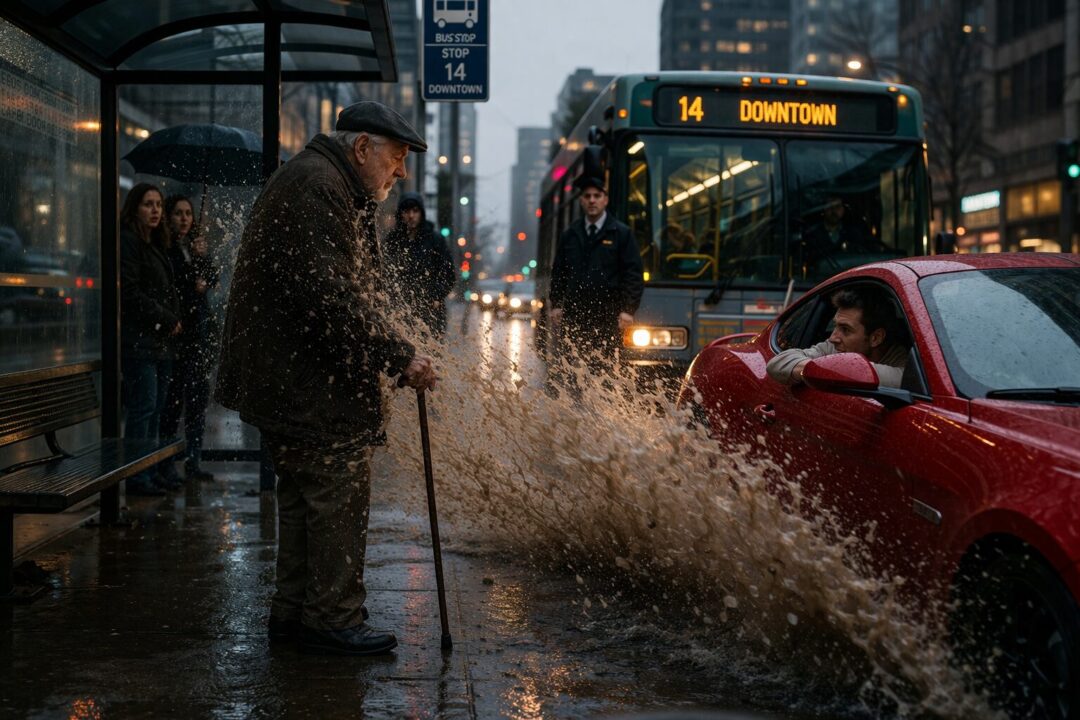
By the time the red car cut through the rainwater and sent a filthy wave over him, Nolan Mercer had already had a bad week, a bad month, and—if he was being honest—a bad year.
The water hit hard enough to sting.
It soaked his coat, climbed his trousers, splattered his face, and seeped cold into the cuff of the hand that still gripped his cane. For one breathless second he simply stood there under the gray November sky, blinking through muddy drops while traffic hissed past the curb.
People looked. That was the worst part.
Not many. Two women under a shared umbrella. A delivery cyclist stopped at the light. A teenager beneath the bus shelter, pretending not to stare. But it was enough. Humiliation only needed an audience, not a crowd.
The red sports car slowed just enough for the driver to glance back.
He was young enough to think cruelty looked like confidence. Dark hair slicked neatly away from his face. White jacket too expensive for a morning like this. Gold chain at his throat catching what little light there was. He leaned toward the open window with the relaxed arrogance of a man who had never been forced to wonder whether the world would be kind to him.
“Get a ride, old man.”
The words landed almost harder than the water.
Nolan straightened as much as he could. His back had not allowed him full dignity in years, but he had learned to carry what remained of it carefully. He was seventy-eight, with a hip that ached in the cold and a right hand that trembled when he was tired. He knew what men like that driver saw when they looked at him: slowness, weakness, inconvenience.
Once, many years earlier, Nolan had been six foot two in work boots and broad enough in the shoulders to swing steel beams into place. Once, he had walked the skeletons of buildings before they were buildings at all. Once, he had gone home with cement in his hair and laughter still in his chest.
Now he took the Number 14 bus twice a week to the clinic across town because pride did not lower blood pressure, and old age was expensive even when you had learned to live cheaply.
The driver waited half a beat, expecting anger maybe. Or pleading. Or silence.
Instead, Nolan wiped rain from his cheek with the back of his hand and said, in a voice so quiet it made the young man lean forward to hear it, “I already have one.”
The driver frowned.
It was a small thing, that line. Barely more than breath. But it carried something the younger man did not understand: the strange calm of someone who had spent a lifetime surviving humiliations and had learned that not every answer needed force behind it to matter.
Then the bus pulled in.
Its brakes sighed. Its doors folded open with a mechanical groan, and warm air drifted out into the wet street. Nolan did not look at the red car again. He kept his eyes on the driver stepping down from the bus.
His name was Reuben Hale, and Nolan knew him well enough to trust his hands.
Reuben had been driving that route for the better part of four years. He was the kind of man who noticed things before most people did—who had once waited an extra thirty seconds because he saw Nolan hurrying awkwardly across the corner with his cane, who remembered which passengers needed time, who spoke gently without sounding sorry for anyone.
That morning, his navy cap was pulled low against the rain. He took in the soaked coat, the muddy water dripping off Nolan’s sleeves, the red sports car idling beside the curb, and the expression on Nolan’s face.
Something in Reuben’s jaw tightened, though his voice stayed warm.
“Come on, sir.”
There are moments in life when kindness feels almost unbearable.
Nolan had discovered that after his wife died. People thought grief was hardest in the big hours—the funeral, the empty closet, the first holiday. They were wrong. It was hardest in the small humiliating ones: the first time he dropped a jar in the grocery store and a stranger bent to help him, the first time a nurse called him sweetheart by mistake, the first time he realized he had to sit down halfway up the staircase in his own house.
Kindness, in those moments, made him feel both grateful and broken.
But that morning it did something else too. It steadied him.
Reuben came close enough to take the elbow Nolan offered. Not too forcefully. Not like he was handling glass. Just enough.
“Easy,” Reuben said. “Watch your step.”
Nolan nodded and moved toward the bus. He could feel the eyes from the shelter on him. He could feel, too, the driver in the red car watching the scene unfold, perhaps amused, perhaps impatient, perhaps suddenly a little less certain of his own cleverness.
Rain tapped against the metal roof of the shelter. The city smelled like diesel, wet concrete, and old leaves ground into the gutter.
Nolan placed one foot on the first bus step.
Then the second.
Behind him, the engine of the sports car revved, irritated, eager to be gone.
He almost smiled.
Part II — The Man in White
Dorian Voss had built his whole adult life around never being made to feel small.
He would not have said it like that. He would have called it ambition, standards, refusing mediocrity. He had a vocabulary for everything except his own insecurity.
At thirty-four, he owned a boutique marketing firm he liked to describe as “lean and elite,” which mostly meant he hired too few people and took too much credit. He had learned, early and well, that presentation could pass for substance in enough rooms to make a man rich. The right watch. The right car. The right tone of mild contempt whenever someone else looked impressed.
He had not come from money. That fact mattered to him almost more than his money itself. He had clawed his way into a version of success and decided that anyone who moved too slowly simply had not wanted it badly enough.
Old age made him uncomfortable.
Not because he hated old people exactly, though he often behaved as if he did. It was because they reminded him of endings, of failure, of bodies that did not obey. His own father had died before sixty, bitter and half-ruined, leaving behind debts, cigarette burns in the garage, and a final lesson Dorian had interpreted in the ugliest possible way: weakness gets punished.
So he had spent years building armor out of polish and speed.
That morning he was already angry before he ever reached the bus stop. His biggest client had delayed payment. His assistant had misscheduled a meeting. The rain had dirtied the side of his car. The city felt clogged with people who moved as if no one important needed to be anywhere.
Then he saw the old man by the curb, close to the puddle, standing there with his cane and his tired coat, and Dorian made the kind of decision small men make when they want to feel large.
He could have eased left.
He did not.
The splash was deliberate enough that he knew it, even if no court in the world could have proven it. The old man’s flinch gave him a mean, sharp jolt of satisfaction. So did the line he threw out the window afterward.
Get a ride, old man.
He expected either fear or fury. He got neither.
“I already have one.”
It was ridiculous, the way the sentence stayed with him.
He watched the bus roll in. Watched the uniformed driver get out. Watched the old man be helped aboard with a quiet dignity Dorian found suddenly irritating. He felt, irrationally, as if something private had happened in front of him and he had not been invited to understand it.
His fingers tapped the wheel.
Rain stitched itself across the windshield. He should have driven off then. Instead he waited, jaw set, impatience growing hot beneath his skin.
Through the bus doors he caught one last glimpse of the old man, bent but unbroken, disappearing into the warmth of the interior. The driver climbed back up behind him.
The bus sign glowed uselessly through the rain, unreadable behind the wet blur.
Dorian muttered, “Move,” though no one could hear him.
The bus pulled out.
It happened in less than a second.
One moment the heavy front tire entered the flooded lane. The next, the street rose up like it had chosen a side. Water crashed over the side of the red car in a thick brown sheet, slamming through Dorian’s open window, across his face, into his collar, down the inside of his white jacket.
It was colder than he expected.
Shock made him gasp. The wheel jerked under his hands. For one ugly, absurd instant he could see nothing but water and his own reflection breaking apart in it.
When it cleared, he sat dripping in the driver’s seat, gold chain plastered to his throat, hair ruined, chest heaving.
“What?!”
No one answered.
The bus continued forward as if nothing important had happened at all.
And that—more than the water, more than the humiliation—was what scorched him. The city had not stopped to witness his discomfort. The rain had not paused. The traffic light still changed. The cyclist had already pushed off. To the world, he was not a man of consequence.
He was just another fool sitting wet in traffic.
For the first time in years, Dorian felt what he had spent his life avoiding.
Small.
Part III — Warm Air
Inside the bus, the windows fogged at the corners from body heat and damp coats. The heater clicked and hummed. Someone farther back coughed softly into a sleeve. The whole space smelled faintly of rubber mats, rainwater, and old fabric warmed by use.
Nolan lowered himself into the first forward-facing seat with care.
His hands shook, though not from cold anymore.
Reuben closed the doors, checked his mirror, then eased the bus back into motion. Only after they had cleared the intersection did he glance over one shoulder.
“Respect costs nothing,” he said.
It was not loud. It was not theatrical. He might have been commenting on the weather.
Nolan let out a breath he had not realized he was holding.
For a moment he only sat there, feeling wet cloth cling to his skin, feeling the ache in his knees, feeling something in his chest loosen that had tightened the instant the dirty water hit him.
Some people, he thought, went through the world trying to prove they mattered by making others feel less. Others did it by noticing who needed a hand.
He turned his head slightly and looked out the blurred window. Behind them, through rain and steam and distance, the red car was barely visible now. Just another shape in traffic.
“Some people forget,” Nolan said.
Reuben’s mouth tipped at one corner. “Not today.”
The bus rocked gently as it moved downtown.
Nolan had not spoken much since Evelyn died.
It had been three years, but grief did not really understand calendars. It learned the rooms of your life and hid in them. In the quiet kitchen at dawn. In the pharmacy line. In the chair no one else used. After her funeral, people had expected him to tell stories, to reach toward company, to fill silence with memory. Instead he had grown more private. The world was loud enough without his participation.
But Evelyn would have hated what happened at the curb.
Not because of the splash. She had lived long enough with him to know that insults passed and weather dried. What she would have hated was the temptation to let it confirm something ugly—that age made a man disposable, that vulnerability erased worth, that kindness from strangers was all he had left.
She had spent forty-seven years reminding Nolan that dignity was not something given by the world. It was something carried.
The bus moved under a railway bridge and for a second the inside dimmed, the rain drumming louder overhead.
Nolan looked at his reflection in the window: lined face, flattened cap, shoulders rounded by time. Not the man he had been. But not less a man for that.
At the next stop, Reuben rose briefly from his seat to hand Nolan a folded packet of napkins from a compartment by the front. It was such an ordinary gesture that Nolan nearly laughed.
“Thanks,” he said.
Reuben shrugged in the way decent people do when they don’t want gratitude to become a burden. “You headed to the clinic?”
“Yeah.”
“You want me to call ahead, tell them you might need a minute to dry off?”
The offer sat between them like another small mercy.
Nolan almost refused on instinct. Then he caught himself. Pride, he had learned late, could be as foolish as vanity.
“That’d help.”
Reuben nodded once. “Done.”
The bus rolled on.
Outside, the city kept wearing its wet indifferent face. Men in expensive coats hurried under awnings. Women tugged children past puddles. A food cart owner wiped rain from his metal counter. Above the street, windows stacked into the distance, each one holding some private version of struggle, irritation, loneliness, hope.
Nolan watched them all blur by and thought about the young man in white.
It would have been easy to turn him into a monster. Easier still to shrink him into a joke. But age had stripped Nolan of simple stories. Cruelty usually came from somewhere. Not excuse—never that. But somewhere.
A father who taught the wrong lesson. A fear of becoming what you despised. A soul so hungry for proof of its own value that it fed on other people’s embarrassment.
Maybe the man in the car would laugh about this later. Maybe he would tell the story to friends and make himself sound clever. Or maybe, for one raw second when cold water hit his skin and shock erased his practiced confidence, he had glimpsed the thing Nolan knew too well: how quickly life could place anyone at the curb.
The thought did not make Nolan pity him.
But it kept him from hating him.
Part IV — What Remains
The clinic receptionist did, in fact, have a towel waiting when Nolan arrived.
Reuben must have called ahead while Nolan was staring out the window pretending not to think. The young woman at the desk handed it over with a kind, matter-of-fact smile and not one unnecessary word. Nolan appreciated that more than sympathy.
By the time he stepped back out an hour later, the rain had softened.
The city looked washed instead of hostile now. Pale light filtered through the clouds. Water still stood in the gutters, but the surface had gone still. Traffic moved slower. Less angrily.
Nolan stood beneath the clinic awning for a minute, one hand resting on the top of his cane.
He could go home. Heat soup. Change clothes. Let the morning fold into the long line of mornings that made up old age.
But he found himself thinking of Evelyn again—of the way she used to tilt her head when she wanted him to notice something in himself he was trying to ignore.
So he did something small and uncharacteristic.
He walked half a block to a corner bakery and bought two coffee cakes wrapped in waxed paper. One for himself, one for the Number 14 bus driver if their timing crossed again on the return route.
They did.
Late afternoon had turned the windows bronze by then. Reuben saw him from behind the glass and opened the door before Nolan reached it.
“You look drier,” Reuben said.
“Improvement by miracle.”
A laugh escaped the driver before he could stop it.
Nolan climbed aboard, held up the wrapped cake awkwardly, and said, “For the call. And the rescue.”
Reuben looked at the package, then at Nolan, and something softened in his face. “You didn’t have to do that.”
“I know.”
That was what made it a gift.
Nolan took his seat again. The city slid by in amber light this time, puddles catching fire from the sunset. Somewhere in the middle of the ride, he realized the morning had changed shape inside him.
Not because a rude man had been punished. Though that had been satisfying.
Not even because someone had stepped in. Though that mattered more.
It was because, for a brief wet moment at a bus stop, the world had asked him what kind of man he still was now that so much had been stripped away—strength, speed, a wife’s hand at his elbow, the easy authority of youth.
And he had answered.
Not with anger. Not with collapse.
With steadiness.
When the bus neared his stop, Nolan rose carefully. Reuben looked back once as the doors opened.
“You take care.”
“You too.”
Outside, the evening air was cool and clean. Nolan stepped onto the sidewalk, adjusted his cap, and waited for the bus to pull away.
Its lights receded down the damp street until they joined the glow of everything else.
He stood there a moment longer than he needed to, listening to the faint drip from the awnings, the far hiss of tires on wet pavement, the city settling itself toward night.
There would be harder days than this one. He knew that. Age promised very little except repetition, loss, and the occasional indignity. But now and then, without warning, it also offered clarity.
Respect costs nothing.
He thought of the phrase as he turned toward home.
Not because it sounded noble. Not because it was profound. But because it was true in the plain durable way the best truths are true. Cheap to give. Costly to live without.
At the corner, he paused to let a young mother maneuver a stroller around a broken patch of sidewalk. She smiled her thanks. Nolan tipped two fingers to his cap and moved on.
By the time he reached his front gate, the last of the light had pooled gold along the wet iron railings. He let himself in slowly, climbed the three familiar steps, and stopped before opening the door.
For the first time in a long while, the silence waiting inside did not feel quite so heavy.
He imagined Evelyn in the kitchen, arms folded, pretending she wasn’t pleased with him.
Then he smiled—a private, weathered smile no one else had earned—and went in carrying what remained of the day like something lighter than grief, lighter than pride, lighter even than victory.
He carried it the way a man carries dignity when he has learned, at last, that no one can splash it off him.