The Flower He Gave Back
The Flower He Gave Back
Part I — The Boy Outside the Gala
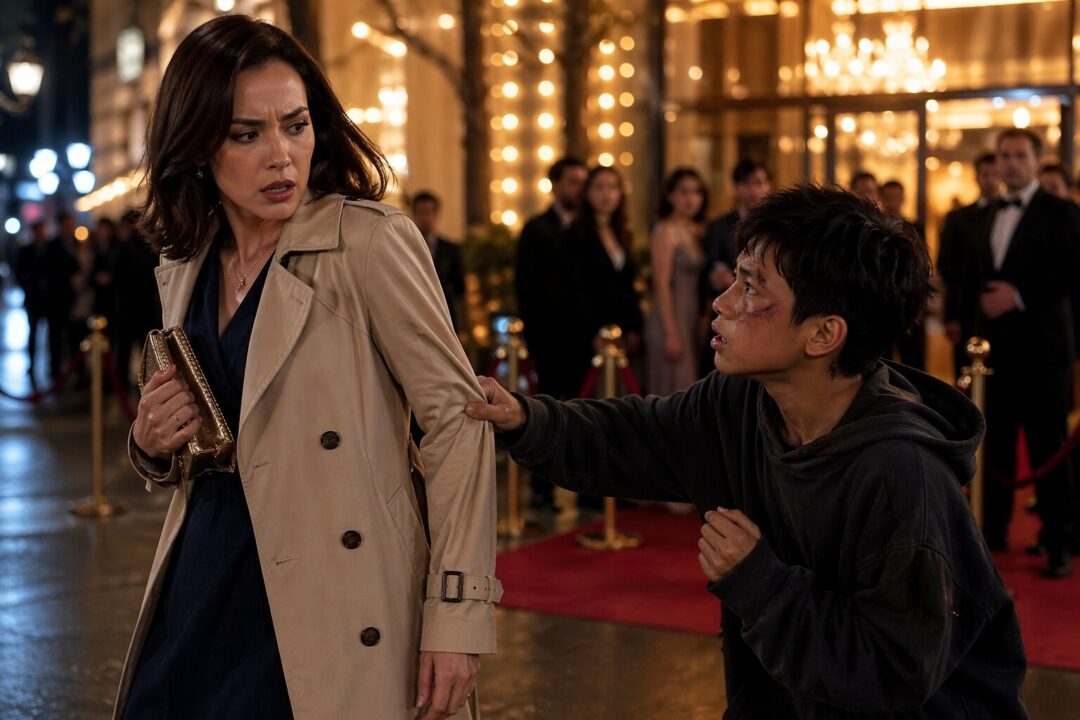
The boy grabbed Claire Whitman’s sleeve before she saw his face, and for one ugly second, the woman who had just been applauded for compassion reacted like compassion was something that happened only behind locked doors.
“Don’t touch me,” she snapped.
Her voice cut through the sidewalk noise.
The boy let go at once.
He was small. Thirteen, maybe fourteen, though hunger made age hard to read. His hoodie hung off one shoulder. His cheek was scraped raw. Dirt marked his hands, his jaw, the side of his neck. One eye had the swollen shine of a bruise that had not yet turned dark.
Behind Claire, the glass doors of the Ashford Hotel glowed gold. Inside, three hundred donors were still drinking champagne beneath chandeliers and a banner that read: Every Child Deserves to Be Seen.
Outside, under strings of warm lights, a child stood two feet from Claire with blood drying near his eyebrow.
She saw the blood.
Then she saw his hand near her purse.
Her body made the decision before her conscience did. She pulled the gold-chain bag hard against her ribs.
“I said don’t touch me.”
The boy’s lips parted, but no sound came out. His breath came fast, as if he had run there or been chased. People on the sidewalk slowed. A couple near the curb looked over. A man holding a valet ticket lifted his phone slightly, not filming yet, but ready.
Claire felt heat climb her neck.
It was ridiculous, she thought. This was ridiculous. She had delivered a speech twenty minutes ago without shaking. She had stood on a stage in a silk dress under a beige trench coat and said, with perfect steadiness, that invisible children were still children.
The room had clapped.
Vivian Cross had kissed both her cheeks and whispered, “Your mother would have been so proud.”
That had been the moment Claire left.
Now a boy with bruised skin and dirty fingernails was staring at her as if she had hurt him more than he had expected.
“I’m not—” he began.
His voice was rough. Frightened.
“Back up,” Claire said.
“I’m trying to—”
“Back up.”
A security guard appeared near the hotel doors. Marcus Reed. Claire knew his name because he had checked her invitation three hours earlier and called her “Ms. Whitman” with quiet professional warmth.
Now his warmth was gone.
“Problem?” Marcus asked.
The boy looked at Marcus and changed. Not visibly enough for the crowd, maybe, but Claire saw it. His shoulders rose. His chin tucked. His hand closed into a fist around something small.
“No,” he said.
Claire should have said no too.
She should have said, I don’t know.
She should have said, Wait.
But embarrassment is a fast, vicious thing. It wants witnesses removed before truth arrives.
“He grabbed me,” Claire said.
Marcus moved closer.
The boy took one step back.
“I didn’t grab her,” he said, though he had. “I mean—I did, but not like that.”
“Hands where I can see them,” Marcus said.
The boy’s face tightened.
Claire heard herself breathe.
It was a small command. A reasonable command, perhaps. The kind of command that made wealthy people feel safe and poor people feel already convicted.
The boy opened his hands.
In his right palm lay a gold flower.
Claire went still.
It was no larger than a quarter, five delicate petals curled around a blue stone center. Under the hotel lights, the stone caught the city’s reflection and held it there, a tiny blue flame in a dirty hand.
Claire’s fingers rose to her coat.
The left lapel was empty.
For one moment, the whole sidewalk narrowed to the pin in his palm.
The gold flower pin.
Her mother’s pin.
The one Claire wore when she needed courage and hated herself for needing anything.
The boy swallowed.
“You dropped it,” he said.
No one spoke.
Not Claire. Not Marcus. Not the couple by the curb. Not the man with the half-raised phone.
The boy kept his palm open.
“I saw it fall by the alley,” he said. “I was trying to give it back.”
Claire looked from the pin to his face.
She had never understood how shame could be physical until then. It landed under her ribs, sharp and low, as if someone had reached into her and turned a key.
The boy’s hand trembled.
Not from drama. Not for effect.
From cold, or fear, or the fact that his body had already spent all its strength getting to her.
Claire reached for the pin.
Then stopped.
His knuckles were split.
“Who did that to your hand?” she asked.
The boy closed his fist.
“Nothing.”
Marcus glanced toward the hotel doors. “Ms. Whitman, I can handle this.”
That sentence should have relieved her.
Instead, it made the boy look smaller.
Claire heard Vivian’s voice from inside: Your mother would have been so proud.
She looked at the banner beyond the glass.
Every Child Deserves to Be Seen.
The boy was standing directly beneath it.
And Claire had looked at him like he was a problem to be removed.
Part II — The Thing She Lost
Claire did not take the pin right away.
That frightened her more than taking it would have.
Because a minute earlier, she would have snatched it back and escaped into the waiting car. She would have told herself anyone would have reacted the same way. She would have made a donation the next morning large enough to forgive herself.
But Eli Mason—though she did not know his name yet—stood with her mother’s gold flower in his palm, and Claire could feel the sidewalk watching.
“What’s your name?” she asked.
The boy’s expression did not soften.
“Why?”
“Because I’m asking.”
“That usually means trouble.”
The line was so plain, so tired, that Claire had no answer for it.
Marcus shifted his weight. “Kid, answer her.”
The boy’s eyes flicked to him.
Claire turned. “Please don’t.”
Marcus blinked, surprised.
“Don’t what?”
“Don’t talk to him like he’s already done something.”
A faint crease appeared between Marcus’s brows. Not anger. Recognition, maybe. Or discomfort at being corrected by someone in pearls after being expected to protect people in pearls.
The boy looked at Claire as if her defense was another trick.
“Eli,” he said at last.
“Eli,” Claire repeated. “I’m Claire.”
“I know.”
That stopped her.
He nodded toward the hotel. “You were on the screen inside. They had speakers outside when somebody opened the door.”
Claire almost laughed, but it came out wrong.
“So you heard my speech?”
“Some.”
“How much?”
“Enough.”
Enough.
It hurt more than an insult.
A black car pulled up near the curb. Claire’s rideshare. The driver glanced at her, then at Eli, then at Marcus. Claire’s phone buzzed in her purse with the arrival notification.
She ignored it.
“Eli,” she said carefully, “what happened by the alley?”
“Nothing.”
“You said you found the pin there.”
“I did.”
“And your face?”
“I fell.”
“You fell on someone’s fist?”
His mouth tightened.
There it was: a flash of humor, sharp and unwilling. Then it vanished.
Claire lowered her voice. “Did someone hurt you?”
Eli looked past her at the hotel doors.
“Does it matter?”
The answer should have been immediate.
Yes.
Of course.
Instead, Claire heard every excuse lining up in her head. She was not a social worker. She was not his guardian. She did not know the situation. Involving herself might make it worse. There were systems for this. There were organizations. She had funded some of them.
The car driver honked once.
Claire flinched.
Eli held out the pin again. “Here.”
She took it this time.
The metal was warm from his hand.
The blue stone flashed under the street lights, and suddenly Claire was eight years old in her mother’s bedroom, watching Anna Whitman fasten the little flower to a navy coat before walking into a rainstorm to sit with a client who could not afford to pay her.
“People don’t become smaller because the world treats them that way,” her mother had said once.
Claire had loved that sentence.
Then she had grown up and learned how expensive it was to live by it.
The pin sat in Claire’s palm like evidence.
“Thank you,” she said.
Eli nodded once and turned away.
The motion was too quick. Too final.
“Wait,” Claire said.
He stopped, but did not face her.
She opened her purse and pulled out cash. Three twenties. Then two more because the first amount looked cruelly small in her hand.
“Here,” she said. “For returning it.”
Eli looked at the money.
His face changed in a way she did not understand until it was too late.
“I didn’t bring it back to sell it to you.”
“That’s not what I meant.”
“That’s what it is.”
“No, it’s—”
“You got your thing back,” he said. “So we’re done.”
Claire lowered the money.
The sidewalk had moved on. The man with the phone was gone. The couple at the curb had climbed into their car. The world did what it always did when discomfort failed to entertain it: it left.
Only Marcus remained close enough to hear.
And from the hotel entrance, Vivian Cross appeared in silver silk, smiling with her whole face until she saw the scene.
“Claire,” Vivian called lightly. “There you are. The board chair is asking for you.”
Claire did not answer.
Eli stepped off the curb.
“Where are you going?” Claire asked.
He did not turn. “Shelter.”
“Which one?”
No answer.
“Eli.”
He stopped again.
His shoulders looked impossibly thin beneath the hoodie.
“I have to get my backpack first,” he said.
“Where is it?”
He nodded toward the alley beside the hotel.
“The guys who jumped me took it.”
The sentence was flat. Not dramatic. Not pleading.
That made it worse.
Claire stared at the dark gap between the hotel and the next building. Thirty feet away. Maybe less. She had walked past it earlier without looking inside.
“What’s in the backpack?” she asked.
Eli hesitated.
Then said, “Everything.”
Part III — The Price of Help
Vivian arrived before Claire could speak.
“Sweetheart,” she said, touching Claire’s elbow, “we need you inside for one quick photo. Two minutes.”
Claire kept her eyes on Eli.
“Someone stole his backpack.”
Vivian’s gaze flicked over him, fast and practiced. Not cruel. Worse: efficient.
“I’m sorry to hear that,” she said. “Marcus can call outreach.”
“No,” Eli said quickly.
Vivian smiled in the direction of his fear, not at him. “There are proper channels.”
Claire heard herself ask, “How long do proper channels take?”
Vivian’s smile thinned.
“Claire.”
That single word carried a warning. Not here. Not now. Not in front of donors. Not while wearing the pin your mother wore when this foundation still meant something.
Eli shifted from foot to foot.
“What time is shelter curfew?” Claire asked him.
He looked suspicious again. “Nine.”
Claire checked her phone.
8:32.
“Which shelter?”
He said nothing.
“Eli.”
“If I tell you, you’ll call somebody.”
“I might call someone who can help.”
“That’s what people say before they make me sit in a room and answer questions until the bed’s gone.”
Claire had spent years in courtrooms. She knew when a witness was exaggerating, hiding, deflecting.
Eli was not doing any of those things.
He was telling her the shape of his life.
“What’s in the backpack?” she asked again.
This time, he answered because time had made pride expensive.
“My papers. School stuff. A picture. The intake letter.”
“Intake for the shelter?”
He nodded.
“I’m supposed to show it before nine. If I don’t, they can give the spot away.”
Claire looked at the alley.
It was narrow and badly lit. Trash bags leaned against brick. A service door stood half open near the back. Somewhere deeper in, metal clanged.
Marcus followed her gaze. “Ms. Whitman, you shouldn’t go in there.”
Eli laughed once.
Not because anything was funny.
Because the rule was so clear: the alley was dangerous for Claire, but it was where he had already been left.
“I’ll go,” Marcus said. “Kid can wait here.”
“No,” Eli said.
Marcus frowned. “You want the bag or not?”
“I want to see it.”
“Why?”
“Because it’s mine.”
The words hit Claire with unexpected force.
Not loud. Not noble.
Just a child insisting that the last thing he owned should not be handled without him.
Vivian stepped closer, lowering her voice. “Claire, this is not something you solve on the sidewalk. We have partners for exactly this sort of situation.”
“Exactly this sort,” Claire repeated.
Vivian’s eyes sharpened. “Do not turn this into something theatrical.”
Claire almost smiled.
Inside the hotel, an event photographer was probably waiting beside a step-and-repeat printed with words like hope, access, future, dignity. Theatrical compassion was still compassion, apparently, as long as it had lighting.
Eli looked from Vivian to Claire.
The trust that had almost appeared in his face was disappearing.
Claire saw it go.
That, more than the pin, forced her next choice.
She turned to Marcus. “Will you walk with us?”
Vivian’s mouth parted. “Claire.”
“Not as security removing him,” Claire said. “As someone making sure no one gets hurt.”
Marcus looked at Eli.
Eli looked away.
Then Marcus nodded once. “Fine.”
Vivian touched Claire’s arm harder. “The board chair donated half a million dollars tonight.”
Claire pulled her arm free.
“There’s a child outside the door.”
“That is exactly why we raise money.”
“No,” Claire said, and her voice surprised her by staying calm. “That’s why we’re supposed to know what the money is for.”
Vivian’s face went still.
For a moment, Claire saw the older woman beneath the silver silk: tired, strategic, frightened of disorder because disorder scared donors away, and donors paid for beds children like Eli needed. Vivian was not a villain. Claire knew that.
That made the moment harder.
“Two minutes,” Vivian said. “Take the photo, and then I’ll personally call—”
“He has twenty-seven minutes.”
Vivian looked at Eli again.
This time she really saw him.
Not enough. But more.
“Claire,” she said softly, “you cannot rescue every child you notice.”
Claire pinned the gold flower back onto her lapel.
“No,” she said. “But I can stop pretending I didn’t notice this one.”
Then she walked toward the alley.
After two steps, Eli followed.
After three, Marcus did too.
Part IV — The Alley
The alley smelled like wet cardboard, grease, and old rain.
Claire’s heels struck the pavement too loudly. Every sound seemed to announce that she did not belong there. The hem of her trench coat brushed a trash bag. She resisted the instinct to pull it away.
Eli noticed.
Of course he noticed.
“You don’t have to come,” he said.
“Yes, I do.”
“No, you don’t. That’s the whole thing.”
Claire had no answer.
The alley narrowed near the middle, where a delivery truck had scraped white paint onto the brick. Eli stopped there and pointed toward a dumpster.
“They were over there.”
Marcus stepped ahead. “Stay behind me.”
Eli’s jaw tightened, but he obeyed.
Claire saw a dark shape wedged behind the dumpster. A backpack. Navy blue. One strap torn.
Eli moved before Marcus could stop him.
“Wait,” Marcus said.
But Eli was already crouching, pulling the bag free with both hands.
For half a second, relief transformed him. His whole face opened. He looked younger. Almost like the child he was supposed to be.
Then a voice came from the service doorway.
“Thought you ran home, Mason.”
Three older boys stood in the shadow.
Sixteen, maybe seventeen. Not men, but old enough to know fear as currency. One wore a red knit cap. Another had Eli’s missing glove tucked into his jacket pocket like a trophy.
Eli froze.
Claire felt Marcus tense beside her.
The boy in the red cap looked Claire up and down. “Who’s this? Your lawyer?”
Eli said nothing.
Claire heard the question land strangely in the dark.
Because she was.
“I am, actually,” she said.
The boys laughed, but not comfortably.
Claire stepped forward before Marcus could tell her not to.
“My name is Claire Whitman. I’m an attorney. He has his property back. We’re leaving.”
Red Cap tilted his head. “We didn’t do nothing.”
“I didn’t ask.”
“You filming us?” the second boy asked Marcus.
“No,” Marcus said.
“Good.”
Claire kept her voice level. In court, panic always wanted to dress itself as authority. She had learned not to let it.
“You can walk away,” she said, “and this ends here.”
Red Cap looked at Eli. “You told her?”
Eli’s hand tightened on the backpack strap.
That was the moment Claire understood something she should have understood earlier: the danger was not only behind him. It was ahead of him too. Eli had to keep living in a world where people remembered what he said.
So Claire did not ask him to speak.
She did not make him perform injury for proof.
She simply took one step closer to the boys and said, “He doesn’t need to tell me anything. I saw enough.”
The second boy shifted.
The third looked toward the street.
Marcus moved beside Claire, silent but solid.
Red Cap spat near the wall. “Whatever. Keep your trash bag.”
Eli flinched at the words.
Claire wanted to say something sharp. Something devastating. Something that would make the boy feel small.
Then she looked at him properly and saw that he was small too. Older than Eli, stronger than Eli, crueler tonight than Eli could afford anyone to be. But still a child in bad shoes pretending not to be afraid of adults.
The realization did not excuse him.
It only made the whole alley feel larger and more broken than one confrontation could fix.
“Go,” Claire said.
They went.
Not running. Not defeated. Just bored enough to pretend they had chosen it.
When they disappeared onto the far street, Eli exhaled so hard his shoulders dropped.
Marcus looked at him. “You okay?”
Eli nodded.
It was a lie, but a functional one.
Claire checked her phone.
8:44.
“We have sixteen minutes,” she said. “Which shelter?”
Eli hugged the backpack to his chest.
“North Halsted Youth Center.”
Marcus frowned. “That’s twelve minutes by car if traffic behaves.”
Claire was already opening her rideshare app when her phone rang.
Vivian.
Claire declined.
It rang again.
She declined again.
A message appeared.
Donors waiting. Please do not make this difficult.
Claire stared at the screen.
Then another message.
Your mother understood strategy.
That one pierced deeper than Vivian could have known.
Claire’s mother had understood strategy. She had understood patience, institutions, compromise. She had also once taken off her own coat and wrapped it around a woman outside a courthouse in February while Claire watched from the backseat, embarrassed because people were staring.
Claire looked at Eli.
He was checking the backpack with frantic hands. Papers. A cracked folder. A photograph bent at the corner. A sealed envelope with the shelter name printed on the front.
When he saw Claire notice the photograph, he shoved it deeper into the bag.
She looked away quickly.
“Car’s two minutes out,” she said.
Eli nodded.
Then, quieter: “You can still go back.”
Claire looked toward the hotel entrance.
Through the glass, the gala shimmered. Silver dresses. Black suits. Candlelight. The easy beauty of people who could discuss suffering without smelling the alley.
Vivian stood near the door, phone in hand.
Claire could still go back.
She could step inside, apologize, pose for the photo, tell the story later in a version that made everyone gentle. She could turn this into a lesson at the next board meeting. She could make Eli a sentence in a speech.
Instead, she unpinned the gold flower and held it in her hand.
For a terrifying second, she wanted to give it to him.
Not because he needed it.
Because she wanted to be forgiven quickly.
Eli saw the movement.
His face closed.
Claire closed her fist around the pin.
Not yet, she thought.
Maybe not ever.
Some gifts were not gifts. Some were burdens disguised as kindness.
Part V — Before Nine
The car ride took eleven minutes.
Claire sat in the back beside Eli while Marcus rode in front. Eli kept the backpack on his lap with both arms wrapped around it. He smelled faintly of rain, metal, and fear. Claire hated that she noticed and hated more that noticing made her careful.
The driver glanced at them in the mirror twice.
On the second glance, Claire met his eyes until he looked away.
Eli saw.
“People do that,” he said.
“I know.”
“No, you don’t.”
The words were not cruel.
Just accurate.
Claire accepted them.
Outside, downtown Chicago slid past in fragments: restaurant windows, wet pavement, laughing groups at crosswalks, a woman carrying flowers wrapped in brown paper, a man sleeping beneath a bus shelter advertisement for luxury watches.
Claire wanted to ask Eli about his parents, his school, the photo in his bag. She wanted to gather facts because facts gave her something to do besides feel.
She asked none of it.
Instead she said, “My mother gave me the pin.”
Eli looked at her lapel, where the gold flower was back in place.
“She dead?”
Claire nodded.
“How long?”
“Nine years.”
“That’s a long time.”
“It is.”
“You still wear her stuff?”
“Only that.”
“Why?”
The question was blunt enough to be merciful.
Claire touched the pin.
“Because she was better than me.”
Eli looked out the window.
After a moment, he said, “Maybe she just had more practice.”
Claire nearly broke then.
Not visibly. She was too trained for that. Her face remained composed. Her hands stayed folded.
But something inside her loosened painfully.
Marcus spoke from the front seat. “Two blocks.”
Eli sat straighter.
The youth center was a low brick building with bright windows and a blue sign. A young woman at the front desk was already turning the lock when they reached the door.
Eli ran the last few steps.
“Wait,” he called. “Please. I’m here.”
The woman looked through the glass.
For one awful second, Claire thought she would shake her head.
Then she opened the door.
“You Mason?”
Eli nodded and fumbled with the envelope. His hands shook so badly he almost dropped it.
Claire started to help, then stopped.
He got it open himself.
The woman checked the paper, looked at the clock, then at Eli’s face.
“You’re cutting it close.”
“I know.”
“You hurt?”
“No.”
Claire and Marcus both looked at him.
The woman noticed.
“Eli,” she said, more gently. “Are you hurt?”
He looked at Claire.
There was a question in his eyes, though Claire could not tell what kind. Whether she would speak for him. Whether she would embarrass him. Whether help always meant losing control of your own story.
Claire said nothing.
Eli swallowed.
“A little,” he said.
The woman opened the door wider. “Come in.”
He stepped inside.
Then stopped.
Turned back.
For a moment, the four of them stood in the doorway: Eli inside the light, Claire and Marcus outside on the dark sidewalk, the staff woman holding the door between both worlds.
Claire removed the gold flower pin.
She did it slowly this time, not as payment, not as apology, but because she did not know what else to do with the ache in her chest.
“I want you to have this,” she said.
Eli looked at the pin.
Then at her.
“No.”
Claire’s hand remained extended.
“It’s important,” she said.
“Then don’t give it away.”
“I thought—”
“You thought I needed something shiny?”
The words landed hard.
Marcus looked down.
The staff woman said nothing.
Claire closed her hand around the pin.
Eli adjusted the backpack strap on his shoulder. In the bright doorway, he looked both safer and not safe enough. A child with a bed for one night. A child with papers. A child with a bruised face and a pride that had survived more than Claire’s pity.
He stepped closer and took her closed fist between both of his dirty hands.
For a second, she thought he was accepting the gift after all.
Instead, he turned her fist over and pressed it gently back toward her chest.
“It’s yours,” he said. “Just don’t lose it again.”
Claire could not speak.
Eli let go.
The staff woman touched his shoulder and guided him inside. Marcus held the door until the woman nodded that it was all right to close it.
Then the lock clicked.
Claire stood on the sidewalk with the pin in her palm.
The blue stone caught the shelter’s fluorescent light this time, not the gala’s golden glow. It looked smaller here. Less magical. More real.
Marcus cleared his throat.
“You need a ride back?”
Claire looked down the street.
Her phone had twenty-seven missed calls and messages she did not want to read. The gala would be ending soon. Donors would collect coats. Vivian would repair the story before anyone else could tell it. By morning, Claire would be difficult, emotional, unstrategic, perhaps admirable depending on who needed what version.
She pinned the flower back onto her coat.
Her fingers were not steady.
“No,” she said. “I’ll walk.”
Marcus nodded.
After a moment, he said, “For what it’s worth, I should’ve asked him first.”
Claire looked at him.
“So should I.”
He accepted that with a small, tired smile, then went to find a cab.
Claire stayed outside the shelter until the lobby emptied.
Through the window, she saw Eli sitting in a plastic chair while the staff woman cleaned the cut near his eyebrow. His backpack rested between his feet. He held one strap with two fingers, as if even inside, even under bright lights, he was not ready to trust the world not to take it.
Claire touched the pin.
For years, she had worn it to feel close to her mother.
Tonight, for the first time, it felt less like memory than instruction.
Not a soft one.
Not a pretty one.
A hard little flower with a blue center, returned by a boy who owed her nothing.
Claire finally turned away from the window and began walking back through the cold city, past restaurants and closed shops and strings of warm lights that made every street look kinder than it was.
At the corner, her phone buzzed again.
She did not check it.
She kept one hand on the pin, not because she was afraid of losing it in the dark, but because now she understood that losing a thing was sometimes easier than admitting you had stopped knowing how to hold it.