The Door She Opened
The Door She Opened
Part I — The Man Outside the Window
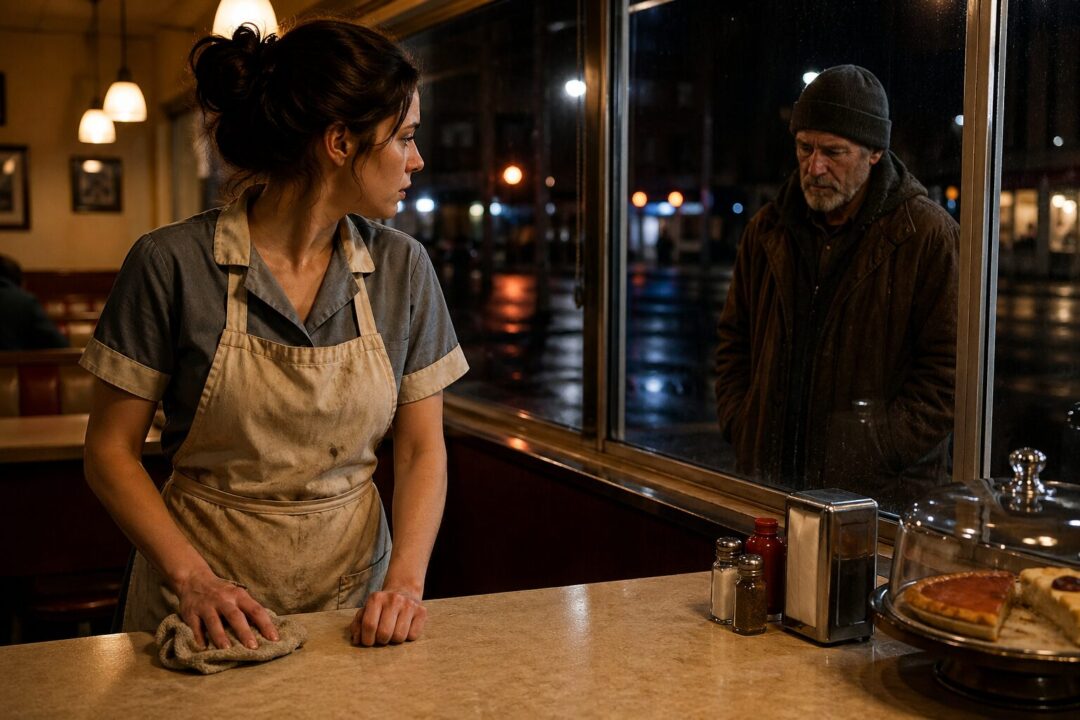
Emily Carter had twelve minutes left on her shift when she saw the old man staring at the pie.
Not at the diner.
Not at the people inside.
At the pie.
It sat under a glass dome near the register, one slice missing, the rest glowing yellow under the tired fluorescent lights. Lemon meringue. The kind of dessert customers ordered when they wanted to feel like life was still simple.
The old man stood outside in the January cold with his hands tucked under his arms. His coat was too thin. His beard was gray and uneven. Every few seconds, he looked away like he was ashamed to be caught wanting something.
Then his eyes came back to the pie.
“Don’t even think about it,” Grant Miller said behind her.
Emily turned. Her manager was wiping down the counter with the irritated speed of a man who believed every problem in the world could be solved by closing on time.
“What?”
Grant nodded toward the window. “Him. We’re not doing that tonight.”
The old man stepped closer to the glass, then stopped before his shoes touched the welcome mat.
“He hasn’t come in,” Emily said.
“He will if you look soft enough.”
Emily looked back at the man. He was not waving. Not knocking. Not begging.
He was just hungry in a way that made asking feel impossible.
The diner was nearly empty now. Tanya was counting tips at booth six. A trucker near the back was finishing coffee that had gone cold twenty minutes ago. The kitchen had already shut down, except for the fryer oil cooling with small, angry pops.
Emily’s feet hurt so badly she had stopped feeling individual toes. Her uniform smelled like onions and dish soap. In her apron pocket was a folded twenty-dollar bill she had been saving for gas until payday.
Rent was due in three days.
Her younger brother had called that afternoon about a school fee he said was “not a big deal,” which meant it was.
And outside, an old man was pretending not to stare at pie.
Grant tossed the rag into a bucket. “Lock the door.”
Emily did not move.
“Emily.”
“I heard you.”
“Then lock it.”
The old man finally looked through the window and met her eyes.
There was no performance in his face. No practiced sadness. No speech waiting. Just a quick flash of embarrassment, like he had accidentally been seen without a shirt.
He turned to leave.
Emily took the twenty from her apron pocket before she could talk herself out of it.
Grant saw the money in her hand. “You’re kidding.”
“I’m buying something.”
“The kitchen’s closed.”
“There’s soup in the warmer.”
“The soup’s counted.”
“Then count it as mine.”
Grant laughed once, sharp and humorless. “You’re a waitress, not a charity.”
Emily opened the register drawer with her key and placed the twenty inside.
“No,” she said. “I’m a person.”
The diner went quiet enough that she heard Tanya stop counting coins.
Grant’s face tightened. For a second, Emily thought he might fire her right there beside the pie case.
Instead, he leaned close and said, “You keep collecting strays, don’t be surprised when you become one.”
Emily felt the words land where he meant them to land.
She still walked to the door.
The old man was halfway down the sidewalk when she called out, “Sir?”
He stopped.
Up close, he looked older than he had through the glass. His cheeks were hollow, but his eyes were clear. His hands trembled, though he tried to hide it by pressing them into his coat pockets.
“We’re closing,” Emily said. “But I can get you soup. And pie, if you want.”
He looked past her into the diner. Then back at her.
“I don’t have money.”
“I know.”
That embarrassed him more than if she had insulted him.
Emily softened her voice. “Come in. It’s cold.”
He hesitated at the threshold like warmth was something he needed permission to touch.
Behind her, Grant said, “He gets ten minutes.”
Emily did not answer.
She held the door open until the old man stepped inside.
Part II — Soup, Pie, and Other Things People Count
The old man chose the booth closest to the door.
People who felt unwanted always did that, Emily had noticed. They sat where leaving would be easy.
She brought him chicken noodle soup, two rolls, coffee, and the largest slice of lemon meringue left under the glass. Grant watched every plate like she was stealing silver.
The old man stared at the food for a moment before picking up the spoon.
“Thank you,” he said.
His voice was low and rough, but educated in a way Emily could not place. Not fancy. Just careful.
“You’re welcome.”
She turned to give him privacy, but a laugh came from the back booth.
The trucker lifted his coffee mug toward Grant. “Guess dinner comes free if you look sad enough.”
The old man’s spoon stopped above the bowl.
Emily felt heat rise in her face.
Before Grant could enjoy the silence, she walked to the trucker’s table and took his mug.
“You were done,” she said.
He blinked. “Excuse me?”
“We’re closed.”
The man’s smile vanished. “That how you treat paying customers?”
“No,” Emily said. “That’s how I treat rude ones.”
Tanya made a small choking sound behind the counter.
Grant’s jaw hardened. “Emily. Kitchen. Now.”
The old man looked down at his soup.
Emily should have been scared. She was scared. She needed the job. Needed every shift. Needed every dollar that smelled like coffee and grease and other people’s impatience.
But the old man’s shoulders had folded inward, and something in her could not bear it.
Not tonight.
Not while he was eating.
“He’s not bothering anyone,” Emily said.
Grant stepped closer. “You are.”
The words were quiet enough not to count as yelling, but loud enough to bruise.
Tanya came over then, keys in hand, voice light but warning. “Grant, let her finish. It’s one bowl of soup.”
“It’s never one bowl,” Grant said. “That’s what people like her don’t understand.”
Emily looked at him. “People like me?”
Grant knew he had said too much. He glanced at the old man, at Tanya, at the trucker gathering his coat.
Then he chose control over apology.
“Clean up when he’s done,” he said. “And tomorrow, we’ll talk about your schedule.”
Emily understood.
A cut shift.
Maybe two.
Punishment with a timecard instead of a fist.
She returned to the counter and pretended her hands were steady.
The old man ate slowly. Not greedily. That almost made it worse. He tore each roll in half, dipped it into the soup, and paused between bites as though reminding himself not to need too much.
When Emily refilled his coffee, he looked up at her.
“Why did you do that?”
She knew what he meant.
The food.
The trucker.
Grant.
All of it.
Emily shrugged. “Nobody should have to be hungry and humiliated at the same time.”
His eyes changed.
Only for a second.
Something old moved behind them, something grief-shaped.
Then he looked back down.
“My wife used to say something like that.”
Emily waited, but he did not continue.
So she did not ask.
People thought kindness meant pulling someone’s story out of them. Emily had learned that sometimes kindness meant letting them keep it.
When he finished, he folded the napkin carefully and placed it beside the bowl.
“May I know your name?” he asked.
“Emily.”
“Emily,” he repeated, like he wanted to remember the exact weight of it.
“And yours?”
The old man looked toward the window. Outside, the sidewalk shone with old snow and passing headlights.
“Arthur,” he said after a pause. “Just Arthur.”
He stood, slower than he probably wanted to. Emily grabbed the leftover pie box from the counter and slid another roll inside when Grant wasn’t looking.
Arthur noticed.
“You don’t have to.”
“I know.”
“That was your money.”
She smiled tiredly. “It was only twenty dollars.”
Arthur looked at her then, really looked.
Sometimes a person heard the lie inside a sentence before the speaker did.
“No,” he said quietly. “It wasn’t.”
Emily had no answer.
He put the box under his coat and walked to the door.
Before he stepped out, he turned back.
“People reveal themselves when they think no one important is watching.”
Emily almost laughed. “Then I hope no one important was watching tonight.”
Arthur’s mouth moved like he wanted to smile but had forgotten how.
Then he left.
Grant locked the door behind him with a hard click.
Tanya waited until Arthur was gone before whispering, “Girl, you just bought yourself a bad week.”
Emily looked at the empty booth. The bowl still held a little broth. The spoon rested neatly across the napkin.
“I know.”
Tanya touched her shoulder.
That was the problem.
Emily did know.
Part III — The Twenty Dollars Came Back
Grant cut her Thursday shift.
Then Saturday.
By Monday, Emily had thirty-eight dollars in her checking account and a rent notice folded into the shape of a threat on her kitchen table.
Her apartment was above a laundromat that shook the floor every time someone ran the heavy-load machines. The radiator hissed like it resented being alive. Her brother, Noah, slept on the couch during the weeks their mother disappeared into what she called “needing space.”
Noah was seventeen and too proud to ask for anything directly.
That was how Emily knew he really needed the school fee.
“It’s not urgent,” he said over the phone Tuesday morning.
“How much?”
“It’s stupid.”
“How much, Noah?”
A pause.
“Eighty-five.”
Emily closed her eyes.
The number was not large enough to be dramatic. That made it crueler. Big emergencies gave people permission to fall apart. Small ones just reminded you how close the floor was.
“I’ll figure it out,” she said.
“You always say that.”
“Because I always do.”
He was quiet. Then, softer, “Em, you don’t have to fix everything.”
She looked at the rent notice.
“Yes,” she said. “I do.”
At the diner that afternoon, Tanya slid half her fries onto Emily’s plate without asking.
Emily slid them back.
“Don’t start,” Tanya said.
“I’m not taking your lunch.”
“You bought a stranger a three-course meal last week.”
“He was hungry.”
“So are you.”
Emily looked away.
Tanya leaned across the booth. “There it is. That thing you do.”
“What thing?”
“You think needing help makes you less generous. It doesn’t. It just makes you human.”
Emily tried to smile. “Put that on a mug.”
“I will. Then I’ll sell it and pay your rent.”
Before Emily could answer, Grant came out of the office holding a white envelope.
“Carter.”
His tone made both women go still.
Emily stood. “Yes?”
“This was left for you.”
He held the envelope between two fingers like it might be dirty. No stamp. No return address. Just her name written in dark blue ink.
Emily took it.
The handwriting was careful.
Arthur’s careful.
Her pulse changed.
Tanya stood behind her. “Open it.”
“I’m at work.”
“Open it.”
Grant lingered, pretending to check the schedule.
Emily slid one finger under the flap.
Inside was a twenty-dollar bill.
The same fold she had made before placing it in the register.
Around it was a small note.
You gave this when it was not extra.
No signature.
No explanation.
Just that.
Emily stared at it so long the words blurred.
Tanya whispered, “Is that from him?”
Emily folded the note again.
“I don’t know.”
But she did.
Grant frowned. “What is it?”
“Nothing.”
“People don’t leave envelopes for nothing.”
Emily met his eyes. “Sometimes they do.”
She put the bill and note into her apron pocket, but the paper seemed to burn there all day.
It should have felt comforting.
Instead, it made her uneasy.
Arthur had known the twenty mattered. He had known enough to return it. Had he watched her count money? Heard Grant? Guessed from the way she hesitated?
That night, Tanya followed her to the bus stop.
“You should post it,” Tanya said.
Emily almost missed the step off the curb. “What?”
“The story. Hungry old man, cruel manager, waitress spends her last cash, mystery envelope. People eat that up.”
“That sounds awful.”
“That sounds like rent.”
Emily said nothing.
Tanya’s voice softened. “I’m not saying exploit him. Blur details. Make it about kindness.”
“Kindness doesn’t need witnesses.”
“No,” Tanya said. “But eviction court does.”
The bus lights appeared at the end of the street.
Emily pulled out the note again.
You gave this when it was not extra.
She imagined taking a picture of it. Posting it. Letting strangers call her an angel. Letting them send money. Letting the story become something useful.
Her thumb hovered over her phone that night for almost ten minutes.
Then she deleted the draft.
Not because she was better than desperation.
Because she was not.
And if she posted it, she knew exactly which part of herself she would be feeding.
Part IV — The Building Had Been Sold
By Friday, the diner smelled like panic.
Grant held a staff meeting after lunch, which was never good. Staff meetings meant someone above him had made a decision and someone below him would pay for it.
He stood near the register with a clipboard.
Tanya crossed her arms.
Emily stayed by the pie case.
The lemon meringue had been replaced by cherry that morning. She hated that she noticed.
Grant cleared his throat. “The building has been sold.”
The dishwasher muttered something in Spanish under his breath.
Grant talked over him. “Operations will continue for now, but there may be changes in staffing, scheduling, and structure.”
“For now?” Tanya said. “What does that mean?”
“It means what it means.”
“No,” Tanya said. “It means you know something and don’t want to say it.”
Grant’s face reddened. “It means we all need to remain professional.”
Emily felt the room tilt slightly.
The diner was not a good job. It was not a dream. It was a place where she went home smelling like fryer oil and sometimes cried in the shower because her body hurt too much to sleep.
But bad jobs could still be load-bearing walls.
Lose one, and the whole house came down.
Grant looked at her then.
Not long.
Just enough.
She understood that if names had to go on a list, hers would be easy to write.
That afternoon, she spilled coffee on table nine and apologized three times to a woman who did not look up from her phone. She forgot to ring in toast. She snapped at Noah when he texted about the fee, then apologized so quickly he asked if she was okay.
She was not.
At 4:17 p.m., a man in a dark overcoat entered the diner and asked for Emily Carter.
Not Grant.
Not the owner.
Emily.
Every server turned.
Grant walked over first. “Can I help you?”
The man removed leather gloves. “I’m looking for Ms. Carter.”
Grant’s smile became thin. “And you are?”
“Daniel Price. Attorney for Arthur Bell.”
The name moved through Emily like cold water.
Arthur.
Tanya looked at Emily.
Emily looked at the attorney.
Grant looked like someone had changed the script without giving him a copy.
“I’m Emily,” she said.
Daniel Price nodded politely. “Mr. Bell would like to speak with you, if you’re willing. I can arrange transportation.”
Grant laughed. “During her shift?”
Daniel turned to him with the calm of a man who billed in six-minute increments. “I was told her shift had been reduced.”
Tanya made a sound that was almost a cough and almost a blessing.
Emily’s face burned.
Grant’s mouth opened, then closed.
Daniel handed Emily a card. Heavy paper. Embossed name. Address downtown.
She did not take it at first.
“What is this about?” she asked.
“Mr. Bell would prefer to explain himself.”
Himself.
Not thank you.
Not reward.
Explain.
That word unsettled her more than anything else.
Tanya stepped close and whispered, “Do not get in a car with a strange lawyer unless I take a picture of his license plate.”
Daniel heard her. “Reasonable.”
Emily almost smiled.
Almost.
Grant said, “Carter, if you leave now—”
Emily turned to him.
For once, she did not feel afraid fast enough.
“If I leave now, what?” she asked.
Grant looked around at the staff, at Daniel, at Tanya.
Power was different when witnesses could afford not to blink.
He said nothing.
Emily untied her apron. Her hands shook, but she made herself fold it neatly.
Tanya touched her arm. “Call me.”
“I will.”
“And if he’s rich, remember I was supportive from the beginning.”
Emily laughed once, breathless.
Then she walked out of the diner before anyone could take it back.
Part V — Arthur Bell Was Not Hungry for Food
Arthur Bell lived in a building where the lobby smelled like polished stone and money nobody had to mention.
Emily hated it immediately.
Not because it was beautiful.
Because it was quiet.
Poverty was never quiet. It buzzed, leaked, coughed, rang, threatened. It came through thin walls and overdue notices and phones you were afraid to answer.
Money had carpet thick enough to swallow footsteps.
Daniel led her to a private office on the tenth floor. The windows looked down on the neighborhood where the diner sat, small and bright at the corner like a match.
Arthur stood when she entered.
For a second, Emily did not recognize him.
The beard was trimmed. His hair was combed. He wore a plain navy sweater, not a suit, but everything about him had changed except his eyes.
Those were the same.
Sad.
Careful.
Watching too much.
Emily stopped in the doorway.
“You,” she said.
Arthur looked down once, as if accepting the accusation.
“Yes.”
Daniel excused himself and closed the door behind her.
Emily did not sit.
Arthur did not ask her to.
“That night,” he said, “I should have told you more.”
“You think?”
He absorbed it.
Good, Emily thought bitterly.
Let him.
On his desk sat a framed photograph of a woman with silver hair, bright eyes, and one hand lifted as if the camera had caught her in the middle of telling someone what to do.
Emily looked away from it before it could make him human.
Arthur noticed anyway.
“My wife,” he said. “Mara.”
Emily crossed her arms. “Did she also pretend to be homeless and watch waitresses get punished?”
Arthur flinched.
It was small, but real.
“No.”
The anger in Emily had been waiting all week for permission. Now it stood up inside her.
“You knew I didn’t have extra money.”
“Yes.”
“You knew Grant was threatening my job.”
“Yes.”
“You sent back twenty dollars like that fixed anything?”
“No,” Arthur said. “It didn’t.”
“Then what was the point?”
He walked to the window, but he did not look out.
“My wife spent the last six years of her life trying to open a neighborhood kitchen. Not a soup kitchen exactly. She hated that phrase. She wanted a place where anyone could eat and nobody had to prove they were poor enough to deserve kindness.”
Emily’s throat tightened despite herself.
Arthur continued, “After she died, I had the building, the money, the paperwork. I had everything except the courage to open the door.”
The phrase hit too close to the diner entrance. To the cold. To his hesitation on the mat.
Emily said nothing.
“So I walked the neighborhood,” Arthur said. “At night. Without my name. Without my money showing. I wanted to know what hunger looked like here when no donors were watching.”
Emily stared at him. “And?”
“And I learned that people are kinder in speeches than they are near doorways.”
That was a good line.
She hated that it was true.
Arthur turned. “Most people looked away. Some were embarrassed. Some were cruel. You were tired, underpaid, afraid, and you still bought a meal with money you needed.”
“Don’t make me sound holy.”
“I’m not.”
“You are. I’m not. I almost posted your note online for rent money.”
“But you didn’t.”
“Not because I’m noble.” Her voice cracked, and she hated that too. “Because I couldn’t stand what it would turn me into.”
Arthur looked at her for a long moment.
“That,” he said softly, “is part of why I asked you here.”
He opened a folder on the desk.
Inside were documents, a check, and a key.
Emily stared at them.
“No.”
“You don’t know what I’m offering.”
“I know enough.”
Arthur did not touch the check. “I bought the diner building.”
The room seemed to narrow.
Emily looked toward the window.
The diner was still there, below them. Small. Ordinary. Endangered.
“I intend to close it for renovation,” Arthur said. “Then reopen it as Mara’s Table. Pay-what-you-can meals during the day. Community dinners at night. Job training. No cameras. No speeches.”
Emily’s hands went cold.
“I want you to help run it.”
She laughed, but it came out wrong. “I’m a waitress.”
“You understand the room better than most people I’ve hired to study it.”
“I don’t run programs.”
“You know who sits near the door because they’re afraid to be asked to leave.”
That silenced her.
Arthur pushed the folder gently across the desk.
“The check is for you. Separate from the position. Enough to cover rent, your brother’s school costs, and breathing room.”
Emily stepped back as if the desk had moved toward her.
“No.”
“Emily—”
“No.” Her voice rose. “You don’t get to watch me struggle and then decide the correct price.”
Arthur went still.
The words surprised even her, but once spoken, they were clean.
He closed his eyes briefly.
“You’re right.”
That was worse than defensiveness.
Emily had prepared for pride. Not admission.
Arthur touched the photograph of Mara with two fingers.
“I was grieving,” he said. “That explains it. It does not excuse it.”
Emily looked at the key.
“What do you actually want from me?”
“The truth,” he said. “Before I ruin my wife’s dream by turning it into my guilt.”
The office was quiet.
Emily thought of Grant saying people like her.
Tanya saying rent.
Noah saying you don’t have to fix everything.
Arthur outside the window, hungry and ashamed.
Emily picked up the key.
Not the check.
The key.
“If I help,” she said, “the current staff gets offered interviews. Real ones.”
Arthur nodded.
“Tanya gets a position if she wants it.”
“Yes.”
“No one has to pray, pose, or tell their trauma to eat.”
“Yes.”
“And you don’t stand in front of cameras talking about the night I bought you soup.”
Arthur’s mouth trembled slightly.
“No cameras,” he said.
Emily looked again at Mara’s photograph.
The woman in the frame seemed like someone who would have liked rules.
“And Grant?” Emily asked.
Arthur’s expression shifted. “Do you want him gone?”
Emily thought she did.
For one bright second, she imagined it. Grant carrying a cardboard box. Grant afraid. Grant learning what it felt like when someone else held the schedule.
Then the satisfaction faded.
“I don’t want to become him,” she said.
Arthur waited.
“He can interview too,” Emily said. “But Tanya sits in.”
For the first time, Arthur smiled.
Not much.
Enough.
Then Emily picked up the check.
Her pride fought her fingers.
Her rent notice won.
“I’m not saying thank you yet,” she said.
“You don’t have to.”
“Good.”
Arthur nodded.
Emily turned to leave, then stopped at the door.
“What did your wife say?” she asked.
Arthur looked at the photograph.
“About what?”
“The thing you said she used to say. The night at the diner.”
For a moment, grief crossed his face so openly that Emily almost looked away.
Then he answered.
“She used to say, ‘You don’t wait to be rich before you feed someone.’”
Emily’s hand tightened around the key.
Outside the window, the diner’s sign flickered once, then steadied.
Part VI — Before She Could Ask
Three months later, Emily unlocked the front door before sunrise.
The old diner still smelled faintly like coffee, but the grease had been scrubbed out of the walls. The red vinyl booths remained because Tanya had threatened to quit if “all the soul got renovated out of the place.” The pie case was still by the register.
There was lemon meringue under the glass.
Not because it sold best.
Because some things deserved to stay.
The new sign over the door read Mara’s Table in dark blue letters. Under it, smaller:
Eat what you need. Pay what you can.
Noah sat in the corner booth with homework spread around him, pretending not to be proud. Tanya moved through the room with a clipboard and the authority of someone born to tell chaos where to stand.
Arthur was in the kitchen washing dishes.
He had insisted.
Emily had let him.
Not as punishment. Not exactly.
But because some men needed to learn service with their sleeves wet.
Grant had interviewed.
Tanya had asked him one question: “When someone hungry walks in, where do you seat them?”
He had not known how to answer.
That was answer enough.
The first week had been messy. Too many people came. Not enough volunteers showed up. A local reporter called three times until Tanya told him the story was not for sale. Emily cried once in the walk-in freezer because a woman with two children asked if taking leftovers would be greedy.
It was not a miracle.
It was work.
Hard, daily, unglamorous work.
But no one had to sit near the door unless they wanted to.
At 7:02 a.m., Emily flipped the sign to OPEN.
For a while, nobody came in.
Then a woman stopped outside.
She was maybe forty. Maybe younger and tired enough to look older. Her coat was buttoned wrong. One child slept against her hip while another held her sleeve and stared through the window at the pie case.
The woman did not knock.
She did not wave.
She only looked inside, then down at her shoes.
Emily felt the past rise so sharply she had to grip the counter.
Tanya saw her face and went quiet.
Arthur came out from the kitchen, drying his hands on a towel.
Nobody spoke.
The woman outside shifted the child on her hip and began to turn away.
Emily was already moving.
She crossed the room, unlocked the door, and opened it wide.
Warm air rushed out into the cold.
The woman froze.
Emily smiled, not too brightly.
Not the kind of smile that asked someone to be grateful.
Just enough to make entering possible.
“Come in,” she said. “There’s soup.”
The woman looked at the sign.
“I don’t have—”
“I know,” Emily said gently.
And this time, no one behind her said a word.
The little boy stepped in first.
Then his mother.
Then the sleeping child, carried across the threshold into warmth.
Emily held the door until they were all inside.
Across the room, Arthur lowered his head.
Tanya wiped at the counter like it had personally offended her.
Noah pretended very hard to read.
Emily closed the door against the cold.
The lemon pie waited under glass.
The soup steamed in the kitchen.
And for the first time in a long time, Emily did not feel like she was fixing everything.
She was only opening the door.
That was enough.