The Stain She Refused to Hide
The Stain She Refused to Hide
Part I — The Red Wine
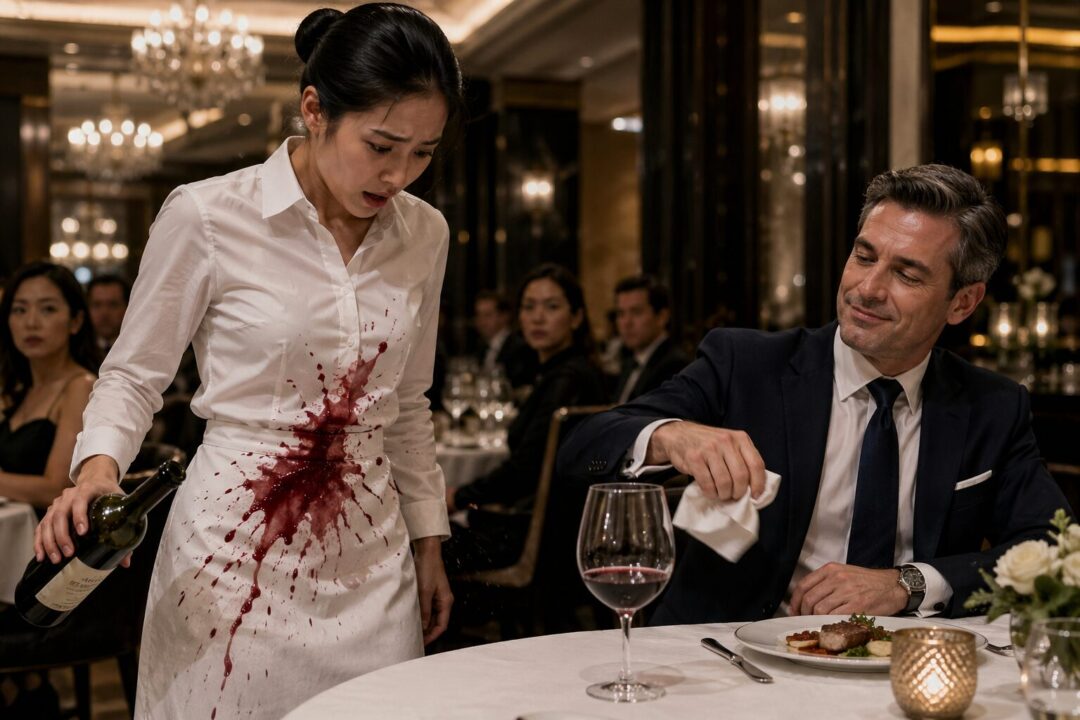
The red wine hit Maya Reyes like a slap, splashing across the front of her white apron and blooming there for everyone to see.
For one breath, the dining room went still.
Crystal glasses hovered above linen tablecloths. Forks paused over plates of black truffle risotto. A woman near the window lowered her champagne flute without drinking. Even the piano in the bar seemed to soften, as if the whole restaurant had leaned in to watch what would happen next.
Maya looked down.
The stain had already begun to spread.
Dark red on white cotton.
Impossible to miss.
Across from her, Brad Whitman sat back in his chair with the calm face of a man who had never once been afraid of being blamed.
“You should watch what you’re doing,” he said.
Maya’s hand tightened around the neck of the wine bottle.
She had been holding it correctly. She knew she had. Her left hand under the base, right hand at the neck, label facing the guest. She had served enough bottles to know when the weight shifted, when a customer reached too far, when a glass moved because someone wanted it moved.
Brad had nudged it.
Not by accident.
Not quite.
A small flick of his fingers against the stem as she poured. Quick enough that most people would miss it. Casual enough that he could deny it.
But Maya had seen it.
So had the table.
Three men in expensive suits sat around Brad, all suddenly fascinated by their plates. One of them had been laughing a second earlier. Now his smile had flattened into something careful.
Maya felt heat crawl up her throat.
“I’m sorry,” she said, because the words had been trained into her body.
Brad lifted one eyebrow.
“For what?”
The question landed harder than the wine.
Maya looked at him.
He was maybe in his early forties, with silver beginning at his temples and a watch that cost more than Maya’s rent for six months. He wore entitlement like cologne. Subtle at first, then everywhere.
“For the spill,” she said.
Brad picked up his napkin and dabbed at a single red drop on the tablecloth near his glass.
“You mean for spilling it.”
The room stayed silent.
That was the part Maya would remember later.
Not the wine. Not the stain. Not even Brad’s voice.
The silence.
People always imagined cruelty was loud. Sometimes it was. But most of the time, cruelty was one person speaking and everyone else deciding the discomfort was not worth interrupting.
Maya swallowed.
Her manager, Celeste Marrow, appeared at her side with the smoothness of someone who had trained herself never to rush in public.
“Maya,” Celeste said softly. “Step away from the table.”
Brad smiled without showing teeth.
Celeste turned to him. “Mr. Whitman, I apologize for the interruption. We’ll have this reset immediately.”
Maya felt the words settle between her ribs.
The interruption.
Not the insult.
Not the hand that had moved the glass.
Her.
She was the interruption.
Celeste’s hand touched Maya’s elbow, light but firm.
“Back hallway,” she murmured.
Maya did not cry in the dining room.
She would be proud of that later, and ashamed of being proud.
She lowered the bottle, turned, and walked between the tables with the stain burning across her apron like a sign.
Behind her, Brad’s voice followed.
“Maybe send someone with steadier hands.”
A few people looked away.
No one said a word.
Part II — The Hallway Behind the Gold Doors
The back hallway smelled like lemon cleaner, steam, and panic.
Maya reached the service sink before her face broke.
Not loudly. She did not sob. She simply bent over the basin, gripped the metal edge, and tried to breathe through the awful pressure behind her eyes.
The wine looked worse under fluorescent light.
In the dining room, it had been dramatic.
Back here, it looked permanent.
She grabbed a towel, soaked it, and pressed it hard against the stain. The red blurred wider. She rubbed faster, and the white cotton turned pink around the edges, as if the apron itself was embarrassed for her.
“Don’t do that.”
Maya turned.
Luis Ortega stood near the dish station, sleeves rolled to his elbows, a stack of clean plates balanced against one hip. He had the tired, steady face of someone who noticed everything because no one noticed him.
“It’ll set deeper,” he said.
Maya dropped the towel into the sink.
For a second, neither of them spoke.
Then Luis said, “I saw him.”
Maya went still.
Luis glanced toward the swinging doors that led back to the kitchen. “The customer. He moved the glass.”
The sentence should have helped.
Instead, it made Maya’s eyes fill.
Because truth was not the same as protection.
“You saw?” she asked.
Luis nodded. “His finger hit the stem. He did it like this.”
He mimed the smallest movement with his hand.
Tiny.
Casual.
Cruel.
Maya pressed her lips together so hard they hurt.
“Did anyone else see?”
Luis looked down.
That was answer enough.
The back hallway doors opened again, and Celeste stepped in. Her black suit was immaculate. Her hair was pulled into a sleek bun so tight it seemed to hold her emotions in place.
“Maya,” she said, “go change aprons.”
Luis lifted his eyes.
Celeste noticed, but did not acknowledge him.
“I want to file an incident report,” Maya said.
Celeste’s face did not change.
“We can talk about that after service.”
“No,” Maya said, surprising herself. “I want to file it now.”
Celeste looked toward the kitchen, then back at Maya. Her voice lowered.
“Brad Whitman books six private dinners here a month. His company held their holiday event upstairs last year. He is not just a guest.”
Maya stared at her.
“He made me apologize.”
“I know.”
“He caused the spill.”
Celeste’s jaw tightened.
“Maya.”
That single word carried a warning.
Maya felt Luis shift beside the dish station.
Celeste heard it too. She turned slightly, enough to remind him of where he stood.
Luis picked up the plates and disappeared into the kitchen.
Maya watched him go.
Celeste opened a cabinet and removed a folded clean apron.
“Put this on,” she said.
Maya did not take it.
“Do you believe me?”
Celeste’s expression flickered.
Just once.
Enough to show that the question had landed somewhere human before the manager inside her buried it.
“I believe this is a very expensive room,” Celeste said. “And expensive rooms protect the people paying for them.”
Maya almost laughed.
It came out like a breath.
“So that’s it?”
“No,” Celeste said. “That’s the part you need to understand before you decide what happens next.”
She held out the apron again.
Maya looked at the clean white cotton.
Then at the one she was wearing.
One could erase the evidence.
One could let the room pretend.
Her hands shook as she untied the stained apron.
Celeste looked away while Maya changed, which somehow made it worse.
When Maya handed over the ruined apron, Celeste did not throw it in the laundry bin. She folded it once and placed it on the metal shelf.
Like something dangerous.
Like something that might still speak.
Part III — The Video That Wasn’t Enough
By nine o’clock, the restaurant had recovered.
That was the cruel efficiency of expensive places.
A shattered glass disappeared in seconds. A stained tablecloth vanished. A crying server returned with dry eyes and a clean apron. The room reset itself around money and manners.
Maya moved through her section like a ghost with good posture.
“Sparkling or still?”
“Of course.”
“I’ll check with the kitchen.”
“Yes, sir.”
Every sentence tasted like metal.
Brad remained at table twelve, laughing now. His jacket was draped over the back of his chair. His wine glass had been replaced. His evening had suffered no visible damage.
Maya’s had been folded on a shelf.
Near the service station, a woman from table nine caught Maya’s eye.
She was around thirty, wearing a green silk blouse and a wedding ring she kept turning with her thumb. Maya had noticed her earlier because she had watched the spill differently from the others. Not with curiosity. With discomfort.
When Maya approached, the woman leaned close.
“I have a video,” she whispered.
Maya’s heart kicked.
The woman unlocked her phone under the edge of the table.
“I started recording after I heard him raise his voice,” she said. “I’m sorry. I didn’t get the spill.”
Maya watched the screen.
There she was.
Standing with wine down her apron.
Brad saying, “You should watch what you’re doing.”
Maya apologizing.
Brad asking, “For what?”
The table silent.
Celeste arriving.
Maya leaving.
It was all there.
And not enough.
The woman looked up at her. “I can send it to you.”
Maya’s throat tightened. “Thank you.”
“I should have said something.”
Maya did not know what to do with the apology.
It was soft.
It was late.
It was also more than anyone else had offered.
The woman gave a small, helpless smile. “I hate that I didn’t.”
Maya nodded because she had no room left to comfort strangers for feeling bad about watching her be hurt.
In the service hallway, she opened the video again.
Her own face looked unfamiliar.
Still. Pale. Controlled.
She had always thought humiliation would look messy.
Instead, it looked professional.
Luis appeared at her shoulder. “Is that it?”
Maya handed him the phone.
He watched without speaking.
When the clip ended, he said, “It doesn’t show his hand.”
“No.”
“But it shows what he did after.”
Maya took the phone back.
“That’s not the same.”
Luis leaned against the wall, arms crossed.
“No. But it’s something.”
Maya almost said something bitter. Something about how “something” was what people offered when they did not have enough courage to give anything useful.
But Luis had given what he had.
His witness.
His certainty.
His presence in the hallway when everyone else had chosen the safety of distance.
So she only said, “Would you say it if someone asked?”
Luis looked at her.
The question sat between them with all its consequences.
“I would,” he said.
Maya believed him.
That made her more afraid for him, not less.
Before she could answer, Celeste’s voice came from behind them.
“Say what?”
Maya turned.
Celeste looked from Maya to Luis, then to the phone in Maya’s hand.
No one moved.
Finally, Maya held out the phone.
Celeste watched the video once.
Then again.
Her face remained controlled, but her thumb paused on the frame where Maya stood stained in the center of the dining room.
“That won’t prove he caused it,” Celeste said.
Maya’s laugh was small and empty.
“No. It only proves how comfortable he was afterward.”
Celeste handed back the phone.
For a moment, she seemed older than she had that morning.
Then the front door host appeared at the end of the hallway.
“Celeste,” he called. “Whitman’s assistant just confirmed the private room for ten-thirty. Eight guests. They requested the reserve list.”
Celeste closed her eyes for half a second.
Maya stared at her.
“He’s coming back?” she asked.
Celeste opened her eyes.
“Yes.”
The host added, “They asked if the same server could handle them. Mr. Whitman said he wanted to make sure there were no hard feelings.”
Maya felt the hallway tilt.
Luis pushed himself off the wall. “No.”
Celeste did not answer him.
She looked only at Maya.
And for the first time that night, Maya saw it clearly.
Celeste was not deciding whether Brad was wrong.
She already knew.
She was deciding how much wrong the restaurant could afford to admit.
Part IV — The Apron on the Shelf
Celeste found Maya in the linen room ten minutes later.
Maya was standing in front of the metal shelf, staring at the stained apron.
Someone had moved it into a clear plastic laundry bag, but the red still showed through. It looked trapped there. Quieter, but not gone.
“You don’t have to serve the private room,” Celeste said.
Maya turned.
Celeste’s voice was lower than usual. Without the dining room around her, without the polished smile, she looked less like a manager and more like a woman who had spent too many years swallowing her own sentences.
“But if I don’t?” Maya asked.
Celeste did not insult her by pretending.
“Ownership will ask why.”
“And you’ll tell them?”
Celeste looked at the bag.
“I’ll tell them there was an incident.”
Maya smiled faintly. “That word again.”
Celeste took the hit without defending herself.
For a moment, the hum of the building filled the room.
Then Celeste said, “My first year here, a man put his hand on my waist every time I passed his chair. I told my manager. She moved me to a different section and said I should be grateful he tipped well.”
Maya did not speak.
Celeste’s eyes stayed on the apron.
“I told myself I would be different when I became the one in charge.”
“And are you?”
The question was quiet.
That made it worse.
Celeste’s face tightened.
“No,” she said.
It was the first honest thing she had said all night.
Maya looked away because the honesty hurt too much to soften her anger.
Celeste stepped closer.
“I am trying to keep you employed.”
“I know.”
“And I am trying to keep myself employed.”
“I know that too.”
The silence after that was not empty.
It was crowded with every server who had smiled through an insult because rent was due. Every manager who had once been hurt and later became fluent in excuses. Every rich man who had learned that the room would rearrange itself around his comfort.
Maya reached for the plastic bag.
Celeste caught her wrist.
“Maya.”
“I’ll serve the room.”
Celeste’s grip loosened.
“But I’m wearing this.”
Celeste stared at her.
“No.”
“Yes.”
“You cannot walk into a private room with a stained apron.”
“Why not?”
“Because it will look—”
“True?”
Celeste stopped.
Maya pulled the apron out of the bag.
The cotton was stiff where the wine had dried. The stain had darkened near the center and faded outward at the edges, like a wound that refused to close cleanly.
“I’m not screaming,” Maya said. “I’m not posting the video. I’m not making a scene.”
Celeste’s eyes sharpened.
“Then what are you doing?”
Maya tied the apron around her waist with hands that had finally stopped shaking.
“I’m not hiding it for him.”
Celeste looked at her for a long time.
Then, from the hallway, Luis appeared.
“There’s a camera,” he said.
Both women turned.
Luis glanced behind him, then stepped inside.
“By the service station. The small black one above the wine fridge. It points toward table twelve.”
Celeste went very still.
Maya felt something inside her lift, then hold.
“Would it show his hand?” she asked.
Luis nodded. “Maybe. The angle is good.”
Celeste’s voice cooled immediately. “Staff are not authorized to access security footage.”
Luis looked at her.
“I know.”
The three of them stood around the stained apron like it was evidence in a case none of them had meant to bring.
Maya said, “Can you get it?”
Luis hesitated.
That hesitation told the truth.
He probably could.
And it could cost him.
Maya shook her head before he answered.
“No. Don’t.”
Luis frowned. “Maya—”
“No. I’m not letting you get fired because he embarrassed me.”
“He didn’t embarrass you,” Luis said.
His voice was quiet but firm.
“He embarrassed himself. Everyone else just helped him pretend he didn’t.”
Maya looked down.
That was the line that nearly broke her.
Celeste turned toward the door.
“Both of you get back to work.”
Luis stared at her.
Maya’s anger flared again.
But Celeste had already stepped into the hallway.
She walked fast.
Not toward the dining room.
Toward the office.
Part V — No Hard Feelings
The private room had velvet chairs, a wall of wine, and a door that closed softly enough to make bad behavior feel protected.
Brad Whitman sat at the head of the table.
Of course he did.
He looked up when Maya entered carrying the wine list.
For the first time all night, his expression changed.
Only slightly.
But she saw it.
His eyes dropped to the apron.
The stain was impossible to miss.
Around the table, his guests noticed too. Two women glanced at each other. One man leaned back as if the air had shifted.
Brad recovered quickly.
“Well,” he said, smiling. “That’s a bold fashion choice.”
Maya placed the wine list beside him.
“Good evening, Mr. Whitman.”
His smile thinned.
“I thought we cleared this up earlier.”
“No, sir,” Maya said. “We cleaned it up.”
One of the guests looked down at his menu.
Brad’s jaw tightened.
Maya moved to pour water. Her hands were steady now. Not because she was calm, but because something in her had gone past trembling.
Brad watched her.
“You know,” he said, loud enough for the table, “in hospitality, attitude matters.”
Maya set the water pitcher down.
“Yes,” she said. “It does.”
The room quieted.
Brad leaned back.
“You have something you want to say?”
Every instinct in Maya’s body told her to retreat.
Smile.
Apologize.
Protect the shift.
Protect the job.
Protect the man from the consequences of his own hand.
Instead, she looked at him.
“You were right earlier,” she said. “I should watch what I’m doing.”
Brad’s smile returned, smug and easy.
Then Maya finished.
“Tonight, I am.”
The room held its breath.
Before Brad could answer, the door opened.
Celeste walked in.
She was carrying a tablet.
Behind her stood Luis, just outside the room, not entering, but not disappearing either.
Celeste’s face was composed in the way storms are composed before they break.
“Mr. Whitman,” she said, “ownership has been notified of the incident at table twelve.”
Brad blinked.
Maya did not move.
Celeste placed the tablet on the table and turned it toward him.
The footage was silent.
That made it worse.
There was Maya beside the table with the wine bottle. There was Brad’s hand near the glass. There was the slight, deliberate nudge. There was the stem shifting just enough. There was the spill.
No raised voice.
No dramatic motion.
Just a small act by a man who thought small acts did not count when they happened to people beneath him.
The clip ended.
No one spoke.
Brad’s guests looked at him now.
Not at Maya.
At him.
Color rose in his neck.
“That’s not what it looks like,” he said.
Celeste picked up the tablet.
“I agree,” she said. “It looks worse.”
Maya felt the words pass through her like light through a cracked door.
Brad stood.
“You need to be very careful.”
Celeste did not step back.
“I am being careful.”
He looked at Maya.
“This is absurd. She spilled wine on herself and now you’re staging some little performance?”
Maya’s throat tightened, but she held his gaze.
For the first time, she did not feel smaller because he was angry.
She felt tired.
That was different.
Tired could still stand.
Celeste’s voice remained even. “Your reservation has been ended for the evening. A car can be called for your party if needed.”
One of Brad’s guests muttered, “Brad, come on.”
That, more than anything, seemed to wound him.
Not the truth.
Not Maya.
The embarrassment.
His power had not disappeared. Men like Brad did not lose everything in one room. But for one moment, the room had stopped rearranging itself to protect him.
And he did not know what to do with the shape of it.
He snatched his jacket from the chair.
“This place is done,” he said.
Celeste gave a small nod.
“That will be ownership’s decision.”
Brad passed Maya on his way out.
He stopped close enough that she could smell his expensive cologne.
“You’ll regret this,” he said under his breath.
Maya looked at him.
Maybe she would.
That was the honest part.
Maybe tomorrow ownership would decide Brad’s money mattered more. Maybe Celeste would be punished. Maybe Luis would be questioned. Maybe Maya would be called dramatic by people who had never had to choose between rent and pride.
But regret was not the same as fear.
And for once, she was not carrying his shame for him.
“No,” Maya said. “I’ll remember it.”
Brad left.
The private room door stayed open behind him.
Part VI — What Would Not Wash Out
After midnight, the restaurant looked ordinary again.
That was the strangest part.
The candles were blown out. The glasses were polished. The white tablecloth from table twelve had been replaced. The floor where the wine had spilled shone clean under the low lights.
A person could walk in tomorrow and never know.
Maya stood in the back hallway, untying the stained apron.
Her body felt heavy now that it was over. Not peaceful. Not victorious. Just emptied of the force that had carried her through the last hour.
Luis leaned near the dish station.
“You okay?”
Maya almost said yes.
Then she almost said no.
Instead, she said, “I don’t know yet.”
Luis nodded like that was a complete answer.
Celeste came out of the office with her phone in one hand and her face unreadable.
“Ownership wants a written report from all three of us tomorrow morning,” she said.
Luis’s shoulders tensed.
Celeste looked at him.
“I told them I pulled the footage.”
Luis stared at her.
“You didn’t have to do that.”
“Yes,” Celeste said. “I did.”
Maya watched her manager.
There was no dramatic apology. No hug. No sudden transformation into the woman Celeste had once promised herself she would become.
But there was this.
A choice made late.
Late still mattered.
Celeste turned to Maya.
“You’re paid through the rest of the night. Go home.”
Maya looked down at the apron in her hands.
“What do I do with this?”
Celeste’s eyes moved to the stain.
For once, she did not answer immediately.
“Whatever you want,” she said.
Maya expected herself to throw it in the trash.
She imagined the satisfaction of it. The stained cotton hitting the bin. The lid closing. The night ending.
But when she moved toward the trash, her hands stopped.
The apron had been shame in the dining room.
Evidence in the office.
Armor in the private room.
It was ugly.
It was also hers.
So Maya folded it carefully.
Once.
Then again.
She placed it in her tote bag beside her street shoes and the phone with the partial video still saved.
Luis gave her a small smile.
Celeste looked away, but not fast enough to hide the wetness in her eyes.
Outside, the city was cold and bright. The kind of cold that made every breath visible.
Maya stepped onto the sidewalk in her black slacks and white shirt, carrying the stained apron home like something fragile.
No crowd applauded.
No headline appeared.
No one promised that tomorrow would be fair.
But as she walked past the restaurant windows, she caught her reflection in the glass.
For once, she did not see the girl standing alone in the dining room while everyone looked away.
She saw someone who had turned around.
Someone who had walked back in.
Someone who had worn the truth where everyone could see it.
And that was not the same as justice.
But it was not nothing.