The Rocket on the Balcony Taught Everyone Where Kindness Ends
Part I — Red Lights in the Rain
Amanda was still wearing her navy scrubs when she ran across the apartment parking lot after the black SUV.
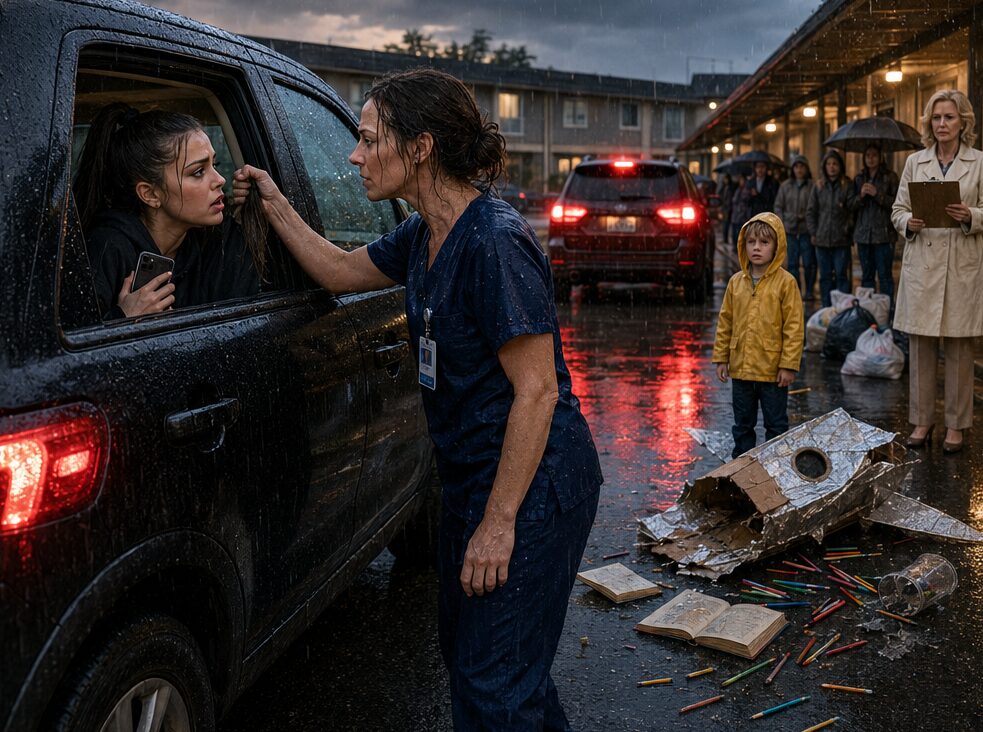
Rain slapped the asphalt hard enough to make every red brake light bleed into the puddles. Her badge bounced against her chest. One sneaker slipped, caught, slipped again. Behind her, Joshua sat on the wet ground with both hands in his lap, crying beside a crushed cardboard rocket and a scatter of colored pencils rolling under the tires of parked cars.
The SUV was almost at the speed bump.
Almost gone.
In the rear passenger seat, Jessica turned toward the open window. Her glossy ponytail hung over one shoulder. Her phone was still in her hand. For one second, through the rain and the red light, Amanda saw the girl’s mouth bend into something that might have been embarrassment, disbelief, or a smile.
That was the last thing Amanda could bear.
“Stop,” she shouted.
The SUV kept rolling.
Amanda reached the window just as the front wheels climbed the speed bump. She grabbed the first thing her hand found—Jessica’s ponytail—and pulled.
Jessica screamed.
The driver hit the brakes.
Someone behind Amanda gasped, “Oh my God.”
Barbara, standing under the covered walkway in her cream raincoat, shouted, “Amanda, don’t make this worse!”
But Amanda did not let go.
For weeks, she had made everything smaller. Her voice. Her anger. Her son. She had apologized in the group chat. She had moved his project away from the mailboxes. She had smiled when people called him “sweet” in the same tone they used for “messy.” She had told Joshua adults just liked rules.
Now his sign was stuck under soggy cardboard near the back tire.
Now his pencils were floating through rainwater.
Now her seven-year-old was trying not to sob loudly because even his crying felt like something he should control.
Jessica twisted in the window, one hand over her scalp, her eyes wide and wet with shock.
Amanda pulled just enough to make her look.
“Look at him,” Amanda said.
The parking lot went still.
Not quiet. The rain was too loud for quiet. The SUV engine still trembled. Somewhere, a donation bag slid off a folding table and spilled sweaters onto the sidewalk.
But the people stopped moving.
Jessica looked past Amanda.
She looked at Joshua.
And for the first time all evening, her face changed.
Part II — Take a Book, Leave a Dream
A week earlier, Joshua had asked if a rocket could also be a library.
Amanda was rinsing cereal bowls before another twelve-hour shift, trying to calculate whether she had enough money for after-school care and the overdue electric bill at the same time. Joshua stood in the kitchen doorway wearing one sock, his blond hair flattened on one side from sleep, holding an empty shipping box almost as tall as his chest.
“A rocket library?” Amanda asked.
“For the book swap,” he said. “People can put books in it. The rocket takes them to other people.”
“That sounds scientifically questionable.”
He smiled because that was their kind of joke.
The apartment still smelled faintly of cardboard from the boxes they had never fully unpacked. They had moved into Willow Creek Apartments three months earlier, after Amanda’s rent went up across town. Willow Creek had beige siding, clipped hedges, a clean lobby, and a residents’ group chat where people used too many exclamation points before saying unkind things.
Welcome everyone to Saturday’s community book swap!!!
Please remember shared spaces should remain tidy!!!
Amanda had chosen it because the school bus stopped near the entrance and because the leasing office had said the building was “very family friendly.”
What they meant, she later learned, was that children were welcome as long as they were quiet, clean, supervised, and nowhere near the mailboxes.
Joshua was not loud. He was not wild. He was the kind of child who whispered facts about planets to grocery-store cashiers and apologized to furniture when he bumped into it. But he was visible in a way Willow Creek did not quite forgive. He drew on scrap paper in the lobby while waiting for Amanda. He asked neighbors if they knew Saturn could float in a bathtub. He carried treasures in his pockets: bottle caps, smooth rocks, a bent paper clip he said looked like a comet.
He wanted friends.
That was the thing Amanda could not solve with overtime.
So when he built the rocket, she said yes.
They worked on it between her shifts. Joshua taped two boxes together and cut a window in the front for paperbacks. Amanda found aluminum foil from the kitchen drawer, and he smoothed it over the nose cone with careful fingers. He colored red fins at the bottom, then changed one to purple because “real rockets can have style.”
He sharpened every colored pencil until the tips looked new.
On the side, he wrote in blocky letters:
TAKE A BOOK, LEAVE A DREEM.
Amanda opened her mouth.
Joshua saw her looking. “I know,” he said quickly. “Dream has an A. I just ran out of room.”
“It’s perfect,” she said.
He touched the sign with one finger. “Do you think kids will put notes on it?”
“I think they might.”
“Do you think they’ll know it’s for everybody?”
Amanda wanted to say, Of course.
Instead she said, “We’ll put it somewhere people can see.”
That Friday afternoon, they carried the rocket down to the mail area. It looked smaller outside their apartment, more fragile under the fluorescent lights, with its foil wrinkling at the edges and one fin slightly crooked. Joshua placed a stack of old children’s books inside: a dinosaur book, two joke books, one battered paperback about astronauts.
He arranged the pencils in a plastic cup.
Then Barbara came through the glass lobby door with a clipboard, two canvas totes, and a smile that arrived before the rest of her face.
Barbara had lived at Willow Creek for eleven years. She organized the holiday lobby wreaths, the canned-food drive, the book swap, and the summer “porch potluck,” though most units did not have porches. She knew the property manager’s cell number. She referred to the building as “our little community,” and somehow the word our always sounded selective.
“Oh,” Barbara said, stopping in front of the rocket.
Joshua stood straighter.
“It’s for tomorrow,” he said. “For the books.”
Barbara looked at the cardboard, then at the mailboxes, then at Amanda’s scrubs. Amanda had not had time to change before pickup.
“How creative,” Barbara said.
Joshua beamed.
Then Barbara added, “We just need to be mindful of shared spaces.”
Amanda felt the sentence land where all those sentences landed: in the part of her that kept a mental list of things they could not afford to lose.
“Of course,” Amanda said. “We’ll make sure it stays neat.”
Barbara’s smile held.
“It’s just that the entry is the first thing people see. We don’t want it to look like a daycare.”
Joshua looked down at the rocket.
Amanda put a hand on his shoulder. “We’ll keep an eye on it.”
Jessica came in behind her mother, earbuds in, phone raised, ponytail glossy and high. She glanced at the rocket.
“What is that?” she asked.
“A little library,” Joshua said softly. “But a rocket.”
Jessica looked at her mother, then back at it. “So, like, trash NASA?”
Barbara made a small sound. Not quite a laugh. Not quite a correction.
“Jessica,” she said, but gently, like the problem was tone, not cruelty.
Amanda felt Joshua’s shoulder tighten under her palm.
She should have said something then.
She should have.
Instead, she smiled the smile she used with angry parents at the hospital when their fear came out as blame.
“It’ll be gone after the swap,” Amanda said.
Joshua looked up at her.
Just for a second.
Then he looked away.
Part III — The Shape of Being Reasonable
By Saturday morning, three children had put books in the rocket.
By noon, five had written their names on the fins.
Joshua stood beside it in his yellow rain jacket, even though it was not raining yet, and explained the rules to anyone who slowed down.
“You don’t have to leave a book today,” he told a smaller girl with braids. “You can bring one later. Rockets come back.”
The girl took a joke book and drew a star on the purple fin.
Amanda watched from near the refreshment table, holding a paper cup of coffee she had not had time to drink. She had come straight from the hospital after helping calm a four-year-old who needed stitches and a father who kept saying, “I can’t look.” At work, Amanda knew exactly how to be useful. She could lower her voice, warm a blanket, distract a frightened child with a glove balloon.
At Willow Creek, she never knew where to put her hands.
Barbara moved around the book swap like a mayor at a ribbon cutting. She adjusted stacks of paperbacks. She straightened napkins. She told people the charity pickup would be next Friday and reminded them to bag donations “nicely, not like closet cleanout panic.”
People laughed.
Amanda tried to laugh too.
Joshua did not notice. For twenty full minutes, he was not the new boy from 3B. He was the keeper of the rocket. Children asked him where the books went. He told them Mars first, then maybe Jupiter if they were heavy.
His face changed when people listened.
Amanda felt something in her unclench.
Then Jessica arrived with two girls Amanda had seen before near the parking lot, all three carrying iced coffees, all three dressed like the weather existed for other people. Jessica’s eyes went straight to the cluster of children around the rocket.
“Oh my God,” she said, not softly enough. “It’s a whole event now.”
One friend laughed.
Joshua heard it. Amanda saw the moment he heard it because his hand stopped moving in the middle of sharpening a blue pencil.
Barbara was pouring lemonade. “Jess,” she said.
Jessica lifted her phone. “No, it’s cute. It’s giving homeless NASA.”
The words spread less loudly than a shout but more permanently.
One of the children stepped back from the rocket. Another looked at Joshua to see if laughing was allowed.
Joshua’s face went pink. He bent over the pencil cup, pretending to fix something.
Amanda started forward.
Barbara caught her eye.
Not with a threat. That would have been easier.
With a look that said: Don’t embarrass yourself.
Amanda stopped.
Jessica filmed for maybe six seconds. Just enough to capture the rocket, the crooked sign, the children’s drawings, Joshua’s bowed head.
“Jessica,” Barbara said again, this time with a little more firmness. “Put the phone away.”
Jessica rolled her eyes but lowered it.
Amanda walked to Joshua.
“Hey,” she said. “Need help?”
“No.”
“You sure?”
His voice became very careful. “I’m just making them sharper.”
He sharpened the blue pencil until the tip broke.
That night, the video did not appear anywhere Amanda could find. That almost made it worse. The harm had no evidence. Just Joshua eating half his dinner and saying he was not hungry. Just him asking whether rockets were maybe “too babyish.” Just Amanda standing in the bathroom with the shower running, furious at a seventeen-year-old girl and more furious at herself.
On Monday, the message came from the property manager.
Hi Amanda, hope you’re well. We’ve received a few concerns about unsupervised child activity around the mailbox area. Totally understand kids need space, but please make sure personal items are not left in common areas. Thanks for helping keep Willow Creek welcoming for everyone!
Amanda read it three times in the break room.
The word welcoming made her put down her sandwich.
Then Barbara texted privately.
I hope you know I didn’t mean for this to become an issue. We just all have to be considerate in shared spaces.
Amanda typed six replies and deleted all of them.
In the residents’ group chat, she wrote:
Sorry for any inconvenience. Joshua and I will move the rocket after this weekend. Thank you for being patient.
She stared at the message after she sent it.
A small gray checkmark appeared.
Then a heart reaction from Barbara.
Then Jessica reacted with a rocket emoji.
Amanda locked her phone so hard it clicked.
That evening, Joshua saw the message anyway.
He was sitting beside her on the couch, leaning against her arm while she checked the schedule for the week. His hair smelled like school soap and rain. She thought he was reading his dinosaur book until his body went still.
“Did people complain about me?” he asked.
Amanda closed the phone.
“Not about you.”
“But it said child activity.”
“It’s just adult stuff.”
“Was my rocket in the way?”
Amanda had spent all day telling frightened children the truth in gentle pieces. Now, with her own son, she reached for a lie because it felt kinder.
“Adults just like rules,” she said.
Joshua nodded like he understood.
That hurt more than if he had cried.
The next afternoon, when Amanda came home from work, the rocket was gone from the mail area.
She found Joshua dragging it across the sidewalk toward the parking-lot edge near the recycling bins.
“What are you doing?” she asked.
He stopped, breathing hard.
“I’m putting it where people don’t have to see it unless they want to.”
The sentence was too adult for him.
Amanda wanted to march the rocket back to the mailboxes. She wanted to knock on Barbara’s door and say, He is seven. He is allowed to exist near the mail.
Instead, she looked at the rent reminder taped to the fridge upstairs. She thought of after-school care. She thought of the property manager’s cheerful exclamation points.
She helped Joshua carry the rocket under the covered edge by the recycling area, where it would stay mostly dry if the wind behaved.
“Here?” he asked.
Amanda swallowed.
“Here.”
Part IV — Shared Spaces
Friday arrived with low clouds and a plumbing problem at Joshua’s after-school program.
Amanda got the call near the end of her shift, while restocking stickers in a pediatric exam room.
“We’re closing early,” the coordinator said. “I’m sorry. It’s the bathrooms. Everyone has to be picked up by four.”
Amanda looked at the clock.
She had already worked fourteen hours because someone called out. Her feet ached. There was dried apple juice on one sleeve and a smear of marker on the other from a toddler who had drawn a sun on her wrist.
“I’ll be there,” she said.
By the time she picked Joshua up and drove back to Willow Creek, rain had started in earnest. The parking lot was crowded. Residents carried donation bags toward Barbara’s black SUV, which sat near the covered walkway with its back hatch open.
Barbara stood with her clipboard under the awning, cream raincoat untouched by rain, directing people like traffic.
“Winter coats separate from linens, please. Books in the blue bins. Not loose, thank you.”
Jessica leaned against the SUV in an oversized hoodie, scrolling her phone, while two friends huddled near her under one umbrella.
Joshua spotted his rocket before Amanda had fully parked.
“It’s okay,” he said quickly, as if answering a question she had not asked. “I put a trash bag over the top.”
He unbuckled.
“Wait for me,” Amanda said.
But he was already opening the door.
She watched him run across the lot, hood bouncing, backpack crooked. The rocket stood near the covered walkway, not at the mailboxes, not in the center, not anywhere important. Still, two donation bags had been placed beside it, pushing it half into the path.
Joshua pulled the trash bag off the top and checked inside.
A little girl in pink boots approached him with a thin picture book. Amanda saw Joshua brighten.
Even through the rain, that small brightening reached her.
Amanda grabbed her bag, locked the car, and started across the lot.
Then Barbara’s voice cut through the rain.
“Joshua, honey, that needs to move.”
Amanda stopped.
Joshua looked up. “It’s not in the way.”
“It is, sweetheart. We need this area clear.”
Jessica did not look up from her phone. “It’s literally by the donations.”
“It’s a library,” Joshua said.
Jessica’s friend snorted.
Barbara gave Amanda a look across the parking lot. Not angry. Worse. Patient.
Amanda walked faster.
“Joshua,” Barbara called, “your mom is right there. Let her help you.”
But Joshua had already grabbed the side of the rocket.
“I can move it,” he said.
The cardboard had softened from damp air. When he pulled, one fin bent inward. The plastic cup of colored pencils tipped, spilling red, blue, yellow, green across the wet pavement.
He froze.
Jessica finally looked up.
“Oh my God,” she said. “Again with the pencils.”
Amanda was close enough now to see Joshua’s ears go red.
“I’ll get them,” he said.
He crouched, gathering pencils in both hands.
A gust of rain blew under the awning and lifted the trash bag. The rocket tilted, bumped against Jessica’s shin, and left a wet smear on her leggings.
Jessica stepped back sharply.
“Seriously?”
“It didn’t mean to,” Joshua said.
“It’s cardboard.”
“I know.”
“It’s wet trash.”
Amanda was almost there.
“Jessica,” Barbara said, with that familiar soft warning that never protected the person who needed protecting.
Joshua stood, trying to drag the rocket by himself. It lurched sideways into the path behind the SUV.
Jessica grabbed one side, not to help but to shove it away from her.
“Move it over there,” she snapped.
The rocket folded where her hand pushed.
Joshua cried out as if she had pushed him instead.
“Don’t! The shelf—”
Jessica shoved harder.
The rocket slid toward the curb. One fin collapsed. The books spilled out, their pages opening in the rain like small white birds that could not fly.
Joshua lunged after the sign.
At the same moment, the SUV rolled backward a foot.
Maybe the driver thought everyone was clear.
Maybe Barbara had waved without looking.
Maybe it was only an inch too much.
The rear tire caught the bottom of the rocket and pressed it flat with a sound Amanda felt in her teeth.
Joshua fell backward onto the wet asphalt.
For one second, nobody moved.
Then Joshua made a sound Amanda had never heard from him before.
Not pain.
Shame.
A thin, broken sound, like he was trying to keep his crying polite.
Amanda reached him and dropped to her knees.
“Joshua. Look at me. Are you okay?”
He nodded too fast. Rain ran down his cheeks and mixed with tears.
“My sign,” he said.
Amanda looked.
The cardboard sign was pinned beneath the crushed side of the rocket. TAKE A BOOK, LEAVE A DREEM, the misspelled word darkening as water soaked in.
Jessica stood by the SUV door, breathing hard. Her friends had gone silent.
Barbara said, “Everyone just calm down.”
Jessica gave a short laugh. Not loud. Not happy. More like she could not believe this was happening to her.
“It was already trash,” she said.
Amanda looked up.
Jessica was climbing into the back seat.
The door was still open. Her ponytail slid over her shoulder. Her phone was still in her hand.
Barbara moved toward Amanda.
“Amanda, let’s not make a scene.”
Something inside Amanda went very quiet.
She looked at Joshua on the ground.
She looked at the pencils floating away in rainwater.
She looked at the SUV beginning to roll forward.
And then she ran.
Part V — Look at Him
Later, Amanda would remember the run in pieces.
Her badge hitting her chest.
A yellow pencil crushed under her shoe.
Barbara calling her name.
Joshua saying, “Mom?” in a voice that made her hate herself and need to keep going at the same time.
The SUV’s brake lights painted the rain red.
Jessica turned toward the open window.
Amanda did not plan what her hand did.
She reached the car at the speed bump, grabbed Jessica’s ponytail, and pulled her back toward the window.
Jessica screamed.
The SUV stopped so suddenly Amanda’s hip hit the door.
“Are you insane?” Jessica shouted, grabbing Amanda’s wrist.
Maybe Amanda was.
That was the terrible part.
For a second, with Jessica’s hair in her fist and everyone watching, Amanda felt the hot, clean satisfaction of finally not apologizing.
Then she saw Joshua’s face.
He had stopped crying.
He was staring at her.
Not relieved.
Afraid.
The satisfaction cracked.
But Amanda still did not let go.
Barbara rushed toward them. “Let her go right now.”
Amanda’s voice came out low. “She needs to look.”
“She’s a child,” Barbara snapped.
Amanda turned on her.
“So is mine.”
The sentence hit harder than a shout.
Barbara stopped.
Jessica was crying now, angry tears streaking her makeup. “I didn’t do anything. He put it there.”
Amanda loosened her grip, but kept her hand tangled enough that Jessica could not disappear back into the leather seat.
“Look at him,” Amanda said.
Jessica shook her head. “Let go of me.”
“Look at him.”
The rain filled the space between them.
Slowly, Jessica looked.
Joshua stood beside the crushed rocket with his hands hanging at his sides. His oversized rain jacket dripped onto his shoes. The little girl in pink boots held the ruined picture book against her chest. Colored pencils moved in the shallow current along the parking-lot slope.
No one said “shared space.”
No one said “property value.”
No one said “be mindful.”
Amanda saw Jessica see it. Not all of it. Maybe not enough. But something.
The girl’s mouth parted.
Her eyes shifted from Joshua to the cardboard to the pencils to the residents watching from under umbrellas and awnings.
For once, she did not know what face to make.
Amanda let go.
Jessica pulled back into the SUV, both hands flying to her ponytail. The driver shut the window. The vehicle stayed there, engine humming, trapped by the speed bump and by every person who had witnessed the moment.
Barbara found her voice again.
“You crossed a line.”
Amanda was shaking so hard she could barely feel her fingers.
“Yes,” she said.
The word surprised her.
She walked back to Joshua.
Each step felt longer than the run.
When she reached him, she knelt in the rain.
“Are you hurt?”
He shook his head.
“Anywhere?”
He shook his head again.
His lower lip trembled.
“You pulled her hair,” he whispered.
Amanda closed her eyes.
“I did.”
“You tell me not to grab.”
“I know.”
The rain ran down the back of her neck, cold and deserved.
“I was wrong to grab her,” Amanda said. She made herself say it where people could hear. “And she was wrong to treat you like you were in the way.”
Joshua looked at the rocket.
“It’s wrecked.”
Amanda wanted to say they could fix it. She wanted to say it did not matter. She wanted to wrap him in a clean towel and undo the whole parking lot.
Instead she said the truth.
“Yes.”
He bent and picked up the plastic cup, cracked down one side. Two pencils remained inside.
A blue one.
A purple one.
He held them like they were something rescued from a place no one should have to go.
Part VI — The Balcony Window
The formal warning came Monday morning.
Amanda sat in the leasing office across from the property manager, still in scrubs because she had come straight from work again. The office smelled like vanilla plug-in air freshener and printer toner.
Barbara sat two chairs away with Jessica beside her.
Jessica’s ponytail was lower than usual.
Amanda noticed that and hated that she noticed.
The property manager used words like incident and inappropriate and community standards. Amanda listened. She apologized for touching Jessica. She did not say but after the apology. She did not defend the part that was indefensible.
Then Mrs. Howard from 2A, who had once called Joshua “always underfoot,” appeared in the office doorway.
“I need to say something,” she said.
Barbara’s face tightened.
Mrs. Howard looked uncomfortable, as if decency had interrupted her morning and she resented it.
“That girl has been making fun of the boy’s project all week,” she said. “I heard it. More than once.”
Jessica stared at the floor.
Another resident sent an email. Then another. Not heroic statements. Not grand defenses. Just small admissions that people had seen more than they said.
I thought someone else would handle it.
I didn’t want to get involved.
The rocket wasn’t bothering anyone.
Barbara did not push for eviction after that.
She did not apologize either.
Jessica wrote a note on white stationery with her name embossed at the top. Amanda knew Barbara had chosen the paper.
I am sorry for what happened to your project. I should have been more careful with my words and actions.
Joshua read it once and put it on the kitchen table.
“She didn’t say rocket,” he said.
“No,” Amanda said.
“She said project.”
“Yes.”
He pushed the note away.
For two days, the apartment felt smaller than before.
Joshua went to school. Amanda went to work. The crushed rocket sat folded by the door because neither of them wanted to throw it away first. The colored pencils dried on paper towels near the sink, their labels peeling, their tips soft.
On Thursday evening, Amanda found Joshua cutting a smaller box with safety scissors.
She stood in the doorway and said nothing.
He had chosen a shoe box this time. He covered it with foil from the kitchen drawer and drew two small fins on construction paper. The sign was smaller too, written carefully, with the A squeezed in where it belonged.
TAKE A BOOK, LEAVE A DREAM.
Amanda sat beside him.
“Where do you want to put it?”
He did not answer right away.
Then he pointed to the balcony window.
“Inside,” he said. “People can see it from the courtyard.”
Amanda felt the answer open and close at the same time.
“Okay.”
Together, they cleared space on the little balcony table. It was barely a balcony, more like a square of concrete with a railing and two folding chairs. Joshua placed the new rocket behind the glass, angled outward.
Visible.
Untouchable.
That night, after dinner, there was a soft knock at the door.
No one stood outside.
On the mat lay a children’s book about the solar system.
No note.
Joshua picked it up and held it against his chest.
The next morning, there was a new pack of colored pencils beside the door. Still sealed. Twelve colors.
Amanda looked down the hallway, but every apartment door was closed.
Joshua opened the pack carefully. He took out the blue and purple first.
“Do I have to put them downstairs?” he asked.
“No,” Amanda said.
He looked at her, waiting for the rest. For the lesson. For the rule that would make everyone comfortable.
Amanda touched the top of the little rocket through the glass.
“You get to choose who reaches it.”
Joshua nodded.
Outside, the courtyard was damp from earlier rain. A few residents passed on the walkway, pretending not to look up and looking anyway.
From the third-floor balcony, the rocket shone softly behind the window.
It was smaller now.
But it was still pointed at the sky.