He Dumped Rotting Waste On My New Patio Line And Livestreamed His Own Ruin
Chapter 1: The First Van Over The Line
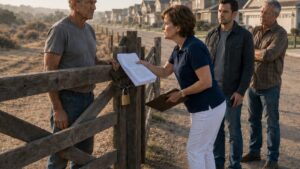
The tire marks were pressed into the damp edge of Paul Nelson’s lawn like someone had rolled a thumb through fresh paint.
He stood barefoot on the new patio with his coffee cooling in one hand, looking down at the black half-moons cut into the grass. Yesterday, that strip had been clean. Yesterday, the concrete crew had rinsed the last dust from the forms, packed their tools, and told him not to drag furniture across the slab for another week. Yesterday, Paul had stood exactly where he stood now and imagined a chair, a small table, a quiet morning with no engines, no shouting, no one taking more than they were given.
Now the rear tire of a white commercial van sat over the line.
Not near it. Not leaning toward it. Over it.
Paul set the coffee on the patio wall and stepped onto the grass. The soil gave under his heel. He bent slowly, not because his back could not handle it, but because he wanted to look at the damage without letting anger hurry him. The grass had been flattened in two slick arcs, the blade tips dark with mud. Beside the patio edge, half hidden by the shadow of the van, a little orange survey stake leaned in the dirt.
Paul touched it with two fingers and straightened it.
The stake marked the boundary. The surveyor had driven it in three weeks ago while Paul stood watching with his arms folded, pretending not to care about inches. The new patio had cost more than he had first planned. Concrete, drainage, permit, cleanup. Every receipt sat in a folder on his kitchen table because he knew how neighborhoods could be. People smiled at mailboxes, then measured each other’s fences with their eyes.
Across the narrow driveway edge, Brian Campbell’s garage door was open. A second van sat inside it, its rear doors open, boxes stacked halfway to the roof. Brian stood beside it in a pressed polo, one hand on his phone, the other waving at a delivery driver who was trying to back out.
Paul waited until Brian looked over.
Brian gave him a fast smile that was not apology and not greeting.
“Morning, Paul.”
Paul glanced at the van tire, then back at him.
“Your van’s on my grass.”
Brian looked down as if surprised by the existence of the ground. He took three steps toward the driveway, phone still in hand.
“That little strip?” He laughed once, short and dry. “It’s basically shared access.”
“No,” Paul said. “It’s my lawn.”
Brian’s smile held, but the warmth dropped out of it. He was younger than Paul by fifteen or twenty years, broad through the shoulders, always moving like someone had promised him the room before he entered it. His company logo was printed on the van door, though Paul had never paid attention to the business name. The vans came and went at odd hours. Doors slammed at dawn. Engines idled after dark. Men called across the driveway while Paul sat inside pretending the windows kept sound out.
“It’s been used for access since before you poured that thing,” Brian said, nodding toward the patio.
Paul looked behind him. The concrete was pale and clean, squared carefully along the yard, the edge still sharp enough to catch the morning light.
“The patio is on my property.”
“I didn’t say it wasn’t.” Brian lifted his free hand. “But you built right up close. Now there’s no room to swing in.”
“There’s room on your side.”
Brian’s jaw shifted. For the first time, his eyes went to the orange stake.
Paul saw him see it.
That was the part that made him quiet.
Mistakes looked different from choices. A mistake stepped back when shown the line. A choice studied the line and decided whether anyone was brave enough to defend it.
Brian pocketed his phone. “Look, I’m not trying to make this a thing.”
“Then move the van.”
“I’ve got a route leaving in ten minutes.”
“Move it first.”
Brian gave another laugh, but this one was for someone invisible. “You retired guys kill me. Whole day free and somehow still no flexibility.”
Paul felt the old heat rise in his chest. Not loud. Not dramatic. Just a familiar pressure behind the ribs, the place where too many small things had been stored because none of them felt worth becoming the kind of man who shouted in driveways.
He had once lived next to a man who shouted about everything. Leaves. Mailboxes. Dogs. Children crossing a lawn. Paul had been younger then, newly married, and he had promised himself he would never become a man whose whole life narrowed down to a property line.
But that man had not been standing beside tire marks in fresh grass, looking at the first peaceful thing he had bought for himself in years.
Paul reached into his pocket and took out his phone.
Brian’s expression changed. “What are you doing?”
Paul took one photo of the tire. One of the survey stake. One wide shot showing the van, the patio, and the line between them.
“Documenting it.”
“Come on.” Brian’s voice sharpened. “Don’t be that guy.”
Paul lowered the phone.
From the sidewalk, Deborah Martin slowed with a grocery bag hooked over her elbow. She lived two houses down and always knew which garbage bin belonged to which house, which mailbox had been dented, which neighbor’s son had come home late. She looked at the van, then at Paul, then at Brian.
“Everything okay?” she asked.
“Paul’s worried about a tire,” Brian said before Paul could answer. “Because I’m trying to get my guys out for work.”
Deborah’s eyes flicked to the tire. It was clearly on Paul’s side. She saw it. Paul knew she saw it. But her mouth tightened in the way people’s mouths tightened when truth asked for a spine.
“Well,” she said carefully, “it is tight through here since the patio went in.”
Paul stared at her.
Brian spread his hands as if the neighborhood itself had testified.
Paul said nothing. The silence did not feel noble now. It felt like a door closing from the wrong side.
Deborah adjusted the grocery bag. “I just mean, nobody wants trouble.”
“No,” Paul said. “Nobody does.”
Brian nodded toward Paul’s trash cans, two heavy black bins sitting just inside the driveway edge where they had always sat on collection day.
“Those are the real problem, honestly. Move those back and everybody can use the space.”
“They’re on my property.”
Brian’s smile came back, thinner than before. “You keep saying that like it settles everything.”
Paul looked at the survey stake again. A small orange flag, cheap wire, clean dirt. It should have settled everything. It had been measured, marked, paid for, recorded. Yet here he stood, discovering paper did not become a boundary until someone made it one.
The delivery driver called Brian’s name. Brian turned away as if the conversation had ended because he decided it had.
Paul watched him climb into the van. The engine started, rattling the morning quiet. Mud shook from the tire as Brian backed out, leaving the grass bruised and low. He did not wave as he drove away.
Deborah lingered.
“You know how he is,” she said softly.
Paul looked at her, waiting.
“He runs hot. With the business and all. Maybe just don’t let it turn into something.”
Paul picked up his coffee from the patio wall. It had gone cold.
Behind the cup, across the clean concrete and the damaged grass, Brian’s garage swallowed the second van in shadow. Paul knew he should call the city, the association, someone whose job was to turn lines into consequences. Instead he stood there with photographs in his phone and a feeling he disliked because it had no clean place to go.
By noon, the sun had dried the tire marks into dark crescents.
At dusk, Paul rolled the trash cans back from the street and placed them exactly where they belonged, inside the line, handles facing the house.
Brian stepped out of his garage, wiping his hands with a shop rag.
“Paul,” he called.
Paul paused with one hand on the lid.
Brian pointed at the bins. “Move those trash cans by tomorrow, or I’ll move them for you.”
Chapter 2: The Patio Everyone Suddenly Had Opinions About
One trash can sat crooked in the morning, shoved so hard its rubber wheel had carved a fresh scrape near the patio form line.
Paul saw it before he unlocked the back door.
The can had not tipped. Whoever moved it had wanted it moved, not emptied. It leaned at an angle, one black lid half open like a mouth interrupted mid-word. Beside it, the scrape ran pale across the concrete dust at the driveway edge, stopping inches from the orange survey stake.
Paul stood behind the glass with his hand on the doorknob.
For a moment, he did not move. That was the old habit. Wait. Watch. Let the first wave pass. Give people a chance to become decent on their own.
Then he opened the door.
The morning smelled of warm rubber and cut grass. Across the driveway, Brian’s garage was shut, but both white commercial vans were gone. Paul straightened the trash can and ran his thumb along the scrape. Plastic had dragged there. Heavy plastic. Not wind. Not raccoons. Not accident.
He took a picture.
Inside, on the kitchen table, the survey folder sat under a ceramic bowl of keys. Paul lifted the bowl, pulled the folder free, and opened it. The papers were clean, official, boring in the way truth often was before anyone needed it. Measurements. Lot numbers. A stamped diagram. The boundary line drawn straight and simple across the page.
He carried the folder outside and stood with it near the patio, looking from paper to ground, ground to paper. There was comfort in precision. There was also a strange helplessness. The paper knew the truth perfectly. It could not make Brian care.
A voice came from the sidewalk.
“Paul?”
Deborah Martin stood near the mailbox, one hand on the strap of her purse. She was dressed for errands, but her eyes were already on the folder.
“Morning,” Paul said.
She hesitated. “I heard there was some trouble yesterday.”
“You heard from Brian.”
Her face pinched. “He mentioned the access issue.”
“There is no access issue.”
“He said the patio comes right up close to where trucks have always turned.”
“His vans have never had the right to turn on my lawn.”
Deborah looked at the patio, then at the scrape, then away toward Brian’s closed garage. “I’m not saying he’s right.”
Paul waited.
“He said you blocked a shared strip with your trash cans.”
“There’s no shared strip.”
“He made it sound like there was.”
“That’s why he made it sound that way.”
Deborah did not answer. A car passed slowly. The driver glanced toward Paul’s patio, toward Deborah, toward the open folder in Paul’s hand. Paul felt suddenly ridiculous, standing outside with paperwork like a man preparing for trial over grass.
He shut the folder.
Deborah saw the motion. Her voice softened. “He can be difficult. But if this gets ugly, everyone on the street has to live with it.”
Paul almost laughed. Not because it was funny. Because somehow the mess already on his grass had become a problem of his manners.
“I’ve lived with it,” he said. “That’s the part no one sees.”
Deborah’s eyes moved to the scrape again. This time she did not look away as quickly.
Before she could answer, Brian’s first van turned onto the street.
It came in too fast for the narrow residential road, brake lights flashing once as it swung toward the driveway. Brian drove with one hand high on the wheel, phone mounted near the dash, elbow out like he was arriving somewhere that belonged to him. The van rolled past Deborah, past Paul, then backed toward Brian’s side.
For three seconds, Paul thought he would stay within his own driveway.
Then the rear wheels crossed the edge again.
The van stopped with one tire over Paul’s grass, closer to the patio than yesterday.
Brian climbed out and looked at the folder in Paul’s hand.
“Oh, we’re doing documents now?”
Paul said, “Move the van.”
Brian leaned against the door. “You know what your problem is? You built that patio and decided the whole neighborhood has to bend around it.”
Deborah shifted. “Brian—”
“No, I’m serious.” Brian pointed toward the concrete. “That thing went in and suddenly there’s cones, stakes, cans, photos. Like he’s running a checkpoint.”
Paul’s grip tightened on the folder, bending one corner. He forced his fingers open.
“It’s my yard.”
“It’s wasted space,” Brian said. “You sit there for coffee twice a day. I’ve got crews. Deliveries. Actual work.”
The word actual landed where Brian meant it to land.
Paul had spent forty years working before he stopped. He had missed dinners, ignored birthdays, answered calls from places where no one thanked him because the problem only mattered when it wasn’t fixed. Retirement had not made his time worthless. But men like Brian treated quiet as vacancy. If you were not rushing, shouting, posting, selling, you were in the way.
Paul opened the folder and held out the survey.
Brian did not take it.
“Line’s here,” Paul said.
Brian’s gaze flickered to the orange stake again. “Surveyors get things wrong.”
“This one didn’t.”
“You paid him.”
“I paid him to mark my property.”
Brian laughed and turned toward Deborah. “See? Patio tyrant.”
Deborah frowned. “I didn’t say that.”
“No, but you see it.” Brian took out his phone. “Everybody sees it.”
Paul felt the shift before he understood it. The way Brian angled the screen. The way his mouth settled into an expression too clean to be natural.
“You recording?” Paul asked.
“Public accountability,” Brian said. “People should know what kind of neighbor blocks a working business over six inches of grass.”
“It isn’t six inches.”
“It’s never six inches with guys like you.”
Paul looked at Deborah. She looked uncomfortable, but not surprised. That told him enough. Brian had already been saying it elsewhere. At mailboxes. In driveways. Maybe online. Paul had mistaken the first van over the line for the beginning. It was not the beginning. It was the part Brian finally let Paul see.
A second white van appeared at the end of the street.
This one was driven by a worker in a cap, but Brian waved him in with sharp motions. “Back it up there. No, tighter. You’re fine.”
The worker hesitated when he saw Paul standing by the stake.
Brian’s voice hardened. “You’re fine.”
The second van backed in behind the first, its rear bumper crossing the same invisible line, both vehicles now crowding Paul’s lawn and narrowing the driveway until the trash cans looked trapped between them and the patio.
Deborah whispered, “Brian, that’s too close.”
He ignored her.
Paul took another picture. Then another. His hands were steady, which surprised him. Inside, something had gone cold and exact.
Brian lifted his own phone and aimed it.
“There he goes again,” he said to the screen. “Mr. Nelson documenting working people because he doesn’t like vans near his fancy new patio.”
Paul lowered his phone. He could answer. He could hold the survey up to Brian’s camera. He could explain every measurement, every permit, every inch.
Instead he heard his own old promise: Don’t become the man who fights in driveways.
He went inside with the folder.
The door shut behind him, but it did not shut out Brian’s voice.
For an hour, Paul sat at the kitchen table with the paperwork spread before him. He read the same line three times without absorbing it. The vans remained outside. The trash cans remained boxed in. The new patio, visible through the sliding door, looked less like a place to sit and more like evidence awaiting a verdict.
His phone buzzed.
Paul glanced down.
A neighbor had sent a link without comment.
The video loaded with Brian’s face filling the frame, smiling with theatrical exhaustion. Behind him, Paul’s patio showed in a tight crop that hid the survey stake and made the trash cans look like they blocked the driveway.
Text across the video read: WHEN YOUR NEIGHBOR BUILDS A PATIO AND THINKS HE OWNS THE STREET.
Brian’s voice came through the speaker.
“Meet the patio tyrant.”
Chapter 3: The Smell Arrives Before The Wheelbarrow
Paul heard the flies first.
They made a restless black sound against the afternoon heat, a living buzz that did not belong beside clean concrete. He had been sitting in the armchair on the patio, not relaxing exactly, but refusing to be driven inside by two vans and one man’s voice on a phone. The survey folder lay closed on the small table beside him. His own phone was face down on top of it.
The buzzing grew louder.
Then came the squeal of a wheelbarrow.
Paul lifted his head.
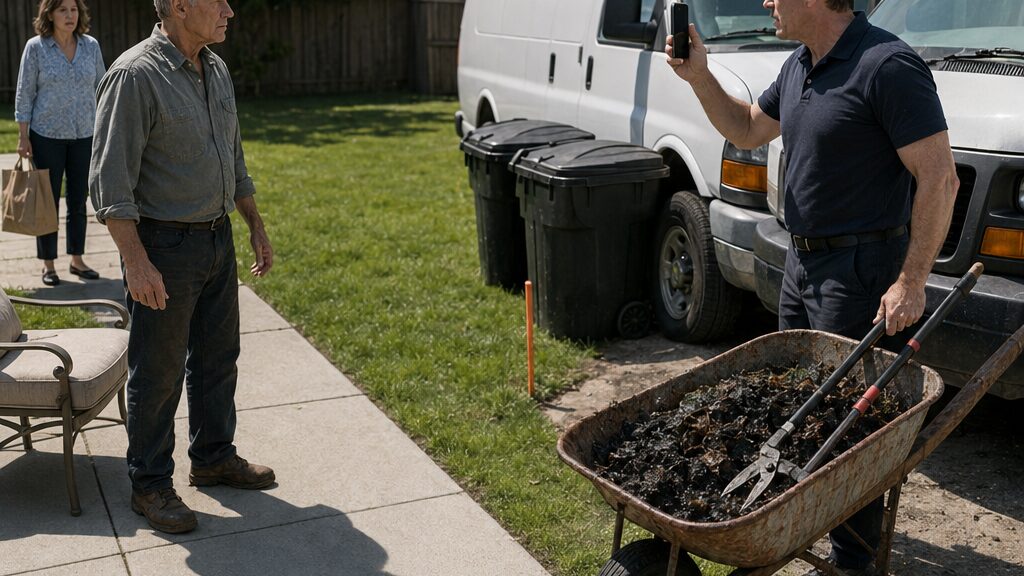
Brian Campbell came around the front corner of his house pushing a rusted wheelbarrow heaped with rotting yard waste. Wet leaves, black grass clumps, broken branches, spoiled mulch, something pale and pulpy collapsed near one side. A smell rolled ahead of it, sour and hot, the stink of things sealed too long in plastic and brought out for punishment.
Brian held his phone up in his other hand.
He was already live.
“Here we go,” Brian said to the screen, breathless with performance. “I told everybody I was done letting this guy block access. Today we take back the space.”
Paul rose slowly from the armchair.
Brian angled the phone toward him, then toward the trash cans, then carefully away from the orange survey stake. The two commercial vans sat behind Brian, parked over the line again, their white sides glaring in the sun. The camera saw what Brian wanted it to see: Paul, the trash cans, the expensive patio, the wheelbarrow of waste framed like a tool of justice instead of filth.
Paul stepped off the patio onto the lawn.
“Stop there.”
Brian grinned. “You hear that? Stop there. Like he’s got a badge.”
“Wrong side of the line,” Paul said.
For the first time all day, Brian’s smile twitched.
The phrase was not loud. It did not need to be. It landed between them, plain as the survey stake.
Brian pushed the wheelbarrow another foot forward.
The tire rolled over Paul’s grass.
“Line, line, line,” Brian said, turning the phone slightly toward his own face. “This is what I deal with. A man who built a patio on top of a working access point and now wants to lecture me about lines.”
Deborah appeared on the sidewalk, drawn by the smell or the sound. She stopped near the mailbox, one hand over her nose. A delivery driver slowed at the street, saw the phone, and kept walking.
Paul did not look away from Brian.
“Take the wheelbarrow back.”
Brian laughed. “Or what?”
The question opened something in the air.
Paul saw the comments moving on Brian’s screen, tiny bright lines he could not read from where he stood. He did not need to. He understood the shape of them. People loved a simple villain. Brian was offering them one: an old man on a patio, trash cans lined like barricades, a business owner fighting for access. Paul’s silence had given him room to rehearse it.
Brian shoved the wheelbarrow closer.
The smell hit harder. Rotting leaves slid wetly against the metal basin. A dark trail dripped through the front seam and spotted the lawn.
“You’re dumping that on my property,” Paul said.
“I’m clearing the access you blocked.”
“That’s yard waste.”
“That’s what was piled on the side because my guys couldn’t get through.”
Paul looked past him at the vans. “Your guys can’t get through because your vans are over my line.”
Brian swung the phone fast toward Paul’s face. “Say that again. Say it so everyone hears how insane this is.”
Paul said nothing.
The silence bothered Brian more than any insult would have. His eyes hardened. He turned, reached into the wheelbarrow handles, and pulled out a pair of heavy-duty branch loppers. Long handles. Thick jaws. Not a pole-saw, but close enough in threat: metal built to bite through living wood.
Deborah’s voice came thinly from the sidewalk. “Brian, what are you doing with those?”
“Removing obstructions,” Brian said.
Paul’s eyes moved to the loppers, then to the patio edge.
A small ornamental branch from the young tree Paul had planted near the corner leaned toward the driveway, nowhere near blocking anything. Brian stepped to it anyway and snapped the lopper jaws shut inches from the new concrete.
The sound cracked across the yard.
Paul felt it in his teeth.
Brian held the loppers open again, the blades catching sun. “Move the cans, Paul.”
“They’re on my property.”
“Everything’s on your property if you squint hard enough.”
He lowered the loppers toward the little tree.
That tree had been an afterthought at the nursery. Paul had chosen it because the tag promised shade in five years. Not today. Not soon. Later. A quiet future thing. He had planted it himself, back aching, palms dirty, setting it just inside the survey line so no one could ever say it crowded them.
Brian set the blades around a green branch.
Paul took one step forward.
Brian saw it and smiled at the phone. “Now he’s coming at me.”
Paul stopped.
That was the trap. Not hidden, not clever, just ugly and effective. Brian wanted motion. A raised voice. A hand reaching for the phone. Anything that could be clipped, posted, captioned, believed.
Paul looked at the wheelbarrow, the loppers, the vans, the hidden survey stake, the watching neighbor, the phone. He breathed in through his nose and tasted rot.
“Put the loppers down,” he said.
Brian squeezed.
The branch did not cut. The jaws only bit the bark, leaving a pale crescent scar.
“Last chance,” Brian said. “Move the trash cans.”
Paul’s hand flexed once at his side.
Brian moved the loppers away from the tree and pointed them toward the patio edge as if he could cut concrete through will alone. “You think that slab makes you king? You poured it too close. Everybody knows it.”
“No,” Deborah said quietly.
Both men looked at her.
She stood near the sidewalk, face pale above the hand still covering her nose. Her eyes were not on Brian now. They were on the orange stake, visible from her angle behind his van.
Brian swung the phone toward her. “Deborah, don’t start.”
She stepped back, frightened by the sudden attention. “I just said no.”
Brian’s face flashed with anger. Not at Paul. At the break in the picture he had built.
He shoved the loppers under one arm, grabbed the wheelbarrow handles with both hands, and lifted.
The load shifted, wet and heavy.
“Fine,” he said. “If he wants a line, let him clean up to it.”
Paul moved, but not fast enough to stop the first slide.
The wheelbarrow tipped.
A black mass of rotted grass, leaves, and sludge spilled onto Paul’s lawn with a wet slap. It spread toward the driveway in a thick, shining heap. The smell burst open in the heat. Flies rose, circled, and settled again.
Brian pushed harder.
More waste slid out, dragging a brown trail across the grass and onto the clean driveway edge beside the patio.
Paul stood still.
The sound of the livestream comments pinged from Brian’s phone.
Brian lowered the emptying wheelbarrow and looked at Paul over it, breathing hard, face flushed, eyes bright with the terrible relief of a man who had finally done the thing he had been threatening to do.
“Well?” Brian said.
Paul looked at the sludge touching the driveway. He looked at the scar on the young tree. He looked at the loppers tucked under Brian’s arm.
Then he looked at the trash cans, boxed in by the vans, trapped exactly where Brian had wanted them.
The property line had been quiet for weeks. A wire stake. A paper folder. A set of photographs no one had cared to see.
Now it stank in the sun.
Brian lifted the phone closer to Paul’s face.
“Go
Chapter 4: The Crash That Made The Line Visible
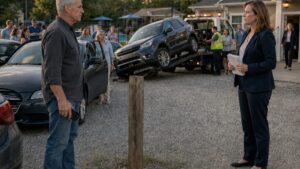
“Move the cans before I cut through,” Brian said, and this time he pointed the loppers toward the patio as if the blades could make his lie true.
The phone hovered in his other hand. Paul could see himself in the little screen, smaller and harsher than he felt: gray shirt, stiff shoulders, jaw locked, standing beside a spill of rotting waste while Brian narrated him into a villain.
Behind Brian, the two white vans boxed in the driveway edge. Their rear tires sat deep on Paul’s side of the grass, so close to the trash cans that the bins could not be rolled straight back without striking metal. Brian had arranged the scene carefully and still believed arrangement was the same as truth.
Paul looked at the orange stake.
Then at the van tire.
Then at the waste bleeding across the grass.
Then at the phone.
Brian smiled when he noticed. “Yeah. Everybody’s watching now.”
Paul did not answer. He turned and walked toward the trash cans.
A murmur went through the small gathering at the sidewalk. Deborah stood with one hand still near her mouth. A delivery driver had stopped beside his truck. Another neighbor watched from behind a half-open gate. Nobody stepped forward. Nobody told Brian to put down the loppers. Nobody told Paul he was right.
That was the shape of it. People waited for the line to defend itself.
Paul gripped the handle of the first trash can.
It was heavy from yesterday’s yard clippings and the cracked bricks he had thrown away after the patio crew left. The plastic flexed under his fingers. The wheel nearest the van was trapped in a rut made by Brian’s tire. Paul pulled once. It barely shifted.
Brian moved closer, raising the phone.
“Careful,” he said, his voice louder for the audience. “That’s company property right there.”
Paul looked over his shoulder. “Then move it off my property.”
Brian’s nostrils flared. “You don’t get to damage my van because you don’t like where it’s parked.”
“I told you to move it.”
“You told me a lot of things.”
The loppers clicked open.
Paul turned fully. For one second, he imagined reaching for them. Taking the tool from Brian’s hands. Snapping it across the driveway. He imagined the clean satisfaction of it and knew, with equal clarity, how it would look on Brian’s screen. An old man lunging. A tool grabbed. A frame cropped before the threat.
No.
Not the loppers.
The cans.
Paul set both hands on the first bin, braced one foot against the edge of the driveway, and pulled hard.
The wheel jumped the rut. The can lurched sideways. Brian stepped back fast enough to show fear before remembering to look angry.
“Hey!” he shouted.
Paul did not stop. He swung the bin in a rough arc, using its weight and momentum, not caring now about the perfect quiet sound he had wanted for this yard. The can slammed into the rear quarter of the nearest van with a hollow, violent boom.
The noise cracked through the afternoon.
Deborah gasped.
The phone shook in Brian’s hand.
A dent appeared in the van door, sharp along one edge where the trash can’s metal hinge had struck. The bin bounced, tipped, and rolled against the tire that had no business being there.
For one heartbeat, everyone was silent.
The boundary had been invisible a moment before. Now it had a sound.
Brian stared at the dent. His mouth hung open, not with pain, but with recalculation. The performance dropped from his face. Beneath it was panic, raw and quick.
Paul grabbed the second trash can.
Brian found his voice. “Don’t you touch that!”
Paul pulled. This one came free faster, its wheels skidding through the wet trail of waste. Brian stepped toward him with the loppers raised, then stopped when Paul looked at him.
Not a challenge. Not a threat. Just a look that said there would be no more pretending.
The second can crashed into the side of the van below the company logo. The sound was deeper this time, a hard metallic thud followed by the scrape of plastic. The van rocked once on its tires. A second dent bloomed beside the first.
Brian’s face went white around the mouth.
“You just destroyed company property,” he said.
Paul breathed once. His hands were shaking now, not from regret, but from the force he had spent too long refusing to admit he possessed.
“No,” Paul said. “I cleared my driveway.”
Brian jabbed the phone toward him. “You all saw that. You all saw it.”
Paul looked at the phone and stepped back onto the clean patio edge, keeping his shoes out of the waste. He could smell the rot rising harder now, stirred by movement. Flies clustered on the black pile, then lifted again when Brian stomped toward the van.
“You’re done,” Brian said. “You understand me? Done.”
He walked around the rear of the van, filming the dents in tight close-up. “Look at this. Look what he did. Unprovoked. This is what I’ve been dealing with.”
“Unprovoked?” Deborah said, barely above a whisper.
Brian swung toward her. “Stay out of it.”
She flinched, and Paul hated that he had let things come this far. Not because Brian was yelling. Because every day Paul had chosen not to make the first complaint had trained everyone else to treat the line as optional.
Brian pointed the loppers toward the waste pile. “He attacked my vehicle.”
Paul picked up his phone from the patio table. The survey folder was still beneath it. He opened the camera roll and scrolled back through the pictures: yesterday’s tire mark, the stake, the van crossing the line, the shoved trash can, the second van angled over the grass. He had evidence. He had always had evidence.
He had also had time.
That was the part he could not photograph.
Brian was pacing now, face shiny with sweat, phone held high. “I’m calling the police.”
“Call them,” Paul said.
The words came out calmer than he expected.
Brian stopped. He had wanted protest. Fear. An apology. Anything he could turn toward the lens.
Paul gave him nothing.
Brian tapped the screen hard with his thumb, then put the call on speaker. He kept the livestream running, the phone angled so Paul, the dented van, and the heap of waste all stayed in frame—but still, carefully, not the survey stake.
“Yeah, I need officers out here,” Brian said when the dispatcher answered. “My neighbor just damaged a company vehicle. I have it on video. He’s been harassing my business for days.”
Paul walked to the orange stake and stood beside it.
Brian noticed too late.
The delivery driver at the curb shifted his weight. Deborah stared at the stake, then at the tire pressed past it. The camera, still in Brian’s hand, caught the movement of their eyes even if Brian refused to follow them.
The dispatcher’s voice crackled through the speaker, too faint for Paul to make out.
Brian raised his voice. “Yes, I’m safe for now. He’s still standing there. No, I’m not ending the video. I’ve got the whole thing live.”
Chapter 5: The Video Brian Could Not Stop Showing
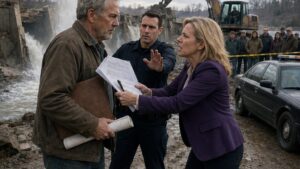
The responding officer stepped around the rotting waste and looked first at the dented van.
That told Paul how the story sounded before anyone explained it.
The officer was calm, professional, one hand resting near his belt, his eyes moving across the driveway in pieces: dents, trash cans, waste pile, loppers, vans, Paul, Brian, neighbors. He paused at the smell but did not comment on it.
“Who owns the van?” he asked.
“Company does,” Brian said immediately. “I’m responsible for it. He threw trash cans into it while I was recording.”
The officer looked at Paul. “Is that what happened?”
Paul could feel Brian’s phone aimed at his face. The livestream had not stopped. Brian held it chest-high now, like a shield. Every answer Paul gave would be performed into the little black glass before it reached anyone standing there.
“I moved my trash cans,” Paul said. “His van was parked over my property line.”
Brian gave a harsh laugh. “He moved them into the van. You saw the dents.”
“I see dents,” the officer said. “I also see a pile of yard waste. Whose is that?”
Brian’s jaw tightened. “It’s from cleanup.”
“Whose cleanup?”
“The access strip.”
Paul said, “There is no access strip.”
The officer looked from one man to the other. “Okay. One at a time.”
Brian lifted his free hand. “Officer, he’s been blocking a working vehicle route for days. We have a business to run. He built this patio too close, stuck cans in the way, and when I tried to deal with it, he lost it.”
Paul reached for the folder on the patio table.
The officer noticed the movement. “Sir, just tell me before you reach for anything.”
Paul stopped. “Survey papers. On the table.”
“Bring them over slowly.”
Brian scoffed. “Of course he has papers ready.”
Paul picked up the folder and handed it over. The officer opened it on the hood of the dented van, using the flattest part he could find. Brian angled his camera toward the papers but kept talking.
“Documents don’t give him the right to attack a vehicle.”
“No,” the officer said, reading. “They help me understand where the vehicle is parked.”
The first crack appeared in Brian’s expression.
His phone buzzed while he held it. He glanced down and dismissed the notification without answering. Paul saw the name for only a fraction of a second: Edward Brown.
Brian saw Paul see it.
“Don’t look at my phone,” Brian snapped.
Paul did not respond.
The officer walked to the survey stake, then to the rear tire of the nearest van. He crouched briefly and looked along the line, comparing paper to ground. The orange stake stood half a foot inside the shadow of the bumper. The tire was clearly past it.
“Who moved this stake?” the officer asked.
“No one,” Paul said.
Brian said, “Those things get knocked around.”
Deborah’s voice came from the edge of the driveway. “It’s been there.”
Everyone turned toward her.
She swallowed. “I mean, I’ve seen it there. Since the patio work.”
Brian’s face flushed. “Deborah, you don’t know anything about the survey.”
“I know where the stake was,” she said, quieter but still speaking.
The officer looked at her. “You saw the van parked like this before today?”
Deborah hesitated.
Paul felt the pause like pressure against a bruise. He did not blame her, not exactly. Brian’s vans blocked the street. Brian’s workers came and went. His temper moved faster than most people’s courage. Neutrality could look like kindness when trouble had not yet reached your own door.
Then Deborah nodded.
“Yes,” she said. “Yesterday too. Maybe before that. I didn’t want to get involved.”
Brian turned the phone on her. “Unbelievable.”
She stepped back, but her eyes stayed on the stake. “You angled the camera away from it.”
The officer looked at Brian’s phone. “You’re still recording?”
“Absolutely,” Brian said. “For my protection.”
“I’m asking you to stop streaming while we sort this out.”
“No. This is public accountability.”
Paul watched the officer’s patience tighten but not break.
“Then your recording may be relevant,” the officer said. “Do you have footage of the moments before the cans hit the van?”
Brian’s confidence returned. “Yes. And he looks insane.”
“Show me.”
Brian hesitated.
It was small, but Paul saw it. The half-second delay of a man who had wanted the video believed, not examined.
“Sure,” Brian said.
He tapped the screen, muttering about signal, comments, playback. The phone buzzed again. Edward Brown. This time Brian rejected the call so fast the screen barely lit.
The officer noticed. So did Paul.
Brian started the clip.
His own voice came out first, bright and theatrical: “Today we take back the space.”
The image shook toward the wheelbarrow, then toward Paul’s patio. The survey stake was missing from the frame. Brian’s hand had cropped it out. Then came the trash cans, the vans, Paul standing still.
“Stop there,” the officer said.
Brian paused.
“Pan left.”
“This is a recording.”
“Then rewind a little. I want to see the left side.”
Brian’s thumb hovered. “The important part is when he damages the van.”
“The important part is all of it.”
Deborah, still near the sidewalk, said, “He hid the marker.”
Brian glared. “Stop saying that.”
Paul opened his own phone and brought up the photo he had taken minutes before the dumping, wide enough to show the vans, the cans, the stake, and Brian with the wheelbarrow.
He held it out, not to Brian, but to the officer.
“This was before he tipped it.”
The officer compared Paul’s photo to Brian’s paused video. He said nothing for long enough that Brian began talking again.
“Anybody can take pictures from an angle.”
Paul swiped to the previous photo. The shoved trash can. The scrape near the patio. The first van over the grass. The second van. He did not explain each one. He let the sequence sit there.
The officer looked up. “Why was yard waste dumped here?”
Brian’s mouth worked. “I told you. Cleanup.”
“On his driveway?”
“It’s disputed.”
“By who?”
Brian pointed at Paul. “By him.”
“That doesn’t make sense,” the officer said.
The phone buzzed again.
Edward Brown.
Brian’s hand closed around it so tightly his knuckles showed pale. The livestream comments slid up the screen beneath his thumb. Paul caught fragments now because the phone was closer.
wrong side of the line?
show the stake
why won’t he stop live
Brian saw them too. His breathing changed.
The officer said, “Mr. Campbell, I need you to set the loppers down.”
Brian looked at the tool tucked under his arm as if he had forgotten it was there.
“They’re for branches.”
“Set them down.”
Brian dropped them onto his side of the driveway with a clatter too loud for the moment.
The officer continued playing the clip. There was Brian’s voice again, sharper now. “Move the cans before I cut through.” The loppers snapped near the patio. Paul’s voice followed, flat and clear: “Wrong side of the line.”
Deborah looked at Paul then. Not with triumph. With shame.
Brian reached for the phone. “Okay, you’ve seen enough.”
The officer held it away just slightly. “Not yet.”
Brian’s face twisted. “That’s my property.”
“The phone?”
“Yes.”
“The video is your recording of an incident you called us to investigate.”
Brian’s eyes darted to the watching neighbors. The audience he had invited was no longer behaving like an audience. They were witnesses now, and worse, they were thinking.
The phone buzzed again.
This time the caller ID stayed bright against the screen.
Edward Brown.
Brian stared at it as if the name had stepped physically into the driveway.
The officer looked down. “You need to take that?”
Brian swallowed.
“No,” he said.
But his thumb slipped, and the call connected.
Chapter 6: The Call That Fired Him Live
“Brian?” Edward Brown’s voice came through the phone speaker before Brian could get it away from the officer’s hand. “Tell me that video is not still live.”
For the first time since the wheelbarrow appeared, Brian had no performance ready.
The officer held the phone out. Brian snatched it back and jabbed at the screen, but the audio stayed loud. The livestream comments continued sliding upward. Neighbors stood frozen along the edge of the driveway. Even the flies seemed louder in the silence between Edward’s words.
“Edward,” Brian said, forcing a laugh that had no air in it. “I’m handling a situation.”
“I can see what you’re handling.”
Paul stood beside the orange survey stake with the folder closed against his thigh. He had expected anger from the phone, maybe confusion, maybe the brittle concern of someone protecting a company logo. What came through instead was controlled alarm.
Brian turned away from the group, as if three steps could make the call private. “This neighbor attacked one of our vans. I’ve got police here.”
“I watched the clip,” Edward said. “I watched you push a wheelbarrow onto his property.”
Brian’s eyes flicked toward the officer. “That’s not—he blocked access. I’ve told you about this guy.”
“You told me a retired neighbor was interfering with your route.”
“He is.”
“You did not tell me you were parking vehicles over a marked property line.”
The words landed harder than the crash had.
Brian’s mouth opened. Nothing came out.
Paul felt, unexpectedly, no satisfaction yet. Only a steadying in the air. As if a door had opened and shown that the room behind Brian’s confidence was not power, but panic.
Edward continued, voice clipped. “You were warned last month about using company vans for personal convenience.”
Brian lowered his voice. “Not on speaker.”
“It’s already on speaker. You made the entire situation public.”
The officer’s expression did not change, but his pen moved on his notepad.
Deborah looked down at the driveway.
Paul watched Brian’s shoulders tighten. That was the hidden part, then. Not just arrogance. Not just the need to win a neighbor argument. Brian had been dragging a work problem across Paul’s lawn and calling it access.
Brian turned the phone toward his chest, trying to shield the microphone. “Edward, listen to me. The route’s impossible without that swing space. The street’s too narrow, and the south deliveries are stacked. I had guys waiting this morning because he put those cans there.”
Paul said quietly, “The cans were inside my line.”
Brian spun toward him. “Stay out of my call.”
Edward heard anyway. “Was that Mr. Nelson?”
Paul did not answer. He looked at the officer.
The officer said, “This is an active call on speaker in the middle of an investigation. Keep it relevant.”
Edward exhaled sharply through the speaker. “Then here is relevant. Brian, did you bring yard waste onto that property?”
Brian’s face darkened. “It was already an obstruction issue.”
“Did you bring it?”
Brian said nothing.
“Did you threaten the patio area with cutting tools?”
“They were loppers. For branches.”
The officer glanced at the loppers on the driveway.
Edward said, “I watched you point them at him.”
“I didn’t touch him.”
“That is not the defense you think it is.”
The comment feed on Brian’s screen kept moving.
wrong side of the line
company guy is cooked
he literally said cut through
Brian saw the words. So did Paul. Brian’s thumb moved as if to end the livestream, then stopped. To end it now would look like defeat. To keep it going was worse. He was trapped by the same little glass square he had raised like a weapon.
Paul almost felt sorry for him.
Almost.
Then the smell shifted in the heat, and the pile of rotting waste slid another inch down the driveway groove.
Edward’s voice hardened. “Brian, we have already had two customer complaints about vehicle storage. One neighbor complaint about blocked curb access. And now I am watching you create property damage exposure while wearing our company shirt.”
Brian swallowed. “He damaged the van.”
“Because you parked it where it did not belong?”
“He threw trash cans into it.”
The officer said, “The position of the vehicle is part of what we’re determining.”
Edward said, “I can see the stake in the wide shot someone posted in the comments.”
Brian went still.
Paul looked toward Deborah. Her phone was in her hand now, lowered but active. Her face colored when Paul noticed. She had filmed, or photographed, or shared. Not to attack Brian, maybe. Maybe just to prove what she had been too afraid to say out loud.
Brian noticed too. “You posted that?”
Deborah’s voice was small but steady. “I posted the whole yard. Not cropped.”
“You had no right.”
“You went live,” she said.
That changed something. Not everything. But enough.
Brian’s anger flashed toward her, then broke under Edward’s voice.
“Do not start on another neighbor while I’m speaking.”
Brian pressed his lips together.
The officer looked at Deborah. “Please stay available. I may need your statement.”
She nodded once, eyes still down.
Paul remembered her saying nobody wanted trouble. He understood her better now than he had that morning. Avoiding trouble did not keep it from happening. It only decided who faced it alone.
Edward said, “Brian, this is over.”
Brian’s grip tightened on the phone. “Don’t do this right now.”
“You did this right now.”
“I can fix it.”
“You can start by ending the stream.”
Brian looked at the screen.
The comments were moving too fast now. Some mocked him. Some demanded he show the stake. Some repeated Paul’s words until the phrase looked less like a comment and more like a verdict.
wrong side of the line
wrong side of the line
wrong side of the line
Brian’s face twisted. “They don’t understand. None of you understand what I’m dealing with.”
For a second, his voice lost its edge. Paul heard the exhaustion beneath it, the thin fear of a man whose status had been load-bearing and was now cracking in public. But fear did not clean waste from someone else’s driveway. Pressure did not move a van back over the line. Desperation did not make the loppers harmless.
Edward said, “I understand liability. I understand misuse of vehicles. I understand a public video showing you escalating a private property dispute while representing us.”
Brian stared at the dented van door. The two dents caught the sunlight unevenly, ugly and real.
“He shouldn’t have touched the cans,” Brian said, but even he sounded less certain now.
Paul looked at the trash cans lying against the van tires. He knew what he had done. He knew how it looked from the wrong angle. He also knew the wrong angle had been the whole point.
The officer asked Paul, “Do you want to make a formal trespass and dumping complaint?”
The question should have felt simple. It did not.
Paul saw Brian hear it. Saw the panic sharpen again. Saw Deborah watching him, waiting to see which kind of man he would be now that the power had shifted.
For years, Paul had told himself restraint meant not forcing consequences. That peace was a thing maintained by absorbing. By letting the loud man leave with his pride. By collecting proof and never using it because using it felt too close to wanting a fight.
But the line had never been unclear.
Paul looked at the waste on his lawn, the scarred branch, the dented van, the orange stake.
“Yes,” he said. “I do.”
Brian shut his eyes briefly.
Edward’s voice came through the speaker, cold and final. “Brian, you’re fired immediately.”
Brian’s eyes opened.
“And before those vans move,” Edward continued, “you will clean that driveway.”
Chapter 7: Hands And Knees Under The Blistering Sun
Brian knelt in the driveway with a scrub brush in one hand and his phone lying face down beside the hose.
The flies rose every time he dragged the brush through the sludge. They lifted in a black shimmer, circled his head, then settled again on the wet leaves and rotted grass mashed into the concrete grooves. His shirt clung to his back. Sweat ran from his temple to his jaw. The knees of his pants were already soaked dark.
Paul watched from the patio without speaking.
The officer had not left yet. He stood near the dented van, finishing notes, while Brian scraped the first heavy pile into a contractor bag the officer had told him to use. Edward Brown was no longer on the phone, but his voice seemed to remain in the driveway, cold and official, attached to the vans like another company decal.
You’re fired immediately.
Brian had ended the livestream after that. Not with a sign-off. Not with a final accusation. He had stabbed the screen with his thumb, breathing through his teeth, and the sudden absence of his own audience had made him look smaller than the crash had.
Now there was only the scrape of the brush.
Plastic bristles rasped against concrete. Water ran brown toward the street. The young tree near the patio held its scarred branch still in the heat.
Paul stood beside the armchair for several minutes before sitting down. He did it deliberately, not because his legs were tired. He had imagined this chair in quiet. He had bought it for mornings, for evenings, for the simple act of occupying his own space without apology. If he stayed standing, Brian still controlled the scene. If he sat, the patio became what it had been built to be.
Brian looked up when the chair legs clicked softly against the concrete.
“You enjoying this?” he muttered.
Paul rested both hands on the arms of the chair.
The old answer rose in him automatically: no, of course not. A softening answer. An answer meant to prove he was not petty, not cruel, not one of those men who fed on a neighbor’s fall.
He let the answer pass.
Brian’s mouth twisted. “Yeah. Thought so.”
The officer glanced over. “Keep cleaning, Mr. Campbell.”
Brian dropped his eyes and scrubbed harder. The brush caught on a clump of wet leaves and flicked dirty water across his wrist. He swore under his breath, low enough that the officer let it go.
Deborah approached from the sidewalk carrying a roll of paper towels she did not seem to know what to do with. She stopped at the edge of Paul’s driveway, careful not to cross the line of waste.
“Paul,” she said.
He looked at her.
Her eyes moved to Brian, then to the orange stake, then back to Paul. “I’m sorry.”
Brian snorted without looking up.
Deborah ignored him, though her fingers tightened around the paper towels. “I should have said something yesterday. I saw the tire. I knew it was over. I just…” She swallowed. “I didn’t want him turning on me next.”
Paul understood that too well to enjoy hearing it.
For a moment, he almost gave her a speech. About how silence fed men like Brian. About how lines became suggestions when witnesses treated them as inconveniences. About the loneliness of standing beside proof while everyone else waited for peace to mean surrender.
Instead he nodded once.
Deborah’s face changed, not relieved exactly, but accepted into the truth without being rescued from it.
“I posted the wide video,” she said. “Not to pile on. Just so people could see the stake.”
Brian slammed the brush into the driveway. “You had no right filming me.”
Deborah looked at his phone on the concrete. “You went live first.”
The officer said, “Mr. Campbell.”
Brian’s shoulders rose and fell. He went back to scrubbing.
Paul leaned forward and picked up the survey folder from the patio table. The corner was bent where his grip had crushed it earlier. He smoothed it with his palm, then set it aside. The paper had mattered. The photos had mattered. Deborah’s wide shot had mattered. The officer’s notes mattered.
But none of it had mattered until Paul stopped treating his own certainty like something shameful.
The officer walked over with his notepad. “Mr. Nelson.”
Paul stood.
“I’ll include your complaint for trespass and dumping. The vehicle damage will be documented too. Given the positioning, the video, and the circumstances, that part may take some sorting out.”
Paul nodded. “I understand.”
Brian looked up sharply, as if he had hoped Paul would argue with that, prove something ugly. Paul did not.
The officer lowered his voice a little. “You have the survey documents. Keep the photos. If this continues, call before it gets to this point.”
Paul felt the sentence land where it belonged. Not as blame. Not as comfort.
As a line he should have drawn sooner.
“I will,” Paul said.
When the officer walked away, Paul went to the two trash cans. One lay on its side near the dented van; the other leaned against the bumper. Their black plastic was streaked with grime and one lid hinge had cracked, but they were still usable.
Brian paused, watching him.
Paul lifted the first can upright. He did not shove it. He did not make another show of force. He rolled it slowly back to its place beside the driveway, inside the line, the wheels clicking over clean concrete and then stopping just short of the survey stake.
Then he brought the second.
He placed both handles facing the house.
Exactly where they belonged.
The small action seemed to irritate Brian more than shouting would have. He stared at the cans, then at Paul. His face was red from heat, humiliation, and something more brittle than anger.
“You went too far,” Brian said.
There it was. The last invitation.
Paul could step into it. He could remind Brian of the vans, the loppers, the waste, the livestream, the way his own employer had heard him lie. He could say all the things that were true and still hand Brian one final argument to hold.
Instead Paul looked at the driveway.
A dirty brown wash still streaked the concrete, but the worst of the pile was gone. Brian’s knees were planted in the mess he had brought. The brush waited in his hand. The vans sat dented and silent, both of them still too close to the orange stake, though not for much longer. A tow driver had been called. Edward had made sure of that.
Paul walked back to the patio.
Brian said, louder, “You hear me?”
Paul sat down in the armchair.
The patio held the heat of the day, clean and pale under his shoes. Beyond it, the lawn was wounded but not ruined. The young tree would keep the crescent scar. Maybe it would grow around it. Maybe the branch would always show where the blade had bitten and failed to cut through.
Brian waited for an answer.
Paul gave him none.
The silence was different now. It did not bend around Brian. It did not protect him. It did not ask Deborah to understand or the officer to approve. It simply stayed where it was, like the stake in the ground.
After a while, Brian lowered his head and scrubbed.
The brush scraped concrete in short, angry strokes. The dented van door creaked softly as the metal cooled in the late sun. Deborah walked home without looking back. The officer’s cruiser pulled away from the curb.
Paul leaned into the chair and watched the line grow quiet again.
The story has ended.