They Told Him To Leave The Cabin Until He Asked When His Mother Signed The Valley Away
Chapter 1: The Papers Arrive Below The Waterfall
“Get off our land, Scott. Now.”
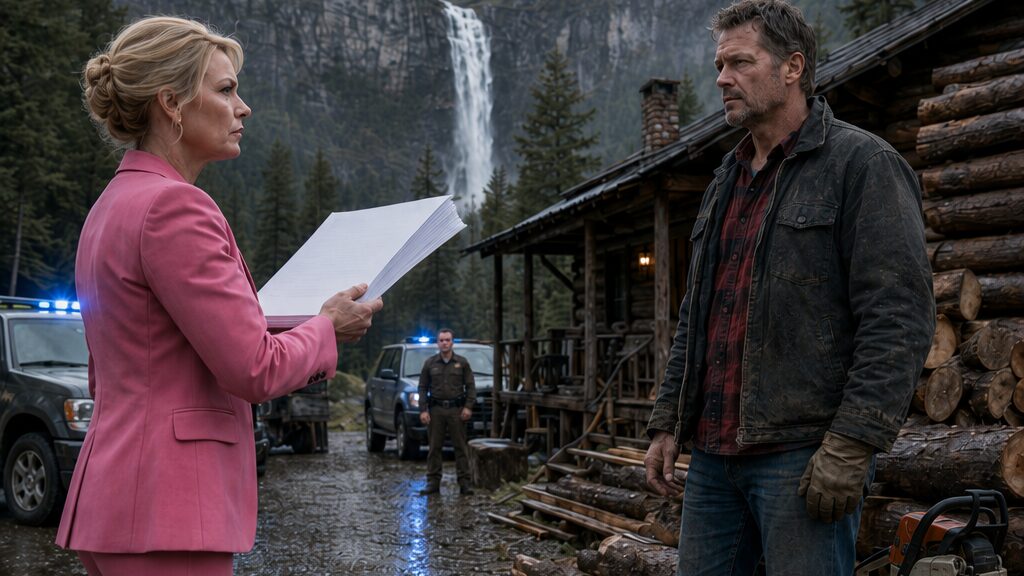
Lisa White said it from the gravel drive like she had rehearsed it on the way up the valley. Her pink suit looked wrong against the timber stacks and mud, bright as a warning flag in front of the old cabin. In one hand she held a thick white packet. In the other, she pointed past Scott’s shoulder toward the porch where their mother’s wind chimes still hung.
Behind her, two sheriff’s vehicles idled near the gate, blue lights flashing against the wet bark of the pine trees. The sound did not belong there. Nothing about the lights belonged beside Virginia Mitchell’s cabin, where the loudest thing for thirty years had been the waterfall cutting down the ridge.
Scott lowered the chainsaw until the bar pointed at the dirt.
He had been cutting stormfall since eight that morning, clearing the last of the fir that had come down across the timber road. His gloves were damp, his jacket smelled of sawdust and chain oil, and his knees still hurt from kneeling beside the tree. He looked at the deputy first, not Lisa.
“Is there a reason you brought them?”
Lisa gave a short laugh without smiling. “Because you don’t listen when family asks.”
The older deputy stepped forward carefully, one hand near his belt but not on it. He looked uncomfortable, the way people looked when they had been told one story on the drive in and found another waiting for them.
“Mr. Mitchell,” he said, “we’re here to keep this civil.”
“This is civil,” Scott said.
Lisa lifted the white packet higher. “It’s over. The trust amendment is valid. The cabin, the valley parcel, the timber rights, all of it transferred into the estate control account. I am the named beneficiary and executor. You were supposed to remove your things by this morning.”
Scott heard the waterfall behind the words. It kept falling, steady and indifferent, over the black rock face above the cabin. His mother had loved that sound. She used to say it made the valley feel like it had a pulse.
He did not ask Lisa to repeat herself. He had learned over three years of caring for Virginia that people repeated cruel things with more confidence the second time.
Instead, he wiped one glove against his jeans and nodded toward the packet.
“Let me see it.”
Lisa’s chin moved back. “You had your chance at the reading.”
“I wasn’t invited.”
“You were notified.”
“After it started.”
The deputy’s eyes shifted toward Lisa.
Her face tightened. “Frank’s office sent the notice according to procedure.”
Scott almost smiled at that word. Procedure. It was the kind of word that made harm sound polished.
“Let me see the page,” he said.
Lisa pulled out a clipped copy, not the whole packet, and held it away from him as though he might tear it in half. “You can read it from there.”
He stepped close enough to see the black type. His mother’s name, Virginia Mitchell, sat at the top. Below it, the legal language bent the valley into numbered parcels and clauses. He read past the parts that sounded official and found the part that mattered.
Lisa White, sole controlling beneficiary of the Mitchell Valley Property Trust.
His own name was not there.
It was not crossed out. It was not limited or explained. It was simply absent, as if the years of groceries, medication alarms, night fevers, frozen pipes, and unpaid repairs had belonged to someone else.
Scott’s jaw worked once. He made it still.
“When was this signed?”
Lisa snapped the page back. “It says right there.”
“I’m asking you.”
“Six weeks before she passed.”
The chainsaw in his hand felt suddenly heavy. Not dangerous. Just heavy. The kind of weight that reminded him he was standing in a yard he had regraded by hand after the spring flood, in boots Virginia had once scolded him for leaving by the stove.
The deputy cleared his throat. “Mr. Mitchell, do you have any paperwork showing you have a current right to occupy the property?”
Scott looked at the cabin. The porch boards sagged where he had been meaning to jack them up. The front window still had the quilt Virginia liked folded over the back of the chair. The valley gate key hung inside by the kitchen calendar. He had paperwork somewhere. Receipts. Timber permits. Bank deposits for logs sold to pay hospice bills. A copy of an older trust, maybe, in a metal file box under his bed.
But he did not have it in his hand.
“No,” he said.
Lisa exhaled through her nose, the sound of someone hearing exactly what she expected. “Then we’re done.”
The younger deputy glanced at the chainsaw. “Could you set that down, sir?”
Scott looked at it as if he had forgotten it was there. He turned, walked to the chopping block, and placed it on the wood with the carefulness of setting down a sleeping animal. He took off his gloves next, finger by finger, because his hands needed something ordinary to do.
Lisa watched every movement. “You have until sunset. I’m being more generous than I have to be.”
“Generous.”
“You lived here rent-free for years.”
The word struck harder than the paperwork.
Scott turned back.
“I lived here because Mom couldn’t get from the bed to the bathroom without help.”
“And you made sure everyone knew it.”
“No,” Scott said quietly. “I made sure she didn’t.”
That landed. Not visibly on Lisa, but the deputy heard it. Scott saw it in the way the man’s face changed, just a small tightening around the mouth.
Lisa lifted the packet again, using it like a shield. “This is not a family argument anymore. These are legal documents. Frank Perez reviewed everything. The signatures are verified. The trust is clear.”
Scott looked at the date line again before she tucked the copy away. His eyes held on the month, the day, the year.
Six weeks before Virginia died.
He remembered that week with physical clarity. He remembered the snow turning to gray slush along the gate. He remembered Virginia waking at noon and asking whether her husband had come in from the barn, though Scott’s father had been gone twelve years. He remembered standing beside her bed with the gate remote because she had asked why strangers kept driving up the road.
He remembered her not knowing the four numbers that opened the valley gate.
The deputy folded his hands in front of him. “Mr. Mitchell, we can’t decide an estate dispute here. If the property representative wants you gone, and you can’t show contrary paperwork today, you’ll need to address it through probate.”
Lisa seized on it. “Exactly. And until then, he leaves.”
Scott looked past her to the sheriff’s vehicles. One of them was parked beside the split-rail fence Virginia had painted white every summer until the tremor took her grip. The flashing blue lights kept catching the wet rails, turning them cold.
“Who called you?” Scott asked the deputy.
The man hesitated. “Ms. White requested assistance with a trespass issue.”
Trespass.
Scott let the word settle into the gravel between them.
Lisa’s expression did not change, but her fingers tightened around the packet.
“I don’t want this uglier than it has to be,” she said. “Take your tools. Take whatever is yours from the cabin. Sandra Clark is bringing a buyer up the road tomorrow. The place needs to be clear.”
“A buyer.”
“Don’t act surprised. The valley costs money, Scott. Insurance. Taxes. Maintenance. You think stacking logs and playing caretaker pays for everything?”
His silence betrayed him. Not because he had stolen anything. Because there were answers, and they were in boxes, drawers, bank envelopes, old notebooks in the truck, places where his private accounting had stayed private. He had kept records the way his father had, enough for himself, not enough for a fight.
Lisa saw the pause and mistook it for guilt.
“That’s what I thought,” she said.
Scott stepped toward her. The deputy shifted, but Scott stopped well short. His voice stayed low.
“Give me a full copy.”
“You can get one from Frank.”
“I’m asking you.”
“I’m telling you no.”
For the first time, anger moved through him sharp enough to scare him. Not because he wanted to shout. Because he wanted to say everything at once: the nights Lisa did not come, the bills Virginia hid from both of them, the way their mother cried after phone calls because she did not know how to keep peace between children who heard different promises.
Instead, he looked at the top page of the packet.
“When exactly did she sign?”
Lisa’s eyes narrowed. “I already told you.”
“No. You told me six weeks before she died. What day. What time. Where.”
“It doesn’t matter.”
“It matters if she didn’t understand what she was signing.”
Lisa’s face hardened, but something moved behind it. Fear, maybe. Or insult. “Don’t you dare use Mom’s illness because you don’t like what she decided.”
Scott stood still.
The waterfall filled the silence.
The deputy looked from Lisa to Scott. “That’s a probate issue.”
“Maybe,” Scott said. “But I know that week.”
Lisa tucked the packet under her arm and turned toward the vehicles, as if leaving first made her the winner. “Sunset, Scott. After that, I file formally and I come back with removal papers.”
Scott watched her heels scrape gravel that he had spread himself last fall. She paused beside the lead vehicle and looked back.
“This isn’t your valley anymore.”
Scott did not raise his voice. He did not need to. The deputy was close enough to hear him. So was Lisa.
“She couldn’t remember the gate code that week.”
Chapter 2: The Reading No One Invited Him To
“The amendment replaces all prior valley instructions.”
Frank Perez said it with both hands flat on his desk, as if pressure from his palms could keep the words from tipping the room over. The law office smelled faintly of toner, coffee, and the lemon cleaner someone had used too heavily in the hallway. Scott stood just inside the door, still wearing the jacket he had thrown on when he got the message from the office assistant.
Lisa sat in the chair nearest Frank. She did not turn around when Scott came in.
The chair beside her was empty.
Nobody had saved it for him. Nobody had called the cabin until after Frank had begun reading.
Scott looked from the empty chair to the folder on the desk. White packet, neat clips, colored tabs, black signatures reproduced in clean blue ink. It had the cold look of something already decided.
“What did you say?” Scott asked.
Frank’s eyes flicked toward Lisa before returning to him. “Scott, I understand this is abrupt.”
“You called me twenty minutes ago.”
“The notice was mailed.”
“To the cabin?”
“Yes.”
“The mailbox has been knocked sideways since the snowplow hit it.”
Lisa turned then. “That is not Frank’s fault.”
Scott looked at her for the first time that morning. Her hair was smooth, her suit pressed, the same bright pink she would later wear in the yard. She had dressed for a performance of order.
Frank adjusted his glasses. “Perhaps we should take a breath.”
“No,” Scott said. “Read the part again.”
Frank glanced down. “Under the amendment dated February fourteenth, Virginia Mitchell directs that the Mitchell Valley Property Trust, including residential cabin, upper ridge parcel, lower timber road access, and associated rights, shall pass under the control of Lisa White as executor and controlling beneficiary.”
Scott waited for the rest.
There was no rest.
Frank continued with language about administration, taxes, liquid assets, personal effects. Scott heard Lisa’s name again. He heard financial accounts. He heard charitable remainder. He heard no mention of the valley staying whole under his care, no mention of the cabin, no mention of the promise Virginia had made with her hand on the porch rail while the hospice nurse waited inside.
“Where am I?” he asked.
Frank did not pretend not to understand. He looked down at the pages.
“You are not listed as a beneficiary under this amendment.”
The office went very quiet.
Scott stared at the page Frank had turned toward him. There was a space where older language should have been, or maybe his mind only made one. A blankness his eyes kept trying to fill.
Lisa’s voice came from the chair. “Mom changed her mind. That was her right.”
Scott looked at the back of her head. “Six weeks before she died.”
“She still knew what she wanted.”
“Did she?”
Lisa turned fully. “You were not the only one who loved her.”
He took that in. It was the kind of sentence that was true enough to hide behind.
“No,” he said. “I wasn’t.”
Frank lifted a hand. “This office is not the place for accusation. The signatures were witnessed and notarized. The document is facially valid.”
“Facially,” Scott repeated.
“It means—”
“I know what it means.” Scott stepped closer to the desk. “Did you meet with her alone?”
Frank’s mouth opened, then closed. He touched the corner of the packet and squared it with unnecessary care. “Virginia was accompanied to all final estate discussions.”
“By Lisa.”
“By her daughter, yes.”
“Did my mother tell you, without Lisa in the room, that she wanted me removed from the valley trust?”
Lisa stood. “Removed? Listen to yourself. You’re making it sound like somebody erased you.”
Scott looked at the page again.
Frank’s voice lowered. “Scott, emotions are high. Your mother’s medical condition does not automatically invalidate her choices.”
“I didn’t say automatically.”
“You would need evidence of incapacity, undue influence, procedural defect, something substantial. Disappointment is not standing.”
There it was again. A word that made him smaller.
Standing.
Scott had stood at Virginia’s bedside when she forgot how to swallow pills. He had stood outside in January thawing the pump line with a heat gun so she could wash. He had stood in the dark listening to her call Lisa’s name and then apologize because she meant his.
But in Frank’s office, standing meant something else.
“What about the old plan?” Scott asked. “The one she signed after Dad died.”
Frank looked more uncomfortable now. “Superseded.”
“By this.”
“Yes.”
“Show me where.”
Frank turned pages, found a clause, and angled the document. Scott read the language slowly. It was clean. Too clean. Revoke. Replace. Direct. Assign.
At the bottom, Virginia Mitchell’s signature leaned across the page. It looked like hers if you did not know how her hand had changed. The V began right. The rest trembled.
Scott felt something inside him move, not break, exactly. More like an old support beam shifting under weight.
Lisa reached for her purse. “I don’t have time for this. Sandra Clark is waiting on the title summary.”
Scott turned to her. “You already have a broker?”
“The valley has expenses.”
“Mom’s been gone nine days.”
“She was sick for two years,” Lisa snapped. “Bills don’t wait because you want to sit in the cabin and mourn with a chainsaw in your hand.”
Frank said her name softly, warning.
Lisa looked away.
For the first time that morning, Scott saw the strain under her polish. Not grief alone. Fear. Her nails tapped once against her purse clasp and stopped. She had come ready to control the room because maybe control was the only thing keeping her upright.
That did not make the paper less cruel.
Scott looked back at Frank. “I want a full copy.”
“You are entitled to request records through proper channels.”
“I’m requesting.”
Frank hesitated, then slid a copied set from beneath the top folder. “This is a courtesy copy. It may not include all administrative exhibits.”
Scott took it.
The packet was lighter than it should have been. He did not know why he thought that until his thumb ran along the tabs. Exhibit A, property schedule. Exhibit C, account list. Exhibit D, personal effects. No Exhibit B.
“What’s missing?”
Frank blinked. “Excuse me?”
“Exhibit B.”
Lisa turned back too quickly.
Frank took the packet from Scott, flipped through it, and frowned. “It may have been omitted from the courtesy copy.”
“What is Exhibit B?”
Frank checked the amendment. “Referenced as supplemental valley instruction.”
“Valley instruction,” Scott said.
Lisa’s voice sharpened. “It was administrative. Frank already said the amendment controls.”
Frank did not confirm that. He looked at the packet again, then at the file on his desk. “I’ll have my assistant check whether it was scanned separately.”
Scott watched him closely. “You don’t know.”
Frank’s face closed. “I know the executed amendment is valid on its face.”
“Facially,” Scott said.
Lisa gathered her purse. “This is exactly why Mom changed it. You always turned everything into some quiet judgment. You sat up there like you were the only one doing anything, and the rest of us were supposed to feel guilty for having lives.”
Scott folded the packet once against his palm. “Did she say that?”
Lisa did not answer.
Frank stood. “I think we should stop here.”
The office door opened before anyone moved toward it. The assistant stood in the doorway holding another folder against her chest. She looked young enough to regret every interruption she had ever made.
“Mr. Perez,” she said, “the courier log is in the old matter file.”
Frank’s expression changed. Barely, but Scott caught it.
“What courier log?” Scott asked.
The assistant looked from Frank to Lisa to Scott. “For the February fourteenth amendment.”
Frank said her name under his breath, not angry, but warning her to stop.
She swallowed. “It wasn’t signed here. It was sent over from the hospice wing.”
Lisa’s chair scraped the floor.
Scott looked down at his mother’s trembling signature copied on the page in his hand.
“Sent by who?” he asked.
No one answered before Lisa walked out.
Chapter 3: Six Weeks On The Kitchen Calendar
The kitchen calendar was still open to February when Scott came through the cabin door.
He stopped so abruptly the screen door bumped his shoulder. The square for the fourteenth had a thin blue line through it in Virginia’s handwriting, but the words above the line were not clear. Her letters had collapsed into one another by then, the way her fingers had curled inward when she got tired. Scott stood with Frank’s courtesy packet under one arm and stared at that square until the room seemed to narrow around it.
The valley gate key hung on its hook beside the calendar.
Below it, the little plastic remote rested in the bowl where Virginia used to toss loose buttons, cough drops, and pennies. Four raised rubber numbers on the remote opened the main gate. Virginia had known that code for twenty-eight years.
That week, she had not.
Scott set the white packet on the kitchen table.
The cabin held its breath around him. Coffee cup by the sink. Quilt over the chair. Medicine chart still taped to the cabinet because he had not been able to take it down. On the counter lay the notebook he had used to track Virginia’s meals, pain pills, water intake, and the small victories no legal document would ever name.
February fourteenth.
He opened the notebook to that week.
Monday: confused after nap. Asked for Dad.
Tuesday: refused soup. Said strangers at gate.
Wednesday: called Lisa twice, upset after.
Thursday: Lisa visit 1:10–3:45. Mom tired after.
Friday: did not know gate code.
Scott read the Thursday line again.
Lisa visit.
He had written it without suspicion then. Lisa had started coming every week after New Year’s, always dressed for town, always bringing a paper bag of pastries Virginia barely touched. Scott had been relieved at first. He had told himself Lisa was trying.
He had also used those visits to leave the room.
That fact sat heavily now.
He had gone to the feed store once. To the county office another day. To pick up prescriptions. To stand outside longer than necessary because Lisa’s voice in the bedroom made him feel like a boy listening through walls.
He pulled his phone from his pocket and found Donna Torres in his contacts. It rang four times.
“Scott?” Donna’s voice was cautious.
“Do you remember February fourteenth?”
Silence. Then a chair creaked somewhere on her end. “That’s a specific question.”
“The amendment was signed that day.”
Another silence, longer.
Donna had been the hospice nurse who came three times a week, a careful woman with tired eyes and a way of speaking to Virginia as if illness had not made her less adult. Scott trusted her more than he trusted most people.
“Scott,” she said, “I can’t discuss medical details over the phone unless—”
“I’m not asking you to violate anything. I’m asking if you were there.”
She exhaled softly. “I was scheduled.”
“But?”
“I didn’t see her.”
Scott’s hand tightened around the phone. “Why not?”
“I was told it wasn’t a good time.”
“By my mother?”
“No.”
He closed his eyes.
Donna continued, each word measured. “Lisa met me in the hall near the hospice room. She said Virginia was resting after a legal appointment and asked me to come back later. I noted it as a refused visit.”
“A legal appointment.”
“That’s what she said.”
“Was Frank Perez there?”
“I didn’t see him.”
“Did you see a notary?”
“I saw a woman leaving with a folder. I don’t know who she was.”
Scott looked at the white packet on the table. It looked almost clean in the kitchen light.
“What condition was Mom in that week?”
Donna did not answer right away. When she did, her voice was lower. “She had good moments. You know that.”
“I know.”
“And she had moments where she couldn’t track a full conversation. Especially afternoons. Especially when she was tired.”
“The signing was in the afternoon.”
Donna said nothing.
That was answer enough, but not proof. Scott was beginning to understand the difference, and it made him feel both foolish and furious.
“Would you be willing to say what you just said if someone asked officially?”
“I’d tell the truth from the chart,” Donna said. “But charts don’t always say what families need them to say.”
He looked at the notebook again. His own handwriting was plain, private, unofficial. Monday. Tuesday. Wednesday. Thursday. Friday. A life reduced to lines no one had asked to see.
“Did Mom ever mention a valley letter?”
Donna made a small sound. “Once.”
Scott straightened.
“When?”
“Late January, maybe. She asked me whether letters had to be witnessed. I told her legal documents did. Personal letters didn’t. She said personal was all she had energy for.”
“What else did she say?”
“I’m not sure I should—”
“Donna.”
“She said she didn’t want the ridge sold. She said Lisa needed money and you needed the place. Then she got upset and told me not to repeat that because it would make both of you angry.”
Scott pressed his knuckles against the edge of the table until the wood bit back.
His phone buzzed before he could answer. A text from Lisa came across the screen.
Sandra Clark will be at the access road tomorrow morning with the buyer’s photographer. Don’t interfere. You have until sunset to remove personal property from the cabin.
He read it twice.
Then another message appeared.
And don’t start calling people trying to make Mom look incompetent.
Scott stared at that sentence long enough for Donna to say his name.
“I’m here,” he said.
“She texted you?”
“Yes.”
Donna’s voice shifted, careful again. “Scott, write everything down. Dates. Times. Who said what. Don’t trust memory alone.”
He looked around the kitchen at all the things he had trusted memory to hold. The dent in the floorboard where Virginia dropped a cast-iron pan in 1998. The cabinet shelf with the good mugs. The gate code she had forgotten. The promise she had made when he sat by her bed and she told him the valley had to stay whole because some things should not be divided just because people were.
“I should’ve written more down,” he said.
“You were caring for your mother.”
“I was hiding behind work.”
Donna did not soften it with comfort. “Then stop.”
After the call ended, Scott pulled the kitchen drawer open. Receipts, twine, batteries, loose screws, old postcards. He searched until he found a pencil, then wrote Lisa’s text in the back of the notebook beneath Donna’s name.
He went through the calendar next. January. February. March. Lisa’s visits were there, not always in words, sometimes just an L in Virginia’s failing script or Scott’s block letters: Lisa 2. Groceries. Nurse. Frank? He stopped at that.
Frank?
The note sat on the week before the signing. He had no memory of writing it.
Outside, tires crunched faintly on the lower road. Scott went to the window, but no vehicle appeared beyond the trees. The valley hid sound strangely; sometimes trucks on the highway seemed close, and footsteps by the gate vanished into water noise.
He took the phone again and opened saved voicemails. He had not deleted Virginia’s messages. Couldn’t.
Most were ordinary. Need milk. The furnace clicked again. Don’t forget the pie at church, though she had not gone to church in months.
Then one from January twenty-ninth.
Her voice came thin and breathless through the speaker.
“Scotty, I put it where he said I should, but I don’t know if that makes it real. Don’t let anyone sell the ridge. Not yet. Not while I’m still—”
The message cut off.
Scott stood with the phone in his hand, listening to the silence after her voice as if the rest might come back if he waited long enough.
Chapter 4: The Offer In The Pink Envelope
“You’re tearing this family apart over land you already took from.”
Lisa said it before Scott had both boots on the porch. She stood at the foot of the steps with a pale pink envelope in her hand, the color too close to her suit from the day before to feel accidental. Behind her, the valley road curved between the pines, still empty for now, but Scott could see fresh tire marks in the mud near the gate.
She had come early. Before Sandra Clark. Before any photographer. Before Scott had found whatever the rest of Virginia’s voicemail had meant.
He looked at the envelope. “What is that?”
“A way for this to stop before you embarrass both of us.”
He did not move down the steps.
Lisa lifted the envelope. “Five thousand dollars today. Another ten when you’re fully out of the cabin. You sign a release, you don’t interfere with the sale, and you stop calling hospice staff like Mom was some helpless woman who didn’t know her own mind.”
Scott stared at the envelope, then at his sister’s face.
“You think fifteen thousand dollars buys the valley?”
“No,” Lisa said. “I think it helps you move.”
“I don’t need help moving.”
“You need help understanding what’s over.”
The cabin door was open behind him. On the kitchen table, the white packet lay beside Virginia’s notebook, his mother’s calendar, and a legal pad where he had begun writing dates in a straight column: January 29, February 7, February 14, February 16. His pencil marks looked thin against the weight of what they had to prove.
Lisa glanced past him into the cabin. Her eyes caught the papers.
“So this is what you’re doing now.”
“This is what I should have done sooner.”
“You mean building a case against me.”
“I mean writing down what happened.”
She came up one step. “What happened is Mom made a decision. Maybe she finally saw what everyone else saw.”
Scott’s hand tightened on the porch rail. “Say it.”
“You lived here. You cut timber. You ran everything through your own hands. You were always the one with access.”
“The timber paid for her care.”
“Where are the records?”
He did not answer fast enough.
Lisa gave a small, bitter nod. “Exactly.”
“I have records.”
“Where?”
“In boxes.”
“In boxes,” she repeated. “Convenient.”
The word struck because it was partly fair. Not the accusation beneath it, but the shape of it. Scott had receipts in the truck glovebox, a ledger under the workbench, deposit slips folded in an old seed catalog, paid invoices in a coffee tin above the freezer. He had kept track like a man keeping track for himself and his mother, not for a sister with a lawyer, a broker, and deputies.
Lisa saw the hesitation and leaned into it.
“You always did this. You made everything look simple because you didn’t explain a thing. Then the rest of us were supposed to trust that Saint Scott had it handled.”
“Don’t call me that.”
“Why not? That’s what you wanted, wasn’t it? Mom looking at you like you were the only one who stayed.”
He stepped down one stair. “You could have stayed.”
“I had a job. I had a mortgage. I had my own family.”
“You had a phone.”
Her face changed, the anger flashing into something older. “And every time I called, she was tired. Or asleep. Or you said it was a bad day.”
Scott opened his mouth, then stopped.
There had been bad days. There had also been days when Virginia had asked him not to tell Lisa how bad things were because she hated the worry in Lisa’s voice. He had obeyed. He had thought he was protecting both of them.
Lisa took his silence as proof.
“You controlled the story, Scott. You controlled the house, the doctors, the bills, the visitors, the checkbook, the timber. And now you’re shocked she made sure I wasn’t left with nothing?”
“You weren’t left with nothing.”
“No,” Lisa said, raising the envelope again. “You were.”
The cruelty of it was quieter than the police lights had been. It came wrapped in neat paper and a number too small to mean anything except leave.
Scott stepped down to the gravel.
“Did you know she left a voicemail about the ridge?”
Lisa’s fingers tightened on the envelope. “Mom left a lot of voicemails. Half of them didn’t make sense.”
“This one did.”
“Then play it.”
He almost did. His phone was in his pocket. One swipe, one tap, and Virginia’s voice would stand between them. Don’t let anyone sell the ridge. Not yet. Not while I’m still—
Not while she was still what? Alive? Able to choose? Trying to fix what Lisa had already changed?
Scott did not play it.
Lisa noticed.
“You don’t have what you think you have,” she said.
“No. Not yet.”
A vehicle sounded at the lower bend before she could answer. A white SUV came up the valley road slowly, tires nosing around ruts. Behind it was a dark pickup Scott did not recognize. The SUV stopped near the gate, and Sandra Clark got out in a long tan coat with a tablet tucked under one arm. She looked toward the cabin, then toward the ridge, already measuring with her eyes.
The pickup door opened next. Brandon King stepped out wearing clean boots that had never worked the slope and a jacket too expensive for mud. He did not come forward immediately. He stood beside the truck and looked at the timber stacks.
Lisa turned toward them, relief and tension crossing her face at once.
“You brought the buyer here?” Scott asked.
“He had a right to see what he made an offer on.”
“He made an offer before probate was settled?”
Sandra approached with a broker’s smile that faltered when she saw Scott’s expression. “Mr. Mitchell, I understand this is sensitive.”
“No,” Scott said. “You understand it’s valuable.”
Sandra stopped at the fence line. “I understand there is a signed trust amendment naming Ms. White as executor and controlling beneficiary. My role is limited.”
“Limited to selling land I’m being told to leave.”
Brandon King looked at Lisa. “Is there a dispute?”
Lisa’s smile stiffened. “No. There’s grief.”
Scott turned toward her. “Don’t dress this up.”
She moved close enough that Sandra and Brandon could not easily hear. “Take the envelope.”
“No.”
“You think you’re being noble? You’re not. You’re making Mom’s last weeks into a courtroom story.”
“You made them into a closing deadline.”
Lisa’s eyes shone, but not with softness. “You have no idea what those bills looked like.”
“I paid bills.”
“You paid the ones you wanted me to see.”
The accusation landed with enough force that he looked away. Not because it was true, but because he understood how she had built it. His quiet had left rooms for stories. He had let his labor stand in place of explanation, and now Lisa was filling the silence with theft.
Sandra had begun taking photos of the access road. Not the cabin. The road. The gate. The curve wide enough for logging trucks. Brandon walked beside her, pointing toward the lower timber landing.
Scott stepped off the porch and crossed the yard.
“Stop photographing.”
Sandra lowered the tablet but did not put it away. “I’m documenting access conditions.”
“There’s a title dispute.”
“There is an estate transition,” Sandra said carefully.
“There is a missing exhibit, a signing date during hospice, and a beneficiary trying to buy my silence.”
Lisa came up behind him. “That is not what that was.”
Scott turned. “Then what was it?”
“A kindness,” Lisa said, but her voice cracked on the word, and that crack told him more than she wanted it to. “A way to keep this from getting worse.”
Brandon looked between them now with open unease. “Lisa, if there’s a probate challenge—”
“There isn’t.”
“There will be,” Scott said.
Lisa’s face hardened again. “Then bring it. But you’d better bring more than a voicemail and some old resentment.”
Sandra, perhaps trying to recover control, walked toward the access road with a small bundle of orange survey flags. “We can at least mark the proposed road widening. That doesn’t transfer anything.”
Scott watched her push the first flag into the mud near the gatepost his father had set by hand. Then another. Then a third, bright and artificial against the wet ground.
The pink envelope remained in Lisa’s hand.
The white packet waited inside on the kitchen table.
And between them, the access road began to bloom with flags marking a future that had not asked him permission.
Chapter 5: The Attorney Remembers The Silent Room
“Did my mother ever tell you, without Lisa in the room, that she wanted me gone?”
Scott asked the question before Frank Perez had finished closing his office door. He stayed standing this time. The courtesy packet, Virginia’s calendar copy, and his own notes were tucked under his arm in a brown folder he had found beside the truck manual. It looked poor beside Frank’s polished desk, but it had dates in it now.
Frank did not sit either.
“That is a complicated question.”
“No. It’s a simple one with consequences.”
Frank looked toward the frosted glass wall, where his assistant’s shadow moved behind a filing cabinet. “Scott, I need to be careful. I represented your mother’s estate planning interests, not yours.”
“I’m not asking who you represented. I’m asking who was in the room.”
Frank removed his glasses and rubbed the bridge of his nose. For the first time, he looked older than Scott remembered. Not old, exactly, but worn down by the difference between documents and people.
“Lisa was present for the final two discussions.”
“And before that?”
“I spoke with Virginia by phone in January.”
“Alone?”
“I believed so.”
“You believed so.”
Frank put his glasses back on. “She called from the cabin. I had no way of knowing who was nearby.”
Scott opened his folder and placed a photocopy of the kitchen calendar on the desk. The paper curled at the edges. “This is the week before the amendment. I wrote ‘Frank?’ on Thursday. I don’t remember why.”
Frank leaned over it but did not touch it.
Scott watched his eyes. They moved to the date, then away too fast.
“What happened that day?” Scott asked.
“I would need to review the file.”
“Review it.”
Frank gave a professional exhale. “I can’t simply disclose privileged communications.”
“She’s dead.”
“That does not erase privilege.”
“But Lisa can use the document to remove me.”
“The document speaks for itself unless challenged through proper channels.”
Scott let silence sit between them until Frank looked uncomfortable inside it.
Then Scott said, “That’s the problem. Everybody keeps letting the document speak because Mom can’t.”
Frank’s face changed, not much, but enough.
He sat down slowly and opened a drawer. “I can review the administrative file for nonprivileged procedural details.”
“Do that.”
Frank looked up sharply, but Scott did not apologize.
The file he pulled out was thicker than the white packet. It had notes, printed emails, a courier receipt, scanned IDs, and a yellow sticky note folded inward so its writing was hidden. Frank sorted carefully, building piles that revealed less than they promised.
Scott remained standing. If he sat, he feared the tiredness would catch him.
“February fourteenth,” Frank murmured. “Hospice wing. Mobile notary. Witnesses arranged by Lisa. Draft amendment prepared after instruction call.”
“Instruction call with who?”
Frank did not answer immediately.
Scott leaned forward. “With who?”
“With Virginia and Lisa present.”
“On speaker?”
“I believe so.”
“You believe a lot.”
Frank’s jaw tightened. “I followed standard practice for a client who had mobility issues and wanted an amendment executed quickly.”
“Why quickly?”
Frank picked up a note, then set it down. “Virginia expressed concern about estate liquidity.”
“My mother never used the word liquidity in her life.”
“That may have been Lisa’s phrasing.”
Scott felt his pulse move in his throat.
Frank continued, defensive now. “It is common for family members to help elderly clients articulate concerns.”
“Help,” Scott said.
“The attorney still evaluates capacity.”
“You weren’t there.”
Frank did not deny it.
The room seemed smaller. Scott heard a copier start somewhere down the hall, pages sliding through a machine one at a time.
“You sent a notary and witnesses to hospice,” Scott said. “You never sat alone with her, never asked Lisa to leave, never asked why the old valley instructions were being replaced.”
“I asked whether she understood she was changing the distribution.”
“And?”
Frank looked at the file. “She said she wanted Lisa protected.”
Scott waited.
“That’s not the same as wanting me gone.”
“No,” Frank said quietly. “It is not.”
For a moment, neither of them moved.
Then Frank’s assistant appeared at the door with a thin county records folder. “I’m sorry. The clerk’s office sent the scanned property schedule.”
Frank took it too quickly. “Thank you.”
Scott saw the top page before Frank could cover it. Exhibit A. Property Schedule. Behind it, another sheet with a county stamp and a line at the top:
Exhibit B — Supplemental Valley Letter referenced but not recorded.
Scott reached for it. Frank pulled the folder back.
“Scott.”
“Is that in your file?”
Frank looked at the sheet, then at his own packet. He opened the white copy from the first day, thumbed through the tabs, and stopped where Exhibit B should have been.
His expression emptied.
“It is referenced in the recording index,” he said.
“But not attached.”
“Not in this file.”
“Was it attached when she signed?”
Frank did not answer.
Scott felt the old anger rise again, but this time it had shape. “You drafted a document that refers to a letter you don’t have.”
“I may have had it in draft review.”
“May have.”
“Scott, estate files can have—”
“Don’t.”
Frank stopped.
Scott opened his folder and removed Donna’s note. Not a formal statement. Just an email she had sent after he asked whether she could confirm scheduling. It said she was prevented from seeing Virginia on the afternoon of February fourteenth because family advised a legal appointment was underway.
Frank read it once and set it down.
“That doesn’t establish incapacity,” he said, but the sentence had less force than before.
“No. It establishes Lisa controlled the door.”
“Families often manage visits.”
“Donna was hospice.”
Frank’s mouth pressed into a line.
Scott sat then, not from weakness but to keep himself from pacing. “What did Mom keep asking you about?”
Frank closed the file.
“Tell me.”
Frank looked toward the frosted glass again. “There were several calls in late January. Virginia was worried the ridge would be sold too quickly. She said you understood the roads and timber and water rights. She also said Lisa would need financial fairness.”
Scott’s throat tightened.
“That sounds like Mom.”
Frank nodded once. “She did not want a fight.”
“She got one.”
“She asked whether a personal letter could guide interpretation of her trust wishes.”
“The valley letter.”
Frank’s eyes lifted.
Scott leaned forward. “That’s what she called it?”
“Yes.”
“Why isn’t it here?”
“I don’t know.”
“That’s not good enough.”
“No,” Frank said, quieter now. “It may not be.”
The admission should have felt like victory. It didn’t. It felt like finding rot under a floorboard: proof that the creak had a reason, but not yet enough to keep the house standing.
Frank turned another page. “There are medical notes in the file Lisa provided.”
Scott stiffened. “Lisa provided?”
“She submitted a physician’s general letter saying Virginia had intermittent lucidity and could participate in decisions during clear periods.”
“General.”
“Yes.”
“From when?”
“Early January.”
“Before the signing.”
Frank nodded.
Scott gave a bitter laugh without sound. “So the paper that says she could sign came from before she couldn’t remember the gate.”
Frank did not correct him.
“But it may still be enough,” Frank said. “Capacity is not all or nothing. If she had a lucid interval, if witnesses believed she understood, if the notary recorded no concern, then legally—”
“Legally,” Scott said, “Lisa can stand in the room and answer for her.”
Frank’s eyes dropped.
Scott gathered his papers. At the door, he paused.
“Did Mom ever say she wanted the valley sold?”
Frank did not hide behind procedure this time. He looked down at the file, at the place where the missing exhibit should have been.
“No,” he said. “She kept asking whether the valley letter had been included.”
Chapter 6: The Valley Letter Was Never Mailed
The envelope was behind the truck seat, sealed, bent, and addressed to Frank Perez in Virginia’s slanted hand.
Scott found it only because the old pickup would not start. He had gone out before sunrise to drive to the county records office, turned the key, and heard nothing but the starter’s tired click. When he shoved the seat forward to get the jumper cables, a stack of old maps slid down behind the cab pocket, and the envelope came with them.
For several seconds he did not pick it up.
The paper was cream-colored, not legal white. The address had been written with a blue felt-tip pen Virginia used when her fingers could no longer press a ballpoint hard enough. The stamp was missing. In the upper corner, she had written only her initials.
V.M.
Scott sat on the running board with the envelope in both hands.
He had carried groceries in this truck. Oxygen tanks. Bags of firewood. Virginia’s wheelchair folded in the bed beneath a tarp. She must have put the letter here during one of those days when she still insisted on riding along to the mailbox even if she was too tired to get out.
He opened it with his pocketknife because his hands were not steady enough to tear.
The letter inside was three pages. The first began formally, as though Virginia had tried to sound like Frank.
To Mr. Perez, regarding the valley and my children.
Then the formality fell away.
Scott read slowly, lips moving without sound.
I do not want the ridge sold if Scott can still keep it. He knows the road, the spring, the timber, and where the ground gives way after hard rain. This is not because I love Lisa less. Lisa needs money and certainty. Scott needs the place because he has given his life to it, whether he would ever say that or not.
He stopped there.
The waterfall sounded from above the cabin, steady as breath. The pickup’s dead engine ticked once in the cold.
He kept reading.
If the accounts can make Lisa whole, do that first. If they cannot, give her a fair portion from the lower parcel but not the ridge. The cabin should stay with Scott as long as he keeps it as home and does not sell it for timber. I am afraid if I say this plainly, Lisa will hear punishment where I mean protection.
On the second page, Virginia’s handwriting wavered. Lines drifted downward.
Scott has not taken from me. He pays more than he admits. He does not tell Lisa because pride is easier for him than being understood.
Scott closed his eyes.
There it was. Love and accusation in the same sentence. His mother had known him better than he had let himself be known.
He turned to the last page.
I have been tired and confused some days. If I change papers, make sure I understand them alone. Not with either child speaking for me. I want both protected. I do not want the valley used to prove who was loved more.
The letter ended without a formal signature block. Virginia had signed her name, but no witness had signed beneath it. No notary stamp. No date on the last page, only the envelope postmark space left blank.
Not mailed.
Not recorded.
Not the missing legal weapon he had wanted.
Scott folded the pages back together and sat with them until his legs began to ache. He wanted to feel relief. Instead he felt the cruel shape of partial truth. The letter said almost everything he needed someone to know, and still it might not be enough to move the law.
His phone buzzed.
Lisa.
He almost let it ring out, then answered.
“You need to be gone by noon,” she said. No greeting. No softness.
“I found the letter.”
Silence.
The kind of silence that hears more than it admits.
“What letter?” Lisa asked.
“The valley letter.”
Another pause. Shorter. “If Mom wanted Frank to have something, Frank would have it.”
“She put it in the truck.”
“That doesn’t make sense.”
“No. It doesn’t make your version easy.”
Her voice sharpened. “Do not wave some confused note around and call it estate planning.”
“I’m not.”
“Good. Because Sandra spoke with Brandon last night. He is still willing to proceed if access is clear and you stop creating a cloud over title.”
“Cloud,” Scott said. “Another clean word.”
“You think I like this?” Lisa snapped. “You think I wanted to sell the place she died in?”
“Then don’t.”
“I don’t have your luxury.”
He looked at the cabin, at the sagging porch, at the unpainted rail, at every repair he had postponed because the next medication refill came first. “Living here while she died was not a luxury.”
Lisa’s breath trembled through the line. For one moment he thought she might say something true without defending it.
Instead she said, “You always know how to make me the one who left.”
“I didn’t say that.”
“You never had to.”
The line clicked dead.
By midmorning, Scott had the letter copied, photographed, and placed inside a plastic sleeve beside the white packet. He called Frank, who answered on the third ring and went quiet when Scott read the first lines aloud.
“It may help establish intent,” Frank said carefully.
“But?”
“But without formal execution, witnesses, or delivery to my office, it is not automatically controlling.”
“Automatically,” Scott said.
“I’m not dismissing it.”
“You’re telling me it can be dismissed.”
“I’m telling you the other side will try.”
Scott hung up and called Donna. She listened while he read the part about Virginia wanting both children protected.
Donna’s voice was thick when she spoke. “That sounds like her.”
“Would you say that if asked?”
“Yes. But Scott—”
“I know. It doesn’t solve it.”
“No,” Donna said. “But it changes what silence means.”
After the call, he did what he had avoided for years. He pulled every box from under the bed, every coffee tin from the freezer shelf, every stained folder from the workbench. Timber checks. Hospice invoices. Property tax receipts. Grocery runs. Fuel bills. A deposit slip with Virginia’s note on it: lower logs to care account.
By noon, the kitchen table looked like a life taken apart.
By one, his back hurt and his head pulsed. He found enough to prove he had not pocketed timber money, but not enough to make the records clean. There were cash payments he had written only in the notebook. There were repairs paid from his account and reimbursed later from Virginia’s. There were gaps Lisa could still point at if she wanted to call him a thief.
He had made the truth harder to defend by keeping it humble.
At three, a text from Lisa appeared.
Deputies are coming at five. You were warned.
Scott placed Virginia’s letter on top of the white packet.
For a long while, he did not move. The cabin grew dim around the table. Outside, the waterfall kept its old rhythm. He thought of Virginia writing that Lisa would hear punishment where she meant protection. He thought of Lisa’s voice breaking on the word luxury. He thought of the way private words became weapons once carried outside.
At five minutes before five, the first blue light flickered between the lower pines.
Then another.
Scott stood at the kitchen table, looking down at his mother’s unmailed letter, and understood that by the time Lisa reached the porch, he would have to decide whether Virginia’s last priv
Chapter 7: Tell Me The Date She Understood It
“The paperwork is legal,” Lisa said, standing at the bottom of the porch with the white packet clutched against her ribs. “You can dislike it, Scott, but you cannot pretend it doesn’t exist.”
Scott held Virginia’s letter in one hand and the gate log in the other. The deputies had parked where they had parked the first time, beside the split-rail fence. Sandra Clark stood near the survey flags with her tablet tucked flat against her coat, no longer taking pictures. Brandon King waited by his truck with his hands in his pockets, watching the cabin as if the building itself had become a risk.
Scott came down the porch steps slowly.
“Then let it survive the whole timeline,” he said.
Lisa’s eyes moved to the papers in his hand. “What did you do?”
“I wrote things down.”
“You mean you made a story.”
“No,” Scott said. “I stopped letting you be the only one with papers.”
The older deputy stepped forward. “Mr. Mitchell, Ms. White says you refused to vacate after notice. We’re not here to settle probate, but we need to understand whether there’s a court order or immediate safety issue.”
“There’s no court order,” Scott said.
Lisa turned toward him. “There is a trust amendment naming me executor and controlling beneficiary. He has no right to remain here.”
The deputy looked at Scott. “Do you have anything showing a conflicting right?”
Scott looked down at the letter. Virginia’s handwriting sloped across the cream paper. Personal. Unwitnessed. Not enough, Frank had said, and still too much to ignore.
“I have enough to show this isn’t a simple trespass.”
Lisa laughed once. “A note from a confused woman?”
Scott felt the anger rise, but he kept it behind his teeth. He set the gate log on the hood of the nearest patrol vehicle because it was the only flat surface between them.
“February fourteenth,” he said. “That’s the date your amendment was signed.”
Lisa looked at the deputy. “This is harassment.”
Scott opened the log. “The main gate recorded three entries that afternoon. Lisa’s car at one-ten. A second vehicle at two-oh-six. Lisa’s car leaving at three-forty-seven. Donna Torres was scheduled to see Mom at two-thirty.”
“Donna wasn’t family,” Lisa said.
“She was hospice.”
“She came at bad times constantly.”
The deputy looked up. “Is Ms. Torres here?”
Scott turned toward the lower road.
At first there was only the sound of the waterfall and a crow moving in the pines. Then a compact gray car eased through the gate and stopped behind the sheriff’s vehicles. Donna Torres got out wearing her work jacket, though she was not on shift. She looked smaller outside the hospice rooms, standing in the valley dirt with everyone turned toward her.
Lisa’s face went pale with anger. “You called her here?”
“I asked if she would tell the truth.”
Donna walked over, eyes lowered until she reached the patrol car hood. Then she looked at Lisa.
“I’m sorry,” she said.
Lisa folded her arms. “For what? Following Scott into this?”
“For not asking harder questions that day.”
The sentence changed the yard.
Sandra’s hand tightened on her tablet. Brandon looked toward his truck as if calculating whether he should leave. The deputy straightened.
Lisa’s voice sharpened. “You have no right to discuss my mother’s care in a driveway.”
Donna nodded. “I won’t discuss her private medical details beyond what records can support. But I can say I was scheduled to see Virginia on February fourteenth. I was told not to enter.”
“Because she was exhausted.”
“You told me there was a legal appointment.”
“There was.”
“You told me she was resting after it. I never saw her alone that day.”
Scott did not look at Lisa. He kept his eyes on the gate log, on numbers and times, because if he looked at his sister’s face he might see too much of the child she had been. The girl who used to run down this same drive with scraped knees, shouting for Virginia to watch her jump the creek.
“Frank never saw her alone either,” Scott said.
Lisa’s head snapped toward him.
“He told me,” Scott said. “Final two discussions, you were present. Instruction call, you were present. Signing, mobile notary, you arranged the witnesses.”
“I helped our dying mother handle business.”
“You answered for her.”
“I protected her from you.”
The words came out before Lisa could polish them. Even she seemed to hear the mistake.
Scott lifted his eyes. “From me?”
“You were in that house every day,” she said, voice trembling now. “Every paper, every pill, every bill went through your hands. Do you know what that looked like from town? Do you know what it felt like to call and hear you say she was asleep again?”
“She was asleep.”
“Every time I needed to talk to her about the future?”
Scott looked away first because this part was not entirely a lie. He had guarded Virginia’s rest. He had guarded the quiet. He had sometimes guarded himself from Lisa’s questions because he did not want to explain how bad things were or how much everything cost or how tired he had become.
“I should have shown you the records,” he said.
Lisa’s mouth tightened. She was ready for accusation, not admission.
Scott took the folder of timber receipts from under his arm and set it beside the gate log. “The lower logs paid into the care account. The fuel, taxes, pump repairs, hospice supplies—some from Mom’s account, some from mine. It’s messy. That’s on me. But it isn’t theft.”
Lisa stared at the folder as if it were a trap.
Sandra stepped closer, careful. “Ms. White, if there are disputed financial records and a disputed signing condition, we may need to pause the buyer’s timeline.”
Brandon’s face hardened. “I was told title would be clean.”
“It is clean,” Lisa said.
“No,” Scott said. “It’s quiet. That’s not the same.”
He opened Virginia’s letter and placed it on top of the white estate packet when Lisa lowered it without realizing. Her fingers jerked, but she did not pull away fast enough. For a moment, the two papers touched: the legal copy that erased him and the unmailed letter that named what Virginia had been trying to protect.
Lisa looked down.
Scott did not read the whole letter aloud. He could not do that to Virginia, not here, not with Sandra and Brandon and deputies watching. He read only the lines that mattered to the conflict.
“I do not want the ridge sold if Scott can still keep it. Lisa needs money and certainty. Scott needs the place because he has given his life to it, whether he would ever say that or not.”
Lisa’s eyes closed for a second.
When she opened them, they were wet and furious. “That letter is not witnessed.”
“I know.”
“It isn’t notarized.”
“I know.”
“It does not change the amendment.”
“Maybe not by itself.”
“Then what are we doing?”
Scott folded the letter back along its old creases. “We’re done pretending the amendment tells the whole story.”
The deputy looked at Lisa. “Ma’am, without a court order, and with this being a disputed estate matter, I’m not removing him from the property today.”
Lisa turned on him. “You said if he had no paperwork—”
“I said we don’t decide probate. And this appears more complicated than trespass.”
Sandra stepped back from the survey flags as if they suddenly belonged to someone else.
Brandon opened his truck door but did not get in. “Lisa, I’m not proceeding while this is open.”
“It’s not open,” Lisa said, but the words had lost weight.
Donna stood beside the patrol car, hands folded, looking at the ground.
Scott gathered the gate log and receipts, but left the letter resting on the white packet. Lisa saw it and grabbed both.
For a moment, he thought she might tear the letter.
Instead, she pressed the whole folder against her chest. Something in her face broke—not confession, not surrender, but the loss of a story she had repeated long enough to need.
“You think Mom chose you,” she said.
“No,” Scott said. “I think she was trying not to lose either of us.”
Lisa looked toward the ridge. The waterfall moved white through the trees.
“She told me you’d be fine,” Lisa whispered. “She always said you’d be fine.”
Scott swallowed. “I wasn’t.”
The admission hung there, plain and late.
Lisa looked back at him, and for one breath they were not opposing sides of a packet but two children standing in the yard of a house that had taught them different versions of love.
Then her face closed again.
She pulled a larger original folder from the back seat of her car and thrust it at him. “You want the whole thing? Take it. Take every page and make your case.”
Scott accepted the folder.
It was heavier than Frank’s copy, heavier than Lisa’s packet, filled with originals, scans, tabs, and notes. He opened it on the patrol hood as she stepped away. Exhibit A. Account schedule. Personal property. Medical letter. Courier receipt.
Exhibit B was still only a reference line.
Scott looked up.
Lisa saw his expression and shook her head once. “I gave you what I had.”
But the folder’s index listed one more page than the folder contained, and the missing line had a title typed cleanly beside it:
Supplemental Valley Letter — received for review.
Chapter 8: The Valley Stays But The Family Changes
“The amendment may stand unless both sides accept a correction.”
The probate mediator said it in a room with no windows and a pitcher of water sweating onto a plastic tray. Scott sat with Virginia’s letter copied in front of him, the white estate packet stacked beside it, and his own notes clipped so tightly the paper had begun to bend. Lisa sat across the table. She had worn gray this time, not pink.
Frank Perez sat at the end of the table, quieter than Scott had ever seen him.
The mediator tapped the file with one finger. “What you have is enough to create a serious dispute. It is not, by itself, a guaranteed invalidation.”
Lisa looked down.
Scott had expected that sentence to hurt more. It did hurt. But after weeks of hearing words like capacity, influence, standing, and procedural defect, he had learned that truth and outcome did not always arrive in the same vehicle.
The mediator continued. “There are concerns about access, witness circumstances, the missing supplemental letter, and whether Virginia Mitchell’s instructions were fully incorporated. There are also practical concerns. A prolonged challenge could consume estate resources neither of you can afford to lose.”
Lisa’s mouth moved at that. Money, again. Always the thing she had been afraid to name plainly until it had become sharper than grief.
Scott looked at the white packet. The first day, it had seemed like a wall. Now it looked more like a door someone had tried to shut too fast.
Lisa’s attorney slid a proposal across the table. Scott did not pick it up until Frank gave him a small nod.
The proposal offered him cash. More than the pink envelope. Enough to leave with his head above water if he found a small place near town. In exchange, he would withdraw objections, waive future claims, and agree not to challenge the trust amendment or interfere with sale.
Scott read the paragraph twice.
Then he pushed it back.
“No.”
Lisa’s eyes lifted. “You haven’t even asked how much.”
“I read it.”
“It would help you.”
“It would quiet me.”
The mediator folded her hands. “Mr. Mitchell, settlement often requires confidentiality.”
“Then it isn’t settlement for me.”
Lisa’s voice was tired now. “What do you want, Scott?”
He looked at her for a long moment. The easy answer would have been everything. The valley, the cabin, an apology, a version of Virginia’s last weeks that did not include doubt. But easy answers belonged to people who had not read legal documents at kitchen tables at midnight.
“I want the immediate sale withdrawn,” he said. “I want the ridge removed from any listing while the estate is reviewed. I want the cabin occupancy recognized until review is complete. I want the timber accounts audited so nobody gets to keep calling me a thief. And I want the file to say the February amendment did not include the full valley instruction.”
Lisa leaned back as if each sentence had weight.
Frank looked at the mediator. “Those terms are workable as interim correction.”
Lisa gave a short, bitter laugh. “Of course you think that now.”
Frank accepted it without defending himself.
The mediator turned to Lisa. “Ms. White, there is risk in refusing. The buyer has already paused. If formal proceedings begin, the missing exhibit and hospice access issue become part of the record.”
Lisa’s hands were clasped so tightly her knuckles paled. “And what about what I needed?”
Scott looked at her.
Not what I wanted. Needed.
The room waited.
Lisa’s voice dropped. “Mom told me there wouldn’t be enough if the valley stayed tied up. She said Scott knew how to live with nothing, but I didn’t. Do you know what that sounded like?”
Scott did not answer.
“It sounded like she trusted you to survive and me to fall apart.”
For the first time, he saw the wound without the weapon wrapped around it.
“She was wrong to put that on you,” he said.
Lisa’s eyes filled, but no tears fell. “And you were wrong to let me think you were taking everything behind the hill.”
“Yes.”
The word cost him less than silence had.
He opened his folder and slid the timber records toward her. “I should have shown you these when she was alive. I thought if I explained, it would sound like I was asking to be thanked.”
Lisa looked at the records but did not touch them.
“And I should not have brought deputies to her house,” she said.
Her voice almost disappeared on the last two words.
Her house.
Scott looked down at Virginia’s letter. There were still lines he had not read aloud to anyone. Lines about Lisa hearing punishment where Virginia meant protection. Lines about Scott’s pride. Lines about a mother who had tried to divide fear into fairness and failed.
The mediator waited.
Lisa reached for the proposal, turned it over, and pushed it aside. “Pause the sale,” she said. “Put the cabin occupancy in writing. Audit the timber accounts. Add a statement that the valley instruction was referenced but not included.”
“And the ridge?” Scott asked.
Lisa’s jaw tightened. “No listing during review.”
Brandon King’s offer died in that sentence without anyone saying his name.
The formal papers took another hour. Nothing dramatic happened. No judge struck a gavel. No one declared the amendment void. Frank drafted careful language that admitted concerns without admitting malpractice. Lisa agreed to a mediated review of the estate distribution and a temporary stewardship clause allowing Scott to remain at the cabin, maintain the road, manage necessary timber work, and preserve the ridge from sale while the missing instruction was investigated.
It was not everything.
It was not nothing.
When it came time to sign, Lisa paused with the pen above the page. Scott saw the tremor in her fingers and remembered Virginia’s signature on the amendment.
“Did she understand?” Lisa asked, not looking at him.
Scott knew what she meant.
He could have answered cruelly. He could have said no and made that the final shape of their mother’s last weeks. He could have used the question the way the document had been used against him.
Instead, he said, “Some moments, yes. Some moments, no. That’s why no one should have let her do it with only one of us in the room.”
Lisa closed her eyes.
Then she signed.
Several weeks later, Scott opened the valley gate with the old remote Virginia had forgotten in February.
The gate groaned, then rolled back along the fence line. The orange survey flags were gone from the mud. The lower road still needed grading. The porch still sagged. The pump line had started knocking again, and the ridge would need clearing before winter. Responsibility had not become lighter just because someone had written it down.
Scott drove up slowly, stopped near the cabin, and carried a file box inside.
He placed the white estate packet on the kitchen shelf, not hidden, not displayed. Beside it, he placed a copy of Virginia’s letter and his clean binder of timber records. The calendar still hung by the gate key hook, turned now to a new month.
For a while, he stood in the kitchen and listened to the waterfall.
Then he went back outside.
At the gate, he replaced the cracked keypad cover, tightened the loose hinge, and tested the remote twice. Open. Close. Open.
The valley was not his because he had won it. Not completely. Not cleanly.
It stayed because the lie had finally been made to share space with the truth.
Scott looked up toward the ridge Virginia had feared would be sold, then down the road where Lisa’s car had disappeared after mediation without either of them waving.
He pressed the gate button one last time and watched it open.
The story has ended.