The HOA Tore Out His Medical Ramp While Building Ten Cabins On His Island
Chapter 1: The Ramp Was Gone Before Sunrise
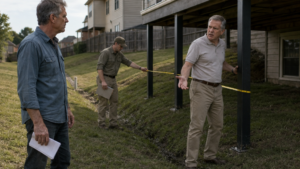
The first ramp post came out of the dock with a wet wooden crack just as Scott Mitchell cut the boat engine.
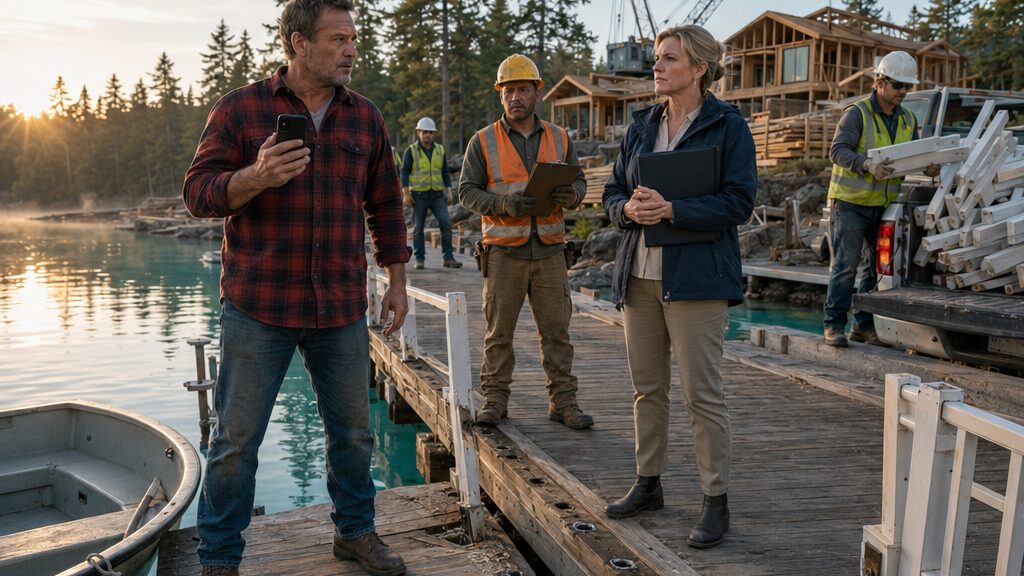
For half a second, the sound did not belong to the morning. It rose over the slap of lake water against aluminum, over the gulls crying above the pines, over the low diesel throb from the construction barge anchored fifty yards beyond his shoreline. A worker in an orange vest leaned his weight into a pry bar. Another man steadied the white safety rail Scott had bolted in himself three nights earlier. When the post finally gave, the rail tilted like a broken arm.
Scott let the boat drift until its bow bumped the dock.
“Stop,” he called.
No one stopped.
A man in a yellow hard hat glanced over, then looked away toward a pickup backed near the landing, its tailgate already down. Two rail sections lay in the truck bed. Scott recognized the scuffed left rail by the strip of gray tape he had wrapped around it where Angela’s hand would land first.
He stepped from the boat with his phone already recording.
“Stop the work,” he said again, quieter this time.
The worker with the pry bar froze long enough to look past Scott. Scott followed his eyes.
Cynthia Adams stood near the top of the dock in clean boots and a pale rain jacket, holding a folder against her chest as if it were something fragile. Behind her, beyond the dock road and the raw scrape of cleared earth, a crane lifted a beam over the frame of an unfinished cabin. There were more frames beyond it, pale wood and black window openings arranged along the island curve like teeth.
Cynthia did not raise her voice. She never did when there were other people around.
“Mr. Mitchell, you were notified that this structure was unauthorized.”
Scott kept the phone pointed at the dock. “This is an access ramp.”
“It is an exterior modification.”
“It is a medical accommodation.”
Her eyes moved briefly to the phone, then back to him. “You did not submit it as one.”
Tyler Flores came down from the pickup with a clipboard tucked under one arm. He was broad through the shoulders, his hard hat pushed back just enough to show the sweat already forming at his hairline. He looked more tired than hostile.
“Mr. Mitchell,” Tyler said, “we’re just following the removal order.”
“Show it to me.”
Tyler held out the clipboard.
Scott did not take it. “Not a work packet. The order. Signed. With the date I was served.”
Cynthia opened her folder before Tyler could answer. “The association has enforcement authority over shoreline improvements under the lake-access easement.”
Scott turned the phone toward her. “Say that again.”
Her face tightened. “I’m not performing for your recording.”
“You’re removing a ramp from my dock before sunrise. You can explain the authority on camera.”
A worker lifted the loose rail into the truck. Metal brackets scraped against the bed. The sound went through Scott’s teeth.
He looked at the exposed line of bolt holes left along the edge of the ramp. He had countersunk them carefully because Angela dragged her left foot when she got tired. He had sanded every board, checked every screw, measured the slope twice with a level and once with the old measuring tape his father kept in the boathouse. Temporary, he had written on the form. Dock access stabilization. He had thought the vaguer words would keep Angela out of a public argument.
Now the vague words were being used against him.
“Tyler,” Scott said, still recording, “when did your crew start?”
Tyler shifted his weight.
Cynthia spoke first. “That’s not relevant.”
“It is if they started before I received notice.” Scott kept his eyes on Tyler. “When?”
Tyler looked toward the truck, then the worker with the pry bar, then finally at Cynthia. “We got here at six.”
Scott checked his phone screen. “It’s six thirty-eight. I was not handed anything before six.”
Cynthia’s voice remained flat. “Notice was posted at the residence.”
“The residence is up the hill. The ramp is here.”
“Posting at the residence satisfies the association requirement.”
“Who posted it?”
Cynthia opened the folder and slid out a white page. “The notice was posted this morning.”
“This morning when the crew was already here?”
A gust came off the water and lifted the corner of the page. Cynthia pressed it down with two fingers.
Tyler’s jaw moved once, as if he had almost said something and swallowed it.
Beyond them, a grinding wheel screamed against steel. Orange sparks jumped from one of the cabin frames near the shoreline, bright even in the pale morning. Scott turned his head toward the noise. The crane cable swung slowly. Men in vests moved around stacked lumber. A sign on a stake read, in black marker, CABIN DELIVERY ACCESS.
Cynthia followed his look. “The improvement project is separate.”
“No,” Scott said. “It’s right behind you.”
“The board approved that project after months of review.”
“And my ramp?”
“Your ramp was not approved.”
“My sister cannot get from the boat to the house without it.”
For the first time, Cynthia’s expression changed. Not softened. Measured. The look of someone hearing a fact she had known might come up and had prepared herself not to react to.
“You submitted a dock stabilization request,” she said. “You did not provide medical documentation.”
“I provided photos of storm damage. I requested temporary safety access.”
“You installed before approval.”
“You told me emergency stabilization could proceed.”
“I did not tell you that.”
“I didn’t say you did.”
Scott saw Tyler’s eyes flick toward Cynthia again.
Cynthia closed the folder. “Mr. Mitchell, this island shoreline is subject to association control where access, liability, and improvement standards are concerned. You’ve known that since you purchased the property.”
“I didn’t purchase it. My father left it to me.”
“Then your father would also have known.”
That touched something Scott had not expected to feel in front of her. He kept his hand steady around the phone.
“My father allowed emergency lake access,” he said. “Not cabins. Not demolition crews. Not you deciding whether my sister can reach her own door.”
Cynthia’s mouth tightened. “The board does not make decisions based on emotional framing.”
Scott almost laughed. It came out as a breath.
Behind him, the worker with the pry bar lowered the tool, uncertain now. The second worker stood with one hand on the remaining rail. The ramp, half stripped, seemed suddenly narrow and exposed.
Tyler stepped closer to Scott, lowering his voice. “Look, I can pause them for a few minutes, but I’ve got an order to clear everything along this run before the materials come in.”
“What materials?”
Tyler hesitated.
Cynthia said, “Do not discuss the construction schedule with him.”
Scott slowly turned the phone from Tyler to Cynthia. “Clear everything along what run?”
Cynthia did not answer.
A folded site map was clipped beneath Tyler’s top sheet. The wind caught its corner and lifted it just enough for Scott to see the island outline, the dock road, and ten dark rectangles curving around the shore. He reached toward it.
Tyler pulled the clipboard back by instinct. Then stopped, embarrassed by the motion.
Scott had already seen enough.
One rectangle sat over the south landing, close to the cedar stump where his father’s oldest survey pin was buried. The label beside it was printed clearly.
Cabin 10.
Scott lowered his phone just enough to look at the real shoreline, then back at the map.
The cabin was not beside his marker.
It was on top of it.
Chapter 2: Ten Cabins Circled The Wrong Shore
Five weeks earlier, Scott set one end of the level on the boat deck and the other on the dock, then stared at the gap as if staring long enough might flatten it.
The storm had lifted the outer dock six inches at one corner and twisted the old landing boards just enough to make the crossing look harmless until weight shifted. For Scott, it was awkward. For Angela, it would be a fall. Her left brace would catch on the raised edge. Her hand would reach for the old rail that no longer lined up with the boat gate. If the lake moved under her at the wrong moment, she would have nowhere to put her balance.
He measured again.
Too steep.
The house waited up the island path, pale cedar siding visible through the pines. Their father had built it low and plain, facing the morning water, with a wide kitchen and a screened porch Angela had always claimed was “the only place quiet enough to hear herself think.” She had said it again from the rehab center two days before.
I don’t need perfect, Scott. I just need to get inside without everyone lifting me like furniture.
He had promised her she would.
Now he stood on the dock with a pencil behind his ear, three treated boards stacked beside his boot, and a phone full of unanswered messages from the association office.
Scott photographed the warped landing, the loosened posts, the missing rail brackets. He framed each picture close, avoiding anything that showed the chair ramp measurements he had sketched in chalk. Not because he meant to deceive anyone. Because once a thing went to the HOA, it stopped belonging to the person who needed it.
It became an agenda item.
He opened the association portal and typed: Emergency dock access stabilization after storm damage. Temporary ramp and safety rail to preserve safe entry pending full repair.
He read it twice. His thumb hovered over the screen.
Medical accommodation sounded too large. Too public. Too much like inviting Cynthia Adams and half the board to discuss Angela’s body in a room with stale coffee and a sign-in sheet. Angela had spent months fighting to keep the details of her recovery from becoming neighborhood conversation. Scott would not be the one to hand them over.
He attached the photos and hit submit.
A heron lifted from the reeds.
For three days, nothing happened.
On the fourth, Scott called the association office from the dock, holding the phone between his shoulder and ear while he pulled the first damaged board loose. A young assistant answered, put him on hold, came back, put him on hold again, then finally said, “For emergency stabilization, you can take reasonable temporary steps if you upload photos and keep the footprint the same.”
“Footprint stays the same,” Scott said. “I’m not expanding the dock.”
“Then just make sure the board gets the follow-up packet.”
“Before my sister comes home?”
“I can’t speak for the board schedule.”
He closed his eyes. “Is temporary safety work allowed or not?”
A pause.
“I would document everything,” the assistant said.
Scott took that as the closest thing to permission he was going to get.
By sunset, the first temporary boards were fitted. Not pretty. Strong. He laid them with the grain running clean underfoot, braced the slope, and set the rail height where Angela’s right hand could find it without reaching. He worked until the porch light came on behind him and the water turned black.
The next morning, a buzzing passed overhead.
Scott looked up from the dock and saw a small survey drone moving along the island edge. It hovered above the south landing, dipped toward the pines, then angled toward the old cedar stump.
He stood and waved one arm.
The drone did not leave.
A construction skiff idled beyond the no-wake marker. Two men in vests watched a tablet. One pointed toward the island’s west shore. Scott wiped his hands on his jeans and walked to the end of the dock.
“This is private property,” he called.
The boat operator lifted a hand in a gesture that could have meant apology or acknowledgment. The drone moved farther inland.
Scott took out his phone and recorded it until the battery warning flashed.
That afternoon, an email arrived from Harbor Ridge Lake Association.
Subject: Exterior Modification Notice.
Scott opened it standing in the kitchen, saw Cynthia Adams’s name beneath the header, and felt the old tightening behind his ribs.
Dear Mr. Mitchell,
It has come to the board’s attention that work has begun at the Mitchell Island dock landing. Please be advised that all exterior modifications affecting shoreline visibility, community access, or association-controlled easement areas require full board review prior to installation.
He read the sentence twice.
Community access.
Association-controlled easement.
He scrolled down. There was no mention of storm damage. No mention of temporary stabilization. No mention of the assistant’s call.
Attached were three documents: the modification policy, the shoreline standards, and a file titled Proposed Island Improvement Concept.
Scott opened the last one.
The screen filled with a clean architectural rendering of the island from above, too smooth and bright to resemble any place that had mud, roots, or old dock nails in it. Ten small cabins curved along the shoreline in a deliberate arc. Walking paths connected them. A dock extension cut across the south landing. A label described the project as Lakeside Guest Cabin Initiative — Phase One.
Phase One.
Scott zoomed in until the image blurred. The first cabin sat near the old boathouse road. The fifth stood where the pine roots came out after heavy rain. The tenth was drawn almost exactly where the temporary ramp touched land.
A second email arrived before he finished reading.
Cynthia Adams had written only one line above the automatic notice.
Please refrain from further unapproved work while the board reviews all island-related access matters.
Scott looked out the kitchen window toward the dock. The new rail stood white in the late light, clean against the gray boards, waiting for Angela’s hand.
Then he looked back at the ring of cabins on his screen and understood that the board was not only reviewing his ramp.
They were reviewing the island as if it already belonged to them.
Chapter 3: The Approval Form Became A Wall
The denial letter called the safety rail decorative.
Scott sat in his truck outside the marina office and read the word until the letters stopped making sense. Decorative. As if he had spent three nights in the damp, sanding edges and checking the slope by flashlight, because the dock needed dressing up. As if Angela’s hand would reach for ornament.
He had printed the letter at the marina because the island printer had jammed, and now the pages lay across the passenger seat beside his ramp photographs. In the photos, the rail looked plain and temporary: white boards, galvanized brackets, no trim, no flourish. The denial looked more polished than the thing it condemned.
Dear Mr. Mitchell,
Your request for dock access stabilization is denied at this time pending full exterior review. The installed ramp and decorative rail alter the approved shoreline appearance, create potential association liability, and obstruct planned access improvements under the recorded lake-access easement.
He stopped there.
Obstruct.
That one was worse than decorative.
Scott took a picture of the letter, then another of the photo beside it. He was learning to record things in pairs now: what they called it, and what it was.
The HOA office occupied the back of a converted lake-supply building near the marina. A bell over the door rang when Scott entered. Inside, framed maps of Harbor Ridge hung beside notices about dock permits, dues, quiet hours, guest passes. Cynthia Adams stood at the counter with Kimberly Jones, both looking down at a spreadsheet.
Kimberly glanced up first. “Scott.”
Cynthia turned more slowly. “Mr. Mitchell. Do you have an appointment?”
“No. I have your letter.”
“If you’re here to appeal, the procedure is on page two.”
“I’m here because you called my sister’s safety rail decorative.”
Kimberly’s eyes moved to the letter in his hand.
Cynthia held out one palm, not quite stopping him, not quite inviting him closer. “The board evaluated the request as submitted.”
“I submitted storm damage photos.”
“You submitted a stabilization request for a dock structure in an easement area.”
“It’s my dock.”
“The lake-access easement gives the association review authority over shoreline conditions affecting common access.”
“Common access for emergencies,” Scott said. “Not ten rental cabins. Not clearing my ramp.”
Cynthia’s expression remained composed, but Kimberly shifted at the word rental.
“The cabin initiative is still in review,” Cynthia said.
“Then why did a survey drone fly over my island?”
“Preliminary site assessments are part of review.”
“Without permission?”
“The association has rights under the easement.”
“You keep saying that like the word gets bigger every time.”
Kimberly looked down at the spreadsheet.
Cynthia closed the folder in front of her. “Mr. Mitchell, I understand this is personal to you. But the board has to consider liability for the entire community. Unapproved structures near the water expose the association to risk.”
“My sister falling off a damaged dock is also risk.”
“Then submit the proper documentation.”
He almost did. Right there, he almost said Angela’s name, the brace, the rehab date, the promise he had made. But he saw Kimberly’s pen pause over the spreadsheet. He saw the corkboard behind Cynthia with meeting notices and printed complaints. He imagined Angela’s condition translated into minutes, attached files, homeowners murmuring beside folding chairs.
So he said, “Tell me what form.”
Cynthia slid a packet across the counter. “Medical accommodation requests require supporting documentation, installation specifications, contractor insurance, board review, and legal approval if the modification affects common or easement-controlled areas.”
“How long?”
“The board meets next month.”
“She comes home before then.”
“Then you should not have waited to file properly.”
The words landed with no raised voice at all.
Scott picked up the packet. “And until then?”
“The ramp remains in violation.”
The bell over the door rang behind him. A delivery driver entered with two boxes, ending the conversation by making it public in a different way. Cynthia turned to sign. Kimberly did not look at Scott.
Outside, he sat in the truck with the packet on his lap. His phone buzzed before he started the engine.
“Scott Mitchell?” a man asked when he answered.
“Yes.”
“This is Tyler Flores with the shoreline crew. I’m trying to confirm barge access for the island work. Cynthia gave me this number as the local contact.”
Scott looked through the windshield at the HOA office door. “What island work?”
A pause.
“The cabin access clearing. South landing first, then the west curve.”
“There is no cabin access clearing approved through me.”
Another pause, longer. Paper rustled on Tyler’s end.
“Okay,” Tyler said carefully. “Maybe I’ve got the wrong contact.”
“You said south landing.”
“That’s what’s on the work order.”
“What else is on it?”
“I can’t really—”
“Tyler, you called the property owner. Read me the line.”
Scott heard voices behind Tyler, machinery beeping in reverse, a hollow metallic clang.
Tyler exhaled. “Shoreline clearance for Phase One access. Remove brush, loose materials, temporary obstructions, unapproved ramp obstruction at south dock.”
The truck cab became very still.
“Say the last part again.”
“I shouldn’t have called you. Let me check with Cynthia.”
“No. Who put the ramp on that order?”
“I don’t generate the orders, Mr. Mitchell.”
“When is this scheduled?”
“I need to verify.”
The line clicked dead.
Scott sat with the phone against his ear until the screen went dark. Then he opened the denial packet and flipped to the last page.
At the bottom of Cynthia’s letter was the time stamp: 9:12 a.m. Accommodation request incomplete.
Tyler’s accidental call log showed 9:47 a.m.
Scott opened the photo Tyler’s number had sent automatically with the contractor contact card. It included a cropped screenshot of the day’s work assignments, probably by mistake, a blur of text and checkboxes meant for the crew.
One line was clear enough.
Removal approved: 9:18 a.m. — C. Adams.
Scott put the truck in gear, then stopped before backing out.
Six minutes.
Six minutes after marking his request incomplete, Cynthia had approved removing the ramp.
Chapter 4: The Old Survey Changed The Ground
“This easement does not say what your HOA thinks it says.”
Donald Davis kept one finger pressed on the old plat book as if the paper might slide away from the truth if he lifted it. The county records office smelled of dust, toner, and damp coats. Fluorescent lights hummed over rows of metal cabinets. Scott stood across the table with Cynthia’s denial letter folded in his back pocket and Tyler’s accidental screenshot open on his phone.
Donald had not seemed eager to help when Scott first walked in. He had listened with the tired patience of a man who had heard too many neighbors claim too many feet of shoreline. But when Scott set down the printed cabin rendering and the old tax map from his father’s file box, Donald’s face had changed by one careful degree.
Now he tapped the easement language with his nail.
“Right here. ‘Emergency lake access and maintenance passage for common safety purposes.’ That’s narrow. It does not create a buildable common area. It does not transfer control of the island. It does not let an association construct rental cabins.”
Scott leaned closer. The typed words blurred, then sharpened.
“My father signed that?”
“He granted it.” Donald turned a page protected in cloudy plastic. “Different thing.”
The signature at the bottom was familiar in a way that hit Scott before he was ready. His father’s initials sat beside a handwritten note in the margin, dark ink faded brown with age.
Access in emergencies only. No permanent structures.
Scott touched the edge of the page but not the writing.
“He never told me about the note,” Scott said.
“People don’t always explain paperwork they think will never be misused.”
Scott looked away toward the records office window. Through the glass, he could see the marina parking lot and, beyond it, a thin strip of lake shining between two buildings. He remembered his father keeping the island open during storms, letting stranded boaters tie up at the south landing, letting fire crews use the dock once when a cottage across the water burned. Emergency access had meant decency. A place to land when the lake turned against you.
Scott had let the HOA turn that decency into a door.
“Does this stop them?” he asked.
Donald took off his glasses and rubbed the bridge of his nose. “It gives you a good argument. It does not stop a concrete truck.”
That answer followed Scott back to the island.
By evening, the construction site had changed again. The ring of cabins was no longer just stakes and lumber. Framed walls stood along the west shore. Black window openings stared toward the water. Work lights hung from temporary poles, not yet lit, waiting for dusk. The crane sat still with its boom angled over the pines.
Scott crossed from the dock to the old cedar stump, moving carefully around ruts left by equipment tires. The ramp was still half gone. One remaining rail section leaned crookedly against the lower landing, tagged with orange tape. He could not look at it long.
Donald walked behind him with a survey wheel and a metal detector borrowed from the county maintenance room, though he had made clear twice that he was there unofficially.
“I’m not certifying anything,” Donald said.
“You’ve said that.”
“I mean it.”
“I know.”
“You need a licensed surveyor for court.”
“I’m not in court. I’m trying to stop them from pouring concrete on my father’s line.”
Donald gave him a brief look. “That sentence is how people end up in court.”
They found the first marker under moss and roots near the cedar stump. Donald brushed dirt away with a gloved thumb until dull metal showed. Scott knelt beside it, one hand on the ground. He had walked past that spot a thousand times as a boy and never cared what lay beneath it. The island had simply been the island. The pines, the dock, the porch, the path where Angela used to race him barefoot, the flat rock where their father cleaned fish.
Now every inch needed proof.
Donald set a flag beside the pin. Then another. Then a third, farther inland than Scott expected.
The line they made did not follow the HOA’s site tape. It cut across the cleared ground at an angle, passing through a row of stacked concrete forms.
Scott walked toward the nearest form. White spray paint marked the dirt.
CABIN 10.
He stopped.
Donald came up beside him and said nothing for a moment.
The cabin form sat on Scott’s side of the flagged line. Not by inches. By enough that a person could stand in the difference and spread both arms.
Scott took out his phone and began recording.
“Say what we’re looking at,” he said.
Donald stepped back. “No. I told you, I’m not certifying.”
“Then don’t certify. Just stand there while I record the flags.”
Scott filmed the metal pin, the flags, the form boards, the spray-painted number, the tire tracks leading from the dock road. He filmed the crane in the background and the half-removed ramp below. He filmed his own boots on the line because he needed something in the frame to prove scale.
His phone buzzed.
A message from Cynthia.
Board has reviewed your continued objections. Any interference with approved association work may result in additional enforcement and recovery of costs.
He read it twice, then showed Donald.
Donald’s mouth drew into a thin line. “Approved by whom?”
“Them.”
“That isn’t always enough.”
From the dock, a worker shouted to another. A saw started up near Cabin 6. The sound ripped through the trees, then settled into a steady whine. Scott looked toward the cabins and felt anger rise, clean and hot, then fold into something heavier.
“My father should have written it clearer,” he said.
Donald closed the plat book he had carried under one arm. “Your father wrote ‘no permanent structures’ in the margin. That is clear enough for a decent person.”
Scott almost answered, but the words caught.
A decent person.
His father had believed paperwork followed decency. Scott had believed privacy did. Both of them had left gaps for people like Cynthia to stand in and call the gap authority.
At the south landing, the orange tape on the remaining rail fluttered in the wind. The bolt holes along the ramp edge were small dark circles now, collecting grit.
“How fast can they pour?” Scott asked.
Donald looked toward the stacked forms. “Once the truck is here? Fast.”
“Tomorrow?”
“Maybe sooner, if they’ve got inspection signed off.”
Scott looked back at the flagged line crossing Cabin 10. The sun had dropped low enough that the unfinished cabin frames cast long shadows over the dirt. One of those shadows reached the survey pin and covered it completely.
Donald took his glasses off again and spoke without looking at him.
“If concrete goes in that form, undoing this stops being a board argument and starts becoming a much more expensive fight.”
Scott looked from the pin to the dock, from the dock to the stripped ramp, and then to the tenth cabin’s empty wooden outline waiting for morning.
Chapter 5: The Board Called Safety A Violation
Cynthia Adams opened the meeting with Scott’s ramp frozen on the projector screen.
The image filled the white wall behind the board table: a crooked shot from Scott’s phone, one worker lifting the rail, another standing near the exposed bolt holes, the crane rising beyond Cynthia’s shoulder like it belonged in the frame more than the dock did. In the video, Scott’s own recorded voice had just asked when the crew started. Cynthia paused it before Tyler answered.
“This,” she said, facing the room, “is an unauthorized obstruction to association improvement.”
The words stirred the homeowners seated in folding chairs. Some leaned to see the screen better. Others looked toward Scott, who stood at the back because every seat had been taken by the time he arrived. Kimberly Jones sat at the board table with a stack of financial sheets clipped in front of her. She did not smile. She did not look away either.
Scott held his folder against his side. Inside were the denial letter, the work-order screenshot, the survey flags printed from his phone, and Donald’s careful note stating only that the old easement appeared limited to emergency access. Nothing in the folder said enough by itself. That was the problem. Every piece proved part of the truth and left Cynthia room to call the rest incomplete.
Cynthia clicked to the next slide. It showed the cabin plan, clean and bright, with paths, docks, rental projections, and landscaped shorelines.
“Our community has deferred dock maintenance for years,” she said. “Insurance premiums have increased. Shared roads need resurfacing. The guest cabin initiative is projected to offset a special assessment that many residents have told us they cannot afford.”
A murmur moved through the room. Scott saw Kimberly’s jaw tighten. There it was—the pressure underneath Cynthia’s calm. Not just power. Money. Fear. Homeowners who did not want another bill. A board president who had promised them a solution.
Cynthia turned slightly, making sure the room could see both the cabin rendering and the paused ramp removal.
“Mr. Mitchell’s objections have delayed access preparation. The board is sympathetic to personal concerns, but we cannot permit unapproved construction to interfere with association-approved improvements.”
Scott stepped forward. “That ramp does not interfere with the cabins unless the cabins need my dock.”
Cynthia’s eyes moved to him. “Comments will be taken after the presentation.”
“No,” Scott said. “You put my dock on the wall. I’m commenting now.”
A few chairs shifted. The HOA attorney seated near the end of the table lifted a hand as if preparing to interrupt, but Cynthia gave the smallest shake of her head.
Scott walked down the side aisle. He did not raise his voice. He placed his folder on the table and opened it to the photo of the exposed bolt holes.
“You called this decorative.”
Cynthia folded her hands. “The request was reviewed as submitted.”
“You called it an obstruction.”
“It was installed without approval.”
“It was installed because my sister cannot safely get from a boat to the house without a ramp and rail.”
The room quieted in a way that made Scott hate himself for saying it there. Not because it was shameful. Because Angela had asked for one thing—to come home without becoming the story. He felt every face turn, felt the private fact leave his mouth and become community property.
Kimberly leaned forward. “Why wasn’t that in the original request?”
Scott looked at her. There was no cruelty in the question. That almost made it worse.
“Because I was trying to keep her medical details private.”
Kimberly’s expression shifted, not enough to call sympathy, but enough to show the answer had landed somewhere unplanned.
Cynthia seized the gap. “And the association cannot evaluate what it has not been given. That is precisely why procedure matters.”
Scott nodded once. “Procedure also matters when you remove the thing before the notice is served.”
He tapped his phone and restarted the video. Tyler’s voice came through the room speakers because Scott had sent the file ahead with his appeal.
“We got here at six.”
Scott’s recorded voice followed. “It’s six thirty-eight. I was not handed anything before six.”
Cynthia reached toward the laptop. “This clip lacks context.”
Scott clicked pause before she could. The screen froze on the worker lifting the rail. Behind him, the crane held a beam over an unfinished cabin.
“The context is behind him,” Scott said.
A man in the second row muttered, “Those cabins pay for the road.”
Another voice answered, “Not if they’re on his land.”
Cynthia’s face stayed composed, but color rose at the edge of her neck. “The ownership issue is under legal review.”
Scott pulled out the printed survey images. “Cabin 10 crosses the old line.”
The HOA attorney finally spoke. “The association disputes that characterization.”
“Of course it does,” Scott said. “It already ordered the ramp removed.”
Kimberly picked up one of the photos before Cynthia could stop her. “Where is this pin?”
“South landing. Near the cedar stump.”
“That area is part of the lake-access easement,” Cynthia said.
“Emergency access,” Scott said. “Not construction.”
Cynthia opened a folder and removed a memo with the attorney’s letterhead. “Counsel has advised that the association may proceed with approved improvement work while ownership questions are under review, provided no permanent certificate of occupancy is issued until final title confirmation.”
The room absorbed the phrase slowly. Proceed while under review.
Scott looked at the memo, then at Kimberly. “So you knew there was an ownership question.”
Kimberly’s eyes flicked toward Cynthia.
Cynthia answered before she could. “Large projects often involve title clarifications. That does not give one homeowner the right to halt community improvements by installing an unapproved structure.”
Scott heard the shape of the room changing. Some people wanted the cabins. Some people feared the cost of stopping. Some cared about the ramp but not enough to pay for the road. Cynthia had placed them all in a narrow hallway and called it governance.
He slid the medical accommodation packet from his folder. The top page was still incomplete in two places. Contractor insurance. Installation specifications. He had thought temporary meant common sense would fill the gap. It had filled it with Cynthia’s language instead.
“I should have filed this first,” he said.
No one moved.
“I didn’t because I didn’t want my sister’s condition discussed here.” He looked at Cynthia, then at Kimberly, then at the homeowners whose eyes had softened or hardened depending on what the story cost them. “That was my mistake. But my mistake did not give the board authority to tear out access before review. And it did not make my dock association property.”
For a moment, Cynthia looked less like a wall and more like a person calculating damage. Then the wall returned.
“The board will consider your appeal,” she said. “In the meantime, work approved under the legal memo continues.”
Scott’s phone buzzed on the table.
He almost ignored it. Then he saw Tyler’s name.
One photo loaded slowly, line by line. Dawn-gray construction site. Concrete forms. A truck schedule clipped to a board.
Under the photo, Tyler had written: Concrete for Cabin 10 scheduled 6:15 a.m.
Scott looked up from the phone.
Cynthia was already calling the next agenda item.
Chapter 6: The Tenth Cabin Exposed The Lie
The concrete chute was already swinging toward Cabin 10 when Scott ran past the survey flags.
The truck had backed in before full daylight, tires sunk into damp dirt, drum turning with a steady wet churn. Crane lights still glowed over the unfinished cabin frames. Men in hard hats moved fast in the cold morning, speaking in clipped half-sentences. Someone had pulled Scott’s orange survey flags and laid them beside a stack of forms as if they were trash waiting for pickup.
Scott grabbed the nearest flag and drove it back into the ground with his boot.
“Stop the pour.”
A worker at the chute looked toward Tyler Flores.
Tyler stood near the truck with his clipboard in one hand and his phone in the other. He looked like a man who had slept in his clothes. When he saw Scott, he did not seem surprised.
“Hold,” Tyler called.
The chute operator lifted one hand off the lever.
Cynthia Adams came from the cabin road in a dark coat, the HOA attorney beside her carrying a leather folder. She had not expected Scott to arrive before the pour. That was the first real crack he had seen in her timing.
“Mr. Mitchell,” she said, “you are entering an active construction zone.”
“So are you,” Scott said, placing another flag. “On my side of the line.”
“The association does not accept your private interpretation of the survey.”
“This isn’t private.” Scott held up his phone. “I sent the board the pin locations, the easement language, and Donald Davis’s note last night.”
“An unofficial note from a retired technician is not a survey.”
“No. But it is enough to stop you from pouring concrete until a licensed surveyor confirms the boundary.”
The attorney stepped forward. “The board has authority to proceed while title matters are pending.”
Scott pointed to the truck. “Then sign for it.”
The attorney blinked. “Excuse me?”
“Sign a statement saying you personally reviewed the boundary dispute and instructed this crew to pour on the marked area anyway.”
Cynthia’s eyes narrowed. “That is not how this works.”
Scott turned to Tyler. “Is that enough for you?”
Tyler looked at the chute, then the form, then Cynthia. The truck drum kept turning. The sound filled every pause.
“I need clear authorization,” Tyler said.
“You have it,” Cynthia replied.
“In writing,” Tyler said.
The words landed harder than Scott expected. Cynthia turned toward him slowly.
Tyler swallowed, then kept going. “The work order says shoreline clearance and foundation prep. It doesn’t say disputed boundary pour. It doesn’t say medical accommodation removal. I’m not putting my crew in the middle of a property fight unless somebody signs direct responsibility.”
Cynthia’s composure became very still.
The attorney lowered his voice. “Tyler, your company is under contract.”
“My company is under contract to do permitted work,” Tyler said. “Not guess where his island ends.”
Scott watched him then, really watched him. The man who had removed the rail. The man whose crew had pulled the post before sunrise. Tyler was not suddenly an ally. His crew had still loaded Angela’s ramp into a truck. But fear had changed direction in him. It was no longer only fear of Cynthia’s schedule. It was fear of being the hand that made the wrong thing permanent.
Scott stepped to the edge of the form and held up the video from the ramp removal. The frame showed Tyler in the background, Cynthia near the dock, one worker with the rail in his arms.
“You were told to remove the ramp before I was noticed because it was slowing mobilization,” Scott said.
Tyler did not answer.
Cynthia did. “No one used that language.”
Tyler looked down.
Scott waited.
Finally, Tyler said, “The email said the south landing had to be clear before the cabin materials staged.”
The attorney’s head turned toward Cynthia.
Scott felt the small payoff of it and did not let himself mistake it for victory. It confirmed the thing he had suspected: the ramp had not been removed because it was unsafe. It had been removed because it was in the way.
Cynthia recovered quickly. “The ramp was unauthorized regardless of scheduling.”
“And the cabin?” Scott asked. “Is that authorized regardless of the line?”
The truck driver leaned out of the cab. “I need to know if I’m pouring or washing out.”
No one answered him.
The morning brightened around them, showing everything too clearly: the raw scrape of earth, the black forms, the empty place where the flags had been pulled, the crane waiting over the cabin frames, the dock below with its half-stripped ramp. Scott looked toward the house. Angela was not there yet. She was still on the mainland, waiting for him to say the way home was ready.
He had stopped the pour.
She still could not get up from the dock.
That truth cut through the satisfaction so cleanly that he almost missed Cynthia’s next move.
The attorney opened his folder and removed a two-page document. He handed it to Scott with the careful neutrality of someone offering a solution sharpened on both edges.
“The board is prepared to resolve the immediate access issue,” the attorney said. “If you sign this temporary license, the association will authorize restoration of a compliant ramp within forty-eight hours.”
Scott read the first paragraph.
Temporary Medical Access License.
He kept reading.
The license granted the association continued access rights around the south landing, west shoreline, and related improvement areas pending final review. It allowed “reasonable use, maintenance, construction access, and future modification coordination” across the disputed strip. It required Scott to withdraw all interference complaints during review.
He looked up. Cynthia’s face told him she already knew which paragraph he had reached.
“You’ll give back the ramp,” Scott said, “if I give you the shoreline.”
Cynthia’s voice was calm. “We are offering a practical compromise that lets your sister access the home while preserving the project schedule.”
Tyler looked away.
The truck drum kept turning behind them, full of concrete waiting to harden somewhere.
Scott held the unsigned license in one hand and looked down the hill toward the dock, where the missing rail left a pale scar along the ramp edge. For the first time all morning, he understood exactly what Cynthia was asking him to trade: not pride for access, but the island’s future for Angela’s next step.
Chapter 7: Scott Had To Stop Hiding
“Do not give them the island to get me a ramp.”
Angela said it from the kitchen table with the unsigned license between them, her left hand resting on the edge of the paper as if she could hold the whole shoreline in place by touch alone. Scott had brought her to the island only as far as the house by using the narrow service path and the old utility cart, a trip that left her pale and silent by the time they reached the porch. The ramp was still gone. The rail was still missing. The dock below them looked like a mouth with teeth pulled out.
Scott stood at the sink, hands braced on the counter, looking down through the window toward the water.
“I can fight the license later,” he said.
“You won’t.”
He turned.
Angela’s voice had no anger in it. That made it harder to meet.
“You’ll tell yourself you bought time,” she said. “Then they’ll use the paper. Then you’ll spend years trying to undo what you signed because I needed to get from a boat to a door.”
“You do need to get from a boat to a door.”
“Yes,” she said. “I need a ramp. I don’t need you handing them what Dad left us.”
Scott looked at the license again. The HOA attorney’s language sat neat and clean across the page. Temporary. Access. Coordination. Review. Words soft enough to hide what they took.
Angela slid the paper away from herself.
“You keep trying to protect me by not saying why this matters,” she said. “Now they’re using the empty space.”
Scott did not answer.
Outside, a saw started somewhere beyond the trees, then stopped almost immediately. Work at Cabin 10 had paused, but the rest of the island was still breathing construction. Generators hummed. Men called to each other near the west shore. Every sound reminded him that the ramp had been easy to remove because he had let its purpose stay vague.
His phone buzzed. A message from Tyler.
If you want your rail sections, check our yard before tomorrow afternoon. Disposal order came through.
Scott read it once, then passed the phone to Angela.
Her face changed at the word disposal.
“They’re throwing it away?”
“Trying to.”
Scott was out of the house before the message finished cooling in his hand.
At the contractor yard near the marina, the removed ramp pieces lay behind a chain-link fence among broken pallets, bent rebar, and cracked buckets of hardened cement. The white rail sections were stacked near a dumpster. Gray tape still wrapped the spot where Angela’s hand was supposed to land.
Tyler met Scott at the gate. He looked past Scott once, toward the yard office, before unlocking it.
“I’m not supposed to release anything,” Tyler said.
“I’m not asking you to.”
“You’re recording?”
“Yes.”
Tyler gave a short nod, as if he had expected that answer. “Then record this too. We were told to dispose of noncompliant removed material after forty-eight hours unless the board directed storage.”
“Who told you?”
“Cynthia’s office.”
Scott filmed the rail sections, the brackets, the scraped posts, the tape. He did not touch them. He wanted to. He wanted to load every board into his truck and bolt the rail back before dark. But Cynthia had turned every practical act into a violation. This time he would not give her an easy one.
He turned the phone toward Tyler.
“Did you know it was a medical access ramp when you removed it?”
Tyler looked at the rail. “Not when we started.”
“When did you know?”
“When you said it at the dock.”
“And after that?”
Tyler’s mouth tightened. “After that, I should’ve stopped longer.”
It was not an apology. Not exactly. It was something more useful than an apology because it had weight.
Scott lowered the phone. “Will you put that in writing?”
Tyler looked toward the office again. “I’ll confirm the timeline. That’s all.”
“That’s enough.”
It was not enough, but Scott had learned to build from pieces.
By noon, he sat in the marina office with the medical accommodation packet spread across a scratched counter. The clerk let him use the copier without asking questions. Scott attached everything he had avoided attaching before: Angela’s mobility letter, the ramp slope measurements, the storm photos, the removal video stills, the denial letter, Tyler’s timeline, Donald’s easement note, the cabin foundation photos, and the work-order screenshot showing Cynthia’s six-minute decision.
He wrote the cover letter twice.
The first version was too angry.
The second version was too careful.
The third said what he should have said from the beginning.
My sister Angela Mitchell requires safe, stable access between the boat landing and the island residence. The removed ramp and rail were temporary safety modifications installed after storm damage and before her return home. The HOA removed them before completing accommodation review and while pursuing construction access across the same area. I request immediate reinstatement of access using the attached specifications and formal withdrawal of the violation.
He signed it.
At the HOA office counter, Cynthia was not there. Kimberly Jones was.
She looked at the thickness of the packet and then at Scott. “Is that the accommodation filing?”
“Yes.”
“Cynthia called an emergency vote for tomorrow morning.”
Scott slid the packet across the counter. “Then the board has this before the vote.”
Kimberly did not touch it right away. “The vote is on the settlement license.”
“Of course it is.”
“She says it resolves the access problem.”
“It gives her access rights she doesn’t have.”
Kimberly’s face tightened. “People are scared, Scott. They hear ‘halted project’ and they hear special assessment. Some of them are on fixed incomes. Some already think you’re trying to keep everyone away from the lake.”
“My sister cannot use her own dock.”
“I know that now.”
The now sat between them.
Kimberly picked up the packet, but her hand remained on top of it after she did, as if she had not decided where to carry it.
“Did Cynthia know there was a title warning before she ordered the ramp removed?” Scott asked.
Kimberly looked toward the closed office door.
“That’s a board matter.”
“Then bring it to the board.”
“She controls the agenda.”
“Then change it.”
Something moved in Kimberly’s expression—irritation first, then fear behind it. Not fear of Scott. Fear of the thing she might have to admit she had helped push along because the numbers had looked so bad and the cabin renderings had looked so easy.
“I supported the project because the reserves are short,” she said. “Not because I wanted your sister stranded.”
“Then don’t vote like those are the same thing.”
Scott left before she could answer.
The next morning came gray and windless. Angela stayed at the kitchen table with the accommodation copy, reading every page slowly. Scott was packing his folder when the motor of a small boat approached the dock below. He looked through the window, expecting Tyler, or Cynthia, or another notice.
Kimberly climbed out alone.
She carried a yellow envelope under her arm, held tight against the lake air. Scott met her at the damaged ramp. She stopped before stepping onto it, noticing the empty bolt holes, the missing rail, the slight shift in the lower board where Angela’s foot could catch.
For the first time, she looked at the ramp as if it were not an argument.
She held out the envelope.
“Cynthia received the title warning before the removal order,” Kimberly said. “And before she marked your accommodation incomplete.”
Scott opened the envelope at the dock.
Inside was a copy of a memo with the attorney’s letterhead, dated two days before the crew came. One paragraph had been highlighted.
Boundary and easement authority remain unresolved at the south landing. Recommend no permanent construction or removal of existing access features until title and accommodation issues are reviewed.
Scott looked up.
Kimberly’s eyes were wet, but her voice stayed firm.
“She told us it was routine title cleanup,” she said. “She did not tell us this.”
Chapter 8: The Rail Went Back Before Dark
The board walked past the glowing cabin frames in a line, careful not to step in the ruts.
By late afternoon, the island looked half-built and half-wounded. Cabin walls stood open to the lake. Plastic sheeting snapped where windows would go. The crane was still, its boom angled over the treetops, and the concrete forms for Cabin 10 sat empty under a temporary stop marker Tyler had placed himself. Down at the south landing, the space where the rail had been removed waited in plain view, a row of dark bolt holes along the ramp edge.
Scott stood beside them with Angela’s accommodation packet in one hand and the unsigned license in the other.
Cynthia Adams arrived last.
She wore boots this time, but they were still too clean for the island. The HOA attorney walked beside her. Kimberly stayed a few steps back with the yellow memo folder tucked under her arm. Tyler stood near his truck with two workers and the rail sections, which he had not disposed of. The gray tape was still on the left rail.
Cynthia looked at it, then at Scott.
“This inspection is not an admission,” she said.
“No,” Scott said. “It’s an inspection.”
The county inspector crouched near the ramp, checked the exposed holes, then examined the specifications Scott had submitted. He measured the slope, checked the landing width, and ran one hand along the remaining board.
“The proposed rail height and bracing are safer than what was removed,” he said.
Cynthia’s attorney stepped forward. “Safer if maintained. The association’s concern is liability.”
Scott opened his folder to the page with Angela’s medical letter and the installation specifications, but he did not hand over the letter first. He handed over the specs.
“Then approve the safer version. Condition it on these materials, this slope, and this inspection. Don’t call the absence of a ramp safer than a ramp built to standard.”
Cynthia took the page but did not look at it long.
“The association cannot allow homeowners to install first and justify later,” she said.
Scott nodded. “Then your emergency policy needs a way to handle repairs when someone can’t wait a month to reach their own door.”
A board member murmured something to Kimberly. Kimberly did not respond. She opened the yellow folder.
“Before we discuss policy,” she said, “the board needs the full record.”
Cynthia turned. “Kimberly.”
“No.” Kimberly’s voice shook once and then steadied. “Not this time.”
She handed copies of the title warning memo to the other board members. The attorney’s face changed before anyone else’s did. Scott watched him scan the highlighted paragraph, then look toward Cynthia, not with surprise exactly, but with the bleak recognition of a problem that had become public at the worst possible moment.
Kimberly read the paragraph aloud.
“Recommend no permanent construction or removal of existing access features until title and accommodation issues are reviewed.”
The words moved across the dock more quietly than the saws had, but they cut deeper.
Cynthia did not deny receiving it. That mattered.
She said, “The recommendation was not binding.”
Scott felt Angela’s presence before he turned. She stood at the top of the path with one hand on the old porch rail, watching from a distance she could manage but not comfortably. She had refused to stay inside. She had also refused to be brought down in the utility cart for display.
Scott looked back at Cynthia.
“You had a warning not to remove existing access features,” he said. “You removed one anyway.”
“The ramp was unauthorized.”
“It was how she got home.”
Cynthia’s eyes went briefly to Angela, then away. The move was small. Scott did not mistake it for remorse. But the room—if the island dock could be called a room—shifted around that glance. The issue stopped being a file in Cynthia’s folder. It stood uphill in a gray sweater, refusing to be hidden and refusing to be used.
The HOA attorney spoke low to Cynthia. Scott could not hear the words. He did not need to. Tyler stood with arms folded near the truck. The inspector held the ramp specs. Kimberly waited with the memo still open.
Cynthia finally turned to the board members.
“We can withdraw the violation without conceding the broader property dispute,” she said. “We can authorize a temporary compliant ramp pending final review.”
Scott lifted the license. “Not with this.”
Cynthia looked at the paper. “The association needs access assurance.”
“The association has emergency access under the old easement. Not construction access. Not future modification rights. Not a blanket license around the island.”
The attorney said, “A narrower agreement could be drafted.”
“No,” Scott said. “You already have the narrow agreement. It was written before any of us were standing here. Emergency access only. No permanent structures. My father put that in the margin because he thought people would understand the difference.”
For a moment, no one spoke.
Then Kimberly said, “I move that the violation be withdrawn, the ramp restored under the submitted safety specifications, Cabin 10 remain halted pending boundary confirmation, and emergency medical-access repairs be reviewed under a separate expedited procedure.”
Cynthia stared at her.
Another board member seconded it.
The vote did not feel like victory. It felt like boards shifting under weight. Reluctant hands. Tight faces. Cynthia voting no with her mouth pressed flat. Kimberly voting yes without looking away from the empty rail line. The motion passed by one.
Tyler’s crew started before dusk.
They did not rush. The county inspector watched the first brackets go in. Scott held the rail steady while one worker set the bolts through the old holes. The drill bit caught once where the wood had splintered during removal, and the sound made Scott’s hand tighten around the rail. Tyler noticed.
“We’ll replace that board,” he said.
Scott looked at him.
Tyler added, “No charge.”
Scott nodded once. It was not forgiveness. It was a repair.
The white rail went back piece by piece. The gray tape remained on the left side because Scott asked them to leave it there. When the last bolt tightened, the ramp looked almost the way it had before, except Scott could see every mark removal had left: the widened holes, the scraped paint, the bruised edge of the lower board. Practical justice did not erase damage. It only stopped the damage from becoming permanent.
By the time Angela came down the path, the unfinished cabins behind her had gone dark. The crane was a black line against the orange sky. Cabin 10 sat unpoured, its form boards empty.
Scott moved toward Angela, but she held up one hand.
“Let me try it.”
He stepped back.
She placed her right hand on the restored rail. Her fingers found the gray tape. One foot, then the brace, then the second foot. The boards held. The rail held. The lake moved softly below, but the ramp did not.
Halfway down, Angela stopped beside Scott.
“You didn’t sign it,” she said.
“No.”
She looked toward the dark cabin frames, then back to the rail under her hand.
“Good.”
Scott stood beside her without touching her elbow. At the bottom of the ramp, she turned carefully and looked back at the house, the dock, the exposed shoreline, the workers packing their tools, the board members leaving in silence.
The island was not whole. Not yet.
But Angela crossed the last board on her own.
The story has ended.