The Will Left Him Nothing, Then Police Came To The Lake House Door
Chapter 1: The Police Lights Reached The Lake House Before Sunset
The first black vehicle came down the pine road with no siren, only lights, red and blue breaking across the wet trunks like something had already gone wrong.
Nicholas Thompson saw it from the kitchen window while the kettle hissed on the stove behind him. For one second, his mind made the old mistake. He thought of his mother’s oxygen machine. He thought of the night Barbara had stopped breathing right and he had run barefoot over the cold slate floor to unlock the front door for paramedics.
Then a second vehicle rolled into view behind the first.
Then a third.
He turned the burner off with the edge of his knuckle and stood still as the convoy curved past the lower dock road and climbed toward the stone-and-glass entrance of the lake house.
No ambulance.
No neighbor waving from the passenger seat.
Just sheriff’s vehicles and a dark sedan he recognized before the door opened.
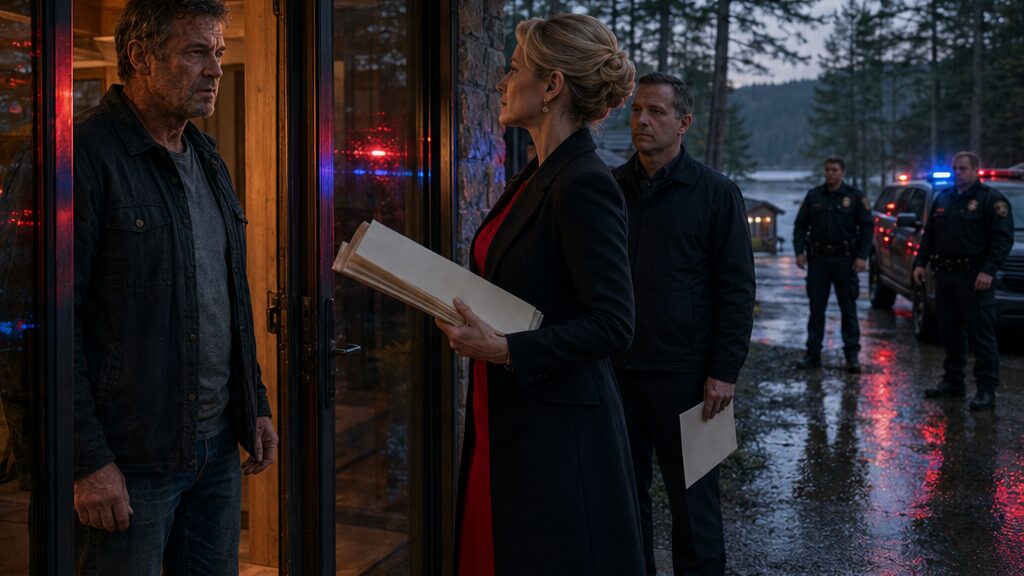
Sandra stepped out in a red dress too bright for the gray evening, her hair pinned tightly at the back of her head, one hand holding a cream-colored legal packet against her ribs. She did not look toward the lake. She did not look toward the windows where their mother used to sit wrapped in a blanket after sunset.
She looked straight at the front door like she had practiced this entrance.
Nicholas wiped his hands on a dish towel, though they were not wet. On the counter, Barbara’s mug still sat near the sink, the blue one with the chip under the handle. He had not moved it in three weeks. He told himself it was because there were too many things to sort. The truth was uglier and smaller. If the mug stayed there, then not everything had left.
A deputy knocked.
The sound hit the glass twice, hard enough to make the frame tremble.
Nicholas opened the door before the third knock. Cold air moved in, carrying lake damp and exhaust.
The civil process officer stood slightly ahead of the deputies, his face arranged into the careful blankness of someone who had decided not to know more than his paperwork required. Sandra stood beside him. The red of her dress reflected in the glass panel behind Nicholas, turning thin and warped beside the police lights.
“Nicholas Thompson?” the officer asked.
“You know who I am.”
“I need you to step outside.”
Sandra’s mouth tightened, as if his answer had embarrassed her.
Nicholas looked past them to the lower drive. Two deputies stood near the garage. Another vehicle blocked the road to the dock. The lake beyond them was smooth and dark, the mountain line already fading into evening. It looked almost peaceful, which made the scene feel staged.
“What is this?” he asked.
Sandra lifted the packet.
“This is what happens when you ignore legal notice.”
“I haven’t ignored anything.”
“You ignored the estate’s demand for payment. You ignored the vacancy notice. And now there are missing items from the property.”
Nicholas blinked once. “Missing items?”
The officer shifted. “Ma’am, let’s keep this straightforward.”
Sandra did not look at him. “It is straightforward. He has been occupying estate property without authorization and refusing to account for what he removed.”
Nicholas almost laughed, but the sound dried before it reached his throat. “I live here because Mom asked me to live here.”
“No,” Sandra said. “You lived here because it was convenient.”
The words landed harder than he expected. Not because they were clever. Because she had found the softest place and touched it without hesitation.
Behind Nicholas, the house held its breath. The hall still smelled faintly of lemon oil and the cedar chest he had opened the week before to find Barbara’s winter blankets. The front room lights were low. Their mother’s chair faced the lake as if she might return to it after dinner.
The officer unfolded a paper. “Mr. Thompson, we’re here to serve notice of estate possession and a demand for return of listed personal property. There is also an allegation of unauthorized removal.”
“Allegation by who?”
Sandra’s eyes flicked to his. “By the executor.”
“You mean by you.”
“I mean by the person Mom trusted to handle things properly.”
Nicholas felt his jaw tighten. For three weeks after the funeral, he had kept quiet through Sandra’s emails, her clipped messages, her inventory lists, her sudden certainty about everything Barbara had wanted. He had told himself grief made people formal. He had told himself not to answer cruelty with cruelty. He had told himself that if he waited, Sandra would remember their mother was not a file to close.
Now deputies were standing in the driveway of the house where he had slept in a chair for the last six months of Barbara’s life.
“What payment?” he asked.
Sandra opened the packet and pulled out a page with colored tabs along one side. “Occupancy, damage, missing property, and reimbursement to the estate. You can pay it today and leave peacefully, or this becomes a criminal matter.”
The officer gave her a quick look. “Mrs. Roberts—”
She stepped closer to Nicholas, lowering her voice but not enough. “Pay what you owe, or they take you in.”
For a moment, the police lights were the only things moving. Red and blue slid across the glass door, across Sandra’s cheek, across the packet in her hand. Nicholas looked at the top page. The lake house address was stamped beneath the attorney’s letterhead. Below it, in neat black type, was a line that made the whole porch tilt.
Beneficiary of lake house property: Sandra Roberts.
He reached for the page.
Sandra pulled it back.
“Don’t,” she said. “You’ve had enough time touching things that weren’t yours.”
He looked at her then. Really looked. The sister who used to drive three hours to arrive late on Sundays, carrying expensive groceries and guilt in equal amounts. The sister who stood in the hallway during Barbara’s bad days and spoke too loudly, as if volume could make their mother less confused. The sister who had cried at the funeral without letting anyone touch her.
“What did you do?” Nicholas asked.
Her expression changed, but only for a second.
“I did what Mom asked me to do.”
“No,” he said quietly. “What did you do?”
The officer cleared his throat. “Mr. Thompson, the document indicates Mrs. Roberts has authority over the property. If you dispute that, you’ll need to do it through probate. Tonight we need compliance with the notice.”
Nicholas looked back at the page. He knew the house had been part of the estate. He knew there would be paperwork. Barbara had been too tired near the end to discuss details for long, but she had said one thing often enough that it had become part of the house itself.
Don’t let this place turn you two into strangers.
And later, on a night when rain kept tapping the skylights and Sandra had gone back to the city angry about bank forms, Barbara had gripped Nicholas’s wrist and whispered, Don’t let her sell it just to prove she can.
Sandra slid the page forward now, giving him a controlled glimpse like charity.
His name was not on the property distribution. Not reduced. Not delayed. Not shared.
Gone.
The absence was worse than an accusation. It was a clean white space where a life had been.
Nicholas felt heat crawl up his neck. He wanted to say all of it at once: the medicine schedule, the nights Sandra missed, the way Barbara could not remember the month by the end, the promise made by the window, the fact that he had fixed the dock railing with one hand while holding the baby monitor in the other.
Instead, he looked at the date beneath the revision line.
His stomach tightened.
“That’s not right,” he said.
Sandra’s fingers pressed into the packet. “It is notarized. It is witnessed. It is filed.”
“I didn’t ask whether it was filed.”
“Nicholas, don’t do this in front of them.”
He almost smiled at that. She had brought them to his door, and now she wanted privacy.
The officer extended the notice. “You can accept service, or I can leave it at your feet.”
Nicholas took the paper. His hand was steady enough. That surprised him.
Sandra leaned closer. “You have until tomorrow to decide whether you want this handled quietly.”
He looked at the legal packet again, at the stamped address, at the date that sat there pretending to be ordinary.
“When exactly did she sign that version?” he asked.
Sandra’s lips parted, then closed.
The officer glanced at her. One of the deputies by the garage turned his head.
Nicholas waited.
Sandra slid the page back into the packet and held it flat against her chest. “You can ask Larry Green at the proper time.”
“I’m asking you.”
“And I’m telling you,” Sandra said, her voice low now, “not to make this harder than it has to be.”
The police lights kept moving across the glass. For the first time since the vehicles came down the road, Nicholas was not looking at them.
He was looking at his sister’s hand, clamped over the date she would not say aloud.
Chapter 2: The Reading Where His Name Was Missing
“This version supersedes all prior estate documents,” Larry Green said, and Nicholas heard the sentence before he understood what it had taken from him.
The conference room had no windows facing the lake. That was the first thing he had noticed a week after the funeral, when he and Sandra sat across from each other at Larry’s long table with a box of tissues neither of them touched between them. The office was thirty miles from the house, above a bank and beside a dental clinic, and everything in it seemed designed to keep grief from leaving marks.
Larry Green wore a navy suit and reading glasses low on his nose. A cream-colored packet lay open in front of him. Colored tabs divided the pages. Nicholas recognized Barbara’s full name typed at the top and felt a strange, childish urge to correct the document for using it so coldly.
Barbara Thompson had hated being called Barbara in formal settings. “Makes me sound like I’m being billed,” she used to say.
Sandra sat straight beside him in a charcoal coat, a leather folder on her lap. She looked tired but composed, the way she had looked at the funeral when neighbors came through the receiving line and told her how strong she was. Nicholas had not felt strong. He had felt hollowed out, as if the last year had been removed from his body and stacked somewhere he could not reach.
Larry turned a page.
“The lake house property, including primary structure, attached garage, lower dock access, and surrounding acreage, is devised in full to Sandra Roberts.”
Nicholas waited for the rest of the sentence.
There was no rest.
Larry continued with the contents of certain accounts, a vehicle, household items to be inventoried, proceeds after debts. His voice did not change. That made it worse. He read Nicholas’s name two pages later in a paragraph about personal effects to be distributed at the executor’s discretion.
At the executor’s discretion.
Sandra did not look at him.
Nicholas lowered his eyes to the table. The wood grain blurred, sharpened, blurred again. He placed both palms flat on his knees where no one could see them.
“Can you read the house section again?” he asked.
Larry paused. “Of course.”
He read it again.
It did not change.
Nicholas looked at Sandra. “You knew?”
Her face tightened, not with surprise, but with preparation. “Mom wanted clarity.”
“Clarity.”
“She didn’t want us fighting over property.”
“She told me not to let you sell it.”
Sandra’s eyes flashed. “She told everyone different things when she was upset.”
Nicholas felt something in him step toward anger, and he stepped back from it because that was what he had been doing for years. He had stepped back when Sandra told nurses she would handle forms he had already filled out. He had stepped back when she corrected him in front of hospice staff. He had stepped back at the funeral when she chose the flowers without asking.
He had thought stepping back was mercy.
Larry folded his hands. “It is not unusual for a testator to revise estate documents late in life. The executed will before us appears properly signed, witnessed, and notarized.”
“When?” Nicholas asked.
Larry checked the document. “Six weeks before her passing.”
The room became very still.
Six weeks before Barbara died, she had been asking whether her own father was coming for supper. Six weeks before she died, Nicholas had labeled the bathroom mirror with a note that said, You are home at the lake. Six weeks before she died, she had looked at a photograph of the dock in summer and asked whose place it was.
Sandra said, “She had good days.”
“She had minutes,” Nicholas said.
Sandra’s mouth pressed into a line. “That isn’t fair.”
“No. It isn’t.”
Larry lifted one hand slightly. “Capacity is not the same as perfect memory. The legal question is whether she understood the nature of the document at the time of signing.”
Nicholas turned to him. “And did she?”
Larry’s professionalism held, but he looked down before answering. “Based on the file, the signing requirements were met.”
“That’s not what I asked.”
Sandra leaned forward. “Nicholas, this is exactly why Mom wanted it clear. You turn everything into an accusation.”
He stared at her. “I moved into that house because you asked me to.”
“I asked you to help.”
“I left my work half-finished for months.”
“And I covered bills you never saw.”
There it was. Not the whole truth, but one of Sandra’s truths. She had paid for things. Repairs, supplemental care, taxes when Barbara’s accounts were tangled. She had sent money and emails and instructions from three hours away. Nicholas knew that. He had never denied it. But money had let Sandra speak as if she had been present.
Larry slid a copy of the property page toward Nicholas.
The paper stopped inches from his hand.
His name was nowhere on it.
A memory rose so sharply that he had to grip the chair. Barbara in the lake room at dusk, her hair thin against the pillow, the oxygen tube resting under her nose. The television had been on mute. Sandra had left after a fight about whether to move Barbara closer to the city. Barbara had reached for Nicholas with surprising strength.
Don’t let this place turn you two into strangers.
“I need a copy of the previous will,” Nicholas said.
Larry exhaled through his nose. “As of now, this is the operative document.”
“That wasn’t my question.”
Sandra gave a short laugh without humor. “Do you hear yourself? Mom is gone one week and you’re already challenging her wishes.”
Nicholas looked at her then, and grief did something strange inside him. It did not break open. It hardened into shape.
“I’m asking what changed.”
“She changed,” Sandra said. “She was tired. She wanted me to handle the house because she knew I would make decisions.”
“Decisions like selling it?”
“If selling it is responsible, yes.”
Nicholas heard the word responsible and thought of the old dock steps he had rebuilt after Barbara nearly fell. He thought of crushing pills into applesauce, arguing with insurance, sleeping in jeans because emergencies never waited for pajamas. He thought of Sandra arriving with a new scarf for Barbara and leaving before the evening confusion started.
Larry said, “Mr. Thompson, if you believe there was undue influence or lack of capacity, you are entitled to consult probate counsel. But I need to be clear. A challenge requires more than disagreement with the outcome.”
“Do I have standing?”
Larry hesitated. “That depends on prior documents and your expected interest under them.”
Sandra’s head turned toward Larry.
Nicholas saw it.
A small movement, but sharp. Not confusion. Warning.
“You said prior documents,” Nicholas said.
Larry adjusted his glasses. “I said generally.”
“No. You said prior documents and expected interest.”
Sandra closed her folder. “This is becoming unproductive.”
Nicholas looked back to the will. The signature page lay beneath Larry’s hand, only partly visible. Barbara’s name appeared in a shaky line that looked almost like hers, but not quite. Below it were two witness signatures, the notary block, dates, formal seals.
He leaned forward.
One witness name meant nothing to him.
Not a neighbor. Not a nurse he recognized. Not one of Barbara’s friends from the lake association. Not anyone who had sat at her kitchen table or carried soup up the porch steps.
“Who is that?” he asked.
Larry followed his gaze. “One of the witnesses.”
“I can see that. Who is it?”
Sandra stood. “We’re done for today.”
Nicholas did not move. He kept looking at the unfamiliar name beneath his mother’s final signature, and for the first time since Larry began reading, the missing inheritance was not the only thing that frightened him.
Someone had stood in the room when Barbara signed away the lake house.
And Nicholas had no idea who they were.
Chapter 3: The Date On The Paper Did Not Belong To Her
Barbara’s calendar was still open to the week Sandra claimed everything became clear.
Nicholas found it under a stack of pharmacy printouts on the kitchen desk, its spiral bent, the paper softened at the corners by months of being turned with tired fingers. The house was quiet now except for the refrigerator and the low knocking sound the dock made when small waves lifted it against the posts. Outside, the tire tracks from the sheriff’s vehicles still cut dark lines through the wet gravel.
He had not slept after Sandra left.
At dawn, he made coffee and did not drink it. He placed the civil notice beside the copied property page and forced himself to look at both until the words stopped swimming. Unauthorized occupancy. Missing estate property. Beneficiary. Possession. Demand.
Then he opened the calendar.
Barbara’s handwriting filled some days and vanished from others. Earlier months had neat notes: call Sandra, Nicholas dock screws, soup with neighbor, bank folder. Then the writing changed. Larger. Slanted. Sometimes the same reminder appeared three times in one square.
The signing date sat in the middle of a bad week.
Nicholas knew it before he checked the care notebook. He remembered the Tuesday because Barbara had tried to put orange juice in the cabinet with the plates. He remembered the Thursday because she had cried when he would not let her walk to the dock alone. He remembered the Saturday because Sandra had visited and left angry after Barbara called her by their aunt’s name.
The will revision had been signed on Friday.
Barbara’s calendar square for that day contained only two words, written twice.
Home? Lake?
Nicholas sat down.
For months he had told himself not to write the worst things down. Barbara had been proud. Even at the end, when confusion took whole rooms from her, she would have hated a record of every lost word. He had kept medication logs and appointment times, but not the moments that felt like theft: the day she forgot the stove was hot, the morning she asked if Nicholas’s father was still alive, the evening she smiled at Sandra like a visitor.
He had thought love meant protecting her dignity.
Now Sandra had paperwork, and Nicholas had mercy no court could read.
He pulled the care notebook from the drawer. On the signing date, he had written: morning dose refused, later taken with applesauce. Restless after lunch. Asked three times if house was ours.
He remembered the question exactly.
Is this still ours?
He had said yes.
He had believed it.
By nine, Sandra had sent a message with no greeting.
Vacate plan required by 5 p.m. tomorrow. Return jewelry box and listed contents. Failure to comply will be treated as refusal to cooperate with estate inventory.
Nicholas stared at the words jewelry box. Barbara’s jewelry box had been a walnut case with a cracked velvet lining, kept in the lake room cabinet. He had seen it after the funeral when Sandra made a list of “valuable household pieces.” He had not touched it since.
He typed, I didn’t remove it.
He erased the sentence.
He typed, When was Mom alone with Larry?
He erased that too.
Silence had been his habit for so long that even now his hands resisted breaking it.
Instead, he photographed the calendar, the care notebook, the property page, and the notice. Then he drove to the county records office with the will packet on the passenger seat, its stamped lake house address facing up like a dare.
The probate clerk behind the glass looked overworked and unmoved by grief. Nicholas gave Barbara’s name, the case number from Larry’s letter, and his own identification. The clerk typed for a while.
“There is a filed will,” the clerk said.
“I have that one.”
“There’s also a reference to an earlier instrument.”
Nicholas gripped the edge of the counter. “Earlier will?”
“I can confirm an earlier document is referenced in the filing history. I can’t release copies unless you’re authorized or you file the proper request.”
“What did it say?”
The clerk looked at him over the top of the monitor. Not unkindly, but firmly. “I can’t discuss contents.”
“Can you tell me if I was in it?”
“I can’t discuss contents.”
He lowered his voice. “My sister is trying to remove me from the house.”
The clerk’s eyes shifted to the packet in his hand, then back to the screen. “Then you need to file quickly or talk to counsel quickly. Once estate property is transferred or sold, unwinding things gets harder.”
That was not legal advice. It was not comfort. But it was the first honest warning anyone official had given him.
Outside, in the parking lot, Nicholas opened his truck door and sat sideways with his feet on the pavement. The lake house suddenly felt far away and fragile, not because it was small, but because paper could move faster than memory. Sandra had the executor title. Larry had the file. The clerk had rules. Nicholas had a calendar square that said Home? Lake? and a mother who could no longer explain what she meant.
His phone buzzed.
Unknown number.
He answered.
For a moment there was only wind, then a man’s voice said, “Nicholas? It’s Kevin Moore.”
Nicholas straightened. Kevin handled seasonal work around the lake properties: gutters, dock checks, fallen limbs after storms. He had known Barbara for years in the way people around lake houses knew each other, through keys left under planters and repairs paid for by check.
“Kevin.”
“I heard there were deputies out there last night.”
Nicholas closed his eyes briefly. “Sandra made sure everyone heard.”
“I don’t want trouble.”
“Then why are you calling?”
Kevin breathed into the phone, uneasy. “Because I saw your truck at records. Figured you’re asking questions now.”
Nicholas looked across the lot at the courthouse doors. “I should’ve asked them earlier.”
“Maybe.”
The word stung because it was true.
Kevin said, “Sandra told me she had authority. I believed her.”
“When?”
Silence.
Nicholas stood up slowly.
“When did she tell you that, Kevin?”
“I need work around that lake,” Kevin said. “I’ve got people who call me because your mother trusted me. I can’t be in the middle of this.”
“You already are.”
Another long pause. Then Kevin said, “She had me change the side-door lock.”
Nicholas felt the parking lot tilt the same way the porch had tilted under the police lights.
“After Mom died?”
Kevin did not answer fast enough.
Nicholas pressed the phone harder to his ear.
Chapter 4: The Lock Was Changed Before The Funeral
The side-door keypad had a fresh scratch beneath the number seven, a thin silver crescent showing through old black paint.
Nicholas stood with his hand on the frame, staring at it as if the mark might explain itself. The keypad had been there for years, mounted beside the mudroom door where Barbara used to come in after watering her porch planters. Its cover was faded, its corners worn by cold fingers and grocery bags. But the scratch was new. So was the faint line around the casing where someone had pried the faceplate loose and set it back unevenly.
Before.
Kevin’s word had followed Nicholas all the way from the county parking lot back to the lake house.
Not after Barbara died. Before.
Nicholas crouched and ran his thumb over the casing. He remembered the last week of Barbara’s life in pieces: the oxygen tube kinked under her blanket, Sandra’s perfume in the hallway, Barbara asking whether the lake was frozen even though it was late spring. He remembered trying to get through one afternoon without raising his voice when Sandra insisted she needed “all access points clean and organized.” He had thought she meant for hospice equipment, for safety, for the endless practical demands that death seemed to bring before it fully arrived.
Now he saw the door differently.
He walked around the side of the house toward the caretaker shed near the tree line. The gravel was damp enough to hold boot prints. Kevin’s old pickup was parked half-hidden behind the shed, its tailgate down, a coil of orange extension cord hanging over one side. Nicholas had asked him to meet in person. Kevin had said no twice. Then Nicholas had sent one sentence.
If you changed locks before she died, you know this isn’t just probate.
Kevin was waiting inside the shed with the door open. He wore a work jacket and held a paper cup of coffee like he needed something to do with his hands.
“I didn’t break in,” Kevin said before Nicholas reached the doorway.
“I didn’t say you did.”
“You’re looking at me like I did.”
Nicholas stopped just inside the shed. It smelled of sawdust, fuel, wet rope, and the lake mud that dried on everything stored near shore. Barbara’s old rake leaned against one wall. Nicholas had fixed its handle two summers ago after she refused to throw it away.
“When did she ask?” Nicholas said.
Kevin rubbed the heel of his hand against his forehead. “Sandra called me the week before your mother passed.”
“The exact day.”
“I’d have to check.”
“Check.”
Kevin looked at him then, offended and afraid at once. “Don’t talk to me like I work for you.”
Nicholas swallowed the first answer that came. It would have been angry, and anger would let Kevin retreat into being insulted. Nicholas knew that pattern because he had used it himself. Silence as dignity. Silence as control. Silence until everyone else’s version hardened into fact.
He forced his voice lower. “You’re right. I’m asking because I need the date.”
Kevin set the coffee on a shelf and pulled a small notebook from his jacket pocket. Its cover was bent, held closed by a rubber band. “I keep work notes. For billing.”
Nicholas took one step closer but did not reach for it.
Kevin flipped through pages. “She called on the eighth. I changed the code on the ninth.”
Nicholas felt the number settle into place.
“The signing date was the eleventh.”
Kevin’s fingers stopped on the page.
Neither of them spoke.
Outside, wind moved through the pines, and the lake knocked gently against the dock posts below the hill. Nicholas could see the house through the shed window, all stone and glass, beautiful enough from a distance to hide what had happened inside it.
“What did Sandra tell you?” he asked.
Kevin closed the notebook halfway. “She said your mother had already decided. Said she was executor, or would be. Said you were overwhelmed and things needed to be secured.”
“Before the will was signed.”
“She made it sound like paperwork was done.”
“Her paperwork was not done.”
Kevin looked away. “I didn’t know that.”
“Did you change all the locks?”
“Just the side door code. She wanted access without bothering you.”
“Bothering me?”
“That’s what she said.”
Nicholas pictured Sandra coming through the side door while he slept in the chair near Barbara’s room, while medicine alarms buzzed, while Barbara drifted between memories. He pictured her moving through drawers, cabinets, papers. Not stealing like a stranger. Arranging like someone preparing to inherit before the person had left.
“Did you take inventory photos?” Nicholas asked.
Kevin’s face changed again.
That was answer enough.
“She said it was for insurance,” he said. “Your mother had valuable things. Jewelry, silver, old documents. She said if something went missing later, we needed a record.”
“We?”
“I held the flashlight in the upstairs hall. That’s all.”
Nicholas stepped back, because suddenly the shed felt too small.
Barbara’s jewelry box. The walnut case with the cracked velvet lining. Sandra had listed it as missing after showing up with deputies. If she had photographed it before Barbara died, then she knew where it had been. If she had access before the signing, then she could have moved it, hidden it, or used its absence as pressure.
“Do you have those photos?” Nicholas asked.
“No. She took them on her phone.”
“Did you see the jewelry box?”
Kevin’s mouth tightened. “Yes.”
“When?”
“The night of the ninth.”
“Where?”
“In the lake room cabinet. Lower shelf.”
Nicholas closed his eyes briefly. He had checked that cabinet after the funeral. The shelf had been empty except for a stack of old lake association newsletters and a box of brass curtain rings.
Kevin said, “I thought maybe you moved it after. I didn’t want to get involved.”
“You are involved.”
“I’ve got a business around here, Nicholas. People pick sides on lake roads faster than they pick contractors. Sandra has the legal papers. You had grief and a temper.”
Nicholas opened his eyes. “A temper?”
“That’s what she told people.”
He let that sit between them. There had been moments, yes. He had shouted once in the driveway when Sandra tried to arrange a facility transfer without telling him. He had slammed the pantry door the day Barbara refused food and Sandra criticized the grocery list. He had walked out of a hospice meeting because he could not listen to the phrase quality of placement one more time.
Sandra had collected those moments. Maybe she had needed them. Maybe they helped her turn him into the unstable brother living rent-free in a house he would not leave.
“What else did she say?” Nicholas asked.
Kevin looked at the notebook. “She said you weren’t thinking straight. Said she was trying to protect the estate from being drained.”
“I spent my own money on repairs.”
“She said you’d say that.”
Nicholas almost smiled. It hurt too much to become humor.
He held out his hand. “I need a copy of that page.”
Kevin pulled the notebook back. “No.”
“Kevin.”
“No. I’m not handing you my work records so I can get dragged into a lawsuit.”
Nicholas stared at him. “Sandra brought deputies to my mother’s house and accused me of stealing a jewelry box you saw before she had the lock code changed.”
“I didn’t say she stole it.”
“I didn’t either.”
Kevin looked toward the house, then toward the lake road. His shoulders sagged. “I can write down the dates.”
“That won’t be enough.”
“It’s what I can do.”
Nicholas wanted to force the notebook from his hand. The thought shocked him because it came clean and fast. He could imagine grabbing it, walking out, having something solid at last. Something with ink and dates. Something better than memory.
Instead, he stepped back.
“Keep your notebook,” he said.
Kevin looked relieved too quickly.
Nicholas pointed toward the side door. “But if anyone asks, don’t say you don’t remember.”
Kevin’s relief faded. “You don’t know what Sandra’s like when she thinks someone embarrassed her.”
Nicholas looked at the house again. “I’m starting to.”
His phone buzzed before Kevin could answer.
Sandra.
He let it ring until it stopped. Then a text appeared.
Last chance to resolve quietly. Return the missing jewelry box and sign the possession agreement by tomorrow evening.
A second message followed with an attachment.
Nicholas opened it.
The screen filled with a formal notice from the sheriff’s office referencing a complaint submitted by the estate executor. It listed the jewelry box, unspecified contents, and suspected removal of estate property. The language was careful, conditional, but the threat sat plainly beneath it: forty-eight hours to return the property or face further action.
Kevin had come to stand beside him without meaning to.
“Is that about the box?” Kevin asked.
Nicholas turned the phone so he could read it.
Kevin’s face went gray.
Nicholas looked back toward the house, toward the side door Sandra had opened before the will was signed, toward the room where Barbara had kept the walnut box.
For the first time, he understood that Sandra was not only trying to take the lake house.
She was building a reason to make him look like he had stolen from it.
Chapter 5: The Nurse Who Remembered The Wrong Question
“I’m not signing anything for a family fight,” Emily White said, and kept the clinic door only half open.
Nicholas had expected reluctance. He had not expected the tiredness in her face, or the way she looked past him toward the parking lot before she looked at the folder in his hand. Emily had worn blue scrubs whenever she came to the lake house during Barbara’s final months. Now she wore a gray cardigan over a clinic badge turned backward, as if even her name needed protection.
“I’m not asking you to sign anything,” Nicholas said.
“You’re holding a folder.”
“That doesn’t mean I came with a trap.”
Her expression said she had heard that before.
Behind her, phones rang somewhere in the small office. A copier started, stopped, started again. The clinic sat between a pharmacy and a tax preparer, thirty minutes from the lake road, a place too ordinary for the kind of questions Nicholas had brought to it.
Emily lowered her voice. “Sandra already called.”
Of course she had.
“What did she tell you?”
“That you were grieving and looking for someone to blame.”
Nicholas felt the old defensive answer rise. He could have told Emily about the deputies. The lock. The will. The missing jewelry box. He could have opened the folder and let all the paper spill into her doorway until she had no choice but to see the shape of it.
Instead, he heard Kevin saying, You had grief and a temper.
He loosened his grip on the folder.
“I am grieving,” he said. “And I might be looking for someone to blame. But that’s not the question I came to ask.”
Emily’s face changed a little. Not enough to be trust. Enough to be curiosity.
“What is the question?”
“On the week of May eleventh, did my mother understand what the lake house was?”
Emily looked down the hallway behind her. “I can’t discuss medical details with you in a doorway.”
“Then don’t do it in a doorway.”
She almost closed the door. He saw the decision pass across her face. Professional caution. Personal memory. Fear of being pulled into something that would not stay clean. Then she stepped back.
“Five minutes.”
The clinic office had two chairs, a small desk, and a window facing the parking lot. Emily did not sit behind the desk. She stayed standing, arms folded, close enough to leave quickly.
Nicholas set the folder on a chair instead of the desk. He took out one page: a copy of Barbara’s calendar, the square marked Home? Lake?
Emily looked at it and then away.
“You recognize that week,” he said.
“I recognize a lot of weeks.”
“Please.”
She rubbed both hands over her face, then dropped them. “Your mother had fluctuations. Some days she knew exactly who was in the room. Some days she asked me when her husband was coming home.”
“He’d been dead fourteen years.”
“I know.”
“She signed a revised will that Friday.”
Emily’s eyes moved back to the calendar.
Nicholas watched the knowledge land. Not surprise exactly. Something closer to regret.
“Did you witness it?” he asked.
“No.”
“Were you there that day?”
“I came in the morning.”
“And?”
Emily walked to the window. In the parking lot, a man in a baseball cap was trying to coax a child into a car seat. Normal life, Nicholas thought, had a cruelty to it when yours had stopped.
“She knew your voice,” Emily said. “She almost always knew your voice.”
“That’s not what I asked.”
“No. It’s what I can say without records.”
He nodded once. He deserved that. He had come asking for truth but needed her to risk more than he had risked when it mattered.
“What else can you say?”
Emily turned from the window. “She was frightened when routines changed. She could become very clear for a few minutes if someone grounded her. A familiar object. A song. The lake outside the window. But if you moved too quickly from one topic to another, she would agree just to stop the pressure.”
Nicholas swallowed. “Sandra moved quickly.”
Emily did not answer.
“She told you not to talk to me,” he said.
Emily’s folded arms tightened. “She told me you were exhausted and taking things personally.”
“I was exhausted.”
“I know. That’s partly why I believed her.”
The sentence hit differently because it was not cruel. Emily was not trying to win. She was telling him how easy he had been to misread. Unshaven, sleepless, angry in flashes, silent for days. He had given Sandra material, not because her story was true, but because he had never thought he would need to defend himself against it.
“She said you were refusing to accept that your mother trusted her with decisions,” Emily added.
Nicholas looked at the calendar again. “Did my mother ever mention changing the lake house to Sandra?”
Emily shook her head slowly. “Not to me.”
“Did she mention me?”
Emily’s eyes softened, and that was worse.
“She asked whether you had the lake letter.”
Nicholas went still.
“What lake letter?”
“I don’t know.”
“She used those words?”
“Several times.”
“When?”
“Near the end. Usually in the evening. She’d ask, ‘Does Nicholas have the lake letter?’ or ‘Tell him the lake letter is not for the lawyers.’ Once she asked me if I mailed it, but I didn’t know what she meant.”
Nicholas sat down because his knees had changed without warning. The office chair creaked beneath him.
The lake letter.
Not for the lawyers.
Barbara had hidden things in ordinary places. Grocery money in recipe books. Spare keys inside empty tea tins. Birthday cards bought months early and tucked into drawers with sticky notes. She had believed memory needed help long before illness made it obvious.
“Did you tell Sandra?” he asked.
Emily’s silence answered first.
Nicholas looked up.
“She was handling paperwork,” Emily said quietly. “I thought it might matter.”
“What did she say?”
“She said your mother got fixated on old phrases. That there was no letter. That bringing it up would upset you.”
Nicholas closed his eyes.
Emily said, “I’m sorry.”
He opened them again. “I don’t need sorry. I need to know whether Mom could understand a will that took the house from me two days after Sandra changed the lock code.”
Emily’s face sharpened. “Two days after what?”
Nicholas told her then, not everything, but enough. The side door. Kevin. The inventory photos. The jewelry box claim. Sandra’s deadline. Emily listened without interrupting. Her professional caution did not vanish, but something human moved behind it, pushing against the rules.
“I can’t hand you medical records,” she said when he finished. “Even if I wanted to. There’s process.”
“I figured.”
“But if a proper request comes through, I won’t pretend not to remember.”
That was not enough. It was also more than he had when he walked in.
Nicholas stood. “Thank you.”
Emily touched the edge of the calendar copy. “There’s something else.”
He waited.
“The week Sandra had me stop discussing old promises with you, your mother had been asking about the lake room cabinet. Not the house generally. The cabinet under the photographs.”
“The one where the jewelry box was.”
“I don’t know. I never opened it.”
“What did Sandra say?”
Emily looked toward the door again, as if Sandra might appear in the clinic hallway in her red dress, holding papers.
“She said old promises were making your mother anxious. She said, ‘Don’t encourage her to talk about things Nicholas thinks he’s owed.’”
Nicholas folded the calendar copy slowly and slid it back into the folder.
In the parking lot, he sat in his truck for several minutes before starting the engine. Across the street, the pharmacy sign flickered in bright daylight. His phone showed less than thirty hours before Sandra’s deadline.
He drove back toward the lake road with one phrase moving through him like a key finding its lock.
The lake letter is not for the lawyers.
At the first turnout above the water, he pulled over and called the house phone, the old landline Barbara had refused to cancel. He did not know why. Habit, maybe. Some childish part of him wanted to hear the empty rooms ring.
On the fourth ring, voicemail picked up.
Barbara’s recorded voice filled the truck, thin and cheerful from before the illness.
You’ve reached the lake house. Leave us something worth calling back for.
Nicholas gripped the steering wheel until the message ended.
Then, behind his own reflection in the windshield, he saw the lake house far below, its glass front catching the pale afternoon light, and he knew exactly which cabinet he had to search before Sandra came back with another notice.
Chapter 6: The Settlement Offer Came With A Threat
“You’re going to tear this family apart over money,” Sandra said, and placed the settlement paper directly on top of their mother’s will.
Larry Green’s office felt smaller than it had at the reading. Maybe because this time Nicholas knew where to look. The cream-colored will packet sat at the center of the table, lake house address visible beneath a binder clip. Sandra’s new settlement agreement covered half of it, a clean white sheet with Nicholas’s name typed into a paragraph that said he would waive present and future claims.
In exchange, the estate would give him enough money to relocate and would not pursue the missing-property complaint.
Enough money. The phrase was not in the document, but Sandra had used it in the lobby before Larry called them in.
Enough to let you land on your feet, Nicholas. More than generous, considering.
Now she sat across from him in a pale blouse and dark jacket, no red dress, no deputies behind her, but the same force in her posture. Larry sat at the head of the table with a pen in front of him, untouched.
Nicholas read the first page. Then the second. Then the clause near the bottom.
Confidentiality regarding all estate disputes and allegations.
He looked up. “You want me quiet.”
“I want this finished.”
“You want me quiet.”
Sandra’s eyes flicked toward Larry. “I want you to stop turning Mom’s death into an investigation.”
Nicholas touched the corner of the will packet beneath the settlement paper. “You made it one.”
“I made it orderly.”
“You changed the locks before she signed.”
Larry’s pen moved slightly under his fingers.
Sandra’s face did not change quickly enough. “Who told you that?”
Nicholas did not answer.
“That house needed to be secured,” she said.
“From who?”
“From confusion. From people coming in and out. From things disappearing.”
“Things like the jewelry box you photographed two days before the will was signed?”
Larry turned to her. “Sandra?”
She gave him a look that held warning and embarrassment. “Inventory is normal.”
“Before death?” Nicholas asked.
“If decline is significant and assets are at risk, families often—” Larry began.
Nicholas turned to him. “Did you know she changed the lock code before the signing?”
Larry stopped.
The room quieted around the question.
Sandra leaned back. “This is exactly why I offered the settlement. You’re collecting fragments and making them ugly.”
“They were ugly before I collected them.”
“You lived in Mom’s house for months. You think that didn’t cost anything? You think I wasn’t getting calls about taxes, insurance, repairs, hospice gaps? You got to be the devoted son because you were there. I got to be the person everyone resented for asking how we were paying for it.”
For the first time that morning, Nicholas saw not strategy but hurt. Old hurt. Resentment polished into righteousness. Sandra had paid bills from a distance and turned each payment into proof that she was practical while he was sentimental. Maybe she had believed that was love. Maybe part of it had been.
“I never said you did nothing,” he said.
“You didn’t have to. Everyone else did it for you.”
Larry cleared his throat. “The issue before us is whether Mr. Thompson is willing to resolve his potential claims and the estate’s property concerns without further escalation.”
Nicholas looked at him. “When you met with my mother about the revised will, was Sandra in the room?”
Larry removed his glasses slowly. “There were multiple conversations.”
“That isn’t an answer.”
Sandra said, “Mom wanted me there.”
Nicholas kept his eyes on Larry. “Was my mother ever alone with you long enough to explain why she was removing me from the lake house?”
Larry’s jaw shifted.
There it was: not a confession, not proof, but a crack in the smooth legal wall.
“I spoke with Barbara,” Larry said.
“Alone?”
“Portions of the discussion included Sandra because Barbara requested assistance.”
Nicholas leaned forward. “Did my mother say, in her own words, that I should be treated as someone occupying the house without permission?”
Sandra slapped her palm lightly on the table. Not loud, but enough. “That is not what the will says.”
“No,” Nicholas said. “That’s what you said to the deputies.”
Larry looked between them. “I was not involved in any law enforcement communication.”
“Civil process,” Sandra corrected sharply.
Nicholas almost missed it. Larry did not. His eyes narrowed slightly.
Sandra saw the shift and softened her voice. “I was trying to avoid chaos. Nicholas wouldn’t leave. He wouldn’t account for property. He wouldn’t accept the document. What was I supposed to do?”
“Ask why Mom had a calendar that week saying Home? Lake?” Nicholas said.
Sandra froze.
He had not meant to reveal that yet. The words had slipped out because he was tired of having to ration the truth while Sandra spent lies freely.
Larry’s attention sharpened. “What calendar?”
Sandra recovered first. “Mom wrote confusing things for months. That doesn’t prove anything.”
“No,” Nicholas said. “It doesn’t. Neither does one page with a signature if no one will say what she understood when she signed it.”
Sandra’s voice dropped. “Be careful.”
“Why?”
“Because if you push this, the theft complaint goes forward tomorrow. You will not like answering questions about missing valuables.”
“I didn’t take them.”
“Then return them.”
Larry lifted a hand. “Let’s step back.”
But Nicholas was done stepping back.
“I’m doing this because she didn’t sign that alone,” he said.
Sandra looked at him as if he had struck her.
For a second, he saw the sister from before the files and deadlines, the one who stood in the hospital parking lot six months earlier and whispered that she could not watch their mother disappear by inches. Then the executor returned, clean and armored.
“You have until morning,” Sandra said. “Sign, vacate, and this remains a family matter. Refuse, and I let the complaint proceed.”
Nicholas slid the settlement paper back across the table.
“I need a copy of everything Larry has on the signing.”
Larry said, “I can provide copies through proper request.”
“Do that.”
Sandra stood. “You don’t have the money to fight this.”
The sentence was true enough to sting. Nicholas had delayed jobs, drained savings, and kept receipts in a shoebox because Barbara’s bad days did not care about invoices. He did not have money for a long legal war. Sandra knew that. Maybe Larry knew it too.
Nicholas stood anyway.
“No,” he said. “I don’t.”
Sandra’s expression shifted, almost satisfied.
“But you brought deputies to the house because you thought fear would do what the document hadn’t done yet.” He picked up his folder. “That means you’re afraid of something too.”
He left before she answered.
At the lake house, the evening had gone gold and cold. Nicholas went first to the lake room cabinet, the one under the photographs where Emily said Barbara had asked about the letter. The lower shelf was still empty where the jewelry box had been. He removed old newsletters, curtain rings, two cracked photo frames, and a tin of buttons.
Nothing.
He checked behind the cabinet, under the drawer liner, inside the hollow back panel Barbara had once used to hide Christmas cash. Nothing.
Frustration rose so fast he nearly kicked the cabinet door shut. Instead, he sat on the floor, breathing hard, surrounded by small useless objects.
Above him hung an old photograph of the lake house before the glass addition, back when the porch had been screened and Barbara’s hair was still dark. Nicholas stood in the picture at twelve or thirteen, holding a fish he had not wanted to touch. Sandra stood beside him, pretending not to smile. Barbara was between them, one arm around each child.
The frame hung slightly crooked.
Nicholas reached up to straighten it.
The bottom edge shifted.
He stood carefully and lifted the frame from the wall. The paper backing had been cut and taped back into place. Behind it, held flat against the cardboard, was a sealed envelope yellowed at the edges.
Nicholas did not open it at first.
He stood in the lake room with the settlement deadline waiting, the missing jewelry box unresolved, and his mother’s handwriting on the front of the envelope.
For Nicholas — when the house becomes too loud.
Chapter 7: The Letter Did Not Overturn The Will
Nicholas opened the envelope with a kitchen knife because his hands were not steady enough to trust with the paper.
The blade slipped under the flap, lifting old glue with a soft tear that sounded too loud in the lake room. Morning had not fully reached the windows yet. The glass held a dim reflection of him standing beneath the photograph frame, hollow-eyed, still wearing the same shirt from Larry’s office. On the floor below him lay the settlement paper Sandra wanted signed by morning.
The envelope held two pages folded around a small brass key.
Nicholas touched the key first. It was not a house key. Too small, old-fashioned, with a round head worn smooth by fingers. He knew it before memory supplied the image: Barbara’s walnut jewelry box, the one with the cracked velvet lining.
He unfolded the letter.
His mother’s handwriting began carefully, then wandered as if her hand had grown tired halfway down the page.
Nicholas,
If you are reading this, then the house has become too loud and I have not found the courage to say things plainly while both of you are in the room.
He sat in the chair by the window because standing no longer made sense.
The letter was not a legal document. Barbara had not written like a person trying to satisfy a court. She wrote like herself: direct in places, evasive in others, tender when she could no longer avoid it. She wrote that the lake house had been bought with years of sacrifice, not so one child could use it as proof against the other. She wrote that Sandra had helped in ways Nicholas did not always see. She wrote that Nicholas had given her the gift of dying at home, though she hated that he had given up so much to do it.
Then came the line that made him stop breathing normally.
The lake house should never be used to make one child pay the other for being loved.
Nicholas read it three times.
There was more. Barbara wrote that she wanted the house handled with fairness, and if fairness failed, she wanted Nicholas to have “the box, the key, and the truth that I did not mean for you to be treated like a stranger at my door.” She wrote that Sandra was frightened of being left out. She wrote that Nicholas was too willing to be quiet when quiet only helped the loudest person.
He almost smiled then, but it broke before it became anything.
Even dead, she had found his flaw.
Tucked behind the second page was a smaller note, only one paragraph.
If the lawyers make a mess of what I meant, remember that paper is not the same thing as promise. But do not destroy yourself trying to make paper confess.
Nicholas laid both pages on the table beside the will packet, the civil notice, the calendar copy, and the settlement agreement. The room looked less like a home now and more like a place where grief had been asked to testify.
The key sat in his palm.
For one foolish moment, he thought it would be enough. The letter would show Larry. Larry would show Sandra. Sandra would have to stop. The missing jewelry box would no longer be a weapon because Barbara had left him the key. The whole thing would turn, not cleanly, but decisively.
By noon, in the probate mediation room, Larry Green took the letter in both hands and read it twice.
Sandra read it once.
She did not cry. Nicholas had expected anger, denial, maybe dismissal. Instead, she placed the page on the table and looked at the wall behind Larry’s shoulder.
The mediator sat between them with a legal pad, saying little.
Larry removed his glasses. “This is emotionally significant.”
Nicholas waited.
“But it is not, by itself, a properly executed testamentary amendment.”
Sandra exhaled, almost silently.
Nicholas looked at Larry. “She says she didn’t want me treated like a stranger at the door.”
“I understand.”
“She says the lake house shouldn’t be used to make one child pay the other.”
“I understand that too.”
“Then why are we still talking like the will is the only thing that matters?”
Larry’s face tightened. “Because in probate, the will is the operative instrument unless successfully challenged. A personal letter may support context. It may support a claim if paired with other evidence. But it does not automatically overturn the document.”
The words should have crushed him more than they did. Instead, they clarified the shape of the fight. Barbara had warned him. Paper is not the same thing as promise. Do not destroy yourself trying to make paper confess.
Sandra leaned forward. “Mom wrote letters when she was emotional. You know that.”
Nicholas turned toward her. “She left the key.”
“To what?”
“The jewelry box.”
Sandra’s eyes flicked to the brass key.
There. Small but visible.
Larry noticed too.
Sandra recovered. “That doesn’t prove you didn’t take the box.”
“No,” Nicholas said. “It proves she expected me to have something from it.”
“It proves she felt guilty,” Sandra said, and now her voice sharpened. “She felt guilty because you made her feel guilty. Every day, sitting there like a martyr, making sure everyone saw you carrying trays and fixing railings and sleeping in chairs. Do you know what it was like to walk into that house and feel like a visitor with my own mother?”
Nicholas looked at her for a long moment.
There was the deeper wound, ugly and human. Sandra had not only wanted the lake house. She had wanted the document to say Barbara chose her. She had wanted something official enough to silence every evening she had arrived too late, every moment Barbara turned first toward Nicholas’s voice.
“You were not a visitor,” he said.
Sandra’s mouth twisted. “No? She called me Cynthia the last time I came alone.”
Nicholas knew the name. Barbara’s older sister, dead for twenty years.
“She called me Dad once,” he said.
“That’s different.”
“Because it happened to me?”
Sandra’s face flushed.
Larry cleared his throat. “The issue remains whether there is evidence regarding capacity or undue influence at the time of execution.”
Nicholas placed Barbara’s calendar copy beside the letter. “This is the week.”
Sandra looked away.
He placed the care notebook page beside it. “This is the Friday.”
Larry leaned in, scanning the entries.
Morning dose refused. Later taken with applesauce. Restless after lunch. Asked three times if house was ours.
The mediator finally spoke. “Was there medical care in the home that day?”
Nicholas said, “Emily White came that morning. She can’t hand me records without process. But she remembers Mom being confused about ownership that week.”
Sandra gave a short, bitter laugh. “So now a nurse is going to decide what Mom meant?”
“No,” Nicholas said. “You already tried to decide that for everyone.”
The mediator lifted a hand. “Let’s keep this productive.”
Sandra reached into her folder and pulled out a copy of the signed will. She placed it over Barbara’s letter, covering the line about being loved.
“This,” she said, tapping the signature page, “is what she signed.”
Nicholas stared at the paper. The shaky signature. The witness name he still did not know. The notary seal. It looked strong because it knew how to look strong.
Barbara’s letter looked fragile beneath it.
For a moment, Nicholas wanted to shove the will aside and shout. Instead, he slid the pages apart carefully. He would not treat his mother’s handwriting the way Sandra had.
“My mistake,” he said quietly, “was thinking one thing would prove everything.”
Sandra frowned.
Nicholas gathered the letter, but he left the calendar and care note on the table.
“I don’t need this letter to overturn the will today,” he said. “I need it to show why the date matters.”
A knock sounded at the mediation room door.
The clerk opened it partway. “There’s a Kevin Moore here. He says he was told to bring something to Mr. Thompson.”
Nicholas turned.
Kevin stood in the hallway with his work cap in both hands and a folded notebook page inside a clear plastic sleeve. He would not look at Sandra at first. When he finally did, the fear in his face had changed into something harder.
“I made a copy,” Kevin said.
Sandra stood so fast her chair scraped the floor.
Kevin stepped into the room and handed the sleeve to Nicholas.
On the page was an entry dated two days before Barbara signed the revised will.
Changed side-door code at Sandra Roberts request. Inventory photos, lake room cabinet, jewelry box present.
Chapter 8: The Truth Stayed Longer Than The Police Lights
Nicholas placed the will packet, Barbara’s calendar, the care note, Emily’s written statement summary, Kevin’s lock log, and the lake letter in one straight line across the mediation table.
No one touched them at first.
The room was quiet enough that he could hear traffic passing below Larry Green’s office windows, ordinary tires on ordinary pavement while his mother’s last months lay flattened into paper. The will packet still looked the most official. Cream stock, tabs, seals, signatures. It had the posture of authority. Beside it, Barbara’s calendar looked worn and uncertain. The care note looked plain. Kevin’s copied log looked almost embarrassingly simple. The lake letter looked like it belonged in a drawer, not under fluorescent lights.
But together, they said what none of them could say alone.
Nicholas stood at the end of the table because sitting made him feel cornered again.
“The code changed on May ninth,” he said. “The inventory photos were taken that night. The jewelry box was present. The will was signed on May eleventh. My mother’s own calendar that week says Home? Lake? twice on the same day. My care note from the signing date says she asked three times if the house was ours.”
Sandra sat with both hands clasped in front of her. The red dress was gone. So were the deputies, the wet driveway, the flashing lights. But Nicholas could still see that scene reflected in the glass whenever he blinked.
Larry Green looked older than he had at the reading.
The mediator tapped a pen once. “Mrs. Roberts, can you explain why access was changed before the document was executed?”
Sandra’s chin lifted. “The house needed to be secured.”
“Before you had authority under the revised will?”
“I had my mother’s trust.”
Nicholas looked at her. “Then why didn’t you let her say that alone?”
Sandra’s eyes moved to him.
He did not raise his voice. That mattered to him now, not because quiet was dignity, but because precision was stronger.
“You said she chose you,” he continued. “You said she wanted clarity. You said she wanted me out. But Larry can’t say she explained that alone. Emily remembers you asking staff not to discuss old promises. Kevin changed the lock before the signing because you told him everything was already handled.”
Sandra’s face hardened, but her eyes had begun to shine.
“You’re making it sound like I dragged her hand across the page.”
“I’m saying you built the room around her before she signed.”
Larry’s pen stopped moving.
Sandra looked at him. “Are you going to let him accuse me like this?”
Larry folded his hands over the will packet. “I need to clarify something for the record.”
The mediator nodded.
Larry took a breath. “My file reflects that Barbara Thompson affirmed the document. However, my notes do not reflect a private conversation in which she independently explained the reason for excluding Nicholas from the lake house distribution.”
Sandra stared at him. “You never said that mattered.”
“It may matter now.”
“You said the signing was valid.”
“I said the formalities appeared satisfied.”
“That is the same thing.”
“No,” Larry said, and the word was quiet but firm. “It is not.”
Nicholas watched Sandra absorb the betrayal of a man simply becoming careful. For weeks she had wrapped herself in Larry’s formal language. Now the same language had edges.
The mediator turned a page on the legal pad. “A court challenge would be costly and uncertain. But the combination of capacity concerns, access changes before execution, inventory before death, and attorney-process ambiguity creates risk for the estate.”
Sandra laughed once, softly, without humor. “Risk for the estate. That’s what we’re calling it.”
Nicholas said, “What do you want to call it?”
She looked at him then, and the old resentment came through stripped of polish. “You got her at the end.”
He did not answer.
“You got the soft voice. The thank-yous. The neighbors bringing casseroles and telling you what a good son you were. I got bills. I got calls where she didn’t know who I was. I got to be the practical one because someone had to be.”
Nicholas felt the room shift, not toward forgiveness, but toward the part of the truth that did not excuse anything and still had to be seen.
“You could have told me that,” he said.
“You would have looked at me like you look at me now.”
“How is that?”
“Like I took something from you.”
He looked down at the papers. “You did.”
Sandra pressed her lips together.
He picked up Barbara’s letter, but only to move it out from under the will page. “I’m not asking for everything. I’m not asking anyone to pretend the bills weren’t real. I’m asking you to stop using Mom’s weakest weeks as proof she wanted me erased.”
No one spoke.
Outside the office, a phone rang and stopped. Somewhere in the hallway, a printer began feeding paper.
The mediator broke the silence. “There are several paths. Litigation. A formal capacity challenge. Referral for review of the execution circumstances. Or negotiated correction without admission beyond the written terms.”
Sandra looked at the mediator. “Meaning?”
“Meaning you can reduce the risk of a broader challenge by agreeing to partial redistribution, return of disputed personal property, and a supplemental filing acknowledging concerns about the circumstances surrounding the revision.”
Larry said, “I would also need to file a statement correcting the implication that I had a full private explanation from Barbara regarding the lake house exclusion.”
Sandra’s face went pale with anger. “That makes me look like I did something wrong.”
Nicholas looked at the lock log. “You changed the lock before she signed.”
“I was protecting the house.”
“From your brother?”
She looked away first.
That was the closest thing to an answer he would get.
The negotiations took two hours. They were not clean. Sandra fought every phrase. Larry argued over wording. The mediator kept bringing them back from accusation to terms. Nicholas refused the confidentiality clause. Sandra refused to admit fraud. Larry refused to say the will was invalid. No one got to have the perfect sentence.
In the end, Sandra agreed to release the missing jewelry box if it was “located among estate items,” to distribute Barbara’s personal contents according to the lake letter, and to place a portion of any lake house sale proceeds into a separate negotiated share for Nicholas if the property sold within the year. Larry agreed to file a statement noting that concerns had been raised regarding capacity, access, and the absence of a documented private explanation for the lake house change.
The will still stood.
That hurt more than Nicholas expected.
But the theft complaint would be withdrawn. The possession deadline would pause pending written agreement. The estate record would no longer tell Sandra’s version alone.
When they were done, Sandra gathered her papers with sharp, careful movements. At the door, she stopped.
“The box is in storage,” she said.
Nicholas looked up.
“Estate storage,” she added quickly, as if the correction could restore something. “I had it moved after the funeral.”
“After?”
Her face tightened.
He did not press. Not because it did not matter, but because he knew the difference now between a truth that needed proving and a truth that had already shown itself.
“What’s in it?” he asked.
Sandra’s mouth trembled once before she controlled it. “Mostly costume jewelry. Some old pins. A photograph of us on the dock. The deed key Mom kept even after it didn’t open anything.”
“And the brass key?”
Sandra looked at the small key on the table beside Barbara’s letter.
“No,” she said quietly. “She must have kept that one.”
For the first time, Sandra sounded less like executor than daughter.
Nicholas did not offer comfort. She had not earned that from him, and he had finally stopped giving away silence as a gift to people who used it against him.
By sunset, he was back at the lake house.
No vehicles blocked the driveway. No red and blue lights crossed the glass. The stone entrance reflected only trees, sky, and Nicholas standing alone with a folder under one arm and Barbara’s letter in his hand.
Inside, the house felt neither saved nor lost. It felt witnessed.
He walked to the lake room and returned the old photograph to the wall. This time he left the frame straight. On the table beneath it, he placed the brass key, the letter, and the copied log, not as a shrine and not as evidence, but as things that had survived being hidden.
His phone buzzed once.
A message from Larry: Filing will be submitted tomorrow. Complaint withdrawal confirmed.
Nicholas read it twice, then set the phone facedown.
He opened the front door and stood on the threshold where Sandra had held the will packet and told him to pay or be taken in. The evening air smelled of pine and cold water. Down by the dock, small waves touched the posts with the same patient knock as before.
Barbara had not given him the house whole.
She had not saved him from the fight.
But she had left enough for the document to stop being the only voice in the room.
Nicholas locked the door behind him, then held the key a moment longer before putting it in his pocket. For the first time since the funeral, he walked down the steps because he chose to, not because someone had ordered him out.
The story has ended.