They Ordered Margaret To Tear Down The Blue Gate Her Husband Built Before He Died
Chapter 1: The Notice Taped To The Blue Gate
The notice was taped crookedly across the latch, as if whoever had placed it there had been in a hurry to leave before Margaret Bennett opened the door.
She saw it from the front window before she put on her shoes.
A white rectangle against blue wood. Black letters in a plastic sleeve. The morning sun had just cleared the roofline across the street, and the dew still clung to the grass in silver beads, but the paper already looked official, dry, and final.
Margaret stood behind the curtain with one hand resting against the sill.
For a moment, she did not move.
The gate waited at the end of the short path the way it had waited every morning for twelve years, a little uneven at the top, the paint faded where the sun hit hardest, the left hinge darker from oil. It was not grand. It was not even especially pretty to anyone who had not known the hands that made it. Four feet wide, waist-high, painted a blue that had once matched the spring sky and now carried weather in every brush mark.
Charles had never built anything perfectly. He had built things to last.
Margaret slipped her feet into her old garden shoes and took her cardigan from the hook by the door. The house was quiet behind her. Too quiet, even after six years of practice. The hallway clock ticked. The refrigerator hummed. Somewhere in the kitchen, the phone buzzed once against the counter, then stopped.
She ignored it.
Outside, the air had that early heat that promised a hard afternoon. She kept one hand near the railing as she came down the porch steps, not because she needed it every time, but because Charles’s voice lived in small instructions now.
Don’t rush the last step, Margie.
She did not rush.
The blue gate stood between the front walk and the strip of lawn that led to the mailbox. Charles had built it after the winter Margaret slipped on wet leaves and cracked two ribs against the old stone border. She had hated the walker, hated the way people lowered their voices when they visited, hated the suggestion that perhaps the mailbox could be moved closer to the porch.
Charles had listened without correcting her. Then, the next Saturday, he dragged boards from the garage, took measurements with a pencil tucked behind his ear, and built a gate that opened inward with the gentlest pressure of her palm. He lowered the latch so she could reach it without stretching. He sanded the handle twice because the first time she said it caught at her skin.
It embarrassed her how clearly she remembered the sawdust on his shoes.
The notice covered the latch now.
Margaret stopped in front of it and read the bold line through the plastic.
FINAL NOTICE OF NONCOMPLIANCE.
Below that, smaller print stated that the exterior structure at the front-left property line remained in violation of Fairbridge Glen Homeowners Association standards governing uniform fencing, approved exterior color palettes, and nonconforming structures visible from the street.
She read it once.
Then again.
Her eyes moved down to the scheduled action.
Removal authorized Friday, 9:00 a.m., by contracted vendor.
Today was Tuesday.
Margaret looked toward the houses on either side. Curtains hung still in Katherine Cooper’s front room. Across the street, a sprinkler clicked in a half-circle, scattering water over already-green grass. A delivery truck slowed at the corner and passed without stopping.
No one had seen the notice go up.
Or someone had, and no one had said anything.
Margaret lifted the plastic sleeve from the bottom edge. The tape resisted. Whoever had stuck it there had wrapped one strip around the latch itself, pressing the notice hard against the metal as if to make sure she could not open the gate without touching the order.
She set her thumb on the tape and peeled slowly.
The sound was small and mean.
A strip of blue paint came up with it.
Margaret froze.
For a second, the notice hung loose in her fingers, the tape stretching between paper and wood. Beneath it, a raw sliver of old board showed pale and exposed, a thin wound where the color had lifted away.
Her throat tightened so quickly she had to look up at the sky.
It was only paint. She knew that. She was too old to mistake paint for flesh, wood for bone, a latch for a hand. Still, she found herself pressing the pad of her thumb lightly over the bare strip, hiding it from the morning.
The gate moved under her touch. Not much. Just the small give of old hinges.
“Easy,” she whispered.
The word slipped out before she could stop it.
She finished removing the notice and carried it inside without folding it.
In the kitchen, she placed it flat on the table beside the bowl of oranges Rachel had brought two days ago. The oranges were too bright, the notice too white. Margaret stood looking at both until the phone buzzed again.
This time she picked it up.
There were two missed calls from Rachel Miller and one message from a number Margaret knew without saving. Nicole Harris, HOA Board President.
Margaret opened the message.
Mrs. Bennett, this is a reminder that the board has exhausted all notice requirements regarding the noncompliant blue gate and front fence segment. Vendor access is scheduled Friday at 9:00 a.m. Please ensure the area is clear. If you interfere with removal, enforcement may be present. Thank you for your cooperation.
Margaret read the last sentence twice.
Thank you for your cooperation.
She sat down slowly.
The kitchen chair complained under her weight with the same little wooden creak it had made for twenty years. Charles had once promised to fix that too, then decided he liked knowing which chair she had chosen.
She set the phone facedown.
On the far wall, below the calendar, hung a small square of painted wood. Charles had used it to test the blue before painting the gate. There were two brushstrokes on it—one darker, one lighter. Margaret had picked the lighter. Charles had said the darker would hide dirt better. She had said she was not choosing a color based on dirt.
He had laughed so hard he left a thumbprint in the wet paint.
Margaret had never cleaned it.
Her phone rang.
Rachel’s name filled the screen.
Margaret let it ring four times before answering.
“Grandma?” Rachel sounded breathless, as if she had been calling between meetings, errands, and worry. “Are you okay? I saw the email from the HOA. They copied me because I’m listed as your emergency contact. What happened?”
“Nothing happened,” Margaret said.
“That’s not what the email says.”
Margaret looked at the notice on the table. The words removal authorized seemed darker than the rest.
“They put paper on my gate.”
Rachel exhaled. “Grandma.”
Margaret did not like that tone. She heard it from doctors. From bank clerks. From young people in offices who thought a soft voice made a decision less insulting.
“I took it off.”
“They’re saying Friday. They’re saying if you don’t clear the area, they may have someone there.”
“Yes.”
“Grandma, you cannot stand out there and fight contractors.”
“I can stand in my own yard.”
“That’s not what I mean.”
Margaret closed her eyes. Through the kitchen window, she could see the top rail of the gate. The missing paint spot was too small to see from there, but she knew exactly where it was.
Rachel’s voice softened. “Maybe we should talk about replacing it. Something approved. Something safer.”
The word safer landed more sharply than Rachel intended. Margaret knew that. She also knew intentions did not keep a person from feeling cut.
“It opens fine,” Margaret said.
“I know you love it.”
Margaret’s hand tightened around the phone.
Love was too small a word for some things and too large for others. She loved Rachel. She had loved Charles. She did not love the gate the way people loved things bought in antique shops or arranged on shelves. The gate was not an ornament. It was a sentence Charles had written in wood when both of them knew they were running out of time.
“I have to go,” Margaret said.
“Please don’t hang up mad.”
“I’m not mad.”
“You sound mad.”
“I’m busy.”
“With what?”
Margaret looked at the notice, the oranges, the little blue paint square on the wall.
“With Friday,” she said, and ended the call.
She remained at the table for a long while.
Outside, the neighborhood continued its polished morning. Garage doors lifted. Dogs barked behind neat fences. A mower started somewhere down the block, its engine turning the silence into something ordinary.
Margaret picked up the notice again. She did not tear it. She did not crumple it. She did not even mark it with the pen lying beside the grocery list.
She carried it to the hallway closet, opened the door, and took out the old metal recipe box where Charles had once kept screws, washers, receipts, and little paper labels he insisted might be useful someday.
Inside, under a folded warranty for the water heater and a faded receipt from the hardware store, was the first violation letter from six months ago. Then the second. Then the hearing notice. Then the fine schedule.
Margaret placed the final notice on top.
The papers fit too neatly.
She closed the box and held it against her chest for one breath, annoyed at herself for the gesture. Then she returned it to the shelf.
Before going back to the kitchen, she stepped outside once more.
This time she opened the gate.
The latch rose beneath her thumb exactly as Charles had meant it to, easy even on a stiff morning. The gate swung inward without scraping the path. Margaret walked through, closed it behind her, then opened it again.
Once.
Twice.
On the third time, her phone buzzed in her cardigan pocket.
Another message from Nicole.
To avoid escalation, please confirm by end of day that you will not obstruct Friday’s removal.
Margaret stood with her hand on the latch.
The blue paint was warm now where the sun touched it. Beneath her fingers, the handle was smooth from years of use, from Charles’s sanding, from her palm, from weather and habit and grief.
She typed with one thumb.
I will be home.
She did not add thank you.
She did not add cooperation.
Then she put the phone back in her pocket, closed the gate gently, and listened to the latch settle into place.
Chapter 2: The Board Called It A Simple Violation
The Fairbridge Glen community room smelled of floor polish, burnt coffee, and the artificial lemon spray someone used on the folding tables before meetings.
Margaret arrived fifteen minutes early and still found the front row full.
Not full with people who needed seats. Full with binders, purses, a sweater draped over one chair, a stainless-steel tumbler placed in another. Reserved, though no one had written the word.
She paused at the aisle with her appeal folder held against her ribs.
At the long table in front, Nicole Harris arranged papers into squared stacks. Nicole was younger than Margaret by at least thirty years, maybe more, with smooth dark hair pulled back at the nape of her neck and reading glasses hanging from a chain that made her look older only when she wanted authority. She wore a cream blazer despite the heat and had the composed expression of someone who believed composure and fairness were the same thing.
“Mrs. Bennett,” Nicole said, looking up. “You can sit anywhere.”
Margaret glanced at the occupied empty chairs.
A man from the landscaping committee moved his tumbler without meeting her eyes. Margaret sat in the freed chair, knees close together, folder on her lap.
Behind her, neighbors came in quietly and then became louder as they found one another. She heard her name once, not as greeting but as direction.
That’s her.
She kept her eyes on the board table.
Katherine Cooper entered just before seven.
For years, Katherine had crossed Margaret’s lawn without asking, carrying extra tomatoes or borrowing vanilla or bringing back a dish with a note taped to the lid. After Charles died, she came less often. Then the visits stopped, though the waves from across the driveway continued, small and careful. Katherine now sat two rows behind Margaret, close enough that Margaret smelled her lavender hand cream.
“Margaret,” Katherine said softly.
Margaret turned halfway.
Katherine’s face had the pinched look of someone who had rehearsed an apology and forgotten it at the door.
“Hello, Katherine.”
“I didn’t know it had gone this far.”
Margaret waited.
Katherine pressed her lips together. “I mean, I knew there were letters, but I didn’t—”
Nicole tapped the microphone.
The room settled too quickly.
Margaret turned forward.
Nicole called the meeting to order and moved through the first items with efficient calm. Pool access hours. Trash bin placement. Guest parking reminders. A complaint about holiday lights remaining up past the approved date. Each issue came with a rule number, a date, a motion, a second.
Then Nicole lifted a stapled packet.
“Next item is the exterior structure appeal for property 1148 Willow Bend Lane, homeowner Margaret Bennett.”
Margaret felt the room look at her.
Nicole did not.
“As the board has discussed in prior sessions, the front-left gate and attached fence segment at 1148 Willow Bend remain out of compliance with Fairbridge Glen architectural standards. The structure differs in height, color, style, material finish, and placement from approved community fencing.”
She clicked a remote.
On the screen behind her, Margaret’s gate appeared.
Not as Margaret saw it in morning light, with the handle worn soft and the blue faded into weather. This photograph had been taken from across the street under a flat gray sky. The gate looked crooked. The color looked brighter than it was. Someone had circled it in red.
A murmur moved through the room.
Margaret stared at the red circle.
Nicole continued. “The board has provided six months of notice, two opportunities for voluntary correction, and one appeal extension. Fines have been assessed according to the published schedule. The homeowner has not submitted an approved modification request or contractor plan.”
Margaret opened her folder.
Her fingers felt slow, but they found the first page.
Nicole looked toward her. “Mrs. Bennett, you have five minutes.”
Five minutes.
Charles had taken three weekends to build the gate because the first latch was wrong and the second set of hinges squeaked and he insisted the post needed more depth. Five minutes was what the board gave her to explain twelve years of weather and six years of widowhood.
Margaret stood.
The room shifted again. Someone coughed.
“I did not submit a contractor plan,” she said, “because there was no contractor.”
Her voice sounded thinner than she wanted. She cleared her throat.
“My husband built the gate. Charles Bennett. Some of you knew him.”
A few eyes moved away.
“He built it after I fell near the front walk. I had trouble with the old fence opening. The latch was too high and stiff. He made this one low enough for me to manage.”
Nicole folded her hands. “Mrs. Bennett, the board understands that the structure may have personal value.”
Personal value.
The phrase was clean and empty. It made the gate sound like a teacup.
Margaret looked at the projected image.
“The gate is safe.”
“That has not been established by an approved inspector.”
“It has opened every day for twelve years.”
“That does not address compliance.”
Margaret felt heat climb into her face.
A board member flipped through the packet. “The issue is not whether the gate functions. The issue is whether it conforms.”
“Conforms to what?” Margaret asked.
Nicole’s expression did not change. “To standards every homeowner agreed to when purchasing property in Fairbridge Glen.”
“My husband and I bought our house before half those standards existed.”
“And the covenants allow updates.”
Margaret heard a small sound behind her, almost sympathy, almost impatience.
She took the second page from her folder. It was a photograph, not of the gate, but of Charles standing beside it the day he finished. He had one hand on the post and his cap pushed back, smiling as if he had built a bridge.
Margaret had not meant to show that picture. She had brought it because she could not leave it behind.
She held it up anyway.
“This was not put there to offend anyone.”
Nicole’s face softened, but only slightly. “No one is accusing you of intending offense.”
“Then why is it circled in red?”
The room went still.
Nicole glanced back at the screen, then at the remote in her hand, as if noticing the circle for the first time.
“The red mark is for identification.”
“It looks like a target.”
Katherine made a small sound behind her.
Margaret lowered the photograph before her hand could tremble.
Nicole removed her glasses and set them on the table. “Mrs. Bennett, I do not doubt that your husband cared for you. But the board has a responsibility to the entire neighborhood. If we make exceptions based on sentiment, we put ourselves in an impossible position.”
There it was.
Sentiment.
A word people used when they wanted to make memory sound unreasonable.
Margaret slid Charles’s photograph back into the folder.
“What would be possible?” she asked.
Nicole hesitated. “You may install an approved gate in one of the accepted colors. The board can provide the list again.”
“That gate is approved by me.”
A few people shifted. Someone whispered.
Nicole’s voice cooled. “That is not how shared community standards work.”
Margaret looked over the board table, then past it to the projected gate. The red circle seemed to pulse at the edge of her vision.
“When Charles was alive,” she said quietly, “no one called it a problem.”
Nicole did not answer at once.
The landscaping committee man cleared his throat. “With respect, the neighborhood has changed. We’ve had several homes sell recently, and buyers notice inconsistent exterior features.”
Buyers.
Margaret almost laughed.
Charles had died in the downstairs bedroom with the window cracked open because he liked hearing the gate click when Margaret went out for the mail. Buyers noticed inconsistent features.
Nicole tapped the packet straight. “The board is not unsympathetic. But enforcement must be consistent.”
Margaret turned, just enough to look at Katherine.
Katherine’s eyes were wet. She looked down immediately.
Something inside Margaret settled—not peace, not forgiveness, but a hard little understanding. People could remember and still choose silence. Maybe silence was easier when rules did the speaking.
Nicole called for a motion to deny the appeal.
It came quickly.
A second followed.
Margaret remained standing while the vote passed.
The finality was quiet. No gavel. No dramatic exchange. Just raised hands and lowered eyes.
“Removal remains scheduled for Friday at nine,” Nicole said. “Mrs. Bennett, we strongly encourage you not to interfere. If necessary, enforcement will be present to ensure safety.”
Margaret placed her folder under her arm.
“Safety,” she repeated.
Nicole’s gaze flickered. “For everyone involved.”
Margaret nodded once, because if she spoke again, her voice might betray her.
She walked out while they moved on to irrigation complaints.
In the parking lot, the evening heat rose from the pavement. Margaret reached her car and rested one hand on the roof until the dizziness passed. Through the community room windows, she could see the projected image change from her gate to a chart about water usage.
Her phone buzzed.
A message from Rachel: Please call me after the meeting.
Margaret did not call.
She sat behind the wheel with Charles’s photograph on the passenger seat. In the picture, he was laughing at something she had said. She could not remember what. That frightened her more than the fines, more than the red circle, more than Friday.
She could lose the joke.
She could lose the sound of it.
When she started the car, Nicole stepped out of the building and lifted one hand.
“Mrs. Bennett,” she called.
Margaret lowered the window two inches.
Nicole approached, no longer behind the table, no microphone, no packet. In the dimming light, she looked tired rather than severe.
“I hope you understand this is not personal.”
Margaret looked at the photograph on the seat, then back at Nicole.
“That is what makes it worse,” she said.
Nicole’s mouth tightened.
“Friday will proceed,” she said, more softly. “With or without homeowner cooperation.”
Margaret rolled up the window.
She drove home slowly, taking the long way past houses with matching fences, matching mailboxes, matching porch lights glowing in the same warm shade.
When she pulled into her driveway, the blue gate was a dark shape against the lawn.
For the first time, it looked alone.
Chapter 3: Rachel Said A New Gate Would Be Safer
Rachel arrived with soup Margaret had not asked for and a face that tried too hard not to show alarm.
She came in through the kitchen door, the way family did, balancing a grocery bag against her hip. Her hair had come loose from its clip, and there was a pen mark on the inside of her wrist. Margaret noticed these things before noticing the tightness around her granddaughter’s mouth.
“You didn’t call me,” Rachel said.
“I drove home.”
“That wasn’t my question.”
“It was my answer.”
Rachel set the bag on the counter and took out a container of soup, a loaf of sliced bread, bananas, and a pharmacy bottle Margaret recognized with irritation. Rachel had picked up her refill.
“I can still manage the pharmacy,” Margaret said.
“I was already there.”
“You live twenty-five minutes away.”
“I was already there after I drove twenty-five minutes.”
Margaret almost smiled. Almost.
Rachel opened cabinets as if the kitchen still belonged partly to her childhood. Bowl from the left. Small plates from the right. Soup pot from the lower drawer that stuck unless lifted at the handle. She had spent summers in this house when she was little, running through the yard barefoot, opening and closing the blue gate until Charles told her she was wearing out his hinges.
The memory rose so suddenly that Margaret had to turn toward the sink.
Rachel noticed. Rachel always noticed too much and understood only half of it.
“Grandma,” she said, quieter now, “tell me what happened at the meeting.”
“They voted.”
“To remove it?”
“Yes.”
“Can we appeal outside the HOA?”
“We?”
Rachel shut the refrigerator with her hip. “You know what I mean.”
Margaret did know. That was part of the trouble.
The soup warmed on the stove, filling the kitchen with the smell of chicken broth and thyme. Rachel stirred too often. Margaret sat at the table with the final notice in front of her, though she had not meant to bring it out again. It had become a thing people gathered around.
Rachel glanced at it.
“They said there’s an approved model.”
“I heard.”
“I looked it up. It’s not terrible.”
Margaret’s silence made Rachel stop stirring.
“It’s a white vinyl gate,” Rachel said carefully. “Plain, but safe. Lightweight. The latch is easy. I could pay for it.”
Margaret looked at her then.
Rachel’s expression folded. “I’m not trying to insult Grandpa.”
“You are trying to replace something he built with something from a catalog.”
“I am trying to keep you from getting hurt.”
Margaret pushed the notice an inch away.
“That gate has never hurt me.”
“No, but fighting over it might.”
The soup began to bubble. Rachel turned off the burner and stood with her back to Margaret for a moment longer than necessary.
Margaret knew fear when she saw it from behind.
Rachel had been sixteen when Charles died. Old enough to understand death, young enough to be angry that understanding did not help. She had loved him with a child’s certainty that beloved people should stay where they were placed. After the funeral, Rachel had polished every tool in the garage and cried when Margaret gave away his work boots.
Not the gate, though. No one had suggested touching the gate then.
Rachel brought two bowls to the table. Margaret did not want soup, but she picked up her spoon.
For a few minutes, they ate without speaking.
Then Rachel said, “I remember when he built it.”
Margaret’s spoon paused.
“You were mad,” Rachel said, with a small smile. “You told him you didn’t need special equipment like an old museum exhibit.”
Margaret looked down at the broth.
“I did not say museum.”
“You said something like it.”
“I said I was not a display.”
Rachel’s smile faded. “He told me he wasn’t building it because you were weak.”
Margaret swallowed.
“He said he was building it because the house should meet you where you were.”
The words entered quietly and found an old room.
Margaret set the spoon down.
Charles had said many things while building the gate. Some she remembered clearly. Some had worn thin at the edges. Some returned without warning, called back by Rachel’s younger voice carrying them across the kitchen.
“He told you that?”
Rachel nodded. “I was sitting on the porch steps with lemonade. He made me hold screws in a cup.”
“You dropped half of them in the grass.”
“I was ten.”
“You were careless.”
“I was ten,” Rachel repeated, softer this time.
They both smiled, and for a moment the kitchen was almost kind.
Then Rachel looked toward the front of the house.
“But Grandma, that was twelve years ago.”
Margaret’s smile disappeared.
Rachel saw it and closed her eyes briefly. “I don’t mean it stopped mattering. I mean things change. Your balance changed. The neighborhood changed. The HOA changed. Maybe keeping the promise doesn’t have to mean keeping every board exactly where he nailed it.”
Margaret pushed back from the table.
“I need air.”
“Grandma—”
“I said air, Rachel, not a lawyer.”
She took her cardigan from the chair and walked to the front door before Rachel could help her. Pride made her move too quickly, which was foolish, which made her angrier. On the porch, she slowed. The evening had cooled. Crickets rasped from the shrubs. The blue gate stood in the dim wash of the porch light, its color deeper now, almost navy.
Rachel came out behind her but stayed near the door.
Margaret descended one step at a time.
At the gate, she placed her fingers on the latch. Her knuckles ached tonight. Rain tomorrow, maybe. Charles had known weather by his knees. Margaret knew it by her hands.
“This is the height,” she said.
Rachel came closer. “What?”
“He tried three heights. The first one was too high when my shoulder was bad. The second was too low and looked foolish. This one—” She lifted the latch. “This one let me open it without asking him.”
The gate swung inward.
Margaret stepped through, then turned back.
“After I fell, everyone wanted to make things easier by making my world smaller. Move the mailbox. Stop gardening. Use the back door. Wait for Charles. Wait for you. Wait for someone.” She touched the top rail. “He made this so I could leave my own house.”
Rachel’s face changed in the porch light.
“Why didn’t you tell the board that?”
Margaret laughed once, without humor. “Would they have put that in the packet under color violation?”
“You have to let people understand.”
“No,” Margaret said. “I have to decide what they are allowed to have.”
Rachel looked wounded, and Margaret regretted the sharpness immediately, but not the truth.
Inside the house, Margaret’s phone began ringing.
Neither of them moved at first.
Then Rachel said, “Do you want me to get it?”
“No.”
Margaret went back inside. The phone was on the kitchen counter, screen glowing with an unknown number. She let it go to voicemail.
When the screen darkened, she unlocked the phone and opened the saved messages folder.
Rachel stood in the doorway.
“Grandma?”
Margaret did not answer. Her thumb hovered over one file, saved so long ago the phone had transferred it through three devices and two store clerks who had called her “ma’am” in voices too loud.
Charles Bennett, Mobile.
She pressed play.
Static came first, then wind, then Charles’s voice, thinner than it had been in the room but still unmistakably his.
“Margie, I’m at the hardware store, and before you tell me we don’t need another can of paint, they had the blue on sale.”
Rachel brought one hand to her mouth.
Margaret stared at the table.
Charles chuckled in the recording, breath catching slightly at the end. That had been during the treatments, when he pretended not to be tired and she pretended to believe him.
“I checked the latch again before I left,” his voice continued. “I fixed it low enough so you can open it even on the hard mornings.”
Margaret’s thumb moved fast.
She stopped the message.
The kitchen filled with the absence of his voice.
Rachel whispered, “There’s more?”
Margaret locked the phone.
“Yes.”
“What does he say?”
Margaret put the phone in her cardigan pocket.
“Enough.”
Rachel’s eyes shone. “Grandma, that could help them understand.”
Margaret looked toward the front window, where the gate was only a shadow now.
“That message is not for them.”
Rachel stepped closer. “Then what are you going to do Friday?”
Margaret did not answer right away.
In her pocket, the phone felt heavier than paper, heavier than wood, heavier than a thing made of glass and wires had any right to feel.
At last she said, “I’m going to be home.”
Chapter 4: The Contractor Put Tape Around The Latch
Margaret was dressed before sunrise.
She chose the blue cardigan without meaning to, then stood in front of the mirror and almost took it off. It was too close to the gate’s color, too easy for someone to think she was making a point. Then she looked at the woman in the glass—white hair brushed back, blouse buttoned wrong at the second button, mouth set too firmly—and decided she had spent enough years dressing to avoid other people’s interpretations.
She fixed the button.
In the kitchen, she made toast she did not eat. She poured coffee and forgot it until it cooled. The phone sat beside the mug, faceup, its black screen reflecting the ceiling light. Twice she reached for it. Twice she pulled her hand away.
At eight-thirty, Rachel called.
Margaret let it ring.
At eight-forty, Rachel called again.
This time Margaret answered.
“Grandma, I’m coming over.”
“No.”
“I’m already in the car.”
“Then turn around.”
“Please don’t do this alone.”
“I am in my own house.”
“You know what I mean.”
Margaret looked through the front window. The gate stood still in the morning sun. A thin haze hung over the lawns, the kind that would burn off by noon. Across the street, a neighbor stood half-hidden behind a porch column with a coffee cup in hand.
“They said nine,” Margaret said.
“That’s why I’m coming.”
“No, Rachel.”
Silence filled the line, tight and frightened.
“You think I’m trying to take it from you too,” Rachel said.
Margaret closed her eyes.
“I think everyone wants me to be reasonable after deciding what reasonable means.”
“That’s not fair.”
“I know.”
Rachel’s breath shook. “Then let me stand with you.”
Margaret opened her eyes. On the far side of the gate, a white pickup turned slowly onto Willow Bend Lane.
“No,” she said again, softer. “Not for this part.”
She ended the call before Rachel could answer.
The truck stopped at the curb.
A man in a gray work shirt climbed out and opened the back. He moved with the practiced boredom of someone sent to do a simple job early, before the heat. He lifted out a toolbox, a drill case, and a roll of yellow contractor tape. A second vehicle pulled in behind him—Nicole’s silver sedan.
Margaret put the phone in her cardigan pocket and stepped outside.
The air smelled of cut grass and engine exhaust. The contractor looked up as she came down the porch steps. His eyes moved from her to the gate, then to Nicole, who was already walking across the lawn with a folder tucked under her arm.
“Good morning, Mrs. Bennett,” Nicole said.
Margaret stopped on the path. “Is it?”
Nicole’s face tightened, but she kept her voice even. “We’re here to carry out the scheduled correction. I’d like this to be as calm as possible.”
The contractor unrolled a length of yellow tape.
Margaret watched him tear off a strip with his teeth.
“What is that for?”
“To mark the work area,” Nicole said.
“He knows which gate it is.”
“It’s standard.”
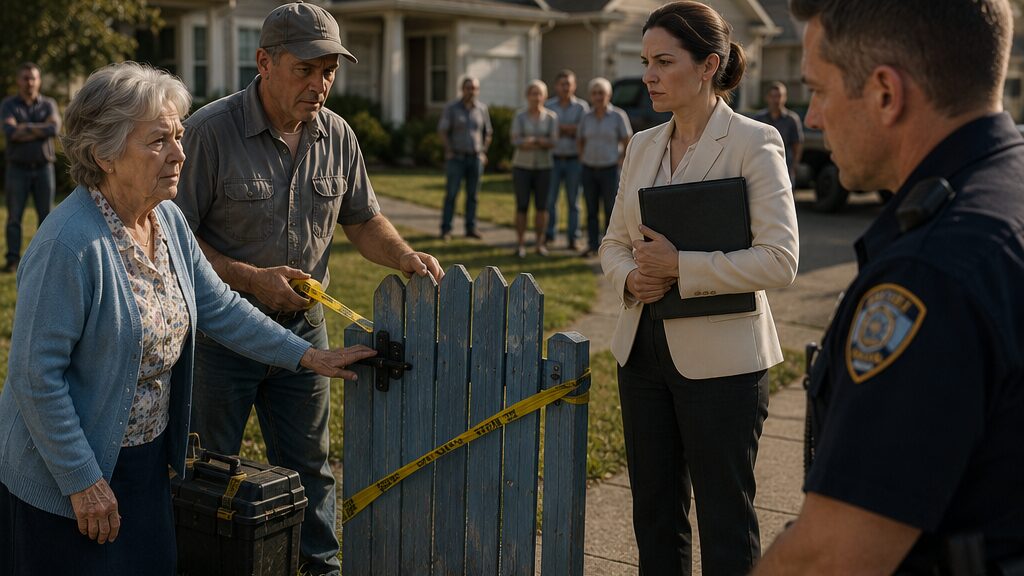
The contractor wound the tape around the left post first, then stretched it across the gate’s face. The yellow crossed the blue like a warning over a body. When he reached the latch, Margaret stepped forward.
“Not there.”
The contractor paused.
Nicole opened her folder. “Mrs. Bennett.”
“Not around the latch.”
“It has to be secured.”
“It is secured. It has been secured for twelve years.”
A few neighbors had come outside now. Not close enough to be involved. Close enough to watch. Katherine stood in her driveway in a pale sweater, one hand at her throat.
The contractor glanced at Nicole.
Nicole lowered her voice. “Please don’t make this harder than it needs to be.”
Margaret laughed once, quietly. It surprised even her.
“You keep saying things like that as if I am the one who brought tape.”
Nicole took a slow breath. “The board has given you every opportunity to handle this privately.”
“Privately?” Margaret looked at the neighbors, the truck, the tools laid out on her grass. “You took a photograph of my gate and put it on a screen with a red circle around it.”
“That was part of the appeal record.”
“It was part of making sure everyone knew what to look at.”
The contractor shifted his weight.
Nicole’s tone cooled. “Mrs. Bennett, the vendor is authorized to remove the noncompliant structure. You do not need to assist, but you cannot obstruct.”
Margaret walked to the gate.
Not quickly. She refused to give them hurry. The contractor held the loose strip of tape in both hands, waiting. Margaret placed her right palm over the latch before he could wrap it.
The metal was warm.
“You can measure it,” she said. “But you cannot take it while I am standing here.”
The contractor looked deeply uncomfortable. “Ma’am, I don’t want any trouble.”
“Then don’t make any.”
Nicole closed her folder. “This is exactly what we were trying to avoid.”
“No,” Margaret said. “You were trying to avoid seeing me.”
The words emptied something in the yard.
Nicole’s eyes flicked toward the neighbors. “I am going to ask you one more time to step away.”
Margaret kept her hand on the latch.
The contractor set the tape down and picked up a measuring tool from his belt. “Maybe I can just start with the fence panel,” he said, trying to ease around the moment.
The short fence segment ran from the gate to the hedge, three narrow blue boards Charles had cut to match the slope of the ground. It was barely long enough to offend anyone. The contractor moved toward it.
Margaret turned, too fast.
Her shoe caught the edge of the path where the concrete had lifted near the root of the old maple. She felt the misstep before the fall, that terrible half-second when the body knows more than the mind can correct. Her hand grabbed for the gate and missed the top rail. Her hip struck the grass first, then her shoulder. The sky tipped white.
Someone shouted.
The phone flew from her cardigan pocket and landed facedown in the lawn.
For a moment, sound went far away.
Then it rushed back all at once—the contractor saying, “I didn’t touch her,” Nicole calling her name, Katherine crying out from the driveway, a car braking at the curb.
Margaret tried to sit up.
Pain flashed along her side, hot and humiliating.
“Don’t move,” Nicole said, kneeling awkwardly near her but not touching. “Mrs. Bennett, please don’t move.”
Margaret pushed at the grass. “Get away from the gate.”
“Forget the gate. Are you hurt?”
The question came too late to be comforting.
A police cruiser pulled up behind Nicole’s sedan. Someone must have called before the fall, or maybe Nicole had arranged for an officer to come by. Margaret could not tell. The driver’s door opened, and an officer stepped out, tall, dark-haired, hand resting near his radio as he took in the scene.
“I’m Officer Reed,” he said. “What’s going on?”
Nicole rose too quickly. “This is a scheduled HOA enforcement action. The homeowner fell while interfering with removal.”
Margaret turned her head. “That is not what happened.”
The officer looked at her, then at the contractor, then at the yellow tape across the blue gate.
“Ma’am, stay still for a second.”
His voice was firm, but not unkind. He crouched beside her. The name on his badge read Thomas Reed.
“Did you hit your head?”
“No.”
“Any chest pain? Trouble breathing?”
“My pride hurts.”
His eyes flickered, almost a smile, then returned to focus. “Anything else?”
“My gate.”
Nicole made a small sound. “Officer, with respect—”
Thomas raised one hand without looking at her. “One thing at a time.”
Margaret liked him for that and resented needing to.
Another officer arrived, speaking into a radio. The neighbors drew closer by inches. Katherine had crossed halfway onto the lawn now, tears visible on her face.
Margaret looked toward her phone.
It lay in the grass near the contractor tape, a few feet from Thomas’s boot.
“My phone,” she said.
“I’ll get it.”
Nicole stepped forward. “Officer, I think we should keep the area clear.”
Thomas looked at her then, and something in his face changed. Not anger. Measurement.
He picked up the phone and turned it over. The screen had lit from the fall. The saved message was open, paused where Margaret had stopped it the night before.
Charles Bennett, Mobile.
Thomas held it toward her. “Is there someone you want me to call?”
Margaret reached, but her hand shook. She hated that. She hated the tremor more than the pain.
“I can hold it,” he said.
Her thumb touched the screen by accident or by decision. She never knew which.
The recording began.
Static. Wind.
Then Charles’s voice came out small and tinny in the bright morning.
“Margie, I’m at the hardware store, and before you tell me we don’t need another can of paint, they had the blue on sale.”
The yard went still.
Margaret closed her eyes.
No one moved. Even the contractor seemed to stop breathing.
Charles chuckled through the speaker, the sound worn by years and storage and distance.
“I checked the latch again before I left. I fixed it low enough so you can open it even on the hard mornings.”
Thomas looked from the phone to the gate.
Margaret opened her eyes. His face had changed, just as the morning had changed, not into softness exactly, but into attention.
The recording kept playing.
There was a pause. Charles breathed, a thin sound he had tried to hide.
“And if one day I’m not there to walk out with you—”
Margaret’s hand shot up.
“Stop it.”
Thomas stopped the recording at once.
Her breath came ragged. The words had escaped farther than she meant them to. Too much of him was in the grass now. Too many strangers had heard.
Nicole stood frozen beside the path, folder hanging at her side.
Katherine covered her mouth.
Margaret tried again to sit. Pain caught her ribs and bent her forward.
Thomas put a steadying hand near her shoulder, not forcing, only there. “Easy.”
“I am not confused,” Margaret said. Her voice came low, but clear enough for the yard to hear. “I know what day it is. I know what that notice says. I know that gate is not the right shade of approved white.”
No one answered.
The contractor looked at his tape on the latch as if it had become something else in his hands.
Margaret turned her face toward Nicole.
“You thought it was ugly,” she said.
Nicole’s lips parted, but no words came.
Thomas looked at the yellow tape, then at Nicole’s folder, then back at Margaret.
“Ma’am,” he said quietly, “do you want medical called?”
“No.”
Rachel’s car came around the corner too fast and stopped crooked behind the cruiser.
Margaret saw her granddaughter jump out before the engine fully quieted.
“Grandma!”
Rachel ran across the lawn, face white with fear. She dropped to her knees beside Margaret and touched her arm, her hair, her shoulder, as if counting what remained.
“I told you not to come,” Margaret whispered.
Rachel’s eyes filled. “I didn’t listen.”
Margaret almost smiled.
Thomas rose, still holding the phone. Nicole stepped toward him with the brittle composure of someone trying to recover procedure.
“Officer, the board has authority to remove the structure. This situation is unfortunate, but—”
Thomas looked down at the phone in his hand, then at Margaret on the grass beneath the blue gate crossed in yellow tape.
“I understand you have paperwork,” he said. “But right now, nobody is removing anything.”
Nicole stared at him.
“That isn’t your decision.”
“No,” Thomas said. “It’s my scene. And until I’m satisfied nobody’s being endangered here, the tools stay in the truck.”
Behind Margaret, the gate moved slightly in the breeze.
The yellow tape scratched against the latch.
Chapter 5: The Voice On The Grass Changed The Officer’s Face
Rachel wanted an ambulance.
Margaret wanted everyone off her lawn.
Neither of them got exactly what they wanted.
A paramedic came because Thomas called one despite Margaret saying no, and the contractor put his tools back in the truck because Thomas told him to do that in a voice that did not invite conversation. Nicole stood near the sidewalk making phone calls in clipped phrases. The second officer kept the neighbors from drifting closer, though nothing could stop them from watching from driveways and porch steps.
Margaret sat on the grass with Rachel’s cardigan folded beneath one elbow. Her own blue cardigan had a grass stain along the sleeve. That bothered her more than it should have. She kept rubbing at it with two fingers until Rachel gently took her hand.
“Stop,” Rachel said. “You’ll make it worse.”
Margaret looked at her. “I have heard that advice today.”
Rachel’s mouth trembled.
“I’m sorry,” she said.
“For what?”
“For thinking this was easier than it was.”
Margaret looked away.
The paramedic asked questions Margaret answered impatiently. Name. Date. Pain level. Dizziness. Did she lose consciousness. Had she taken blood thinners. Rachel answered one question at the same time Margaret did, and Margaret gave her a look that made the paramedic hide a smile.
“I’m allowed to know your medications,” Rachel said.
“You are allowed to know less loudly.”
The paramedic recommended evaluation at urgent care. Margaret refused the ambulance but agreed, under Rachel’s fierce silence, that she would be driven after the yard cleared. She did not want to leave while the contractor’s truck remained at the curb.
Thomas returned with her phone.
He had not pocketed it. He carried it carefully, screen dark, as if it were evidence or a small sleeping thing.
“Mrs. Bennett,” he said, crouching again so she did not have to look up too far. “I’m going to give this back to you.”
Margaret held out her hand.
He placed it in her palm.
“Did I say anything I shouldn’t have?” she asked.
“No, ma’am.”
“That recording was private.”
“I understand.”
“No,” she said, sharper than she intended. “You heard it. That doesn’t mean you understand it.”
Thomas accepted that with a small nod.
Rachel looked between them. “What recording?”
Margaret did not answer.
Nicole ended her call and approached before Thomas could speak again.
“Officer Reed, I spoke with the management company. They confirmed the board is within its rights to proceed. The vendor has other jobs today, and we can’t simply delay because Mrs. Bennett became upset.”
Rachel rose so quickly Margaret reached for her sleeve and missed.
“Became upset?” Rachel said.
Nicole’s eyes flicked to her. “I’m sorry. I didn’t mean—”
“She fell while someone was taping off her gate.”
“No one touched her.”
“I didn’t say they did.”
Nicole’s face showed strain now. The polished meeting-room calm had thinned in the heat. “This is exactly why we requested enforcement. We were concerned the removal might become unsafe.”
“You made it unsafe,” Rachel said.
Thomas stepped between them slightly, not blocking, just shifting the shape of the conversation.
“We’re not going to solve the HOA matter on the lawn,” he said. “Ms. Harris, do you have documentation showing removal authorization?”
Nicole held out her folder.
Thomas read the top page. Margaret watched his eyes move over the printed words, the rule numbers, the dates, the signatures. Paper always looked so confident until someone had to apply it to a person.
He turned one page.
Then another.
“The homeowner was notified,” Nicole said.
“I see that.”
“She was given appeal rights.”
“I see that too.”
“And the board voted.”
Thomas closed the folder. “I’m not disputing your process.”
Nicole’s shoulders lowered a fraction.
“But I’m also not letting a removal continue today after a medical incident and escalating conflict.”
“Escalating because she obstructed.”
Rachel made a sound, but Margaret squeezed her hand before she could speak.
Thomas’s voice remained even. “Escalating because everyone here can see this is not just about a gate.”
Nicole looked toward the blue boards, still crossed by yellow tape. For a second, something unguarded passed over her face—confusion, perhaps, or frustration at being asked to see what she had trained herself not to see.
Then she said, “Personal attachment does not cancel community rules.”
“No,” Thomas said. “But it may affect how reasonable people enforce them.”
The second officer shifted near the sidewalk. The contractor leaned against his truck with both hands in his pockets, pretending not to listen.
Margaret felt suddenly tired.
She had wanted them to stop. Now that they had, even temporarily, she did not know where to put the force of her resistance. Her side ached. Her arm trembled. The whole neighborhood had seen her on the ground.
Her phone rested in her lap.
Rachel followed her gaze.
“Grandma,” she said softly. “Was that Grandpa?”
Margaret closed her hand around the phone.
Nicole heard. Her expression altered again, not softened fully, but touched by the inconvenience of humanity.
“Mrs. Bennett,” Nicole said, “I truly am sorry for your loss. I lost my father last year, and I know objects can feel—”
“Do not finish that sentence,” Margaret said.
Nicole stopped.
Margaret looked at her over Rachel’s shoulder.
“You know objects can feel like what? Like people? Like anchors? Like excuses? Like clutter nobody else is brave enough to throw away?”
Nicole swallowed. “I was going to say important.”
“No, you weren’t.”
The words left Margaret before she could make them polite. Once spoken, they hung there, plain and not entirely fair.
Nicole’s face flushed.
Margaret saw it and felt a small sting of shame. Nicole was wrong. That did not mean every word Margaret threw at her became right.
But the yellow tape on the latch kept moving in the breeze, rasping.
Thomas glanced toward it. “Can that tape come off for now?”
The contractor looked to Nicole.
Nicole looked at Margaret.
It was such a little thing, that pause. Such a clear thing too.
Margaret saw the chain of permission: contractor to Nicole, Nicole to the rules, rules to a board, board to documents, documents to nobody’s hands. For twelve years she had opened the gate by herself. Now a strip of tape waited for permission to stop hurting her.
Nicole nodded.
The contractor walked over and began unwinding the tape from the post. When he reached the latch, he worked carefully. The tape had stuck to the place where the first strip had taken paint with it. He slowed, but not enough.
Another fleck of blue lifted.
Margaret made a sound despite herself.
The contractor froze.
“I’m sorry,” he said.
He sounded like he meant it.
Margaret nodded once because she could not speak.
Katherine stepped forward from the edge of the yard.
“Margaret,” she said.
Margaret did not look at her.
Katherine came no closer. “I should have said something at the meeting.”
Nicole turned toward her. “Katherine—”
“No.” Katherine’s voice shook, but she kept going. “I should have.”
Margaret looked up then.
Katherine’s eyes were red. “I remember Charles building it. I remember why.”
Nicole’s face tightened. “This is not the appropriate time.”
“It never seems to be,” Katherine said.
For one clear second, Margaret saw the woman who used to come through the yard with tomatoes, who had sat on the porch with Charles while he tested the latch, who had brought soup after the funeral and cried into a napkin because she said good neighbors were not supposed to become memories.
Then Katherine looked away first.
Thomas handed Nicole her folder back.
“Here’s what’s going to happen,” he said. “Medical has recommended Mrs. Bennett be evaluated. The vendor is leaving. The removal is paused for today.”
Nicole’s mouth opened.
Thomas raised a hand. “I’m not making an HOA ruling. I’m making a safety call. If you want to reschedule, you can do that through whatever process you use. But I strongly suggest you hold off until everyone has had a chance to cool down and clarify what’s being removed and why.”
Nicole’s voice was quiet. “The board will need to respond.”
“I’m sure it will.”
Margaret looked at Thomas. “You’re not saving my gate.”
“No, ma’am,” he said. “I’m stopping today from getting worse.”
She appreciated the distinction.
Nicole stepped back toward the sidewalk and made another call. This time her voice was lower, and Margaret caught only pieces.
Medical incident. Temporary delay. Liability concern.
There it was. Not mercy. Not recognition. Liability.
Still, the contractor closed the truck bed. The drill case disappeared. The tape, now crumpled, went into a bucket.
The paramedic helped Margaret stand. Rachel held her other arm. Margaret hated every second of it and needed both of them.
Once upright, she looked at the gate.
Without the tape, it seemed smaller. Not safe, exactly. Just itself again, with two fresh wounds where paint had lifted near the latch.
Margaret stepped toward it.
Rachel tightened her grip. “Grandma.”
“I’m not going anywhere.”
She reached out and touched the damaged paint. The bare wood underneath was pale, almost new-looking despite its age. Charles had always said wood kept its first color inside, no matter what weather did to the surface.
Her phone buzzed in her hand.
A message from Nicole, though Nicole stood only yards away.
The board will postpone removal for 48 hours pending review. This does not waive enforcement rights.
Margaret read it, then looked up.
Nicole was watching her.
For the first time all morning, Margaret saw uncertainty in the younger woman’s face. Not surrender. Not apology. But the first hairline crack in certainty.
Margaret slid the phone into her pocket.
“Forty-eight hours,” Rachel said after reading over her shoulder.
Margaret looked at the gate.
Forty-eight hours was not grace. It was a pause between blows.
But it was time.
And sometimes time was the only mercy procedure accidentally gave.
Chapter 6: Katherine Remembered Who Painted The First Board
Katherine came over the next afternoon with a covered dish and no courage to offer it.
Margaret saw her through the front window standing at the blue gate, casserole held in both hands, staring at the latch as if it might accuse her. The white dish towel tucked around the pan lifted slightly in the breeze. Katherine did not open the gate.
Margaret watched longer than she should have.
Her side hurt from the fall. Urgent care had found no fracture, only bruising that would darken before it healed and instructions to rest that Margaret had already decided were suggestions. Rachel had stayed the night on the couch and left at noon after extracting promises Margaret had phrased loosely enough to survive.
No ladders.
No arguments alone.
Call if Nicole contacts you.
Margaret had agreed to all three while intending to interpret the middle one according to circumstance.
Now Katherine stood at the gate.
Margaret opened the door.
Katherine looked up, startled. “I didn’t want to bother you.”
“You’re standing in my yard with dinner.”
A faint, ashamed smile moved across Katherine’s face. “Chicken and rice.”
“You always did bring chicken and rice when you didn’t know what to say.”
“That obvious?”
“After thirty years, yes.”
Margaret came down the porch steps slowly. Katherine’s eyes followed each careful movement, but she had the sense not to offer an arm.
At the gate, the two women stood on opposite sides.
Katherine looked at the chipped paint near the latch. Her face tightened.
“I saw that happen.”
“So did everyone.”
“I should have come sooner.”
“Yesterday or six months ago?”
Katherine flinched.
Margaret regretted the precision of it and kept it anyway.
Katherine shifted the pan. “Both.”
The street was quiet except for a leaf blower somewhere beyond the next block. Fairbridge Glen always had a machine running. Mowers, blowers, trimmers, pressure washers. The sound of keeping nature acceptable.
Margaret lifted the latch and opened the gate inward.
Katherine stepped through.
For a moment, neither of them moved toward the house. Katherine looked at the gate from inside the yard, where the blue seemed softer, less like a violation and more like shade.
“He painted the first board twice,” Katherine said.
Margaret’s hand tightened on the latch.
Katherine nodded toward the leftmost slat. “That one. He said the grain drank the color wrong.”
Margaret looked at the board.
She had forgotten Katherine was there that day.
Charles had set the first board across two sawhorses in the driveway. Katherine had come over with a bag of peaches and ended up holding the paint can while Charles argued with himself about brush marks. Margaret, still sore from the fall and furious about needing a cane, had sat on the porch pretending not to watch.
“He told me not to tell you he was nervous,” Katherine said.
Margaret let out a small breath. “Charles was never nervous about wood.”
“He was nervous about you hating it.”
Margaret looked away.
Katherine held the casserole like a shield. “He said if he made it look too much like a railing, you’d refuse to use it. If he made it look like part of the garden, maybe you’d forgive him.”
The memory returned with uncomfortable clarity: Charles pretending the gate was for the roses, not for her. Charles saying the old opening had annoyed him anyway. Charles measuring her reach when she was distracted, then lying badly when she caught him.
“He was a terrible liar,” Margaret said.
“The worst.”
They stood with the gate open between them and the street.
Katherine’s eyes filled. “Margaret, I’m sorry.”
Margaret closed the gate. The latch clicked.
“For what exactly?”
The question made Katherine look older.
“For complaining,” she said. “Not at first. Not formally. But I said something last year to the landscaping committee. About inconsistent front features. I didn’t name you.”
Margaret said nothing.
“They were talking about resale values after the Millers moved out. Someone mentioned mailboxes, someone mentioned porch lights, and I said the board had let too many little things slide. I didn’t mean—”
“The gate.”
“I saw Nicole write it down.” Katherine’s voice thinned. “I knew as soon as she did. And I didn’t stop her.”
Margaret felt the bruise along her side pulse.
A neighbor’s careless sentence could become a committee note. A committee note could become a photograph. A photograph could become a red circle. A red circle could become yellow tape around a latch.
Katherine wiped under one eye with the back of her wrist. “I told myself it wasn’t personal.”
Margaret almost laughed. The phrase seemed to be spreading through Fairbridge Glen like mold.
“And was that comforting?”
“For a while.”
Margaret turned toward the porch. “Bring the chicken in.”
Katherine followed.
Inside, the kitchen held the soft disorder of Rachel’s worry: an extra blanket folded over a chair, a pharmacy bag by the toaster, a glass Rachel had used and washed but left on the drying mat. Katherine placed the casserole on the counter and looked at the little square of blue-painted wood hanging below the calendar.
Her lips parted.
“You kept that?”
Margaret took two plates from the cabinet. “Charles kept everything first. I only failed to throw it away after.”
Katherine stepped closer to the paint square. “His thumbprint.”
“Yes.”
They ate at the kitchen table, though neither had much appetite. Katherine spoke in small pieces, each one placed carefully between them.
She had been lonely after her own divorce, though she did not use that as an excuse. She had resented how Margaret’s house seemed full even after Charles died. She had thought rules might keep the neighborhood from changing too quickly, then watched rules become a way to smooth away anything with a story.
Margaret listened, not forgiving, not refusing to.
Outside, a car slowed in front of the house.
Both women turned.
Nicole’s silver sedan passed without stopping.
Katherine set down her fork. “She’s calling an emergency board vote.”
Margaret looked at her.
“How do you know?”
“She called me this morning. She wanted a statement confirming that the gate has been discussed as a neighborhood concern before yesterday.”
Margaret’s appetite vanished completely.
“And what did you say?”
Katherine folded her napkin, unfolded it, then folded it again. “I said yes.”
Margaret stared at her.
Katherine looked up quickly. “Then I said I also needed to state that I knew why Charles built it.”
Margaret sat very still.
Katherine’s voice shook. “Nicole said emotional context wasn’t relevant to the compliance question.”
“Of course she did.”
“But she sounded different when she said it.”
Margaret looked toward the hallway closet where the metal recipe box sat on the shelf. All those notices. All those words. Relevant. Noncompliant. Authorized. Corrective action.
“What does the emergency vote do?” she asked.
“It can authorize permanent removal after the forty-eight-hour pause. Nicole wants it clean. Proper. No contractor acting under the previous order, no confusion after the police report.”
“Clean,” Margaret said.
Katherine looked ashamed. “Tomorrow evening.”
Margaret rose from the table.
Her side caught, and she gripped the chair until the pain passed. Katherine half-stood but did not reach for her. Good. At least she remembered one thing.
Margaret went to the hallway closet and took down the metal recipe box. It felt heavier than before, as if paper gained weight when ignored.
She brought it back to the kitchen table and opened it.
Katherine watched as Margaret removed the violation letters, the fine schedules, the hearing notice, the final notice. Beneath them lay the faded hardware store receipt Charles had saved, the one with the date printed faintly at the top and the paint code circled in pencil.
Margaret had not looked at it in years.
Katherine leaned closer. “That’s the blue?”
Margaret nodded.
At the bottom of the receipt, in Charles’s blocky handwriting, was one line.
Low latch. Smooth handle. No asking.
Katherine covered her mouth.
Margaret touched the words once.
There was no magic in them. They would not force Nicole to care. They would not rewrite the covenants. They were not a court order or an exemption or proof of anything except that Charles had known exactly what he was building.
But proof was not the same as permission.
Margaret took her phone from her pocket and opened the voicemail again. Her thumb hovered over the play button.
Katherine whispered, “Are you going to let them hear it?”
Margaret looked at the phone, then at the receipt, then through the window toward the blue gate standing in its small square of afternoon light.
“No,” she said.
Katherine’s shoulders fell.
Margaret closed the phone.
“Not unless I decide the room deserves him.”
Katherine nodded slowly.
Margaret gathered the papers into a stack, but this time she did not put them away. She left them on the table beside the receipt and Charles’s handwriting.
Tomorrow, Nicole would bring rules.
Margaret would bring the gate.
Chapter 7: Margaret Refused The Exception They Offered
The emergency meeting was moved from the small community room to the clubhouse hall because too many residents wanted to attend.
Nicole announced the change in an email at noon, using words like safety, capacity, and orderly participation. Margaret read the message twice and understood the part Nicole had not written: the lawn had made the gate public in a way the board had not planned.
By six-thirty, the parking lot was half full.
Rachel drove Margaret and said almost nothing on the way. That was new. Her granddaughter had always filled worry with words, stacking them one on top of another until silence had nowhere to sit. Tonight she kept both hands on the steering wheel and glanced at Margaret only when they stopped at lights.
Margaret wore the same blue cardigan, washed but still faintly stained at one sleeve. The bruise along her side had turned purple and yellow beneath her blouse. She had taken two pain tablets with tea and refused Rachel’s suggestion of the cane.
“You can lean on me,” Rachel said as they parked.
“I know.”
“That wasn’t an instruction.”
Margaret looked at her. “I know that too.”
Rachel got out first and came around anyway, not reaching, just waiting. Margaret accepted the waiting.
Inside, the clubhouse hall hummed with uncomfortable voices. Folding chairs had been arranged in rows facing a long table where Nicole sat with the board. On an easel beside the table was another photograph of Margaret’s gate. This one had no red circle. It did not need one. Everyone knew where to look.
Katherine sat near the aisle. When she saw Margaret, she stood.
Rachel stiffened beside her, but Margaret touched her arm lightly.
“Not tonight,” Margaret said.
Rachel swallowed whatever she had been ready to say.
Katherine held out the aisle seat. “I saved it in case you wanted it.”
Margaret looked at the chair, then at Katherine.
This was not forgiveness. Not yet. But there were different kinds of standing beside a person, and some arrived late because fear made them slow.
“Thank you,” Margaret said, and sat.
Rachel sat on her other side.
At seven, Nicole tapped the microphone. The sound cracked through the room and made everyone settle.
“This emergency session concerns the enforcement pause at 1148 Willow Bend Lane,” she began. “The board recognizes that Friday’s attempted correction became distressing. We are grateful Mrs. Bennett was not seriously injured.”
Margaret watched Nicole’s hands. They were folded tightly over a printed agenda.
“Before any vote,” Nicole continued, “I want to clarify that the board’s role is not to judge personal grief or sentimental value. Our obligation is to enforce standards consistently.”
There it was again, polished and placed.
A few people nodded. Others looked at Margaret and quickly away.
Nicole lifted a paper. “However, after consultation with the management company, the board is prepared to offer Mrs. Bennett a temporary personal accommodation. If she agrees to repaint the gate in an approved color, remove the attached fence segment, and sign an acknowledgment that the structure will not transfer with the property upon sale, the board will defer full removal for twelve months.”
Rachel leaned toward Margaret. “That’s something.”
Margaret kept looking at Nicole.
A temporary personal accommodation.
The room seemed to wait for gratitude.
Nicole looked directly at her. “Mrs. Bennett, this would allow you time to adjust while preserving the board’s ability to enforce the rule going forward.”
Time to adjust.
Margaret had heard those words after Charles died. The funeral director had said grief took time. The doctor had said the house might need adjustments. Rachel had said, gently, that Margaret should give herself time before making decisions.
No one ever seemed to understand that sometimes time did not adjust a person away from love. Sometimes it taught the hands exactly where grief lived.
Nicole set down the paper. “Would you like to respond?”
Rachel’s hand found Margaret’s under the row of chairs.
Margaret stood slowly.
Pain pulled at her side, but she did not show it. The microphone at the aisle was too tall. A board member hurried to lower it, but Margaret reached first and adjusted it herself.
The room quieted.
She had brought the metal recipe box in a canvas tote. Rachel had offered to carry it. Margaret had refused. Now she set the tote on the small table beside the microphone and took out three things: the hardware receipt, the square of test-painted blue wood, and her phone.
Not the photograph of Charles. That remained at home. His face was not for them.
“I appreciate the offer,” Margaret said.
Her voice sounded rough, but steady.
Nicole inclined her head.
“I’m refusing it.”
A ripple moved through the hall. Rachel’s hand lifted toward her mouth, then lowered.
Nicole blinked. “Mrs. Bennett, I would encourage you to consider—”
“No.”
The word did not come loudly. It did not need to.
Margaret placed the painted square on the table. Its blue looked small beneath the hall lights.
“I am not asking to be excused because I am sad,” she said. “I am not asking the neighborhood to keep every broken thing because someone once loved it. I know houses change. I know paint fades. I know wood rots if no one cares for it.”
She looked toward the gate photograph.
“That gate needs repair. The left post is loosening. The paint by the latch is damaged. The fence board nearest the hedge should be reinforced. I know that because I open it every day.”
Nicole’s face shifted, perhaps surprised by the admission.
Margaret picked up the receipt.
“My husband wrote this before he died. Low latch. Smooth handle. No asking.”
The room went still.
She did not look at Katherine. She did not look at Rachel. If she did, she might lose the small, hard road her voice was walking.
“He built it after I fell because everyone wanted to protect me by reducing the parts of my life I could reach. He did not make me a monument. He made me a way out of my own front yard.”
The words trembled at the edge. She slowed.
“Your rules saw a color. A height. A nonconforming structure visible from the street. That is what rules do when no one asks them to look harder.”
Nicole’s eyes dropped to the agenda.
Margaret turned slightly toward the rows behind her.
“Yesterday, Officer Reed stopped the removal because I was on the ground and people were afraid of liability. That is not dignity. That is fear of paperwork.”
A quiet, uneasy laugh moved through one corner of the room and died quickly.
“I do not want a private exception that disappears when I die or sell my house. I do not want my gate hidden, repainted white, or treated like something the neighborhood is generously tolerating until I am gone.”
Her hand closed around the phone, but she did not play the voicemail.
Not yet.
“I am asking this board to create a hardship and legacy review for structures that serve accessibility, safety, or long-standing personal history. Require inspection. Require maintenance. Require repairs. I will meet those. But stop pretending fairness means treating a handmade gate, a wheelchair ramp, a memorial bench, and a decorative nuisance as if they are all the same problem.”
Nicole’s lips parted.
Margaret lifted the painted square.
“This color was approved by no committee. It was approved by the man who knew my hand shook worse in the mornings and sanded the handle until it did not hurt me.”
Rachel began to cry silently beside the chair.
Margaret placed the square down again.
“If you vote tonight to remove it, then vote knowing what you are removing. Not clutter. Not stubbornness. Not an old woman’s refusal to update. You are removing the last thing my husband built so I could keep walking out under my own power.”
For a moment, no one moved.
Then a board member spoke into his microphone. “Mrs. Bennett, are you submitting that as a formal motion?”
Nicole turned sharply toward him.
Margaret looked at the man, then at Nicole.
“I don’t know your procedure well enough.”
Nicole’s jaw tightened. Then, after a long pause, she said, “Homeowners cannot make board motions. But a board member may.”
The board member looked down the table. “Then I move that we postpone removal pending review of a proposed hardship and legacy exterior structure policy, and that Mrs. Bennett be allowed to submit a repair and safety plan for the gate within thirty days.”
The room shifted again, this time with the sound of something being reconsidered.
Nicole stared at him. “This was not on the agenda as a policy vote.”
“No,” he said. “The removal was. I’m moving to postpone it.”
Another board member seconded.
Nicole sat very still.
Margaret saw the conflict in her face then. Not cruelty. Calculation, pride, weariness, and something like embarrassment. Nicole had built herself around even lines and equal rules. Margaret had placed a human hand on the ruler.
Discussion opened.
Some residents complained about slippery slopes. Some asked about ramps. One man worried about resale values and was answered, unexpectedly, by Katherine, who stood and said, “I would rather live on a street where people remember one another.”
Her voice shook, but she said it.
Rachel rose only once, to say that safety repairs could be done without erasing the original work. She did not tell Margaret’s story for her. She simply offered to help find an inspector.
Nicole listened with her eyes lowered.
At last, she spoke.
“I still believe the board must be careful,” she said. “But I also believe consistency without judgment can become its own kind of negligence.”
The sentence cost her. Margaret could hear it.
Nicole looked at her. “Mrs. Bennett, if this motion passes, the gate is not automatically approved. It must be inspected and repaired.”
“I said that.”
“And the policy may not protect every structure residents care about.”
“It shouldn’t.”
Nicole studied her.
Then she called the vote.
Hands lifted along the board table. One against. Four in favor. Nicole hesitated last, then raised her hand too.
The motion passed.
There was no applause. Margaret was grateful for that. Applause would have made the room feel too easy, too eager to turn discomfort into celebration.
Instead, people stood slowly. Chairs scraped. Conversations started in low voices. Nicole gathered her papers without looking up.
Margaret put the receipt, painted square, and phone back into the tote.
Rachel hugged her carefully. Margaret allowed it.
When Rachel pulled away, Nicole stood in front of them.
For a moment, neither woman spoke.
Then Nicole said, “I should have come to your house before the first fine.”
Margaret looked at her.
“Yes,” she said.
Nicole accepted the answer. “I’m sorry.”
Margaret did not rush to absolve her. She had learned that quick forgiveness sometimes served the person asking more than the person harmed.
“I believe you are beginning to be,” Margaret said.
Nicole’s eyes shone, but she nodded.
Outside, the night air was cool. Rachel offered her arm. This time Margaret took it, not because she could not walk, but because accepting steadiness was not the same as surrender.
At the car, Rachel opened the passenger door.
“Grandma,” she said, “you didn’t play the rest of the voicemail.”
Margaret settled into the seat and held the tote on her lap.
“No.”
“Why not?”
Margaret looked through the windshield at the lit clubhouse windows, where neighbors still moved behind glass.
“Because I was enough.”
Rachel closed her eyes, and a tear slipped down her cheek.
Margaret reached over and patted her hand.
Then she looked down at the tote, where Charles’s words rested among paper, paint, and the phone she had chosen not to use.
For the first time since the notice appeared, the gate felt less like something she was defending from the world and more like something she had carried into it.
Chapter 8: What Remained Visible From The Street
The new post went in on a Tuesday morning, three weeks after the emergency vote.
The contractor was not the same man who had come with the yellow tape. Margaret noticed that first and was relieved by it, then annoyed at herself for caring. This contractor was older, with sun-browned forearms and a habit of asking before touching anything.
“Original latch stays?” he asked.
“Yes.”
“Original handle?”
“Yes.”
“These three boards?”
“The left one especially.”
He nodded each time and marked his notes with a carpenter’s pencil.
Rachel stood nearby with coffee for everyone and a folder of inspection paperwork tucked under one arm. She had become very good at saying little while making sure nothing important went missing. The safety inspector had come the week before, gently tested the gate, frowned at the loose post, and said the structure was repairable if reinforced properly.
Repairable.
Margaret had slept better after that word than after any pill.
Katherine came over with a tray of muffins and stood on the public side of the gate until Margaret opened it.
“You can come in,” Margaret said.
Katherine’s smile was small. “I thought I’d wait to be invited.”
Margaret considered her. “That may be wise for a while.”
“Yes,” Katherine said. “I thought so.”
But she came in, and Margaret did not regret opening the gate.
Nicole arrived later with two rolled documents and no blazer. She wore a plain cotton shirt, and her hair was clipped back loosely. Without the board table in front of her, she looked less like an office and more like a tired woman trying to repair something she had not known she was breaking.
“I don’t need to supervise,” she said. “I just wanted to bring the stamped approval.”
Rachel accepted the papers, scanning them with the intensity of someone who no longer trusted official language to behave itself.
Nicole turned to Margaret. “The board approved the provisional hardship and legacy review. Six-month trial. It will need a full vote at the annual meeting.”
“Rules do enjoy having more meetings,” Margaret said.
Nicole’s mouth curved faintly. “They do.”
The contractor removed the weakened post first. Margaret had thought she was prepared. She was not.
When the old post came free, dark soil clinging to its base, she felt the loss in her knees. Charles had dug that hole too shallow the first time, cursed the clay, then dug it deeper while Margaret sat on the porch pretending to read. He had come inside that night with dirt behind one ear.
The contractor laid the post gently on the grass.
“Do you want to keep any of this?”
Rachel looked toward Margaret.
Nicole looked away, giving privacy too late but giving it.
Margaret walked to the old post and touched the weathered top. It was softer than it should have been, rot beginning where rain had found its way under paint. Keeping it in the ground would not have honored Charles. It would only have allowed what he built to fail.
“No,” she said.
The word hurt less than she expected and more than she wanted.
“Take that part.”
The contractor nodded.
The new post was cedar, stronger, set deeper, hidden behind the original boards once finished. The left board stayed. The latch stayed. The handle stayed, removed and reattached with careful screws. The blue paint could not be matched exactly, though Rachel had brought the old paint code and the square with Charles’s thumbprint. The paint store mixed a shade close enough to make Margaret quiet when she saw it.
Not identical.
Alive things rarely were.
By noon, the gate stood again.
It looked like itself and not itself. Straighter. Stronger. The old handle sat against fresh paint. The first board bore its weather honestly. Near the latch, where the tape had lifted the color, the contractor had sanded the edges smooth and sealed the spot beneath a thin coat that left the scar faintly visible if one knew where to look.
Margaret knew.
She was glad.
Nicole stood at the sidewalk, studying it from the street. “It’s still blue.”
Margaret glanced at her.
Nicole added quickly, “I mean that as an observation.”
“It is still blue,” Margaret said.
“The approved record says heritage blue.”
“Is that what we’re calling it?”
Nicole looked embarrassed. “The board thought it needed a category.”
“Of course it did.”
Rachel laughed softly.
The sound loosened something in the yard.
A few neighbors passed during the afternoon. Some slowed to look. One called that it looked nice. Another asked the contractor for his card. The man who had worried about resale values drove by without turning his head.
Margaret found she did not mind.
After the contractor packed up, Rachel took photos for the file. Nicole gave a copy of the approval to Margaret and another to Rachel. Katherine carried the empty muffin tray home and returned, without being asked, to sweep sawdust from the walkway.
No one made speeches.
No one applauded.
By late afternoon, the front yard was quiet again.
Rachel had to leave before dinner. She hugged Margaret on the porch, careful of the bruising that had faded to yellow along her side.
“Call me if it hurts more.”
“It will hurt the same whether I call you or not.”
“Call me anyway.”
Margaret smiled. “Bossy child.”
“Stubborn grandmother.”
Rachel kissed her cheek and walked down the path. At the gate, she stopped and rested her hand on the latch.
“I used to swing on this when Grandpa wasn’t looking,” she said.
“He knew.”
Rachel looked back. “He did?”
“He said if you broke it, he’d make you help rebuild it.”
Rachel laughed, but her eyes shone. She opened the gate, stepped through, and closed it gently behind her.
Margaret watched her drive away.
Evening came slowly. The lawns turned gold, then green-gray. Porch lights clicked on up and down Willow Bend Lane. Somewhere, a sprinkler began its familiar ticking arc.
Margaret went inside and made tea.
The phone sat on the kitchen table beside the metal recipe box. For weeks, it had felt like a locked room. Tonight she picked it up without dread.
She opened the saved message.
Charles’s name appeared on the screen.
For a long moment, she only looked at it.
Then she pressed play.
The familiar static came first. The wind. His voice teasing her about blue paint. His chuckle. The line that had escaped onto the lawn.
“I checked the latch again before I left. I fixed it low enough so you can open it even on the hard mornings.”
Margaret sat at the table.
This time, she did not stop the recording.
There was the pause. The breath he had tried to hide.
“And if one day I’m not there to walk out with you, I don’t want you waiting by the door for someone else to decide when the world is safe enough. Open the gate, Margie. Even if it’s just for the mail. Even if it’s just to tell the roses they look dramatic. Promise me you’ll keep opening it.”
The message continued with a rustle, a car door chime, then his softer laugh.
“And don’t pick the darker blue. You’re right. Dirt is a terrible reason to choose a color.”
The recording ended.
Margaret stared at the phone until the screen dimmed.
She had never played that last part for Rachel. She had not played it for the board. She had not needed to. Some promises lost their shape when offered as evidence. Some stayed truer when carried privately.
She saved the message again, though it was already saved.
Then she took the little painted square from the wall, held it in both hands, and studied the thumbprint Charles had left. The gate outside was repaired. The rule was changed, at least enough to make space for people before paint charts. Nicole would have more meetings. The board would argue over language. Residents would test the limits. Life would complicate what had been simple for one night.
That was all right.
Simple rules had nearly taken the gate.
Complicated mercy might keep others standing.
Margaret returned the painted square to its hook and carried her tea to the porch.
The evening air had cooled. The repaired gate stood at the end of the walk, blue in the last light, visible from the street. Not hidden. Not white. Not untouched. The new post held straight. The old latch caught the glow from the porch lamp.
Margaret went down the steps.
She did not hurry. She did not perform slowness either. Her hand found the rail for the last step, then let go.
At the gate, she placed her palm over the handle.
Smooth.
Charles’s work. The contractor’s work. Her own insistence. All of it there beneath her hand.
Across the driveway, Katherine lifted a hand from her porch. Margaret lifted hers back, then opened the gate.
The latch rose easily.
The gate swung inward without scraping.
Margaret stepped through to the sidewalk and stood for a moment facing the street. Cars rested in driveways. Porch flags stirred faintly. The neighborhood looked almost the same as it always had, which was to say it looked changed only to someone who knew where to see it.
Behind her, the gate waited open.
Margaret walked to the mailbox. She took out a grocery flyer, a utility bill, and a small envelope from the HOA. For a second, old fear tightened in her chest. Then she opened it under the streetlight.
Inside was a copy of the approved repair record.
At the bottom, under exterior notes, someone had typed: Existing blue gate preserved under hardship and legacy review, homeowner-maintained, visible from street.
Visible from street.
Margaret folded the paper once and held it against her chest.
Then she walked back under her own power, opened the blue gate, and went home.
The story has ended.