The Child Who Wouldn’t Look Away
The Child Who Wouldn’t Look Away
Part I — The Loudest Quiet in the Room
By the time the little girl said it, everyone in the diner had already noticed him.
Noticed, then looked away. Noticed, then pretended not to stare. Noticed, then hidden their curiosity inside the ordinary sounds of lunch.
The roadside diner was full enough to feel crowded but not full enough to hide anyone. Red vinyl booths lined the windows. Waitresses moved between tables with coffee pots and practiced smiles. Silverware clinked against plates. A television over the counter murmured a baseball game no one was really watching.
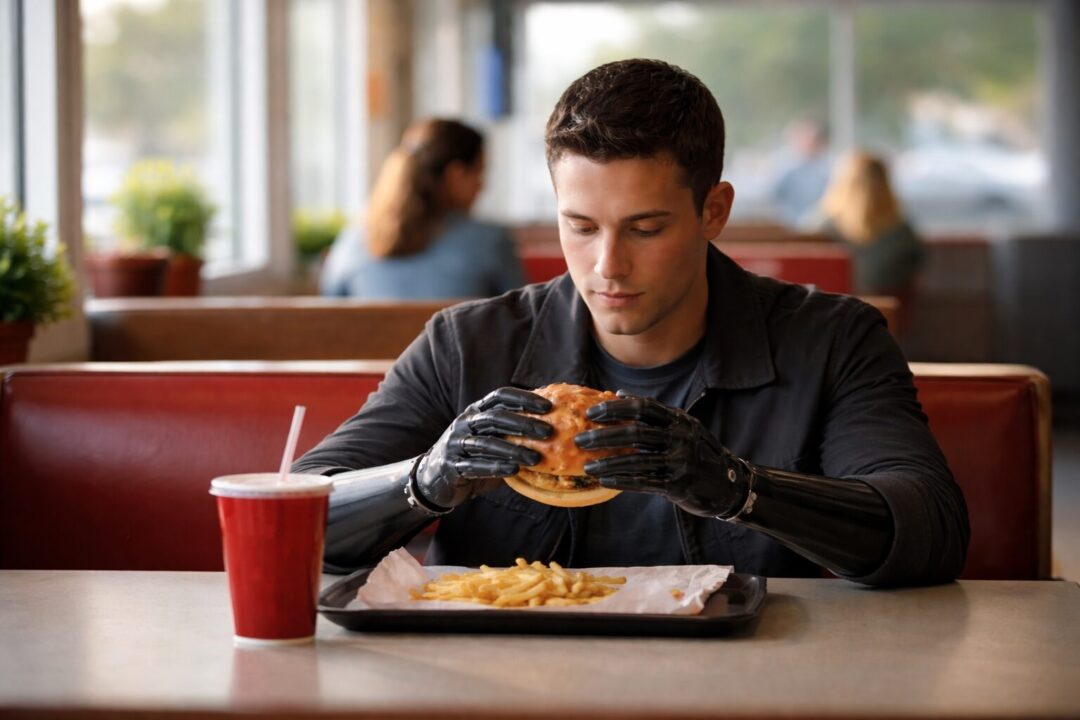
At the smallest table near the back, a young man sat alone with a burger, fries, and a paper cup sweating onto the tray.
His name was Nolan.
He had the straight-backed stillness of someone who had once worn a uniform long enough for discipline to become part of his posture. His dark hair was clipped close. His jaw was clean-shaven and tight. At a glance, he looked like any other veteran stopping somewhere off the highway for lunch.
At a second glance, people slowed down.
Both of his forearms ended in prosthetics: black and steel, sleek and precise, their mechanical fingers built for grip and function but not for softness. Not for a paper wrapper slick with grease. Not for something as ordinary and embarrassingly human as trying to hold a burger together while strangers watched.
Nolan had chosen the back table for a reason. It let him face the room without sitting in the center of it. It gave him a wall behind him. It reduced the number of directions from which pity could arrive.
He had become good at these calculations.
What he had never gotten used to was how visible struggle could be when the struggle was small.
Not pain. Not blood. Not the obvious kind of suffering people knew how to respect from a distance. Small struggle was worse. Small struggle was tying a bag. Picking up a receipt. Opening a ketchup packet. Lifting a burger that wanted to collapse in his hands while people around him ate with the unconscious grace of the uninjured.
He had already adjusted his grip three times.
Across the diner, in a booth by the window, a little girl with a cloud of bright red curls watched him with complete concentration.
Her name was Tessa.
She sat beside her mother, Maren, who had the tired, efficient look of a woman trying to survive lunch with a child and a dozen other unfinished tasks still waiting for her after. Maren had a denim jacket hanging off one shoulder and a tote bag wedged against the wall of the booth. She was opening sauce packets, sliding napkins across the table, checking her phone, then guiltily putting it facedown again.
Tessa wasn’t interested in her fries.
She was watching Nolan.
Children stared differently than adults. Adults stared in fragments, glancing and retreating, ashamed of being caught. Children stared as if seeing was a form of honesty. Tessa leaned forward over the table, her freckled cheeks serious, her eyes fixed on Nolan’s tray.
Nolan knew she was looking. He knew several other people were too.
He kept his eyes on the burger.
He told himself to take one bite, finish the fries, leave.
Then Tessa said, in a voice far clearer than her mother would have liked, “Mom, he can’t even eat.”
The sentence sliced through the diner more cleanly than a shout.
Conversations didn’t stop. That would have been almost merciful. Instead, the room bent. A man in a booth near the counter looked over. A teenage boy halfway through a milkshake glanced up. A waitress turned, then immediately busied herself wiping a table that was already clean.
Maren froze.
“Tessa,” she said quickly, too softly at first. Then lower, sharper. “Lower your voice.”
But the damage was done.
Nolan didn’t look up. That was the part Maren would remember later—the way he didn’t defend himself, didn’t glare, didn’t make the child feel cruel. His shoulders drew in by less than an inch, but it was enough to see he had heard every word.
He set the burger down carefully.
“Mom,” Tessa said again, baffled rather than mean, “but he—”
“Enough,” Maren whispered.
Nolan rose halfway out of his chair, then stopped. The old instinct to leave came fast. It always did. Escape first. Preserve what was left of your dignity by denying everyone a longer look. But standing up was its own kind of admission, and he hated giving a room that much power.
So he sat back down.
His prosthetic fingers settled against the edge of the tray.
He fixed his eyes on the paper cup and wished, with a weariness deeper than anger, that lunch could just be lunch.
Part II — A Truth No One Wanted
Maren could feel heat crawling up her neck.
She wanted to apologize. She wanted to vanish. She wanted to teach her daughter, in one impossible instant, the entire complicated etiquette of suffering—how adults were expected to notice pain and not name it, to feel pity and disguise it as politeness, to preserve other people’s dignity by pretending not to see what was difficult right in front of them.
But Tessa was six. Six-year-olds did not understand social camouflage.
To Tessa, a problem was a thing you identified so it could be solved.
Maren reached for her daughter’s hand across the table. “We are not talking about people like that.”
“Like what?” Tessa asked, genuinely confused.
Maren had no answer that wasn’t uglier than the truth.
At the back table, Nolan picked up the burger again. His mechanical fingers closed with slow precision around the paper. He almost had it. Then the wrapper slipped, and the top bun shifted sideways.
The sight of that tiny failure felt bigger than it should have.
Tessa saw it too.
Her expression changed.
Not into pity. Into understanding.
Nolan had seen that expression before, though rarely from children. It was the moment people crossed from curiosity into the recognition that what they were witnessing was not spectacle. It was effort.
Maren followed her daughter’s gaze and finally understood what Tessa had been trying, badly, to say. The shame inside her changed shape. It was no longer just embarrassment over the loud remark. It was the realization that her daughter had named the truth because the truth was obvious—and because every adult in the room had chosen to protect themselves from the discomfort of responding to it.
“I’m going to say sorry,” Maren murmured, sliding from the booth.
But Tessa was already moving.
She wriggled free before Maren could stop her, shoes squeaking against the tile. She lifted her own plastic tray with both hands—not because she planned it, not because she was staging some scene, but because in a child’s mind, if someone was eating alone, the obvious first step was not to leave them alone.
“Tessa.”
The girl kept walking.
At his table, Nolan looked up.
For one strange second, the whole diner seemed to inhale.
The little girl approached him with an earnestness so complete it disarmed him before she had said a word. Up close, her hair was even brighter, her freckles dusted across her cheeks like cinnamon. She stopped beside his chair and set her tray down on the empty half of the table as if she belonged there.
Nolan stared.
From behind her, Maren arrived too late to prevent anything and too uncertain to interrupt what she didn’t yet understand.
“Tessa,” she said, breathless. “Come back here.”
But Tessa wasn’t looking at her mother.
She was looking at Nolan’s burger.
Then she looked at him and asked, in a quiet voice that somehow carried farther than the first one, “Why are you eating alone?”
It was such a naked question that Nolan almost laughed.
Because he had learned that sitting alone invited fewer calculations from strangers.
Because people either thanked him too hard for his service or looked at his arms as if they were trying not to imagine the story behind them.
Because sometimes company required explanations, and explanations were exhausting.
Instead he said, “Just having lunch.”
Tessa considered that. “You can sit with me.”
Something loosened in the room.
Not enough. Not yet. But enough to change the angle of it.
Maren was at the table now, one hand half-raised in apology. “I am so sorry,” she said, the words tumbling out. “She didn’t mean—”
“It’s okay,” Nolan said automatically.
People always said that when something wasn’t okay but they didn’t want to carry anyone else’s guilt too.
Tessa frowned at the burger again, studying the problem with the same intensity she might have used on a puzzle.
Then she said, “I can help.”
Part III — The Smallest Brave Thing
Later, Maren would not remember whether the diner became quiet or whether her memory edited the noise away because the moment demanded it.
What she remembered was Nolan’s face.
Not his first expression—that was surprise, plain and unguarded—but the one that came after, when the surprise turned into something more dangerous. Hope, maybe. Or the fear of hope. The look of a man who had spent enough time being observed that kindness felt less believable than discomfort.
Tessa had already reached for the burger.
She didn’t snatch it. She took it carefully with both small hands, respecting its fragility and, though she couldn’t have named it, his. She held it up the way a child offers something precious.
“I can hold it,” she said.
Maren opened her mouth to stop her, then closed it again.
Because stop her for what?
For being direct?
For doing, without hesitation, the very thing every adult in the room had decided was too awkward to attempt?
Nolan glanced at Maren, giving her one last chance to rescue him from the tenderness of it.
Her eyes were wet already.
“It’s your choice,” she whispered.
That mattered.
Not the child’s innocence, not the room watching, not the weight of the moment gathering around an ordinary lunch table. Just that. It’s your choice.
Nolan looked at the burger in Tessa’s hands.
Then at the little girl waiting with complete seriousness.
Then he leaned forward and took a bite.
It should have been nothing.
A bite of burger in a roadside diner. Meat, bread, mustard, grease, the sound of a television somewhere overhead. The smallest event imaginable.
Instead it broke something open.
Nolan smiled first with his eyes, as if the expression reached him before he could stop it. Then his mouth followed. A real smile, sudden and helpless. It transformed his whole face, stripping years off the guarded set of it. A soft, startled laugh escaped him next, and he shook his head as if he couldn’t quite believe that this was how the knot in his chest had been undone—by a six-year-old in a yellow sweater treating help like the simplest thing in the world.
Tessa smiled back, satisfied that the problem was being solved.
“There,” she said.
The line was so matter-of-fact that a few people nearby laughed quietly, not at Nolan but with the relief of tension leaving their bodies all at once.
The teenage boy at the counter looked down at his shake, suddenly embarrassed by his earlier curiosity. The waitress who had been wiping the same table for too long finally moved on. A man in work boots took off his cap and rubbed a hand over the back of his neck as if ashamed he had done nothing but watch.
Maren sat down slowly in the chair across from Nolan, as if asking permission without words.
He nodded.
For the first time since he had entered the diner, he was no longer an exhibit in a room full of strangers. He was part of a table.
Tessa climbed into the seat beside him and guarded the burger with solemn focus. Every time he needed another bite, she adjusted the angle. Once she pushed his fries toward him as if arranging a proper meal for an honored guest.
“What’s your name?” she asked.
“Nolan.”
“I’m Tessa.”
“I guessed that was probably something like Tessa.”
She narrowed her eyes. “How?”
“You look like a Tessa.”
That made her laugh.
Maren pressed her fingertips to her mouth. She was smiling now, though the smile carried the sting of recognition with it. Her daughter had not been kinder because she was better trained. She had been kinder because she was not trained at all.
Nolan took another bite.
“This is probably the strangest lunch I’ve had in a while,” he said.
“Is it bad strange?” Tessa asked.
He looked at her, then at Maren, then down at the tray between them with its paper wrappers and scattered fries and all the mundane evidence of a moment that had somehow become enormous.
“No,” he said. “Not bad strange.”
He wanted to say more. That there had been months after rehab when he refused restaurants entirely. That public places made him tired before he even sat down. That strangers thought heroism made injury easier to carry, when really it only made people more comfortable inventing noble meanings for private losses.
Instead he said, “You helped more than you know.”
Tessa accepted that with a nod, as if of course she had.
Part IV — What Stayed After
When lunch ended, the diner returned to itself in visible ways.
Orders were called. Coffee was refilled. The baseball game kept playing to no one. Someone laughed too loudly near the register. A family by the door gathered backpacks and jackets and left in a shuffle of ordinary noise.
But something had shifted all the same.
Maren saw it in the way people looked at Nolan now. Not with erased curiosity—curiosity never vanished completely—but with less distance. Less fear of acknowledging him as human. A waitress asked whether he wanted a refill and waited for the answer instead of directing the question at the table as a whole. The man in work boots nodded to him on the way out. Small things. Awkward things. Human things.
Tessa, having fulfilled her mission, moved on to the subject of whether Nolan liked onion rings and if he had ever seen a lizard in real life.
He answered every question.
By the time the tray was mostly empty, the hard set of his shoulders had gone. He looked tired still, but it was no longer the defensive fatigue he had carried in with him. It was the softer kind, the kind that arrives after bracing for humiliation and finding gentleness instead.
Maren stood first.
“We should let you finish your day,” she said.
Nolan glanced at the untouched corner of Tessa’s fries, then at the booth by the window where they had been sitting before all this began.
“I think you already improved it.”
Maren looked down, suddenly emotional in a way she hadn’t expected. “I’m sorry about what she said.”
Nolan considered that.
“She wasn’t wrong,” he said.
The words landed harder than an apology would have.
Maren started to protest, but he shook his head.
“She said out loud what everyone saw.” He looked toward the room, then back at her. “She’s just the only one who did something after.”
For a moment Maren could not speak.
There it was—the whole uncomfortable truth of adulthood, exposed by a man who had every reason to resent the scene and somehow had chosen not to. Adults had rules. Adults had manners. Adults knew how to manage appearances. And sometimes all those polished social instincts added up to one ugly result: they left people alone inside their struggle because they were too afraid of doing the wrong thing to do anything at all.
Tessa slid off her seat.
“Bye, Nolan,” she said, then paused. “Next time don’t sit alone.”
He smiled, deep and unguarded. “I’ll remember that.”
She marched back toward the booth with the confidence of someone who had set the world right in one small corner of it.
Maren lingered a second longer.
“Thank you,” she said.
Nolan blinked, surprised. “For what?”
“For letting kindness be clumsy,” she replied.
That made him laugh again—the same startled, warming laugh that had changed the room when it first appeared.
After they left, Nolan remained at the table for another minute.
Not because he needed more time to eat. Because he needed a moment to feel the aftershock of what had happened.
Outside the window, trucks passed in bursts of sun and shadow. The road stretched on. Somewhere beyond the highway were all the familiar things waiting for him: errands, silence, routines built carefully around what he could and could not do without help. None of that had changed.
And yet something had.
The worst part of public vulnerability had never been difficulty itself. It had been the loneliness that wrapped around it when other people decided not to touch it. Tessa had broken that loneliness with the recklessness only a child could afford and the courage many adults no longer possessed.
She had crossed a room.
She had asked the wrong question the wrong way.
She had made everything harder for one painful minute.
Then she had made it honest.
And because it was honest, she had made it kind.
Nolan stood, tucked his chair in with the side of one prosthetic wrist, and made his way to the register. The waitress there smiled at him with something closer to ease than pity.
“Take care,” she said.
“You too.”
Outside, the afternoon light hit bright and warm. Nolan paused on the sidewalk and looked back once through the diner window.
Inside, Tessa had returned to her booth, already halfway into a new conversation, one hand waving dramatically as she talked. Maren listened with the exhausted devotion of a mother who had just learned something from her child she would not forget.
Nolan walked to his truck with a smile he didn’t have when he came in.
It was not because a little girl had fed him lunch.
It was because, for the span of a meal, she had refused the lesson the rest of the world kept teaching: look away, stay polite, do not step too close to another person’s difficulty.
She had looked directly.
She had stepped close.
She had helped.
And long after the taste of the burger was gone, that was what remained.