The Paw at the Door
The Paw at the Door
Part I — The Dog in the Snow
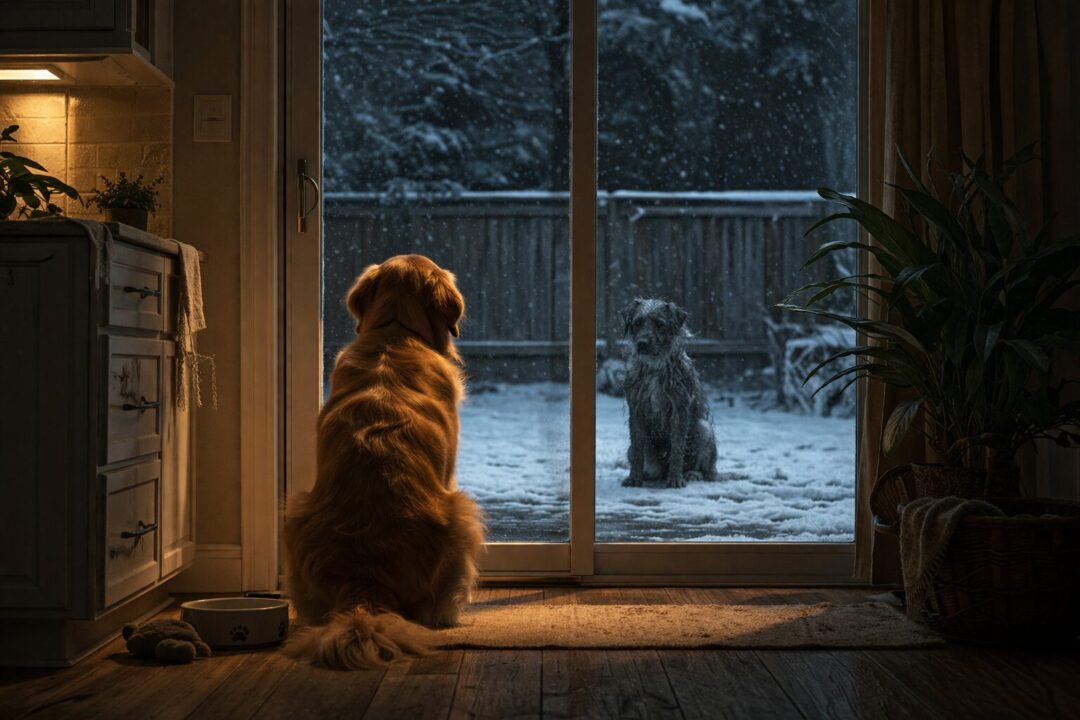
By the time Mara noticed the shape beyond the glass, Juniper had already seen him.
The golden retriever was standing so still in the kitchen that Mara first thought she was listening for something outside—the wind, maybe, or the brittle scrape of bare branches against the fence. Then Juniper lowered her head, the piece of chicken she had begged from the cutting board still held carefully in her mouth, and stared at the sliding door with a focus that made Mara put down the dish towel in her hand.
Snow had been falling since before dawn. Not the beautiful, drifting kind that made the neighborhood look magical, but a wet, relentless sleet-snow that stuck to the patio stones in patches and turned every corner of the yard meaner than it needed to be. The back fence was lined with gray slush. The dead winter grass had vanished under a rough white crust.
At first Mara saw nothing.
Then the shape moved.
A dog sat just beyond the glass, half-shadowed by the weak porch light and the pale wash of afternoon sky. He was medium-sized, lean to the point of alarm, his coat matted dark with mud and meltwater. One ear folded strangely against his head. Snow clung to his back in small melting clumps. He was not pacing. He was not barking. He was simply there, staring in with the exhausted patience of something that had run out of options before it had run out of hope.
Mara felt the old, familiar ache open in her chest.
She had grown up learning not to look too long at strays. In the town where she was raised, looking too long usually ended with wanting to help, and wanting to help usually ended with being told why you couldn’t. No room. No money. No time. Someone else’s problem. Nature. Bad luck. That was the language adults used when kindness felt too expensive.
But Juniper did not know that language.
The retriever walked to the glass with the slow gravity of a creature who had made up her mind. She stood on the warm side of the door, framed by the glow of the kitchen, and looked directly at the muddy dog outside.
The stranger did not move closer. He only lowered his head a fraction, as if even his hunger was tired.
“Hey,” Mara whispered, though she wasn’t sure which of them she meant.
Juniper dropped the chicken onto the floor.
Not near her own bowl. Not near Mara’s feet.
She dropped it right by the door.
Mara watched her dog glance from the food to the stranger, then back again, a small, intent movement that was impossible to misunderstand. Juniper was not guarding her dinner. She was offering it.
Outside, the dog lifted his face. His eyes caught the kitchen light for a moment, and Mara saw what the mud had half-hidden before: he was young, maybe not even fully grown, but his expression had the defeated watchfulness of an animal that had already learned disappointment too many times.
For one strange second the whole kitchen seemed to go silent around that sight—the ticking clock over the stove, the hum of the refrigerator, the wind pushing sleet against the fence. Juniper stood beside the food, waiting.
The dog in the snow looked not at the chicken, but at her.
As if the question was not whether he was hungry.
As if the question was whether he was allowed.
Part II — Things the Cold Takes
The neighborhood behind Mara’s rental backed onto a strip of undeveloped land and a drainage ditch, and every winter the place seemed to collect the lost. Grocery bags. Broken sleds. Once, a bicycle missing both wheels. Three years ago, before Juniper, Mara had found a calico cat sheltering beneath the deck stairs of the old duplex she used to live in. She had fed it for six days before animal control finally came. She still thought about the way it had looked at her from the trap—not angry, not trusting, just tired.
She had told herself she wouldn’t do that again.
It wasn’t cruelty. It was arithmetic.
Her job at the dental office paid enough to keep the heat on, enough to cover Juniper’s food and annual shots, enough to let her send a little money every month to her younger brother when he was between jobs again. It did not pay enough for impulse rescues and surprise vet bills and the thousand hidden costs of opening your life to something wounded.
Still, for the last week, she had seen signs.
Tracks along the back fence after snowfall. Torn trash bags near the alley. Once, when she came home late from work, she’d glimpsed a quick shadow near the hedge and thought it was a raccoon until the headlights caught the flash of a narrow canine face. Juniper had gone to the window each morning afterward, nose fogging the glass, quietly alert.
So this was not a miracle appearance. Not exactly.
This was hunger finally choosing a door.
Mara crouched a few feet behind Juniper and studied the stranger more carefully. His coat might once have been brown beneath the mud. There was a raw-looking patch near one shoulder. His paws were dark and wet. One front leg seemed stiff when he adjusted his weight.
He was close enough now that she could see him shiver.
“Oh, buddy,” she said softly.
At the sound of her voice, he flinched—not backward, but inward, like something in him tightened. He didn’t run. That might have been worse. Running would have meant strength. This stillness looked like depletion.
Juniper made a low sound in her throat, not a growl, not a whine, just a pulse of concern. Then she nudged the chicken closer to the track of the sliding door with her nose.
Mara laughed once under her breath, and the sound broke on the way out. “You’re really serious about this.”
Juniper turned and looked at her, and Mara could have sworn there was expectation in that warm amber gaze. Not demand. Just certainty. As if the retriever, in all her uncomplicated faith, assumed that once a problem had been clearly seen, the next step was obvious.
Mara stood.
The dog outside froze harder.
She moved slowly toward the handle, speaking in that nonsense-soft voice people used with frightened animals and grieving children. “It’s okay. Easy. Easy.”
The stranger’s eyes tracked her hand. His body tensed, but he did not retreat.
Juniper stepped back from the door, not far, just enough to create space. The movement was so deliberate Mara stopped with her fingers on the latch and looked at her in surprise. Juniper sat down, calm and upright, beside the piece of chicken.
The message, somehow, was clear.
Not mine. Safe.
Mara slid the door open two inches. Cold air spilled in at once, sharp enough to sting her bare ankles. The muddy dog recoiled half a step, then stopped. Snow hissed softly against the patio stones. Juniper stayed seated, mouth closed, shoulders loose, her whole body speaking a language older than commands.
The dog outside stared at the gap.
Then at the food.
Then at Juniper.
Mara had the odd, powerful feeling that she was witnessing a decision more fragile than most people’s courage.
He stepped forward, then checked himself.
His nose crossed the edge of the opening and pulled back, catching the scent of warmth, cooked meat, clean water, another dog, a human. Safety and danger bundled together, impossible to separate.
“Come on,” Mara whispered.
He did not obey the words.
He watched Juniper.
And Juniper did the smallest thing of all: she lowered her head and looked away, giving him the dignity not to be stared at while he debated whether to trust the world one more time.
Part III — The Threshold
It happened in inches.
The muddy dog stretched his neck toward the food first, paws still braced outside in the slush. He snatched at nothing, stopped, then tried again, testing the air as though the room itself might lunge at him. Mara held her breath. Juniper did not move.
The dog edged one paw over the track.
Then another.
The sound of claws against the metal strip was so slight Mara would barely have noticed it on any other day, but in that moment it felt like the loudest thing in the house. The dog’s body remained low, ready to bolt, but he was inside now—or enough of him was. His head dipped. He seized the chicken and jerked back a fraction, waiting for protest.
None came.
Juniper stood, and Mara’s heart lurched, but the retriever only took one measured step nearer and stopped at the dog’s side. Not crowding. Not claiming. Present.
The stranger gulped the food so fast it was almost painful to watch.
When it was gone, he lifted his head sharply, eyes wide, as if bracing for the price.
Still nothing.
Mara was crying before she realized it. Not hard. Not dramatically. Just the quiet involuntary kind, tears slipping free because something inside her had been struck cleanly and without warning.
Juniper looked toward the kitchen, then back to the dog, then padded to her water bowl. She drank once, stepped aside, and looked over her shoulder.
Mara laughed wetly this time. “Okay,” she said. “Okay, I get it.”
She fetched a second bowl, filled it at the sink, and set it down several feet away from Juniper’s, giving the stranger room. He startled at the movement, then caught the scent and approached with the same impossible mixture of urgency and fear. His leg was definitely stiff. He limped when he forgot to hide it.
He drank as though he could not believe in abundance unless it physically touched him.
Juniper stood watch.
That was the only phrase that fit. She was not excited, not prancing, not trying to initiate play the way she did with every dog at the park. She simply remained near, broad golden body angled slightly outward, as though placing herself between the stranger and every threat the world had trained him to expect.
Only after the water was gone did the muddy dog seem to remember the human in the room.
His head came up. He looked at Mara fully for the first time.
Up close, she could see how young he really was. A scar nicked the bridge of his nose. One eye was rimmed pink from the cold. He should have looked wild. Instead he looked careful.
“It’s all right,” she said, though she knew words were flimsy things.
He did not come to her. He did not wag. He held himself at that exact point between flight and collapse.
Then Juniper crossed the last small distance between them and, with infinite slowness, rested one paw against his shoulder.
Not a push.
Not a pin.
A touch.
The muddy dog went completely still.
Mara would remember that moment long after she forgot other things from that winter—the invoices, the salt-streaked roads, the way the sky darkened at four-thirty. One dog standing over another beside a bowl on a kitchen floor. The golden’s paw lying there as lightly as a promise. The stranger’s rigid body softening by degrees beneath it, as if permission had entered him through contact.
He did not flinch away.
He lowered his head again, and this time when he drank the last few drops from the bowl, his shoulders were no longer gathered into a knot.
Juniper kept her paw there for another beat, maybe two.
A gesture so small no one would have called it dramatic.
Yet somehow it changed the room.
Part IV — The Shape of Mercy
His chip, when the emergency vet scanned him the next morning, was dead.
Not missing. Not unregistered. Dead.
“Cheap implant, probably old, maybe damaged,” the vet tech said with a sympathetic shrug. “No active owner information. No current vaccine records either.”
Mara nodded as if this was merely logistical. Inside, something had already tipped. There were still steps to follow: posting in lost-pet groups, calling the county shelter, taking pictures and waiting the legally required days. She did all of it. She was responsible. She was not reckless.
But by then the dog had a blanket by the radiator and a temporary name.
She called him Ash.
The name arrived without planning, maybe because of the gray weather, maybe because of the way he looked like something that had come through fire and weather and hadn’t decided yet whether it was allowed to glow again.
For the first two days, Ash ate like a thief and slept like a soldier—one eye half-open, body curled tight, waking at the smallest sound. He followed Juniper more than he followed Mara. If Juniper lay down, he chose the rug nearby. If Juniper went to the back door, he rose and watched. When Mara tried to hand-feed him medicine for the inflammation in his leg, he took it carefully but with visible suspicion.
Juniper, meanwhile, treated his recovery as a formal assignment.
She brought him toys he ignored.
She escorted him into the yard and back.
She refused to eat until he had approached his bowl first, which made Mara mutter, “You are the most manipulative saint I have ever met.”
Slowly, Ash changed.
Not in one cinematic rush. Not the way stories liked to lie about healing.
He changed in moments.
On the fourth morning, Mara woke to find him asleep on his side instead of curled into a defensive knot.
On the sixth day, he barked once at the mail truck and looked startled by the sound of his own voice.
A week later, while Juniper was chewing a rope toy in the living room, Ash rolled onto his back in a shaft of winter sunlight and exposed his belly to the ceiling with the deep, absent-minded trust of a creature who had forgotten to be afraid for half a second.
Mara saw it and had to sit down.
No owner ever called.
No frantic family arrived with photographs and apologies and a story that would make his scars easier to understand. The waiting period passed. The shelter confirmed what she had already known in the marrow of her bones.
He was theirs if she wanted him.
Wanted was too small a word by then.
Still, she hesitated for one night.
Not because she doubted the answer, but because she respected what it asked of her. Money. Time. Vet care. Patience. The possibility of damage that would not show up all at once. Love, which was always the least practical and most expensive commitment.
She stood at the kitchen sink after midnight, looking out at the patio where the first storm had almost kept him. Juniper and Ash were asleep behind her, one golden body, one brown, their breathing oddly synchronized.
“What am I doing?” she whispered to the dark glass.
The answer came from memory, not reason.
Juniper dropping her food by the door.
Juniper stepping back.
Juniper placing one paw on a trembling shoulder as if mercy were not a grand decision but the simplest instinct in the world.
Mara laughed quietly at herself.
“All right,” she said. “Fine. You win.”
Behind her, a tail thumped once against the floor.
She turned.
Juniper had not lifted her head, but one eye was open.
Watching.
Part V — A Warm Room
By spring, the mud had washed out of Ash’s coat for good. Underneath it was a rich brown threaded with black along his spine, handsome enough that strangers stopped to admire him on walks. The stiffness in his leg eased with treatment, though on cold mornings it still returned for the first few steps. His wary silence softened into selectiveness. He was never a dog who loved everyone. Mara respected that. He loved carefully.
He loved Juniper first.
Then, slowly, he loved the house.
Then he loved Mara in the grave, thoughtful way of animals who understand exactly what has been given to them and do not spend affection cheaply.
There were setbacks. A thunderstorm in April sent him trembling behind the washing machine. A man in a heavy work jacket reached for his head too quickly at the park and Ash snapped at empty air, horrified by his own panic. Healing was not a straight road. Mara learned that too.
But each time he startled, Juniper appeared.
Not dramatically. Not like a hero charging into battle.
She simply came and stood near him.
Sometimes that was enough.
Sometimes, when he was very shaken, she would lean her weight against his shoulder until his breathing slowed. And every time Mara saw it, she thought of that first evening—the open door, the bowl, the paw.
One year later, on the season’s first real snow, Mara stood in the kitchen again with a dish towel in her hand while Juniper and Ash waited hopefully at her feet for scraps from a roasted chicken.
The weather had turned the yard white in less than an hour. Snow feathered the fence posts and glazed the patio stones. The same door reflected the same warm kitchen light. For a moment the whole scene folded over on itself, past and present fitting together so precisely it made her still.
Ash noticed first.
He walked to the glass.
Not tense. Not frightened. Just alert.
Mara’s pulse skipped before she saw what he had seen: not a dog this time, but a stray cat moving along the fence line, thin and fast and hesitant in the falling snow.
Ash stood at the door.
Then he looked back over his shoulder.
Juniper, slower now with age but no less certain, carried a piece of chicken in her mouth.
Mara burst out laughing, tears stinging her eyes before she could stop them.
“Oh no,” she said. “Absolutely not. We are not becoming that house by accident.”
But even as she said it, she was already reaching for a small plate.
Outside, the cat paused and looked toward the glass.
Inside, Juniper set down the chicken.
Ash moved aside.
And Mara, with the deep exasperation reserved only for love, went to open the door.