The Notice on Our Blue Door Looked Official Until My Wife Recognized the Signature
Chapter 1: The Paper Taped Across Our Blue Front Door
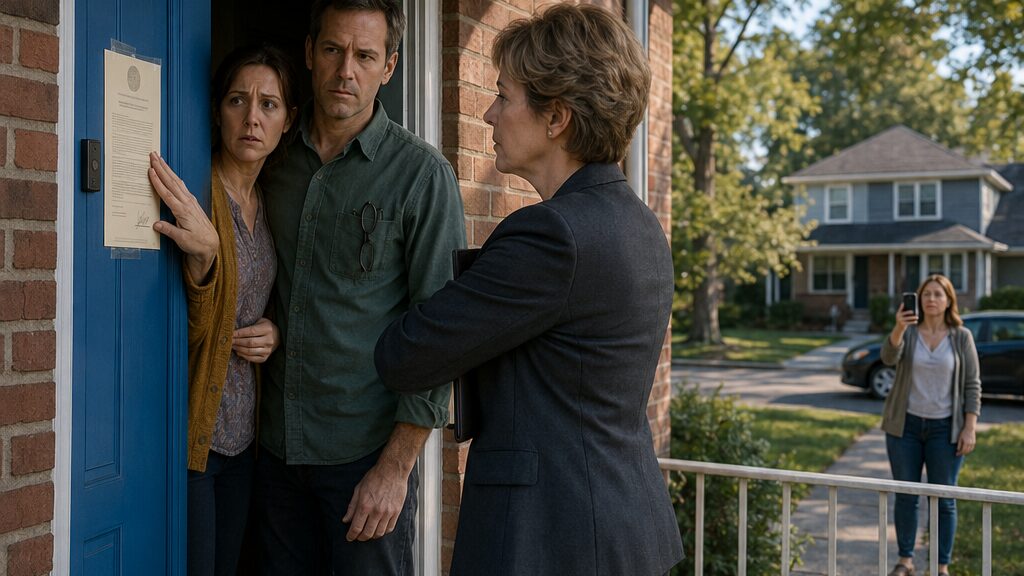
Catherine Hall was pressing a cream-colored sheet against our blue front door when I opened it.
For half a second, neither of us moved.
Her left hand held the paper flat beside the doorbell. Her right hand gripped a roll of clear packing tape. Behind her, at the edge of our front walk, the community manager stood with a tablet tucked against his chest.
“Mr. Mitchell,” Catherine said. “Good. You’re home.”
I looked at the heading before I looked at her.
IMMEDIATE POSSESSION AND ACCESS ORDER.
The words were centered in black capitals beneath something that resembled a county seal.
“What are you doing?”
Catherine tore the tape with her teeth and fixed the top edge of the paper to our door.
“Serving notice.”
“On my front door?”
“On the property.”
I reached toward the page, then stopped myself.
Across the street, a neighbor had come out with a phone in hand. She was not pretending to check messages. The camera was pointed directly at us.
Catherine noticed too. Her posture changed almost imperceptibly. Shoulders straighter. Voice clearer.
“The association has documented chronic noncompliance,” she said. “You’ve been given repeated opportunities to cure. At this point, access is required.”
“Access for what?”
“The stabilization process.”
I knew the phrase. I had seen it in two HOA emails about exterior maintenance. What I had never seen was anything suggesting the association could take possession of our home.
Rachel appeared behind me.
“What’s happening?”
I turned enough to block some of the doorway.
“Nothing yet.”
Catherine gave me a look that said she had heard the lie.
“Mrs. Mitchell should be aware,” she said. “You have seventy-two hours.”
Rachel stepped beside me.
“Seventy-two hours for what?”
Catherine tapped the paper with one manicured nail.
“To comply with temporary possession and access requirements. Failure may result in securing the property.”
Rachel stared at her.
“Securing?”
The word hung there.
I could hear a lawn mower somewhere behind the houses. A delivery truck hissed to a stop at the corner. Ordinary sounds, all of them, while a woman stood on our porch telling us someone might secure the house we owned.
I looked at the order again.
The first violation listed was a dead patch of grass near the utility box.
Resolved six weeks earlier.
The second was an unapproved exterior fixture.
That had been the replacement porch light, the same size and color as the old one. I had sent the receipt after the community manager asked for proof.
The third alleged obstruction of scheduled inspection access.
No one had ever scheduled an inspection with me.
“You’re citing closed items,” I said.
“They were not closed.”
“I have emails.”
“You have correspondence.”
Her distinction was deliberate.
Rachel looked at me.
“You said the porch-light thing was done.”
“It was.”
Catherine folded her arms.
“This is exactly why the association has moved beyond informal communication.”
I felt the old reflex come up in me: keep your voice low, don’t give anyone a sentence they can quote, don’t make yourself the problem.
Years earlier, at a municipal office job, I had objected to records being altered after a deadline. I had been right. I had also spent the next eight months hearing that I was combative, rigid, difficult to work with.
Being right had not protected me.
So I did what I had trained myself to do.
I got quieter.
“Which county division issued this?”
Catherine blinked.
“What?”
I took my reading glasses from my shirt pocket. One arm was slightly loose at the hinge, and I had to settle them carefully on my nose.
“The order. Which division?”
Her eyes went to the page.
“The legal authority is stated.”
“That isn’t what I asked.”
The docket line read:
CV-24-1087-HOA-P.
I had spent eleven years around municipal records before leaving for warehouse operations. I was no lawyer, and I knew enough not to pretend otherwise. But file numbering systems had a grammar. Departments developed habits. Courts did too.
This number felt wrong.
Not impossible.
Wrong.
Catherine’s mouth tightened.
“You should direct legal questions to counsel.”
“Whose counsel?”
“The association’s.”
“Then why does this carry what looks like a county seal?”
The neighbor across the street shifted position, keeping her phone raised.
Catherine glanced at her and lowered her voice.
“Mr. Mitchell, I am not going to debate a lawful enforcement action on a sidewalk.”
“You brought it to my sidewalk.”
Rachel touched my arm.
Not gently.
“Joseph.”
I knew that tone.
Something was wrong beyond the paper.
Catherine stepped backward.
“You have seventy-two hours. I suggest you use them productively.”
The community manager followed her toward the curb.
I watched until they reached the white management-company sedan.
Only then did I peel the tape from the top edge of the order.
“Don’t tear it,” Rachel said.
“I’m not.”
Her breathing had changed.
I looked at her.
She was reading the middle section now. Her eyes moved line by line, then stopped.
“What?”
She didn’t answer.
I checked the violations again.
Dead grass.
Exterior fixture.
Inspection obstruction.
Then a fourth item I had not noticed at first: chronic pattern of noncooperation.
I nearly laughed.
Not because it was funny.
Because it sounded familiar.
“What is it?” I asked again.
Rachel pointed at the lower half of the page.
“Why didn’t I know about repeated notices?”
My hand went still.
Catherine’s sedan rolled past the house.
Rachel looked at me.
“Joseph.”
“There were a couple of letters.”
“A couple?”
“They weren’t serious.”
“This says repeated opportunities to cure.”
“Because they count every email as a notice.”
“How many?”
I folded my glasses.
“Rachel—”
“How many notices did you get?”
The silence answered before I did.
Her face changed.
Not fear now.
Something sharper.
“You told me it was handled.”
“I thought it was.”
“You thought?”
“I answered them.”
“That is not what I asked.”
Across the street, the neighbor finally lowered her phone.
Rachel carried the order inside.
I followed her to the kitchen, where she placed it flat on the table beneath the pendant light.
The paper looked even more official indoors. The seal had a raised appearance. A signature curved across the bottom above a line identifying a retired county judicial officer as authorizing authority.
Rachel leaned closer.
I was still thinking about the docket number.
She was staring at the signature.
“What?” I said.
Her fingers hovered above the page without touching it.
Then she whispered, “That looks like my mother’s signature.”
Chapter 2: Three Years of Receipts and Two Months of Silence
By noon, Rachel had arranged my unopened HOA envelopes in a straight line across the kitchen table.
There were two.
That was the number I had told myself mattered.
Two envelopes.
Not the six emails. Not the portal alerts. Not the photograph attached to a compliance reminder. Just two physical envelopes, both unopened because I had already read what I assumed were copies online.
Rachel placed the cream-colored order beside them.
“You hid these from me.”
“I didn’t hide them.”
“You put them in the garage file cabinet.”
“I put all property mail there.”
“Unopened.”
I had no answer that did not sound worse when spoken aloud.
She pushed one envelope toward me.
“Open it.”
I did.
The letter inside was dated seven weeks earlier. NOTICE OF CONTINUING NONCOMPLIANCE.
The dead grass near the utility box.
“That was fixed,” Rachel said.
“I know.”
“When?”
I reached for my phone and searched photographs. I found one taken after I reseeded the patch.
The timestamp was six weeks and four days old.
Rachel read it.
“Three days after this letter.”
“Yes.”
“Did you send proof?”
“Yes.”
“Show me.”
I opened my email.
The message was still there, sent to the community manager with two photographs attached.
Subject: Cure Completed — Landscape Item.
No reply.
Rachel looked away.
For one brief second, I thought I saw relief.
Then she picked up the second envelope.
That one contained notice of failure to permit inspection access.
“I never knew about an inspection,” she said.
“Neither did I.”
“You didn’t appeal this?”
“I emailed.”
“That isn’t what I asked.”
I felt irritation rise, mostly because she was right.
“I was trying not to turn every little thing into a war.”
Her chair scraped back.
“And how’s that going?”
She left the kitchen.
I stood alone with the papers.
The edges of the older notices had curled inward from humidity in the garage. The order Catherine had taped to our door remained perfectly flat.
That difference bothered me.
So did the docket number.
I carried everything to the garage.
Three years of ownership records filled half a metal cabinet: dues statements, insurance renewals, contractor receipts, architectural approvals, tax notices. I had kept more than I remembered.
By late afternoon, I had built a timeline.
Dues paid every month.
No delinquency.
No fines posted to the account until eight weeks earlier.
Landscape complaint opened.
Landscape proof submitted.
Porch-light complaint opened.
Receipt submitted.
Inspection-access violation created.
No matching appointment request.
Then the phrase appeared for the first time:
chronic pattern of noncooperation.
I logged into the HOA portal.
A red banner crossed the top of the screen.
ENFORCEMENT ESCALATED — APPEAL WINDOW CLOSED.
My stomach tightened.
The deadline had passed four days earlier.
Rachel came back into the garage carrying two mugs of coffee. She put mine down without speaking.
I pointed to the screen.
“I missed the appeal.”
She read the date.
“You didn’t know?”
“I should have.”
“That’s not the same thing.”
“No.”
She sat on the folding chair beside the cabinet.
For a while, the only sound was the old garage refrigerator clicking on.
Then she said, “Why didn’t you tell me?”
I kept looking at the screen.
“Because every time one of these arrived, I thought I could clear it.”
“That isn’t why.”
I turned.
Rachel’s anger had cooled into something harder to face.
“You didn’t tell me because you thought I would worry.”
“Yes.”
“And you decided that for me.”
I looked down.
Years earlier, after my complaint at the municipal office, Rachel had watched me come home every night with my jaw tight and my work bag untouched by the door. She had heard me say I was fine until I lost the position anyway.
I had promised myself I would never drag that kind of uncertainty into our house again.
Apparently I had learned the wrong lesson.
“I’m sorry,” I said.
She nodded once.
Not forgiveness.
Acknowledgment.
Then she pointed at the order.
“Find out if it’s real.”
We worked until after dark.
The first break came from a photograph.
One of the violation entries in the portal alleged that our porch light had remained unapproved as of May 18. Attached was a close-up image of the fixture.
I enlarged it.
Rachel leaned over my shoulder.
“What?”
“The date.”
The image metadata showed May 11.
A full week before the alleged observation date.
More importantly, the receipt for the replacement fixture was dated May 14.
Rachel stared.
“So that photo is of the old light.”
“Yes.”
“They used it as proof about the new one.”
“That’s what it looks like.”
We checked the landscape file.
Another problem.
The compliance report claimed the grass defect remained uncured through June 3. But our submitted photograph, with location data and timestamp intact, showed new growth by May 29.
The records did not merely disagree with us.
They disagreed with each other.
By Tuesday morning, our kitchen table had disappeared under paper.
Receipts.
Printed emails.
Portal screenshots.
Bank confirmations.
Three years of dues payments.
Rachel sorted by date while I marked each item with removable tabs.
At nine fifteen, I found a second version of the possession order buried in the portal’s document archive.
This one was uploaded two days before Catherine came to our house.
The signature was the same.
The docket number was not.
One version read CV-24-1087-HOA-P.
The other read CV24-1087-HOAP.
Rachel came around the table.
“That can’t both be right.”
“No.”
She picked up the paper Catherine had taped to the door.
The copied signature sat beneath the altered case line.
“Look at the date,” she said.
I did.
The authorization date was June 12.
The document version in the portal had been created June 10.
“That’s not necessarily impossible,” I said.
Rachel gave me a look.
“You always do that.”
“Do what?”
“Find a reason not to believe your own eyes.”
I leaned back.
She was right again, and I was getting tired of it.
Around eleven, I called the association office.
The community manager answered.
I asked for the case file underlying the order.
There was a pause.
“You’ll need to submit a records request.”
“I’m asking what court action this comes from.”
“Mr. Mitchell, I’m not authorized to interpret legal documents.”
“Then tell me who uploaded it.”
Another pause.
“Management.”
“Catherine?”
“I didn’t say that.”
The line went quiet.
Then he added, almost too softly, “You should look at the stabilization notices.”
“What stabilization notices?”
But he had already returned to his official voice.
“Submit your request in writing.”
He hung up.
I searched the portal for the phrase.
Dozens of documents appeared, most generic.
Then I saw something I had missed because it was filed under community updates rather than enforcement.
PROPERTY STABILIZATION PHASE ONE.
A map loaded.
Our house sat inside a shaded block of twelve properties.
I zoomed in.
Three addresses had warning icons beside them.
Ours.
The house two doors down.
Another at the end of the street.
Rachel read over my shoulder.
“Those are the same people who complained about inspection notices.”
I looked at her.
“How do you know?”
“Neighborhood group.”
I searched the archived notices attached to those addresses.
Most were private.
But three public board packets included enforcement summaries.
I opened the first.
The wording was familiar.
Persistent noncooperation despite repeated opportunities to cure.
The second used the same sentence.
So did the third.
Not similar.
Identical.
I printed all three.
Rachel stood at the counter while the pages slid out one by one.
I lined them beside our order.
Same phrase.
Same escalation pattern.
Same reference to access.
Three different households.
For the first time since Catherine pressed that paper to our blue door, I stopped asking why she wanted us to move faster.
I began asking why she wanted several of us to move at once.
Chapter 3: The Signature Rachel Had Known Since Childhood
Laura Ramirez examined the order for nearly a full minute without touching the signature line.
She sat at the end of her dining table with the paper centered before her and both hands folded in her lap.
Rachel stood by the window.
I remained across from Laura.
No one had taken off a coat.
Finally, Laura said, “Where did you get this?”
“Catherine Hall taped it to our front door.”
Laura’s eyes lifted.
“In public?”
“Yes.”
“And described it as what?”
“An immediate possession and access order.”
“That’s the title.”
“She said we had seventy-two hours before the property could be secured.”
Rachel turned from the window.
“Mom.”
Laura looked back at the paper.
The house was quiet. On the sideboard behind her sat framed photographs from different years: Rachel at graduation, Laura in judicial robes, all of us at Thanksgiving. Ordinary family evidence.
Laura adjusted the page by gripping its upper corners.
Still not the signature line.
“I did not sign this,” she said.
Rachel exhaled.
I had expected relief.
Instead I felt the problem grow larger.
“Could someone have used an old signature from a public record?” I asked.
“Yes.”
“Does this look copied?”
Laura’s expression hardened.
“I’m not giving you a handwriting opinion over coffee.”
“Mom,” Rachel said.
“I said I didn’t sign it. That is what I know.”
Her restraint irritated me because it resembled my own.
I slid a birthday card onto the table.
Rachel had brought it from a box in our hall closet. Laura had mailed it four years earlier.
Love always, Mom.
The capital L leaned left before the rest of the word moved right. The final stroke of her name ended in a narrow upward hook.
The order carried the same hook.
Laura looked at the card.
For the first time, something moved in her face.
Not surprise.
Disgust.
Rachel saw it too.
“You recognize it.”
“I recognize my own writing.”
“Then call somebody.”
Laura looked up sharply.
“No.”
The answer was so immediate that Rachel stepped back.
“What do you mean, no?”
“I mean I am not calling a clerk, a judge, a county attorney, or anyone else and saying my daughter has a problem with her HOA.”
“This is not an HOA problem anymore.”
“I know exactly what it is.”
“Then do something.”
Laura pushed back her chair.
“I am doing something. I am telling you the signature is not mine.”
Rachel stared at her.
“That’s it?”
Laura turned to me.
And I knew before she spoke.
“You asked me once never to use my position for you.”
Rachel looked between us.
“What is she talking about?”
I felt the old shame rise.
Years earlier, during the municipal records dispute, Laura had offered to introduce me to someone who handled public-employment appeals. I had refused.
Not politely.
I had told her I would not become the son-in-law people whispered about.
“I said I wanted to handle my own problems,” I admitted.
Rachel’s voice went flat.
“When?”
“Years ago.”
“And apparently the two of you made this into a family constitution?”
Laura closed her eyes briefly.
“No.”
“It sounds like one.”
Laura faced her daughter.
“If I make a private call now, every legitimate thing Joseph finds can be recast as influence. You know that.”
Rachel laughed once.
There was no humor in it.
“Of course. Procedure.”
“Yes.”
“Always procedure.”
The word landed harder than I expected.
Laura’s professional distance had never bothered me much. I understood it. Rachel had grown up inside it.
Laura looked at the order again.
Then she tapped the seal.
“This is not the most troubling part.”
I leaned forward.
“What is?”
“The case line.”
I told her I had noticed the format.
She nodded.
“This division code does not exist.”
Rachel came back to the table.
“You’re sure?”
“Yes.”
“And the seal?”
“Could be reproduced from any number of public documents. Badly, in this case.”
She pointed near the bottom.
“This title is also nonsense. A homeowners association does not obtain possession of an owner-occupied home through a document labeled this way.”
“Could outside counsel have drafted it?”
“Someone could draft anything.”
That answer stayed with me.
Laura picked up the birthday card, then placed it beside the order.
The resemblance between the signatures was obvious now.
Too obvious.
“I will give you a written statement,” she said. “Limited. Factual. I did not sign this document. I did not authorize use of my signature. I did not issue this order.”
Rachel said nothing.
“I will not make a call.”
Still nothing.
Laura looked at me.
“Find the case.”
The next morning, I stood at the county records counter with the docket number written on a yellow note.
The records employee typed the first version.
No result.
Then the second.
Nothing.
I gave her the core number without the HOA letters.
Her eyebrows lifted.
“There is a case.”
My chest tightened.
“What kind?”
She turned the monitor slightly away out of habit.
“Closed civil property matter.”
“HOA?”
“No.”
“Can I get the public docket?”
She printed a summary.
The case was four years old.
Wrong subdivision.
Wrong parties.
Wrong issue.
But the final order had been signed by Laura Ramirez before her retirement.
I stared at the page.
So the signature had not come from a birthday card.
It had come from a real case.
A real order.
Someone had taken authentic authority and moved it into a false context.
My phone rang before I left the building.
Catherine.
I answered.
“Mr. Mitchell, I understand you’ve been making inquiries.”
“About the order you served.”
“The management summary.”
I stopped walking.
“The what?”
“The document delivered Monday is a management summary of enforcement authority.”
“You called it an order.”
“It is titled as an order.”
“You told us the property could be secured in seventy-two hours.”
“Upon continued noncompliance.”
“By what court?”
Her silence lasted less than a second.
Still long enough.
“Joseph, I think you are conflating internal enforcement language with judicial process.”
She had never called me Joseph before.
I looked down at the county printout.
“Then why is a retired judge’s signature on it?”
This time the silence stretched.
When Catherine spoke, her voice was colder.
“I would advise you not to make accusations.”
“I asked a question.”
“You are creating unnecessary exposure for yourself and the association.”
“By checking a case number?”
“I’m ending this call.”
She hung up.
I returned to the records counter.
The employee was helping someone else, so I waited.
When my turn came, I asked for the public access history on the closed file.
She frowned.
“Request history?”
“If available.”
Some records were not.
This one was.
She disappeared through a side door and returned with a printed log.
Most entries were old.
Then, three weeks earlier, someone had requested certified copies of the final order.
Requesting entity:
Hall Residential Management.
Authorized contact:
Catherine Hall.
I read the line twice.
Catherine had not accidentally received a stray document from counsel.
She had gone looking for the exact closed case carrying Laura’s signature before the order appeared on our blue door.
Chapter 4: The Renovation Vote Nobody Had Mentioned to Us
My blue front door filled the boardroom wall before I had even taken my seat.
Twenty feet high, every scratch in the paint visible.
The photograph had been taken the morning Catherine taped the order beside our doorbell. In the projection, the cream paper looked almost white against the blue, and my hand appeared at the edge of the frame as if I were reaching toward evidence in a courtroom.
Across the bottom of the slide, in small gray letters, were the words:
CHRONIC NONCOMPLIANCE — PHASE ONE ACCESS OBSTRUCTION.
I stopped in the aisle.
Rachel touched my back.
“Joseph.”
The HOA board president was speaking into a table microphone.
“If everyone could find a seat, we have a full agenda.”
I sat.
Catherine stood near the projector with a remote in one hand. She wore the same composed expression she had worn on our porch, but now she had a screen behind her and a row of board members in front of her.
That changed the balance.
Or maybe it only made visible what had already been there.
“Phase One,” she said, “addresses the highest-risk properties identified during stabilization review.”
The slide changed.
A map appeared.
Twelve homes shaded in pale orange.
Ours among them.
Three carried red outlines.
The same three addresses I had found in the enforcement packets.
Catherine continued.
“These properties have created delays in inspection access, exterior standardization, and contractor sequencing.”
Contractor sequencing.
I wrote the phrase down.
Beside me, Rachel leaned close.
“Did they ever tell us about a contractor?”
“No.”
The board president called for homeowner comments after Catherine finished.
I was fifth in line.
The first two residents complained about landscaping costs. The third wanted to know whether the association planned to replace mailboxes. The fourth asked why dues had risen without visible improvements.
Then I stood.
The microphone was colder than I expected.
“My name is Joseph Mitchell. My home is the blue door in the first slide.”
A few people turned.
I saw recognition on one neighbor’s face.
The video from our porch had traveled farther than I knew.
I held up the county request log.
“Management served my household with a document titled Immediate Possession and Access Order. It used a docket number from an unrelated closed civil case and displayed the copied signature of a retired judge who did not authorize it.”
A murmur moved through the room.
Catherine did not move.
The board president raised a hand.
“Mr. Mitchell, legal allegations should be submitted through counsel.”
“I’m not making a legal conclusion. I’m describing documents.”
“You are implying misconduct.”
“I’m asking why Hall Residential Management requested a certified copy of that closed case three weeks before a version of its order appeared on my door.”
That changed the room.
Not dramatically.
No one gasped.
But people stopped shifting in their chairs.
Catherine lifted the microphone at the presentation table.
“The document Mr. Mitchell references was an internal management summary. It was never represented as a court-issued writ.”
I looked at her.
“You told my wife our property could be secured in seventy-two hours.”
“Upon continued noncompliance.”
“Under whose authority?”
The president struck the table once with his palm.
“This is becoming adversarial.”
The word reached inside me.
Adversarial.
Difficult.
Combative.
For one second, I was back in the municipal office, standing under fluorescent lights while a supervisor explained that tone mattered more than the altered record I had found.
My hand tightened around the paper.
I nearly sat down.
Then Rachel said from behind me, quietly enough that only I heard:
“Don’t disappear.”
I looked at the projected map.
Our blue door was gone now, replaced by twelve shaded homes.
“I’d like the board minutes to reflect the question,” I said. “What authority supported the seventy-two-hour possession threat?”
The president’s jaw shifted.
“We’ll refer that to counsel.”
“Thank you.”
I sat before my voice could change.
Halfway through the meeting, the answer to a different question arrived.
A board member asked why the stabilization schedule had been accelerated.
Catherine changed slides.
A contractor timeline appeared.
Patrick Jones, the treasurer, leaned toward his microphone.
“We should explain the pricing condition.”
Catherine turned.
“I don’t think we need to get into procurement detail tonight.”
Patrick’s face reddened.
“It’s already in the packet.”
The room grew still again.
He cleared his throat.
“The contractor offered reduced unit pricing if Phase One access is completed before the next assessment cycle.”
Rachel’s pen stopped moving.
I looked at the map.
Three red homes.
Twelve orange ones.
The first renovation zone.
“What happens if access isn’t completed?” someone asked.
Patrick rubbed his forehead.
“The discount expires.”
“How much?”
The president interrupted.
“That figure is preliminary.”
Patrick stared at the table.
Then he said, “Enough that we would likely need a special assessment.”
The room changed faster this time.
Voices rose.
Someone asked how much.
Someone else demanded to know why homeowners had not been told.
The board president tried to restore order.
I kept watching Patrick.
He looked sick.
Not guilty exactly.
Cornered.
After the meeting, I found him in the parking lot beside a dark sedan.
“Patrick.”
He closed his car door without getting in.
“I shouldn’t have said that the way I did.”
“Was it true?”
He looked toward the building.
“Yes.”
“Were the three red homes selected because we resisted access?”
“They were selected because management classified them as delay risks.”
“That isn’t what I asked.”
His mouth tightened.
“You’re not the only one under pressure, Joseph.”
“I didn’t say I was.”
He looked at me then.
For the first time, I saw something other than board polish.
Fear.
“The reserve account is thinner than people think,” he said. “Roof drainage, retaining wall, insurance renewal. If the contractor reprices, everyone gets hit.”
“So Catherine threatened possession to keep a discount.”
“I didn’t say that.”
“You didn’t have to.”
Patrick stepped closer.
“We hired management because no one on that board has time to chase twelve households for access. Catherine gets things done.”
The phrase sounded practiced.
“And if getting things done requires a fake order?”
His face hardened.
“I never approved a fake order.”
“Did you approve aggressive enforcement?”
He looked away.
That was answer enough.
Rachel was waiting by our car when Catherine approached.
“Joseph.”
I turned.
She held a thin folder.
“I think this situation has become unnecessarily broad.”
“You put my house on a wall.”
“I presented compliance data.”
“With my front door as a warning.”
Her expression barely changed.
Then she offered me the folder.
“What is that?”
“A discretionary access waiver.”
I did not take it.
“For us?”
“Yes. Your property can be removed from Phase One mandatory access review.”
Rachel looked at me.
Catherine continued.
“In exchange, I would expect you to withdraw your document allegations and refrain from disrupting contractor coordination.”
There it was.
Not an apology.
Not an explanation.
A door opening just wide enough for us.
I took the folder.
Inside was a one-page waiver.
Our address.
Our names.
No other households.
For a moment, I saw the easiest version of the future.
No hearing.
No seventy-two-hour threat.
No more photographs of our house on screens.
Rachel and I could go home, repaint the blue door where the tape had lifted a small chip, and let the rest belong to someone else.
Catherine watched me read.
“You said you wanted your home left alone.”
“I do.”
“This does that.”
I closed the folder.
Then I handed it back.
“No.”
Her face changed at last.
“Think carefully.”
“I have.”
“You missed your appeal deadlines, Joseph.”
“I know.”
“You have unresolved violations.”
“I dispute that.”
“You are exposing yourself to costs you may not understand.”
The old fear stirred.
This time I let it be there.
“I want the complete management correspondence related to Phase One enforcement, the closed case file, and the possession document.”
Catherine’s voice dropped.
“You are not entitled to everything you want.”
“Then deny the request in writing.”
I walked away before she could answer.
The next morning, I submitted the records demand through the association portal.
At 4:17 that afternoon, the status changed.
RECEIVED — PENDING COUNSEL REVIEW.
For the first time in years, I had made myself visible on purpose.
Now I needed to know what Catherine had known before she came to our door.
Chapter 5: The Draft They Expected Everyone to Treat as Law
The first email in the production began with a sentence that made Rachel pull her chair closer to mine.
Do not serve this as an order.
I read it twice.
The sender was outside HOA counsel.
The date was nine days before Catherine came to our house.
The email continued in clipped professional language: the attached draft summarized potential enforcement remedies, but no possession action had been filed, no judicial authorization existed, and management should avoid language implying immediate court authority.
Rachel whispered, “There it is.”
I did not answer.
The records had arrived in three batches after nearly two weeks of objections, redactions, and revised production links. Hundreds of pages.
Most were useless.
Scheduling chains.
Vendor invoices.
Board packets.
Repeated reminders to format subject lines consistently.
I had almost missed the email because the attachment was filed under LEGAL OPTIONS — WORKING.
I marked the paper edge with a yellow tab.
Then I opened Catherine’s reply.
Understood.
One line.
Nothing else.
Rachel stood.
“So she knew.”
“She knew counsel warned against serving the draft as an order.”
“That’s what I said.”
“Not exactly.”
She stared at me.
“Joseph.”
“I’m not defending her.”
“You keep sanding the edges off everything.”
I looked at the growing chronology on our home-office wall.
Dates.
Requests.
Versions.
Signatures.
I had learned long ago that weak claims often ruined strong evidence. If I said Catherine forged a judicial order and the association proved someone else assembled the file, I lost ground.
“I need to know what happened next.”
Rachel folded her arms.
“Fine.”
The next email arrived two days later.
From Catherine to outside counsel.
If households believe access remedies are immediate, will they move faster, or does the qualification language need to remain on resident-facing versions?
I stopped breathing for a second.
Rachel read over my shoulder.
Neither of us spoke.
Counsel’s answer came forty minutes later.
Qualification language must remain. Do not imply issued judicial relief where none exists.
I printed both.
Yellow tab.
Red tab.
Then another message.
Catherine to the community manager:
Use the clean version for escalation packets. Keep the explanatory memo internal.
Rachel sat slowly.
“What does clean version mean?”
I opened the attachments.
The internal version carried a footer:
DRAFT SUMMARY — NOT A COURT ORDER — NO IMMEDIATE POSSESSION AUTHORITY.
The resident-facing version did not.
Same title.
Same borrowed seal image.
Same copied signature block.
No disclaimer.
The room seemed suddenly too small.
For days, I had imagined a single dramatic moment of wrongdoing.
Someone copying Laura’s signature.
Someone pasting it onto a false page.
A clean line between innocent people and guilty ones.
The correspondence showed something uglier because it was more ordinary.
The document had evolved by revision.
A warning removed here.
A footer deleted there.
A title left untouched.
Each person could later point to someone else.
The board had asked for stronger enforcement.
Counsel had described hypothetical remedies.
Management had simplified.
The community manager had uploaded.
Catherine had served.
Responsibility spread across enough hands that everyone could claim they had touched only one edge.
I kept reading.
Near midnight, I found the decision point.
Patrick had forwarded a finance memo to Catherine and the board president.
If Phase One access slips beyond contractor pricing window, special assessment exposure becomes likely.
Catherine replied:
Then compliance cannot remain optional in practice.
Twenty minutes later, she sent the message asking for the clean version.
I sat back.
Rachel studied my face.
“That’s it.”
“Yes.”
“You found it.”
“I found where pressure became a choice.”
The next afternoon, Patrick came to our house.
He did not knock on the blue door.
He waited near the driveway until I stepped outside.
“I heard the production went out,” he said.
“Some of it.”
He shoved his hands into his pockets.
“I want to explain something.”
I almost laughed.
“Everybody does now.”
He absorbed that.
Fairly.
Then he said, “I approved the enforcement budget.”
“I know.”
“No, you know I voted for it. That’s not the same thing.”
I waited.
Patrick looked toward the line of houses.
“The insurance renewal came in high. The reserve study was worse. People already think dues are too high. If we announced a special assessment—”
“You thought people would blame the board.”
“They would.”
“So you pushed management.”
“I told Catherine we needed access completed.”
“Did you know about the order?”
“Not before it went out.”
I watched him.
“Did you ask how she planned to get compliance?”
He looked down.
“No.”
That answer cost him something.
I could see it.
“I told myself management had tools,” he said. “That’s what we paid them for.”
“And now?”
“Now I think I didn’t want details because details would make me responsible.”
The sentence sat between us.
It was the first honest thing I had heard from anyone connected to the board.
It also made me angry.
“You were responsible anyway.”
“I know.”
“Three homes were marked as delay risks.”
“I know.”
“My wife thought someone could lock us out.”
His eyes closed briefly.
“I know.”
For a moment I wanted him to suffer under that sentence.
Then I remembered unopened envelopes in my garage.
Different scale.
Different harm.
Same instinct.
Not knowing as a form of protection.
I said, “Will you say this publicly?”
Patrick looked toward the board president’s house at the far end of the block.
“I don’t know.”
“Then you’re still choosing.”
He left without answering.
That evening I revised the complaint I had been drafting.
The first version accused Catherine of fabricating the entire scheme.
I deleted that paragraph.
I replaced it with dates.
Counsel warning.
Catherine acknowledgment.
Finance pressure.
Request for clean version.
Resident-facing copy without disclaimer.
Public service at our home.
Seventy-two-hour statement.
I attached the county log showing Catherine’s request for the closed case carrying Laura’s signature.
I attached our violation chronology and the predated photograph.
I included my missed appeal deadline.
Rachel noticed.
“You’re giving them that?”
“Yes.”
“They’ll use it against you.”
“They already have.”
“You don’t have to volunteer it.”
“I’m saying the process harmed us. I can’t pretend I handled every part correctly.”
She looked at me for a long moment.
Then she nodded.
The complaint went to the county administrative hearing office and the HOA’s registered address the next morning.
Two days later, Rachel and I were driving past Hall Residential Management when traffic slowed near the entrance.
A man in a plain jacket stood by the glass doors holding a rigid envelope.
A process server.
Through the window, I saw Catherine approach.
He asked her something.
She answered.
Then he handed her the envelope.
She looked down at the stamped face of it.
For the first time, the paper in Catherine Hall’s hands was not something she had chosen to deliver to someone else.
My phone rang before the light changed.
The caller ID showed the HOA’s outside counsel.
A settlement conference had been requested.
Chapter 6: The Offer That Would Save Our House and Bury the Truth
Catherine slid the settlement across the mediation table and gave me everything I had wanted three weeks earlier.
All violations withdrawn.
All access demands canceled.
All enforcement fees removed.
Written confirmation that no possession authority existed.
Our home removed from Phase One mandatory access review.
Rachel read the first page without expression.
I read the last.
Confidentiality.
Non-disparagement.
Withdrawal of complaint.
No admission.
No disclosure of settlement terms or underlying management correspondence.
Outside counsel sat between us at the head of the narrow table.
“This resolves the dispute completely,” he said.
I looked at Catherine.
She had lost weight around the face since I last saw her. Or maybe the boardroom lights had hidden it.
“You’re offering to leave us alone,” I said.
“I’m offering certainty.”
“For us.”
“For the parties.”
“What about the other homes?”
Counsel answered.
“They are not parties to this matter.”
Catherine did not look away.
“You asked for your violations to be withdrawn, Joseph. They are withdrawn.”
I turned one page back.
The signature line waited at the bottom.
For a moment, I wanted to sign.
Not theoretically.
Physically.
I wanted to feel the pen move.
I wanted the red banner gone from the portal. I wanted Rachel to stop checking the front window when a car slowed near the house. I wanted to repaint the small place where Catherine’s tape had lifted a chip from the blue door and never discuss docket formats again.
Outside counsel pushed a pen toward me.
“You have a good outcome here.”
Rachel’s hand moved under the table and rested against my knee.
Not pressure.
Presence.
I picked up the pen.
Catherine exhaled softly.
Then I asked, “Why did you do it?”
Counsel leaned back.
“We are not relitigating allegations during settlement.”
“I asked Catherine.”
She looked at him.
He gave the smallest shake of his head.
Catherine ignored it.
“Because the association was running out of room.”
Counsel said her name.
She continued.
“Insurance increased. Reserves were inadequate. The contractor had already threatened repricing twice. Every delayed inspection created another scheduling gap.”
“So you frightened people.”
“I pushed compliance.”
“With a document you were warned not to serve as an order.”
Her jaw tightened.
“You think those are clean categories because you worked in records.”
The comment surprised me.
She had researched me.
Catherine folded her hands.
“You see one page. I see four hundred homes and a board that wants lower costs, higher standards, no assessment, no complaints, no litigation, and no visible disruption.”
“That doesn’t answer the question.”
“It answers more than you want it to.”
She leaned forward.
“You think I woke up wanting your house? I wanted twelve access forms signed before a contractor walked. I wanted the retaining wall funded. I wanted insurance renewed without another emergency increase.”
Rachel spoke for the first time.
“So you decided fear was cheaper.”
Catherine looked at her.
“Yes.”
The room went still.
Outside counsel removed his glasses.
Catherine’s eyes flickered toward him.
Then back to us.
“I told myself everyone would receive hearings before anything permanent happened,” she said. “I told myself the language was aggressive, not false.”
“But you removed the warning.”
“I approved the clean version.”
“After counsel said not to.”
“Yes.”
There was no triumph in hearing it.
Only fatigue.
I looked at the settlement again.
Catherine said, “If this continues, the management contract may collapse. The board will blame us. The contractor may reprice. Homeowners may get the assessment anyway.”
“So that makes the document necessary?”
“No.”
Her answer came quickly.
That mattered.
“It makes me understand why I made the choice,” she said. “It does not make the choice correct.”
Outside counsel interrupted.
“We should take a break.”
The mediation paused.
Rachel and I returned home with the unsigned settlement in my folder.
I placed it on the kitchen table beside the original cream-colored order.
Two documents.
One had threatened us with authority it did not possess.
The other offered safety at the price of silence.
That evening, I went outside with a plastic scraper and removed the last strip of old tape from the blue door.
Rachel stood behind the screen.
“You missed a piece.”
“I see it.”
I worked the edge carefully.
The paint beneath was lighter where the sun had not reached.
When the tape finally came loose, Rachel said, “Are you going to sign?”
“I don’t know.”
She opened the screen door.
“Yes, you do.”
I looked at her.
She crossed her arms.
“If we sign, we keep the house out of Phase One.”
“Yes.”
“No fees.”
“Yes.”
“No more violations.”
“Yes.”
“And nobody else gets the emails.”
I rubbed the adhesive between my fingers.
“That’s what confidentiality means.”
She watched me.
Then she said, “Wouldn’t that be the same thing you did to me?”
The question landed quietly.
I stopped moving.
Rachel continued.
“You decided I was safer not knowing. You decided fear could be managed if you kept the paper in the garage.”
I looked toward the street.
The house two doors down had its porch lights on.
One of the other red-marked homes.
“I thought I was protecting you.”
“I know.”
That made it worse.
She stepped closer.
“Maybe Catherine thought she was protecting four hundred homes from an assessment.”
“That’s not the same.”
“No. It isn’t.”
She waited.
“But the part where one person decides other people don’t need the truth?”
I looked at the strip of tape in my hand.
For weeks, I had wanted to prove Catherine and I were different kinds of people.
Maybe we were.
But not in every way.
The next morning, we returned to mediation.
I slid the settlement back.
Unsigned.
Outside counsel’s face closed.
Catherine looked at me.
“What do you want?”
The answer had changed.
“Not your resignation.”
She blinked.
“Not damages beyond our documented costs.”
Counsel leaned forward.
“Then what?”
“A written withdrawal of every enforcement action based on the disputed process.”
I placed a list on the table.
“Restored hearing rights for affected households whose deadlines ran during Phase One escalation. Preservation of all management correspondence. Independent review of the resident-facing document. Public clarification that no possession order existed.”
Catherine read the page.
“You’re narrowing your complaint.”
“Yes.”
“Why?”
“Because I don’t want to punish every homeowner to prove you were wrong.”
Something shifted in her expression.
Not gratitude.
Recognition, perhaps.
Counsel said, “Confidentiality?”
“No.”
“Non-disparagement?”
“I’ll agree not to make claims beyond the documented record.”
“That is not the same thing.”
“No.”
Catherine kept reading.
Finally she said, “The board will never accept open review.”
My phone vibrated.
An HOA portal notification.
Rachel checked hers at the same time.
The board president had posted a special meeting notice.
OPEN HEARING — PHASE ONE ENFORCEMENT REVIEW.
First agenda item:
Immediate Possession and Access Order — authority, service, and resident impact.
Catherine looked at my screen.
For the first time since she had stood at our blue door, neither of us controlled what happened next.
The whole neighborhood was going to hear about the order.
And this time, I would have to speak before anyone else could decide what my silence meant.
Chapter 7: This Time the Notice Was Real and My Name Was Under It
Catherine entered the hearing room looking past me for Laura.
I knew what she was doing because I had done a version of it myself for years—searching the room for the person with more authority, more protection, more power to absorb the consequences.
Laura was not there.
Not yet.
I stood alone at the evidence table with the original cream-colored order in a clear sleeve, the county request log, the printed email chain, and the stamped complaint that had brought us all into the room.
Rachel sat in the first row behind me.
Patrick was three seats farther down.
The board president sat with outside counsel.
Catherine stopped when she saw the empty chair beside me.
Then she looked at Rachel.
“Your mother isn’t attending?”
Rachel’s expression did not change.
“This is Joseph’s complaint.”
The hearing officer called the matter to order before Catherine could answer.
The first exhibit was the paper from our blue door.
That part mattered to me.
For weeks, other people had tried to rename it.
Management summary.
Internal enforcement language.
Resident-facing version.
Draft.
But there it was under fluorescent lights with the same title Catherine had served in public:
IMMEDIATE POSSESSION AND ACCESS ORDER.
The hearing officer asked me to begin.
I had prepared notes.
I did not use them.
“My name is Joseph Mitchell,” I said. “Before I explain what management did wrong, I need to explain what I did wrong.”
Outside counsel looked up.
Rachel’s face stayed still.
“I received earlier notices and did not use every appeal procedure available to me. I answered some by email. I ignored others because I believed they were minor and because I thought staying quiet would keep the situation from becoming larger.”
Catherine watched me carefully.
“I also failed to tell my wife how far enforcement had escalated.”
The hearing officer asked, “Why is that relevant to your complaint?”
“Because the association will say I missed deadlines.”
Outside counsel shifted.
“I did.”
I placed the portal printout on the table.
“The deadline passed. That part is true. I am not asking anyone here to pretend otherwise.”
For the first time that morning, the room felt less hostile.
Not friendly.
Clearer.
I continued.
“What I am challenging is what happened after management knew ordinary enforcement had become difficult.”
I showed the landscape proof.
The porch-light photograph taken before the alleged violation date.
The missing inspection appointment.
Each item alone looked small.
Together they built the pattern.
Then I put up the county record.
“The docket number on the document served at my house traces to an unrelated closed property case.”
The hearing officer studied it.
I added the request log.
“Three weeks before service, Hall Residential Management requested certified copies from that closed case.”
Catherine’s attorney stood.
“We do not dispute that records were requested for legal research.”
“Neither do I,” I said.
The answer surprised him.
I turned to the next exhibit.
“This is outside counsel’s warning.”
I read only the first sentence.
“Do not serve this as an order.”
Silence.
Then the next.
No judicial authorization existed.
Do not imply immediate court authority.
Then Catherine’s acknowledgment.
Understood.
The hearing officer looked at her.
Catherine did not look away.
I placed the next email beside it.
Her question about whether households would move faster if they believed remedies were immediate.
Then counsel’s warning again.
Qualification language must remain.
Then the clean version.
The footer gone.
The disclaimer gone.
The title unchanged.
The copied signature block still present.
The hearing officer asked, “Who authorized resident-facing service?”
No one answered immediately.
Outside counsel began, “The production history reflects several levels of review—”
Catherine said, “I did.”
He turned sharply.
She kept her eyes on the table.
“I authorized service.”
The room moved.
Not loudly.
A breath here.
A chair there.
The board president whispered something to counsel.
Catherine continued.
“I did not believe residents would actually be dispossessed under that document.”
The hearing officer asked, “What did you believe they would think?”
That was the question.
Catherine took a long time.
Finally she said, “That delay had consequences.”
“And the seventy-two-hour statement?”
“I made it.”
“Was there any filed action authorizing possession in seventy-two hours?”
“No.”
Patrick closed his eyes.
The hearing officer looked toward the board table.
“Did the board approve this enforcement approach?”
The president answered too quickly.
“We approved stronger compliance measures. We did not approve false legal representations.”
Patrick raised his hand.
Every head turned.
The hearing officer said, “Mr. Jones?”
He stood.
His voice shook once before settling.
“We approved funding for escalation.”
The president stared at him.
Patrick continued.
“We were facing a likely special assessment if the contractor pricing window expired. I pushed management to complete access.”
“Did you review the resident-facing document?”
“No.”
“Why not?”
Patrick looked at me.
Then at the floor.
“Because I did not want to know exactly how compliance was being obtained.”
No one rescued him from the sentence.
Not the president.
Not counsel.
Not Catherine.
The board could no longer place everything inside one woman’s bad judgment.
That was the complication none of them wanted.
Catherine had made the choice.
But the board had created the pressure, approved escalation money, praised rapid results, and avoided details.
The hearing officer recessed.
During the break, Laura arrived.
She did not come to my table.
She sat beside Rachel.
Catherine saw her and went pale.
For a moment, the old viral version of the story almost happened anyway.
The woman accused of serving a document with a copied judicial signature facing the retired judge whose signature had been used.
But Laura did not stand.
She did not confront Catherine.
When the hearing resumed, she was called only to authenticate one narrow fact.
She swore in.
The clear sleeve containing the order was handed to her.
She studied it slowly.
I watched Catherine watching her.
Laura said, “The signature resembles mine.”
Outside counsel asked, “Is it possible it came from a public order?”
“Yes.”
“Did you sign this document?”
“No.”
“Did you authorize anyone to place your signature on it?”
“No.”
“Did you issue any possession order regarding the Mitchell property?”
“No.”
That was all.
No speech.
No humiliation.
No rescue.
Laura returned to her seat.
I felt something release in me.
For weeks, I had imagined that her authority would be the strongest part of our case.
It was not.
The strongest part was the chronology.
The warning.
The removal of the warning.
The service.
The statement at the door.
The pattern across other homes.
And, unexpectedly, my own admission that I had failed to appeal on time.
The hearing officer issued interim findings that afternoon.
The possession document was not a valid court order.
All enforcement actions dependent on it were suspended.
Affected households would receive restored hearing windows.
The HOA was ordered to preserve communications and submit the management process to independent review.
The board would have to review its own authorization structure, not merely Catherine’s conduct.
No one was arrested.
No one was led away.
Catherine remained seated.
That felt more truthful than the ending I had once imagined for her.
Outside the room, she approached me.
Rachel and Laura had moved ahead.
Patrick stood near the elevators.
Catherine stopped a few feet away.
“You could have asked for me to be terminated.”
“I could have asked.”
“Why didn’t you?”
“Because I wanted the process fixed.”
She gave a tired laugh.
“You think that’s kinder?”
“No.”
I looked at her.
“I think it’s more accurate.”
Her face tightened.
Then softened by a degree.
“The contract review will probably end us anyway.”
“Maybe.”
“And the assessment may still happen.”
“I know.”
“You understand people will blame you.”
The sentence found the old wound exactly.
Difficult.
Combative.
The man who made things worse by refusing to let things go.
I felt it.
Then I said, “They can blame me in public.”
Catherine looked at me for a long second.
This time, I did not lower my eyes.
Three weeks later, the HOA board met again.
The room was full.
The management contract had entered formal review. Catherine remained in place temporarily while records were audited. Patrick voted for the independent review and, before the vote, acknowledged that the board had demanded results without demanding enough visibility into the methods.
The president did not applaud him.
Neither did anyone else.
That was fine.
The corrected policy passed narrowly.
No household could lose a hearing window because of a management-created classification.
No document could use judicial formatting or signatures without identified legal authority.
Affected owners received new notices.
The contractor schedule was revised.
The discount shrank.
A special assessment remained possible.
Practical justice, I learned, does not make all the bills disappear.
One evening, several weeks after the hearing, the doorbell rang.
Rachel and I both froze.
Then we looked at each other and laughed—not because it was funny, but because our bodies had remembered before our minds could.
I opened the blue door.
A plain white envelope rested on the mat.
No tape.
No seal pretending to be something else.
No copied signature.
Across the front were the words:
CORRECTED HEARING NOTICE — AFFECTED HOUSEHOLDS.
My name appeared beneath them.
So did Rachel’s.
Inside was a schedule for every household whose appeal rights had been cut short during Phase One.
I read the list once.
Then again.
The house two doors down.
The home at the end of the street.
Ours.
Rachel stood beside me.
“You okay?”
I touched the place on the blue paint where Catherine’s tape had once lifted a small chip.
“I think so.”
“You going to put that one in the garage?”
I looked at her.
“No.”
We carried it to the kitchen together.
The story has ended.