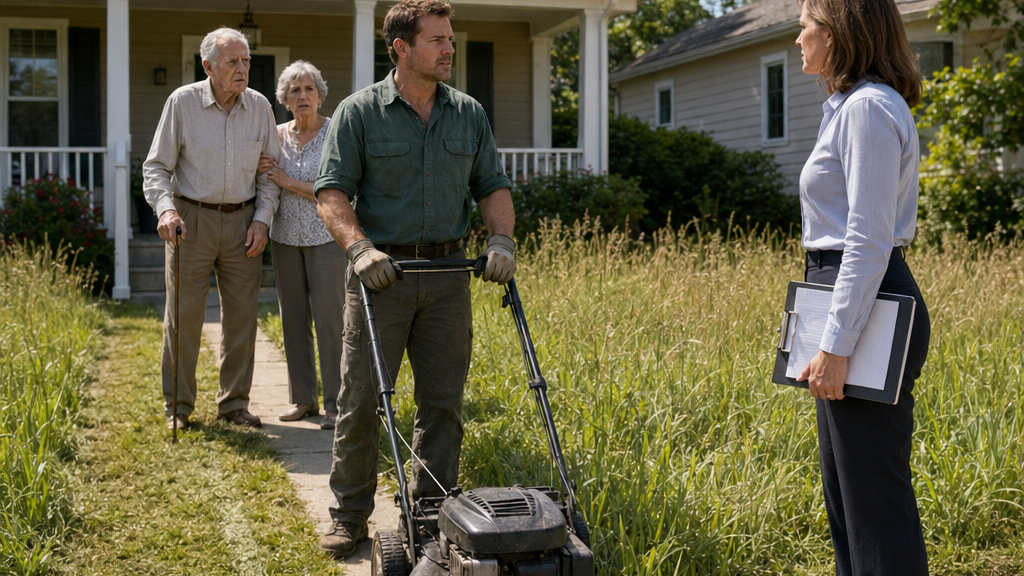
The HOA Threatened an Elderly Couple Over Their Lawn—Then Their Mower Refused to Walk Away
Chapter 1: The Line Jack Cut Through Their Yard
“You can’t do that here.”
Jack Robinson heard the woman before he shut off the mower.
The machine rolled another foot through the Harris yard, chewing a clean green path into grass that had climbed nearly to his thighs in places. Then he released the handle. The engine coughed down, leaving the sudden quiet filled by cicadas and the faint metallic tap of something against concrete.
Charles Harris’s cane.
The old man stood near the front walk with one hand wrapped around its curved handle. His fingers were trembling hard enough that the cane tip clicked against the pavement every few seconds.
Jack looked from him to the woman coming across the driveway.
She carried a clipboard tucked against one hip and wore the expression of someone who had already decided what the conversation was going to be.
“I said you can’t do that here,” she repeated.
Jack wiped his forehead with his sleeve. “Mow the grass?”
“You’re performing work on a property with an active compliance matter.”
Behind her, half the yard stood wild and yellow-green. The other half was beginning to look like a yard again.
Jack glanced at Charles.
Charles gave a small, embarrassed shake of his head, as if apologizing for the entire scene.
Linda Harris stepped off the porch. She moved carefully, holding one hand against the railing longer than she seemed to need to.
“This is Jennifer Wright,” she said. “She’s with the association.”
“Compliance committee,” Jennifer corrected.
Jack nodded once. “Jack Robinson.”
“I know who you are.”
That surprised him.
Jennifer tapped the clipboard. “You’ve done common-area cleanup for the association before.”
“Once or twice.”
“Then you should know contractors aren’t supposed to enter an active violation situation without authorization.”
Jack looked at the grass again.
He had come because a neighbor two streets over had waved him down while he was finishing another property and asked whether he could at least check on the Harris place. Nobody had mentioned an active file. Nobody had mentioned a compliance committee.
They had only said the couple was having trouble.
He had expected a broken mower.
Instead he had found Charles trying to pull weeds one-handed while leaning on his cane.
Linda had been sitting on the porch step with a plastic grocery bag beside her and both hands curled stiffly in her lap.
Jack had unloaded the mower before he thought to ask why no one else had done it.
Jennifer stepped closer to the cut line.
“This neighborhood has standards,” she said. “That’s not personal. It’s the same requirement for everyone.”
Jack saw Charles’s jaw tighten.
Linda looked down at the lawn.
Jack said, “They clearly want it cut.”
“That isn’t the issue.”
“Feels like the issue.”
Jennifer’s eyes moved to the mower. “Are they paying you?”
“No.”
That changed something in her face—not softness, exactly, but caution.
“So this is volunteer work?”
“It’s mowing.”
“For an owner with an open enforcement file.”
Charles shifted his weight. His cane rattled against the walkway again.
Jack had noticed the tremor when he first arrived, but standing still made it worse. Charles’s right hand seemed to fight with itself around the handle.
Linda reached toward him.
Her own fingers barely straightened.
Jack looked at her hand, then at Charles’s.
Jennifer continued speaking, something about liability and association policy, but Jack lost half of it.
Linda saw where he was looking.
“We’re not refusing to take care of it,” she said quietly.
Charles looked at her.
“Linda.”
She ignored him.
“We just got behind.”
Jennifer’s voice softened by half a degree. “Mrs. Harris, you’ve received multiple notices.”
“I know.”
“And there was time to correct the condition.”
Linda rubbed her thumb across the knuckles of her other hand.
Jack saw the swelling now.
“We had someone coming every other week,” she said. “We had to stop.”
Jennifer waited.
Linda glanced at Charles, then said, “His medication went up again.”
Charles’s face hardened with embarrassment.
Jack felt something in himself settle.
Not anger.
Something heavier.
He remembered an older customer from years earlier who had asked whether Jack could “come by sometime” after his regular crew had stopped. Jack had been backed up for three weeks and said he would call when things slowed down.
He never did.
Months later, someone told him the man had moved into assisted living.
Jack had no idea whether the yard had mattered at all.
But he remembered the way “sometime” had sounded.
He turned back to Jennifer.
“What exactly do you need from me?”
“I need you to stop until there’s documented authorization.”
Jack could have argued.
Instead he switched the mower fully off, pulled the key, and walked toward Charles.
“Mr. Harris.”
Charles looked at him.
“Do you want me to finish your lawn?”
Jennifer opened her mouth.
Jack held up one hand without looking at her.
“I’m asking him.”
Charles’s cane trembled against the concrete.
For a moment, he seemed angrier at the question than grateful for it.
Then he looked across his yard.
A straight strip of cut grass ran from the curb almost to the porch. On either side, weeds leaned inward over it.
“Yes,” Charles said.
His voice was thin but clear.
“I want my lawn cut.”
Jack nodded.
“Okay.”
He looked at Jennifer. “Now you have the homeowner telling you.”
“That does not address insurance, access, or contractor rules.”
“I’ve got liability coverage.”
“That’s not the same thing as being authorized for this property.”
“Then give me the form.”
Jennifer’s lips tightened.
“It doesn’t work like that.”
“Then tell me what does.”
For the first time, Jack saw uncertainty flicker across her expression.
Not about the rule.
About him.
She had arrived expecting a contractor who would back off when challenged. Instead he was asking for the procedure.
Jennifer flipped a page on the clipboard.
“I’ll contact the property manager.”
“Good.”
“You still should not continue until—”
Charles spoke behind them.
“He has my permission.”
Jennifer turned.
Charles had straightened as much as he could.
“My name is on the deed,” he said. “I’m asking him to finish.”
Linda put one swollen hand on his arm.
Jennifer looked from the couple to Jack.
She exhaled slowly.
“I’m documenting that I advised you of the issue.”
“Document it,” Jack said.
Then he restarted the mower.
The engine swallowed the conversation.
He pushed forward.
The second strip fell beside the first.
He did not look back for several minutes.
When he finally did, Jennifer was standing at the edge of the driveway taking a photograph.
Not of him.
Of the line in the grass.
By noon, most of the front yard was cut.
Jack was bagging clippings near the curb when Linda came toward him carrying a white envelope.
“Can I show you something?”
Charles, seated in a porch chair, said, “Linda, leave it.”
She stopped.
The envelope bent slightly between her fingers.
Jack noticed the association logo in the corner.
“I don’t need to see anything you don’t want me seeing.”
Linda looked at her husband.
Then she slid a folded notice out anyway.
There were numbers in bold. Late charges. Compliance penalties.
Jack skimmed until a phrase halfway down the page caught his eye.
Possible lien action.
He read it twice.
Then he looked at Charles sitting beneath the porch shade.
The old man’s cane rested against his knee, shaking slightly with him.
“How far has this gone?” Jack asked.
Neither of them answered.
Chapter 2: The Notice Beneath Linda’s Grocery Receipts
The unopened envelopes were stacked beneath a grocery receipt and a coupon for canned soup.
Jack noticed them before he sat down.
Four white envelopes from the property-management company. One had been opened cleanly. Another had a torn corner. Two still looked sealed.
Charles saw Jack looking.
“They send the same thing over and over.”
Linda set three glasses of iced tea on the kitchen table.
“No, they don’t.”
Charles gave her a look.
She sat carefully, flexing her fingers before wrapping them around her glass.
Jack had finished the lawn twenty minutes earlier. The difference outside was almost startling. Through the kitchen window, he could see the first strip he had cut running straight from the sidewalk toward the house, darker than the rest where the mower had laid the grass flat before trimming it down.
The yard looked ordinary now.
The table did not.
Linda pushed the latest notice toward Jack.
He didn’t touch it immediately.
“You want me to read this?”
“Yes.”
Charles said, “There’s nothing in there we don’t already know.”
Linda’s mouth tightened.
“That’s not true either.”
Jack unfolded the page.
The balance was more than a single fine. It included repeated lawn-maintenance penalties, administrative charges, and older fees that had rolled forward.
The number was not catastrophic by itself.
But it was large enough to matter to people counting prescriptions against groceries.
Jack said, “Have you talked to the manager?”
Charles stared toward the window.
“I’ve talked to plenty of people.”
“What did they say?”
“That the grass was too high.”
Linda closed her eyes briefly.
Jack waited.
Finally she said, “Charles told them we were handling it.”
“We were.”
“With what?”
Charles looked at her sharply.
She lowered her voice.
“With what, Charles?”
He tapped two fingers against the table.
The tremor turned the motion into a light stutter.
Jack looked down at the paper again.
“How long since you had regular lawn service?”
Charles said nothing.
Linda answered.
“Almost four months.”
Jack looked up.
Charles leaned back.
“We had a man.”
“What happened?”
“Nothing happened. We stopped calling him.”
Linda said, “We stopped paying him.”
Charles’s jaw moved.
She reached toward him, then seemed to think better of it.
“His prescription changed in the spring,” she said. “Insurance covers part. Not all.”
Jack had heard versions of that sentence from customers before. A roof repair postponed because of dental work. Tree trimming delayed after a hospital stay. A broken fence left leaning because somebody’s deductible came first.
But those people were usually explaining why they wanted the cheap option.
The Harrises had simply stopped asking.
Charles stared at the table.
“Parkinson’s doesn’t care if the grass is six inches or sixteen.”
Linda gave a dry little laugh.
“My hands don’t care either.”
She held them out.
The joints were swollen around the knuckles. Her fingers bent slightly even when she tried to straighten them.
“Arthritis,” she said. “Some mornings I can’t open a jar.”
Jack looked toward the window again.
He thought of Charles trying to pull weeds.
“You were doing this yourselves?”
Charles said, “Trying.”
“That yard was nearly two feet high in spots.”
“I know how high it was.”
Jack heard the defensiveness and stopped.
His instinct was to fix things by moving.
Cut the grass. Haul the brush. Make the call. Solve the immediate problem.
Sitting still with someone else’s pride required more discipline.
Linda touched the stack of envelopes.
“We paid the first fine.”
Charles looked at her.
“We did.”
“We put it on the card.”
Jack asked, “And the rest?”
She shook her head.
“Then another one came.”
Charles said, “They keep adding fees even after they know you’re behind.”
Jack frowned.
“Did you tell them why?”
“I told them we were working on it.”
“That’s not what he asked,” Linda said.
Charles’s face flushed.
Jack leaned back.
There it was.
Not the whole answer, but something close to it.
Charles had told the HOA there was a problem.
He had not told them what the problem actually was.
Jack said, “If there’s a medical hardship process—”
“I’m not asking them for charity.”
“No one said charity.”
“It’s what it is.”
Linda looked at Jack.
“He thinks if he signs something saying he can’t maintain the property, they’ll decide we shouldn’t be here.”
“That’s not what I said.”
“You don’t have to.”
Charles pushed his chair back an inch.
The cane beside him tipped.
Jack caught it before it hit the floor.
For one second, Charles’s hand reached for it and missed.
They both froze.
Jack set the cane upright beside him without comment.
Charles took it.
His grip tightened.
The humiliation in his face was so quick Jack almost missed it.
Jack understood then why the envelopes were unopened.
It was not carelessness.
Opening them required admitting that the problem had become something Charles could not muscle through.
Jack said, “I can talk to the manager.”
“No.”
“I work with them sometimes.”
“No.”
“I could at least find out—”
Charles’s voice sharpened.
“I said no.”
Linda looked down.
Jack stopped.
The old regret rose in him again, the memory of that customer he never called back.
But this was different.
He had spent years telling himself the mistake had been not helping soon enough.
Maybe the deeper mistake was thinking help only counted when he decided what it looked like.
Jack folded the notice carefully.
“All right.”
Charles seemed surprised.
Jack slid it back.
“I won’t call anyone for you.”
Linda’s shoulders dropped a little.
“But if you want me involved, you tell me.”
Charles nodded once.
Outside, the fresh lawn made the whole property look changed.
Inside, nothing important had changed yet.
Jack stood to leave.
His phone buzzed before he reached the porch.
An email notification filled the screen.
The sender was the HOA property-management office.
Subject: Contractor Activity — Harris Property.
Jack opened it.
The first sentence was enough.
His mowing had been added to the active compliance file.
Chapter 3: Helping Them Made the File Worse
By Monday morning, Jack’s good deed had its own case number.
He read the email again while sitting in his truck outside the HOA clubhouse.
The Harris lawn was now compliant.
The Harris account was not.
And according to the property manager, Jack’s work had raised a separate concern involving unauthorized contractor activity on a property under active enforcement.
He stared through the windshield.
He had spent Saturday believing the obvious problem had been waist-high grass.
Now the grass was cut, and the paperwork had multiplied.
Inside, Jennifer Wright was already waiting.
The property manager sat behind a small conference table with a folder open in front of him.
Jennifer had Jack’s photograph from Saturday printed in color.
The image showed the mower at the edge of the newly cut strip.
Jack almost laughed.
“You took a good picture.”
Jennifer did not.
The manager gestured toward a chair.
“Jack, nobody’s accusing you of malicious conduct.”
“That’s comforting.”
“We’re trying to keep this narrow.”
Jennifer said, “I tried to do that Saturday.”
Jack looked at her.
“You told me I couldn’t mow a lawn the homeowners asked me to mow.”
“I told you there were rules around active compliance properties.”
“And now the grass is cut.”
“Yes.”
“So that part’s fixed.”
Jennifer folded her hands.
“The physical condition is corrected. The accrued balance is separate.”
Jack sat back.
“That’s the part I’m having trouble with.”
The manager turned a page.
“Some fines can stop accruing after correction. Existing charges don’t automatically disappear.”
“What about the lien language?”
“That’s an escalation step, not an immediate foreclosure notice.”
Jack looked at him.
“You think that distinction means much to an eighty-year-old man reading the word lien?”
The manager paused.
“No. But it matters procedurally.”
Jennifer slid a printed policy across the table.
“And this matters too.”
Jack looked down.
Approved vendors performing work on common property or association-directed corrective projects had to maintain specified insurance coverage and receive authorization before beginning work.
He read farther.
There were provisions about property access, damage claims, and disputes over who had directed the work.
Jack frowned.
“I wasn’t working for the association.”
“No,” Jennifer said. “Which is one reason I asked whether the Harrises had hired you.”
“They gave permission.”
“After you had already started.”
That landed harder than Jack expected.
He looked up.
Jennifer continued.
“If you damage an irrigation line and Mr. Harris later says he never hired you, who pays?”
“He wouldn’t say that.”
“You don’t know that.”
“I do.”
“No, Jack. You believe that.”
The manager stayed quiet.
Jennifer tapped the photograph.
“You entered, unloaded commercial equipment, and began work before you had explicit authorization from the homeowner.”
Jack felt his face warm.
“He was standing ten feet away.”
“That isn’t the same thing.”
“He was trying to weed the yard himself.”
“That still isn’t the same thing.”
Jack opened his mouth, then stopped.
Because she was right about that part.
He had seen a problem and acted.
He had not asked Charles first.
Not until Jennifer forced the question.
Jack looked again at the rule.
Saturday had felt morally simple.
Monday did not.
The manager said, “This isn’t about punishing you for helping.”
“Feels close.”
“It’s about making sure informal intervention doesn’t create another problem.”
Jennifer added, “And making sure vendors who work with the association understand where the line is.”
There was that word again.
Line.
Jack thought of the first straight strip through the Harris grass.
“What are you saying?”
The manager hesitated.
Jennifer answered.
“Your approved-vendor status is under review.”
Jack stared at her.
He did not make most of his money from HOA work, but enough neighborhood jobs came through management referrals to matter.
“You’re going to pull me from the vendor list because I cut an old couple’s grass for free?”
“I said under review.”
“That’s a nice way to say it.”
Jennifer’s expression tightened.
“You keep reducing this to grass.”
Jack almost laughed again, but there was nothing funny in it.
“That’s interesting coming from you.”
The manager stepped in.
“Both of you.”
Silence settled over the room.
Jack looked out through the clubhouse window.
Across the street, two houses had crews working. One mower. One edger. One blower whining at the curb.
Everything looked orderly.
He imagined Charles at his kitchen table with the unopened envelopes.
Then he imagined a contractor damaging something, a homeowner denying permission, an insurance fight.
Jennifer’s rule was not imaginary.
That was the problem.
If she had been simply cruel, Jack would have known what to do with her.
Instead she had handed him a policy that exposed exactly what he had done wrong.
He rubbed his thumb over the edge of the paper.
“So what happens to the Harrises now?”
The manager turned back to the folder.
“The lawn condition has been marked corrected as of Saturday.”
“That stops new lawn fines?”
“For that condition, yes, unless it falls out of compliance again.”
“And the balance?”
“Still subject to review.”
Jennifer said, “They’ve had multiple notices.”
Jack looked at her.
“You know why they got behind now.”
“I know what was said Saturday.”
“You saw his hands.”
“That isn’t documentation.”
There was no cruelty in her voice.
That somehow made Jack angrier.
“He needs documentation to prove he shakes?”
“No. He needs documentation if he’s requesting an exception or hardship accommodation under the governing process.”
Jack leaned forward.
“What process?”
Jennifer glanced at the manager.
The manager reached into the folder.
“There are several options depending on circumstances.”
He pulled out a thin packet.
Jack watched him flip through it.
Payment plan.
Hearing request.
Appeal.
Then a heading caught Jack’s eye.
Hardship Review Request.
He pointed.
“That.”
The manager stopped.
Jack took the packet.
The form was two pages.
It asked for the nature of the hardship, expected duration, requested accommodation, and supporting information if applicable.
Jack read the title again.
“How long has this existed?”
Jennifer said, “It’s part of the compliance procedures.”
“That wasn’t my question.”
The manager answered.
“Several years.”
Jack looked between them.
“Did they get one?”
Jennifer said, “Not with every violation notice.”
“Did anyone tell them about it?”
“The notices explain appeal and review rights.”
“That’s not the same thing.”
“It’s in the packet.”
Jack flipped backward through the file.
The manager let him.
One older notice included a paragraph directing the homeowner to contact management regarding hardship or accommodation options.
Jack felt the argument he had been building collapse slightly.
It had been there.
Not prominent.
Not warm.
But there.
He pictured Charles saying, I told them we were handling it.
Jack looked at the form.
“Did they ever submit one?”
The manager checked the file.
“No.”
“Start one?”
“No.”
“Call about it?”
Jennifer answered this time.
“Mr. Harris called twice.”
Jack looked up quickly.
“What did he say?”
“That the yard would be handled.”
“Anything else?”
“He said he didn’t need assistance.”
Jack sat still.
The room changed around that sentence.
Saturday’s story had been easy to tell: elderly couple struggling, HOA pressing, contractor helping.
But Charles had not merely failed to ask.
He had apparently refused an opening.
Jack thought of the cane falling beside the kitchen table.
The quick flash of shame when Jack caught it.
He folded the hardship form.
“Can I take this?”
The manager nodded.
Jennifer said, “Only if Mr. Harris wants it.”
Jack met her eyes.
This time he did not argue.
“Yeah,” he said. “I know.”
He stood.
At the door, he looked back at the open compliance folder.
The lawn photograph sat on top.
Clean strip on one side.
Tall grass on the other.
He had thought that line showed exactly where the problem ended.
Now he understood it might only show where the easier part ended.
He tapped the folded hardship form against his palm.
The question was no longer why the HOA had not helped Charles Harris.
It was why Charles had apparently been offered a way to ask—and refused to use it.
Chapter 4: The Form Charles Would Not Sign
“I threw one away.”
Charles said it before Jack had finished unfolding the hardship form.
They were at the Harris kitchen table again, the same stack of notices pushed farther to one side, the same cane resting against Charles’s chair. Outside, the lawn still looked better than it had on Saturday, but thin shoots had already begun rising unevenly along the darker strip Jack had cut first.
Jack looked at Charles.
“You threw away what?”
“The form.”
Linda stopped sorting a small pile of pharmacy receipts.
Charles kept his eyes on the table.
“The hardship form. They sent one before.”
Jack sat back slowly.
“You told me you never asked for help.”
“I didn’t.”
“That’s not what I asked.”
Charles’s hand tightened around the edge of the table. The tremor made his knuckles tap lightly against the wood.
Jack laid the blank form down between them.
“You had this?”
“Something like it.”
“And you threw it away?”
“Yes.”
Linda closed her eyes.
Jack had come prepared to explain what he had learned at the clubhouse. He had rehearsed how to say it without making Charles feel cornered.
Now the words came out sharper than he intended.
“Why?”
Charles looked up.
“Because I didn’t need it.”
Jack glanced toward the window, then back at him.
“You were trying to pull weeds with one hand while holding a cane with the other.”
“I said I didn’t need the form.”
“That isn’t the same thing.”
Charles’s jaw set.
For an instant, Jack heard Jennifer’s voice in his own.
He stopped.
Linda pushed the pharmacy receipts into a neat square.
“He thought they’d use it against us.”
Charles looked at her.
“Linda.”
She didn’t retreat this time.
“You did.”
Charles said nothing.
Jack asked, more carefully, “Use it how?”
Linda rubbed one thumb across the stiff joints of her opposite hand.
“He thought if he signed something saying he couldn’t maintain the property, somebody would decide we couldn’t maintain the house either.”
“That’s ridiculous,” Jack said.
Charles’s eyes snapped toward him.
“To you.”
Jack went quiet.
Charles leaned back, breathing harder than the conversation seemed to warrant.
“You know what happens when people start looking at you like you can’t do things?”
Jack did not answer.
“They stop asking what you want. They ask your wife. They ask your doctor. They ask each other.”
Linda’s face softened.
Charles went on.
“First it’s, ‘Do you need help with the yard?’ Then it’s, ‘Are you still driving?’ Then it’s, ‘Is that house too much for you?’”
His voice had grown rough.
Jack looked at the cane.
Charles noticed.
“That,” he said, “is exactly what I mean.”
Jack lifted his eyes.
“I wasn’t—”
“I know what you were doing.”
The words were not cruel. That made them worse.
Charles looked at the blank form.
“I bought this house when I could still climb a ladder with a sheet of plywood on my shoulder. I replaced half those porch boards myself. I put the shelves in that garage. I planted the maple out front.”
His hand shook harder.
“Now everybody sees the cane first.”
Linda reached across the table.
This time Charles let her take his hand.
Jack thought of Saturday.
He had looked at the tall grass, looked at Charles, and decided within minutes what needed to happen.
He had been right that the lawn needed cutting.
He had never stopped to ask whether being rescued in front of his own house might carry a cost Charles was not ready to pay.
“I’m sorry,” Jack said.
Charles frowned.
“For what?”
“For acting like getting the grass cut fixed the problem.”
Charles looked away.
Jack slid the hardship form closer, but not all the way.
“I’m not going to fill this out for you.”
Linda glanced at him.
“I’m not going to call the manager for you either.”
Charles’s shoulders loosened slightly.
“But I think you should know exactly what happens if you don’t do anything.”
He reached into his work folder and took out the latest account notice.
The language was dry.
Balance review.
Collection schedule.
Lien consideration.
Charles had seen the words before. Jack knew that now.
But this time he watched Charles read them instead of reading for him.
“When?” Charles asked.
Jack pointed to the date.
Charles went still.
Linda leaned forward.
“That’s before the board meeting.”
“Three days before,” Jack said.
She looked at Charles.
“Can they do that?”
Jack shook his head.
“I don’t know exactly what they’ll authorize. But the account is scheduled for lien review before the next regular board meeting.”
Charles stared at the date.
The room seemed smaller.
Linda said, “Then we need to call.”
Charles’s first response came automatically.
“No.”
Jack almost interrupted.
He stopped himself.
Linda did not.
“Charles.”
“I said no.”
“And what happens if we do nothing?”
“We pay it.”
“With what?”
He looked at her.
She pulled the pharmacy receipts back toward the center of the table.
There were more than Jack had noticed before.
Linda selected one and turned it over.
“You know what this was.”
Charles did.
“You know what next month is.”
He closed his eyes briefly.
Jack let the silence sit.
Eventually Charles said, “I called them twice.”
Jack remembered Jennifer saying the same thing.
“What did you tell them?”
“That I’d handle the yard.”
“Did you mention Parkinson’s?”
“No.”
“Linda’s arthritis?”
“No.”
“Medication costs?”
Charles gave him a tired look.
“No.”
“Did they ask if you needed assistance?”
Charles did not answer.
Linda did.
“Yes.”
Jack looked at him.
Charles’s voice dropped.
“I told them no.”
There it was.
Not a hidden conspiracy.
Not a missing notice.
A proud man protecting the last version of himself he still recognized.
Jack had wanted a simple answer for why the process had failed.
He had found one.
It just wasn’t an answer that let him stay angry at only Jennifer.
Later that afternoon, he drove Linda to the pharmacy because Charles was too unsteady to drive.
He waited in the parking lot while she went inside.
When she returned, she carried one small white bag.
She sat in the passenger seat but did not close the door immediately.
“He hates that I told you.”
Jack kept both hands on the steering wheel.
“I figured.”
“He thinks needing help is the same as losing control.”
Jack looked at the pharmacy doors.
“Maybe because people keep helping without asking him.”
Linda gave him a sideways look.
“You mean you?”
“Yeah.”
A small smile touched her mouth.
“At least you learn fast.”
Jack nodded toward the bag.
“How long has he been worried about the house?”
“Since the doctor told him to stop using ladders.”
“That long?”
“He didn’t say it out loud. But after that, every suggestion sounded like an eviction notice to him.”
Jack thought of the form on the kitchen table.
“When you get home, don’t push him.”
Linda looked at him.
“That surprises me.”
“Me too.”
He started the truck.
“But he needs to decide before that review date.”
Linda shut the door.
When they returned, Charles was standing on the porch.
The hardship form was in his hand.
He did not invite Jack inside.
He held the paper out.
“I’m not signing this today.”
Jack nodded.
“Okay.”
“I want to read everything first.”
“Okay.”
“And if I do it, I talk at the meeting.”
Jack studied him.
“You want to go?”
“I don’t want you explaining me to those people.”
The words were blunt, but Jack felt something ease in his chest.
“That sounds fair.”
Charles looked down at the form.
His thumb trembled against the edge.
“I’ll ask for time,” he said. “My way.”
Jack nodded once.
Charles went back inside.
For the first time since Saturday, Jack did not feel the urge to follow.
Chapter 5: Jennifer Had One Choice She Never Mentioned
The property manager did not look up when Jack asked the question.
“Can the compliance chair recommend a temporary administrative hold?”
The manager’s pen stopped over the Harris file.
Jennifer Wright, seated at the other end of the clubhouse office, turned toward Jack.
The manager finally looked up.
“Yes.”
One word.
That was all it took.
Jack felt his anger return.
Not the hot, uncomplicated kind he had carried Saturday. This was narrower.
More useful.
“For hardship?”
“For circumstances requiring review,” the manager said carefully. “A hold does not erase charges or approve an accommodation. It pauses certain escalation steps while the board evaluates the request.”
Jack looked at Jennifer.
“You knew that.”
“Yes.”
“Did you recommend one?”
“No.”
The manager closed the folder halfway.
“Jack—”
“No. I’m asking her.”
Jennifer sat straight in her chair.
“I heard you.”
“Why didn’t you?”
“Because there was no hardship request.”
“You saw Charles.”
“That is not a request.”
“You heard Linda.”
“That still is not a request.”
Jack took a breath.
He had promised himself before walking in that he would not turn this into a fight.
Jennifer seemed to notice him making the effort.
She said, “You want me to make an exception based on a conversation in a driveway.”
“I want to know why you didn’t pause long enough to find out what was happening.”
“We had been finding out for months.”
“No. You’d been sending notices.”
“And receiving responses from Mr. Harris saying the matter would be corrected.”
Jack had no answer to that.
Jennifer continued.
“Twice he said he did not need assistance. Once in writing.”
The manager reopened the folder and turned it toward Jack.
There was the note.
Owner states matter will be corrected. No accommodation requested.
Jack recognized the trap in his own thinking.
Every time he found a fact that made the HOA look colder, another fact appeared that made Charles’s silence part of the problem.
But the hold still existed.
He tapped the folder.
“That was before Saturday.”
Jennifer’s expression changed slightly.
“Yes.”
“Saturday you saw enough to know things were different.”
“I saw enough to know there might be a hardship.”
“And you still didn’t recommend a pause.”
“No.”
“Why?”
Jennifer looked at the manager.
He did not rescue her.
For a few seconds, the only sound came from the copier cycling in the next room.
Then Jennifer said, “Because last year we paused an enforcement case for someone who claimed family hardship.”
Jack waited.
“The owner had a board member call me privately. We delayed fines. We delayed the hearing. Six months later, three other homeowners demanded the same treatment.”
“What happened?”
“One of them had already paid. Another had been denied an extension.”
Jack folded his arms.
“So?”
“So the association spent four months being accused of favoritism.”
Her voice had changed.
Less official.
More tired.
“At meetings. In email chains. On neighborhood pages. People said rules only mattered if you knew someone.”
The manager looked down at his desk.
Jennifer continued.
“I was the person who recommended that first pause.”
Jack had not expected that.
She gave a short, humorless laugh.
“I was called compassionate until somebody else wanted the same exception.”
“What does that have to do with Charles?”
“Everything, if you’re the one expected to apply rules consistently.”
“No,” Jack said. “It explains you. It doesn’t explain him.”
Jennifer’s jaw tightened.
Jack kept his voice even.
“You got burned for using discretion once. So now you’re afraid to use it at all.”
“That’s not what I said.”
“It’s what you’re doing.”
Jennifer glanced toward the closed office door.
“The board election is next month.”
Jack understood the rest without being told.
“You’re running again.”
“Yes.”
“And you don’t want anybody saying you gave special treatment.”
“I don’t want anyone saying the rules depend on who produces the saddest story.”
The sentence hung there.
Jennifer heard it too.
Her face shifted.
Jack said nothing.
She rubbed one hand over the edge of the clipboard.
“That sounded worse than I meant.”
“Probably.”
“I’m not saying they’re lying.”
“I know.”
Jack surprised himself by meaning it.
He moved to the window.
Across the street, the Harris lawn could not be seen from the clubhouse, but he pictured it anyway.
The grass was short now.
Technically compliant.
The original visual offense had vanished.
Yet the account remained alive because the real problem had never been the grass alone.
Jack turned back.
“Charles is filling out the hardship request.”
Jennifer’s eyes narrowed.
“He agreed?”
“He’s reading it. He wants to speak at the meeting himself.”
Something in her posture loosened.
“Good.”
Jack noticed.
“You wanted him to?”
“I want owners involved in their own cases.”
“So do I.”
Jennifer looked at him.
There it was: the first thing they had agreed on without qualification.
Jack took a photograph from the file.
It was the one Jennifer had taken Saturday.
Tall grass on the right.
Clean mower strip on the left.
Charles’s cane barely visible near the walkway.
“You know what I thought this picture proved?”
Jennifer said nothing.
“That I’d fixed something.”
He put it back.
“What it actually proves is I started work before I had permission.”
Jennifer’s expression softened, but only slightly.
“That matters.”
“I know.”
Jack leaned on the back of a chair.
“And you know what else it proves?”
“What?”
“You saw the same scene I did.”
Jennifer’s eyes stayed on the photograph.
“You had enough information after Saturday to recommend a temporary hold.”
She did not deny it.
Jack waited.
Finally she said, “I chose not to.”
“Because of the election?”
“Because of consistency.”
“And because of the election.”
Jennifer looked at him.
“Yes.”
It was the first clean admission Jack had heard from her.
Not corruption.
Not cruelty.
Fear.
Fear of being accused again.
Fear of looking weak.
Fear that discretion would cost her authority.
Jack understood it.
He still thought she was wrong.
“Withdraw the recommendation for lien review,” he said.
Jennifer shook her head.
“I won’t do that unilaterally.”
“You could recommend a hold.”
“I could.”
“Will you?”
“No.”
Jack stared at her.
“Why tell me all that, then?”
“Because understanding my reason is not the same as agreeing with my decision.”
The answer irritated him because it sounded fair.
Jennifer straightened the file.
“I’ll support putting the hardship request on the meeting agenda if it’s completed in time.”
“But you won’t pause the review before then.”
“No.”
Jack nodded slowly.
At least the line was visible now.
He knew exactly where she stood.
Outside, as he crossed the neighborhood toward his truck, Melissa Campbell stepped off the sidewalk near the corner.
Jack knew her by sight. She lived two houses down from the Harrises.
“You’re the mower guy,” she said.
“Sometimes.”
She looked toward the Harris property.
“I was one of the people who complained.”
Jack stopped.
Melissa folded her arms.
“That grass was bad.”
“It was.”
“I didn’t know why.”
Jack said nothing.
“I thought they’d just stopped caring.”
“A lot of people did.”
Melissa looked embarrassed, but not defensive.
“I still think the standards matter.”
“So does Jennifer.”
“That supposed to scare me?”
Jack almost smiled.
Melissa glanced toward the Harris yard.
“What happens now?”
“They have a board meeting.”
“And after that?”
“Depends.”
She was quiet.
Then she said, “If the problem is that they can’t maintain the yard, why are we acting like the only two choices are fines or pretending the rule doesn’t exist?”
Jack looked at her.
Melissa continued.
“There are twelve houses on this section.”
He waited.
“My mower works.”
Jack understood.
“You volunteering?”
“I’m saying if Charles and Linda agree, I could take a week sometimes.”
Jack thought of Saturday, when he had acted before asking.
This time he said, “You need to ask them.”
“I will.”
“And it can’t just be you.”
“Then help me find other people.”
Jack looked back toward the clubhouse.
Jennifer was still inside with the file and the photograph.
For the first time, Jack saw a possible answer that did not require defeating her.
He took out his phone.
“If Charles says yes,” he said, “we build something he controls.”
Melissa nodded.
“And I’ll tell the board exactly that.”
Chapter 6: Charles Asked for Time in His Own Voice
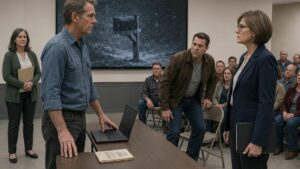
Charles’s hand shook so badly when his name was called that the rubber tip of his cane clicked twice against the clubhouse floor.
Jack started to rise.
Charles looked at him.
Jack sat back down.
That was the agreement.
Charles would speak first.
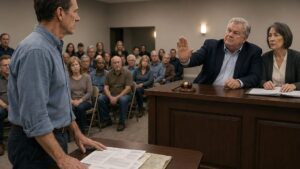
The meeting room was not large. A folding-chair audience faced a long table where the board sat beside the property manager. Jennifer occupied one end with the Harris file closed in front of her.
Melissa sat across the aisle from Jack.
Linda sat beside Charles, both hands folded carefully around her purse.
The board chair called again.
“Mr. Harris?”
Charles pushed himself upright.
Linda reached for his elbow.
He paused.
Then let her help.
Jack watched him make the short walk to the front.
Every instinct he had told him to get up, take the microphone, make the explanation cleaner.
Instead he stayed seated.
Charles placed one hand on the lectern.
His tremor traveled visibly through his arm.
“I’m Charles Harris,” he said.
His voice shook.
No one interrupted.
“My wife and I have lived on our street twenty-one years.”
He swallowed.
“I know what the yard looked like.”
The board chair nodded.
Charles stared down at his notes.
“I’m not here to tell you it looked acceptable.”
Jack saw Jennifer glance toward him.
Charles continued.
“I’m here because I kept saying I could handle it after I couldn’t.”
Linda lowered her eyes.
That sentence changed the room.
Not dramatically.
No gasps.
No applause.
Just a shift in attention.
Charles looked toward the board.
“I have Parkinson’s disease. My wife has arthritis. We had lawn service. Then my medication changed and we stopped paying for the lawn service.”
He paused until his hand settled enough to turn the page.
“When management asked whether I needed help, I said no.”
Jack saw one board member lean forward.
Charles’s mouth tightened.
“That was pride.”
He looked briefly at Linda.
“Mostly mine.”
Jennifer lowered her gaze to the file.
Charles said, “I thought if I put in writing what I can’t do anymore, that would become the only thing people saw when they looked at me.”
His fingers shook against the paper.
“I was wrong to ignore the form.”
He stopped.
Jack could hear the ventilation system.
Charles looked at the board chair.
“But I’m asking now.”
He did not say please.
He did not need to.
“I need more time. I need the lien process stopped while we work this out. And I need you to let me accept help without treating that help like another violation.”
He stepped away from the lectern.
Jack felt his chest tighten.
Charles had said in less than two minutes what Jack would have buried under ten minutes of anger.
The board chair thanked him.
Then Jennifer opened the file.
“The lawn condition itself is currently corrected,” she said.
She placed three photographs on the table.
The first showed the property before Jack arrived.
The second showed the mower paused beside the first clean strip through the tall grass.
The third showed the completed yard.
Jack recognized the sequence.
The cut line had become evidence.
Not of defiance.
Of progression.
Jennifer said, “The issue before the board is the accrued balance and collection status, along with the newly submitted hardship request.”
One board member asked, “Is the property currently compliant?”
“Yes.”
“Are new lawn fines accruing?”
“No.”
The treasurer adjusted his glasses.
“That does not resolve the existing balance.”
Jack knew that voice before the sentence finished.
Here came the part nobody could mow away.
The treasurer explained that some charges were administrative, some were violation penalties, and some had already been posted under the collection policy.
“Simply erasing the full account tonight,” he said, “creates a different consistency problem.”
Jack watched Jennifer.
She did not look pleased.
She also did not disagree.
The board chair called Jack’s name.
He stood.
This time Charles did not stop him.
Jack walked to the lectern.
He looked once at the photograph of the half-cut lawn.
“I’m Jack Robinson.”
One of the board members nodded.
“We know.”
Jack heard a few chairs move behind him.
He ignored them.
“I want to start with the part that’s mine.”
Jennifer looked up.
“I began work on the Harris property before I had explicit permission from Mr. Harris.”
The room stayed still.
Jack continued.
“I saw the yard. I saw him trying to work in it. I decided I knew what needed to happen.”
He glanced toward Charles.
“I should have asked first.”
Charles gave a small nod.
Jack turned back to the board.
“I also didn’t know there was an active compliance file or contractor procedure connected to it.”
The treasurer asked, “Are you disputing the association’s contractor rules?”
“No.”
Jennifer’s eyes lifted slightly.
Jack said, “I’m disputing the idea that following those rules required continuing escalation after the situation became clear.”
Now the room tightened.
He did not look at Jennifer.
Not yet.
“I made a mistake because I acted too quickly. That doesn’t mean the association made no mistake.”
Jennifer’s mouth pressed into a line.
Jack took a sheet from his folder.
“This is what we’re proposing.”
He held it up.
“No outside contractor enters the property unless the Harrises request it. No one decides they need help without asking them. Volunteer lawn work is scheduled directly with Charles and Linda. The volunteers provide their own ordinary residential equipment. If professional work is needed, the Harrises hire or approve a contractor themselves.”
A board member asked, “Who are the volunteers?”
Jack looked toward Melissa.
She stood.
“Neighbors.”
The word sounded almost awkward in the room.
Melissa walked forward.
“I complained about their grass.”
Charles looked at her.
She met his eyes.
“I thought they stopped caring.”
Linda’s fingers tightened around her purse.
Melissa continued.
“I was wrong about that.”
Then she turned to the board.
“I still don’t want eighteen-inch lawns in the neighborhood. I also don’t think fines are going to make Mr. Harris’s hands stop shaking.”
Jennifer looked down.
Melissa placed another sheet beside Jack’s.
“Four households have agreed to rotate basic mowing if the Harrises want us to. Nothing automatic. They can say no.”
Jack saw Charles’s face change at that last part.
Not relief exactly.
Recognition.
The board chair asked the property manager whether such an arrangement violated any rule.
The manager shook his head.
“Not if the homeowners authorize the work and no association funds are involved.”
The treasurer said, “That addresses maintenance going forward. It does not resolve the account.”
Jennifer spoke before Jack could.
“I agree.”
Jack turned toward her.
She had opened the Harris file to the photograph again.
She touched the image of the first cut strip.
“The compliance chair had authority to recommend a temporary administrative hold after Saturday.”
Jack felt Melissa shift behind him.
Jennifer continued.
“I did not recommend one.”
The board chair looked at her.
“Why?”
Jennifer inhaled slowly.
“Because I was concerned about unequal enforcement and accusations of favoritism.”
The treasurer frowned.
“Was that concern documented?”
“No.”
“Did you believe by Saturday that a legitimate hardship might exist?”
Jennifer paused.
“Yes.”
The answer seemed to cost her something.
Jack watched her.
She did not look at him.
The board chair said, “Then the question is whether escalation should have continued while hardship review was available.”
Jennifer nodded.
“That is the question.”
Jack understood then that she was not going to excuse herself.
She also was not going to perform repentance for the room.
She was simply putting her choice where everyone could see it.
The board deliberated for nearly twenty minutes.
Charles sat with his cane between his knees.
Jack did not speak.
At one point, Linda reached for Charles’s hand.
His tremor continued inside hers.
When the board returned, the chair read from a handwritten motion.
Lien escalation would be halted immediately pending final account disposition.
The newest penalties assessed after Saturday would be suspended for review.
Charles and Linda would receive temporary hardship status for lawn-maintenance compliance.
The volunteer arrangement would be allowed under a written homeowner-consent procedure to be drafted by management.
Jack felt Melissa exhale beside him.
Then the chair raised one finger.
“The existing older balance is not being erased tonight.”
Charles’s face tightened.
The treasurer spoke.
“We need to separate charges that can be adjusted from charges already processed under the collection policy. We also need to determine what payment-plan authority exists.”
Linda whispered something to Charles.
Jack could not hear it.
Charles nodded.
The board chair looked at him.
“Mr. Harris, the lien process is stopped. The account will come back for final disposition after review.”
Charles stared at the table.
Then he lifted his head.
“How long?”
“Two weeks.”
He considered that.
“Okay.”
It was not victory.
It was time.
And this time, Charles had asked for it himself.
Chapter 7: The Grass Grew Back, but Not the Same Way
Jack turned onto the Harris street expecting to see an overgrown edge along the driveway.
Instead, he saw Melissa Campbell behind a mower.
She had already finished half the front yard.
For a second, Jack thought he had come on the wrong Saturday.
Then Melissa spotted his truck and lifted one hand from the handle.
“You’re late.”
Jack parked at the curb.
“I’m six minutes early.”
“Then I’m extremely early.”
The mower idled between them.
Jack looked toward the porch.
Charles sat in his usual chair with his cane beside his knee. Linda was at a small table near the door, sorting something into two envelopes.
Six weeks had passed since the board meeting.
The grass had grown several times since then.
It had not grown wild.
That was the difference.
The final account decision had arrived two weeks after the hearing.
The newest penalties assessed after Jack’s Saturday mowing were removed. The lien escalation was canceled. The older charges remained, but the board approved a payment plan small enough that Linda had read the monthly amount twice before believing it.
The hardship status lasted six months and could be reviewed again if needed.
No miracle.
No erased history.
No promise that Charles’s Parkinson’s would improve or Linda’s hands would hurt less.
Just enough room to breathe.
Jack walked toward Melissa.
“Which week is this?”
“Mine.”
“I thought next week was yours.”
“It was.”
“So why are you here?”
She shrugged.
“The family on the corner swapped with me.”
Jack smiled.
A shared calendar now hung inside the Harris kitchen. Four households had volunteered for rotation. Nobody came without checking first. If Charles wanted a week skipped, it was skipped. If Linda wanted the front bed left alone, nobody touched it.
The first draft Jack had written had been too complicated.
Schedules. Equipment lists. Contact numbers. Backup assignments.
Charles had looked at it and said, “You turned mowing into government.”
So Jack had crossed out half of it.
The final rule was simple.
Ask first.
Melissa pushed the mower forward again.
Jack watched her finish the strip nearest the sidewalk.
The old cut line from that first Saturday was long gone. The grass had grown evenly over it.
He had expected the disappearance to bother him.
It did not.
Linda called from the porch.
“Jack.”
He walked over.
She handed him one of the envelopes.
“What’s this?”
“The board letter.”
“I already saw it.”
“The final one.”
Jack took it but did not open it.
Linda smiled.
“You can. Charles already complained about every sentence.”
From his chair, Charles said, “Because they use twelve words when four would work.”
Jack opened the envelope.
It confirmed what the manager had told them by phone: newer penalties removed, lien action canceled, older balance placed on the approved plan, hardship status active, volunteer maintenance permitted with homeowner consent.
At the bottom was one additional paragraph.
The board had adopted a temporary written procedure allowing homeowners facing documented hardship to request short administrative holds before escalation, subject to review.
Jack read it again.
“They changed the process.”
Charles grunted.
“They clarified it.”
Linda looked toward him.
“Let him have one nice sentence.”
Jack folded the letter.
“Where’s Jennifer?”
Charles raised an eyebrow.
“You miss her?”
“No.”
“Good.”
Linda said, “She stopped by last week.”
Jack looked at her.
“For what?”
“To give us the signed copy.”
“She could’ve mailed it.”
“She said that too.”
Jack glanced at Charles.
“What happened?”
“Nothing.”
Linda smiled.
“That means something happened.”
Charles frowned at her.
Jennifer had apparently stood on the porch for less than five minutes.
She had told Charles the new hold procedure was not written for him alone and would apply to anyone who met the same requirements.
Charles had said that sounded fair.
Jennifer had then said she should have recommended a pause after seeing his condition that Saturday.
Charles had replied that he should have filled out the form the first time it arrived.
Neither apologized again.
They did not need to.
Jack looked down at the envelope.
That sounded more honest than a handshake for an audience.
Across the yard, Melissa shut off the mower.
“Done.”
Charles leaned forward.
“No, you’re not.”
Melissa looked around.
“I missed something?”
Charles pointed with his cane toward the narrow strip between the porch walk and the flower bed.
“That.”
Melissa squinted.
“It’s fine.”
“It’s high.”
“It’s half an inch higher.”
Charles reached for his cane.
Linda immediately stood.
“Charles.”
“I’m going ten feet, not crossing the desert.”
Jack watched him rise.
His legs steadied slowly beneath him.
He had better days and worse ones now. Today looked like something in between.
Melissa glanced at Jack.
Jack did not move.
That was new too.
Charles walked toward the small electric trimmer leaning near the porch wall.
Jack had brought it three weeks earlier after Charles asked for something light enough to use safely for short stretches.
Not a mower.
Not a ladder.
Nothing that could drag him across the yard.
Just a compact trimmer with a shoulder strap and a safety shutoff.
Charles picked it up.
Linda said, “Five minutes.”
He looked at her.
“Seven.”
“Five.”
“Six.”
She sighed.
“Six.”
Charles smiled.
Jack stepped closer only when Charles held out the cane.
“Take this.”
Jack did.
Charles fitted the strap over his shoulder.
His hand shook as he wrapped his fingers around the trimmer handle.
The motor whirred softly.
He started with the narrow strip.
Slowly.
The line he cut was not perfectly straight.
Jack noticed that.
Charles noticed too.
He stopped, adjusted his stance, and corrected the next section.
Melissa crossed her arms.
“You know I could’ve done that in thirty seconds.”
Charles kept trimming.
“I know.”
“Just checking.”
“I know.”
He reached the end of the strip and switched the trimmer off.
Six minutes almost exactly.
Linda looked at the porch clock through the window.
“You cheated by starting before I checked.”
Charles handed the trimmer to Jack.
“Prove it.”
His breathing was heavier.
The tremor in his right hand had worsened from the effort.
Jack took the trimmer without comment.
Charles reached for his cane.
Jack held it out.
But Charles did not take it immediately.
He looked at the narrow strip he had finished.
Then at Melissa’s broader sections.
Then at the rest of the lawn.
Four people had cut it over the last month.
Different mower patterns.
Different speeds.
Different ideas about how close to trim around the maple.
The yard was not maintained by one rescuer anymore.
It was maintained by agreement.
Charles finally took the cane.
“You missed a spot,” he told Jack.
Jack looked down.
“Where?”
Charles pointed to one blade standing higher than the rest.
Jack stared at him.
Melissa started laughing.
Even Linda did.
Jack shook his head.
“You want me to get scissors?”
Charles considered it.
“No. Leave it.”
Jack looked at him.
Charles settled his weight onto the cane.
“Can’t make everything perfect.”
It was such an ordinary sentence that nobody answered.
Melissa loaded her mower into her garage down the street.
Linda carried the association letter inside and tucked it into a drawer instead of leaving it on the kitchen table.
Jack coiled the trimmer cord.
Charles remained near the walkway.
The original line Jack had cut through the waist-high grass no longer existed.
For weeks, Jack had thought of that line as the moment he chose not to walk away.
Now he understood that staying had required something harder than starting.
It had required learning when not to push.
When to ask.
When to let Charles speak.
When to admit Jennifer had been right about one thing and wrong about another.
When to build help that did not turn the people receiving it into spectators.
Jack lifted the trimmer toward his truck.
Charles called after him.
“Next Saturday.”
Jack turned.
“What about it?”
Charles nodded toward the lawn.
“Melissa’s not doing the side yard. Her turns are crooked.”
From halfway down the sidewalk, Melissa shouted, “I heard that.”
Charles smiled.
Jack laughed and opened the truck bed.
“Next Saturday,” he said.
Charles tapped the cane once against the pavement.
Not because his hand had slipped.
Because he meant it.
The story has ended.