The HOA Fined Brian Over the Wrong Shade of Black—Then He Opened Their Books
Chapter 1: The Seventy-Five-Dollar Shade of Black
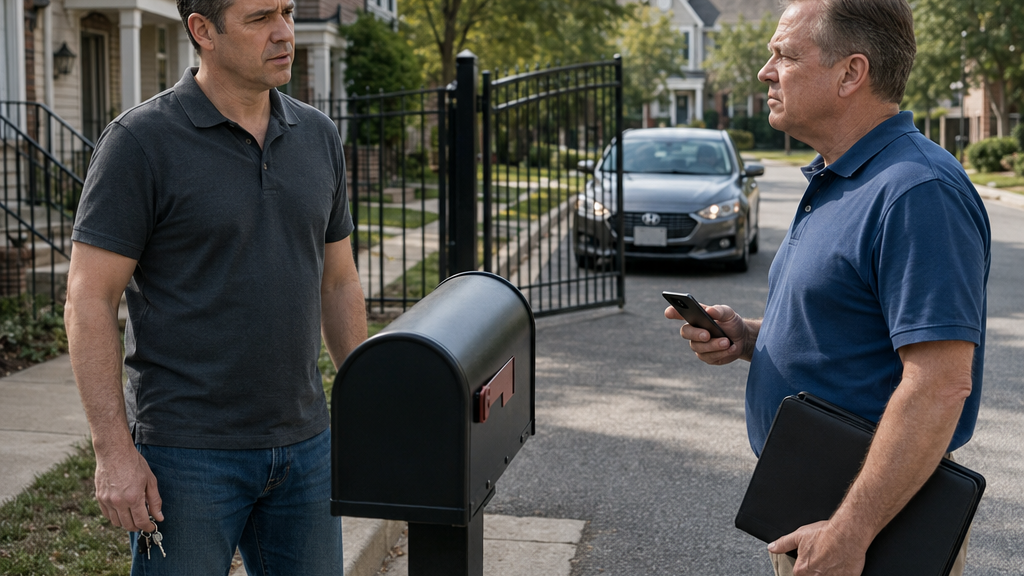
Donald Williams took three pictures of Brian Miller’s mailbox before he said good morning.
Brian stood at the end of his short townhouse walk with a travel mug in one hand and his keys in the other, watching Donald crouch slightly to capture the side panel, the post, and finally the small metal door.
“What are you doing?”
Donald straightened. He wore the same blue polo he usually wore during association walk-throughs, tucked neatly into khaki pants. A folder was pressed beneath one arm.
“Documenting a violation.”
Brian looked at the mailbox.
Three days earlier, a delivery truck had backed too close to the curb and bent the box sideways. Brian had hammered the bracket straight, replaced one cracked screw, sanded the scraped metal, and sprayed the whole thing black.
It looked like a black mailbox.
Donald opened the folder and handed him a single-page notice.
The amount at the bottom was impossible to miss.
$75.
Brian read the violation description twice.
“Finish color inconsistent with approved community standard.”
He looked from the page to the mailbox.
“What color is it supposed to be?”
“Black.”
Brian waited.
Donald did not smile.
Brian turned back toward the mailbox. Morning light caught the freshly painted metal, revealing a soft satin sheen.
“It is black.”
“It’s the wrong black.”
For a second, Brian thought he had misunderstood.
Then Donald pointed toward the row of mailboxes extending down the street.
“Those are the approved finish.”
Brian looked at the nearest one. It was black too, just older, dulled by years of sun.
“What’s the specification?”
Donald’s expression changed slightly.
“The association standard.”
“I understand that. What specification defines it?”
“The architectural guidelines.”
“Color code?”
Donald shifted the folder under his arm. “Brian, I’m not going to debate shades with you on the sidewalk.”
“I’m not debating. I’m asking what I violated.”
Farther down the street came the grinding mechanical cough of the entrance gate trying to close.
Both men glanced toward it.
The gate moved six inches, stopped, shuddered, then reversed.
A sedan waiting outside honked once.
Brian looked back at Donald.
“That’s still doing that?”
“The gate company has been notified.”
“It’s been doing that since spring.”
Donald’s jaw tightened.
“This is about your mailbox.”
That sentence bothered Brian more than the seventy-five dollars.
Donald tapped the notice.
“You have ten days to correct it or appeal. If the balance remains unpaid after the deadline, late charges apply.”
“And if I appeal?”
“The compliance status stays open until the board reviews it.”
Brian folded the page once.
Donald started walking away, then stopped.
“One more thing. Continued noncompliance can affect amenity privileges.”
Brian stared at him.
“You’re talking about suspending my pool access because my black mailbox is the wrong black?”
“I’m telling you what the enforcement policy allows.”
Donald walked toward the next building.
Brian remained at the curb.
Emma Davis came out two doors down carrying a grocery bag toward her car. She glanced at Donald, then at Brian’s paper.
“What now?”
Brian held it up.
“Apparently I own an illegal shade of black.”
Emma laughed until she realized he wasn’t joking.
“You’re serious?”
“Seventy-five dollars.”
She stepped closer to inspect the mailbox.
“It looks exactly like mine.”
“That’s what I thought.”
Emma touched the edge of the door with one finger.
“Yours is shinier.”
Brian gave her a look.
“I’m sure civilization will recover.”
“Don’t get into a war over this,” she said. “Just ask them what paint to use.”
“That’s what I did.”
“And?”
“They told me the standard is the standard.”
Emma sighed. She had served briefly as board secretary years earlier and still carried the fatigue of it.
“That sounds like Donald.”
The entrance gate groaned again.
Emma glanced toward it.
“That thing nearly closed on my car last week.”
Brian unfolded the notice.
“Glad they’re focusing on priorities.”
Inside his townhouse, he set the notice beside his laptop and opened the association’s architectural guidelines.
The document was thirty-eight pages long.
Mailbox standards occupied four paragraphs.
Posts had to remain uniform. Replacement boxes required board-compatible design. Finish had to match the community-approved exterior scheme.
Brian searched for “black.”
Four results.
None included a manufacturer, paint code, sheen requirement, or product number.
He searched for “mailbox.”
Nothing more specific appeared.
He opened the violation notice again and read the exact language Donald had selected.
Inconsistent with approved community standard.
Brian had spent most of his working life reading sentences designed to sound more precise than they actually were.
He worked as a forensic bookkeeper, usually for small companies that suspected an employee, vendor, or partner had mishandled money. His job was rarely dramatic. It was invoices, dates, deposits, duplicate entries, missing documentation.
Precision mattered.
So did knowing when precision was missing.
At lunch, he logged into the homeowner portal to file an appeal.
A red banner appeared above his account balance.
COMPLIANCE ACTION PENDING.
He clicked past it and found the latest association budget.
He had not intended to read the whole thing. He was looking for the architectural committee line.
Instead, his eye caught another entry.
Gate Maintenance and Emergency Repair.
The number beside it was large enough to make him sit back.
Brian opened the prior year’s budget.
Then the year before that.
The amounts changed, but the category appeared each time.
He looked through his front window toward the entrance.
From there, he could just see the top of the black metal gate.
A vehicle approached.
The gate began to open, jerked halfway, stopped, and forced the driver to wait.
Brian looked back at the three years of spending on his screen.
Then at the seventy-five-dollar mailbox notice lying beside his keyboard.
For the first time that morning, he stopped thinking about paint.
Chapter 2: The Numbers Behind the Broken Gate
The reserve fund had dropped after the second dues increase.
Brian checked the figures again because the first result irritated him enough to make him distrust himself.
He opened the annual statements side by side.
Beginning reserve balance.
Owner contributions.
Capital expenditures.
Ending balance.
Then he pulled the dues notices from his email.
The association had increased assessments once early in the year, citing higher landscaping and insurance costs, then again several months later after what Donald had called “unexpected infrastructure pressures.”
More money had come in.
Yet the maintenance reserve had fallen faster.
Brian leaned back from his desk.
That did not automatically mean anything was wrong.
Reserve funds were supposed to be spent. Gates failed. Pumps broke. Irrigation lines cracked. Insurance rose. Contractors charged more than people expected.
He knew better than most people how quickly innocent numbers could look suspicious when separated from context.
He also knew what happened when people used that truth as an excuse not to ask questions.
The mailbox notice was pinned to the corkboard above his desk now, not because he considered it evidence, but because he was tired of finding it under papers.
He had drawn a line beneath the seventy-five-dollar amount.
Below it, on a legal pad, he wrote:
Gate.
Landscaping.
Fountain.
Reserve.
The next afternoon he walked through the common areas with no folder and no camera, trying to see them as a resident rather than an accountant.
The front fountain was dry.
Two sections of decorative landscaping near the clubhouse had browned badly.
The gate worked on his way in, but when another resident entered five minutes later, the right panel stalled before opening fully.
Near the pool, Emma was locking her bicycle.
“You’re auditing the bushes now?” she asked.
Brian glanced at her.
“What makes you say that?”
“You’ve been staring at that dead hedge for thirty seconds.”
“I’m observing.”
“That’s worse.”
He told her about the reserve decline.
Emma’s humor disappeared.
“How much?”
“Enough to ask what they spent it on.”
“Brian.”
“What?”
“You know emergency repairs get messy.”
“I know.”
“No, I mean really messy. When I was secretary, we had a sewer line break under Building C. One contractor opened the pavement, another handled the pipe, another closed it. The books made it look like we paid three companies for one hole.”
“That’s why you reconcile the records.”
“And that’s why you don’t decide someone stole money because QuickBooks looks ugly.”
Brian looked at her.
“I haven’t decided that.”
Emma raised an eyebrow.
He disliked that she could tell when he was already forming a theory.
“I’m looking.”
“Good. Look.”
She unlocked her bicycle.
“Just remember you started looking because Donald insulted your mailbox.”
After she left, Brian stood beside the dry fountain longer than he needed to.
That evening, he built a simple spreadsheet.
Three years of expenses.
Vendor.
Date.
Category.
Amount.
Description.
Nothing complicated.
The gate entries attracted his attention first because they were easy to isolate.
One payment had been made in late April for emergency gate repair.
Another appeared in May.
Similar amounts.
Similar descriptions.
Different invoice references.
Brian highlighted both.
He checked the board minutes.
April: gate malfunction discussed.
May: no detailed mention.
He opened the maintenance summary.
One line referred to “continued access-control stabilization.”
He frowned.
That could explain a second payment.
Or it could be language broad enough to explain almost anything.
He marked it yellow rather than red.
That distinction mattered to him.
Yellow meant question.
Red meant confirmed inconsistency.
By midnight, most of the spreadsheet remained white.
A handful of cells were yellow.
One was red.
A landscaping invoice had been entered twice in the management summary, same amount, same date, same invoice number.
Brian checked the annual total.
Only one appeared to have affected the final expense balance.
A reporting duplication, not a duplicate payment.
He removed the red.
The small act annoyed him, then reassured him.
He did not want suspicious numbers.
He wanted correct ones.
Two nights later, a new HOA message appeared in his inbox.
REMINDER: OUTSTANDING COMPLIANCE BALANCE.
His seventy-five-dollar fine now carried an administrative late charge.
Brian stared at the total, then closed the message without paying.
He returned to the spreadsheet.
The gate entries were still unresolved.
So were several broad categories labeled “emergency maintenance.”
He added a column for supporting documentation.
Most entries had something—invoice reference, contract notation, board approval date.
Several did not.
He totaled them.
The number was large enough that he recalculated manually.
Then again with a calculator.
He stopped before assigning meaning.
The next morning, Emma found him at the mailbox row, comparing the old boxes to his repaired one.
“You still haven’t painted it?”
“I don’t know what paint they want.”
“Ask management.”
“I did.”
“And?”
“They told me to match the existing finish.”
Emma looked at his box, then hers.
“Yours is maybe ten percent more emotionally confident.”
Brian almost smiled.
Then the gate made its familiar metallic clatter.
He watched it hesitate.
“How many times has that been repaired?”
Emma shrugged.
“At least twice that I remember.”
“Same company?”
“No idea.”
Back at home, Brian searched the association’s vendor summaries.
The gate company appeared twice.
Nothing conclusive.
He moved on.
Pressure washing had been performed around the clubhouse and sidewalks the prior summer.
One payment went to a company called Apex Pressure Washing.
A second, three weeks later, went to Prime Clean Solutions.
The amounts were nearly identical.
Brian pulled the service descriptions.
Both referenced clubhouse concrete.
Both referenced common-area walkways.
Both fell within the same project month.
He checked the vendor contact records.
Different business names.
Different invoice numbers.
Then he noticed something else.
The phone numbers were not the same.
But the mailing addresses were only a few blocks apart.
He stared at the entries.
It could still be coincidence.
Subcontracting.
A second phase.
A corrected invoice.
A management mistake.
He highlighted both rows yellow.
Then he looked at the mailbox notice above his desk.
The HOA had demanded exactness from him over black paint.
Brian turned back to the spreadsheet.
For the first time, he wondered how exact they had been with their own money.
Chapter 3: Two Vendors for the Same Work
The new HOA envelope arrived while Brian was staring at a $38,400 gap.
He heard the mail slot snap shut downstairs, ignored it for several minutes, then finally went to retrieve the delivery.
The association logo was visible through the envelope window.
His balance had increased again.
Late fee.
Administrative charge.
Warning of possible amenity suspension.
Brian set it beside his keyboard.
On the monitor, thirty-eight thousand four hundred dollars sat in a subtotal beneath entries labeled emergency maintenance.
The problem was not that the expenditures existed.
The problem was that the public records he had been given did not show what supported them.
No corresponding work-order numbers appeared beside several charges.
No contract reference.
No approval date.
Some descriptions were as vague as “urgent site maintenance.”
Brian knew vagueness was not fraud.
But thirty-eight thousand four hundred dollars of vagueness was enough to justify better questions.
He emailed the management representative.
Please provide the supporting invoices and work orders associated with the emergency maintenance entries listed below.
The response came that afternoon.
Mr. Miller,
The financial summaries available through the owner portal represent the association’s official reporting. Additional records requests may be subject to processing requirements.
Brian read it twice.
He replied with the exact categories, dates, and amounts.
The next morning, he received six PDF files.
None were work orders.
Three were summary ledgers.
Two were board packets he already had.
One was an invoice index that referenced documents not attached.
Brian called management.
“I’m asking for the underlying records.”
“The board packet contains the financial reporting.”
“I understand. I need the records supporting the reporting.”
There was a pause.
“You mean individual vendor documentation?”
“Yes.”
“That may require board authorization.”
“For owner inspection?”
“I’d have to check.”
Brian wrote the sentence down.
Not because it proved anything.
Because vague resistance often changed once the request became specific.
That evening, he returned to the two pressure-washing vendors.
Apex Pressure Washing.
Prime Clean Solutions.
He searched the contact sheets attached to older HOA packets.
Apex listed a mailing address on a commercial strip.
Prime listed a post-office box.
Nothing useful.
Then he found an older certificate of insurance for Apex.
At the bottom was an emergency contact number.
Brian compared it with Prime’s vendor application.
Same last four digits.
He leaned closer.
Not the same full number.
But close enough to suggest either a shared office line, related companies, or recycled contact information.
He searched public business information available online.
The records were incomplete.
No clean answer.
He added a note:
Possible relationship. Unconfirmed.
The next day, Emma knocked on his door.
“You coming to the meeting Thursday?”
Brian nodded.
“Probably.”
She saw the late-fee notice on the kitchen counter.
“You still haven’t paid?”
“If I pay it, they’ll call the issue resolved.”
“It can be resolved.”
“The mailbox issue can.”
Emma folded her arms.
“And the rest?”
“I’m trying to find out.”
“You sound like you already know.”
Brian turned toward her.
“I have thirty-eight thousand four hundred dollars in emergency maintenance with incomplete supporting records.”
“Incomplete in what they gave you.”
“Yes.”
“That isn’t the same thing as nonexistent.”
“I know.”
“Do you?”
He looked away.
Emma softened slightly.
“I’m not defending Donald. I’m not defending Pamela. I’m saying associations are run by volunteers, management companies, contractors, half-finished email chains, and people who forget to attach things.”
“That’s not a defense either.”
“No. It’s context.”
Brian returned to his desk.
Emma glanced at the spreadsheet.
“What are the yellow cells?”
“Questions.”
“And red?”
“Confirmed problems.”
“How many red?”
Brian hesitated.
“None right now.”
Emma nodded.
“Keep it that way until you know.”
After she left, Brian stared at the color coding.
Her warning irritated him because it was correct.
He had once lost a client after refusing to soften findings in a partnership dispute. The client had accused him of becoming obsessed with proving wrongdoing.
Brian had insisted the records justified every conclusion.
He still believed that.
But he also remembered how satisfying it had felt when the numbers finally proved him right.
That satisfaction was dangerous.
On Thursday evening, the clubhouse meeting room was nearly full.
Donald sat at the center of the board table. Pamela Hall sat to his right with a laptop open.
During homeowner comments, Brian stood with a single page instead of his whole file.
“I have a records question.”
Donald looked at him.
“Is this related to your compliance appeal?”
“It’s related to association expenditures.”
A few residents shifted in their chairs.
Donald’s expression hardened.
“Your compliance matter remains open.”
“I’m aware.”
“Then I suggest we keep these issues separate.”
“I am keeping them separate.”
Brian held up the page.
“I’ve asked management for work orders and vendor support tied to specific emergency-maintenance entries. I received summary reports, not the underlying documentation.”
Pamela leaned toward her microphone.
“Those records exist.”
“Good. I’d like to inspect them.”
“The association isn’t obligated to assemble custom reports for individual owners.”
“I’m not asking for a custom report.”
Brian kept his voice level.
“I’m asking for the source documents behind existing payments.”
Donald glanced toward the other board members.
“This feels less like an ordinary records request and more like an attempt to create allegations.”
Brian felt several residents looking at him.
The mailbox fine was suddenly in the room even though no one had mentioned it.
Donald continued.
“If you’re unhappy with a compliance decision, there is an appeal process. Financial insinuations are not an appropriate substitute.”
Brian’s restraint thinned.
“There are two gate-repair payments that appear to cover the same failure.”
The room became quieter.
Donald’s eyes narrowed.
“And two pressure-washing vendors billing similar work in the same month.”
Pamela closed her laptop halfway.
Brian knew, even as he said it, that he had moved from requesting records to implying a conclusion.
He could almost hear Emma’s warning.
Incomplete is not nonexistent.
But he had already crossed the line.
Donald leaned back.
“You’re accusing this board of paying bills twice?”
“I’m saying the records raise that question.”
“No,” Donald said. “You’re saying it publicly before reviewing the full records.”
Brian held his gaze.
“Then let me review them.”
For several seconds, no one spoke.
Finally, one of the unnamed board members murmured something to Donald.
Donald turned back to Brian.
“Submit your request in writing with the exact documents you want.”
“I already did.”
“Submit it again.”
Brian sat down.
Emma, three chairs away, did not look at him.
The following morning, Donald emailed him directly.
The subject line read:
COMPLIANCE AND RECORDS REQUEST.
Brian opened it.
The first paragraph reminded him that his mailbox account remained delinquent.
The second stated that the association would not discuss “speculative claims” outside formal procedures.
The third said a sufficiently specific records request would be reviewed.
Brian exhaled slowly.
Fine.
Specific was something he understood.
He opened a blank document.
He listed each questionable payment by date and amount.
Then he listed what he wanted:
Original vendor invoices.
Work orders.
Executed contracts.
Bid documents.
Cancelled checks or equivalent payment records.
Board approvals.
Conflict-of-interest disclosures applicable to the vendors.
He stopped at the last item.
Then added three years of records rather than one.
Before sending it, he returned to the vendor contact information one more time.
Apex.
Prime.
Gate contractors.
Emergency maintenance.
He noticed a mailing address he had seen before, buried inside an older vendor index.
Not enough to identify anyone.
Not enough to accuse anyone.
But enough to make the next request matter.
Brian attached the list, copied the management representative, and pressed Send.
For the first time since Donald had photographed his mailbox, Brian was no longer asking the HOA to explain a rule.
He was asking them to show him the receipts.
Chapter 4: The Mistake Brian Wanted to Be Right About
Donald arrived at the next HOA meeting carrying a work order Brian had never seen.
He did not wave it dramatically. That would have been easier to dismiss.
He simply placed it on the table in front of him, adjusted his reading glasses, and said, “Before we go any further, I think we should correct the record.”
Brian felt Emma turn slightly in her chair.
The meeting room was brighter than usual, every fluorescent fixture on. Pamela sat beside Donald with her laptop open. The management representative had a thin stack of folders arranged by date.
Donald lifted the first page.
“This is the April gate service order. Motor failure, emergency dispatch, temporary stabilization.”
He placed it down and lifted another.
“This is the May work order. Replacement control board, alignment, final programming.”
Brian looked at the dates.
Different technician signatures.
Different parts.
Different scopes.
The two payments he had flagged were not duplicates.
At least not in the way he had implied publicly.
Donald did not smile.
“That is why,” he said, “we should be careful before suggesting the association paid twice for the same work.”
A resident behind Brian shifted noisily.
Someone whispered.
Brian stared at the work orders.
He could feel the room changing its opinion of him in real time.
He had spent a week asking for these documents. Their absence had mattered. But now that they existed, so did something else.
His mistake.
He stood.
“I’d like copies.”
“You’ll receive them with the other records,” Donald said.
Brian nodded.
Then he heard himself say, “That resolves the gate duplication question.”
Donald paused.
The room quieted again.
Brian continued.
“I said the payments appeared to cover the same failure. These show two phases of work. I was wrong to imply more than that before seeing them.”
Pamela looked up from her laptop.
Donald seemed almost disappointed.
He had prepared for resistance.
Brian sat down.
His face felt hot.
After the meeting, Emma caught him near the clubhouse door.
“You did the right thing.”
“It didn’t feel like it.”
“It wasn’t supposed to.”
Brian looked through the glass toward the entrance.
The gate opened for an incoming SUV, jerked once, then continued.
Emma folded her arms.
“You were suspicious.”
“I had a reason.”
“Yes.”
“And they withheld the supporting records.”
“Yes.”
“And I still went too far.”
“Yes.”
He gave her a tired look.
“You enjoying this?”
“No. I’m trying to keep you from turning every yellow cell red because you want Donald to be guilty.”
Brian looked away.
“You think this is about the mailbox.”
“I think part of it is.”
“That doesn’t make the numbers disappear.”
“No. But being suspicious doesn’t make every suspicion true.”
The sentence followed him home.
He cleared his desk before reviewing the newly released records.
The gate work orders went into a folder marked RESOLVED.
Not proven.
Not suspicious.
Resolved.
It irritated him to write the word.
Then he opened the rest.
There were invoices for irrigation repairs, electrical work, landscaping, fountain service, and emergency access work.
Some were clean.
Some were sloppy.
One invoice had no purchase authorization attached.
Another had an approval email but no competing quote.
Several emergency jobs had been approved after the work was already underway.
That was poor governance.
It was not automatically theft.
Brian forced himself to separate the categories.
Documentation failure.
Policy failure.
Possible conflict.
Unsupported expense.
He worked more slowly than before.
Near midnight, he opened the second gate work order again because something in the vendor block looked familiar.
The repair itself was legitimate.
The company address was listed in a small industrial complex across town.
Brian searched the vendor index.
There it was again.
Not under the gate company.
Under one of the businesses tied to grounds and maintenance support.
Same complex.
Same suite range.
He frowned.
That still proved very little.
Commercial parks housed dozens of companies.
He kept looking.
An older vendor application included an emergency contact.
A surname appeared there.
Hall.
Brian stopped.
He pulled up Pamela Hall’s publicly listed board conflict disclosure from the annual packet.
No vendor relationships disclosed.
He searched older meeting minutes.
Nothing.
Then he found a scanned invoice from the prior year with handwritten delivery instructions.
“Call P. Hall if gate access fails.”
Brian sat back.
The handwriting could have belonged to anyone.
The contact could have been administrative.
The shared address could still be coincidence.
But the pattern was no longer just two similar invoices.
He printed the page and set it beside Pamela’s disclosure form.
The mailbox notice still hung above the desk.
Brian looked at it.
Then, almost annoyed with himself, he took it down.
The paper had been driving him harder than he wanted to admit.
He slid it into a drawer.
When he returned to the records, the first question he wrote at the top of the page was no longer:
What did they steal?
It was:
What relationship was never disclosed?
Chapter 5: The Relationship Missing From the Minutes
The attorney found the family connection before Brian did.
He had hired the HOA lawyer after management delayed another round of documents and replied that several requested records required “additional board review.” The consultation cost more than Brian wanted to spend on a dispute that had started with spray paint, but by then the mailbox was no longer the expensive part.
The attorney sat across from him in a small conference room with three binders open.
“You said this vendor appears under more than one category?”
“Yes.”
“Gate support, pressure washing, miscellaneous emergency maintenance.”
The attorney turned a page.
“And this address?”
“Same commercial complex as another vendor.”
“That alone means nothing.”
“I know.”
The attorney studied him over the top of the document.
Brian almost laughed.
Apparently everyone had decided he needed to hear that sentence regularly.
Then the attorney tapped an application form.
“This name does mean something.”
Brian leaned forward.
The listed owner of one maintenance company shared Pamela Hall’s family name.
The attorney had cross-checked older association paperwork and found an insurance form that identified the man as a relative.
Not distant.
A cousin.
Brian felt the old rush of satisfaction rise immediately.
There it is.
He suppressed it.
“Was it disclosed?”
“I haven’t found a disclosure in what they produced.”
“Was there competitive bidding?”
“Not consistently.”
The attorney turned another binder toward him.
“Now here’s where you need to stay careful.”
Several invoices had corresponding photos.
A repaired retaining wall.
Pressure-washed concrete.
Gate hardware.
An emergency drainage repair.
The work existed.
Brian studied the before-and-after photographs.
“So we’re not looking at invented vendors.”
“Not based on this.”
“Inflated pricing?”
“Possibly in some cases. But you’d need comparable bids or an expert to say that cleanly.”
Brian exhaled.
His original theory was becoming smaller.
Stronger, perhaps.
But smaller.
The attorney continued.
“What you clearly have is a governance problem. Related-party work without proper disclosure. Missing bidding documentation. Emergency exceptions being used repeatedly. Approvals recorded after expenditures.”
“And unsupported charges.”
“Some. Not all.”
Brian nodded.
The attorney closed one binder.
“You want this to survive scrutiny, stop trying to make it bigger than it is.”
The sentence landed harder than Brian expected.
Back home that evening, he stood in front of the corkboard.
The mailbox violation was gone.
In its place were three headings:
PROVEN.
UNRESOLVED.
EXPLAINED.
He moved several pages from UNRESOLVED to EXPLAINED.
It felt like losing ground.
Then he realized that was exactly the wrong way to think about it.
He was not supposed to be winning a case against numbers.
He was supposed to be finding out what happened.
Two days later, the association allowed a supervised records inspection.
Pamela was present when Brian arrived.
She looked tired.
“Management says you requested every contract for three years.”
“Only the categories I listed.”
“That’s still a lot.”
“It’s association money.”
Pamela gave him a controlled smile.
“It’s also an association run by volunteers.”
Brian sat at the records table.
“I understand.”
“Do you?”
He looked up.
Pamela folded her hands.
“My cousin has done work here. Yes.”
The admission came so plainly that Brian almost missed its significance.
“You disclosed that?”
“I mentioned it.”
“Where?”
“To Donald. To management.”
“That isn’t the same as a formal conflict disclosure.”
Pamela’s expression hardened.
“He gave us better rates than the bigger companies.”
“Were there bids?”
“Sometimes.”
“And when there weren’t?”
“We had broken equipment and angry residents who wanted it fixed immediately.”
Brian thought of the gate.
The fountain.
The landscaping.
“So the emergency classification became the process.”
“No. The emergency classification became what happened when people complained for months and then suddenly expected something repaired yesterday.”
There was bitterness in her voice now.
Not guilt exactly.
Exhaustion.
Brian opened one invoice.
“This one was approved after payment.”
“Because the contractor wouldn’t wait thirty days.”
“This one has no competing quote.”
“Because the first company wanted almost twice as much.”
“Do you have that quote?”
Pamela said nothing.
Brian let the silence sit.
She looked toward the records boxes.
“My cousin is reliable.”
“That may be true.”
“He answers the phone.”
“That may be true too.”
“You make everything sound dirty.”
“I’m asking why his relationship to the treasurer wasn’t in the minutes.”
Pamela stood.
“Because sometimes getting something fixed matters more than making a perfect paper trail.”
Brian looked at her.
“That’s exactly what the board said about my mailbox.”
She stared at him.
He regretted the line almost as soon as he said it. It was satisfying, and therefore dangerous.
Pamela pushed the chair in.
“You think this is some grand scheme because Donald hurt your feelings.”
“No.”
“Yes, you do.”
She walked out.
Brian stayed with the records.
Hours later, the attorney called.
He had found more related-party payments.
Not enough to prove wholesale theft.
Enough to establish a repeated pattern.
Brian kept reading.
Some prices appeared reasonable.
Some were higher than comparable work.
Several approvals were retroactive.
Two emergency jobs had no clear work order at all.
The case was becoming less dramatic and more serious.
The board had not invented tens of thousands in fake repairs.
Instead, they had repeatedly bypassed the rules they enforced on everyone else.
That evening, Donald was waiting near Brian’s mailbox.
Not photographing it this time.
Just standing beside it.
“We need to talk.”
Brian stopped several feet away.
“About the records?”
Donald nodded.
They walked toward the community entrance.
The gate opened halfway, hesitated, then completed its cycle.
Donald watched it.
“We knew it was failing before spring.”
Brian said nothing.
“I kept delaying the full replacement,” Donald continued. “It was expensive.”
“How expensive?”
“Enough that we would have needed a special assessment.”
Brian looked at him.
Donald’s shoulders sagged slightly.
“I thought we could keep patching it.”
“So you approved emergency work.”
“Yes.”
“Without bids.”
“Sometimes.”
“With Pamela’s cousin.”
Donald looked toward the street.
“He could come quickly.”
“And the conflict disclosure?”
“I should have required it.”
Brian waited.
Donald rubbed his forehead.
“You think I was protecting Pamela.”
“Were you?”
“I was protecting the board from having to tell two hundred homeowners we ignored a problem until it became expensive.”
There it was.
Not a suitcase of money.
Not a secret account.
Something smaller and more ordinary.
Pride.
Donald continued.
“Pamela told me if I forced formal bidding on every repair, we’d either wait weeks or raise assessments again.”
Brian studied him.
“You already raised dues twice.”
“For operating costs.”
“And the reserve still fell.”
“I know.”
“Then why keep hiding the problem?”
Donald gave him a tired, almost angry look.
“Because every meeting, people demand lower dues and perfect landscaping and a working gate and no special assessments. You think the board exists outside that pressure?”
“No.”
“Pamela said if I insisted on full bidding and delayed repairs, she’d put a special assessment on the agenda and make me explain why.”
Brian understood then.
Donald had not been protecting residents from inconvenience.
Not entirely.
He had been protecting them from a bill.
And himself from being the person who admitted why the bill had become necessary.
Donald looked back toward Brian’s townhouse.
“You wanted to know what I was protecting.”
Brian said nothing.
Donald’s mouth tightened.
“The answer is probably both.”
Chapter 6: When Their Standards Reached the Boardroom
Brian began the special meeting by telling everyone where he had been wrong.
The room was packed.
Residents stood along the back wall. Folding chairs had been added near the clubhouse doors. Donald sat at the board table but not in the center this time. Pamela was several seats away from him, a thick binder closed in front of her.
Brian stood beside a projector screen.
The first slide contained only two gate invoices.
“These are not duplicate payments for the same work,” he said. “I suggested publicly that they might be. The source records show two legitimate phases of repair.”
A few heads turned.
Donald looked down.
Brian continued.
“I’m correcting that first because what follows should be judged on what the records prove, not on what I originally suspected.”
Emma sat in the second row.
She gave him one small nod.
Brian advanced the slide.
The next page showed procurement requirements from the HOA’s own policy.
Competitive quotes above specified thresholds.
Conflict disclosure.
Documented approval.
Emergency exception requirements.
Then came a sample of actual transactions.
Not dozens.
Five.
Enough to show the pattern without drowning the room in paperwork.
“This pressure-washing work was performed,” Brian said. “The issue is not whether the concrete was cleaned. The issue is that related vendors were used without clear disclosure or documented competitive review.”
Pamela leaned toward her microphone.
“You keep saying related vendors.”
Brian looked at her.
“One primary maintenance vendor is owned by your cousin.”
Murmurs moved through the room.
Pamela’s face tightened.
“I never denied that.”
“Was it disclosed to homeowners?”
“I told the board.”
The independent forensic CPA seated near the end of the table opened a folder.
“That distinction matters.”
The room went quiet.
The CPA had spent the prior week reviewing the subset of records released after the attorney’s formal demand.
“Based on what I reviewed,” the CPA said, “there are three separate issues. First, incomplete procurement documentation. Second, related-party transactions without adequate formal disclosure. Third, a smaller category of expenditures that currently lack sufficient support.”
“How much?” someone asked.
The CPA gave a figure.
Far less than thirty-eight thousand four hundred dollars.
Still significant.
Brian felt no disappointment.
That surprised him.
Months earlier, he might have.
The CPA continued.
“The records do not support a conclusion that all emergency-maintenance spending was fabricated. Much of the work was clearly performed. But several payments were approved outside normal procedure, and some supporting documentation remains deficient.”
Donald finally looked up.
“What does that mean practically?”
“It means the association needs a full independent audit of the affected period.”
Pamela leaned forward.
“And while you audit, things still break.”
The CPA did not respond.
Pamela looked directly at the residents.
“You all want this framed like someone robbed you.”
Brian watched her hands tighten around the edge of the binder.
She was angry, but not theatrical.
“You complained when the gate stayed broken. You complained when the fountain stopped. You complained when landscaping died. My cousin answered emergency calls when larger companies wanted contracts, deposits, scheduling windows.”
A resident called from the back, “That doesn’t mean you get to hire family.”
Pamela flinched.
“No. It means I got work done.”
“With our money,” another resident said.
“With your money,” Pamela replied. “And usually for less than the big contractors quoted.”
Brian stepped back from the microphone.
This was the character complication he had not expected months earlier.
Pamela had broken rules.
She had also convinced herself that doing so was practical stewardship.
Donald spoke next.
“I approved some of those exceptions.”
Several residents turned toward him.
He looked older than Brian remembered from the morning of the mailbox violation.
“The gate should have been addressed sooner,” Donald said. “I delayed a major replacement because I did not want to bring a special assessment to the membership.”
“Why not?” someone asked.
Donald gave a humorless laugh.
“Because the last dues increase generated sixty-three complaint emails.”
A few residents looked down.
Donald continued.
“That does not excuse what happened. It explains the pressure.”
Brian returned to the microphone.
“This is the part I think matters.”
The room settled.
“The association fined me because my mailbox finish didn’t meet a standard.”
Donald looked at him.
Brian did not raise his voice.
“I was told standards matter. I think they do.”
He changed the slide.
Conflict disclosure requirement.
Bid policy.
Emergency-authorization language.
“These are standards too.”
No one applauded.
Brian was glad.
Applause would have made it feel easier than it was.
Emma raised her hand during homeowner comment.
“I thought Brian was turning a mailbox fight into a crusade.”
A few people laughed softly.
She continued.
“And for a while, I think he was.”
Brian looked at her.
“But he corrected himself when the gate records proved him wrong. The board should be willing to do the same.”
That changed something in the room.
Not dramatically.
But visibly.
Residents who had spent weeks treating Brian as a man obsessed with seventy-five dollars began asking narrower questions.
Who approved the vendors?
Which payments lacked support?
What policies had been bypassed?
How much would a full audit cost?
How much would proper repairs cost?
That last question brought the room back to reality.
The management representative distributed estimates.
Deferred gate work.
Fountain repair.
Landscape replacement.
Reserve replenishment.
The numbers were uncomfortable.
One resident shook his head.
“So we fix the governance problem and still get a bill?”
“Yes,” the representative said.
The room soured immediately.
Brian understood the test.
Accountability had been popular when it meant exposing the board.
It became harder when it meant paying for the maintenance that had been postponed.
Donald looked toward Brian.
“Standards cost something.”
Brian met his eyes.
“So does avoiding them.”
The board moved into formal motions.
Independent audit.
Temporary limits on discretionary emergency spending.
Mandatory conflict disclosures.
Competitive bid requirements above threshold.
A resident petition to remove Donald from the presidency while allowing him to remain an ordinary member until the vote.
Pamela sat very still.
Then the management representative announced the next step.
Ballots would be distributed that night.
The membership would vote on the audit, governance changes, board authority, and the funding required to address legitimate deferred repairs.
The room, so eager for answers minutes earlier, went quiet.
For the first time, the question was no longer whether the board had failed its own standards.
It was whether the residents still wanted those standards once enforcing them came with a price.
Chapter 7: The Mailbox Stayed Exactly Where It Was
The entrance gate opened cleanly on the first try.
Brian slowed his car almost without meaning to.
For months, he had learned to expect the hesitation—the mechanical shudder, the pause, the driver in front of him inching forward and then stopping again. This time the black metal panels separated smoothly, held long enough for him to pass, and closed behind him without a sound beyond the normal hum of the motor.
He checked the rearview mirror.
Nothing stalled.
Nothing reversed.
At the next mailbox row, his own box stood exactly where it had been all along.
Still black.
Still slightly shinier than the older ones beside it.
No violation tag.
No replacement notice.
No warning tucked beneath the flag.
Brian parked and walked back toward it.
The association’s final report had been mailed two days earlier, but the real consequences had taken months.
The independent audit did not uncover the sweeping theft some residents had expected after the special meeting. It found something less cinematic and, in Brian’s view, more instructive.
Payments without adequate support.
Related-party work without proper disclosure.
Emergency exceptions used too freely.
Bidding rules ignored.
Approvals completed after money had already moved.
Some charges were recoverable. Others were legitimate work supported badly enough to make everyone distrust them.
Pamela resigned before the audit process ended.
She did not leave the neighborhood.
Brian saw her sometimes at the grocery store or walking near the clubhouse. They nodded once or twice. Neither tried to repair what had happened between them.
The association negotiated repayment on several unsupported or improperly approved charges. Not every disputed dollar came back. The accountants would not certify amounts the records could not establish cleanly, and Brian found himself defending that restraint when residents complained.
“If we can’t prove it,” he said at one meeting, “we don’t call it recoverable just because we dislike how it was handled.”
The words sounded familiar.
Emma noticed too.
Afterward, she caught him stacking papers.
“That almost sounded like something I told you.”
Brian looked at her.
“I don’t remember that.”
“Of course not.”
Donald lost the presidency in the membership vote.
The removal was not dramatic. No shouting. No applause.
The votes were counted, the result announced, and Donald sat still for several seconds before giving a short nod.
He remained a homeowner.
At the next regular meeting, he sat in the audience rather than at the board table.
Brian had expected to enjoy seeing that.
He didn’t.
Donald had made choices that required consequences. Brian still believed that. But stripped of the title, Donald looked less like the man who had once photographed a mailbox as though documenting a crime and more like an older neighbor who had let pride and fear turn temporary shortcuts into a system.
The new policies were passed in stages.
Conflict-of-interest disclosures became mandatory and annual.
Large contracts required multiple bids unless an emergency exception was documented in writing.
Emergency purchases required a second board approval above a defined threshold.
Vendor relationships had to be recorded in the meeting minutes.
Monthly financial reports included clearer reserve movements and open capital projects.
Brian helped draft some of the controls.
He refused to join the board.
The request came during a late meeting when one of the newly elected members said, “You’re already doing half the work. Why not make it official?”
Brian shook his head.
“I don’t want the seat.”
A few residents looked surprised.
“You’ve spent months fighting over governance,” someone said.
“I’ve spent months asking for better governance.”
“That sounds like the same thing.”
“It isn’t.”
Emma, seated near the aisle, smiled.
Brian continued.
“I’m happy to help build the financial controls. I’m happy to explain what the reports should show. But I don’t need authority over the neighborhood to prove the authority should be accountable.”
There was no applause.
Again, he was grateful.
They voted to accept his offer anyway.
The part nobody celebrated came next.
The audit had confirmed that many repairs were real.
So were the deferred needs.
The gate had required more than patching.
The fountain needed a new pump assembly.
Several irrigation sections were overdue.
The reserve balance was too thin.
The homeowners received a modest special assessment.
The reaction was immediate.
Emails.
Complaints.
Arguments at the clubhouse.
One resident stopped Brian beside the pool.
“So this is the result? We find out they mishandled money and then we pay more?”
Brian understood the anger.
Months earlier, he might have answered differently.
Now he said, “Some of the money was mishandled. Some of the work was postponed. The repairs still exist.”
“That’s not fair.”
“No.”
The resident waited, perhaps expecting more.
Brian added, “But pretending the bill isn’t real is how they got into this.”
The man shook his head and walked away.
That was the part Brian had not understood when the story began.
Accountability was easy to admire when it belonged to someone else.
Harder when it required paying what avoidance had postponed.
The final mailbox issue appeared near the bottom of the agenda at the last meeting of the season.
Brian almost laughed when he saw it.
The management representative read the recommendation.
“The architectural committee has completed review of mailbox finish specifications. Existing guidance did not contain a sufficiently defined paint standard to support the violation as issued.”
Donald sat in the third row.
Pamela was absent.
The representative continued.
“The original seventy-five-dollar fine, administrative fees, and associated penalties will be voided.”
Brian heard a few quiet reactions around the room.
Someone whispered, “Finally.”
The representative looked at him.
“Mr. Miller, your account will reflect the correction by the end of the week.”
Brian nodded.
“Thank you.”
That was all.
No speech.
No demand for an apology.
The committee had also adopted an actual replacement standard, including a manufacturer reference and approved finish.
Emma leaned toward him.
“So now black has a definition.”
“Apparently civilization required one.”
She smiled.
After the meeting, Brian walked home instead of driving.
The repaired gate opened for a resident ahead of him.
On the far side of the clubhouse, new landscaping had been planted where the dead sections had been removed. The fountain was running again, though one light remained out beneath the water.
Nothing looked perfect.
That seemed appropriate.
Near the mailbox row, he saw Donald standing beside his car.
For a moment, Brian wondered whether he would keep walking.
Donald noticed him.
“The gate works.”
Brian stopped.
“So far.”
Donald gave a small nod.
“I heard the mailbox fine was reversed.”
“Yes.”
“You were right about the standard being vague.”
Brian looked at him.
“And wrong about the duplicate gate payment.”
Donald’s mouth shifted into something close to a tired smile.
“Yes.”
They stood there in the fading light, two men who had spent months reducing each other to positions.
Donald looked toward the gate.
“I should have brought the assessment to the residents when we first knew.”
Brian said nothing.
“I thought if I could keep everything moving, no one would care how.”
“They cared when they found out.”
“I know.”
Donald glanced toward Brian’s mailbox.
“I meant what I said back then.”
“About standards?”
“Yes.”
Brian waited.
Donald exhaled.
“I just didn’t apply it evenly.”
That was as close to an apology as Brian expected.
Maybe as close as Donald knew how to give.
Brian nodded once.
“No. You didn’t.”
Donald got into his car and left.
Brian remained beside the mailbox.
He ran his thumb across the edge of the metal door where the delivery truck had scraped it months earlier.
The satin-black paint was beginning to lose some of its shine now.
Soon, it would probably look like all the others.
For a while, Brian had wanted the box to prove something.
That Donald was ridiculous.
That the board was hypocritical.
That he had been right to push.
By the end, it meant something simpler.
A rule was not made legitimate because someone with a title enforced it.
A suspicion was not made true because someone skilled enough believed it.
Standards mattered.
So did evidence.
So did admitting when either one failed.
Brian lifted the mailbox flag, checked inside, and closed the door.
Behind him, the entrance gate began another cycle.
The panels opened.
A car passed through.
Then the gate closed smoothly and stayed closed.
Brian left the mailbox exactly as he had painted it.
The story has ended.