The Neighbor Who Accused Me of Theft Never Looked Above My Firewood Shed
Chapter 1: The Notice Nailed Above the Split Oak
The word THIEF was nailed above my missing firewood.
Not taped. Not tucked under a windshield wiper. Nailed through the center of a white sheet of printer paper into the cedar trim of my shed, where the hammer blows had left two fresh crescents in wood my father had planed by hand.
I stood in the gravel with my work gloves still on and read the notice twice.
NOTICE OF PROPERTY THEFT AND UNAUTHORIZED REMOVAL.
Below that, in smaller type, it claimed I had taken “community-delivered firewood” from the neighboring parcel and moved it onto my property. It demanded immediate return of the material and warned that the matter had been referred to the Brookfield Ridge Homeowners Association.
At the bottom was George Walker’s name.
Compliance Committee Chair.
The cold had hardened the mud overnight. My boots cracked through the crust as I stepped toward the woodpile.
Three rows were wrong.
Most people would not have noticed. The stack still stood shoulder-high against the weathered shed, each split of oak laid bark-side out, ends aligned. But I had built those rows myself. I knew where the darker red oak ended and the pale white oak began. I knew which pieces had twisted grain and which would split clean under one strike.
Someone had taken close to a quarter cord.
Not loose scraps. Seasoned oak.
I pulled the nail from the notice and folded the paper once. Then again.
Across the narrow strip of grass, George’s lawn looked combed even in January. His flag moved stiffly above the porch. The wheels of his green metal barrow were parked beside his garage, washed clean except for a stripe of brown mud inside the left rim.
George came around the corner of his house before I reached the survey stake.
He wore a gray coat zipped to his throat and bright yellow rubber boots. The boots were too clean for the frozen ground except at the soles.
“You saw it,” he said.
I held up the folded notice. “I saw this.”
“You should’ve thought about that before you helped yourself.”
His voice carried. George rarely spoke at a volume meant for one person.
I looked past him toward the barrow. “Helped myself to what?”
He gave a small laugh, as if I had chosen the weakest possible answer.
“Don’t do that, Jeffrey. Everybody knows where the delivery was dropped.”
“No delivery was dropped here.”
“That pile wasn’t that high last week.”
“It was higher yesterday.”
His mouth tightened.
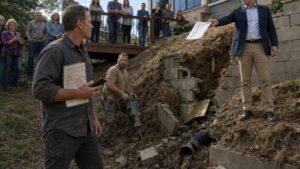
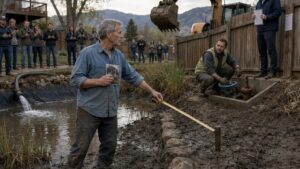
Between us, the survey stake leaned toward my property. It was an old steel pin with a flat wooden marker wired beside it, painted orange so snowplows and landscapers would see it. My father had reset the marker every spring, though the pin beneath it had not moved since the county survey in 1978.
Now the wooden marker was bent nearly twenty degrees.
George followed my eyes and shrugged. “Probably your truck clipped it.”
“My truck doesn’t cross this side.”
“Your equipment crosses wherever you feel like putting it.”
That was an old complaint. My work truck sometimes sat on the gravel apron while I unloaded chainsaws or climbing rope. The apron had existed before Brookfield Ridge had gates, landscaping rules, or a clubhouse with imitation stone columns. My property had been here when the rest of the land was pasture.
George treated that history like a clerical error.
He stepped closer. “I’ve already spoken to Kathleen.”
“About wood you say I stole.”
“About a pattern.”
“What pattern?”
“Noncompliance. Harassment. Property encroachment. Now theft.”
He counted the words as if reading from a form.
I could feel the folded paper pressing into my palm through the glove.
“Did you call the sheriff?” I asked.
“Not yet.”
“Why not?”
“Because I’m giving you a chance to fix this inside the community.”
There it was. Inside the community meant inside a system where George wrote the first report, summarized the first conversation, and sat at the table when the board decided which version sounded reasonable.
A car slowed at the intersection. The driver looked toward us, then continued.
George noticed. He always noticed an audience.
“I’ll put copies in every mailbox if I have to,” he said. “People deserve to know who they live beside.”
“You certain you want to do that?”
His eyebrows lifted.
“I asked if you’re certain.”
He moved close enough that I could smell coffee on his breath.
“You threatening me?”
“No.”
“Sounded like one.”
“I’m asking whether you want witnesses before you make the accusation any larger.”
For half a second, something shifted behind his eyes. Then he laughed.
It was not a nervous laugh. It was open and dismissive, meant to make my caution look like weakness.
“Witnesses,” he repeated. “You’ve spent too much time alone in that shed.”
He turned and walked back across the grass.
One yellow boot stepped directly beside the bent stake. The other landed in a patch of thawed mud where the morning sun had reached between the houses.
The sole left a broad chevron print.
George called over his shoulder, “Hearing’s Thursday. Seven o’clock. Don’t pretend you didn’t get notice.”
I watched him push the wheelbarrow into his garage.
Then I looked down.
The mud beside the stake held two kinds of tracks. George’s boot print was clear. Beside it ran a narrow wheel rut, deep on one side and shallow on the other, as if one tire carried more weight or was slightly underinflated.
The rut crossed from his yard, curved around the stake, and ended at the bare patch in front of my woodpile.
I followed it back with my eyes.
There was no corresponding track leading from my pile toward the road. No delivery truck marks. No pallet impressions. Only the barrow route, repeated enough to press through the frost.
I took out my phone and photographed the ground.
At noon, an email arrived from Kathleen Roberts.
The subject line read: NOTICE OF COMPLIANCE REVIEW.
She wrote that the board had received a complaint involving property removal, intimidation, and an unauthorized surveillance concern. I was instructed to attend Thursday’s meeting and bring any documentation I wished the board to consider.
Unauthorized surveillance.
I read that phrase twice.
No one had mentioned a camera.
I called Kathleen.
She answered on the fourth ring. “Jeffrey.”
“Your email says surveillance.”
“That is one of the concerns submitted.”
“Submitted by George?”
“I’m not discussing the complainant’s statement outside the hearing.”
“He told me he filed it.”
“Then you have your answer.”
“What surveillance is he claiming?”
A pause.
“The committee report says you may have equipment directed toward adjoining property.”
“My camera covers my shed.”
“That can be addressed Thursday.”
“Did anyone from the board inspect it?”
“No.”
“Did anyone inspect the woodpile?”
“No.”
“Did anyone ask me whether wood was missing from my property?”
Her voice softened, but only slightly. “That is why we hold hearings.”
“No. Hearings are where you decide after someone has already written the story.”
“Jeffrey, I am trying to keep this from escalating.”
“It already has.”
I ended the call before I said something that would become another line in George’s report.
That evening, three porch lights came on while I worked near the shed. They did not usually come on together. A neighbor across the lane stood behind a front window longer than necessary. Another slowed while collecting a trash bin and looked at the woodpile without waving.
George had not waited until Thursday.
I split two rounds of oak because my hands needed work. The first opened cleanly. The second caught the maul and held it.
My father used to say twisted grain punished impatience. You could strike harder and bury the steel, or turn the round, study the seam, and find the place it had already decided to break.
I set the maul down.
The stack had been his before it was mine. Not the same wood, of course, but the same place and the same method. He had taught me to season oak for two full summers, to keep it off the soil, to cover only the top so the sides could breathe.
After he died, I kept doing it exactly his way.
Some promises were spoken aloud. Others were habits you were afraid to change.
I walked to the bent survey marker and pulled it upright as far as the wire allowed. The orange paint was scraped near the bottom. Beneath it, the barrow rut darkened in the failing light.
The accusation bothered me.
The missing wood angered me.
But the sentence in Kathleen’s email stayed with me most.
Unauthorized surveillance concern.
George knew there was a camera, or suspected one. Yet he had accused me first.
I turned toward the shed.
Under the eave, almost invisible beneath a length of black gutter, a small camera faced the stacking area. I had installed it after tools disappeared from my truck the previous summer. Its view stopped at the gravel line and included the survey stake at the far edge.
A green status light blinked once.
Then again.
I went inside, shut the shed door, and reached for the recorder.
Chapter 2: The Man in the Yellow Boots
At 2:07 in the morning, George Walker’s yellow boots crossed the survey stake.
The first frame was grainy enough to leave room for denial. A dark figure entered from the right, coat collar raised, head lowered against the wind. But the infrared light flattened every bright surface, and the boots glowed pale at the bottom of the screen.
I leaned closer to the monitor.
The timestamp advanced.
02:07:14.
George pulled his wheelbarrow behind him. Its left tire wobbled once per rotation.
He stopped beside the stake, looked toward my house, then toward the road.
He never looked up.
The camera was eight feet above him.
He stepped across the line, parked the barrow in front of the oak, and began loading.
Not hurriedly. Not like a man afraid of being caught. He selected pieces by size, fitting them together the same way a delivery driver might stack a load for transport. Twice he rejected a split and put it back because it was too long.
At 2:11, he wheeled the load toward his garage.
I paused the footage on a frame where his face turned sideways.
It was George.
I printed the image.
Then I printed the frame showing his boot beside the orange stake, the frame showing both hands on my oak, and the frame showing the wheelbarrow crossing back toward his property.
Four photographs lay warm from the printer on the workbench.
The anger I had held under control since morning finally sharpened into something simple.
I could have walked next door then.
I could have knocked until he opened the door and held the picture against the glass.
Instead, I returned to the footage.
At 2:43, George appeared again.
The same coat. The same boots. The same wheelbarrow.
He took a second load, larger than the first.
But when he left, he did not turn toward his garage.
He pushed the barrow along the road, past the camera’s edge, toward the lower end of the subdivision.
I rewound it.
Watched again.
The first trip went right, directly toward George’s side gate. The second went left, away from his house.
At 3:18, he returned with the wheelbarrow empty.
I sat back.
Proof should have felt cleaner than that.
I copied the video to two drives and placed one in the metal document box beneath my desk. Then I made a folder with the notice, Kathleen’s email, photographs of the tracks, and printed stills from the recording.
I did not send any of it.
That was the first mistake I made after learning the truth.
I told myself I was being careful. George had already raised the boundary issue and questioned the camera. I wanted the county plat. I wanted the easement language. I wanted every answer ready before he could create another question.
But part of me wanted him to repeat the accusation in front of everyone.
I wanted him confident.
That desire cost me time.
The county offices opened at eight-thirty. By nine, I was standing beneath fluorescent lights while a clerk searched archived parcel records. Brookfield Ridge had been redrawn twice since my father bought the property, and the old parcel number did not match the HOA map.
Tyler Green came out carrying a rolled plat under one arm.
“You’re Allen?” he asked.
I nodded.
He was younger than I expected, with a county badge clipped to his belt and reading glasses pushed into his hair.
The clerk had apparently warned him about the dispute, because he said, “I can explain the line. I can’t decide who stole what.”
“I’m not asking you to.”
“That would make you unusual this week.”
He spread the plat across a counter.
My parcel formed an irregular wedge at the corner. The gravel drive, shed, and woodpile all sat inside it. A utility easement ran along the road, but it granted access to the power company, not neighbors and not the HOA.
Tyler traced the boundary with one finger.
“The pin you described should be here.”
“It is.”
“And the pile?”
“About four feet inside.”
“Then it’s yours. The association’s common-area map starts across the lane. There’s no community wood storage designated on this plat.”
“Could a delivery for the HOA legally be dropped on my land?”
“Not without your permission.”
He glanced at the photographs I had placed beside the map.
“That the pin?”
“Yes.”
“And this is the person taking the wood?”
“Yes.”
He studied the image but did not ask who it was.
“I can certify a copy of the plat,” he said. “If you need a field verification, that takes a request and a fee.”
“Would you say the line is unclear?”
“No.”
“Would George Walker have access to these records?”
“Anyone does.”
That mattered.
George had served on the compliance committee for four years. He knew how to request plats. He knew my parcel was grandfathered outside several HOA restrictions. He had complained about it often enough.
He had not made a mistake about the line.
By noon, I had a certified copy and a short written note identifying the pin and easement. Tyler had been careful with the language. He confirmed location, not ownership of the individual logs. He proved where the wood sat, not why George took it.
On the drive home, I passed Emily Sanchez’s house at the lower end of the subdivision.
A service van was parked outside. Its rear doors stood open, revealing furnace parts and coils of ducting. A delivery driver carried a small electric heater toward the porch.
I slowed without meaning to.
Emily stood in the doorway with her arms folded tight across her chest. She saw my truck and looked away.
The second wheelbarrow load had gone in that direction.
I kept driving.
When I reached home, George was fastening something to the community bulletin board beside the mailboxes. He stepped away as I approached.
A copy of his theft complaint hung beneath the notice for the monthly board meeting.
My full name was printed in bold.
George had included a statement claiming that firewood purchased through “private community coordination” had been moved onto my property sometime before January 6. He alleged that I became threatening when asked to return it.
There was no mention of him entering my land.
No mention of the missing rows.
The complaint was dated January 5.
The camera showed George taking the wood on January 7.
He had dated the accusation two days before the theft.
“You made copies,” I said.
George tucked the staple gun into his coat pocket. Today he wore brown work shoes instead of the yellow boots.
“I said I would.”
“You also changed the date.”
His face remained still, but one hand closed around the pocket.
“Records were created when the issue began.”
“The issue began before the wood moved?”
“You’ve been shifting things around that boundary for years.”
“This complaint says firewood.”
“It says property concerns.”
“It says I took a delivery.”
“Then bring your argument Thursday.”
A woman opened one of the mailboxes a few feet away. She removed an envelope, saw us, and closed the box quickly.
George lowered his voice.
“You think one little camera makes you untouchable?”
I looked at him.
There was the confirmation.
He knew.
“You haven’t seen what the camera shows,” I said.
“I don’t need to. Anything pointed into my yard violates privacy rules.”
“It doesn’t point into your yard.”
“That will be for the board to decide.”
“No. The field of view is a fact.”
His jaw shifted.
I could have handed him the still photograph. I could have watched him search for another lie.
Instead, I said, “Wear the yellow boots Thursday.”
For the first time, George had no answer ready.
I walked back to my property.
Three mailboxes stood open along the lane. Inside each was a folded copy of George’s accusation. He had delivered them house to house, exactly as promised.
By the time I reached my shed, a fourth resident was reading one beneath the bulletin-board light.
I opened my evidence folder and placed the certified plat behind the night images.
The proof could clear the line.
It could clear the woodpile.
But George had already made the accusation public, and the second load had gone somewhere he did not want named.
Thursday’s hearing was no longer only about catching a thief.
It was about deciding how much truth to show before I understood what all of it meant.
Chapter 3: Here Is the Thief You Described
George wore the yellow boots to the hearing.
They appeared beneath the folding table before I saw the rest of him—bright rubber, scrubbed clean, their thick chevron soles planted squarely on the clubhouse floor.
For a moment, I wondered whether he had forgotten.
Then he glanced at the folder under my arm and smiled.
He had not forgotten. He believed the boots proved nothing.
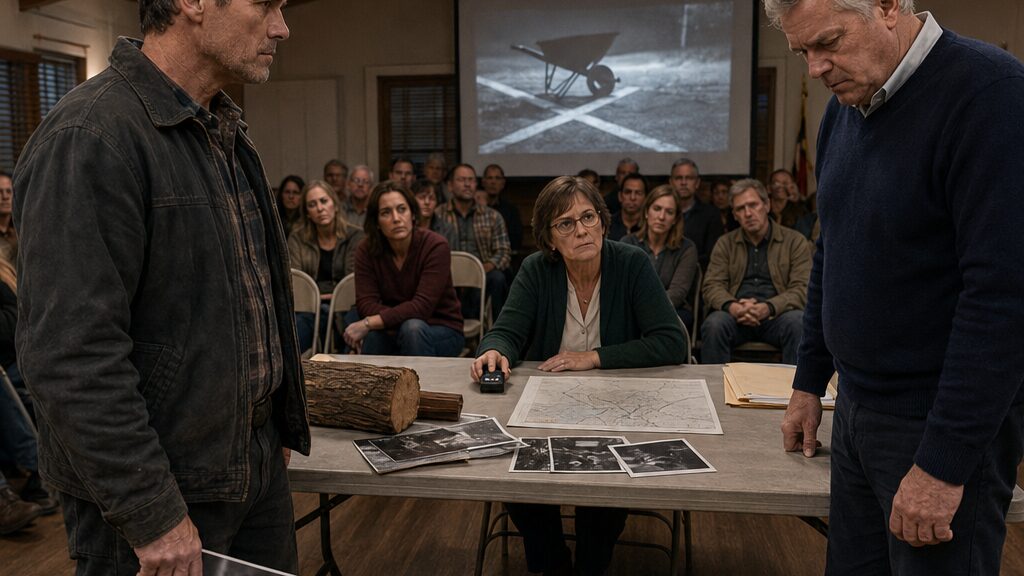
The Brookfield Ridge clubhouse had room for forty people, though fewer than twenty usually attended board meetings. That night, almost every chair was occupied. George’s notices had done their work.
Kathleen Roberts sat at the center of the front table with two board members beside her. A digital recorder lay near her hand. Behind them hung a framed list of community standards: RESPECT. STEWARDSHIP. ACCOUNTABILITY.
George stood at a smaller table to the side. On it, he had arranged his complaint, photographs of my woodpile taken from the road, and a printed copy of the HOA rule governing exterior cameras.
I placed my folder on the empty table opposite him.
A woman in the second row whispered to the man beside her. Both looked toward me, then stopped when I met their eyes.
Kathleen tapped the microphone.
“This compliance review concerns a reported dispute involving removed property, boundary conduct, resident intimidation, and possible improper surveillance. This is not a court proceeding. The board’s purpose is to determine whether association rules were violated and whether corrective action is appropriate.”
George nodded solemnly.
I stayed standing.
Kathleen looked at me. “Mr. Allen, you may sit.”
“I’m fine.”
Her mouth tightened, but she continued. “Mr. Walker submitted the initial report. He will summarize it first.”
George rose with a sheet of paper in both hands.
His voice was measured now, stripped of the volume he used outdoors.
“During the first week of January, firewood acquired for informal community assistance was temporarily placed near the boundary between my property and Mr. Allen’s. Mr. Allen moved that material into his existing stack. When approached, he responded in a manner I considered intimidating and referenced witnesses and surveillance.”
He looked around the room.
“I attempted to resolve the matter privately. Instead, Mr. Allen refused to return the wood and has continued operating a camera that may capture portions of adjoining property.”
Kathleen said, “What resolution are you requesting?”
“Return of the wood or reimbursement to the affected residents. Removal or repositioning of the camera. A formal warning for threatening conduct. And applicable fines.”
“Against Jeffrey?” someone asked from the back.
Kathleen raised a hand. “There will be time for resident comment.”
I looked at George’s boots.
Mud remained in a narrow seam where the rubber met the sole.
Kathleen turned to me. “Mr. Allen, your response?”
“I have questions first.”
“This is your opportunity to present your position.”
“My position depends on exactly what he’s accusing me of.”
George exhaled through his nose.
Kathleen said, “Proceed briefly.”
I looked at George. “You’re saying wood intended for other residents was placed on my property.”
“Near the boundary.”
“On which side?”
“The placement wasn’t surveyed at the time.”
“Was it inside my parcel?”
“I can’t say where every individual split landed.”
“Did you see me move it?”
“I saw the pile increase.”
“When?”
“During that week.”
“Which day?”
George glanced at his complaint. “The concern began January fifth.”
“And you filed this report that day?”
“Yes.”
“You’re certain?”
“I date my records accurately.”
The room was quiet enough to hear the heating vent click.
I turned to Kathleen. “Is the recorder running?”
“Yes.”
“I want him to repeat the accusation plainly.”
Kathleen frowned. “He has summarized it.”
“No. He has used ‘concern,’ ‘near,’ and ‘informal.’ I want the action he says I committed.”
George pushed his chair back.
“You stole firewood meant for people in this community.”
A faint movement passed through the audience.
I kept my eyes on him.
“And you are asking the board to punish me for that statement of fact?”
“Yes.”
“On the record?”
“Yes, Jeffrey. On the record.”
I opened the folder.
The first page I removed was not the camera image. It was the certified county plat.
I placed it on the display easel Kathleen had set up for meeting documents. The enlarged parcel lines were marked in black. Tyler’s certification stamp appeared at the bottom.
“This is the current county record,” I said. “The woodpile stands four feet inside my boundary. The utility easement does not give the HOA or any resident storage rights.”
George shook his head. “That doesn’t prove where the delivered wood was placed.”
“No.”
I removed a photograph of the bent orange survey stake.
“This is the marker at the edge of my parcel on January eighth.”
Then the photograph of the wheel rut.
“This track crosses from George’s yard, around the marker, to my stack.”
“Tracks prove nothing,” George said.
“I agree.”
I laid a split of oak on the table.
It was one of the distinctive pieces from the row beside the missing section, pale at one end where a branch knot curved through the grain.
“This proves the kind of wood. Not who moved it.”
George gave a short, impatient laugh. “Are we going to examine every log now?”
“No.”
I removed the first night-camera still.
The timestamp read 02:07:14.
George’s yellow boots stood beside the painted stake.
A few residents leaned forward.
I placed the second image beside it. George’s face showed in profile as he lifted oak into the wheelbarrow.
Then the third: both hands gripping the barrow handles as he crossed back toward his yard.
No one spoke.
George’s smile disappeared slowly, as if he were lowering something heavy.
Kathleen looked from the photographs to his feet.
I picked up the first image and walked to George’s table. I set it on the floor beside his right boot.
The sole pattern in the photograph matched the chevrons under the boot he wore.
“Here is the thief you described,” I said.
A chair creaked in the back row.
George stared at the image.
“That could be anyone.”
“With your coat.”
“It’s a common coat.”
“Your wheelbarrow.”
“You can buy those anywhere.”
“Your face.”
“The image is distorted.”
“At two-seven in the morning, crossing from your yard, using a barrow with a wobble in the left tire.”
His eyes moved toward the audience.
I did not raise my voice.
“You accused me before you took the wood. Your complaint is dated January fifth. The video is January seventh.”
Kathleen reached for George’s filing. “Is that correct?”
“The issue began earlier,” he said.
“What issue?”
“His pile. The boundary. The way he’s been acting.”
“That is not the allegation before us.”
George stood. “The camera is illegal.”
“No,” I said. “Its field of view ends at my gravel line.”
“You recorded me without consent.”
“You were on my property.”
He looked at Kathleen. “You cannot allow him to turn this into some kind of public ambush.”
Kathleen’s expression had changed. The caution remained, but the deference was gone.
“Mr. Walker, did you remove wood from Mr. Allen’s property?”
He gripped the edge of the table.
“I moved wood that was needed elsewhere.”
“That was not my question.”
“People were cold.”
The answer changed the room.
Not enough to clear him. Enough to interrupt the clean satisfaction I had expected.
Kathleen looked at me. “Do you have the full recording?”
“Yes.”
“Will you provide it to the board?”
“I’ll play the relevant portion now.”
I connected the drive to the clubhouse screen.
The footage showed the first trip exactly as the stills had. George entered, loaded the barrow, and wheeled it toward his own property.
A murmur rose when he returned thirty minutes later.
The second load was larger.
On-screen, George turned left at the road and disappeared toward the lower houses.
I stopped the video.
Kathleen said, “Where did that load go?”
George sat down.
No answer came.
The immediate fine against me was withdrawn before the meeting moved to resident comment. Kathleen stated it plainly for the recorder: the available evidence did not support the allegation that I had removed community property, and no camera violation had been established.
It should have felt like the end.
My name had been cleared in the same room where George meant to stain it.
Instead, I kept seeing the second wheelbarrow turning left.
Kathleen asked whether anyone had information relevant to the wood’s destination.
For several seconds, no one moved.
Then Emily Sanchez stood in the second row.
She did not look at George. She looked at me.
Her face had gone pale.
“One load came to my house,” she said.
The room shifted toward her.
Emily held both hands together at her waist.
“My furnace quit that week. The repair company couldn’t get the part until Friday. George brought wood for the stove in the back room.”
“Did you ask him where it came from?” Kathleen said.
“He told me it was emergency wood.”
“From the HOA?”
“He said it was handled.”
George closed his eyes.
Emily’s voice dropped. “I didn’t know it was Jeffrey’s.”
I looked at the woman who had turned away when I passed her house. I remembered the service van, the portable heater, the smoke I had not noticed from her chimney.
“Was all of it delivered to you?” I asked.
She shook her head.
“How much?”
“One wheelbarrow. Maybe less.”
“The video shows two loads.”
“I only saw one.”
George’s first trip had gone toward his own garage.
The second had gone to Emily.
My proof had cleared me, but it had not made him simple.
Emily stepped into the aisle.
“He stole it,” she said, her voice steadier now. “I’m not defending that.”
T
Chapter 4: The Wood That Never Reached His Yard
The first thing I recognized in Emily Sanchez’s stove was not the bark.
It was the split.
A white oak round had forked around an old knot, leaving one side smooth and the other ridged like a bent thumb. I had turned that piece twice before striking it because the grain ran against itself. I remembered the sound it made when it opened.
Now it burned behind the glass door in Emily’s back room.
She stood beside me with both arms folded. The room was warm enough that she had pushed up the sleeves of her sweater, but her hands remained tucked beneath her elbows.
“I would have told you sooner,” she said.
“You had three days.”
“I had two children sleeping in this room because the furnace wouldn’t hold temperature.”
I looked toward the hallway. A portable electric heater sat unplugged beside the wall. One of its plastic vents had browned from use.
“I’m not asking why you burned it.”
Her face tightened. “It sounds like you are.”
I had come intending to examine the wood, confirm the delivery, and leave. The words in my head had been clean: how much, what time, what did George say?
Instead, I heard myself speaking as though she were another person who had crossed the stake.
Emily opened the stove with a cast-iron handle and shifted the log with a poker. Sparks lifted and disappeared into the flue.
“He came around two-thirty,” she said. “Maybe later. I wasn’t watching the clock.”
“The camera shows him leaving my place at two-forty-six.”
She flinched at the word camera.
“He knocked quietly. Said he’d heard the furnace company couldn’t come until Friday. He had the wheelbarrow at the bottom of the steps.”
“Did you ask where the wood came from?”
“I asked whether it belonged to the association.”
“And?”
“He said it was emergency supply.”
“That phrase again.”
Emily looked at the fire. “I wanted to believe him.”
The room smelled of dry oak and hot metal. On a chair near the doorway sat two folded blankets and a child’s winter coat. A plastic cup with a faded cartoon rocket rested on the floor.
“He wouldn’t take money,” she said.
That stopped me.
“How much did you offer?”
“Forty dollars. It was what I had in cash.”
“He refused?”
“He said neighbors take care of neighbors.”
The line sounded like George. Not because he lived by it, but because he liked phrases that positioned him at the center of whatever virtue they described.
“Then he told me not to mention it,” Emily continued.
“Why?”
“He said some people would complain about preferential treatment. He said the board hadn’t approved a formal program yet.”
“Did he name me?”
“No.”
“Did he say the wood was his?”
“He said it was handled.”
I watched the knotted split settle deeper into the coals.
“Did he bring all of the second load here?”
Emily shook her head. “The wheelbarrow wasn’t full when he arrived. Maybe two-thirds.”
“Where did the rest go?”
“I don’t know.”
A child laughed somewhere deeper in the house. Emily glanced toward the hall, then lowered her voice.
“There was another furnace out on the north loop. An older couple. George mentioned checking on them.”
“Did he take wood there?”
“I assumed he did.”
Assumption was how George had built his complaint. One vague phrase at a time.
Emily turned from the stove.
“You should know something else.”
I waited.
“When I saw your name on that notice, I asked him what was happening. He said you had claimed the emergency wood as part of your private stack. He said you’d rather let people freeze than admit the boundary was shared.”
My jaw tightened.
“Did you believe him?”
“For about a day.”
“What changed?”
“I drove past your place. The pile looked like it had been cut away from the front, not added to.”
She met my eyes.
“And George kept telling me not to get involved.”
The small payoff was there, though it did not feel like one. Emily had seen enough to doubt him before the hearing. She had stood up anyway, knowing the room would learn why she needed the wood.
“You didn’t have to tell everyone,” I said.
“Yes, I did.”
“You could have spoken to Kathleen privately.”
“That would have protected me.” She looked at the stove. “It would also have protected him.”
Her answer left no room for the judgment I had brought with me.
I asked how many pieces remained. She showed me a short stack behind the stove, perhaps twenty splits. I photographed them, then lowered the phone.
“You don’t need to return those.”
“I can replace them.”
“With what?”
She did not answer.
“Burn them,” I said. “The problem is not that you were cold.”
Her shoulders loosened, but only slightly.
“The problem is that he decided he could take them,” I added.
“And then he lied about you.”
“Yes.”
I left through the back door.
The north-loop house had a thin ribbon of smoke rising from its chimney. I did not stop. If George had helped them, they could tell the board when they were ready. I was not going door to door collecting other people’s hardship as evidence.
George’s garage stood open when I returned home.
He was inside beside the wheelbarrow, tightening the left wheel with a wrench. A stack of oak rose behind him against the wall.
My oak.
At least half the first load remained there.
He saw me at the end of his driveway and put the wrench down.
“You’ve been talking to Emily.”
“She told the truth.”
“She told part of it.”
“So did you.”
George wiped his hands on a rag. “People needed help.”
“You kept wood.”
“I have a fireplace.”
“That isn’t the same thing.”
“I spent three hundred dollars on space heaters for my daughter last month. I’ve covered emergency groceries for people in this neighborhood. I was going to replace the wood.”
“When?”
“When I could.”
“You could have asked.”
His face changed then—not guilt, not yet. Resentment.
“You don’t answer your door.”
“You didn’t knock.”
“I’ve tried talking to you for years.”
“About my truck. My shed. My gravel. My camera.”
“About being part of the place you live.”
“I was here before the place.”
“That’s exactly how you act.”
The words landed harder than I expected because they contained a piece of truth I did not want from him.
George pointed toward my property.
“You sit behind that line and watch everyone like they’re trying to take something.”
“You crossed the line and took something.”
“Yes.” He said it sharply. “I did.”
It was the first direct admission.
Then he added, “Because Emily’s house was forty-eight degrees and the board would have taken a week to approve anything.”
“That explains one trip.”
He glanced toward the stack in his garage.
“It doesn’t explain your fireplace,” I said.
His mouth compressed.
“Or the false complaint.”
“I panicked.”
“You dated it before the theft.”
“I needed the timeline to show the issue didn’t start that night.”
“You needed me accused before I could accuse you.”
He picked up the wrench again, not as a threat, but because his hands needed something to hold.
“You want me to say I handled it badly? Fine. I handled it badly.”
“You stole from me.”
“I moved wood where it was needed.”
“And kept some where it wasn’t.”
He turned away.
On a shelf near the garage door lay a carbon-copy receipt book. The top sheet had been torn off, but the pressure marks remained on the page beneath it.
I could read only fragments from where I stood.
Delivery.
Oak.
Seventy-five dollars.
George noticed where I was looking and closed the book.
“Who paid you?” I asked.
“No one.”
“That book says otherwise.”
“It’s committee paperwork.”
“The committee does not sell firewood.”
He stepped between me and the shelf.
The movement answered more than his words.
I left without pressing him. The sheriff could have been called. The board could have been emailed. I had enough proof to make the matter worse by dinner.
Instead, I went to the shed.
I wanted the original inventory sheets my father used when he sold wood by the cord. If I could establish the volume missing and compare it to George’s garage, I could calculate the replacement value exactly.
The old filing cabinet stood behind the splitting bench. Its bottom drawer had swollen shut years ago. I pulled until the metal handle bent, then used a pry bar along the edge.
The drawer opened with a cough of sawdust.
Inside were rusted chainsaw files, receipts faded almost white, and a narrow ledger wrapped in oilcloth.
I recognized my father’s handwriting before I opened it.
The first visible page was dated twenty-three winters earlier.
It did not list cord measurements or customer totals.
It listed names.
Beside each name were short marks, quantities, and the same two words repeated in the margin.
Storm wood.
Chapter 5: What My Father Marked Beyond the Line
The first page of my father’s ledger listed twelve names and not one sale.
Beside each was a date, a number of splits, and a small square drawn either inside or outside a heavy pencil line.
I carried the book to the workbench and turned on the lamp.
The paper had yellowed at the edges. Fine wood dust clung to the binding. My father had written in block letters, pressing hard enough that the marks could be felt from the reverse side.
MARTINEZ—30—ICE STORM.
WILLIAMS—18—POWER OUT.
WALKER—24—BABY IN HOUSE.
I read the last entry again.
Walker.
The date was nearly thirty years old, when George would have been a young father.
Beneath the name, my father had drawn the same heavy line and placed the square beyond it.
Outside.
I flipped through more pages.
Each winter followed a pattern. Sales were recorded in the back half of the ledger with prices and measurements. The front pages held names, emergencies, and quantities. Some entries said PAID LATER. Others said NO CHARGE. Several had a check mark and the word RETURNED, meaning replacement wood had come back after spring.
On the inside cover, my father had sketched the shed, road, and survey marker.
The private stack sat behind the line.
A smaller rectangle stood on the roadside side of it, labeled STORM PILE—ASK FIRST.
I looked through the shed window.
There was no second stack now. There had not been one since I took over the property.
I remembered a low rack near the road when I was a boy, but I had thought it held wet scraps and crooked splits. My father had dismantled it during his final winter, when he no longer had the strength to lift a round onto the splitter.
After his funeral, I had rebuilt the main stack and cleared everything else away.
Keep the property intact, he had told me.
Don’t let people take pieces of it just because you stay quiet.
I had remembered the warning.
I had forgotten the square beyond the line.
A truck door closed outside.
George stood near the survey stake, hands in his coat pockets. He did not cross.
I carried the ledger out but kept it against my side.
“What do you want?” I asked.
“To settle this before Kathleen turns it into a legal mess.”
“You created the mess.”
“I know.”
The admission came without emphasis this time.
He looked older than he had at the hearing. Without the yellow boots and committee folder, he seemed less like a man in authority than a man who had spent several nights calculating what he might lose.
“I’ll replace the wood,” he said. “All of it.”
“And withdraw the complaint.”
“Yes.”
“In writing.”
“Yes.”
“Correct the notices you delivered.”
His jaw shifted. “I’ll tell people it was a misunderstanding.”
“It was not.”
“Jeffrey, I’m trying to give you what you asked for.”
“I asked for the truth.”
“I can’t stand in that room and call myself a thief.”
“You stood there and called me one.”
He looked past me toward the shed.
“I made the wrong choice.”
“You made several.”
His gaze returned to the ledger.
“What is that?”
“An old record.”
“Of the wood?”
“Some of it.”
I opened to the page with his name and held it where he could read.
George’s expression changed before he reached the note.
WALKER—24—BABY IN HOUSE.
He touched the edge of the page but did not take the book.
“That was during the freeze,” he said.
“You remember.”
“Our daughter was six weeks old. Power was out almost three days.”
“My father brought you wood.”
“He left it by the garage.”
“He marked it as storm wood.”
George gave a short breath that was almost a laugh, though there was no humor in it.
“I told myself he wouldn’t have cared.”
“He would have cared that you asked.”
“He wasn’t here to ask.”
“I was.”
George looked toward my house.
“You don’t make asking easy.”
There it was again, the part I did not want him to be right about.
I closed the ledger.
“That does not make taking right.”
“No.”
“Or accusing me.”
“No.”
“Or charging someone for what you stole.”
His head lifted.
“I didn’t charge Emily.”
“I didn’t say Emily.”
Silence stretched between us.
The flag on George’s porch snapped once in the wind.
“Who paid you?” I asked.
“An older couple on the north loop.”
“How much?”
“Seventy-five.”
“For my wood.”
“For delivery and time.”
“You pushed a wheelbarrow half a mile.”
“They insisted.”
“You wrote a receipt.”
“They wanted one.”
“Did the receipt say the wood belonged to you?”
He did not answer.
I stepped closer to the stake but stayed on my side.
“I will accept replacement or payment. I will accept a written withdrawal. I will not accept ‘misunderstanding.’”
George’s face hardened as if he had reached the last thing he believed he could defend.
“If you force a public correction, you damage the whole association. Kathleen is already talking about insurance, legal review, committee authority. People will use this against every board decision we’ve made.”
“Then the board should know which decisions can survive the truth.”
“You think they’ll stop with me? They’ll question everything. Fines. inspections. budgets.”
“Maybe they should.”
He stared at me.
“You always wanted the HOA embarrassed.”
“I wanted it off my land.”
“That’s not the same as living with neighbors.”
“No,” I said. “It isn’t.”
The answer surprised both of us.
George looked again at the ledger in my hand.
“My offer stands,” he said. “Wood replaced. Complaint withdrawn privately. You drop the public correction and the sheriff.”
“I haven’t called the sheriff.”
“Then don’t.”
He walked back across the grass.
That afternoon, I built a temporary rack where my father had drawn the storm pile.
I did not put wood on it.
I measured the space, drove two short stakes, and stretched a line between them. The location sat outside the private pile but still on my parcel, close enough to the road that no one would need to cross the survey marker.
It was only a frame.
Still, it looked like a decision waiting to be made.
The phone rang near dusk.
Kathleen spoke quietly.
“The board’s counsel reviewed the recording and George’s complaint.”
“And?”
“He believes we can resolve this through reimbursement and withdrawal.”
“Public withdrawal?”
A pause.
“There are concerns about unnecessarily exposing the association.”
“You mean exposing George.”
“I mean avoiding reputational damage that could affect everyone.”
“He distributed the accusation to everyone.”
“I know.”
“Then the correction goes to everyone.”
“Jeffrey, the board can compensate you without admitting institutional fault.”
“The board did not steal the wood.”
“No.”
“The board did schedule a hearing without inspecting the property. It repeated a complaint dated before the event. It threatened fines based on George’s committee summary.”
Another pause.
“You have a fair point,” she said.
“Then put it in the record.”
Her voice tightened. “If this becomes adversarial, counsel may advise closing the session and sealing supporting documents as part of a settlement.”
“You cannot seal my camera footage.”
“We can restrict association distribution.”
“You can also correct the minutes.”
“I am trying to give you a path that ends this.”
I looked through the shed doorway at the empty rack beyond the line.
“Ending it quietly is what George wants.”
“It may also be what protects the neighborhood.”
“From what?”
“The cost of learning how badly we handled it.”
The honesty of that answer held me silent.
Kathleen continued.
“The second meeting is Monday. I will present a settlement. You should understand that if you reject it, the board may vote to close the record pending legal review.”
When the call ended, I placed my father’s ledger beside George’s original complaint.
One document showed what a boundary had once allowed.
The other showed what secrecy had done to it.
By Monday, I would have to choose whether clearing my own name was enough—or whether the record had to remain open even if everyone preferred the door shut.
Chapter 6: The Price of Keeping Everything Quiet
Kathleen slid the settlement across the table with a confidentiality clause clipped to the front.
The second HOA meeting was smaller than the first. No general notice had been posted. Only the board, George, Emily, and I had been invited. The chairs behind us remained stacked against the clubhouse wall.
On the table lay three documents.
A repayment agreement.
A withdrawal of the fine against me.
A statement saying the dispute had been resolved without admission of wrongdoing by any party.
I read the last sentence twice.
“This does not correct the accusation,” I said.
Kathleen folded her hands. “It withdraws all action against you.”
“That is not the same thing.”
“It also provides full replacement value for the wood.”
“Paid by whom?”
“The association would issue the payment and recover costs internally.”
“So residents pay first.”
“The board’s reserve would cover it.”
“Residents funded the reserve.”
George sat at the far end of the table in a navy sweater. No badge. No committee binder. His yellow boots were absent.
Kathleen kept her eyes on me.
“The purpose is to prevent further damage.”
“To the association.”
“To everyone.”
I lifted the confidentiality clause.
“This says I cannot distribute the footage, discuss the settlement, or characterize George’s complaint as false.”
“It says the parties agree not to disparage one another.”
“He called me a thief in writing.”
“And that notice would be formally withdrawn.”
“Where?”
“In the association record.”
“What about the mailboxes?”
George spoke for the first time. “I’ll collect the copies.”
“They’ve already been read.”
“I’ll tell people the matter is resolved.”
I turned toward him.
“Say what happened.”
His face reddened. “We have been through this.”
“No. You have been avoiding it.”
Kathleen raised one hand. “Let’s keep the discussion productive.”
I reached under my chair and placed the straightened survey marker on the table.
The wooden stake was scraped and stained, its orange paint chipped near the base. I had removed it from the wire that morning and replaced it temporarily with a new marker outside.
Everyone looked at it.
“This was bent the night George crossed the line,” I said. “The agreement calls the boundary disputed. It was never disputed. The county confirmed it.”
Kathleen glanced at the board member beside her. “That language can be changed.”
“The complaint date was false.”
“It can be described as inaccurate.”
“George took two loads.”
George leaned forward. “One load went to Emily. Part of the other went to another house.”
“And the rest went to your garage.”
“Yes.”
It was the first time he had admitted that in front of Kathleen.
She turned toward him.
“How much remained there?”
“I don’t know exactly.”
“I do,” I said. “I photographed it.”
George rubbed a hand over his mouth.
“I intended to replace it.”
“That is not what you told the board.”
“I told the board people needed wood.”
“You told the board I stole it.”
Kathleen looked down at the settlement.
“George, did you personally benefit from the first load?”
He hesitated.
“Yes.”
The answer sat in the room without defense.
One of the board members removed his glasses and placed them beside the agenda.
Kathleen said, “Did you receive payment from any resident?”
George’s eyes moved toward me.
“No.”
I opened my folder and slid a photocopy across the table.
The older couple on the north loop had not wanted to attend, but they had given me the yellow carbon receipt after I explained that the wood was mine. It listed seventy-five dollars for “seasoned oak and emergency delivery.” George’s initials appeared at the bottom.
Kathleen read it.
“Is this yours?”
George stared at the paper.
“They insisted on paying.”
“That is not the question.”
“Yes. It’s mine.”
“You told me no resident paid.”
“I forgot about the receipt.”
Emily made a small sound—not disbelief, exactly, but disappointment.
George turned toward her. “You know why I did this.”
“I know why you brought wood to my house,” she said. “I don’t know why you took some home, charged someone else, and blamed Jeffrey.”
“I was trying to keep the whole thing from falling apart.”
“What whole thing?”
“The promises I made.”
Kathleen’s head lifted. “What promises?”
George pushed back from the table.
“After the heating failures last winter, I told people the committee would create emergency support. The board never approved it. This year, when the cold came back, they called me.”
“You did not bring that proposal to us,” Kathleen said.
“I did. It sat in review.”
“There was no budget.”
“There is never a budget until someone is freezing.”
His voice had risen, but the anger was not aimed in one direction anymore.
“My daughter’s furnace failed in December. I paid for the repair and the hotel. Then Emily called. Then the north-loop house. I had already told people help would exist.”
“So you took my wood to make your promise true,” I said.
“Yes.”
“And when you realized I had a camera?”
“I panicked.”
“You wrote the complaint before you crossed the line.”
“I drafted it before. I changed the specifics after.”
“Why?”
“Because if you reported the wood first, I would lose the committee. Maybe the board. People would know I promised something I had no authority to give.”
“You chose my name to protect yours.”
George looked at the straightened stake.
“Yes.”
No one moved.
The confession did not make me feel larger. It made the table seem smaller.
Kathleen removed the confidentiality clause from the stack.
“This settlement cannot proceed as written,” she said.
The board member beside her nodded.
George looked at her. “Kathleen.”
“No. You used your committee role to create a complaint against the person whose property you took. You altered dates. You accepted money.”
“I was helping people.”
Emily leaned forward.
“You helped me,” she said. “I will say that in any room you ask me to.”
George looked at her.
“But you also made me part of a lie,” she continued. “You told me to stay quiet because you knew the help wasn’t yours to give.”
His shoulders lowered.
That was the moment the story changed. Not when the camera image matched his boots. Not when the receipt appeared.
Emily had given him the one defense he deserved and removed the one he was still hiding behind.
Kathleen asked what correction I wanted.
I had expected the question for days. Still, the answer I had prepared no longer fit.
I looked at the stake between us.
“I want the original accusation withdrawn in writing and delivered to the same homes that received it. The correction should state that the wood was on my parcel, that I did not remove community property, and that George’s complaint contained false dates.”
George’s jaw tightened, but he did not object.
“I want repayment for the wood that went to his house and the wood he sold. Not the load Emily burned. Not the wood delivered during an actual heating emergency.”
Kathleen studied me.
“You are waiving part of the loss?”
“I am separating help from theft.”
George looked up.
I continued.
“The board should adopt a rule that no committee chair investigates or files through his own committee when he is personally involved. Evidence should be inspected before notices go out.”
The board member wrote something on the agenda.
“And the emergency issue?” Kathleen asked.
I glanced toward Emily.
“There can be a rack near my road. Outside the private stack. Marked clearly. Requests go through one person who does not control fines or compliance. Every load is recorded. No one crosses the survey line.”
George gave a tired, humorless breath.
“You’re proposing the thing I tried to do.”
“No. I’m proposing the thing you said you were doing.”
The distinction landed.
Kathleen leaned back.
“And George?”
“He replaces what he kept, repays what he charged, and signs the correction.”
George looked from the receipt to the withdrawn complaint.
“Anything else?”
“Resign from compliance.”
His face went still.
Kathleen did not rescue him.
For several seconds, only the heating system moved air through the room.
Then George reached into his pocket.
He set the small metal compliance badge beside the straightened survey stake.
The sound was barely lou
Chapter 7: The New Stack Outside the Boundary
George returned the first load in the yellow boots.
He came in daylight, pushing the same green wheelbarrow across the strip of grass between our properties. The left tire still wobbled, though less than before. Fresh oak stood above the rim in a careful stack, each piece cut close to sixteen inches.
He stopped at the survey marker.
The old painted stake was back in place, straight now, wired beside the steel pin. Ten feet nearer the road stood a second post, newly painted blue. Between them, I had built the smaller rack from treated lumber and galvanized screws.
George looked from the blue post to the private stack behind the orange marker.
“Where do you want this?” he asked.
The question mattered more than it should have.
“Behind the orange stake,” I said. “That load replaces what you kept.”
He nodded and pushed the barrow across only after I stepped aside.
There was no ceremony to it. He unloaded one split at a time, fitting the pieces into the cut section of my stack. Some were ash instead of oak. Two were still wet enough to darken his gloves.
I pulled one free.
“This won’t season before next winter.”
“I know.”
“The agreement says seasoned wood.”
“The supplier gave me what he had.”
“Then it doesn’t count as full replacement.”
George looked tired rather than offended.
“I can bring more.”
“You’ll need to.”
He nodded again.
A month earlier, I might have heard surrender in that answer and enjoyed it. Now it sounded like arithmetic. A debt measured in weight, moisture, and repeated trips.
He reached for another split.
“How many loads?” I asked.
“Four, maybe five. Depends how much fits.”
“You could have had it delivered.”
“Delivery costs extra.”
The receipt from the north-loop house had been seventy-five dollars. George had repaid that amount first, handing it directly to the couple with a written statement that the wood had not been his to sell. The board minutes recorded the repayment. His own debt to me had been divided into monthly installments and replacement labor.
I understood why he had chosen the wheelbarrow.
His finances were worse than he had admitted at the meeting. Kathleen never gave me details, but the payment schedule told enough. His daughter’s furnace and hotel costs had gone onto a credit card. His property taxes were due. His compliance role had never been paid, though he had carried it like a position with a salary and an office.
The yellow boots moved back and forth across my gravel as he worked.
Not secretly now.
Not comfortably either.
When the barrow was empty, he remained beside it.
“The correction went out yesterday,” he said.
“I received one.”
He had delivered the letter to every house that received the accusation. The wording was plain. He stated that my firewood had been located on my property, that I had not stolen community supplies, and that his original complaint included inaccurate dates and false allegations.
Kathleen’s signature appeared below his.
“Some people asked whether you made me write it,” George said.
“What did you tell them?”
“That the evidence did.”
It was not an apology, but it was not another disguise.
I pointed toward the blue post.
“That rack is for verified heating emergencies. Not general use. Emily will keep the request log. Kathleen will approve releases with another board member.”
“And you?”
“I decide how much wood goes on it.”
George glanced at the empty rack.
“So none yet.”
“Not until the rules are posted.”
His mouth moved as though he wanted to say something about delay. Instead, he took hold of the barrow.
“I’ll bring another load Saturday.”
“Seasoned.”
“Seasoned.”
He turned the barrow at the stake without touching it and went home.
By the end of February, the new policy had passed.
Kathleen called it the Emergency Heating Assistance Procedure, which sounded larger than one roadside rack and a clipboard in Emily’s kitchen. The rule required two signatures for distribution, documented need, and a record of where each load came from. Compliance officers could not investigate complaints in which they were personally involved. Property accusations required inspection or independent records before notices were mailed.
George attended the vote from the back row.
He no longer sat at the board table. He did not speak.
Afterward, Kathleen stood beside the new rack while I fixed a laminated sign to the blue post.
EMERGENCY FIREWOOD
REQUEST REQUIRED
DO NOT CROSS ORANGE PROPERTY MARKER
She read it twice.
“You could remove the last line,” she said. “The boundary is obvious now.”
“It was obvious before.”
She gave a small nod.
“That is fair.”
Emily arrived with a weatherproof box for the request sheets. She mounted it to the post and tested the lid.
“We should keep the form simple,” she said. “Name, address, heating problem, amount received.”
“No explanation of income,” I said.
Kathleen looked at me. “The board may need eligibility criteria.”
“A broken furnace is a broken furnace.”
“What prevents misuse?”
“The quantity is limited. The request is recorded. Two people approve it.”
Emily closed the box.
“And people have to ask,” she said.
The word remained between us.
Ask.
My father had written it in the ledger. STORM PILE—ASK FIRST.
The following week, the first request came from a resident whose heat pump failed during an overnight freeze. Emily called me just after six in the morning. Kathleen confirmed the repair appointment. I moved thirty splits from my private stack to the roadside rack.
No one crossed the orange marker.
By eight, the rack was empty again.
The system worked because the need was real and the limits were visible.
That did not mean everyone respected them.
In early March, I heard the scrape of wood before sunrise and went outside with my coat unfastened.
A resident from the newer section stood at the emergency rack loading splits into the back of an SUV. There was no request form in the box. The temperature was above forty.
“What are you doing?” I asked.
The resident straightened.
“I thought this was community wood.”
“It is emergency wood.”
“My firepit is community use.”
“No.”
The resident gave a short laugh. “It’s five pieces.”
“It’s five pieces you did not ask for.”
“I pay dues.”
“The wood is not purchased with dues.”
A hand rested on the SUV’s open hatch.
“George said the association had a supply program.”
“George does not run it.”
The resident looked toward my main stack.
“You have plenty.”
There it was—the reasoning I knew too well. Plenty turned ownership into permission. Need became whatever the person standing nearest wanted it to mean.
A month earlier, I might have ordered every split returned and locked the rack.
Instead, I pointed to the request box.
“If your house has no heat, fill out the form and call the number. If this is for a firepit, put the wood back.”
The resident studied me, deciding whether the argument was worth an audience that had not yet arrived.
Then the five splits went back onto the rack.
Not neatly.
I rearranged them after the SUV left.
The refusal felt different from shutting everyone out. The line had held without becoming a wall.
Spring came slowly. Mud softened along the shared strip of grass, and the orange stake needed resetting after the frost pushed it upward. I knelt with a small sledge and drove the wooden marker deeper beside the county pin.
George approached with his wheelbarrow.
The yellow boots were scuffed now. One had a dark patch near the ankle.
His final replacement load was seasoned red oak, dry enough that two pieces rang when they struck.
“Moisture meter said seventeen percent,” he told me.
I checked anyway.
Sixteen on one piece. Eighteen on another.
“Good.”
He unloaded the wood behind the orange stake. When he finished, he handed me an envelope containing the final payment for the portion he had sold.
“That settles it,” he said.
“On paper.”
He looked toward the road rack, half full after I had stocked it for a forecasted cold night.
“Emily says three households used it.”
“Four.”
“Any trouble?”
“One firepit.”
“You stop them?”
“Yes.”
He smiled faintly.
“Some things don’t change.”
“Some should not.”
The smile disappeared, but he nodded.
He gripped the wheelbarrow handles, then paused beside the orange stake.
“I should have asked.”
It was the nearest he had come to saying the whole thing.
“Yes.”
“I thought you would say no.”
“I might have.”
He looked at me.
“For your fireplace, I would have.”
“And for Emily?”
I considered the question.
Before the ledger, before the hearing, before I watched my father’s old system return in a form neither of us controlled alone, I could not be sure.
“I should have made it possible to ask,” I said.
George looked down at the line.
“That doesn’t make what I did right.”
“No.”
“Good.”
He pushed the empty barrow toward his yard.
At the stake, the wheel bumped over a root. George steadied it before the tire touched the marker.
By April, Kathleen had completed the board’s policy review. Old compliance notices were checked for conflicts of interest. Two fines were rescinded because no inspection had occurred. The change did not destroy the association, though the meetings grew longer and the records became harder to summarize with a single person’s version.
George attended only once.
He sat near the door, listened to a discussion about drainage, and left before public comment. No one asked him to return to the committee.
I kept my father’s ledger in the shed, wrapped again in oilcloth. On the inside cover, beneath his drawing of the storm pile, I added a second note in pencil.
BLUE POST—REQUEST LOG WITH EMILY.
I did not erase his line.
The private stack remained where it had always been: four feet inside my parcel, ends aligned, top covered, sides open to the air. The orange marker stood between it and the road.
The emergency rack stood beyond it.
One evening, after splitting the last rounds from a winter removal job, I carried a single piece of white oak toward the two stacks. It had twisted grain and a branch knot running through the center. The kind of piece that punished a careless strike.
I stopped at the orange stake.
Behind it was the wood I had cut, hauled, seasoned, and measured.
Beyond it was the smaller rack, waiting for a need that had not yet been reported.
I set the split oak on the public rack.
Then I returned to my side of the line and left the private stack untouched.
The story has ended.