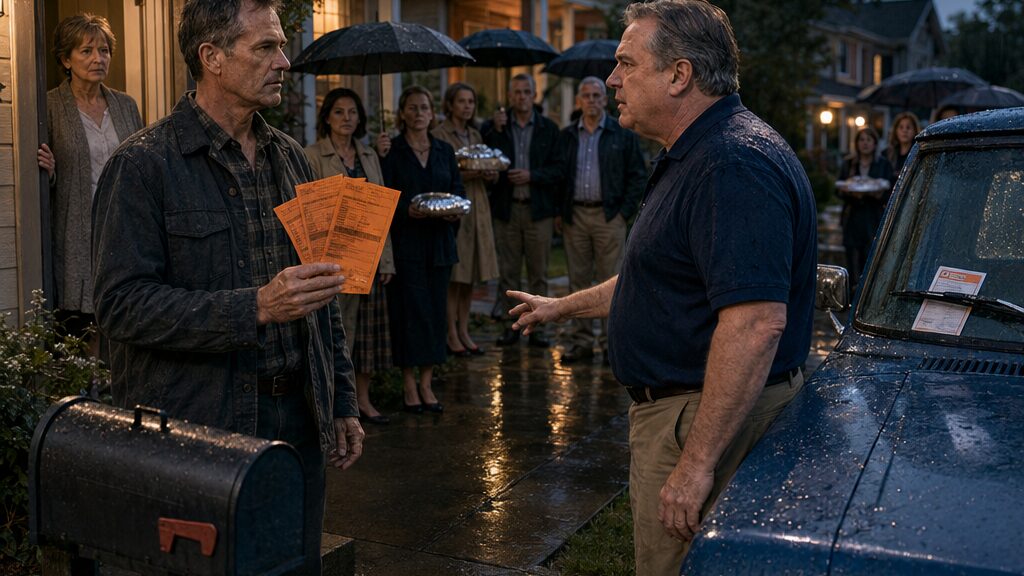
He Parked His Old Truck Beside the Mailbox Until the Whole HOA Learned Why
Chapter 1: The Orange Notice Beneath the Windshield Wiper
Patrick Miller found the first notice tucked beneath the driver’s-side windshield wiper.
The second was trapped under the passenger-side blade.
For a moment, he stood in the street between his faded blue Chevrolet and the black curbside mailbox, comparing them as though they were two diagnoses from doctors who had never spoken to each other.
The paper on the driver’s side was bright orange. It had been folded twice and softened along the creases from riding in his shirt pocket for several days. Across the top, in block letters, were the words DELIVERY ATTEMPTED.
The white sheet on the passenger side was new, dry, and protected inside a clear plastic sleeve.
NOTICE OF VEHICLE VIOLATION.
Patrick read the first paragraph without moving his lips.
The truck, it said, appeared to be an inoperable or stored vehicle placed in view of the street, contrary to the community’s appearance standards. He had forty-eight hours to remove it or provide proof that it was regularly operated.
He looked through the windshield at the handwritten card lying on the dashboard.
FRIDAY.
FULL TANK.
118,442 MILES.
He had written it himself before pulling the truck out of the garage. The mileage was there because Patrick trusted numbers more than recollection. A machine either moved or it did not. A distance was either measured or guessed. A rule either contained the words people claimed it contained, or it did not.
A car horn sounded at the corner.
Three vehicles were waiting to turn into the street. Their drivers wore the patient expressions of people inconvenienced by someone else’s neighborhood.
Across the road, Gregory Harris stepped off his driveway.
He wore a navy polo with the HOA’s green oak-leaf emblem stitched over the chest. Behind him, a white canopy had been raised over his backyard, and strings of warm bulbs hung between two maples. The annual community scholarship fundraiser would begin in less than an hour.
Gregory glanced at the truck, then at Patrick.
“You saw the notice.”
“I’m holding it.”
“We need that space tonight.”
Patrick looked at the stretch of curb beside the mailbox. “It’s occupied.”
“That’s obvious.”
A silver sedan turned into Gregory’s driveway. Another guest lowered a window and asked where to park. Gregory lifted one finger without looking back.
“Down by the common area,” he called. Then he faced Patrick again. “This isn’t the weekend for one of your demonstrations.”
Patrick slid the orange postal notice behind the HOA citation so Gregory could not read it.
“The truck is registered. Insured. It started under its own power and arrived here under its own power.”
“That isn’t the only issue.”
“It’s on a public street.”
“It’s in front of your mailbox.”
“My mailbox.”
Gregory exhaled through his nose. He had always done that before saying something he considered reasonable. Years earlier, when they still borrowed tools from each other, Patrick had taken the sound for patience. Now he recognized it as preparation.
“Amanda approved the guest-parking plan,” Gregory said. “We gave management the expected number of vehicles. We told residents to leave the curb open wherever possible.”
Patrick looked past him at two temporary signs near the intersection. EVENT PARKING, each one said, with an arrow pointing toward the common lot.
Neither sign mentioned Patrick’s curb.
“You told residents,” Patrick said. “Did you tell your guests?”
“I told everyone what they needed to know.”
“That answer hasn’t improved.”
Gregory’s face tightened. “You know this event pays for the scholarship fund.”
Patrick knew. He also knew the fund had become Gregory’s strongest argument for nearly everything: amplified music, delivery vans on the lawn, extra trash by the clubhouse, cars along both sides of the street.
A dark SUV stopped beside them. The driver leaned across the passenger seat.
“Gregory, can we unload here?”
“Give me a minute.”
Patrick reached through the open truck window and removed a blue folder from the seat. Inside was a county parcel map, a printed section of the municipal parking code, and a photograph showing the survey marker near the edge of his lawn.
He held out the map.
“The property boundary ends here.” He tapped the line. “The curb is within the city right-of-way. Your committee doesn’t own it. I don’t own it.”
Gregory barely glanced down. “The HOA can still regulate visible vehicle storage.”
“It isn’t stored. It’s parked.”
“With a handwritten note advertising that you intend to leave it all weekend.”
“The note records when I moved it.”
“It records intent.”
Patrick almost smiled. Gregory had finally started reading words precisely.
The front door of Patrick’s house opened.
Nancy stood behind the screen, one hand resting against the frame. She had changed from the sweater she wore in the afternoon to a loose gray cardigan. Patrick noticed because she changed clothes when the cold settled into her hands, even when the house felt warm to everyone else.
“You all right?” he called.
“I heard voices.”
“Just parking.”
Nancy looked toward the truck, then toward the growing line of vehicles. “That seems to be what it always is.”
She let the screen close.
Gregory lowered his voice. “This doesn’t have to become formal.”
Patrick lifted the citation. “It became formal before you walked over.”
“That came from management, not me.”
“Then you shouldn’t have any trouble letting management explain it.”
Gregory studied him. Rain had begun to gather in tiny dark points on the shoulders of his polo.
“You’ll move it by morning,” he said.
It was not quite a question.
Patrick folded the county map and returned it to the folder. “If the city tells me it’s illegally parked, I’ll move it. If the truck fails to start, I’ll move it. If there’s an emergency, I’ll move it.”
“And if none of those things happens?”
“Your guests will use the common lot.”
The SUV pulled away. Someone farther down the street shouted Gregory’s name.
He stepped back toward his property, then paused.
“The board won’t see this the way you do.”
Patrick slipped the plastic-covered HOA notice beneath the truck’s passenger-side wiper again. “That’s why paper has words on it.”
Gregory walked away.
Patrick stayed beside the truck until the first drops began striking the hood. His satisfaction should have felt clean. The curb was public. The vehicle operated. The distance from the hydrant was correct. He had measured twice from the intersection and once from the mailbox post, even though there was no municipal rule prohibiting him from blocking his own delivery access.
That last point had seemed useful when he found it.
Now, with the orange notice in his hand, it felt less certain.
His phone vibrated.
Amanda Wright’s name appeared on the screen.
Patrick answered. “I received your citation.”
“I’m glad I caught you,” she said. Her voice carried the smooth speed of someone speaking while reading another document. “I’ve reviewed the street question. You’re correct that the curb is municipal right-of-way.”
“So the citation is withdrawn.”
“No. The citation concerns vehicle storage and community appearance, not ownership of the roadway.”
“The truck is functional.”
“Then send current registration, insurance, and evidence of regular use.”
“How regular?”
There was a pause.
“The covenant doesn’t define a mileage threshold.”
“Then what does it define?”
“Patrick, I’m not trying to argue with you.”
“That’s usually said just before someone argues without answering.”
Her tone cooled. “The board has received a complaint that the vehicle was placed there to interfere with an approved association event.”
“Who filed it?”
“I can’t discuss the complainant.”
He looked across the street. Gregory was directing a delivery driver toward the backyard with both arms.
“When was it filed?”
Another pause, shorter this time.
“This afternoon.”
“Before I parked?”
“I would need to confirm the timestamp.”
Patrick said nothing.
Amanda continued. “Move the truck into your driveway tonight. Send me the documentation Monday, and we can avoid escalation.”
“My driveway is private property. The curb isn’t.”
“The association can still address conduct intended to disrupt community operations.”
The phrase sounded larger than the street.
Patrick watched a guest in polished brown shoes step around a puddle and begin the long walk from the common lot. Gregory noticed Patrick watching and turned away.
“I’ll send the documents,” Patrick said.
“And the truck?”
“It remains legally parked.”
Amanda sighed. “Then the board may schedule a compliance hearing.”
The call ended.
Patrick went inside carrying the orange postal notice and the white HOA citation. Nancy was at the kitchen counter sorting the day’s mail: an electric bill, a supermarket circular, and a postcard addressed to the previous owner.
She looked at his empty hands, then at the window.
“Did Jacob bring the pharmacy package?”
Patrick folded the orange notice until the printed words disappeared inside his fist.
“No,” he said. “Not today.”
Chapter 2: Three Missed Deliveries and One Careless Laugh
Three weeks earlier, Jacob Green had driven past Patrick’s mailbox without slowing down.
Patrick saw the postal truck from the garage. He had been replacing a cracked hose on the lawn mower, and the small white vehicle usually paused long enough for him to hear the metal mailbox door fall shut.
That morning, it kept moving.
Patrick wiped his hands on a rag and walked to the curb.
A black sedan sat six inches from the mailbox post. Its rear bumper extended across the approach Jacob used from the driver’s seat. There was enough space for a person to reach the box from the lawn, but not enough for the postal truck to pull alongside it without stopping in the travel lane.
Under the mailbox flag, Jacob had wedged an orange notice.
ACCESS BLOCKED. DELIVERY NOT COMPLETED.
Patrick recognized the sedan. It belonged to one of Gregory’s regular Sunday guests, a man who arrived before lunch and stayed until dark.
He crossed the street.
Music came faintly from Gregory’s backyard. Through the side gate, Patrick could see folding chairs arranged beneath the trees.
Gregory opened the door holding a glass pitcher.
“Everything okay?”
“One of your guests is blocking my mailbox.”
Gregory leaned far enough to look past Patrick. “Whose car?”
“The black sedan.”
“I’ll ask around.”
“Now would help.”
Gregory’s eyebrows rose. “They’re eating.”
“So is my mail?”
For a second, neither man spoke.
Then Gregory gave the small, accommodating smile he used during board meetings. “I said I’ll handle it.”
The sedan remained for another two hours.
The following Saturday it was a pickup truck. The week after that, a white crossover stopped with its right rear tire against Patrick’s grass.
By then, Patrick had taken photographs from the same point near his driveway. Each image included the mailbox post, the parked vehicle, and the number painted on his curb. He saved them in a folder labeled ACCESS, though he had not yet decided whom he intended to show.
The second orange notice came with a parcel number.
Patrick entered it on the postal website and saw the sender’s name.
The pharmacy.
He drove there that afternoon.
A clerk behind the counter searched the computer while Patrick waited beneath fluorescent lights that made every face look tired.
“It was shipped from the central facility,” she said. “We can request a replacement, but it hasn’t been returned to us yet.”
“How long?”
“Usually two to five business days.”
“It’s a refill.”
“I understand.”
“No, it’s my sister’s refill.”
The clerk’s expression changed, not dramatically, but enough to irritate him. Sympathy had always felt to Patrick like a hand reaching for something he had not offered.
“Is she out?” the clerk asked.
“She has enough for a few days.”
“Then I’d request the replacement now.”
Patrick signed the form. When the clerk offered to add a note authorizing in-store pickup for future shipments, he declined.
“Home delivery is part of the plan,” he said.
Outside, he folded the orange notice and placed it in his shirt pocket.
Nancy was staying with him while she recovered from what they both called “the episode.” The phrase allowed her to avoid describing the ambulance ride and allowed Patrick to avoid remembering it. Their mother had once made him promise that Nancy would never have to feel managed by family. Patrick had interpreted that promise his own way: quietly solve what could be solved, disclose only what could not.
He did not tell Nancy about the replacement request.
Instead, he began reading.
The USPS guidance was plain enough. Carriers needed clear access to curbside mailboxes. Repeated obstruction could result in withheld delivery until access was restored.
The municipal code was less direct. It prohibited vehicles from obstructing traffic control devices, hydrants, driveways, and pedestrian access. Mailboxes appeared in a separate public-works section that allowed enforcement when parking prevented routine service.
Patrick printed both pages.
On Monday evening, he waited beside Gregory’s driveway.
Gregory arrived in a golf cart from the clubhouse, a stack of green fundraiser flyers beside him.
Patrick held out one of the photographs.
“This has happened three weekends in a row.”
Gregory glanced at it. “I spoke to people in October about leaving room.”
“It isn’t October.”
“I can’t stand at the curb checking every bumper.”
“You don’t have to. Tell them not to park there.”
“That’s what I did.”
“Then tell them again.”
Gregory set the parking brake and climbed out. “Patrick, these are adults. It’s a public street.”
Patrick handed him the postal guidance.
Gregory read the heading and gave it back.
“So call the post office.”
“The post office didn’t park there.”
“You’re making this sound intentional.”
“I’m telling you it’s repeated.”
A smile appeared at the corner of Gregory’s mouth.
“What?”
“Nothing.”
“You’re laughing.”
“I’m not laughing.”
Gregory looked toward Patrick’s mailbox, then toward the broad open stretch of curb beyond it.
“There are thirty mailboxes on this street. Somehow yours is the only one becoming a federal case.”
Patrick felt the folded pharmacy notice press against his chest.
He could have taken it out. He could have told Gregory that the missed parcel contained medication. He could have said Nancy’s name.
Instead he said, “The rule applies whether you respect the reason or not.”
Gregory laughed then—one short sound, more disbelief than amusement.
“That’s your problem, Patrick. You think every inconvenience becomes sacred once you find a paragraph about it.”
He picked up the fundraiser flyers.
“I’ll mention it again.”
Patrick stepped aside as the golf cart rolled into the garage.
That evening he added the exchange to his notes. He wrote the date, the time, and Gregory’s exact words as closely as he could remember them.
At the bottom of the page, he wrote:
MENTIONED AGAIN IS NOT A PLAN.
The third orange notice arrived four days later.
This time Jacob was still on the street.
Patrick caught up with him at the next cluster of boxes.
“Why not get out and deliver it?”
Jacob kept one hand on the steering wheel. “Curbside route. I’m supposed to serve from the vehicle.”
“It would take ten seconds.”
“For one box. Then the next person asks. Then someone gets hit while crossing between parked cars.”
Patrick looked back at the white crossover in front of his house.
“So the person causing it has no consequence.”
Jacob’s face remained neutral. “I can tell you what the delivery standard is. I can’t settle parking disputes.”
“Can you document the obstruction?”
“It’s documented when I scan the package.”
“Can I get copies?”
“You can request delivery records.”
That was enough.
Patrick spent the next two nights comparing the city parcel map with the county assessor’s records. The line marking his lot stopped several feet before the curb. The grass strip, sidewalk, and street edge all sat within the public right-of-way.
Gregory had been correct about one thing.
It was a public street.
Which meant Gregory could not reserve the curb for his guests.
It also meant Patrick could park there.
He zoomed in until the property line crossed the screen in a clean blue stroke. Then he printed the map, set it beside the postal notices, and opened the municipal code again.
The old truck sat behind him in the garage, dusty and silent.
For the first time in eleven months, Patrick looked at it not as something he had failed to sell, but as an answer.
Chapter 3: The Weekend the Old Truck Took the Curb
The Chevrolet coughed twice before the engine caught.
A belt squealed beneath the hood. Dust lifted from the dashboard vents, carrying the stale smell of vinyl and old coffee through the cab.
Patrick kept one foot on the brake and watched the oil-pressure needle rise.
Eleven months earlier, the truck had been his everyday vehicle. Then a loading ramp at the municipal garage had shifted beneath him, wrenching his hip and ending the kind of work that required climbing under three-ton engines. He had bought a smaller car because it was easier to enter. The Chevrolet remained in the garage because selling it felt too much like agreeing that he would never need it again.
Now its purpose was waiting twenty feet away beside the mailbox.
Patrick backed down the driveway.
He had already measured everything. Fifteen feet from the hydrant. More than twenty from the intersection. Tires within the permitted distance of the curb. No driveway blocked. Registration current. Insurance active.
He parked squarely, shifted into park, and wrote the mileage on an index card.
FRIDAY.
FULL TANK.
118,442 MILES.
He placed the card on the dashboard where anyone photographing the truck would see it.
In the glove compartment lay the three orange postal notices.
He closed the door and tested the lock.
By six, the first guests began arriving at Gregory’s house.
A white sedan slowed beside the Chevrolet. The driver looked at the mailbox, looked at the truck, then continued toward the common lot.
Another car stopped with its hazard lights flashing. Gregory came down the driveway and pointed farther along the street.
Patrick watched from the porch.
Rain began shortly after seven—not heavy, but steady enough to darken the asphalt and turn the sidewalk glossy beneath the streetlamps. Guests walked past in jackets and dress shoes, some carrying covered dishes under umbrellas.
A woman in narrow heels stopped beside Patrick’s yard to adjust the plastic bag protecting a pie. Her companion stared at the truck.
“Is that thing abandoned?”
Patrick heard the question through the screen door.
“No,” he said from the porch.
Both guests looked up.
“It runs.”
The woman gave him a quick, uncertain smile, and they continued across the street.
Inside, Nancy was reading on the couch with a blanket over her legs.
“You look pleased with yourself,” she said.
“The curb is clear.”
“The curb has a truck in it.”
“For Gregory’s guests, it’s unavailable.”
“For the mail carrier too.”
“Jacob doesn’t deliver on Sunday.”
“Tomorrow is Saturday.”
Patrick looked through the window. “The replacement isn’t due until Monday.”
Nancy turned a page. “You checked?”
“Yes.”
It was not entirely a lie. The pharmacy estimate had said Monday through Wednesday. Patrick had decided Monday was the useful part.
At eight thirty, Gregory crossed the street without an umbrella.
Water shone on his hair and ran from the sleeves of his polo. He stopped at the foot of the porch.
“We have a problem.”
Patrick opened the screen door but did not step outside.
“I understand.”
“My guests are parking two blocks away.”
“The common lot is less than one.”
“It’s full.”
“Then the event exceeded its parking plan.”
Gregory glanced back toward the line of cars.
“You did this intentionally.”
Patrick reached to the shelf beside the door and brought out the county map.
“The truck is legally parked.”
“That isn’t what I said.”
“You said there was a problem.”
“You’re punishing people who had nothing to do with your mail.”
“They’re the people parking in front of it.”
“Not tonight.”
“Because the truck is there.”
Gregory stared at him, and Patrick felt the simple perfection of the logic settle between them.
Then Gregory’s gaze shifted past Patrick toward Nancy.
She had lowered her book.
“Good evening, Nancy,” Gregory said.
“Gregory.”
He looked back at Patrick. “Move it in the morning.”
Patrick did not answer.
Gregory walked away through the rain.
For several minutes, Patrick remained at the door. Guests continued down the sidewalk, their umbrellas tilting as they passed beneath the maple branches. He had imagined this moment during the nights he studied the code. Gregory inconvenienced. Gregory forced to recognize the burden he had dismissed.
The reality was quieter than Patrick expected.
No apology. No admission. Just wet shoes and a man walking home without an umbrella.
On Saturday morning, the rain continued.
Patrick made coffee and checked the tracking page. The pharmacy package status had changed.
OUT FOR DELIVERY.
His stomach tightened.
He looked toward the curb. The Chevrolet sat directly beside the mailbox.
Nancy entered the kitchen behind him. “Anything important?”
“Just checking the weather.”
She poured hot water into her mug. Patrick closed the tracking page.
At eleven twenty, Jacob’s postal truck turned onto the street.
Patrick was already outside.
He stood near the Chevrolet with the keys in his pocket. Moving it would take less than a minute. But two of Gregory’s early guests had just entered the street, and an open curb would invite one of them into the space.
Jacob approached.
Patrick raised one hand.
The postal truck slowed but did not stop. Jacob looked at the Chevrolet, then at Patrick. He lifted an orange slip from the tray beside him and held it briefly against the window.
Patrick took the keys from his pocket.
Too late.
Jacob continued down the route.
Patrick stood in the rain while one of Gregory’s guests drove past him toward the common lot.
The victory he had planned remained intact. No one had taken the curb.
Nothing had been delivered either.
He waited until the postal truck disappeared, then unlocked the Chevrolet. The orange notices in the glove compartment shifted when he opened it. Three thin pieces of paper, each recording a failure Patrick had once believed belonged entirely to someone else.
A fourth notice was lodged beneath the mailbox flag.
Patrick pulled it free.
MEDICATION DELIVERY ATTEMPTED.
Behind him, the front door opened.
Nancy crossed the porch without a coat. She came down the walkway slowly, one hand gripping the rail, and stopped when she saw the orange paper.
“What is that?”
Patrick folded it once.
“Nothing you need to worry about.”
Nancy held out her hand.
He did not move.
Her eyes went from the notice to the truck, then to the keys in his other hand.
“Patrick.”
The rain tapped against the mailbox.
“Give it to me.”
He placed the notice in her palm.
She read it, standing beside the truck he had positioned with such care. When she reached the parcel number, her expression did not sharpen or collapse. It simply became still.
“You said Monday.”
“I thought—”
“You said you checked.”
“I did check.”
“And then you parked your truck where Jacob couldn’t deliver it.”
Patrick looked toward Gregory’s house. Cars lined the far curb. Guests hurried beneath umbrellas toward the white canopy.
“They weren’t going to block it again.”
Nancy turned the orange notice over as though the explanation might be printed on the back.
“So you did it first.”
She walked toward the house carrying the notice.
Patrick remained beside the mailbox, the truck keys cold in his hand. For the first time since he had found the property line, he understood that proving he could occupy the curb had never answered the more important question.
Whether he should have.
Chapter 4: Nancy Refuses to Be Protected by Silence
Nancy placed an empty prescription bottle on the kitchen table beside Patrick’s truck keys.
The orange delivery notice lay between them.
Patrick had moved the Chevrolet back into the garage before dark, but the smell of damp upholstery still clung to his jacket. He stood at the counter pretending to clean rainwater from the key ring while Nancy watched him.
“How many?” she asked.
“How many what?”
“Notices.”
He set the keys down.
Nancy waited.
Patrick opened the drawer beneath the telephone and removed the first three orange slips. He laid them beside the newest one, arranging their edges until they formed a straight line.
Nancy looked at the dates.
“You knew this was happening for three weeks.”
“I was handling it.”
“You parked a truck in front of the mailbox.”
“To keep Gregory’s guests from doing it.”
“And Jacob still couldn’t reach the box.”
“That was one morning.”
“That was my medication.”
“The pharmacy is replacing it.”
“That isn’t the point.”
Patrick leaned both hands against the table. “Then tell me the point.”
Nancy picked up the bottle. It rattled once, though there was nothing inside except the small packet of cotton she had never removed.
“The point is that you made a decision about my medicine and didn’t tell me.”
“I made a decision about a parking problem.”
“You canceled the pickup authorization.”
Patrick’s grip tightened against the tabletop.
She had not been supposed to know yet.
Nancy opened the pharmacy application on her phone and turned the screen toward him. The record showed a request made eight days earlier: redirect future specialty refills to the store counter. Beneath it was a cancellation entered the next morning.
Patrick’s name appeared under authorized household contact.
“I called because home delivery is included,” he said. “There was no reason for you to arrange rides across town.”
“I had already arranged one.”
“With whom?”
“That is not your concern.”
“You’re staying in my house.”
“I’m not under arrest in it.”
Patrick stepped back as though she had raised her voice. She had not.
Nancy sat down carefully. Since the episode, she moved with an economy that made small actions seem deliberate. She folded her hands over the empty bottle.
“You told Mom you would look after me,” she said.
Patrick looked toward the dark window over the sink.
“You think I don’t remember?”
“I think you remember the promise the way you want it.”
Their mother had made him promise in a hospital hallway where the vending machines hummed louder than either of them spoke. Nancy had been in another room then too. Patrick had said yes before asking what looking after her meant.
“You weren’t supposed to make me feel dependent,” Nancy continued. “That was the rest of it.”
“I know what she said.”
“Then why are you deciding where my medicine goes?”
“Because you shouldn’t have to organize your life around Gregory’s parties.”
“But you organized mine around your fight with him.”
The sentence left no clean surface for Patrick to defend.
His phone buzzed on the counter.
Amanda Wright had sent an email marked URGENT.
Patrick opened it.
An emergency compliance hearing had been scheduled for Thursday evening. The notice cited intentional obstruction of community operations, visible storage of an infrequently used vehicle, and conduct creating a foreseeable interruption of postal service.
Nancy read over his shoulder.
“They’re blaming you for the mail now.”
“They’re not wrong about Saturday.”
“No,” she said. “They aren’t.”
Patrick looked at her.
She picked up the oldest orange notice. “That doesn’t make Gregory right.”
On Monday morning, they drove together to the management office near the entrance to the development. Patrick had expected Nancy to remain home. Instead, she put the empty bottle in her purse and told him she was coming.
Amanda met them in a small conference room with glass walls. Two folders and a laptop waited on the table.
She was younger than Patrick had imagined from her voice, perhaps early forties, with a dark suit jacket folded over the back of her chair. Her eyes went first to Nancy, then to the orange notices Patrick placed on the table.
“I didn’t know medication was involved,” Amanda said.
“It shouldn’t need to be,” Patrick replied. “Access is access.”
Nancy turned toward him. “Let her speak.”
Amanda folded her hands.
“The association received a complaint Friday afternoon stating that Patrick intended to place an unused vehicle beside the mailbox during the fundraiser.”
“Before I parked it,” Patrick said.
“Yes.”
“Who knew I intended to?”
Amanda glanced at the laptop. “Gregory said you had mentioned using the truck during an earlier disagreement.”
Patrick remembered standing by Gregory’s golf cart, the folded pharmacy notice against his chest. He had said nothing about the truck.
“He guessed,” Patrick said.
“Or he inferred it from something else. I can’t determine that yet.”
“What about my complaints?”
Amanda opened one folder.
“I see your first formal complaint entered Saturday morning.”
Patrick stared at her.
“I emailed photographs two weeks ago.”
“I’m not disputing that you sent something. I’m telling you what appears in the active complaint system.”
“I spoke to you by phone on Friday.”
“That concerned the vehicle citation.”
“I told Gregory three times before that.”
Amanda’s expression remained controlled. “Gregory is not management.”
“He chairs the social committee and handles event-parking reports.”
“Temporarily,” she said. “For association events.”
Nancy removed the empty bottle from her purse and set it beside the orange notices.
“Did he report the blocked mailbox?” she asked.
Amanda looked down.
“I have one notation that he spoke with guests about keeping clear of residential access points.”
“When?”
“October.”
Patrick gave a short breath without humor.
Amanda noticed.
“What?”
“That was the answer he gave me. Word for word.”
She turned the laptop so the screen faced herself more directly and began typing.
Patrick watched her eyes move.
“Gregory’s complaint about your truck was entered at 2:14 Friday afternoon,” she said. “Your first complaint concerning his guests appears at 9:08 Saturday morning.”
“I sent it earlier.”
“I understand what you’re saying.”
“No. You’re repeating what the screen says.”
Amanda’s fingers stopped.
“That is what I have to work from at a hearing.”
Nancy touched one of the orange notices.
“Then we’ll give you more.”
Patrick looked at her.
She held his gaze. “We challenge the whole pattern. Openly. No hiding why the delivery mattered, but no medical details beyond what I approve.”
He began to object.
Nancy raised one finger.
“My medicine. My decision.”
Patrick nodded.
Amanda closed the first folder.
“I’ll send you the complaint summary and the hearing procedures. You may submit postal records, photographs, municipal guidance, and correspondence. But understand this clearly: the board will also review your decision to block the box yourself.”
“I understand.”
It was the first time he had said it without meaning only the parts that favored him.
They returned home shortly before noon.
At 12:17, Amanda’s email arrived.
Patrick downloaded the complaint summary and began comparing the dates with his photographs. The first page listed routine noise, landscaping, and parking reports in numerical order.
Complaint 114.
Complaint 115.
Complaint 116.
Complaint 117.
Then the sequence jumped.
Complaint 122 was Gregory’s report about the truck.
Patrick scrolled back.
There was no 118, 119, 120, or 121.
Four entries were missing from the summary, each falling on a weekend when Gregory had hosted guests.
Nancy stood behind him, reading over his shoulder.
“Are those deleted?”
Patrick looked at the blank space between the numbers.
“No,” he said. “Deleted records usually leave a trace.”
“What does this leave?”
He moved the cursor over the gap.
“Someone decided they didn’t belong in the report.”
Chapter 5: The Complaint Log with Four Missing Weekends
The management portal moved directly from complaint 117 to complaint 122.
Patrick refreshed the page twice.
The numbers did not return.
On Monday afternoon, he drove to the county records office with the orange notices in a plastic folder and a list of dates written in his mechanic’s block lettering. The county could not provide HOA complaint records, but it could confirm the public right-of-way map and the parcel boundary on certified copies.
The clerk stamped each page and slid them beneath the glass.
“You understand this doesn’t override private covenants,” the clerk said.
“I understand.”
The words no longer irritated him.
He spent Tuesday building a timeline rather than an argument.
October 12: Gregory’s first fall fundraiser planning meeting.
October 19: a neighbor’s email about vehicles narrowing the street.
October 26: Patrick’s first blocked delivery.
November 2: second orange notice, pharmacy package delayed.
November 9: third notice.
November 15: Gregory’s advance complaint concerning the Chevrolet.
November 16: Patrick’s self-created obstruction.
He matched each postal scan with a photograph. The timestamps on the images showed the mailbox, curb number, and vehicle plates. The plates mattered less than the pattern, but Patrick included them because incomplete evidence bothered him physically.
Nancy sat across the table with a black marker.
Whenever a document included a prescription name, account number, or medical reference she did not want disclosed, she blacked it out.
“You’re pressing too hard,” Patrick said. “The ink will soak through.”
“That is the purpose.”
“You’ll cover the shipment date.”
“Then print another copy.”
He did.
At three, Amanda called.
“I found the missing complaint numbers,” she said.
Patrick put the phone on speaker.
Nancy stopped marking.
“Where were they?” Patrick asked.
“They weren’t deleted. They were reclassified as event operations.”
“What does that mean?”
“They were removed from the homeowner-compliance queue and placed in the social committee’s event notes.”
“By whom?”
Silence came through the speaker.
“Amanda.”
“Gregory had temporary authority to categorize parking reports connected with association events.”
Patrick closed his eyes.
“So he received complaints about his own guests and marked them resolved.”
“Not exactly.”
“What exactly?”
“He noted that parking reminders had been issued and no further board action was required.”
Nancy leaned toward the phone. “Did he verify that the cars moved?”
“I don’t see verification attached.”
“Did you?”
“No.”
Amanda’s answer was quiet enough to sound different from her usual professional tone.
Patrick opened the portal again. “Can you restore the records?”
“I can restore the classification history. I can’t alter what was originally entered.”
“Send it.”
“I need authorization from my supervisor.”
“You have a hearing against me in three days.”
“I know.”
The call ended without a promise.
That evening, Amanda unlocked the common room so Patrick could inspect archived meeting binders under supervision. The room smelled of carpet cleaner and old coffee. Framed photographs of scholarship recipients covered one wall.
Amanda set a box on the table.
“These are board minutes and event-planning notes. Nothing leaves the room.”
Patrick opened the first binder.
He found references to overflow parking, temporary signs, volunteer drivers, and resident complaints described as “minor access concerns.” Gregory’s initials appeared beside the entries.
Nancy found the first useful line.
“Here.”
A meeting note from October listed four residents who had raised concerns about vehicles near driveways and mailboxes. The resolution column said:
SOCIAL COMMITTEE TO REMIND ATTENDEES. CLOSED.
No follow-up dates. No photographs. No confirmation.
Patrick placed his postal notices beside the meeting minutes. The first notice had been issued seven days after the complaint was marked closed. The second came the following weekend.
Amanda looked at the dates.
“This should have been reopened.”
“It never reached you,” Patrick said.
“No.”
“Because Gregory controlled the classification.”
“Yes.”
The admission did not feel like victory. It felt like discovering a loose bolt after the wheel had already come off.
The door opened.
Gregory entered carrying another binder.
“I was told records were being reviewed.”
Amanda stood. “This is a scheduled evidence session.”
“I’m the social committee chair. Those are committee records.”
“You can remain if Patrick and Nancy agree.”
Nancy looked at Patrick.
He nodded once.
Gregory sat at the far end of the table. His eyes moved from the orange notices to the county map.
“You’ve made quite a project of this.”
Patrick continued arranging documents.
Gregory opened the binder he had brought and removed a sheet of minutes.
“You may want this one too.”
He slid it across the table.
The date was two years earlier. Patrick recognized his own name before reading the rest.
The board had proposed allowing event guests to use curb spaces throughout the neighborhood when the common lot filled. The minutes recorded Patrick Miller speaking in support.
Reasonable temporary use of public curb space benefits association events, provided driveways and emergency access remain clear.
Gregory tapped the sentence.
“You helped create the arrangement.”
Patrick read it again.
At the time, their mother had still been alive. Nancy had lived across town. Patrick’s mailbox had never been blocked. He had been thinking about hydrants, intersections, and fire access—not mail delivery.
“I supported temporary parking,” he said. “Not obstruction.”
“You didn’t mention mailboxes.”
“Neither did you.”
Gregory leaned back. “Because no one considered it a problem until you decided it was.”
Nancy closed the marker cap.
“It became a problem when deliveries stopped.”
Gregory looked at the empty prescription bottle near her folder. His expression shifted, but only for a second.
“I didn’t know,” he said.
Patrick answered before Nancy could. “You didn’t ask.”
“I spoke to my guests.”
“You marked four complaints closed.”
“They were event reports. The committee handled them.”
“By writing one reminder and checking a box.”
Gregory’s jaw tightened. “Those events raised almost half the scholarship fund last year. People complain about cars, noise, folding signs, lights, food trucks. If every inconvenience goes to a hearing, no one volunteers.”
Amanda looked down at the table.
Patrick noticed.
“You agreed with him,” he said.
“I accepted the committee’s status reports,” she replied.
“That isn’t what I asked.”
Amanda met his eyes. “I believed keeping the fundraiser operational was in the association’s interest.”
There it was—not corruption, not conspiracy, simply a sequence of people accepting the convenient version because the inconvenient one required work.
Patrick gathered the records.
Gregory remained seated.
“You still parked your own truck there,” he said. “Whatever these pages show, you caused Saturday’s missed delivery.”
“I know.”
Gregory seemed unprepared for the answer.
Patrick placed the fourth orange notice on top of the folder. “That goes in too.”
He and Nancy left the common room together.
At home, Patrick reconstructed the four missing weekends using the restored classification history Amanda sent later that night. Two complaints concerned blocked driveways. One concerned a narrowed corner. The fourth specifically mentioned difficulty accessing a curbside mailbox.
The report had been submitted by another resident, not Patrick.
Gregory had marked it resolved within fourteen minutes.
Patrick printed the page.
At nine thirty, his doorbell rang.
Gregory stood on the porch without his HOA polo. He wore a plain jacket and held no folder.
“We should settle this before Thursday,” he said.
Patrick kept one hand on the door.
“What does settle mean?”
“You withdraw the request to review the classification records. I’ll make sure no one parks near your mailbox again.”
“And the violation against my truck?”
“I can recommend dismissal.”
“Can you correct the four reports?”
Gregory’s eyes moved toward the street.
“That would create questions we don’t need.”
Patrick looked at the man who had once helped him replace a fence panel after a storm, then refused payment for the lumber. Gregory had not always spoken as though every relationship were a committee negotiation.
“What questions?” Patrick asked.
Gregory lowered his voice.
“The kind that don’t stop with parking.”
Chapter 6: Gregory’s Parties Were Holding More Than Cars
Gregory invited Patrick across the street on Wednesday evening.
It was the first invitation in two years.
The white fundraiser canopy was gone, but pale rectangles remained in the grass where its legs had stood. Folding tables leaned against the fence. On the back patio, a string of bulbs still hung unlit between the maples.
Gregory set two glasses of water on the table.
Patrick brought the folder containing the orange notices.
“You came prepared,” Gregory said.
“You asked to discuss the hearing.”
“I asked to avoid it.”
Patrick sat.
From the patio, they could see the curb beside his mailbox. The Chevrolet was back in the garage. The space stood empty.
Gregory followed his gaze.
“I told everyone to keep that area clear from now on.”
“That solves one part.”
“It solves the part you said mattered.”
“It doesn’t correct the records.”
Gregory rubbed one thumb along a scratch in the tabletop.
“The scholarship fundraiser brought in thirty-eight thousand dollars last year. This year will be lower because of the rain, but still enough to cover four awards.”
Patrick waited.
“The management company uses those numbers in renewal presentations,” Gregory continued. “The board uses the event in property-marketing materials. The sponsors expect attendance.”
“And that gives your guests the mailbox?”
“No.”
“Then why are we discussing scholarships?”
“Because you keep treating this like one neighbor being rude.”
“You laughed at me.”
“I thought you were threatening to call federal inspectors over a sedan.”
“I showed you a postal rule.”
“You always show people rules when you don’t want to tell them what you actually need.”
Patrick’s hand tightened on the folder.
Gregory looked toward the house, where boxes were stacked behind the dining-room windows.
Patrick had noticed them during the fundraiser but assumed they held decorations.
“Are you moving?” he asked.
“No.”
Gregory answered too quickly.
He stood and walked to the patio rail. “My consulting business lost its largest account in spring. Then another in August.”
Patrick said nothing.
“The association events are the one place where people still call me first. Sponsors call. Board members call. Vendors ask me what to do.” Gregory gave a small shrug. “It sounds pathetic when said aloud.”
“It sounds like pressure.”
“It is pressure.”
“That doesn’t explain reclassifying complaints.”
“It explains why I didn’t let every parking objection become a board fight before the event.”
“You marked a mailbox complaint resolved in fourteen minutes.”
“I sent the reminder.”
“You didn’t check whether it worked.”
Gregory faced him. “I couldn’t be everywhere.”
“You didn’t need to be everywhere. You needed to admit the reminder failed.”
The patio light flickered on as dusk deepened. Through the fence came the muted thump of a basketball from another yard.
Gregory returned to the table.
“I can guarantee your curb stays clear,” he said. “I’ll assign a volunteer there. I’ll move the signs. I’ll tell Amanda to withdraw the truck citation.”
“In exchange for what?”
“You stop asking for the classification review.”
“Why?”
“Because once the board sees that I closed reports connected with my own events, they’ll remove me from parking coordination.”
“Maybe they should.”
“And then what? Amanda’s company runs it from an office twelve miles away? Volunteers stop answering calls? The fundraiser shrinks because nobody wants the liability?”
“That is not the only alternative.”
“It is the likely one.”
Patrick opened the folder and removed the fourth orange notice.
He placed it between them.
Gregory picked it up.
The line MEDICATION DELIVERY ATTEMPTED was visible through the fold.
“You knew this one was caused by your truck,” Gregory said.
“Yes.”
“So you’re going to stand at the hearing and blame me for it?”
“No.”
Gregory looked up.
Patrick had not decided to say the words until that moment.
“I’m going to tell them exactly what I did.”
The notice remained in Gregory’s hand.
“You’ll lose your argument.”
“It isn’t an argument if I remove the parts that make me look bad.”
“That is not how hearings work.”
“It is how this one will.”
Gregory folded the orange slip once, then again, compressing the printed warning into a small square.
“You think admitting fault makes you untouchable.”
“No. I think it makes the rest harder to dismiss.”
Gregory set the folded notice down without reading it again.
Patrick looked at it. Three weeks earlier, the orange paper had represented something done to him. On Saturday, it had recorded what he had done to Nancy. Now Gregory handled it like a piece of waste that could be made smaller if folded enough times.
Patrick flattened it with his palm.
“I understand why the event matters to you,” he said. “I even understand why you were afraid to let complaints slow it down.”
Gregory sat very still.
“But you knew people were losing access. You chose the event every time.”
“I chose something that benefits the whole neighborhood.”
“You chose the version where you remained necessary.”
Gregory’s face changed. The defensiveness left first, and what replaced it looked older.
“That too,” he said.
The admission carried no apology, but it was the first thing Gregory had offered that was not shaped for a board.
Patrick closed the folder.
“Correct the records before the hearing.”
“I can’t.”
“You can submit a statement.”
“I won’t confess to manipulating reports.”
“You just admitted it.”
“To you.”
“That is the problem.”
Gregory pushed his chair back. “I offered you a practical solution.”
“You offered me private protection.”
“What else do you want?”
Patrick looked across the street at the empty curb.
“I want the next person not to need a private arrangement with you.”
The basketball in the neighboring yard stopped. For several seconds, the only sound was the hum of an outdoor air-conditioning unit.
Gregory carried both water glasses to the door.
At the threshold, he turned.
“You know the board has photographs of your truck.”
“Yes.”
“They have the dashboard note too. Friday. Full tank. Mileage. It proves you planned to leave it.”
“I did plan it.”
“The covenant does not need a mileage threshold if they decide your purpose was disruption.”
Patrick stood.
Gregory’s voice remained calm. “You may be right about the missing complaints. You may be right about me. But if the board rules on your conduct first, Amanda can close the rest as a separate management review.”
It was not a threat shouted across a lawn. It was worse: a plausible sequence spoken by someone who understood the room.
“You could lose before anyone reaches the records,” Gregory said.
Patrick picked up the orange notice and slipped it back into the folder.
“Then I’ll make sure they reach my conduct first.”
Gregory frowned.
Patrick walked past him through the house and out the front door.
Across the street, Nancy was waiting beneath the porch light. She had seen him leave with the folder and had not asked to come.
“How did it go?” she asked when he reached the walkway.
“He offered to keep the curb clear.”
“That sounds useful.”
“If I stop the review.”
Nancy studied his face. “And you said no.”
“Yes.”
She opened the screen door, then paused.
“What are you going to say Thursday?”
Patrick looked toward the garage. The old Chevrolet waited behind the closed door, no longer hidden and not yet forgiven.
“The part Gregory thinks will make me lose.”
Nancy held the door open.
“You mean the truth.”
Patrick entered the house.
On the kitchen table, the HOA citation lay beside the orange medication notice. He aligned their edges, then left them there for the hearing.
Chapter 7: The Hearing Where Patrick Admitted His Part First
The first photograph on the clubhouse screen showed Patrick’s blue Chevrolet parked directly beside the mailbox.
The second showed the index card on the dashboard.
FRIDAY.
FULL TANK.
118,442 MILES.
The third showed the orange postal notice beneath the mailbox flag.
Gregory stood at the front of the meeting room with the remote in one hand. He wore the navy HOA polo again, though the collar sat unevenly against his neck.
“This was not accidental,” he said. “Mr. Miller documented his intention to occupy the curb throughout an association fundraiser.”
Patrick sat beside Nancy in the second row. The county map rested inside his folder. The orange notice and the HOA citation lay loose on top, their edges aligned.
Amanda sat at the end of the board table with her laptop open. Three board members faced the residents. Nearly every chair behind Patrick was occupied.
Gregory clicked to the next photograph.
“This vehicle prevented postal access and disrupted parking for an approved community event.”
A board member looked at Patrick. “Do you dispute that?”
“No.”
The room shifted.
Gregory lowered the remote slightly.
Patrick stood.
“The truck was mine. I drove it there on Friday. I measured the municipal parking distances and intended to leave it through the weekend.”
Nancy watched him without expression.
“I knew it would occupy the same curb space Gregory’s guests had repeatedly used,” Patrick continued. “I wanted them inconvenienced.”
A whisper moved through the back row.
Gregory had expected resistance. Patrick could see it in the way he glanced toward Amanda, as though checking whether some procedure had been skipped.
The board member asked, “You also knew it blocked your own mailbox?”
“I knew it might.”
“Might?”
Patrick looked at the orange notice on the table.
“I chose not to consider the consequence carefully enough. On Saturday, a medication package for my household was withheld because my truck blocked delivery.”
Nancy had given permission for that sentence and no more.
Gregory stepped forward. “Then the association’s violation notice was justified.”
“Yes,” Patrick said.
The answer stopped him.
Patrick lifted the white citation.
“I am not asking the board to pretend I did nothing wrong. I am asking why this paper appeared within hours, while four earlier parking complaints connected to association events were classified as resolved without verification.”
Amanda’s hands paused above her keyboard.
Patrick placed the HOA citation on the table, then set the orange medication notice beside it.
White paper. Orange paper.
Appearance violation. Interrupted delivery.
From the back of the room, someone asked, “There were four complaints?”
Amanda looked toward the board chair.
The chair nodded. “Answer.”
Amanda rose.
“Four reports were categorized as event operations rather than homeowner compliance matters. At the time, the social committee had temporary authority to classify parking issues associated with approved events.”
“Who classified them?” another resident asked.
Gregory remained standing near the screen.
Amanda did not look at him. “The social committee chair.”
The room went quiet enough for Patrick to hear the projector fan.
Gregory set the remote on the podium.
“The complaints concerned temporary event conditions,” he said. “Parking reminders were issued.”
Patrick opened his folder.
“The first mailbox complaint was marked resolved fourteen minutes after submission.”
He passed copies to the board.
“The next week, Jacob Green withheld delivery at my address. The week after that, another parcel was withheld. The complaints were not resolved. They were closed.”
A board member turned to Amanda. “Did management verify the social committee’s entries?”
“No.”
“Why not?”
Amanda drew a breath.
“Our company was under pressure to keep approved events operational. The fundraiser was prominent in the association’s annual report and contract review. We accepted the committee’s status updates without independent follow-up.”
No one raised a voice. The admission did not need volume.
Gregory looked at her. “You agreed the events benefited the association.”
“I did,” Amanda said. “That did not remove our duty to verify access complaints.”
Patrick felt no satisfaction. Amanda’s error sounded like his own in another form: the convenient outcome had been treated as proof that the method was acceptable.
The board chair studied the photographs again.
“Mr. Miller, why didn’t your original complaint mention medication?”
Patrick glanced at Nancy.
“Because it was not mine to disclose.”
“Then why mention it tonight?”
“Because the delivery consequence is relevant. The diagnosis is not.”
Nancy gave a small nod.
“And before tonight?” the chair asked. “Why did you not explain the urgency privately to management?”
Patrick could have said he expected the rule to stand without sympathy. That was true. It was also incomplete.
“I thought needing an exception would weaken the complaint,” he said. “I wanted the rule to be enough. Then I used the rule to justify something that caused the same harm.”
A woman in the back folded her arms. A man near the aisle looked from Patrick to Gregory as though the room had ceased offering him a simple side to choose.
Gregory returned to his chair.
Patrick placed the county map before the board.
“The curb is municipal right-of-way. The HOA cannot reserve it for one homeowner’s guests. But the association can adopt event rules that protect mailbox approaches, driveways, corners, and hydrants. It can require complaints to remain in the management system. It can prohibit a committee chair from closing reports involving his own event.”
“You came prepared with a policy?” a board member asked.
“I came prepared with dimensions.”
Patrick unfolded a diagram showing a marked clearance area around curbside boxes, overflow parking at the common lot, and a volunteer shuttle route.
Gregory gave a dry laugh. “So you want painted zones in front of every mailbox because of one dispute.”
“Not every mailbox. Only the event corridor where obstruction has been documented.”
“And who drives the shuttle?”
“I will, if needed.”
Nancy turned toward him. That part had not been in the version they reviewed.
Patrick continued. “The old truck can carry people instead of occupying the curb.”
The chair called a recess.
Residents remained in their seats, speaking in low clusters. Gregory stood alone beside the blank screen. Amanda approached Patrick.
“My supervisor approved release of the full classification history,” she said. “The board has it.”
“Thank you.”
“It should have been available before you had to reconstruct it.”
Patrick closed his folder. “Yes.”
She accepted the answer without defending herself.
When the board returned, the chair read the decision.
Patrick’s vehicle citation would remain valid, but the fine would be suspended provided there were no further deliberate delivery obstructions. Gregory would be removed from parking-complaint classification pending review. Management would restore the four reports and audit event-related closures from the previous year.
Gregory’s request to preserve the existing arrangement was denied.
Patrick’s request for permanent no-parking restrictions along the entire street was also denied.
Instead, the board ordered a four-week pilot plan: painted mailbox-clearance markings along the event corridor, mandatory overflow parking, public complaint tracking, and a weekend shuttle when the common lot reached capacity.
“This is not a finding that one party caused every problem,” the chair said. “It is a finding that the current system allowed preventable harm.”
Outside the clubhouse, Gregory caught up with Patrick beneath the parking-lot lights.
“You got your review,” he said.
“We got a pilot.”
“You know it will be a mess.”
“Then we’ll learn where.”
Gregory looked at Nancy, who stood a few steps away.
“I’m sorry about the delivery,” he said.
Nancy held his gaze. “Make the next one possible.”
She walked toward Patrick’s car.
Gregory remained beside the curb.
On Friday morning, a public-works contractor arrived with marking paint, measuring wheels, and orange cones. The board’s pilot map was clipped to a metal board.
The worker pointed toward Patrick’s mailbox.
“Where does the clearance line start?”
Patrick looked at the empty curb, then across the street at Gregory.
For the first time, neither man owned the answer alone.
Chapter 8: The First Saturday the Mailbox Stayed Clear
The guest in the silver sedan stopped with her front bumper six inches from the fresh white line.
She looked at the mailbox, then across the street toward Gregory.
Gregory stood beside a temporary EVENT PARKING sign with a radio clipped to his belt. He raised one hand and pointed toward the common lot.
The sedan continued.
Patrick watched from behind the wheel of the old Chevrolet.
Four weeks had passed since the hearing. White clearance brackets now marked the curb before and after six mailboxes along the event corridor. Small signs at both entrances directed visitors to overflow parking. Amanda had published a complaint number that went directly into the management system rather than through a committee.
Gregory still chaired the social committee, but he no longer classified parking reports.
The arrangement had survived three small gatherings.
Today was its first real test.
The neighborhood was hosting the final scholarship reception of the season. By ten thirty, the common lot was three-quarters full. Patrick had removed the tools from the truck bed, wiped down the bench seat, and taped a SHUTTLE placard inside the windshield.
Nancy inspected the cab before he left.
“It still smells like wet rope.”
“It smells like a truck.”
“It smells like several trucks stacked together.”
He opened the passenger door for her.
“I thought you weren’t coming.”
“I want to see whether your policy works before I trust my medicine to it.”
They drove to the common lot together.
For the first hour, the system ran quietly. Patrick carried guests from the overflow area to Gregory’s house in groups of four. Some recognized the Chevrolet from the hearing photographs. One man looked at the dashboard, perhaps expecting to see the mileage card.
Patrick had removed it.
Near noon, the common lot filled.
Amanda radioed from the entrance. “We have six vehicles waiting.”
Gregory answered before Patrick could. “Use the church lot across the avenue.”
“That wasn’t included in the agreement,” Amanda said.
“I confirmed permission this morning.”
Patrick looked at Gregory through the windshield. Gregory stood near the corner, directing traffic with a folded map in one hand.
The radio crackled again.
“Patrick,” Amanda said, “can you extend the shuttle route?”
He looked at Nancy.
She fastened her seat belt. “You wanted the truck useful.”
Patrick drove across the avenue.
The church lot added seven minutes to each round. Guests complained about the wait, though most stopped once they saw Nancy riding with him and helping older passengers into the cab.
On the third trip, an elderly man stood at the edge of the lot leaning on a cane. His daughter tried to guide him toward a compact car already holding four people.
Patrick pulled alongside.
“There’s room up front.”
The man studied the Chevrolet’s high step.
“I don’t climb like I used to.”
“Neither do I.”
Patrick lowered the tailgate, retrieved the small folding step he once used at the municipal garage, and placed it beneath the passenger door. Nancy steadied the man’s elbow while Patrick held the cane.
When they reached Gregory’s house, Gregory opened the door and helped him down.
“Thank you,” the daughter said.
Patrick nodded and returned to the truck.
The gesture was small. No one clapped. No one photographed it. But as Patrick pulled away, he saw Gregory carry the folding step back to the bed instead of leaving it at the curb.
At one fifteen, a black luxury sedan entered the street and stopped directly beside Patrick’s mailbox.
Its tires remained outside the painted brackets, but the rear bumper extended across the clearance zone.
Gregory hurried over.
The driver lowered the window.
“I always park here,” he said. “Gregory knows.”
Patrick recognized him as one of the fundraiser’s longtime donors.
Gregory bent toward the window. Patrick could not hear the first exchange, but he saw the driver gesture toward the house and then toward the nearly empty stretch of curb beyond the mailbox.
Gregory shook his head.
The driver pointed at the donor placard on his dashboard.
Gregory’s shoulders drew back.
For one moment, Patrick expected the old arrangement to return—not through a formal decision, but through the quiet exception that no one recorded.
Gregory stepped away from the car and pointed toward the church lot.
The driver stared at him.
Gregory did not move.
Finally, the sedan rolled forward.
Patrick stopped the shuttle beside him.
“That looked unpleasant.”
“It was.”
“You could have let him unload.”
“He would have stayed.”
Patrick nodded.
Gregory looked at the SHUTTLE placard. “The church route is backing up.”
“I noticed.”
“I can drive the golf cart between the lot and the corner.”
“The board prohibited it from crossing the avenue.”
“I can keep it on this side and shorten your route.”
Patrick considered the traffic pattern.
“That could work.”
Gregory lifted the radio and informed Amanda.
By midafternoon, the system had become less elegant and more effective. Patrick moved guests across the avenue. Gregory carried them from the corner to the reception. Amanda tracked available spaces from the entrance.
Nancy sat on Patrick’s porch with a cup of tea, watching the curb.
At three forty, Jacob Green’s postal truck turned onto the street.
Patrick was returning from the church lot with two passengers. He slowed as Jacob approached the mailbox corridor.
No cars crossed the white brackets.
No cones stood in the delivery path.
Jacob guided the truck beside Patrick’s box and stopped without entering the travel lane.
He opened the metal door.
From inside the postal truck, he lifted an orange notice that had been clipped beneath Patrick’s mailbox flag since the board hearing. Jacob had left it there at Patrick’s request: the final undelivered reminder, protected in a clear sleeve as a reference for the contractor measuring the access zone.
Jacob removed it.
Then he placed a small pharmacy parcel inside the mailbox and closed the door.
Patrick watched through the windshield.
One of his passengers asked, “Are we moving?”
“In a second.”
Across the street, Gregory was shifting a traffic cone that had drifted into the painted clearance area. He saw Jacob complete the delivery and looked toward Patrick.
Neither man waved.
Patrick drove his passengers to the reception, then parked the Chevrolet in his own driveway.
Nancy was already at the mailbox.
She opened the door and lifted out the parcel. She checked the label before turning toward him.
“It arrived.”
Patrick stopped at the edge of the lawn.
“Yes.”
“You didn’t call the pharmacy.”
“No.”
“You didn’t redirect it.”
“No.”
“And you didn’t park in front of it.”
He looked at the Chevrolet behind him.
“No.”
Nancy held the parcel against her cardigan.
“I might still switch to store pickup.”
Patrick felt the old answer rise—the distance, the inconvenience, the need for a ride.
He let it pass.
“That’s your decision.”
Her expression softened, though she did not smile.
Across the street, Gregory carried the last traffic cone toward the common area. When he reached Patrick’s mailbox, he paused to check the white line. The cone’s base sat an inch inside the bracket.
He moved it back.
Patrick walked to the porch beside Nancy.
The curb remained public. The HOA still had rules. Gregory still cared too much about being needed, and Patrick still noticed every measurement that other people ignored.
None of that had disappeared.
But the mailbox door had opened.
For that Saturday, it was enough.
The story has ended.