She Was Fined Ninety Dollars for Her Roses, Then Found the HOA’s Missing Eighty-Four Thousand
Chapter 1: The Ninety-Dollar Notice Beside the Roses
The letter said ninety dollars could cost Laura Thompson her house.
She read the sentence twice while standing beside the kitchen counter, one hand still inside the certified-mail envelope. The paper was cream-colored and heavier than necessary, with the Briar Glen Homeowners Association seal embossed above her name. Beneath the demand for a landscaping surcharge, a bold paragraph warned that unpaid balances could lead to collection costs, damage to her credit, and a lien against her property.
Payment was due in ten days.
Laura looked through the window over the sink. Beyond the glass, the rose bed curved along the brick wall exactly as it had for fourteen years. The storm the night before had bent one cane across the walkway, but the rest stood upright, their wet leaves shining in the morning light.
The association claimed she had refused an approved landscaping correction.
She folded the notice along its existing crease and carried it outside.
A pale-pink bloom lay face down near the porch step. Laura clipped the damaged stem cleanly, then opened the weathered green notebook she kept on the garden bench.
June 9. Storm damage. One cane lost from the west bed.
Her handwriting stayed level. Only the pressure of the pen betrayed her.
She placed the clipped rose inside a shallow bowl on the kitchen table and set the notice beside it. Then she called the management office.
A recorded voice directed her to an online payment portal.
Laura hung up.
By three that afternoon, she was standing in the HOA clubhouse with the notice in one hand and the clipped rose wrapped in a damp paper towel in the other. She had brought the flower without intending to. It had been on the passenger seat when she parked, and leaving it there in the heat had felt careless.
The clubhouse smelled faintly of chlorine and lemon cleaner. Two homeowners waited near the entrance, one holding a pool-access form and the other a dog on a short leash.
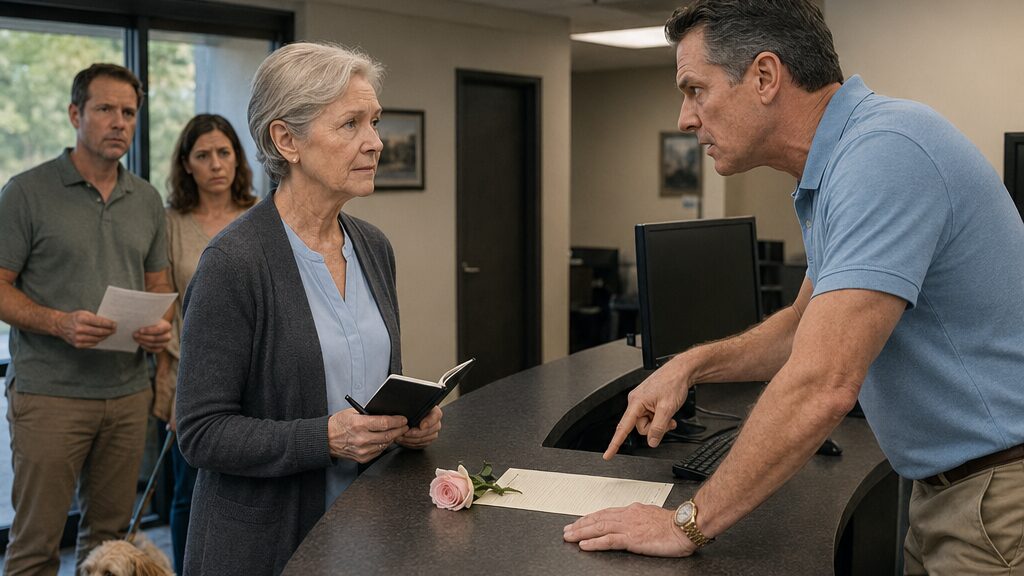
Daniel King stood behind the front counter in pressed khakis and a pale-blue polo embroidered with the Briar Glen emblem. His gold watch caught the overhead light when he extended his hand.
“Mrs. Thompson. I assume you’re here to settle the charge.”
“I’m here to understand it.”
Daniel’s smile remained in place. “It’s a standard landscaping enforcement fee.”
“Authorized when?”
His hand stopped above the paper.
Laura laid the certified notice on the counter. The clipped rose rested beside it, pale against the dark laminate.
“The board approved uniform maintenance standards,” Daniel said.
“I’m not asking about the standards. I’m asking about the ninety-dollar surcharge.”
The homeowner with the dog looked down. The leash went slack between his fingers.
Daniel tapped the notice. “The deadline is printed clearly.”
“So is the threat of a lien.”
“That language is required.”
“By which policy?”
His smile narrowed. “Mrs. Thompson, this does not need to become complicated.”
Laura removed a small notebook from her purse.
“Date of the authorizing vote?”
Daniel glanced toward the waiting homeowners. “You’re holding up office hours.”
“The meeting date will be enough.”
He leaned closer, lowering his voice without softening it. “Pay the charge, Laura. If you don’t, it will go to collections. That can affect your credit, and eventually the association may place a lien.”
He pointed to the bold paragraph as if she had failed to notice it.
For one sharp second, the clubhouse disappeared. Laura saw the brick house at closing seventeen years earlier, her husband standing in the empty living room with two paper cups of coffee. He had laughed at the rose wallpaper and promised they would replace it. They never had. After he died, she could not make herself strip it away.
Daniel’s finger remained on the page.
Laura uncapped her pen.
“Please identify the vote authorizing the surcharge.”
His expression changed. Not much, but enough.
“I don’t have meeting minutes in front of me.”
“Then the reserve study supporting the landscaping expense.”
“That isn’t relevant.”
“The annual budget amendment?”
“No.”
“The contractor invoice?”
Daniel straightened. “The association is not required to produce internal vendor records every time a resident objects to a fee.”
Laura wrote the sentence down.
He watched her.
“What are you doing?”
“Making a record.”
“You are being difficult.”
“I am not being difficult. I am making a record.”
The dog gave a soft whine. No one spoke.
Daniel turned to the computer. His fingers moved across the keyboard with unnecessary force.
“There,” he said. “Your account now reflects the unpaid balance.”
Laura looked at the monitor, but the screen faced away from her.
“The deadline is ten days from today.”
“The charge was due when issued.”
“The notice says otherwise.”
“I’m not debating administrative language.”
“You entered me as delinquent while I was standing here disputing the fee?”
Daniel folded his arms. “I entered the balance according to policy.”
“Which policy?”
“This conversation is over.”
Laura closed her notebook. The fear that had followed her into the clubhouse was still present, but it had changed shape. It no longer felt like a weight pressing down on her. It felt like a loose thread.
She picked up the notice and the rose.
At the door, Daniel called after her.
“You could save yourself a great deal of trouble by paying ninety dollars.”
Laura turned.
“You could save the association a great deal of trouble by showing me where the ninety dollars came from.”
His face held still, but the color rose above his collar.
Outside, she sat in her car with both hands on the steering wheel. The clipped rose lay on the passenger seat. Her pulse thudded in her throat.
She had spent years teaching junior analysts not to confuse confidence with accuracy. Yet she had allowed Daniel’s tone, his watch, his counter, and the printed threat to make her feel briefly ashamed for asking an ordinary question.
At home, she placed the rose in a small glass of water. Then she added a new entry to the garden ledger.
HOA notice received. Charge disputed in person. No authorizing vote identified.
Her phone chimed before she finished the sentence.
An automated email from the management company showed a revised account balance. The ninety-dollar surcharge had become one hundred and seventy-five dollars after a legal-processing fee and collection charge.
The original ten-day deadline had not yet passed.
Chapter 2: The Drawer She Had Kept Closed
The bottom drawer resisted as if it remembered why Laura had stopped opening it.
She pulled harder. Metal scraped against metal, and the filing cabinet shuddered beside the wall of her home office. When the drawer finally released, a dry smell of paper and dust rose into the room.
Inside were the binders she had brought home after retirement and never unpacked properly: federal pension statements, training manuals, old procedural guides, and copies of financial-review templates stripped of agency markings. At the back lay a narrow leather case containing her retired identification card.
Laura did not touch it.
She set the rose ledger on the desk beside the binders and opened a fresh legal pad.
The HOA’s revised balance sat at the top of the first page.
$175.
Below it, she wrote:
Authority for surcharge
Authority for pre-deadline collection fees
Board minutes
Budget amendment
Contractor invoice
Enforcement history
Her phone rang before she finished the list.
Jacob Walker’s name appeared on the screen.
Laura considered letting it go to voicemail. Instead, she answered.
“You sound busy,” he said.
“I’m at my desk.”
“That was not an answer.”
“It was accurate.”
Jacob exhaled. “I called to see whether you want me to come up Saturday. The shelf in the laundry room is still leaning.”
“It has leaned for six months.”
“Exactly.”
Laura looked at the cream-colored notice beside her keyboard.
“I may be occupied Saturday.”
“With what?”
“Association business.”
There was a pause.
“What kind of association business?”
“A landscaping charge.”
“How much?”
“Ninety dollars.”
Jacob laughed once, then stopped when she did not join him. “Pay it.”
“It isn’t authorized.”
“Then pay it and dispute it afterward.”
“That rewards the behavior.”
“It protects the house.”
The word struck more directly than Daniel’s threat had.
Laura aligned the edge of the notice with the legal pad.
“The house is not in danger.”
“How do you know?”
“Because a lien process does not begin with a one-day-old surcharge.”
“That is not what I asked.”
She heard traffic behind him, then the soft click of a turn signal. He was driving home from work, probably with the phone on speaker, his attention divided exactly as he accused hers of being.
“I have the matter under control,” she said.
“You always do.”
His tone was quiet enough to be mistaken for agreement.
Laura changed the subject. “How is the new project?”
“Don’t.”
“Don’t what?”
“Turn this into an interview because you don’t want to tell me what happened.”
Nothing in his voice was raised. That made it worse.
“I received a notice. I asked for supporting records. They refused.”
“And?”
“And I am requesting them formally.”
“Is there a lien threat?”
Laura said nothing.
“Mom.”
“It is standard language.”
“That means yes.”
“It means they printed language designed to frighten people.”
“And did it frighten you?”
Her eyes moved to the framed photograph on the bookshelf. Jacob at twelve, missing a front tooth, his father’s arm around his shoulders. Laura stood beside them in a gray suit, one hand still holding a briefcase.
“I have work to do,” she said.
Jacob’s silence lasted long enough to feel like an answer.
“Pay the ninety dollars,” he said finally. “Please don’t risk the house because somebody challenged you.”
The call ended before she could decide whether she was angrier at him or at the part of herself that understood him.
Laura completed the records request that afternoon. She cited the association’s governing documents and requested inspection of minutes, budgets, reserve studies, enforcement schedules, and vendor invoices for the previous three fiscal years. She asked that all collection activity be paused while the charge was disputed.
Before sending it, she read every sentence twice.
At four fifteen, Ruth Hernandez knocked on the back door holding a foil-covered plate.
“I brought too much cornbread,” she said, which was how Ruth announced most visits.
Laura let her in.
Ruth noticed the open binders immediately. “You working again?”
“No.”
“That looks considerably like work.”
Laura moved the cream notice beneath the legal pad.
Ruth placed the plate on the counter. “Daniel sent me one last winter.”
Laura looked up.
Ruth opened her purse and removed a folded white sheet. “Seventy-five dollars for improper storage. My trash bin was visible from the street for part of one afternoon.”
The legal paragraph at the bottom was identical to Laura’s notice, down to the warning about credit reporting and liens. But Ruth’s page lacked the embossed seal and used a different account code.
“Did you pay it?” Laura asked.
“I did.”
“Why?”
“Because my husband had been gone four months, and I could not bear one more official envelope.”
The answer unsettled Laura more than anger would have.
“Do you know anyone else?”
Ruth hesitated. “A couple. Mostly older folks. People Daniel expects not to make a fuss.”
“Mostly?”
“I did not conduct an audit.”
The words were lightly spoken, but Laura heard the edge beneath them.
She placed the two notices side by side. Identical threat language. Different fees. Different formatting. Different account codes.
“This was not generated automatically,” Laura said.
“How can you tell?”
“The spacing changed around your amount. Mine was inserted manually too. Someone used a template.”
Ruth pulled out a chair. “Does that help?”
“It means someone selected the charge and selected the recipient.”
“Laura.”
“Yes?”
“Do not disappear into this.”
Laura looked at her.
Ruth touched the rose ledger. “You did that after your husband died. Everybody offered to help with the garden. You made schedules instead.”
“The garden survived.”
“That was not my point.”
The formal records request went out by certified mail the next morning and by email to Daniel, Pamela Martin, and the property-management representative.
Jacob arrived unannounced that evening.
He stood in the office doorway, staring at the notice she had left visible on the desk.
“You told me the house was not in danger.”
“It is not.”
“It says lien in bold print.”
“It also says ten days, yet they charged collection fees within hours.”
“That does not make this safer.”
“It makes it improper.”
Jacob picked up the revised account statement. “One hundred seventy-five dollars now?”
“I am addressing it.”
“You are building a case.”
“Yes.”
“Against an HOA over ninety dollars.”
“Against unsupported charges and premature collection action.”
He set the paper down. “Dad used to say you could turn a burned piece of toast into a compliance review.”
Laura’s face went still.
Jacob regretted it immediately; she saw that. But he did not take it back.
“Your father also believed rules should mean what they say.”
“He believed people mattered when rules were wrong.”
Laura closed the drawer with her foot.
Three days later, the association replied.
The email was brief. Her request for minutes and budgets would be reviewed. Vendor invoices, however, were denied because they contained proprietary contractor information and were not subject to homeowner inspection.
Laura read that sentence twice.
Routine invoices were not trade secrets. Landscaping bills did not contain protected formulas. Pool-maintenance charges were not national-security records.
She printed the email and placed it beside Ruth’s notice.
For the first time, the ninety dollars looked less like the issue than the door someone had slammed behind it.
Chapter 3: Seven Business Days of Silence
At five o’clock on the seventh business day, Laura refreshed her email and watched the empty inbox become evidence.
No records had arrived. No inspection date had been offered. Daniel had not acknowledged her follow-up request. The property-management representative had sent only a message stating that the board was “evaluating the scope of disclosure.”
Laura printed that too.
The next morning, she drove downtown with black coffee in a travel mug and the rose ledger in her bag.
The county records office occupied the lower floor of a building that smelled of carpet dust and copier toner. A clerk showed her how to search business registrations, property records, assumed-name filings, and contractor permits.
Laura began with the landscaping company listed on Briar Glen’s annual summary.
It existed. The address matched a small commercial lot outside Asheville. Its registration was current.
The pool-maintenance vendor was different.
Blue Ridge Aquatic Services appeared on two payment summaries Ruth had obtained from old meeting packets, but Laura could not find an active state registration under that exact name. A similar company had dissolved three years earlier.
She wrote the dissolution date in the rose ledger’s back pages, using the same narrow columns she used for pruning cycles.
Date. Source. Claim. Verification.
The method calmed her. Roses responded badly to vague memory. So did money.
By noon, she had found an assumed-name filing for Blue Ridge Aquatic Services. The mailing address was a post-office box on the north side of town.
The name attached to the box was Pamela Martin’s husband.
Laura sat back from the terminal.
Pamela was the HOA treasurer.
She checked the filing again, then asked the clerk how historical mailing records were indexed. The clerk pointed her toward another database and warned that older documents might be incomplete.
Incomplete was not the same as unavailable.
Laura found three annual reports, two vendor permits, and a county tax notice. The business name shifted slightly across the records, but the post-office box remained.
She photographed the public documents and wrote each file number by hand.
Her phone vibrated.
Ruth had sent a picture of a notice posted near the clubhouse mailboxes.
COMMUNITY REMINDER, the heading read. The body warned residents that circulating unverified accusations about board finances could damage property values and expose individuals to legal liability.
No resident was named.
Laura did not need to be.
By the time she returned to Briar Glen, two neighbors were talking beside the mailbox kiosk. They stopped when her car slowed.
Laura parked and walked toward them.
One of the board members stood near the notice with his arms folded.
“Mrs. Thompson,” he said. “Daniel asked that questions go through management.”
“I have sent them through management.”
“The board is concerned about rumors.”
“So am I.”
His mouth tightened. “People are saying money is missing.”
“I have not said that.”
“Ruth has been asking about vendor records.”
“Ruth is entitled to ask.”
The two neighbors avoided Laura’s eyes.
The board member lowered his voice. “This community cannot afford panic over paperwork misunderstandings.”
“Then producing the paperwork would be useful.”
He stepped aside, but not before glancing at the folder beneath her arm.
The public notice had changed the nature of the dispute. Until then, Laura’s questions had existed in letters and quiet conversations. Now the board had placed a warning where every homeowner collected mail.
That evening, Ruth brought over three years of budget packets saved from annual meetings. The pages were incomplete, but they contained summary lines for pool maintenance, emergency drainage, landscaping remediation, and “special project administration.”
Laura arranged them across the dining table.
The dissolved business name appeared first in a packet dated two years after its registration ended.
“That could be a stale vendor label,” Ruth said.
“It could.”
“You do not sound convinced.”
“I am not convinced of anything yet.”
Ruth gave her a look.
Laura corrected herself. “I am trying not to be.”
They traced payments by quarter. Some amounts were round—five thousand, seventy-five hundred, ten thousand. Others looked like reimbursements, precise to the dollar and cent. Several were approved under emergency authority, but the packets contained no descriptions of the emergency.
Ruth pointed to a drainage line item. “That summer the lower street flooded.”
Laura opened the rose ledger.
She had documented the same storm because standing water had killed two bushes near the rear fence.
July 18. Severe rain. Lower cul-de-sac flooded. West bed saturated.
The date matched the first large payment to Blue Ridge Aquatic Services.
“Why would a pool company receive drainage money?” Ruth asked.
“Perhaps it did not.”
Laura searched the county permit database again. A repair permit listed the clubhouse property but named no general contractor. Another record showed equipment delivery from a supplier in Tennessee.
Real materials, perhaps. Real work, perhaps.
But the payment trail remained obscured.
On the third day of her public-record search, Laura located a bank-reference attachment accidentally included in an old permit file. It did not reveal account numbers, but it connected Blue Ridge Aquatic Services to the same post-office box and to a secondary contact number used on Pamela’s HOA treasurer filings.
Laura printed the page.
The first partial answer was now solid: the vendor was not independent of the board.
It was not yet proof of theft.
That distinction mattered, though Laura felt impatience pushing against it.
She created a spreadsheet using figures from the annual summaries and meeting packets. The oldest payment was small. Then came twelve thousand for emergency pump replacement, eighteen thousand for drainage remediation, nine thousand for pool resurfacing coordination, and a series of administrative payments without itemized support.
The total climbed.
Ruth watched from across the table as Laura entered the final amount.
“What does it come to?”
Laura checked the formula manually.
“Eighty-three thousand, nine hundred and forty dollars.”
Ruth went quiet.
Laura rounded it on her notes: approximately $84,000 paid to a vendor whose public identity overlapped with the HOA treasurer’s family and whose original registration had been dissolved.
Her pulse quickened, not with triumph but with the dangerous relief of a pattern becoming visible.
She emailed Jacob a photograph of the totals.
He called within a minute.
“Are you saying they stole eighty-four thousand dollars?”
“I am saying the association paid approximately that amount through a questionable vendor.”
“That is not what your message sounds like.”
Laura looked at what she had written: I think I found where the money went.
She deleted the draft she had been preparing for Ruth and the other affected homeowners.
“I need the underlying invoices,” she said.
“And if they never give them to you?”
“Then their refusal becomes part of the record.”
After the call, Laura added another line to the rose ledger.
Do not confuse a pattern with a conclusion.
Her pen hovered above the page.
Outside, someone tore the community reminder from the mailbox board. By morning, Daniel had replaced it with a laminated copy.
Laura returned to her spreadsheet and highlighted the total.
$83,940.
The ninety-dollar charge had opened a door onto eighty-four thousand dollars in payments.
She still did not know whether the money had been stolen, concealed, or spent through an arrangement no honest board would have approved.
Chapter 4: Eighty-Four Thousand Dollars Was Not the Whole Truth
The supposedly fictitious contractor had left a pump beneath the clubhouse pool.
Laura stood inside the mechanical room with one hand over her nose, listening to the machine cycle through a low metallic hum. The concrete floor was damp. New copper lines ran beside older pipes stained green at the joints, and a white equipment label showed an installation date from the same summer as the first large payment to Blue Ridge Aquatic Services.
The pool contractor crouched beside the pump and shone a flashlight behind it.
“That unit is three years old, give or take,” he said. “Not original construction.”
“Could it have cost twelve thousand dollars?”
“The pump alone? No.”
“The invoice category says emergency pump replacement.”
He straightened. “Pump, electrical work, damaged controls, labor after hours—that could climb. Depends what failed.”
Laura photographed the serial plate and the altered pipework.
Ruth waited near the open door, unwilling to step farther into the heat and chlorine smell. “So the company was real.”
“The equipment is real.”
“That is not what I said.”
“No.”
Laura did not like the distinction as much as she had when correcting other people.
The property-management representative had allowed the inspection only after Laura submitted a written request identifying a possible safety concern. Daniel had not attended, but his absence felt arranged rather than accidental. Before they entered, the representative had reminded Laura twice that photographs could not include proprietary documents.
There were no documents in the room.
There were, however, new drainage controls, replacement valves, and a section of wall repaired with a different color of block. Outside, behind the clubhouse, the contractor pointed to buried lines running toward the lower cul-de-sac.
“Somebody tied pool overflow into the storm system,” he said. “Not elegant, but it would have helped during heavy rain.”
Laura opened her rose ledger to July 18.
Severe rain. Lower cul-de-sac flooded. West bed saturated.
The date matched the emergency payment.
She closed the notebook.
At home, Jacob had spread photocopied invoices across her kitchen table. He had driven up after she admitted the equipment existed, though he claimed he was only there to repair the laundry-room shelf.
“You were right about one thing,” he said when she entered. “These are not normal invoices.”
The documents had come from a supplier listed on a county permit attachment. They showed pumps, control panels, drainage pipe, gravel, concrete, and delivery charges. The materials were real, and the dates aligned with neighborhood repairs.
But several amounts did not.
Jacob pointed to a line marked project administration.
“Six thousand eight hundred dollars on a materials invoice.”
Laura put down her bag.
“A supplier would not normally charge that.”
“There are three more.”
He had circled similar entries. Administrative charges appeared on invoices from different companies, always as round figures and always directed through Blue Ridge Aquatic Services.
Laura sat across from him.
The invoices accounted for more than half the eighty-four thousand dollars. Not all of it, and not cleanly, but enough to destroy the simplest version of the story.
The money had not vanished into an empty company.
Some of it had bought pumps, pipe, labor, and emergency drainage work.
Jacob watched her read. “You told Ruth you thought you found where the money went.”
“I said the vendor was questionable.”
“You texted me that you found where the money went.”
“I corrected that.”
“To me.”
Laura looked toward the window. Ruth was outside clipping dead blooms from the rose bed, a task Laura had not asked her to do.
“Have you said it to anyone else?” Jacob asked.
“I said the payments might be fraudulent.”
“Might be?”
She met his eyes.
“The word I used was fraudulent.”
Jacob leaned back.
“Mom, if real work happened—”
“Real work does not excuse false records.”
“I did not say it did.”
“Then do not soften what they did because part of the money bought equipment.”
“I am asking you not to harden it before you know.”
His words landed with the same irritating precision she had once demanded from junior analysts.
Laura separated the invoices into three stacks: supported materials, uncertain administration, and unsupported payments. The work reduced the alarming total but sharpened the questions. Nearly twenty-two thousand dollars remained without underlying proof. Another fourteen thousand appeared to consist of unexplained coordination fees and markups.
The pattern was still improper.
It was simply not the pattern she had first announced.
That afternoon, the association attorney’s letter arrived by courier.
Ruth carried it in from the porch. “The envelope looks expensive.”
The letter demanded that Laura cease making false statements concerning theft, embezzlement, or fraudulent vendors. It claimed her accusations had caused reputational harm to the board and could interfere with future contracting. She had five days to issue a written retraction.
Ruth read over Laura’s shoulder.
“They are trying to scare you.”
“They may also have a valid point.”
Ruth’s expression changed. “You think Daniel did nothing?”
“No. I think I used a conclusion before I had earned it.”
“You found his treasurer’s family address attached to the vendor.”
“And real repairs attached to the payments.”
“That does not make it honest.”
“It makes it complicated.”
Ruth set the letter down. “Complicated is where people like Daniel hide.”
“Sometimes. It is also where careless accusations hide.”
The words came out harder than Laura intended. Ruth moved away from the table.
For several minutes, only the kitchen clock made sound.
Laura opened the rose ledger again. A page near the center was rippled and stained from rain. Her husband had carried it outside during the flood year to record damage while she took photographs. His handwriting crossed one margin:
Not everything bent is broken.
She traced the faded ink with her thumb.
Jacob had gone to the laundry room. A drill started, stopped, then started again. He had come to repair the shelf after all.
Laura drafted a narrow response to the attorney. She did not retract her concern over undisclosed related-party transactions, but she acknowledged that available records showed some legitimate repair work. She would not repeat that the full eighty-four thousand dollars had been stolen.
Before sending it, she showed Jacob.
He read silently.
“You left yourself room to be wrong,” he said.
“I left the facts room to be complete.”
“That may be the same thing.”
Her phone vibrated on the table.
The message came from Pamela Martin.
Do not call me. Do not reply by association email. I need to speak with you before the board work session tomorrow. They are going to correct the old files.
A second message appeared.
Some of the corrections will not be corrections.
Chapter 5: The Treasurer’s Address and the President’s Debt
Pamela arrived at Ruth’s house carrying no documents, only a brass key.
She held it between two fingers as if it belonged to someone else.
“Where is Laura?” she asked.
Ruth stepped aside. “Dining room.”
Pamela entered without removing her coat. Her eyes went first to the windows, then to the cream-colored notice lying beside Laura’s folders.
“I cannot stay long.”
Laura gestured toward the chair opposite her. “What does the key open?”
“A storage cabinet at a self-storage facility off Hendersonville Road.”
“Owned by the association?”
“Paid for by the association.”
“Disclosed in the budget?”
Pamela gave a tired laugh. “You really do begin with the smallest question that has the worst answer.”
She sat but kept the key in her hand.
Ruth placed coffee on the table. Pamela did not touch it.
“The vendor address belongs to your husband,” Laura said.
“It belongs to a box he rented for his repair business. Daniel asked to use it.”
“Why?”
“Because Blue Ridge Aquatic Services could not open a commercial account after the original company dissolved.”
“Who owned the original company?”
“A pool technician Daniel knew.”
“And the business used afterward?”
“There was no proper business afterward. Not at first.”
Ruth lowered herself into a chair.
Pamela stared at the key.
“The pool pump failed during the flood summer,” she said. “The reserve account could not cover the replacement and the drainage work. The prior board had postponed too much for too long. Daniel paid the emergency deposit himself.”
Laura remained still.
“How much?”
“Twenty-eight thousand.”
The number altered the room.
Pamela continued before either woman could speak. “He used a line of credit from one of his development companies. The pool would have closed, and the lower street would have flooded again. He told us he would carry the cost until the special assessment passed.”
“But it did not pass,” Laura said.
“Homeowners rejected it.”
“So he created another method.”
Pamela nodded.
At first, Daniel had routed legitimate invoices through the old vendor name so the association could reimburse him without disclosing that its president had financed the repairs. He said disclosure would cause panic, invite questions about the empty reserves, and damage sales in the final section of the development.
“Then the reimbursements changed,” Pamela said.
“How?”
“Daniel added coordination fees. He said he had spent months managing contractors and deserved compensation.”
“Approved by the board?”
“Not formally.”
“Reported as income?”
“I do not know.”
“You signed the checks.”
Pamela flinched. “Yes.”
Laura let the word remain between them.
Pamela’s gaze moved toward the sideboard, where Ruth kept family photographs and a small vase holding a red rose.
“I had that same rose once,” she said.
Laura followed her eyes.
“You gave me a cutting after my mother died. The dark-red one by your back fence.”
“I remember.”
“It did not survive.”
Laura almost said that Pamela had planted it too deep. She stopped herself.
Pamela closed her hand around the key. “My husband’s business was failing. Daniel sent him small repair jobs. Nothing improper at first. When Daniel asked to use the post-office box, I knew I should refuse.”
“But you did not.”
“No.”
“Because of the work he gave your husband?”
“Because he helped when nobody else knew we needed help.”
The admission was not an excuse. Pamela did not present it as one.
Laura opened a clean page in her notebook.
“How much of the eighty-four thousand went to actual repairs?”
“About fifty-six thousand, including Daniel’s original deposit.”
“And the rest?”
“Markups, coordination charges, duplicate reimbursements, and some payments I never understood.”
“Did Daniel receive them?”
“Some went to his company. Some paid my husband for work he did. Some were passed through and returned in cash-equivalent credits.”
Ruth pushed her coffee away. “That is not accounting.”
“No,” Pamela said. “It is what happens when frightened people keep calling each bad decision temporary.”
Laura wrote the sentence down, then crossed it out. It belonged to Pamela, not the record.
“What is in the storage cabinet?”
“Old minutes, contractor folders, check copies, drafts of reserve reports. Daniel moved them after management changed systems.”
“Why tell me now?”
Pamela looked directly at her for the first time.
“Because tomorrow he plans to replace incomplete pages with clean versions. He says he is reconstructing the record.”
“Will you testify that the originals were altered?”
Pamela’s grip tightened around the key.
“Not if you put my name in a public accusation.”
“You were treasurer.”
“I know what I was.”
“You signed inaccurate statements.”
“I know.”
“Then your name is already part of it.”
Pamela stood so quickly that the chair legs struck the floor.
“I came here because he is going to destroy evidence.”
“And you are asking me to protect you from evidence.”
“I am asking you not to turn me into the same thing as Daniel.”
Laura rose too.
“I do not decide what you are. Your choices do.”
Pamela’s face emptied.
Ruth stepped between the table and the door.
“Both of you sit down.”
Neither moved.
Ruth looked at Laura. “She brought the key.”
Then at Pamela. “You do not get to buy silence with it.”
Pamela lowered herself first.
Laura remained standing a moment longer, ashamed that it mattered.
“What are you willing to do?” Laura asked.
“I will show you the files. I will identify which entries I signed and which were changed later. I will give a written statement to an independent auditor.”
“Not to the homeowners?”
“Not yet.”
Laura sat.
It was less than she wanted and more than she had possessed an hour earlier.
They drove to the storage facility before dawn the next morning. Pamela waited in Ruth’s car while Laura and Ruth entered the narrow corridor of metal doors. The cabinet stood inside a ten-by-ten unit filled with folding tables, faded holiday decorations, pool signs, and banker’s boxes.
The brass key opened a gray steel cabinet against the back wall.
Inside were six binders.
Laura began with the meeting minutes.
The signatures appeared on separate certification pages. In one binder, a January meeting described emergency authority to complete drainage repairs. In another version of the same meeting, an additional paragraph authorized administrative reimbursement to Daniel’s company.
The font was slightly smaller.
The paper was brighter.
Laura held both pages under the ceiling light.
“Could be a later copy,” Ruth said.
“The signatures are identical.”
“They copied the signature page?”
“Or replaced the page in front of it.”
Further inside the cabinet, they found the original signed packet. The disputed paragraph was absent. A handwritten note on a draft said: Add reimbursement authority after counsel review.
No evidence showed that counsel had reviewed it.
Laura photographed each version in place before removing anything.
At the bottom of the cabinet lay a ledger of checks. Daniel’s original twenty-eight-thousand-dollar advance appeared clearly, followed months later by full repayment. After that came three additional payments labeled project coordination.
He had first rescued the association.
Then he had begun charging it for the power the rescue gave him.
Ruth stood beside Laura, reading over her shoulder.
“Will this prove falsification?”
“It proves substitution.”
“And Pamela?”
“It proves she certified some of the records.”
Ruth waited.
Laura closed the binder.
“I will describe what she did accurately.”
“That was not my question.”
“No,” Laura said. “It was not.”
She placed the original and altered minutes side by side in a document sleeve.
The evidence was stronger now, but the story had become harder to tell cleanly. Daniel was not simply a man who stole eighty-four thousand dollars. Pamela was not simply a frightened witness. Laura herself was no longer only the homeowner who had been wronged.
The signatures on the substituted page meant someone had tried to manufacture authority after the decision.
The question was no longer whether the records were false.
It was whether Laura could expose who changed them without changing the truth into something easier than it was.
Chapter 6: Two Hundred Twelve Pages and One Necessary Correction
Page 212 contained a date that could not exist.
Laura noticed it at 1:17 in the morning, after ten days of sorting invoices, permits, photographs, meeting packets, correspondence, and bank-reference attachments across every flat surface in her office.
The altered minutes said the board authorized Daniel’s reimbursement structure on January 14.
A contractor email attached to the final page referred to the proposed authorization as still awaiting approval on February 3.
Laura read both dates again.
Then she wrote in the margin:
Authorization inserted retroactively.
She did not underline it. The contradiction needed no decoration.
By day thirty-one, the evidence package had grown into three tabbed binders. The cream-colored notice was Exhibit 1. Her handwritten account of the clubhouse confrontation followed it. Ruth’s notice established selective enforcement. Public filings, vendor records, permit attachments, invoices, payment summaries, and altered minutes filled the remaining sections.
The rose ledger lay open beside them.
Its columns had become the model for the entire chronology: date, event, source, verification, correction. When Laura found an inconsistency in her notes, she drew one line through it and wrote the corrected information beside it. Nothing disappeared.
At the print shop, the clerk watched pages emerge in thick stacks.
“Court case?” the clerk asked.
“Homeowners’ meeting.”
The clerk looked at the binders. “That must be some meeting.”
Laura did not answer.
Jacob arrived that afternoon carrying sandwiches and a toolbox he no longer needed. The laundry-room shelf had been level for a week, but neither of them mentioned it.
He began reading the summary while Laura inserted divider tabs.
On page eighteen, he stopped.
“This annotation is wrong.”
Laura kept working. “Which one?”
“You say the twelve-thousand-dollar pump payment was made after the company dissolved.”
“It was.”
“The business registration dissolved. The payment was made to the assumed name account two months before the bank closed it.”
“The vendor had no active corporate status.”
“That is different from saying the account did not exist.”
Laura took the page.
The distinction was narrow. It was also real.
“The payment still lacked proper vendor approval.”
“Yes. But this sentence says money was sent to a nonexistent account.”
She read it again.
The phrase was hers.
If Daniel’s attorney found it, he could use one inaccurate sentence to cast doubt on every accurate one.
Laura removed the page from the binder.
Jacob watched her. “There may be more.”
“I checked every entry.”
“You checked them alone.”
“I know how to review a file.”
“That is not what I said.”
She looked at the stacks surrounding them. For weeks, the room had obeyed her. Every folder had a place; every payment had a number. People had been more difficult. People contradicted themselves, asked for mercy, remembered selectively, and changed what facts meant.
Her husband had once stood in this same doorway while she reviewed pension records on a Sunday morning.
You audit everything except the distance between us, he had said.
At the time, she had called the sentence unfair.
Now she could not remember whether she had ever told him she understood it.
Laura handed Jacob the summary.
“Start at page one.”
He sat beside her.
They found four more issues: two overstated conclusions, one duplicated amount, and a sentence implying Pamela’s husband had received money unsupported by the available records. Each correction made the case less dramatic and more defensible.
Laura added a disclosure sheet to the front.
Earlier statements described approximately $84,000 as missing or stolen. Available evidence now indicates that substantial portions funded actual repairs. The documented concerns are unauthorized related-party transactions, concealed markups, duplicate reimbursement, substituted minutes, selective enforcement, and obstruction of records access.
Jacob read it.
“You are giving Daniel your mistake.”
“It is already his if I hide it.”
The doorbell rang.
Daniel stood on the porch alone.
He wore no HOA polo, only a white dress shirt with the sleeves rolled once. Without the clubhouse counter between them, he looked older than Laura had remembered.
“I hoped we could resolve this privately,” he said.
Laura did not invite him inside.
He held out a one-page agreement. The association would void her landscaping fee, remove all collection charges, confirm that no lien would be filed, and reimburse reasonable document expenses.
“In exchange for what?”
“You withdraw the records complaint and state that your concerns have been resolved.”
“Have they?”
“The association made mistakes during an emergency.”
“You altered minutes.”
His eyes shifted toward the binders visible through the hallway.
“You do not understand what the board inherited.”
“I understand the reserve account was nearly empty.”
“Then you understand why I acted.”
“I understand why you paid the deposit.”
His jaw tightened.
Laura continued. “I do not understand why you repaid yourself and then continued charging coordination fees without authorization.”
“I spent hundreds of hours keeping this place from falling apart.”
“Then you should have asked the homeowners to approve compensation.”
“They rejected every assessment.”
“That did not transfer ownership of the association to you.”
Daniel lowered the agreement.
“You think those people will thank you when the audit increases dues? When insurance asks questions? When buyers see financial instability?”
“No.”
The answer stopped him.
Laura stepped onto the porch and closed the door behind her.
“They may blame me,” she said. “Some probably will. But they are entitled to know what they are paying for.”
“You are risking your own property value.”
“I know.”
“For ninety dollars.”
“No. You made it about ninety dollars because you believed that was small enough to force quietly.”
Daniel looked toward the rose bed. Several bushes had begun their second bloom.
“I kept the pool open,” he said. “I stopped the lower street from flooding. Pamela’s husband got work when he was about to lose his business. Nobody complained while things functioned.”
“You did something useful.”
He looked back at her, surprised.
“Then you decided usefulness exempted you from permission.”
For a moment, neither spoke.
Daniel held out the agreement again. “This guarantees your home is protected.”
Laura thought of the bold lien warning, Jacob’s anger, Ruth paying because she could not bear another official envelope, and Pamela arriving with the key.
Private safety was what she had wanted on the first morning.
It was no longer enough.
She folded the agreement once and returned it.
“No.”
His face hardened, but the anger beneath it looked tired.
“The board will consider a motion to censure you for spreading false allegations.”
“I corrected those allegations in writing.”
“You accused us publicly.”
“I will correct myself publicly.”
That seemed to trouble him more than denial would have.
After he left, Laura returned to the office. Jacob had placed the rose ledger on top of the first binder.
“You told him no?” he asked.
“Yes.”
“You could still lose.”
“Yes.”
He nodded slowly. “Thank you for telling me before it happened.”
Laura sat beside him.
“I was frightened,” she said.
Jacob did not pretend to misunderstand.
“Of the lien?”
“Of needing you to be frightened too.”
He looked down at the summary pages.
“You do not get to protect me by making me irrelevant.”
“No.”
The word was difficult. She let it stand without qualification.
That evening, Laura added one final correction to the file and printed six copies of the disclosure sheet. Ruth agreed to distribute them. Pamela had signed a limited written statement identifying the substituted minutes and her own certifications. She had not asked for her name to be removed again.
The annual meeting began at seven.
By six forty-five, the clubhouse parking lot was full.
Laura crossed it carrying the three binders in a canvas tote. Jacob walked beside her but did not reach for the bag. Ruth followed with the copies. Through the clubhouse windows, homeowners filled every chair and stood along the walls.
As Laura entered, Daniel was already at the microphone.
The cream-colored notice rested on top of her file.
Daniel struck the gavel once.
“Before we address the records request,” he said, “the board will consider a motion to censure Laura Thompson for reckless and damaging accusations against this association.”
Chapter 7: The Meeting Where the Record Finally Changed
Daniel’s motion to censure Laura was seconded before she reached the front row.
The sound came from one of the board members seated beside him. A few homeowners whispered. Others turned to look at Laura as she set the canvas tote on an empty chair and removed the three binders one at a time.
Daniel kept one hand on the gavel.
“The motion concerns repeated public allegations of theft and fraud,” he said, “made without complete evidence and with measurable harm to the association’s reputation.”
Laura placed the cream-colored notice on top of the first binder.
Ruth stood along the wall holding the disclosure sheets. Jacob remained near the back door, close enough to see but far enough that no one could mistake the case for his.
Daniel looked toward Laura. “You will have an opportunity to respond after the board discusses the motion.”
“No,” Laura said.
The room quieted.
Daniel’s expression tightened. “Excuse me?”
“The records request was submitted before the censure motion. It should be addressed first.”
“The chair determines the agenda.”
“Then the record should show that the chair moved to punish the requester before considering the records she requested.”
Several people shifted in their seats.
Daniel leaned toward the microphone. “This is exactly the behavior the motion addresses.”
Laura opened her small notebook.
“Please continue,” she said. “I am making a record.”
The phrase moved through the room with a faint murmur. Two homeowners who had been present at the clubhouse counter recognized it.
Daniel saw that they did.
He set the gavel down.
“You have ten minutes.”
“I need twelve.”
“You have ten.”
Laura did not bargain. She opened the first binder.
“My first statement is a correction.”
The room changed before she explained. People had arrived expecting accusation, defense, perhaps spectacle. A correction offered none of those things.
Laura looked at the disclosure page Jacob had helped her prepare.
“In conversations with several homeowners, I described approximately eighty-four thousand dollars as missing and, once, as stolen. That statement went beyond the evidence available to me.”
Daniel sat back slightly.
Laura continued.
“Substantial portions of those payments funded actual pool, drainage, and repair work. I withdraw any claim that the full amount was stolen.”
A homeowner near the aisle shook his head. Another whispered, “Then what are we doing here?”
Daniel reached for the microphone.
Laura raised one finger.
“I have not finished.”
Something in her voice stopped him.
“The corrected question is not whether every dollar disappeared. The corrected question is whether the board concealed related-party payments, reimbursed its president without authorization, altered meeting records, imposed unsupported charges selectively, and denied homeowners access to the documents needed to discover those actions.”
Ruth began distributing the disclosure sheets.
Daniel said, “Those characterizations remain disputed.”
“They are documented.”
Laura lifted the original cream notice.
“This was issued to me for ninety dollars. It threatened collection action and a lien within ten days. Before that deadline expired, additional fees were added. When I asked for the vote authorizing the surcharge, no meeting date was provided.”
She placed the notice beside Ruth’s winter fee and two redacted copies from other homeowners.
“The same legal threat was used for different charges, with manually altered amounts and account codes. Most recipients were older residents living alone.”
“That proves nothing about intent,” Daniel said.
“It proves selective use.”
She turned to the second tab.
“The association denied access to vendor invoices by calling them proprietary. Public records then showed that Blue Ridge Aquatic Services used a mailing address connected to the treasurer’s family. The original company registration had dissolved, but payments continued under variations of the same name.”
Pamela sat at the end of the board table, hands clasped tightly in front of her.
Laura did not look at her yet.
“Those payments totaled eighty-three thousand, nine hundred and forty dollars. Approximately fifty-six thousand can be tied to real repairs, materials, emergency labor, and reimbursement of funds advanced when the reserve account could not cover urgent work.”
A woman in the second row turned toward Daniel. “You advanced the money?”
Daniel looked at Laura rather than answering.
Laura did.
“Yes. Daniel paid a major emergency deposit from his own funds when the pool pump failed and drainage work was needed.”
The statement disturbed the simple shape of the room’s anger. Several homeowners glanced at one another. Daniel’s shoulders lowered a fraction.
“I prevented the pool from closing,” he said. “And I prevented another flood.”
“You did,” Laura replied.
The acknowledgment landed harder than an insult.
“Then why are we here?” one of the board members asked.
“Because repayment did not end the arrangement.”
Laura opened the second binder.
“After Daniel’s original advance was repaid, additional coordination charges, markups, and duplicate reimbursements continued. Some payments went to his company. Some work was routed through a business connected to Pamela’s husband. None of the available minutes show proper authorization for those financial relationships.”
Daniel stood.
“I spent hundreds of hours managing that work. The association benefited.”
“Benefit does not create approval.”
“The homeowners rejected the assessment that would have funded the repairs.”
“Then the board had to return to the homeowners.”
“And let the neighborhood flood while we held another meeting?”
“No. Emergency action may explain the first decision. It does not authorize every decision after it.”
No one spoke.
Laura turned to the third binder.
“The minutes provided by the association include a paragraph authorizing administrative reimbursement. The original signed packet stored off-site does not.”
Daniel’s face changed.
Laura placed enlarged copies on the table. One showed the original page. The other contained the added paragraph. The same signature sheet appeared behind both.
“The substituted page uses different paper, smaller type, and language drafted after the meeting date. Page 212 of this file contains a contractor email dated February third stating that reimbursement authority was still awaiting approval. The altered minutes claim approval occurred January fourteenth.”
The room filled with low voices.
Daniel struck the gavel once. “Order.”
Pamela stood.
Every sound stopped.
“I certified some of those records,” she said.
Her voice was thin but clear.
Daniel turned toward her. “Pamela, you should speak with counsel before making any statement.”
“I already did.”
She looked at the homeowners rather than at Laura.
“Daniel asked me to treat the added paragraph as a reconstruction of what the board intended. I knew it had not been voted on. I signed later summaries anyway.”
A man near the wall asked, “Did you take money?”
“My husband was paid for work he performed. His post-office box was also used to support the vendor arrangement. I should have disclosed both.”
“Why didn’t you?”
Pamela swallowed.
“Because Daniel helped us when my husband’s business was failing. Because the repairs were real. Because each time I objected, I told myself the next record would fix the last one.”
Daniel stared at the table.
Laura closed the binder.
“I am not asking this room to decide criminal guilt tonight,” she said. “I am asking for actions the association has authority to take now.”
She read the proposed measures without raising her voice: suspend disputed collection activity and liens; void unsupported enforcement fees; preserve all records; hire an independent financial reviewer; disclose related-party contracts; require homeowner approval for non-emergency board compensation; remove Daniel and Pamela from financial authority pending review; and create a resident records committee with rotating membership.
Daniel looked up.
“You are asking them to destroy the people who kept this place functioning.”
“No,” Laura said. “I am asking them to stop confusing service with ownership.”
The vote was not unanimous.
Some homeowners feared audit costs. Some blamed the prior board. One insisted Laura’s original accusation had been reckless. Laura agreed with that part, and the admission seemed to remove the weapon from his hand.
The censure motion failed.
The motion to preserve records and suspend disputed liens passed first. Independent review followed by a narrower margin. Daniel resigned as president before the removal vote could be taken. Pamela submitted her resignation as treasurer and signed a statement acknowledging the substituted minutes.
There was no applause.
Chairs scraped. People formed tense groups. Daniel gathered his papers alone.
As Laura lifted the canvas tote, he stopped beside her.
“You will find out the audit costs more than the money you think I owe.”
“Possibly.”
“And dues will rise.”
“Possibly.”
He looked at the cream notice on top of the file.
“You could have paid ninety dollars.”
“Yes.”
For a moment, he seemed to understand that this was not an answer he could use.
Six weeks later, the association voided Laura’s surcharge and twelve similar fees. Collection action on disputed accounts was suspended. The preliminary review identified concealed markups and unauthorized reimbursements requiring repayment, though the final amounts remained under review.
The pool stayed open.
The neighborhood did not become harmonious. Some residents avoided Laura at the mailbox. Others arrived at her door carrying folders they should have examined years earlier.
On a Saturday morning, Ruth knelt beside the oldest rose near the back fence while Jacob steadied a bucket of soil.
“You are cutting too high,” Laura said.
Ruth looked over her shoulder. “Then come show me.”
Laura nearly reached for the pruning shears.
Instead, she crouched beside Ruth and guided her hand to the proper place on the stem.
The rose ledger lay open on the garden bench. Beside the old entries, a new column listed cuttings given to neighbors and the names of those helping maintain the beds.
Laura clipped one dark-red stem and wrapped its roots in damp cloth.
“For your yard,” she told Ruth.
“I killed the last one.”
“You planted it too deep.”
“I knew you were going to say that.”
“This time, I will help.”
Ruth accepted the cutting.
Across the street, two members of the new records committee carried boxes into the clubhouse. Laura would join them later. She was not chairing the committee. She had insisted on that.
Jacob brushed soil from his hands and looked toward the house.
“The shelf is still level,” he said.
“I noticed.”
“You could say thank you.”
Laura considered him.
“Thank you.”
He smiled, and she returned to the roses before the moment required anything larger.
The cream-colored notice remained in the first evidence binder, no longer a threat and not quite a trophy. It was simply the first record of what happened when someone expected fear to be quieter than a question.
The story has ended.