The HOA Ordered His Work Truck Gone, So He Read the Rule They Never Expected Him to Understand
Chapter 1: The Notice Waiting Under His Windshield Wiper
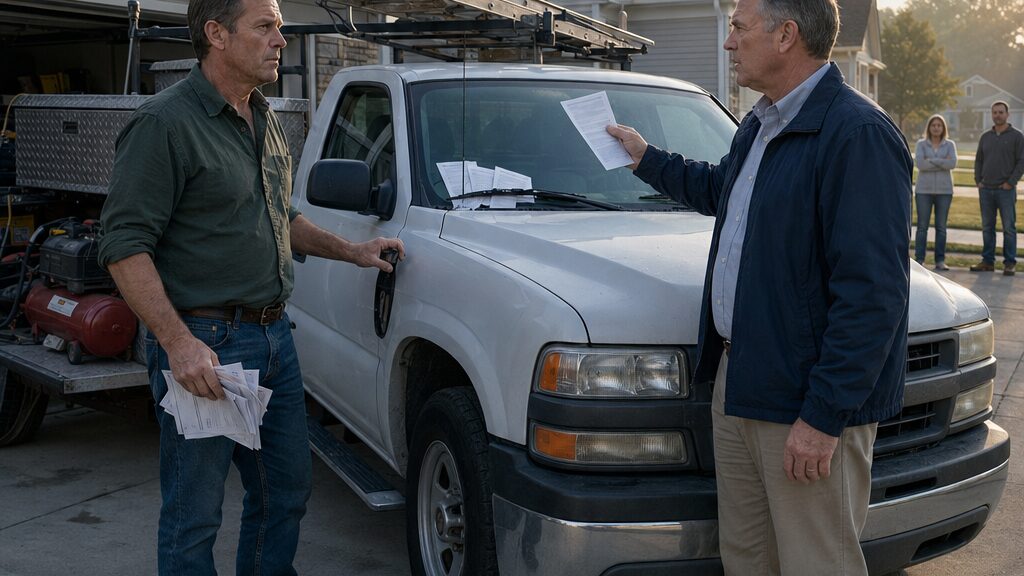
Edward Campbell was standing beside Patrick Mitchell’s truck before Patrick had both feet out the front door.
The white work truck sat where it had sat most nights for nearly nine years, backed into the right side of the driveway with its nose facing the street. Ladders were strapped to the rack. A locked aluminum toolbox crossed the bed. Two five-gallon buckets and a folded extension cord waited behind the cab.
A sheet of paper trembled beneath the driver-side windshield wiper.
Patrick stopped halfway down the walk.
Edward wore a navy windbreaker over a button-down shirt, though the morning was already warm enough that Patrick had rolled his sleeves to his elbows. He stood with one hand in his pocket and the other resting near the paper as if he had placed a flag on conquered ground.
“Morning, Patrick.”
Patrick glanced at the notice. “What’s that?”
“You know what it is.”
“No. I know what it looks like.”
Edward took his hand out of his pocket. “The board received a complaint about a commercial vehicle being stored overnight in a residential driveway.”
Patrick looked at the truck, then back at Edward.
“It was here last night,” Edward continued. “And the night before.”
“It’s here most nights. I own it.”
“That’s the problem.”
Patrick laughed once, without humor. “Owning my truck is the problem?”
“Parking it here overnight.”
A garage door rattled open two houses down. Patrick caught movement at the edge of his vision and hated that he noticed it. He hated even more that Edward noticed him noticing.
Patrick walked past him and pulled the notice from beneath the wiper.
The top carried the neighborhood association’s name. Below it was a reference to Section 7.4 and a warning that commercial vehicles could not be stored on residential driveways during restricted hours.
Six in the evening to eight in the morning.
Patrick read it twice.
“This is my work truck.”
“I understand that.”
“I leave before eight most days.”
“The restriction begins at six.”
“I’m usually still working at six.”
“Then when you return, it needs to be parked somewhere else.”
Patrick looked into the bed. The previous afternoon he had loaded a compact drain snake, an air compressor, three tool cases, pipe fittings, two saws, and enough hardware to handle three scheduled jobs without coming back home.
“Where exactly?”
“That’s up to you.”
Patrick folded the notice once, carefully.
Edward’s expression shifted by a fraction. Maybe he had expected Patrick to tear it up.
“I’ve lived here nine years,” Patrick said.
“I know.”
“I’ve paid every assessment.”
“This isn’t about assessments.”
“I’ve never had a violation.”
“That doesn’t make this one disappear.”
Patrick placed the folded paper on the hood.
“What happens if I leave it here tonight?”
Edward hesitated just long enough to make Patrick listen harder.
“This is the initial notice. Continued violations can result in fines.”
“How much?”
“The schedule starts modestly.”
“That wasn’t my question.”
Edward gave him the amount. Then the next amount. Then the possible increase for repeated noncompliance.
Patrick’s jaw tightened.
The numbers were not ruinous by themselves. That almost made them worse. They were designed to be small enough that arguing over them could be made to look childish.
His phone buzzed in his pocket. His part-time employee was waiting at the first job.
Patrick opened the truck.
Inside the cab were invoices, a worn clipboard, work gloves, and the travel mug Kathleen had bought him three Christmases earlier. Nothing about the truck felt commercial to him in the abstract way the notice meant it. It smelled like coffee, dust, cut lumber, and the vinyl seats heating in the morning sun. It had carried broken water heaters, storm-damaged fence boards, bags of concrete, leaking sinks, and the tools that had kept his business alive through a thin winter.
Edward stepped back from the door.
“I’m not trying to make this personal.”
Patrick looked at him. “You’re standing in my driveway before seven in the morning.”
“I came because a mailed notice takes days.”
“That’s supposed to make it better?”
“I thought it was more respectful to tell you directly.”
For the first time, Patrick believed him.
That did not make him less angry.
“What if I need a few days to figure something out?”
Edward shook his head. “The complaint has already been documented.”
“I didn’t ask you to erase it. I asked for a few days.”
“I can’t selectively suspend enforcement.”
“You’re the president.”
“Which is exactly why I can’t.”
Patrick stared at him.
Edward’s voice stayed level. “You may not like the rule, but the rule applies to everyone.”
The garage door down the street stopped moving. Somewhere a dog barked.
Patrick picked up the notice again.
“Fine.”
Edward seemed relieved. “I appreciate that.”
Patrick looked at him sharply. “I said fine. I didn’t say you were right.”
He climbed into the truck and shut the door.
All morning, the notice sat folded on the passenger seat.
At the first house, Patrick replaced a failed sump pump. At the second, he rebuilt a section of rotted deck railing. At lunch, he sat behind the steering wheel in a strip-mall parking lot and searched for nearby commercial vehicle storage.
The cheapest place he found was far enough away to add almost forty minutes to his mornings and evenings.
He closed the page before finishing the application.
That night, Kathleen found the notice on the kitchen counter.
“What is this?”
“HOA.”
“I can see that.”
Patrick opened the drawer where they kept closing papers and old association documents.
“You’re not going to call them?”
“I already talked to Edward.”
“And?”
“He told me the rule applies to everyone.”
Kathleen leaned against the counter. “Does it?”
Patrick pulled out a thin booklet with a cracked plastic cover.
“That’s what I’m about to find out.”
He found Section 7.4 near the back.
The paragraph was shorter than he expected.
He read the restriction once.
Then again.
Then a third time, slower.
The language mentioned recreational vehicles, oversized vehicles, trailers, and vehicles used primarily for commercial storage. It described overnight parking restrictions on residential lots.
But it did not say what Edward had said in the driveway.
It did not simply say all commercial vehicles.
Patrick straightened in his chair.
Kathleen looked over from the sink.
“What?”
Patrick put one finger beneath the line.
“He left something out.”
Chapter 2: The Board Would Not Hear His Reason
Patrick heard Edward discussing his truck before anyone opened the meeting-room door.
“—not about one resident,” Edward was saying. “It’s about consistent enforcement.”
Patrick stopped in the hallway of the clubhouse.
The door stood open three inches. Inside, chairs scraped against the floor and papers shuffled. The board had apparently begun talking about him before the homeowner-comment portion of the meeting.
Another voice said, “But has he had prior violations?”
“No.”
“Then why not give him thirty days?”
“Because we’ve had complaints about selective treatment before.”
Patrick stepped through the doorway.
Conversation stopped.
Edward looked up from the end of a folding table.
“Patrick. We’re not quite ready for homeowner comments.”
“I gathered.”
Maria Garcia, the treasurer, lowered her eyes to the papers in front of her.
Patrick took a chair against the wall.
The clubhouse room was barely large enough for the board table, twenty metal chairs, a coffee station, and a bulletin board covered with landscaping schedules and pool notices. Nothing about it looked powerful. That irritated Patrick more than if it had. Decisions affecting what he could do on his own property were being made beneath fluorescent lights beside a humming mini-fridge.
Twenty minutes later Edward called him forward.
Patrick carried the notice and the copy of Section 7.4.
“I’m not asking to park a dump truck on the lawn,” he began. “I’m asking to keep the same work truck in the same driveway where it’s been for years.”
Edward folded his hands. “The board understands that.”
“Then you understand that I use it every day.”
“Yes.”
“It’s not abandoned. It’s not being stored for resale. It doesn’t block the sidewalk. It doesn’t leak. It fits entirely in the driveway.”
One board member said, “The issue is the commercial nature of the vehicle.”
Patrick slid the covenant copy onto the table.
“Show me where it says that.”
Edward glanced down.
“Section 7.4.”
“I read Section 7.4.”
“Then you know.”
“I know it says vehicles used primarily for commercial storage. Mine is transportation. I carry tools because I use them.”
Edward looked toward the other members. “The association has consistently interpreted commercial work vehicles as falling under that provision.”
“Interpreted.”
“That’s how covenants are administered.”
Patrick felt Kathleen’s warning from before he left the house: Don’t walk in there trying to win. Walk in there trying to solve it.
He forced his voice lower.
“All right. Then I’m asking for an accommodation while I figure out another option.”
Maria looked up. “What kind?”
“Thirty days. Maybe less.”
Edward answered before anyone else could.
“We can’t create exceptions based on individual inconvenience.”
“Inconvenience?”
Patrick stopped himself.
Maria’s mouth tightened.
Edward said, “I’m not minimizing your work. But if the board grants you thirty days, what do we tell the next homeowner with a trailer? Or an RV?”
A board member to Maria’s left cleared his throat.
“We gave the Johnson property time with that motor home.”
The room went still for half a beat.
Edward’s face changed.
“That was different.”
“How?”
“It involved medical travel.”
“And it sat there for what, two months?”
“Under temporary circumstances.”
Patrick watched Edward rather than the man who had spoken.
“So exceptions are possible.”
Edward leaned back.
“Accommodations are possible when there are documented circumstances that justify them.”
Patrick felt the trap immediately.
Documented circumstances.
He could explain the weak winter. The unpaid invoice from a commercial client. The line of credit he was still carrying. The fact that paying monthly storage would almost certainly mean cutting his employee’s Fridays until business picked up.
Instead he heard himself say, “My circumstances are that I work for a living.”
Kathleen would have hated the answer.
Edward did not react.
“Then you can submit a written request with supporting information.”
“For permission to keep doing what I’ve done for nine years?”
“For temporary relief.”
Patrick looked around the table.
No one seemed eager to meet his eyes.
Maria said, “There’s a storage lot off County Road Twelve. Several contractors use it.”
“I know.”
“It might solve the immediate issue while we review your request.”
“I’m not paying to rent a space twenty minutes away for a truck that fits in my driveway.”
Edward’s tone hardened.
“Then you are choosing continued noncompliance.”
Patrick felt heat rise behind his ears.
There it was: the sentence that turned the problem into his fault.
He stood.
“I’m choosing not to pretend this language says something it doesn’t.”
Edward slid the covenant copy back toward him.
“You’re entitled to challenge the interpretation. Until the board changes its position, enforcement remains in effect.”
Patrick stared at the binder on the table.
It was thick, worn at the corners, stuffed with amendments, meeting policies, architectural standards, and photocopied rules adopted over years. A red tab marked VEHICLES.
“What’s in that?”
“The governing documents.”
“All of them?”
“As maintained by the association.”
“I want a copy.”
Maria looked at Edward.
Patrick saw the reluctance before either of them answered.
Finally Maria said, “Homeowners are entitled to them.”
Edward nodded.
“We can provide an electronic set.”
“I want whatever you’re using.”
Maria gave him a measured look. Then she closed the binder.
“I’ll have the management office make a copy.”
Patrick left the clubhouse angrier than when he entered.
At home, Kathleen sat at the kitchen table with a calculator and the household checking account open on her laptop.
“How bad?”
“They offered me the storage lot.”
“That isn’t what I asked.”
Patrick took off his work shirt and draped it across a chair.
Kathleen rotated the laptop toward him.
“I checked it. Monthly space, insurance requirement, access fee.”
Patrick looked at the total.
“You knew?”
“I knew you wouldn’t tell them.”
“I shouldn’t have to give the HOA our finances.”
“No. But you also don’t get to act like this costs nothing.”
He looked away.
She closed the laptop.
“You could have taken thirty days.”
“They didn’t offer thirty days.”
“You could have applied.”
“I’m not begging Edward Campbell to let me park my own truck at my own house.”
Kathleen stared at him for a moment.
“That right there is going to cost us more than the parking lot.”
The copied documents arrived the next afternoon in a thick packet.
Patrick spread them across the kitchen table.
He found the original covenant date first.
Then the vehicle section.
Then an amendment from years later addressing boats and travel trailers.
Then a board policy adopted much more recently.
The wording had changed from document to document.
Not the recorded covenant.
The board’s interpretation.
Patrick put the pages side by side.
The original Section 7.4 had been written long before his current truck model had even existed.
The phrase “commercial work vehicle” appeared nowhere in it.
It appeared only in the newer board policy.
Patrick read the policy’s header.
Then the covenant.
Then the policy again.
The board had not been quoting the old rule.
It had been enforcing a newer interpretation as if the two were the same thing.
Chapter 3: The Rule Said Less Than Everyone Claimed
Patrick was measuring his own driveway at 5:42 Friday morning when Kathleen opened the front door.
“You realize the neighbors are going to think you’ve finally lost it.”
He stretched the tape from the garage slab toward the sidewalk.
“Twenty-three feet, nine inches.”
“That clears everything up.”
“Hold this.”
Kathleen came down the walk in slippers and took the end of the tape without asking why.
Patrick measured the width next.
Then the distance from the truck to the property line.
Then the setback from the sidewalk.
He wrote each number on the back of yesterday’s invoice.
Kathleen watched him.
“What are you trying to prove?”
“I don’t know yet.”
That was new.
Two days earlier he would have claimed he knew exactly what the board had done wrong. Now the documents had made the problem stranger.
The recorded covenant restricted certain oversized vehicles, recreational vehicles, trailers, and vehicles used primarily for commercial storage. The later board policy said commercial work vehicles were prohibited overnight unless garaged.
One sounded like a property restriction.
The other sounded like a rule somebody had expanded after the fact.
Patrick had spent Thursday night online reading about county land-use classifications until every page seemed to contradict the previous one. At one point he had convinced himself he could simply lease the right side of his own driveway to his business for a dollar a month and call it commercial parking.
By midnight, even he had begun to suspect that sounded too easy.
Still, he needed to know what the county considered the space.
At nine, he stood at a planning counter under a sign directing questions by property type.
The zoning clerk took Patrick’s parcel number, pulled up a map, and listened while he explained.
“So I own the lot,” Patrick said. “My business owns the truck.”
“You own the business?”
“Yes.”
“And you want to designate part of the driveway for commercial vehicle parking?”
“Something like that.”
The clerk gave him the cautious expression of someone who had learned not to answer hypothetical questions too quickly.
“Your parcel is residential.”
“I know.”
“That doesn’t automatically prohibit a home occupation or a work vehicle.”
Patrick leaned forward.
“So I can park it?”
“That’s not what I said.”
Patrick exhaled through his nose.
The clerk turned the monitor slightly.
“County zoning addresses land use. Your HOA covenants are private restrictions. We don’t enforce those, and compliance with county code doesn’t override them.”
“So even if the county allows it—”
“The association may still have a valid private restriction.”
Patrick looked at the screen.
“And if their restriction doesn’t actually cover the truck?”
“That’s a question for someone who deals with association law.”
The answer annoyed him because it was careful.
It also helped.
Edward had spoken as if the county, the HOA, and the board’s own policy all pointed in the same direction.
They did not.
Patrick returned home with a parcel map, zoning notes, and fewer certainties than he had left with.
The truck sat in the driveway.
Its windshield was clean.
For the moment.
He carried the documents inside and placed them beside the covenant binder.
By noon, the kitchen table had disappeared beneath paper.
Kathleen stood in the doorway.
“This feels healthy.”
Patrick pointed to the county notes.
“They don’t care about the truck unless I’m changing the use of the property.”
“That sounds good.”
“It’s not enough.”
“Also sounds healthy.”
He ignored that.
He traced the chain of documents again.
Original covenant.
Recorded amendment.
Board vehicle policy.
Violation notice.
The policy was the strongest language against him.
The covenant was not.
That gap mattered. He just did not yet know how much.
At 6:15 the next morning, Patrick was loading a compact air compressor into the truck when he saw Edward crossing the street.
This time Edward carried another notice.
Two neighbors were outside—one walking a dog, another rolling a trash bin toward the curb.
Patrick kept loading.
Edward stopped beside the hood.
“I was hoping we wouldn’t have to do this again.”
Patrick set the compressor down.
“I told the board I’m reviewing the documents.”
“And the board told you enforcement remains in effect.”
Edward slid the notice beneath the windshield wiper.
Patrick stared at it.
The first notice had embarrassed him.
The second made something inside him go very still.
He pulled out his phone.
Edward frowned. “What are you doing?”
Patrick photographed the truck, the notice, and the timestamp on his screen.
Then he removed the paper without tearing it and placed it on the passenger seat beside the first one.
“I have a question.”
Edward sighed. “Patrick—”
“One question.”
Edward waited.
Patrick walked to the garage workbench, picked up a photocopy of Section 7.4, and brought it back.
“Show me the sentence.”
“What sentence?”
“The sentence that prohibits this truck.”
Edward barely glanced at the paper.
“We’ve already discussed this.”
“No. You told me the board’s interpretation.”
“Yes.”
“I’m asking where the recorded covenant gives you that interpretation.”
Edward’s posture stiffened.
The neighbor with the dog slowed.
Patrick noticed and wished he hadn’t.
He lowered his voice.
“Is it here?”
Edward looked at the page now.
“The restriction on commercial storage—”
“This truck isn’t stored commercially. It transports my tools.”
“It carries commercial equipment.”
“So does a plumber’s van.”
“That doesn’t change the rule.”
“What rule?”
Edward’s face reddened slightly.
Patrick held the page between them.
“Not the policy. The covenant.”
Edward glanced toward the street.
Patrick understood the impulse immediately. He had felt it himself at the board meeting—the awareness of being watched.
Edward said, “The board has authority to adopt reasonable rules interpreting the covenants.”
“Maybe.”
“Not maybe.”
“Then show me where that authority lets you turn ‘commercial storage’ into ‘any work vehicle.’”
Edward’s expression hardened.
“You’re trying to argue technicalities.”
“I’m trying to understand what you’re fining me for.”
“You know what you’re being fined for.”
“That’s not the same thing.”
For several seconds neither man spoke.
Patrick could hear a sprinkler clicking somewhere behind the next house.
Edward finally said, “This policy has been in place for years.”
Patrick looked at him.
“That wasn’t my question.”
“It has been applied to other residents.”
“Also not my question.”
Edward folded his arms.
Patrick waited.
The silence stretched long enough that the neighbor with the trash bin finally went inside.
Edward looked down at the covenant one more time.
Then he said the sentence Patrick would remember later more clearly than anything else from that morning.
“That’s how we’ve always enforced it.”
Patrick did not answer immediately.
He looked at the truck.
At the clean glass where the notice had been.
At the two pieces of paper now lying on the passenger seat.
For the first time since Edward had appeared in his driveway, Patrick did not feel as though he was defending himself.
He felt as though he had finally asked the right question.
Chapter 4: The Loophole Was Not the Victory
Robert Allen rejected Patrick’s idea before Patrick finished explaining the dollar.
“No.”
Patrick sat across from him with the covenant binder open between them and the county parcel map folded beneath his elbow.
“You haven’t even seen the lease language.”
“I don’t need to.”
“You don’t know what I was going to say.”
Robert leaned back in his chair. “You were going to lease a strip of your driveway to your own company for one dollar a month, call that portion commercial parking, and argue that the HOA vehicle restriction no longer applies because the truck is on leased business property.”
Patrick stared at him.
Robert raised one eyebrow. “Close?”
“Pretty close.”
“It’s clever.”
Patrick waited.
“That doesn’t mean it works.”
The words landed harder than Patrick expected.
For three days he had carried the idea like a tool he had finally found at the bottom of a box. He had measured the driveway. He had checked county maps. He had imagined printing a lease, putting a permit inside the windshield, and watching Edward discover that the problem had changed underneath him.
Robert slid the parcel map aside and opened the binder.
“County zoning and private covenants are different systems. The county might permit a certain use. That doesn’t automatically erase a recorded restriction attached to the property.”
“So the board wins?”
“I didn’t say that either.”
Patrick exhaled.
Robert flipped through the copies Patrick had brought.
“You keep wanting one sentence that makes them wrong.”
“They are wrong.”
“Maybe. But that isn’t the same as having a magic sentence.”
Patrick folded his arms.
Robert found Section 7.4 and set it beside the later vehicle policy.
“This part is interesting.”
Patrick leaned forward.
Robert tapped the original covenant.
“This language is specific. Recreational vehicles. Trailers. Oversized vehicles. Vehicles used primarily for commercial storage.”
Then he tapped the newer policy.
“This says commercial work vehicles generally.”
“That’s what I told Edward.”
“And what did he say?”
“That they’ve always enforced it that way.”
Robert stopped turning pages.
“Those exact words?”
“Pretty much.”
“Write down exactly what you remember.”
Patrick did.
Robert continued reading.
There were meeting minutes. Rules adopted by board vote. Architectural guidelines. A vehicle enforcement memo. Two amendments recorded with the county.
Robert separated the documents into piles.
“Here’s your problem,” he said.
Patrick braced himself.
“The board probably does have some authority to interpret ambiguous covenants and adopt reasonable rules.”
Patrick’s mouth tightened.
“And here’s their problem.”
Robert pointed to another page.
“I don’t see where this broader vehicle policy was adopted as an amendment to the recorded covenant.”
Patrick looked at him.
“So?”
“So it matters how they are using it.”
Robert explained without promising anything. A board could often create administrative rules. But there was a difference between clarifying an existing restriction and creating a materially broader one. There was also a difference between enforcing a rule consistently and pretending the underlying covenant said words it did not say.
Patrick stared at the two documents.
The victory he had imagined shrank.
Something sturdier took its place.
“So instead of proving my driveway is commercial—”
“You may be better off asking whether they had authority to expand the restriction this far, and whether they’ve applied that expansion consistently.”
Patrick frowned. “Consistently.”
Robert reached into the binder again.
“You said somebody mentioned an RV at the meeting.”
Patrick remembered the board member’s interruption.
“Yeah.”
“How long was it there?”
“Couple months, apparently.”
“And the board allowed it?”
“They called it an accommodation.”
Robert made a note.
“For what reason?”
“Medical travel.”
“That could be legitimate.”
Patrick felt irritation return. “Then why does it matter?”
“Because Edward told you he couldn’t suspend enforcement because he had to treat everyone the same. That statement may be too simple.”
Robert looked at him directly.
“Rules can allow exceptions. The question is whether the board uses standards, or whether it improvises.”
Patrick sat back.
That sounded less satisfying than a loophole.
It also sounded more dangerous to Edward.
When Patrick got home, Kathleen was at the kitchen table opening mail.
He placed Robert’s invoice beside the binder without meaning to.
She saw it.
“How much?”
Patrick named the amount.
Her hand stopped over an envelope.
“That’s for one meeting?”
“And document review.”
She stared at him.
“He says the dollar lease idea won’t solve it.”
Kathleen closed her eyes for a second.
“So we paid him to tell you the thing you wouldn’t let me tell you for free.”
“That’s not all he said.”
Patrick explained the difference between county permission and private covenants, then showed her the recorded language and the later board policy.
Kathleen listened.
When he finished, she asked, “What happens next?”
“He wants the enforcement history.”
“And that costs more?”
Patrick did not answer immediately.
Kathleen looked toward the window. The truck was visible through the blinds.
“We’re already carrying the slow winter.”
“I know.”
“And storage would cost money.”
“I know.”
“And now fighting storage costs money.”
“I know.”
“Then stop saying ‘I know’ like that fixes anything.”
Patrick’s temper rose.
“What do you want me to do?”
“I wanted you to ask for thirty days.”
“They were going to make me prove I deserved it.”
“Yes.”
“Why should I have to show Edward our bank account?”
“You didn’t have to show him our bank account.”
“He wanted documentation.”
“He wanted something.”
Patrick pushed back from the table.
Kathleen’s voice softened.
“You’d rather pay a lawyer than let somebody know this year was hard.”
“That’s not what this is.”
“It’s part of what this is.”
He looked away.
On the table, the covenant binder lay open beside the county map. Two systems. Two sets of rules. Neither offered the clean escape he had wanted.
His phone rang.
Robert.
Patrick answered.
“I found something else,” Robert said.
“What?”
“In the records you sent me, there’s a reference to a prior vehicle accommodation. Not just the RV mentioned at the meeting.”
Patrick stood still.
“How long?”
“Months.”
“For somebody on the board?”
“I don’t know yet.”
Robert paused.
“But before we decide your treatment was different, I want the actual record.”
Patrick looked at the truck outside.
The fight was no longer about whether he could invent a cleverer definition of his driveway.
It was becoming a question of who had been allowed flexibility before him—and why.
Chapter 5: The Exception Edward Could Not Explain
Maria Garcia placed a stack of old violation records on the table and said, “Edward doesn’t know I pulled all of these yet.”
Patrick looked at her.
They were in the association’s small records room two days later, surrounded by banker boxes, archived newsletters, annual budgets, and years of meeting packets.
“You’re the treasurer.”
“I’m aware.”
“So why wouldn’t he know?”
“Because I asked management for the full vehicle file, not just the documents from your case.”
She sat across from him.
“I supported the first fine.”
Patrick said nothing.
Maria did not look embarrassed.
“You had a work truck. We had a vehicle policy. You said you weren’t moving it. That looked simple.”
“And now?”
“Now it looks expensive.”
Patrick almost laughed.
“At least you’re honest.”
“I’m the treasurer. Expensive gets my attention.”
She opened the first folder.
The records did not reveal a conspiracy.
That disappointed Patrick for about ten minutes.
There were complaints about trailers, a boat left on a side drive, a plumbing van, two recreational vehicles, and a landscaping trailer parked overnight for several weeks.
Some cases ended with immediate compliance.
Some ended after warnings.
Some received temporary extensions.
One homeowner had been allowed nearly three months because a family member was undergoing treatment in another state and the motor home was being prepared for repeated trips.
Patrick read the board notes.
Edward had voted in favor.
“There it is.”
Maria looked at the page.
“That situation was different.”
“Everyone keeps saying that.”
“It was.”
“I’m not saying it wasn’t.”
Patrick pushed the page toward her.
“I’m saying Edward told me exceptions weren’t possible.”
Maria studied him.
“He said consistent enforcement was necessary.”
“He said he couldn’t suspend mine.”
Maria turned another page.
Patrick watched her expression.
“What?”
She did not answer.
He leaned closer.
The next record involved a commercial van. The homeowner had been given forty-five days to secure alternative parking after demonstrating that immediate relocation would create a financial hardship for a new business.
Patrick read it twice.
“Who approved this?”
“The board.”
“Edward?”
“He was vice president then.”
“And?”
Maria turned to the voting page.
“He voted yes.”
Patrick sat back.
The anger came fast, then stalled.
He had wanted proof Edward was a hypocrite.
Instead, the record carried an uncomfortable detail.
The accommodation had led to complaints from three other residents.
One accused the board of favoritism. Another demanded reimbursement for storage fees incurred under the same rule. A third challenged a trailer citation on equal-treatment grounds.
The minutes from the following months became increasingly tense.
Then came the newer enforcement policy.
Commercial work vehicles prohibited overnight.
Fewer exceptions.
Stricter deadlines.
Patrick looked up.
“This is why he changed.”
Maria nodded slowly.
“It was ugly.”
“You were on the board?”
“No. I joined later.”
“What happened?”
“People accused them of making deals for whoever complained loudest. Edward took most of it personally.”
Patrick remembered the way Edward had stood in his driveway and said the rule applied to everyone.
Not smugly.
Almost defensively.
Maria closed the folder.
“He thinks predictability protects the association.”
“By enforcing words that aren’t in the covenant?”
“I didn’t say I agree with how far he’s taken it.”
Patrick ran his thumb along the edge of an old notice clipped into the file.
For the first time, Edward’s rigidity had a history.
That made him easier to understand.
It did not make the fines disappear.
“Does Edward know the policy and covenant don’t match?”
Maria hesitated.
Patrick looked at her.
“That’s a yes.”
“He knows the wording is different.”
“How long?”
“I don’t know.”
“But he knows.”
Maria folded her hands.
“The board has treated the vehicle policy as an interpretation of Section 7.4 for years.”
“Was it ever recorded as an amendment?”
She did not answer.
Patrick felt the room narrow around the question.
Before Maria could speak, the records-room door opened.
Edward stood there.
His eyes moved from Patrick to the files.
“What is this?”
Maria straightened.
“Records review.”
“I can see that.”
“Patrick requested enforcement history.”
Edward stepped inside.
“You should have notified me.”
“I’m the treasurer, Edward, not your assistant.”
Patrick stayed silent.
Edward looked at the folders.
“You’re digging through unrelated cases now?”
Patrick said, “They don’t look unrelated.”
Edward’s jaw tightened.
“The accommodations you’re reading involved specific circumstances.”
“I know.”
“Then you know they don’t establish that your truck is permitted.”
“I didn’t say they did.”
Edward looked almost surprised.
Patrick pushed the old commercial-van record across the table.
“You approved forty-five days here.”
Edward glanced at it.
“That homeowner submitted financial documentation and a transition plan.”
Patrick felt Maria watching him.
There it was again.
Documentation.
He could have done that.
He had chosen not to.
Edward continued.
“And after that decision, the board spent months dealing with accusations that we were favoring one homeowner over another.”
“So you stopped making exceptions.”
“We adopted clearer enforcement.”
“Clearer than the covenant?”
Edward’s face closed.
Patrick lowered his voice.
“You knew those words weren’t in Section 7.4.”
“We had counsel review the board’s authority at the time.”
“That’s not what I asked.”
Edward gathered one loose file back into the stack.
“We are not relitigating years of board decisions in a records room.”
Patrick stood.
“You’re right.”
Edward looked at him.
“We’ll do it through the proper process.”
For once, Patrick did not enjoy Edward’s discomfort.
He understood something now that he had not understood before: Edward was afraid of the same thing Patrick was.
Being made to look weak.
The difference was that Edward had institutional power behind his fear.
Patrick had a truck.
That afternoon, an association management representative delivered another violation notice.
Patrick watched through the front window as the envelope was placed at the door.
Kathleen picked it up before he did.
She read the new fine.
“They raised it.”
Patrick nodded.
“You knew they would?”
“I thought they might.”
She handed him the page.
“So understanding Edward didn’t help.”
“No.”
“Does it change what you want?”
Patrick looked toward the driveway.
“A little.”
Kathleen waited.
“I don’t want to ruin him.”
“That’s progress.”
“I still want him to stop.”
“That sounds more useful.”
Patrick placed the latest notice beside the others.
That evening Maria called.
Her voice was quieter than usual.
“I checked the county recording index.”
Patrick sat upright.
“And?”
“The vehicle policy was adopted by board vote.”
“I know.”
“But I can’t find a recorded covenant amendment that contains the expanded commercial-vehicle language.”
Patrick said nothing.
Maria continued.
“I’m not telling you the policy is automatically invalid. Don’t put words in my mouth.”
“I won’t.”
“I’m telling you we’ve been enforcing that policy as if it were the covenant itself.”
Patrick looked at the worn binder on his kitchen table.
“Does Edward know you found that?”
A pause.
“He will.”
Chapter 6: The Closed Session Changed the Argument
Patrick arrived at the clubhouse carrying the newest violation notice in his hand.
He never made it to the table.
Edward met him just inside the door.
“The board is going into closed session.”
Patrick stopped.
“My hearing is tonight.”
“It is.”
“Then why are you closing the meeting?”
“To consult regarding legal matters.”
“You called me here.”
“And we’ll speak with you afterward.”
Patrick looked past him.
Maria sat at the far end of the table with a calculator, a yellow legal pad, and three stapled packets. Two other board members spoke quietly to each other.
The covenant binder sat in the center.
Patrick held up the notice.
“You fined me again yesterday.”
Edward’s eyes dropped to it.
“Yes.”
“And now I’m not allowed in the room where you’re discussing whether you can fine me?”
“That isn’t what I said.”
“It’s what’s happening.”
Maria stood.
“Patrick.”
He looked at her.
“Give us twenty minutes.”
Edward turned toward her. “Maria—”
“Twenty minutes.”
Something in her tone ended the argument.
Patrick walked back outside.
He sat on the low brick wall beside the entrance instead of going to his truck.
Twenty minutes became thirty-six.
When the door finally opened, Maria motioned him inside.
The room felt different.
No one looked angry.
That worried him more.
Patrick sat opposite Edward.
Maria had one of the packets in front of her.
“We’ve reviewed the enforcement history, the governing documents, the vehicle policy, and the correspondence from Robert Allen.”
Patrick glanced at Edward.
“He wrote you?”
“Today.”
Patrick had authorized Robert to send a formal challenge. He had not known exactly when it would arrive.
Maria continued.
“His letter raises questions about the scope of Section 7.4 and whether the later policy can be enforced in the same manner as a recorded restriction.”
Edward said, “Questions. Not conclusions.”
Maria looked at him.
“I said questions.”
Patrick placed the newest notice on the table.
The paper landed directly beside the covenant binder.
For weeks, notices had appeared under his windshield wiper as statements of authority.
Now one sat in front of the people who had issued it.
Maria opened the packet.
“If this becomes litigation, we need association counsel.”
One board member asked, “How much?”
Maria named an initial estimate.
Patrick felt his stomach tighten.
It was more than he expected.
“And that’s just to start,” she added.
Edward said, “We have reserves.”
“For roofs, drainage, pool equipment, and insurance deductibles.”
“We also have a legal line.”
Maria turned a page.
“And if it goes beyond that, homeowners pay.”
Patrick looked around the table.
That changed something.
He had been thinking of the HOA as Edward, Maria, a binder, and a series of notices.
But the legal bill would not come out of Edward’s pocket.
It would come from assessments paid by families on every street.
His own included.
Edward folded his hands.
“That doesn’t mean we abandon enforcement because someone threatens legal action.”
Patrick said, “I didn’t threaten you.”
“Your attorney did.”
“He asked you to suspend fines while the rule is reviewed.”
“And asserted potential claims.”
Robert had warned Patrick the letter would be firm.
Patrick had enjoyed that when he first read it.
Now Maria’s numbers sat on the table.
“How much are my fines right now?” Patrick asked.
Maria told him.
“And if you keep issuing them?”
“They continue under the schedule.”
Patrick looked at Edward.
“Even knowing the language problem exists?”
Edward’s shoulders tightened.
“The board has not concluded there is a language problem.”
Maria said, “We have concluded there is enough of one to seek counsel.”
Edward did not respond.
The meeting broke after another twenty minutes without a formal decision.
The other board members left first.
Maria carried her packets into the back office.
Patrick gathered his papers.
Edward remained.
“Patrick.”
Patrick looked up.
Edward closed the clubhouse door.
For a moment, neither spoke.
Then Edward said, “You think I enjoy this.”
“I haven’t spent much time wondering.”
“I don’t.”
Patrick waited.
Edward touched the edge of the covenant binder.
“Years ago we made accommodations. Reasonable ones, I thought. Every one became evidence in the next argument.”
Patrick said nothing.
“One homeowner had a legitimate hardship. Then someone else demanded the same treatment without the same circumstances. We denied it. They accused us of favoritism.”
“So you made the rule broader.”
“We made enforcement predictable.”
“Without changing the covenant.”
Edward looked at him.
“We were advised the board had interpretive authority.”
“That’s not the same as saying Section 7.4 contains those words.”
“No.”
It was the first time Edward had said it plainly.
Patrick felt a flash of satisfaction.
It faded almost immediately.
Edward looked tired.
“If we acknowledge the policy exceeded the covenant, people will reopen old cases.”
“Maybe they should.”
“You say that because you’re looking at one truck.”
“And you’re looking at every homeowner except the one standing in front of you.”
Edward flinched slightly.
Patrick regretted the line as soon as he said it, but did not withdraw it.
Edward took a breath.
“I was trying to stop the board from becoming arbitrary.”
“And you became rigid instead.”
“Yes.”
The word surprised Patrick.
Edward looked down.
“But I still think unrestricted commercial vehicles would create a real problem here.”
“So do I.”
Edward looked up.
Patrick continued.
“I don’t want three box trucks next door. I don’t want somebody repairing engines at midnight. I don’t want oil in the street.”
“Then you understand what we’re trying to protect.”
“I understand the goal.”
Patrick tapped Section 7.4.
“I don’t agree that the goal lets you pretend these words say anything you need.”
Maria returned carrying one sheet of paper.
“I think we have a temporary resolution.”
Edward’s expression reset.
“What?”
Maria placed the page between them.
“The board is willing to cancel Patrick’s current fines and suspend enforcement against his truck while counsel reviews the policy.”
Patrick stared at her.
Edward said, “Subject to conditions.”
Maria nodded.
“Truck remains fully on the driveway. No trailers. No exterior storage. No loading or unloading during quiet hours.”
Patrick almost smiled.
Those conditions described what he was already doing.
Then Maria added, “In exchange, Patrick withdraws the formal challenge after his individual fines are removed.”
The room went silent.
Patrick looked at the paper.
There it was.
The victory he had wanted in the first week.
His fines gone.
His truck protected.
No storage lot.
No more lawyer bills if he stopped now.
Edward said quietly, “It solves your problem.”
Patrick read the paragraph again.
Kathleen would understand if he signed.
Robert might even tell him it was economically rational.
Maria certainly thought so.
But the old files came back to him—the commercial van, the RV, the neighbors who had been treated differently depending on what the board decided their circumstances deserved.
If he signed, nothing underneath that would change.
The next homeowner might receive the same notice under the same windshield wiper and have fewer resources to fight it.
Patrick put the paper down.
Maria watched his face.
“What do you want changed?”
“Not just mine.”
Edward stiffened.
Patrick pointed to the settlement.
“I’m not asking for unrestricted commercial parking. Write objective limits. One work vehicle. It has to fit the driveway. No trailers. No hazardous leakage. No early-morning loading. Whatever makes sense.”
Maria said, “That would require a policy revision.”
“Then revise it.”
Edward stared at him.
Patrick continued.
“And review whether the existing policy can legally do what you’ve been using it to do.”
“You’re willing to risk your settlement for that?”
Patrick thought about the attorney invoice.
The weak winter.
Kathleen sitting at the kitchen table with the calculator.
His employee waiting each morning for work.
He did not feel brave.
He felt tired.
“Yes.”
Maria leaned back.
Edward’s face gave away nothing.
Patrick slid the unsigned settlement across the table.
“You don’t have to admit I was right about everything.”
He touched the violation notice beside the binder.
“But I’m not signing something that says the rule only stops being a problem when it reaches my driveway.”
No one spoke.
Maria finally took the agreement back.
“Then the board has another decision to make.”
Patrick stood.
For the first time, the unresolved question no longer belonged only to him.
Chapter 7: The Driveway After the Notices Were Gone
Three weeks later, Patrick entered the clubhouse expecting another violation and found a revised vehicle policy on every chair.
He stopped just inside the door.
No one had called him forward yet. No one had asked him to sit. Edward was already at the end of the table, but the covenant binder was closed in front of him this time.
Maria looked up.
“We’re starting in a minute.”
Patrick picked up the nearest packet.
The first page did not mention his name.
That mattered.
He sat in the second row and read.
The proposed language allowed one regularly used work vehicle on a residential driveway if it fit completely within the paved area, did not obstruct sidewalks or sight lines, did not carry exposed hazardous materials, did not leak fluids, and was not used for loading, unloading, repair, or idling during quiet hours.
Trailers remained restricted.
Oversized commercial vehicles remained restricted.
Exterior storage of equipment outside the vehicle remained restricted.
It was not the unlimited freedom Patrick had imagined during his angriest nights.
It was also not a rule written around him.
The meeting began.
Edward read the proposal aloud in a flatter voice than usual.
When he finished, one homeowner asked, “So now anybody can bring a company truck home?”
Maria answered.
“Not anybody, and not any truck. The language creates objective conditions.”
“What was wrong with the old policy?”
Silence moved through the room.
Patrick watched Edward.
For weeks, he had imagined this moment differently. In some versions, Edward admitted everything. In others, he was forced to apologize. Patrick had pictured the board acknowledging that he had been right while neighbors finally understood what had been done to him.
None of that happened.
Edward looked down at the packet.
“The board’s prior policy went further than the wording of the recorded vehicle covenant in ways that should have been reviewed more carefully.”
A few people shifted in their chairs.
That was all.
No dramatic confession.
No collapse.
But Edward had said it in an open meeting.
Patrick felt something in his shoulders loosen.
Another homeowner asked, “Does that mean all the old violations were invalid?”
Maria said, “No. Each prior case involved different facts. The association is commissioning a formal review of the vehicle rules and enforcement history.”
Patrick understood the careful wording.
They were correcting the problem without pretending every previous decision could be erased by one vote.
Edward continued.
“The proposed working-vehicle provision is meant to distinguish ordinary livelihood use from commercial storage or business operations being conducted from a residential lot.”
His eyes met Patrick’s briefly.
Then he looked away.
When homeowner comments opened, Patrick stood.
The room became quieter.
He carried no binder.
No map.
No stack of notices.
“I have two changes,” he said.
Edward looked almost wary.
Patrick pointed to the provision about vehicle size.
“Put the maximum dimensions directly in the policy instead of saying oversized.”
Maria made a note.
“That makes sense.”
“And add visible fluid leakage as a violation even if the vehicle otherwise qualifies.”
A neighbor behind him said, “You’re asking for more restrictions?”
Patrick turned slightly.
“I’m asking for rules people can read before they get fined.”
The neighbor said nothing.
Patrick faced the board again.
“I also think the single-vehicle limit should stay.”
Edward studied him.
“You’re comfortable with that?”
“I’m not trying to turn my driveway into a fleet yard.”
A small sound moved through the room—not applause, just a few people shifting as tension eased.
Maria asked, “Anything else?”
Patrick thought of all the arguments he could still make.
“No.”
The board voted after discussion.
The revised policy passed.
Then Maria reached for a second document.
“There is one additional matter.”
Patrick sat back down.
“Based on counsel’s review, the fines assessed against the Mitchell property under the disputed commercial-vehicle interpretation will be rescinded.”
Patrick looked at Kathleen, seated two chairs away.
She did not smile yet.
Maria continued.
“Any amount already paid will be reimbursed.”
Kathleen finally exhaled.
Patrick had paid only the first fine before deciding to contest the rest, but the refund was not the important part.
The notices were gone.
The board also approved a review of the broader covenant language and transferred vehicle-enforcement decisions from the president acting administratively to a two-member review process whenever interpretation was disputed.
Edward remained president.
That surprised several people.
It surprised Patrick less.
He had stopped wanting Edward removed somewhere between the archive files and the closed session.
After the meeting, people left slowly.
Maria packed her papers.
Kathleen stood beside Patrick.
“You realize,” she said, “you could have taken the private deal.”
“I know.”
“You also realize we still have Robert’s bill.”
“I know.”
She looked at him.
Patrick smiled faintly.
“That one probably does require more than saying I know.”
“Probably.”
He rubbed the back of his neck.
“I should’ve asked for the temporary accommodation.”
Kathleen raised her eyebrows.
Patrick continued before he lost momentum.
“I didn’t want them knowing business was tight.”
“I know.”
“I thought explaining it meant they had something over me.”
Kathleen’s expression softened.
“And?”
“And I made it harder.”
She nodded once.
“That’s all I wanted you to admit.”
Edward approached before Patrick could answer.
For a moment, the three of them stood beside the folding chairs.
Edward looked at Patrick.
“The size limits were a good addition.”
“Should’ve been there before.”
“Yes.”
The old defensiveness flickered across Edward’s face, then faded.
“I still think the board had a legitimate problem to solve.”
“So do I.”
Edward seemed almost disappointed that Patrick agreed.
Patrick added, “You just tried to solve it with a rule nobody was willing to question.”
Edward glanced toward the closed binder.
“That’s fair.”
Patrick had not expected the words.
He did not know what to do with them.
So he nodded.
Edward extended his hand.
Patrick looked at it for half a second before taking it.
There was no warmth in the gesture, exactly.
There was no hostility either.
It was enough.
The next morning Patrick came outside before sunrise.
His truck waited in the driveway, ladders strapped down, toolbox locked, one compressor secured in the bed.
He loaded a drill case through the passenger door and set his coffee in the console.
Then he stopped.
The windshield was clear.
For weeks, he had developed the habit of looking at the wiper before opening the door.
Nothing was there.
No folded warning.
No fine.
No paper telling him that the vehicle carrying his tools had become evidence against him overnight.
Kathleen opened the front door behind him.
“You leaving?”
“Yeah.”
“Busy day?”
“Three jobs.”
“Good.”
Patrick looked once more at the windshield.
Clear glass reflected the house, the pale street, and a strip of morning sky.
He climbed into the truck.
As he backed out, he saw Edward across the street retrieving his newspaper.
Edward raised one hand.
Patrick raised his in return.
Then he shifted into drive and headed toward the first job, with nothing beneath the windshield wiper.
The story has ended.