The Ring She Couldn’t Afford to Keep
The Ring She Couldn’t Afford to Keep
Part I — The Last Thing Left
By the time Lorraine pushed open the pawn shop door, she had already made the worst decision of her life three times.
Once in the dark before dawn, staring at the ring in her palm while the kettle hissed on the stove she could barely afford to turn on.
Once on the bus downtown, when she almost slipped it back onto her finger and got off two stops early.
And once again outside the shop, when she stood beneath the peeling sign for nearly ten minutes, telling herself that memory did not pay electric bills.
But the fourth time was the one that counted.
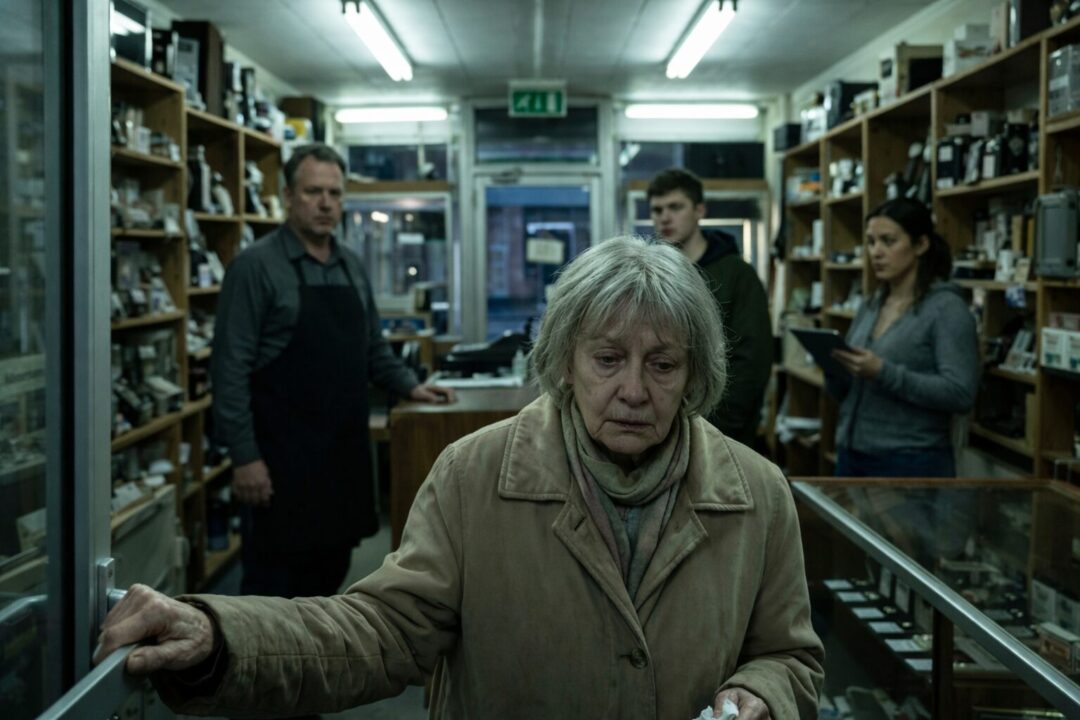
The bell above the door gave a hard metallic jolt as she stepped inside. The sound made everyone look up.
The place smelled faintly of dust, metal, and old air-conditioning. Glass counters ran the length of the room, lined with watches, chains, small gold crosses, and rows of things people had once needed to sell badly enough to part with. Fluorescent lights buzzed overhead. Two customers stood farther down the counter, a young man in work boots and a woman holding a tablet under one arm. Both of them turned, just for a moment, then looked away with the practiced politeness of strangers who did not want to witness another person’s trouble too closely.
Lorraine went straight to the register counter as if hesitation might kill her.
The man behind the glass was broad-shouldered and heavy through the chest, with a dark apron tied over a charcoal shirt. His head was closely shaved, his jaw square, his posture still. He looked like the kind of man who noticed everything and gave away nothing. A jeweler’s loupe sat near his hand beside a tray of rings, a scale, and a small cloth.
Lorraine reached into her coat pocket, pulled out a folded tissue, opened it, and pushed the ring across the glass with more force than she meant to.
“Buy it,” she said. “Right now.”
The words came out harsher than she intended. Not strong. Frayed.
The owner looked down at the ring, then up at her hand.
He didn’t touch it at first.
“Sell anything else,” he said. “Not this.”
The words struck her like a slap.
Heat rushed into Lorraine’s face. She could feel the two people farther down the counter turn back toward them, not openly, but enough. The shame came instantly, hot and familiar. It was the kind that arrived before tears and disguised itself as anger.
“You think I have anything else?” she snapped.
The man said nothing for a beat. Then he picked up the ring carefully, not like merchandise, but like something breakable. He turned it under the light.
Lorraine wished she had never come.
She had not meant for it to become public. She had imagined a number, a nod, cash on the counter, and then she would leave before the transaction could develop a soul. She had counted on indifference. Indifference was easier to survive than scrutiny.
The man raised the loupe to his eye and studied the ring. Lorraine’s fingers curled into her palms so tightly that her nails bit her skin.
“What’s your name?” he asked.
She almost laughed at the absurdity of the question.
“What does that matter?”
“It matters to me.”
She stared at him. “Lorraine.”
He nodded once. “I’m Russell.”
She had not asked.
He tilted the ring again. The stone was small, the band worn thin at the underside, the gold dulled by years of dish soap, hand cream, winter air, and the thousand unnoticed abrasions of a shared life. It was not a rich woman’s ring. It was not the kind that dazzled inside a velvet box. Its value had never lived in the diamond.
Russell lowered the loupe.
“Was this your wedding ring?”
The room seemed to narrow around the question.
Lorraine looked at the ring, then at her own bare left hand. A pale groove still circled the finger where the band had rested for more than forty years. She had only taken it off that morning, and the skin beneath it looked young in a way the rest of her no longer did.
She could have lied. Said it belonged to an aunt. Said she found it. Said it was only gold.
Instead she heard herself answer, quietly now, “Yes.”
Russell’s face did not soften, but something in his stillness changed.
Lorraine hated him for seeing it.
Part II — What Hunger Costs
The truth was that she had not planned to outlive the money.
For thirty-eight years, Lorraine had lived in the same small apartment above a laundromat on Marston Avenue. The wallpaper in the kitchen had curled at the corners since the nineties. The window over the sink stuck in wet weather. The hallway always smelled faintly of bleach and somebody else’s dinner. It had never been much, but it had been theirs.
Her husband, Owen, had worked maintenance at the elementary school four blocks over. He was quiet with everyone else and funny only with her. He fixed everything with patient hands—dripping faucets, broken lamp cords, sagging cabinet doors, children’s bicycles dragged in from the building courtyard by hopeful mothers who knew he could never say no.
He had proposed to her in a park with no ring at all because he couldn’t afford one then. He’d slipped a twist tie from a bakery bag around her finger and promised to replace it when he had enough money.
Three years later, after overtime shifts and months of saving folded into an old coffee tin, he had walked her into a tiny jeweler downtown and bought the ring now sitting in Russell’s hand.
“It’s not fancy,” Owen had said, embarrassed and proud all at once.
Lorraine had laughed and kissed him before he could apologize.
“It’s mine,” she told him. “That makes it fancy enough.”
For decades she wore it without ever thinking she might one day need to measure love against utility. It was there while she chopped onions and folded sheets and stood beside hospital beds. It was there through arguments over bills, through ordinary Tuesdays, through birthdays nobody photographed, through winter illnesses and summer heat and all the durable little invisibilities that made a marriage real.
And then Owen had died in a hospice room with one narrow window and a machine that kept count of everything they were losing.
The final week, when his hands had grown thin and cool, he had reached for her without speaking. Lorraine had leaned over the bed rail, and he had pressed his thumb against the ring on her finger as if memorizing where to find her even after he was gone.
“Keep that on,” he whispered.
She had smiled through tears. “I know.”
“No,” he said, with the last trace of his old stubbornness. “When you think you can’t bear anything else—keep it on.”
At the time, she thought he meant grief.
She had not understood he might also mean poverty.
At first, she managed. There was a modest life insurance payment, a little savings, her Social Security check. But prices rose the way floodwater rises—quiet until suddenly it was around your knees. The pharmacy bill climbed. The rent crept up. The electric company sent warnings in increasingly firm envelopes. Winter had been especially hard. Her heater rattled like a dying engine and still left the rooms cold enough that she wore gloves indoors.
She sold small things first. A silver serving tray she never liked. A lamp from the guest room that no guests had entered in ten years. Owen’s old watch, though that nearly undid her. Then the decent wool coat she only wore for funerals and church, then the spare television, then the box of holiday decorations from the closet.
After that came choices so small they barely felt like choices: one prescription refilled late, then two. Soup stretched over three days. Coffee watered down. Lights switched off before sunset to save pennies.
And still the numbers did not bend.
Two mornings earlier, she had opened the final notice from the utility company and sat down so suddenly the chair legs scraped across the kitchen floor. Disconnection. Five days.
That was when the thought came. Not because she was ready. Because she was cornered.
Now Russell set the ring on the cloth between them and looked at her with unnerving steadiness.
“Why sell it?” he asked.
Lorraine let out a dry, humorless sound.
“Because the power company doesn’t take memories.”
The sentence hung there.
The woman with the tablet lowered her eyes. The young man in boots shifted his weight and studied a display of used speakers with unnatural concentration.
Russell rested both hands on the counter.
“How much do you need?”
Lorraine stiffened. “I’m not asking for charity.”
“I didn’t say you were.”
“I came to sell the ring.”
“You came because you had to.”
The distinction pierced her because it was true.
She looked away first. The fluorescent lights made everything feel harsher than daylight. She wished suddenly, fiercely, that Owen were there—not to save her, not even to speak, but simply to stand near enough that she would not have to feel so singularly exposed.
“It’s all I have left,” she said, and then hated how fragile her own voice sounded.
Russell glanced down at the ring.
Then he pushed it back toward her.
For one terrible second, Lorraine thought he was rejecting it as worthless.
The humiliation cut even deeper than refusal would have.
Her chin lifted on instinct. “Fine,” she said. “Forget it.”
But Russell was already shaking his head.
“No,” he said. “Not fine.”
Part III — The Man Behind the Counter
Russell had been watching people surrender pieces of their lives for seventeen years.
That was what nobody understood about a pawn shop. They thought it was a place full of objects. It was really a place full of thresholds.
Wedding bands that came in after layoffs.
Guitars after divorces.
Tools after injuries.
Necklaces after evictions.
He had learned to read desperation by the way a person set something on the counter. Carefully meant attachment. Casually meant shame. Too fast meant panic.
Lorraine’s ring had hit the glass like a dare.
He had seen enough cons to recognize performance, enough thieves to recognize calculation, enough ordinary damage to recognize the real thing. There had been no greed in her. Only the terrible, stiff-backed posture of someone trying to make a ruin look like a transaction.
And when he asked whether it was her wedding ring, the answer had come from a depth too old to fake.
He looked at the woman standing across from him—her coat too thin for the season, the swollen knuckle on her right hand, the stubborn pride clinging to her like a final garment.
He thought of his own mother, widowed at sixty-one and too proud to let anyone pay for repairs when her hot water heater burst. He remembered finding out only because he noticed she had been boiling kettles on the stove to wash dishes. He remembered the shame in her face when he showed up with a plumber and a checkbook.
People thought dignity lived in self-sufficiency. Russell had learned that dignity often survived inside need like a candle in wind.
He opened the register drawer.
Lorraine blinked. “What are you doing?”
He counted bills without answering. Not dramatically. Not enough to feel theatrical. Just enough to help. Then he closed the drawer, placed the money on the counter beside the ring, and slid both toward her.
“I’m not taking this from you,” he said.
Lorraine stared.
The room seemed to fall silent around them, even the hum of the lights receding for a moment. Her eyes moved from the cash to the ring and back again as if one of them had to be an illusion.
“I said I came to sell it.”
“And I said no.”
She frowned, disoriented, almost angry. “That’s not how this works.”
“Today it is.”
Her lips trembled once, then hardened. “Why?”
Russell shrugged, but there was nothing casual in it.
“Because loss already took enough.”
Something in Lorraine gave way.
Not all at once. Not in a cinematic collapse. First her shoulders dropped, as if she had been physically holding up a wall inside herself and suddenly could not. Then one hand reached for the ring so quickly it looked instinctive, protective. The other hovered over the money, not touching it.
“I can’t…” she whispered.
“Yes, you can.”
“No, I mean—I can’t take this.”
“You can,” Russell repeated quietly. “And you can keep the ring.”
Tears filled her eyes so fast they seemed to surprise her. Lorraine pressed her fingertips to her mouth and looked down, embarrassed by the betrayal of her own face. She had come prepared to surrender an object. She had not come prepared to be seen.
The woman with the tablet turned away completely now, giving her privacy in the only way a stranger could. The young man in boots cleared his throat and stared at the ceiling.
Lorraine picked up the bills as if they might disintegrate. Then she picked up the ring and closed her fist around it so tightly the edges bit into her skin.
Russell reached beneath the counter and handed her the tissue she had brought it in.
That almost broke her more than the money.
She unfolded it with shaking fingers, wrapped the ring carefully, then stopped, unwrapped it again, and slid it back onto her hand.
The motion was slow. Reverent. Final.
When the band settled into its old place, she let out one shuddering breath.
Russell nodded once, as if some balance had been restored.
Part IV — What Remains
He walked her outside because she looked unsteady, though Lorraine would later insist she did not need help.
The late afternoon sun had begun to soften, laying warm light across the sidewalk and the row of parked cars. Palm shadows reached across the pavement in long slants. The city went on around them in the indifferent way cities always do—distant traffic, a bus sighing at the curb, somebody laughing half a block away.
For a moment they stood just beyond the shop window like two people who had exited entirely different lives and found themselves in the same patch of light.
Lorraine looked down at the ring on her hand.
Then at the money.
Then at Russell.
There was still disbelief in her face, but something else had joined it now—something gentler and more destabilizing. Relief, maybe. Or the sudden terror of being treated kindly when you have spent too long bracing for the opposite.
“You don’t even know me,” she said.
Russell folded his arms, not defensive, just awkward under gratitude.
“No,” he said. “But I know what that ring is.”
She gave a broken little laugh through the last of her tears. “Do you?”
He glanced at her hand. “The one thing you were never supposed to have to sell.”
Lorraine closed her eyes.
For the first time since Owen died, the ache of missing him did not feel like an emptiness hollowing her out. It felt like a hand at her back. Not because Russell had replaced anything. No one could. But because, for one impossible moment in a hard fluorescent pawn shop, the world had not treated Owen’s love as a thing to be weighed and priced.
It had treated it as something worth protecting.
She stepped forward before she could talk herself out of it and touched Russell’s cheek with her fingertips, a gesture so instinctive it startled both of them. It was not flirtation. It was not performance. It was the kind of touch mothers used when language failed them.
Then she embraced him.
Russell froze for half a second, then put his arms around her carefully, like a man afraid of crushing something fragile and discovering too late that it needed more strength than softness. Lorraine held on harder than she meant to. She could feel the rough fabric of his apron beneath her palms, the solidity of him, the ordinary human steadiness of a stranger who had refused to make profit from her worst hour.
When she stepped back, her eyes were swollen and bright.
“Thank you,” she said.
Russell nodded, looking faintly embarrassed. “Get your lights back on.”
That made her laugh—a real laugh this time, wet and shaky and alive.
“I will.”
He hesitated, then added, “And if you ever need that ring cleaned, bring it in. Free.”
Lorraine looked at him for a long moment. “I might.”
She started toward the bus stop, then stopped and turned back.
“Russell?”
“Yeah?”
“Owen bought it for me,” she said, lifting her hand slightly. “Took him three years to save.”
Russell smiled then, the first full smile she had seen from him. “Sounds like he knew what he was doing.”
“He did.”
She boarded the bus with the money tucked deep into her purse and her hand curved around the pole, the ring glinting faintly each time the vehicle lurched through sunlight.
The city outside looked no kinder than it had that morning. The rent would still be due. The bills would still arrive. The ache of widowhood would still wake beside her tomorrow like a second body in the bed.
But something had changed.
Need had driven her into that shop. She had entered feeling reduced to what she could surrender. She left with the strange, shaking knowledge that not everything in a hard life could be converted into loss.
That evening, after paying the utility office and stopping at the pharmacy, Lorraine climbed the stairs to her apartment more slowly than usual, but not from exhaustion. The hallway smelled of detergent and onions. Somewhere a television muttered through a thin wall.
Inside, she set her purse on the kitchen table and stood at the sink, staring out at the fading light through the stubborn window. The apartment was still small. The wallpaper still curled. The future was still uncertain.
But when she lifted her left hand, the ring caught the last orange flare of sunset and held it.
Lorraine touched it with her thumb, the way Owen once had in that hospice room.
Keep it on.
She smiled through fresh tears, not because she was no longer afraid, but because fear was no longer the only thing she felt.
Some kindnesses did not solve a life.
They simply returned one piece of it to the person who thought it was gone forever.
And sometimes, in a world that measured everything, that was enough to keep the light burning.