The Man Outside the Glass Doors
The Man Outside the Glass Doors
Part I — The Wrong Kind of Guest
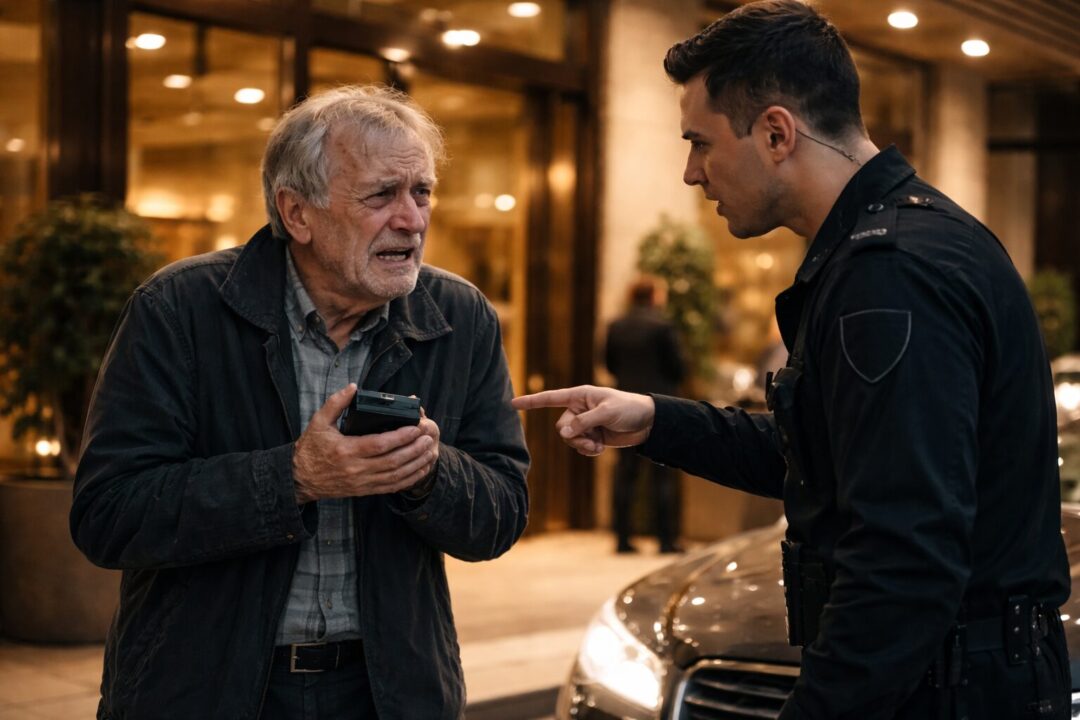
By the time the first black sedan rolled beneath the hotel awning, Edwin Hart was already crying.
Not loudly. Not in a way that asked for comfort. The tears were simply there, slipping down the deep lines in his face as if they had been waiting for an excuse all day. Under the warm gold lights of the Ashbury Grand, with valets hurrying between polished cars and women in evening gowns stepping carefully over the wet curb, Edwin looked like the one thing the hotel was never built to hold: a man who carried his whole life on him, and none of it matched the place.
His jacket was too worn at the elbows. His shoes had gone soft at the sides. His hands, rough and veined and trembling, clutched a small velvet box as if it were something breakable and holy.
“Sir,” the security officer said again, sharper this time. “I need you to hand that over.”
Edwin looked up as though he had only just heard him. The young guard stood square in front of him, broad-shouldered in a dark uniform, one hand near his radio, eyes fixed on the box.
“It isn’t mine,” Edwin said. His voice cracked on the last word. “I was told to bring it down.”
The officer did not move.
Around them, the evening breathed on. Glass doors sighed open and shut. Luggage wheels clicked over stone. Somewhere inside, a string quartet drifted through the lobby in soft, elegant fragments, music meant for people who had never had to apologize for being seen.
The security badge on the officer’s chest read M. Rivas.
“Who told you to bring it?” he asked.
Edwin opened his mouth, then closed it again. The name sat in his throat like shame.
That hesitation cost him.
Officer Rivas stepped forward and took the box from Edwin’s hands. He opened it, frowned, then looked at him with the cool certainty that made older men feel instantly smaller.
“Stay right here.”
“I wasn’t taking it,” Edwin said quickly. “Please. Please, I wasn’t.”
But already the officer had signaled to another guard near the doors. The second man remained by the entrance while Rivas turned back and guided Edwin toward the hood of a parked sedan.
He did not shove him. That would have been easier to hate.
He simply positioned him in the light, in plain view, where the arriving guests could do the rest.
“Empty your pockets.”
Edwin stared at him.
“Now.”
The first thing that came out was a folded handkerchief, washed so many times it had gone thin as paper. Then a bus card. A few crumpled receipts. Two coins. A pack of mints with one left inside. Finally, when his fingers brushed his coat lining, he paused.
“Everything,” Rivas said.
Edwin swallowed and placed a gold wedding band on the hood of the car.
That was when the humiliation became unbearable.
Something changed in the faces of the people watching. Before, he had just been another poor old man who looked lost near a luxury hotel. Now his private life was spread under bright lights for strangers to sort through. A ring. A handkerchief. Transit fare. The tiny evidence of a person who had lived long enough to lose almost everything except the habits of keeping himself together.
Edwin lowered his eyes. His shoulders folded inward.
He could feel them judging the coat. The shoes. The tears. The way he did not speak cleanly enough when frightened. He had known that look since boyhood—the fast, silent calculation people made when they decided what kind of man stood before them.
The kind who belonged.
And the kind who did not.
Inside the hotel, on the third floor, his son was hosting an engagement dinner.
Outside, under the awning, Edwin looked like a thief.
Part II — Things a Father Learns to Hide
It had taken him twenty-three minutes to decide whether to step out of the bus.
He had ridden three stops past the hotel the first time.
At the fourth stop, he had gotten off, crossed the street, waited in the cold, and caught the same route back. Even then he stood on the opposite sidewalk for ten full minutes, staring at the Ashbury Grand as if it were a country that would require papers he did not have.
He had not been invited the usual way. No embossed card. No formal call.
The message came through Lena, a housekeeper who still worked weekends at the hotel and sometimes brought him day-old bread from the kitchen. She had found him sweeping the hallway in his apartment building and said, “Your son left something for you at the desk downstairs.”
It was a note. Just a few lines in clean, hurried handwriting.
Dad, I know this is sudden. I want you there tonight. If you’re uncomfortable coming up, ask for the front desk and they’ll call me. There’s a small blue gift box waiting in the service office—would you bring it up to the Rosewood Suite? It’s for Nora. Please come. — Owen
Edwin had read it six times.
Owen.
Even now, after all these years, the name could split him open.
He still remembered the boy with scraped knees and a secondhand backpack, waiting by the apartment window each night to see whether his father’s bus had turned the corner. He remembered winter mornings when the radiator barely worked, and he’d warm Owen’s socks on the oven door before school. He remembered the years after Ruth died, when every silence in their apartment had sounded like failure.
He remembered, too, the season when Owen had learned embarrassment.
It had not happened all at once. It never does. It came in little flinches. A tighter jaw when Edwin showed up to school in work boots. A quick glance away when classmates noticed his father’s accent. The first time Owen said, “You don’t have to come in,” while standing outside a building where other fathers wore pressed coats and carried leather briefcases.
Edwin had loved him too much to pretend not to understand.
So he made himself smaller.
He took the night shifts. Missed the ceremonies. Waited across the street when picking him up. Learned to celebrate from a distance. Every sacrifice had felt temporary then, part of some invisible bridge fathers built from their own dignity so their children could walk toward a cleaner life.
And Owen had walked.
Scholarships. Law school. Better neighborhoods. Better suits. Better rooms with better light.
Their calls grew shorter. Their meetings rarer. Love remained, but not ease. Edwin never blamed him out loud. Children who climbed often did so by refusing to look down too long.
Still, the note had said Please come.
So Edwin had shaved carefully. Pressed the least-frayed shirt he owned beneath an old iron. Polished shoes too worn to shine properly. Slipped Ruth’s ring from the dish by his bed into his pocket, the way he always did on important days.
At the hotel’s side entrance, a kitchen runner handed him the velvet box and pointed toward the main elevator.
“Rosewood Suite,” the young man said. “Private event.”
Edwin held the box with both hands.
He should have asked someone to escort him.
He should have waited at the desk, as the note said.
But for one brief, dangerous moment, he let himself imagine walking in as a father, not a complication.
He took three wrong turns. Ended up near the ballroom corridor. A woman in formal black passed him, looked twice, and kept walking. Then a staff member asked if he needed help. Then another. Then, somehow, the box was no longer a gift but a question.
By the time security stopped him near the elevator bank, Edwin was already stammering.
By the time they brought him outside, he understood exactly how this would look.
The truth was simple. It was also the least believable story in the world.
Part III — The Son in the Blue Suit
Inside the Rosewood Suite, the speech had just begun when Owen Mercer noticed the empty space by the door.
He had not meant to keep looking for it.
The room was full—investors, colleagues, Nora’s parents, old classmates from a life he had built with discipline and sharp edges. Waiters moved gracefully between crystal glasses and silver trays. Near the center of it all stood Nora, luminous in dark silk, smiling at something her sister had whispered.
The ring box was still missing from the table.
And his father had not come upstairs.
Owen checked his phone again. No new messages.
A thin anxiety began to thread through the polished surface of the evening. He excused himself while Nora’s father was speaking and stepped into the corridor. At first he thought perhaps Edwin had changed his mind and gone home. That would have hurt, but it would have made sense.
Then he saw one of the kitchen porters looking toward the service elevator with an expression that wasn’t casual enough.
“Has there been some issue downstairs?” Owen asked.
The porter hesitated. “Security stopped an older man with a box.”
The sentence seemed to arrive in pieces.
Older man.
Box.
Security.
Owen did not wait for the rest.
He crossed the corridor, took the stairs two at a time, and burst through the lobby doors into the night air just as Officer Rivas said, “Don’t make this worse.”
At first he saw only the arrangement of the scene.
A black car.
Bright lights.
People pretending not to watch.
Then he saw the items spread on the hood.
The handkerchief.
The bus card.
The ring.
And behind them, his father—small, bent, wet-cheeked, trying and failing to keep his hands from shaking.
Owen stopped so suddenly one of the valets nearly collided with him.
For a second he was no longer thirty-four years old in a tailored navy suit. He was twelve again, standing in a grocery aisle while his father counted coins under fluorescent lights, speaking softly so the cashier would not hear the tremor in his voice.
Shame moved through him so fast it felt like heat.
He descended the last two steps.
“What are you doing?”
Officer Rivas turned. “Sir, this man was found with a restricted item connected to a private event.”
Owen looked at the velvet box in the officer’s hand.
Then at Edwin.
His father would not meet his eyes.
It was that, more than anything, that broke him.
Not the tears. Not the spectators. Not even the ring on the hood.
It was the fact that Edwin looked away, as if Owen was one more witness to survive.
“That box,” Owen said quietly, “was meant for me.”
Rivas blinked. “Sir?”
“I asked him to bring it upstairs.”
There was a stillness then, strange and total, as if the entire valet lane had inhaled.
Owen stepped closer.
“And that man,” he said, his voice turning harder now, “is my father.”
No one moved.
The words fell with the force of a door being kicked open somewhere inside the scene. In an instant the whole arrangement changed its meaning. The old man under suspicion was no longer an intruder at the edge of wealth. He was family. He belonged to someone the room recognized. The object in question was not stolen. The accusation was not cautious professionalism. It was public humiliation built on appearance.
Officer Rivas’s posture shifted almost imperceptibly.
“I didn’t have that information,” he said.
“No,” Owen replied. “You had your own.”
The officer looked at Edwin, then at the items on the hood, and finally lowered the box.
An apology was forming. Owen could see it. Thin, procedural, useless.
Edwin spoke before it arrived.
“It’s all right,” he said, though he was still crying. “It was a misunderstanding.”
Owen turned toward him, stunned by the reflex of mercy.
All at once he understood how many such misunderstandings his father had endured in a lifetime. How often Edwin had made himself easier to dismiss so other people could remain comfortable. How often he had accepted injury as the price of not causing trouble.
The realization did not make Owen noble.
It made him ashamed.
Part IV — What Could Not Be Undone
He gathered the items himself.
Not quickly. Not angrily. One by one.
First the handkerchief, folded with care.
Then the bus card.
Then the receipts, smoothed flat before being placed back into Edwin’s coat pocket.
Last came Ruth’s ring. Owen held it in his palm for a second longer than necessary, staring at the gold band worn thin with time.
His mother’s ring.
The one Edwin still carried though she had been gone fifteen years.
When Owen looked up, his father’s face had gone gentler with exhaustion, almost apologetic now, as if the scene had become too burdensome to continue.
“You should go back inside,” Edwin murmured. “Your guests are waiting.”
Owen nearly laughed at the cruelty of that sentence.
Your guests.
As though Edwin himself were not the one person he should have met at the door.
“No,” Owen said.
The word came out low and firm. He slipped the ring into Edwin’s hand and closed his fingers around it.
“No. You’re coming with me.”
Edwin hesitated.
Not because he wanted to leave. Owen could see that now. The longing was there, fragile and almost childlike beneath the humiliation. He hesitated because innocence did not erase what had happened. Because once strangers had seen you reduced, it was difficult to stand upright again simply because the facts had changed.
The crowd had thinned. A few people were still pretending to check their phones. The valets had resumed moving, but with that careful neutrality people used when they knew they had just witnessed something shameful.
Owen took off his coat.
It was instinctive, almost absurd. The night was cool, and the coat was expensive. He placed it around his father’s shoulders anyway, smoothing it there as if the gesture might shield him from the eyes still lingering at the edge of the scene.
Edwin looked startled.
“You’ll be cold.”
“I’ll manage.”
For a moment neither of them said anything. The hotel glowed behind them like another world entirely.
Then Owen did something he had not done in years.
He reached for his father’s elbow, gently, not to steer him like a burden but to accompany him.
And Edwin let him.
They walked toward the glass doors together.
At the entrance, Owen stopped and turned back. Officer Rivas was still there, rigid now in the aftermath of his own certainty.
“You did what you thought your job required,” Owen said. “But next time, ask one more question before you decide who a man is.”
The officer nodded once. He looked as if he wanted to say more, but there was nothing useful left to say.
Inside, the lobby seemed quieter than before, though the music still drifted from upstairs and guests still moved beneath chandeliers in soft currents of color. People looked up as Owen and Edwin entered. A few recognized him. A few recognized the shape of a story without knowing its details.
Nora was waiting at the top of the stairs.
She had come down barefoot, heels in one hand, her face tight with worry. When she saw Edwin in Owen’s coat, she understood enough. She did not ask for an explanation there in the lobby. She simply crossed the marble floor, took Edwin’s trembling hand in both of hers, and said, “I’m so glad you came.”
It was such a small sentence.
It nearly undid him.
The private dinner upstairs never recovered its original shape, and later Owen would be grateful for that. The speeches became shorter. The laughter grew softer, more real. Edwin did not say much. He sat beside Nora’s mother, who kept the conversation on harmless things—the flowers, the pianist, the absurd size of the dessert trays—until his shoulders slowly loosened and some color returned to his face.
Only once did Owen see him touch his pocket to make sure the ring was still there.
Long after the guests had gone, after the last candle had burned low and the hotel staff had begun clearing glasses, Owen stood with his father on the empty terrace outside the suite. The city stretched beyond them in scattered lights.
“I should have come down sooner,” Owen said.
Edwin looked out over the street. “You came.”
It was too generous. Owen knew that.
“I should have met you myself,” he said. “I should have made sure no one—”
He stopped.
No one did that to you.
The sentence would not finish because both of them knew the harder truth: people had done things like that to Edwin all his life. The difference tonight was only that Owen had finally been forced to see it.
His father rested both hands on the terrace rail. The wind lifted a strand of his thinning gray hair.
“When you were little,” Edwin said, “I used to tell myself that if the world was kinder to you than it was to me, then I could bear almost anything.”
Owen stared at him.
“I thought distance was part of the bargain,” Edwin went on. “That maybe a good father was someone who knew when not to embarrass his son.”
The words were spoken gently, without accusation. That made them harder to hear.
Owen’s throat tightened. “You never embarrassed me.”
Edwin did not answer right away.
Below them, a cab pulled up to the curb where the scene had unfolded. New guests stepped out laughing, carrying coats and gifts and expectations. The awning glowed as warmly as ever, innocent as polished stone.
Finally Edwin turned.
“You were young,” he said. “Young people learn from the rooms they want to enter.”
Then, perhaps because the night had already taken enough from both of them, he offered a small, tired smile.
“But maybe they can learn something else too.”
Owen laughed once, helplessly, and wiped at his eyes. He had not cried when his father was being searched. Shock had frozen him then. But here, on the terrace, with the city open below them and the damage no longer deniable, something in him finally gave way.
He stepped forward and embraced his father.
At first Edwin stood stiffly, surprised. Then his hands rose, uncertain and slow, and settled against Owen’s back.
They stayed like that longer than either of them would later describe.
The night could not be rewritten. The hood of the car. The scattered belongings. The instinctive cruelty of a room deciding who belonged. None of it vanished because the truth had finally arrived in a blue suit.
But something else had arrived with it.
Not rescue.
Recognition.
And when Owen walked his father back through the silent lobby an hour later, one hand light at his back, Edwin no longer looked like the wrong kind of guest.
He looked, at last, like a man who had been made to wait too long at the door.