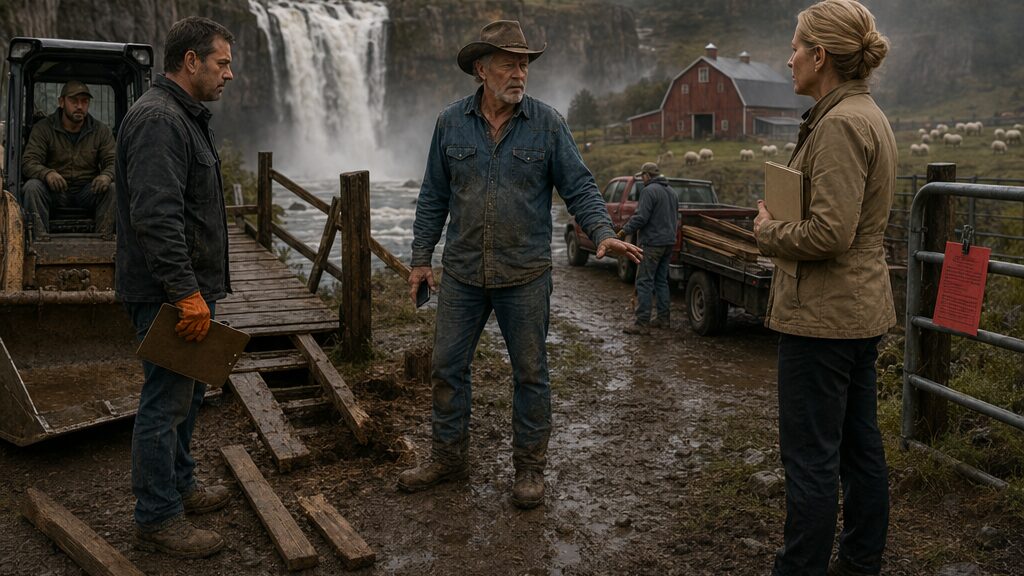
The HOA Sent A Crew To Tear Down The Ramp Beside His Waterfall
Chapter 1: The Machine Was Already At The Ramp
The first board hit the bed of the truck before Stephen Adams reached the gate.
It landed flat with a crack that carried over the roar of the waterfall. For one second, Stephen stood still in the dirt road with one boot half sunk in the soft shoulder, watching a man in orange gloves lift the next board from the ramp he had built with his own hands.
The machine was idling beside the cliff path.
Its bucket hung low, teeth muddy, positioned inches from the last row of posts that held the handrail in place. Below the drop, the waterfall threw white spray into the morning light. Above it, the ramp crossed the narrow rise from the ranch road toward the pump house, not pretty, not fancy, just pressure-treated lumber, galvanized brackets, and railings set at the height Margaret could hold without bending too far.
Half of it was already gone.
“Stop,” Stephen said.
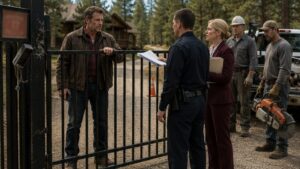
The worker with the board looked toward the machine operator, then toward a man with a clipboard standing near the red truck by the gate. The truck had HOA COMPLIANCE printed on the side in black letters large enough to be read from the barn.
The man with the clipboard lifted one hand. The machine stopped moving, but the engine stayed running.
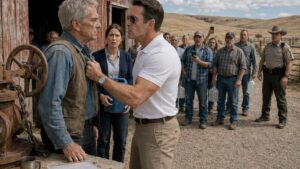
Stephen walked forward without raising his voice. He had left the house without his jacket. His denim shirt was buttoned wrong at the collar, and the old brown hat on his head still had a dark sweat line from yesterday’s fence work. He kept his phone in one hand, camera already open.
A woman stepped from behind the red truck. Stephanie Harris wore a clean tan jacket, dark boots, and the expression of someone arriving after the decision had already been made.
“Mr. Adams,” she said. “You need to remain clear of the work area.”
“That’s my ramp.”
“It is an unauthorized structure.”
“It is on my land.”
“It is inside the High Ridge scenic easement and subject to association review.”
Stephen glanced past her to the gate. A red notice was clipped to the wire with a black binder clip, fluttering in the mist blowing up from the falls. He had not seen it when he came down. He had heard the engine first, then the hard, wrong sound of lumber being pried loose.
“When did that go up?” he asked.
Stephanie did not look at the notice. “You were served.”
“When?”
“This morning.”
“This morning when the crew was already here?”
The clipboard man shifted. “Sir, my name is Ryan Lewis. I’m supervising the removal. We were told the owner had been notified.”
Stephen turned the phone slightly so both Ryan and Stephanie were in frame. “Say that again.”
Ryan’s face tightened. “I said we were told notification had been handled.”
Stephanie took a step forward. “Recording won’t change the violation.”
“No,” Stephen said. “But it might help keep everybody honest.”
Behind them, the waterfall poured through the notch in the cliff, swollen from last week’s rain. The sound had changed over the past month. Stephen knew every voice that water had. Thin summer trickle. Spring flood. Winter sheet. Lately it had begun to pound the rock shelf under the pump house with a low, hollow percussion that told him the bank was giving way beneath the path.
That was why the ramp was there.
Not for visitors. Not for views. Not for some scenic platform, whatever Stephanie had decided to call it in her typed notices. It was there because the old stone steps had pitched sideways, because the handrail had come loose in Stephen’s grip, because Margaret had stood at the kitchen window one afternoon and said she could not get to the storm shelter without feeling the ground move under her feet.
Ryan walked toward the half-removed section. “Mr. Adams, I don’t want anyone getting hurt. Please step back.”
Stephen moved instead to the narrow gap between the machine bucket and the remaining posts. He did not touch the machine. He did not threaten the operator. He simply planted his boots in the mud, close enough that the operator lifted both hands off the controls.
“That ramp stays until I see a court order.”
Stephanie’s mouth pressed into a line. “This is not a court matter. This is an association enforcement action.”
“That’s not the same thing.”
“It is sufficient authority for removal of a non-compliant exterior alteration.”
Stephen looked at the remaining rail. One end hung loose where the worker had cut the bracket. Without it, the slope to the pump house was just wet gravel and exposed roots. He thought of Margaret’s hand on that rail, her fingers curled tight, her breath held until she reached the top.
“You sent a crew onto my property,” he said, “to take apart a safety repair beside a drop-off. I’m asking again. Do you have a court order?”
Stephanie turned to Ryan. “Proceed with what can be removed safely.”
Ryan did not move.
The worker holding the next board lowered it back to the ground.
Stephanie noticed. “Mr. Lewis.”
Ryan looked from Stephen to the waterfall, then to the machine bucket. “He’s standing in the work area.”
“Then ask security to move him.”
The man near the red truck, the one who had been pretending not to listen, straightened. He wore a black jacket with HOA SECURITY on the back. He did not come forward.
Stephen kept the phone steady. “You want to move me from my own access path, you say it clearly on camera.”
Stephanie’s eyes sharpened. “Mr. Adams, you had every opportunity to apply for approval.”
“I did apply.”
“For storm maintenance. Not for a structure visible from common road frontage.”
“It connects to the pump house.”
“It looks like an observation deck from below.”
Stephen gave a short, humorless breath. “Then you were looking from the wrong place.”
Stephanie glanced up toward the cliff, toward the ranch road that curled above the waterfall and disappeared near the red barn. Sheep clustered behind a wire fence, watching the strangers in the way sheep watched everything, with calm suspicion.
“We are not debating aesthetics in the field,” she said. “The board issued its determination.”
“The board can come down here and carry Margaret over that slope themselves.”
Ryan looked at him then, really looked. The worker by the boards stopped pretending to adjust his gloves.
Stephanie’s voice lowered. “Who is Margaret?”
Stephen felt the answer rise and stop behind his teeth.
His wife. The woman who knew every lamb by its markings. The woman who had walked that path for thirty-four years before her lungs started betraying her and her legs stopped trusting uneven ground. The woman inside the house right now, probably still believing he had gone down to check a loose hinge on the gate.
He hated the thought of her name traveling through a board meeting packet, attached to medical language and exceptions. He hated it more than he hated the machine.
“Someone who uses this path,” he said.
Stephanie’s expression changed only a little, but he saw it. Annoyance, maybe uncertainty, quickly covered. “That information was not included in your application.”
“No,” Stephen said.
“Then the association can only act on the request submitted.”
The machine engine vibrated through the ground under Stephen’s boots. Behind him, spray wet the remaining rail until it shone silver. He looked down and saw fresh gouges where the crew had dragged the removed boards toward the truck. One of the post anchors had been pulled clean out of the concrete, leaving a dark hole filling slowly with grit and water.
He had thought he was angry.
Now fear moved under the anger, colder and more precise.
From up at the house, faint over the waterfall, a sound began to pulse. Not the bell on the porch. Not the sheep alarm.
The pump alarm.
Stephen turned toward the red barn, toward the kitchen window hidden beyond it. His phone buzzed in his hand before he could move.
Margaret’s name lit the screen.
He answered without taking his eyes off the broken ramp.
“Stephen,” she said, breath thin and strained. “Why is the pump alarm going off?”
Chapter 2: The Waterfall Was Not The Problem
The warning light above the kitchen sink flashed red against Margaret’s white coffee cup.
Stephen saw it as soon as he pushed through the back door. Flash. Dark. Flash. Dark. A small, heartless rhythm reflected in the window glass, bright enough to show the lines around Margaret’s mouth before he looked directly at her.
She was standing instead of sitting.
That was the first thing that tightened his chest. Her cane leaned against the cabinet by her left hand, but she had one palm flat on the counter and the other pressed against her ribs as if she could hold her breath in place by force.
“Sit down,” he said.
“Don’t start with that.”
“The pump alarm is enough starting for one morning.”
“What did they do down there?”
Stephen crossed to the panel beside the pantry. The lower pasture pump warning was blinking, and the gauge needle trembled close to the yellow band. Not failure yet. Strain. Blockage or pressure loss. Maybe debris against the intake. Maybe vibration from the bank where the crew had pulled the ramp posts.
“They took boards off the path,” he said.
Margaret’s face changed. Not surprise. She had known from his voice on the phone that something was worse than a loose gate hinge.
“How many?”
“Enough.”
“Stephen.”
He opened the drawer where he kept the pump-house keys, though the key ring was already in his pocket. He needed something for his hands. “I stopped them.”
“You stopped them after they started.”
He looked at her then.
She did not say it cruelly. That was the trouble with Margaret. She could place the truth on a table without raising her voice, and it still cut through whatever Stephen had built around himself.
“I’m going down,” he said. “I can reset it from the pump house.”
“On that path?”
“I’ve walked worse.”
“You were thirty when you walked worse.”
“I am not asking the calendar for permission.”
She almost smiled. Almost. Then the alarm pulsed again, and the sound seemed to thin the air in the kitchen. Margaret’s breathing caught. She turned it into a cough, but Stephen saw the way her fingers tightened against the counter.
He crossed to her before she could wave him off. “Use the chair.”
“I am not made of sugar.”
“No,” he said quietly. “You’re made of stubbornness and poor timing.”
This time she did smile, but it did not stay. “That ramp was not just for me.”
“I know.”
“Do you?”
He had no answer that would not become an argument. The ramp had begun as a simple repair. Replace the stone steps, brace the rail, widen the turn by the pump-house door. Then the storm shelter doctor letter sat on the table for three days, and Margaret pretended not to see him reading it twice. Then he measured the grade again and realized the slope was no longer safe for her even with him beside her.
So he made the ramp wider. He made the rail stronger. He poured new anchors. He told himself it was storm maintenance because the pump house needed access and the spillway bank needed reinforcement.
He did not write medical accommodation anywhere on the HOA form.
He hated the phrase.
It made Margaret sound like a condition instead of a person.
The back door opened before he could say anything. Elizabeth came in carrying a paper grocery bag and the hard look she always wore when she had been worried for longer than she wanted to admit.
“There’s a red notice on the gate,” she said. “And a crew truck down by the falls. Tell me I read it wrong.”
“You read it fine,” Stephen said.
Elizabeth set the bag on the table. “They’re removing it?”
“They started.”
Margaret’s head turned sharply. “Started?”
Stephen took the keys from his pocket. “I stopped the machine.”
Elizabeth stared at him. “The machine?”
“They brought equipment,” he said.
“For a ramp?”
“For an unauthorized exterior alteration,” he said, and hated how easily Stephanie’s words came back through his mouth.
Elizabeth went to the window. From there, the waterfall was only visible as white movement beyond the barn roof, but the road down to the gate showed through the cottonwoods. The red HOA truck sat there like a dropped toy against the pasture.
“Where’s your approval file?” she asked.
“In the office.”
“Show me.”
“I need to reset the pump.”
“You need someone to go with you.”
“No.”
“Dad.”
“Elizabeth.”
Margaret moved before either of them could sharpen the next word. She reached for her cane and took one step toward the hall.
Stephen’s voice cracked harder than he meant it to. “Don’t.”
The room went still except for the alarm.
Margaret looked down at the cane, then at him. “This is what the ramp was for.”
He closed his eyes once.
He could still see the gap where boards had been. He could see Margaret’s shoe searching for a stable place on wet gravel. He could see her hand grabbing for a rail that was no longer there.
Elizabeth’s anger shifted. It was no longer aimed only at the red truck by the gate. It moved toward him, confused and hot.
“What did you put in the request?” she asked.
“Storm maintenance.”
“What else?”
“Drainage repair. Access to pump house.”
“And Mom?”
Stephen said nothing.
Margaret’s expression softened in a way that made it worse. “Stephen.”
Elizabeth left the kitchen without asking. He heard the office door open, the scrape of the lower drawer, the slap of folders on the desk. She knew exactly where he kept household paperwork because she had been trying to drag him into the century for ten years.
Stephen turned toward the back door. “I’m going to the pump.”
“I’m coming,” Elizabeth called from the office.
“No, you’re not.”
She came back holding a manila folder and a copy of the HOA application. “You checked the box for routine maintenance.”
“Because it was maintenance.”
“You built a new ramp.”
“I replaced unsafe access.”
“You didn’t include the doctor’s note.”
Margaret lowered herself carefully into the chair at last. The movement was slow, controlled, humiliating only because Stephen knew how much effort she used to make it look ordinary.
“The note was private,” he said.
Elizabeth’s voice dropped. “Private from who? The people trying to tear out what keeps her safe?”
The alarm pulsed again.
Stephen took the file from her hand and saw, paper-clipped to the back, the denial letter he had folded twice and never brought into the kitchen. He had read it standing in the barn, dust floating in the light, one hand on a sack of feed. Denied pending full architectural review. Non-compliant visibility from scenic road. Remove unapproved materials within ten days or face enforcement.
Ten days ago, he had told himself he could fix it quietly.
Elizabeth saw him looking at the letter. “You knew it was final.”
“It wasn’t final.”
“It says remove within ten days.”
“It also says appeal.”
“Did you appeal?”
He looked toward the pump alarm.
Margaret answered for him by closing her eyes.
Stephen walked down to the pump house with Elizabeth after all.
He hated each step because she saw what he had been refusing to name. The missing boards forced him to take the long side of the path, where mud slid under the grass. The severed rail wobbled when he touched it. At the turn by the pump-house door, one anchor hole had filled with water, and the whole remaining section leaned outward toward the drop.
Elizabeth did not say anything.
That was worse than scolding.
He reset the pump, cleared a branch from the intake grate, and checked the lower valve. It took twelve minutes. It would have taken four if the ramp had been whole. When he came back out, Elizabeth stood at the broken edge, looking down at the white rush of water below.
“This isn’t about looks,” she said.
“No.”
“And it’s not only about Mom.”
“No.”
“Then why did you let them think it was?”
Stephen wiped his hands on his jeans. “Because I thought if I kept it ordinary, they’d leave us alone.”
Elizabeth looked at him. “How is that working?”
Before he could answer, his phone buzzed.
An email from the High Ridge Homeowners Association appeared at the top of the screen. Official Notice of Continued Removal. The first line showed in the preview.
Full removal of the unauthorized scenic easement structure will resume in forty-eight hours.
Chapter 3: A Red Truck Stopped Below The Cliff
The red HOA truck came back the next afternoon fast enough to send dust over the sheep road and through the lower pasture fence.
Stephen watched it from the overlook above the waterfall, one hand resting on the loose rail he had braced overnight with two clamps and a length of chain. He had been tightening the last bolt when he heard the engine. By the time the truck stopped below the gate, the sheep had bunched near the barn and the red notice was snapping in the wind like a warning flag.
Stephanie Harris stepped out first.
This time she had brought the security driver and a camera.
She did not walk up the ranch road. She stood at the gate and aimed the camera toward the cliff, toward Stephen, toward the ramp, toward anything that would make sense from below if a person already believed the wrong story.
Stephen wiped his wrench on a rag and looked down at her.
From that angle, he knew what she saw. A man in a hat standing above a waterfall. A rail near the cliff edge. New lumber, bright against old rock. A path that could be made to look like a viewing platform if you cropped out the pump-house door and the warning light and the storm shelter entrance tucked behind the slope.
The waterfall roared between them.
Stephanie lifted her phone. “Mr. Adams, do not perform additional work on the non-compliant structure.”
Stephen raised his voice just enough to carry. “It’s temporary bracing.”
“It is continued construction after notice.”
“It is keeping your crew’s damage from dropping the rest of it into the spillway.”
The security driver looked at the broken section as if he had not thought about where a ramp board went after it came loose beside a waterfall.
Stephanie took another photo.
Stephen felt the old anger rise, the kind that wanted to answer a camera with a gesture, a rule with a dare. Instead he folded the rag and put it in his back pocket.
“If you want to inspect it,” he called, “walk up and inspect it.”
“I can see enough from here.”
“That’s been the problem from the start.”
A second vehicle rolled to a stop behind the HOA truck. Stephen recognized the dark pickup before the driver got out. Patrick King lived below the ridge, where the private road crossed the drainage cut and ran toward three newer houses with painted mailboxes and lawns too neat for the country. Patrick was younger than Stephen by twenty years and had the careful face of a man who always did the math before offering help.
Patrick shut his door and looked from Stephanie to Stephen. “I came because the board packet said there was active construction.”
“There was active removal,” Stephen said.
Stephanie lowered the camera. “Patrick, this is not an open site meeting.”
“I’m a board member.”
“You received the materials.”
“I received photos.” Patrick glanced up at Stephen. “And a complaint about an unauthorized tourist overlook.”
Stephen’s hand tightened on the rail.
The words did not fit the place. Tourist overlook. As if buses had been coming down the sheep road. As if Margaret had been selling tickets from the porch. As if the pump-house path was some scheme he had hidden under lumber and bolts.
“Who told you that?” Stephen asked.
Patrick looked uncomfortable. “It was in the summary.”
“Whose summary?”
Stephanie cut in. “The structure is visible from the scenic easement, and its use was not specified.”
“I specified pump access.”
“You specified storm maintenance.”
“Because the pump keeps the lower road from washing out.”
Patrick looked toward the waterfall then, not at the white water but at the slope beneath the ramp. “Is that why the ditch by my culvert ran brown last rain?”
Stephen did not answer quickly enough.
Stephanie did it for him. “Unpermitted work can destabilize drainage.”
Stephen laughed once, short and sharp. “You’re blaming the brace for the bank it’s holding?”
“I am stating that unreviewed construction creates liability.”
Patrick walked closer to the gate. The red notice brushed against his sleeve. He unclipped it and read the first page. “This says full removal resumes tomorrow morning.”
“Forty-eight hours from the email,” Stephen said.
Stephanie looked at him. “The board has authority to accelerate enforcement if continued work is documented.”
Stephen stared down at her. For a moment, the scene from the little video he knew people would make of this flashed in his mind: red truck below, woman with camera, old rancher above a waterfall, all of it ridiculous enough that strangers might laugh before they understood any of it.
“You want it?” he called down. “Climb up here and take it.”
The security driver’s mouth twitched before he caught himself.
Stephanie did not smile. “That kind of response is exactly why the board has concerns.”
“No,” Stephen said. “The board has concerns because it keeps looking at a repair from the bottom of the hill and calling it something else.”
Patrick folded the notice and clipped it back to the gate, but slower than before. “Stephen, did you submit drawings?”
“I submitted measurements.”
“Medical need?”
Stephen looked away from him.
The waterfall filled the silence.
Patrick understood enough from that silence to lower his voice. “You need to give them everything.”
“I gave them enough to know not to send a machine.”
Stephanie stepped toward her truck. “There will be an emergency board vote tonight to confirm enforcement authority.”
“Tonight?” Patrick said. “I didn’t see that.”
“You will receive the link.”
“That’s not how we usually—”
“We have proxy responses already.”
Stephen felt the ground change beneath him though he had not moved. A proxy vote meant board members had been asked before the confrontation, before Patrick read the notice at the gate, before anyone walked the path or saw the pump-house door.
“How many?” Patrick asked.
Stephanie opened the truck door. “Enough to proceed if the remaining votes align.”
The security driver got in. Dust lifted around the tires before the truck had fully turned.
Patrick stayed by the gate, looking up toward Stephen as if the distance between them had become part of the problem.
“Several board members already voted by proxy,” he said.
Stephen looked at the broken ramp, the clamped rail, the waterfall throwing itself down the cliff as if no committee had ever existed.
For the first time since the crew arrived, he wondered whether standing his ground would matter if the decision had already been made somewhere he had not been allowed to speak.
Chapter 4: The Form That Hid The Deadline
Elizabeth found the denial letter in the bottom drawer of the ranch office, folded behind a stack of feed receipts and clipped to a copy of the application Stephen had sworn was only “pending.”
The word DENIED sat across the second page in square black type.
She stood with the drawer open against her knees, listening to her father and mother speaking low in the kitchen. The pump alarm had been silenced, but the house had not settled. Every pipe seemed to hold its breath. Outside, the waterfall kept up its steady pounding beyond the red barn, louder now that she knew how much of the path beside it had been taken apart.
Elizabeth read the denial twice.
Remove unapproved materials within ten days.
The tenth day had been yesterday.
She took the folder to the kitchen and laid it on the table beside Margaret’s untouched tea.
Stephen looked at it, then looked away.
“You hid this,” Elizabeth said.
Margaret reached for the page before Stephen could stop her. Her hand trembled only once, when she saw the date.
“I didn’t hide it,” Stephen said. “I was handling it.”
“You were handling it by letting a crew show up before breakfast?”
“I filed the request. I called twice. I left messages.”
Elizabeth opened the application. The paper had his neat, blocky handwriting in every blank. He had measured board length, grade, post spacing, drainage angle. He had attached a sketch of the pump-house path with arrows and little notes in the margins. It was careful in the way her father was careful with anything made of wood, wire, or water.
It was also missing the one thing that mattered most.
“You wrote ‘storm maintenance,’” she said.
“It is storm maintenance.”
“You wrote ‘access improvement to pump-house equipment.’”
“It is.”
“You did not write that Mom needs that path to reach the storm shelter. You did not write that her doctor told her not to use the old stone steps. You did not attach the letter.”
Stephen’s jaw tightened. “I wasn’t putting your mother’s medical life into an HOA packet.”
Margaret lowered the denial page to the table. “Stephen.”
He turned to her. “You know how they talk.”
“And now they are talking anyway,” she said.
That stopped him.
Elizabeth saw it land. Not hard enough to break him open, but enough to make him stand still.
She took out her phone. “I’m calling the county.”
Stephen’s eyes snapped back. “For what?”
“For the drainage side. If that spillway bank is unsafe, there may be an emergency exemption.”
“The county won’t move faster than the HOA.”
“We won’t know if we don’t ask.”
He reached for the folder. “This is my property.”
“It’s Mom’s home.”
The room went quiet.
Margaret looked from one to the other, and for a moment Elizabeth hated that she had said it that way. But the truth was already in the room, under the blinking panel, under the folded denial, under the mud Stephen had tracked across the kitchen floor.
Stephen pulled the folder toward him, then stopped. His hand rested on the edge of the paper, thick fingers scarred from work she had watched him do her whole life.
“I thought if I kept it about drainage,” he said, “they’d stay out of the rest.”
Elizabeth’s anger shifted, not disappearing, just turning enough that she could see the fear behind his stubbornness.
“You thought they would respect drainage more than her?”
He did not answer.
Margaret stood slowly. “I’m going to get the letter.”
“I know where it is,” Elizabeth said.
“No.” Margaret’s voice was soft, but it carried. “I will get it.”
She walked down the hall with her cane, each step measured, each tap against the floorboard a small argument Stephen could not win. He looked at the table while she was gone.
Elizabeth called the county drainage office from the porch because the kitchen felt too close.
The clerk who answered sounded tired before Elizabeth finished explaining. She transferred her once, then again, then came back on the line herself.
“Ma’am, if it’s on private association land, the HOA review is separate.”
“It’s a private ranch inside the association boundary,” Elizabeth said. “The repair connects to a pump house and a drainage cut below a waterfall. They’re removing part of it.”
“Removing by owner request?”
“No. By HOA enforcement.”
There was a pause.
“Is active water flow affected?”
“It could be. The bank is unstable. The pump alarm went off this morning after they pulled posts.”
Another pause, longer this time. Papers moved near the phone.
“There is an emergency stabilization provision for drainage structures,” the clerk said. “But you need documentation. Photos, description of immediate risk, and evidence that the work is stabilization, not expansion.”
Elizabeth gripped the porch rail. “What about access?”
“That would be a separate accommodation or safety access issue. If there’s a medical component, include only what is necessary. You don’t have to send full records to everyone, but you need something official.”
Elizabeth looked through the screen door. Margaret had returned to the table with a white envelope. Stephen sat across from her, hat off now, both hands around a coffee mug he had not touched.
“And if the HOA already ordered removal?”
“You need to request an emergency hold in writing. County can’t override private covenants without review, but if removal creates drainage hazard, they should stop until inspected.”
“Should?”
The clerk sighed. “Put everything in writing. Dates matter.”
Dates.
Elizabeth looked at the denial letter again when she went back inside. The deadline had not been hidden in fine print. It had been right there. Stephen had simply decided he could outrun it with phone calls, braces, and pride.
Margaret gave Elizabeth the envelope.
Inside was a short medical letter, plain and restrained. Margaret required stable, railed access to the lower shelter route during severe weather. Uneven stone steps and exposed grade presented a fall and breathing risk. It did not make her sound weak. It made the ramp sound obvious.
Stephen would not look at it.
“You tried to follow the rules,” Elizabeth said, softer now.
He gave a dry laugh. “That supposed to comfort me?”
“No. It means we can show you didn’t just build a tourist deck.”
“That phrase again.”
“Patrick said it came from the summary.”
Stephen leaned back. “Stephanie’s summary.”
“Maybe.”
Margaret slid the letter closer to him. “You don’t have to tell them everything. But you cannot protect me by pretending I don’t need anything.”
Stephen stared at the white envelope as if it were heavier than lumber.
His phone rang.
He almost ignored it, then checked the screen. No name. Local number.
He answered on speaker after Elizabeth pointed at the phone.
“This is Stephen.”
A man’s voice came through low and rushed. “Mr. Adams, it’s Ryan Lewis. I shouldn’t be calling you.”
Stephen sat straighter. “Then why are you?”
“Because tomorrow’s order came through as final removal.”
Elizabeth moved closer.
Ryan continued. “They told my crew the property would be empty when we arrived yesterday. They said the owner had agreed not to be present.”
Stephen’s face went still.
“I never agreed to that,” he said.
“I know that now,” Ryan said. “But somebody wanted us there before you could stop it.”
Chapter 5: When The Road Below Started To Wash Out
The waterfall changed its voice before the rain got heavy.
Stephen heard it from the barn doorway: not louder, exactly, but deeper, a hard drumbeat under the usual white rush. He had heard that sound only a handful of times in forty years, always when water found a new pocket under rock and started arguing with the land about what would hold.
He grabbed his slicker from the nail by the door.
Elizabeth was in the office scanning papers. Margaret was in the kitchen, the medical letter beside her, pretending to read a book she had not turned a page of in twenty minutes. Stephen did not tell either of them what the waterfall had said.
He made it halfway to the pump-house path before the sky opened.
Rain came down in thick sheets, turning the dirt road slick under his boots. The clamps he had placed on the damaged rail shone silver in the dim light. The boards the crew had left loose were stacked under a tarp near the gate, but the holes where the posts had been pulled were already filling with muddy water.
The pump alarm started again.
This time he heard it from outside, thin and frantic through the kitchen wall.
Stephen moved faster.
His boot slid at the first turn. He caught the broken rail by instinct, and it gave six inches before the chain held. For one breath, he hung with his shoulder twisted and the waterfall thundering below him. Spray hit his face, cold as thrown gravel.
“Old fool,” he muttered.
He got to the pump-house door and unlocked it with wet fingers. Inside, the warning light flashed above the control box. Pressure spike. Lower intake strain. He opened the panel, reset the relay, then pulled on gloves and stepped back into the rain to clear the grate.
A branch had wedged across the intake screen, wrapped with weeds and a strip of plastic feed sack. He leaned over the slick concrete lip, one knee braced against the frame, and worked it loose with both hands.
The water surged through the grate so suddenly that the pipe shuddered under his palms.
The whole bank trembled.
He looked down.
The slope below the removed posts had begun to tear away in small brown sheets. Mud slid into the spillway channel, carrying pebbles and grass roots. Not catastrophic. Not yet. But active.
“Dad!”
Elizabeth’s voice came through the rain from above.
Stephen turned too fast and nearly slipped again. She stood at the broken section of path in a hooded jacket, one hand on the temporary rail, eyes wide as she took in the missing boards between them.
“Go back,” he shouted.
“Mom’s not in the kitchen.”
The words cut through the rain cleaner than any alarm.
Stephen pushed past the pump-house door and started up the path.
Margaret was at the top of the slope.
She wore her gray sweater under a raincoat that was not zipped, one hand on her cane, the other on the fence post where the ramp used to begin. Her face was pale, but her eyes were fixed on the small shelter door beyond the pump house, the one set into the bank behind the reinforced path.
“I heard the alarm,” she said.
“You were supposed to stay inside.”
“I heard it twice.”
Elizabeth reached her first. “Mom, don’t move.”
“I know where my feet are.”
Stephen came up from below, breathing hard. “Margaret.”
She looked at him then, and the anger he expected was not there. That was worse. She looked scared and embarrassed that she had been caught being scared.
“If you had fallen,” he said.
“If the pump failed, the lower road would go.”
“If you had fallen,” he repeated, and could not make his voice steady.
Margaret’s hand tightened on the fence post. “This is why I wanted the ramp finished before storm season.”
The sentence hung between them, plain as a nail.
Stephen reached her and offered his arm. She took it, not because she wanted to, but because the mud shifted under her cane and all three of them felt it.
Together, slowly, they got her back to the house.
The phone rang before Stephen had his wet boots off.
Patrick King’s name appeared on the screen.
Stephen answered, still standing on the mat with rain dripping from his sleeves.
“Your ditch just crossed my road,” Patrick said.
Stephen closed his eyes. “How bad?”
“Bad enough that my lower culvert is spitting mud. My wife’s car is on the other side.”
“Stay off it.”
“I figured that out when the gravel started moving.”
Elizabeth took the phone from Stephen’s hand and put it on speaker. “Patrick, can you take pictures?”
“Already am.”
“Send them to me.”
There was wind on Patrick’s end, and water hitting something metal. “I thought your work caused this.”
Stephen opened his eyes.
Patrick continued, quieter now. “That’s what Stephanie said. Unpermitted work, destabilized slope. But I’m standing here looking at water coming from the old channel, not your new brace.”
Elizabeth looked at Stephen.
Stephen wiped rain from his jaw with the back of his hand. “The old channel’s been cutting under that bank for years.”
“Then why didn’t the board know?”
Stephen gave a tired laugh. “Ask the board.”
“I might.”
The call ended with another gust of rain.
For two hours, the house became a place of wet towels, printed pages, phone photos, and controlled panic. Elizabeth spread documents across the kitchen table. Margaret labeled them with sticky notes in her small, exact handwriting. Stephen went back down once more with a rope tied around his waist and Elizabeth watching from the top of the path, jaw clenched hard enough to hurt.
By dusk, the rain eased. The lower pasture gleamed under gray light. The waterfall still roared, but the drumbeat beneath it had softened.
Then an email arrived from the HOA.
Stephanie’s message was brief. The subject line said: Emergency Damage Report. The body stated that the association had received preliminary information suggesting unauthorized construction at the Adams property may have contributed to erosion affecting downstream roads. Pending review, full removal remained scheduled to prevent further liability.
Elizabeth read it aloud once, then stopped.
Margaret’s fingers curled around the edge of the table.
Stephen stood at the window, looking at the path he had not finished because he had been trying to fight quietly.
“I need to give you the rest,” he said.
Elizabeth looked up.
“The doctor’s letter. The pump records. Everything.” He swallowed. “No more half telling.”
Margaret did not smile. She reached across the table and placed her hand over his.
Elizabeth’s phone chimed before she could answer.
A message from Patrick came through with three photos of the washed lower road. Then a fourth image appeared, not from the storm.
It was a scanned memo with an old HOA letterhead.
Patrick’s text followed beneath it.
Found this in archived board files. 2019 drainage review. They knew the spillway was failing before you touched it.
Chapter 6: The Board Called It A Scenic Violation
Stephanie Harris opened the meeting with a photograph of Stephen standing above the waterfall as if the picture itself proved guilt.
The image filled the screen at the front of the HOA office: Stephen in his old hat, one hand on the temporary rail, the broken ramp behind him, white water falling beyond his shoulder. Cropped that way, the pump-house door was invisible. The warning light was invisible. The torn-out post holes were invisible. He looked like a man guarding a view.
Elizabeth sat beside him at the folding table and felt her hands go cold.
The board secretary clicked to the next slide. Red notice on the gate. New lumber. Clamp marks. A close-up of the rail where Stephen had braced it after the crew left.
Stephanie stood near the screen with a folder against her chest. “The issue before us is not whether Mr. Adams believes the work was useful. The issue is whether a visible exterior alteration was installed in a protected scenic easement without approval, and whether continued work creates liability for the association.”
A few neighbors shifted in their chairs. Patrick sat two seats down from Stephanie, arms crossed, watching the slides with a frown that deepened with each cropped image.
Elizabeth glanced at her father.
Stephen had shaved before the meeting. That worried her more than if he had come in mud-splattered and angry. He sat straight, hat on the table in front of him, both hands folded around its brim. The man who had stood in front of a machine had been easier to read. This one was holding himself still with effort.
Stephanie clicked to another photo. “As you can see, the structure resembles an overlook or deck extension.”
“It resembles that because you cut off the pump house,” Elizabeth said.
The room turned toward her.
Stephanie’s eyes narrowed. “You will have an opportunity to speak.”
“She just spoke with a picture.”
Stephen put one hand lightly on Elizabeth’s sleeve. Not a command. A reminder.
Elizabeth stopped.
Stephanie resumed. “The association has no objection to proper maintenance submitted through proper channels. But when owners begin construction first and explain later, we risk setting precedents none of us can afford.”
There it was—the sentence that made some heads nod. Afford. Precedent. Risk. Words that sounded responsible until you put them beside Margaret trying to stand on a washed-out path.
The board secretary invited Stephen to respond.
He stood slowly, carrying only three pages.
Elizabeth had wanted a binder. She had made one. Photos, pump logs, medical letter, drainage maps, emails, denial, Ryan’s call summarized in notes. Stephen had thanked her, then chosen three pages to hold in his own hands.
“I filed wrong,” he said.
The room stilled.
Elizabeth’s chest tightened.
Stephen did not look at her. He looked at Stephanie, then at the neighbors. “I wrote storm maintenance because the bank was failing and the pump-house path needed repair. That was true. It was not the whole truth.”
Stephanie’s expression did not change, but Elizabeth saw her grip tighten on the folder.
“My wife needs a stable, railed path to reach the storm shelter and to move safely near that part of the house during severe weather,” Stephen said. “I did not put that in the first application. I should have.”
A whisper moved through the back row.
He continued before it could grow. “I am not asking this board to discuss her private medical history. I am saying the structure being removed is not a viewing deck. It is access and drainage stabilization.”
Stephanie stepped forward. “No medical accommodation request was submitted before construction began.”
“No,” Stephen said. “It wasn’t.”
Elizabeth felt the damage in that admission. Stephanie could use it. Everyone could hear that.
Then Stephen lifted the second page. “But an emergency drainage concern existed before my work began.”
Patrick uncrossed his arms.
Elizabeth slid copies of the 2019 memo down the table. Patrick took one, then passed the rest along. The board secretary frowned as if paper had started moving without permission.
“This memo,” Stephen said, “was prepared for the association in 2019. It says the waterfall spillway below my pump-house path showed undercutting and should be reinforced before further erosion affected the lower road.”
Patrick held up his copy. “I have a question.”
Stephanie turned. “Patrick, we’re in owner response.”
“I’m asking as a board member. Why wasn’t this in the packet?”
Stephanie paused. “I don’t recall that memo being part of current review.”
“It has our letterhead.”
“It predates my term as president.”
“But not the association’s responsibility.”
A neighbor in the back muttered, “That’s the road that washed last night?”
Elizabeth watched Stephanie’s face then. For the first time all evening, her confidence did not vanish, but it had to work. She rearranged itself in public.
“The memo recommended review,” Stephanie said. “It did not authorize Mr. Adams to build without approval.”
“No,” Stephen said. “It warned you the water was coming.”
The room went quiet enough that the hum of the lights became audible.
Stephanie looked at him. “And yet you began work without submitting complete documentation, which placed the association in a difficult legal position.”
Stephen nodded once. “I did.”
Elizabeth wanted to object, but he kept going.
“But when your crew pulled posts out of wet ground beside that spillway, you made the legal position more important than the ground under it.”
Patrick looked at Stephanie. “Did we tell the crew the owner wouldn’t be present?”
Stephanie’s eyes moved to him sharply. “Operational details were handled by the contractor.”
“Ryan Lewis says his crew was told the property would be empty.”
“I can’t speak to what a contractor understood.”
“You signed the work order.”
The board secretary whispered something Stephanie did not answer.
Elizabeth saw several neighbors lean forward. Not because they suddenly understood all of it, but because the simple story had cracked. It was no longer stubborn rancher versus rules. It was missing memo, cropped photos, medical access, a crew arriving early, a road washing out.
Stephanie closed her folder. “Even if the board agrees to pause and review, all emergency work must be performed under association-approved contractor standards. We cannot have individual owners making structural decisions in protected areas.”
Stephen’s jaw moved once. “The last association-approved action removed half a safety rail.”
“And that is why we need professional review.”
Patrick exhaled. “Then vote to stop removal.”
Stephanie looked toward the screen, where Stephen’s cropped image still stood above the waterfall. “Removal is already scheduled. The board can reconsider if a county emergency hold or proper accommodation request is received before work resumes.”
“Work resumes when?” Elizabeth asked, though she already knew.
Stephanie looked directly at Stephen.
“At sunr
Chapter 7: Stop The Crew Before The Water Turns
Ryan Lewis lowered the machine bucket beside the last support post just as the first light came over the ridge.
The metal teeth stopped a hand’s width above the mud.
Stephen stood on the other side of the post with his phone raised, boots planted where the ramp narrowed toward the pump house. The waterfall below him was gray in the dawn, not white yet, a moving wall of sound in the half-light. Behind Ryan’s machine, two workers waited with pry bars. Behind them, Stephanie Harris stepped out of the red HOA truck with a folder under her arm.
She had come dressed for paperwork. The crew had come dressed for removal.
Stephen had come with a manila envelope tucked inside his jacket.
Ryan leaned out from the cab. “Mr. Adams.”
“Morning.”
“I need you to step clear.”
“No.”
The answer was quiet enough that Ryan looked more tired than angry. He cut the engine. The sudden silence was not silence at all; the waterfall filled the empty space at once.
Stephanie walked up the path from the gate, careful to avoid the wet ruts left by the first removal. “Mr. Adams, we went through this last night.”
“We did.”
“The board authorized completion of removal unless you produced a county emergency order before work began.”
Stephen glanced at the machine bucket. “Work hasn’t begun.”
“The crew is present.”
“That’s not work. That’s an attempt.”
Stephanie’s face tightened. “You are obstructing an authorized contractor.”
Stephen turned the phone slightly so the post, the bucket, Ryan, and Stephanie all stayed in frame. “I’m standing on my access path beside a damaged spillway and asking you not to remove the last safe rail before the county opens.”
“The county office opens at eight.”
“It’s six-twelve.”
“Then you have one hour and forty-eight minutes to stop standing in a work zone.”
Ryan looked away.
Stephen saw that look and held to it. “Ryan, yesterday you told me your crew had been told the property would be empty.”
Stephanie’s eyes moved sharply to Ryan.
Ryan set his jaw. “I said there may have been a misunderstanding.”
Stephen nodded once. “Then understand this clearly. My wife uses this path.”
Stephanie said, “Mr. Adams—”
He took the envelope from inside his jacket.
His fingers did not want to open it. The flap caught on the paper, and for one stupid second he felt ashamed of his own hands, as if they were failing him in front of strangers. Then he saw Margaret in the kitchen before dawn, sitting straight in her chair while Elizabeth helped redact the medical letter with a black marker.
Only what is necessary, Margaret had said.
Not because I am embarrassed. Because they do not get to own all of me.
Stephen unfolded the first page.
“This is a medical accommodation letter,” he said. “It states that Margaret Adams requires stable, railed access to the lower shelter route during severe weather, and that uneven stone steps and exposed grades create a fall and respiratory risk.”
He did not read the diagnosis. He did not read the details Elizabeth had blacked out. He read only the two sentences that mattered.
One of the workers lowered his pry bar.
Stephanie’s expression changed, but not enough. “That was not submitted before construction.”
“No. That was my mistake.”
The admission felt like stepping onto a board he had not tested. He kept his eyes on her.
“I should have sent it. I should have told you the ramp was for more than pump access. I was wrong to think I could keep my wife’s privacy by giving you half the truth.”
Stephanie held out her hand. “I’ll need to review that document.”
“You can have a copy. You don’t get the original.”
“That is fine.”
“And you don’t get to keep removing while you review.”
Her hand stayed in the air for a moment, then dropped. “Medical need does not erase covenant procedure.”
“No,” Stephen said. “But it changes what removal does.”
He took out the second page. “This is the 2019 drainage memo your board had in its files. It says the spillway bank below this path was undercutting and should be reinforced before erosion affected the lower road.”
Ryan looked at the torn ground under the post.
Stephen pointed the phone toward the muddy hole where the crew had pulled the first anchor. “Your crew removed reinforcement from wet ground after that warning existed.”
Stephanie’s voice hardened. “You are making serious accusations.”
“I’m making a record.”
A vehicle came fast up the ranch road, gravel scattering under its tires. Stephen looked past the red truck and saw Elizabeth’s car stop near the gate. She got out with her laptop bag still hanging open, hair pulled back badly, face pale from a night with no sleep.
Margaret was not with her. Stephen had made sure of that.
Elizabeth lifted her phone as she came through the gate. “The emergency hold request is filed. Confirmation timestamp is six-oh-nine.”
Stephanie turned. “Filed with whom?”
“County drainage office and association office. Medical accommodation request sent to the board secretary, you, and the general HOA inbox. Photos attached. Memo attached. Pump logs attached.”
Stephanie took out her own phone.
For a moment, everyone stood waiting for her screen to tell them what kind of morning this would be.
The machine bucket hung above the post. Water ran in thin brown lines around Stephen’s boots. A sheep bleated somewhere near the barn, absurdly ordinary.
Stephanie looked up. “Receipt of an email does not constitute approval.”
“No one said approval,” Elizabeth said. “It constitutes notice.”
Stephen watched his daughter’s hands. They were shaking. She tucked the phone against her chest to hide it, the way he had hidden letters in drawers.
Stephanie looked at Ryan. “Continue with non-structural removal. Do not disturb the ground anchors.”
Ryan did not move.
“Mr. Lewis,” she said.
He climbed down from the machine slowly. “I’m not touching that post with a medical accommodation and drainage hold pending.”
“You have a work order.”
“I have a machine bucket over a support post next to a waterfall and an owner telling me it’s used for storm shelter access.” Ryan looked at Stephen, then back at Stephanie. “If you want me to proceed, I need something higher than an HOA removal notice.”
Stephanie’s face flushed. “The association will not be responsible for contractor delay charges caused by owner interference.”
Stephen almost answered with anger. It came up quick, ready and familiar.
Then he thought of Margaret’s black marker moving across the letter. He thought of Elizabeth standing in the rain watching him reset a pump he could not safely reach alone. He thought of how many days he had spent trying to look unbothered while his house became harder for his wife to live in.
“No,” he said. “The association will be responsible for what it writes down. So write it down.”
Stephanie stared at him.
“Write that you were told about the medical access. Write that you saw the drainage memo. Write that the crew supervisor asked for higher authority before touching the last post. Then sign whatever you still want him to do.”
The security driver shifted near the red truck. Patrick’s pickup appeared beyond him, rolling through the open gate. He got out with his phone pressed to his ear and walked quickly toward them.
“I have the county drainage clerk on the line,” he called.
Stephanie closed her eyes for half a second.
Patrick put the phone on speaker. The clerk’s voice came through small but clear. “This is not a final determination. But based on the emergency submission and photographs, removal of remaining support posts, ground anchors, railing, or drainage-adjacent materials should stop pending review. I’m sending written confirmation now.”
Stephanie said, “The county does not administer our covenants.”
“No, ma’am,” the clerk replied. “But if private enforcement worsens a documented drainage hazard before review, that becomes a separate problem.”
Stephen looked at the last post.
The machine bucket remained above it, useless now. The red notice still hung on the gate. Nothing had been fixed. The ramp was still wounded, Margaret still had to wait, and the board could still find ways to make the next two weeks miserable.
But the machine did not move.
Ryan stepped back from it and lowered the pry bar from his worker’s hand.
Stephen’s phone buzzed. Elizabeth looked down at hers at the same moment.
The county email arrived with a subject line that seemed too plain for what it stopped.
Emergency review pending. Removal must pause until inspection.
Chapter 8: The Ramp Stayed But The Silence Did Not
The red notice came off the gate two weeks later, but the screw holes stayed.
Stephen noticed them after the board secretary unclipped the plastic sleeve and handed him the withdrawal letter. Two small dark marks in the weathered wood. A cleaner square where the paper had protected the gate from dust. Proof that even when a thing was removed, it left an outline.
He folded the letter once and put it in his shirt pocket.
Across the road, the waterfall threw sunlight into mist. The repaired ramp ran beside it with new posts set deeper than his first ones, a corrected drainage lip, and railing sanded smooth where Margaret’s hand would travel. The lumber still looked too bright against the old rock, but it was strong. The county inspector had signed off. The association-approved repair contractor had grumbled, measured everything twice, then admitted Stephen’s original slope had been nearly right.
Nearly.
Stephen had accepted that word without arguing.
Stephanie Harris stood near the gate with a folder held against her side. She had not come in the red truck this time. She had parked her own car below the bend and walked up, boots dusty by the time she reached the ranch entrance.
“The violation is withdrawn,” she said. “The emergency repair is approved subject to the inspection schedule in the letter.”
Stephen tapped the pocket where the paper sat. “I read it.”
“The association will also reimburse the initial removal cost.”
“That was your cost.”
“Yes,” she said after a beat. “It was.”
The words were not an apology. Not fully. But they were not nothing.
Elizabeth stood by the barn with Patrick, comparing pictures of the lower road before and after the new drainage lip had been cut. Patrick’s culvert had held through the light rain that morning. He had already told Stephen twice, in the awkward manner of men who did not enjoy owing anyone anything, that the water ran clear this time.
Margaret watched from the porch.
Stephen knew without looking that she was pretending not to watch too closely.
Stephanie followed his glance. “The board is revising the emergency repair process.”
“That should help the next person.”
“It should.”
“Will it?”
She looked toward the waterfall, where the repaired rail caught the sun. “If people submit complete information.”
Stephen almost smiled. Not because it was funny. Because even now she could not step completely away from the form.
Then she added, quieter, “And if the board stops treating incomplete information as permission to ignore what is obvious.”
He looked at her then.
Her face was tired. The clean certainty she had worn at the first removal was gone, replaced by something more guarded and less polished. She had not been ruined. She had not been chased from office while neighbors cheered. The board had voted to require drainage file review before any future scenic enforcement near active water. Patrick had voted yes. Two members who had sent proxies changed their votes after seeing the memo. Stephanie remained president, though not as comfortably as before.
That, Stephen thought, was probably how real consequences looked most of the time. Not thunder. Not collapse. Just paperwork turned back toward the people who had used it too easily.
“You knew about the old memo?” he asked.
Stephanie looked down at the folder. “I knew there were archived drainage concerns. I did not know the details until Patrick produced the memo.”
“That’s a narrow answer.”
“It’s the accurate one.”
He let that stand.
She opened the folder and removed a copy of the new policy draft. “There will be a separate accommodation form now. Private medical details can go to a designated reviewer instead of the full board.”
Stephen took it.
The paper felt light in his hand. Too light for what it might have saved if it had existed sooner.
“Good,” he said.
Stephanie looked as if she wanted to say more, then decided against it. Maybe restraint was the only apology she had that would not turn into self-defense.
She walked back down the road.
Patrick came over after she left. “Lower road held.”
“I heard.”
“You built the first version pretty close.”
“Nearly right, I’m told.”
Patrick smiled faintly. “That’s high praise from an inspector.”
Stephen looked toward the repaired ramp. “You could have stayed out of it.”
“I tried.”
“That why you sent the memo?”
Patrick’s smile faded. “I thought it was your problem until my road started moving.”
“At least you changed your mind.”
Patrick nodded toward the waterfall. “Water helps with that.”
He left with Elizabeth, both of them heading toward the barn office to send final copies to the county. Elizabeth touched Stephen’s shoulder as she passed. It was quick, but not casual.
Margaret was still on the porch.
Stephen went to her.
She had dressed for the walk before anyone said walk. Blue sweater. Gray coat. Cane in one hand. The other resting on the porch rail, her fingers curved, ready.
“You don’t have to test it today,” Stephen said.
“I know.”
He stepped aside.
She gave him a look. “That was not an invitation to tell me no.”
“I wasn’t.”
“Your face was.”
He held out his arm.
For years, he had tried to make help invisible. He would walk half a step behind her and pretend he was looking at fence wire. He would carry things she could carry so quickly that she could pretend not to notice. He would fix and brace and widen and file under words like maintenance, drainage, access, anything except what it was.
Now he stood beside her in full view of the road, the barn, the gate with its two screw holes, and offered his arm plainly.
Margaret looked at it, then at him.
“This would have been easier if you had done that sooner,” she said.
“I know.”
“I don’t like being discussed in board meetings.”
“I know that too.”
“But I like being trapped in my own house less.”
The words were gentle. They still found their mark.
Stephen nodded.
She took his arm.
They crossed the porch, then the yard, then the start of the ramp. Her cane touched the first board with a soft, solid knock. Stephen felt her weight shift through his sleeve, felt the small pause where the old uneven step used to be, felt her realize it was gone.
The waterfall roared beside them, indifferent and alive.
Halfway across, Margaret stopped. Not because she had to. Because she wanted to.
Below, the lower road curved through pasture toward Patrick’s place, its fresh gravel pale after the rain. Above, the red barn stood with sheep gathered in its shade. At the gate, the notice was gone. Only the holes remained, and even those would weather.
Margaret ran her hand along the rail Stephen had sanded smooth.
“You did good work,” she said.
“The inspector said nearly.”
“The inspector doesn’t know you.”
Stephen looked at the water, then at the ramp, then at his wife standing where he had been afraid to admit she needed to stand.
“No,” he said. “But he read the whole form.”
Margaret laughed once, breathless but real.
They continued to the pump-house door together. Stephen did not hurry ahead. He did not pretend she was walking alone. He stayed beside her, matching her pace while the waterfall kept falling, the ramp held, and the gate remained open behind them.
The story has ended.