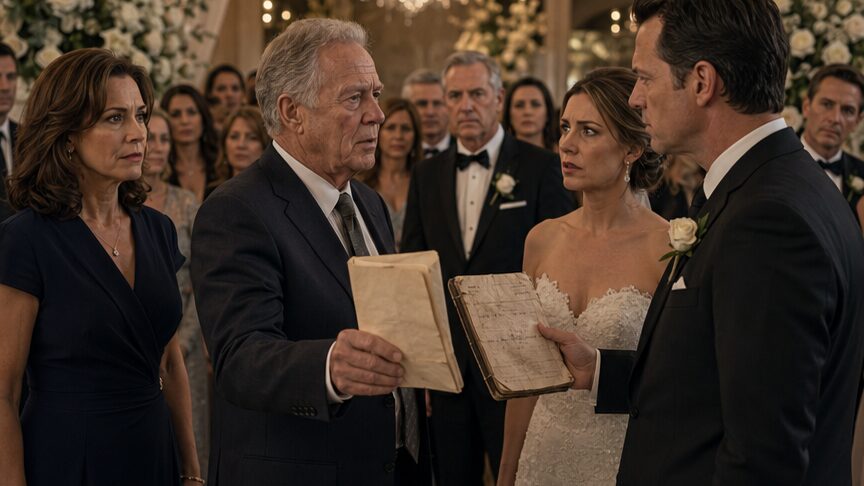
The Will Was Changed Before Her Death, But The Truth Appeared At His Wedding
Chapter 1: The Reading Nobody Expected
Samantha Walker knew something was wrong before Robert Campbell finished the first page.
The conference room was too quiet.
Not respectful quiet. Careful quiet.
The kind of silence people created when they already knew something you didn’t.
Robert sat at the head of the polished table with a folder open in front of him. Mark sat across from Samantha. He wore the expression he always wore when dealing with uncomfortable things—calm, patient, slightly tired, as though everyone else’s emotions were creating unnecessary work for him.
Charles occupied the chair beside Samantha. Her uncle’s hands were folded over the head of a cane he rarely needed but increasingly carried.
The lawyer cleared his throat.
“As outlined in the final will executed on November twelfth—”
Samantha stopped listening.
November twelfth.
The date landed strangely.
Her mother had died six weeks later.
Robert continued reading.
The house.
The savings accounts.
The investment portfolio.
The insurance distribution.
Everything moved smoothly from one sentence to the next.
Everything went to Mark.
Samantha waited.
There had to be another section.
There had to be.
She sat straighter.
Robert turned a page.
Then another.
Still nothing.
No mention of her.
Not one.
For several seconds she wondered if she had somehow missed it.
Then Robert closed the folder.
The room became very still.
Samantha looked directly at him.
“That’s it?”
Robert hesitated.
“That is the document currently governing the estate.”
The words sounded practiced.
Professional.
Carefully neutral.
Her chest tightened.
“You didn’t read my name.”
Mark exhaled quietly.
Not surprised.
Not confused.
Just tired.
Robert folded his hands.
“Your name does not appear as a beneficiary in the final will.”
Final will.
The phrase hit harder than she expected.
Not because of money.
Not because of property.
Because her mother had spent years talking about fairness.
Years.
Margaret Walker had divided birthday gifts equally when her children were adults.
She had worried about appearing to favor one child over another when choosing Thanksgiving seating arrangements.
Fairness was practically a religion.
Now Samantha apparently did not exist.
“You’re saying Mom left everything to Mark?”
Robert nodded.
“The estate is assigned entirely to him.”
Charles shifted beside her.
His jaw tightened.
Samantha stared at her brother.
Mark finally looked up.
“It wasn’t my decision.”
She laughed once.
The sound surprised even her.
“No. Apparently it was Mom’s.”
Nobody answered.
Robert slid a copy of the will toward her.
The paper felt heavier than it should.
Her eyes moved to the signature.
Margaret Walker.
November twelfth.
The signature looked familiar.
But somehow not.
The letters wandered.
Slightly shaky.
Nothing dramatic.
Just enough to bother her.
“Why November?” she asked.
Mark rubbed his forehead.
“Samantha—”
“No.”
She kept staring at the page.
“Why then?”
Robert answered.
“That was the date the revised document was executed.”
Revised.
Not created.
Revised.
“So there was an earlier version.”
Robert nodded carefully.
“There was.”
Samantha looked up.
“May I see it?”
Mark immediately spoke.
“I don’t see why that matters.”
The speed of the response made her turn toward him.
For the first time all afternoon, she saw something other than patience.
Tension.
Small but visible.
Charles noticed it too.
“I think it matters quite a bit.”
Mark leaned back.
“The final document is the legal document.”
Charles ignored him.
“Show her the earlier version.”
Robert hesitated.
Then reached into another folder.
A second document appeared.
Older.
Three years old.
Robert slid it across the table.
Samantha opened it.
And immediately saw her name.
Equal division.
Fifty percent to Samantha.
Fifty percent to Mark.
Exactly what she expected.
Exactly what made sense.
She looked back at the newer version.
Then at the older one.
The difference felt impossible.
“What changed?”
Mark answered before Robert could.
“Mom changed her mind.”
The words landed flat.
As if he had rehearsed them.
Samantha stared at him.
“About her daughter?”
Mark’s expression hardened.
“About her estate.”
The distinction felt deliberate.
The room grew quiet again.
She remembered phone calls during Margaret’s illness.
Conversations cut short.
Visits that became difficult to arrange.
Mom’s increasing confusion.
The time Margaret forgot the year.
The afternoon she called Samantha twice because she couldn’t remember the first conversation.
Small moments.
Nothing she had wanted to make into a bigger issue.
Because conflict exhausted her.
Because illness was painful enough.
Because she trusted her brother.
Now every avoided question returned.
“When was the previous version replaced?”
“November twelfth,” Robert said.
“The same day.”
Six weeks before death.
The thought would not leave her.
Charles suddenly leaned forward.
“Who was present?”
Robert looked uncomfortable.
“The attorney who drafted the revision. Two witnesses.”
“Family members?”
“No.”
“Mark?”
Robert paused.
“Mr. Walker transported his mother to the appointment.”
Silence.
Samantha slowly turned toward her brother.
Mark’s jaw tightened.
“I drove her.”
“How often were you taking her places by then?”
“Frequently.”
“Without telling me?”
“I wasn’t required to report every doctor’s appointment.”
The answer came too fast.
Too defensive.
Charles tapped the table.
“Was this a doctor’s appointment?”
Mark looked away.
Nobody spoke for several seconds.
Finally Robert said, “The drafting attorney handled the execution according to procedure.”
Procedure.
Another cold word.
Another legal answer.
Samantha gathered both copies of the will.
Her hands felt strangely steady.
Inside she felt anything but steady.
She thought of the last Christmas with her mother.
Margaret laughing at old photographs.
Margaret asking Samantha to keep a ceramic angel that had belonged to her grandmother.
Margaret saying, “One day you’ll both have enough reminders of me to get tired of seeing my face.”
That woman had not erased her daughter six weeks before death.
At least Samantha couldn’t believe she had.
Not yet.
The meeting ended shortly afterward.
Robert explained timelines.
Paperwork.
Estate administration.
None of it mattered.
Outside, the afternoon sun felt too bright.
Charles followed her toward the parking lot.
She stood beside her car without opening the door.
For a long moment neither spoke.
Then Charles reached into a worn leather satchel.
He removed a small spiral appointment calendar.
The cover was faded blue.
Samantha recognized it instantly.
Her mother’s handwriting lived inside those pages.
Margaret wrote everything down.
Every lunch.
Every church meeting.
Every doctor’s visit.
Everything.
“Where did you get that?” Samantha asked.
“Your mother’s desk.”
He handed it to her.
“I picked it up after the funeral.”
She opened it carefully.
Margaret’s familiar writing filled the pages.
Appointments.
Phone numbers.
Notes.
Life.
A life reduced to ink.
Charles pointed to November.
Specifically to the week before the will changed.
Samantha studied the entries.
Then frowned.
Then looked again.
Something didn’t fit.
Several days had been crossed out.
Entire appointments missing.
Rewritten.
Moved.
The handwriting looked rushed.
Unlike Margaret.
Charles watched her expression.
“That’s why I kept it.”
“What am I looking at?”
His eyes remained fixed on the page.
“The timeline.”
Samantha looked up.
“The timeline for what?”
Charles took a slow breath.
Then said the words that followed her all the way home.
“Because none of this happened the way Mark says it did.”
Chapter 2: Six Weeks Before Everything Ended
The calendar lay open across Samantha’s kitchen table before sunrise.
Coffee cooled beside it untouched.
She had spent three hours staring at November.
Three hours looking for something she could name.
Something concrete.
Instead she found uncertainty.
Margaret’s handwriting filled every page.
Church meetings.
Grocery lists.
Hair appointments.
Doctor visits.
Then suddenly, during the final weeks, the pattern changed.
Entries became uneven.
Messier.
Several appointments disappeared.
Others appeared in different ink.
The changes might mean nothing.
Or everything.
Samantha hated not knowing which.
Her phone rang.
Charles.
“You still awake?”
“I never slept.”
“Good.”
She laughed weakly.
“That’s not usually how people answer that.”
“I found something.”
Now she sat up.
“What?”
“Come by.”
“Now?”
“Now.”
Forty minutes later she was sitting across from him in his den.
Photographs covered the walls.
Family reunions.
Fishing trips.
Birthdays.
Margaret appeared in dozens of them.
A constant presence.
Charles set several sheets of paper on the table.
Copies.
Phone records.
Appointment confirmations.
Handwritten notes.
Samantha stared.
“How long have you been collecting this?”
Charles looked embarrassed.
“Since October.”
“What?”
He rubbed his neck.
“I started worrying.”
“You never told me.”
His expression darkened.
“You didn’t want to hear it.”
The answer stung because it was true.
For months she had avoided difficult conversations.
Every concern about Margaret’s memory came with a comforting explanation.
Age.
Stress.
Medication.
Grief.
Anything except something serious.
Anything except conflict.
Charles pointed at the calendar.
“Look at November third.”
Samantha did.
A cardiology appointment.
Crossed out.
Rewritten.
November fifth.
“Mom missed that?”
“According to Mark.”
Charles slid another paper forward.
Appointment confirmation.
Attended.
November third.
Samantha frowned.
“What?”
“The office confirmed she was there.”
A chill moved through her.
One discrepancy.
Not proof.
But not nothing.
Charles continued.
“Now look at November sixth.”
Another entry.
Crossed out.
Family dinner.
Mark had told everyone Margaret wasn’t feeling well enough to attend.
Charles handed her another paper.
A church volunteer sign-in sheet.
Margaret’s signature.
November sixth.
Present.
Samantha stared.
“What are you saying?”
“I’m saying things don’t line up.”
The words echoed what she already feared.
Not evidence.
Patterns.
Questions.
The kind that multiplied.
Not the kind that disappeared.
By afternoon she was driving home with copies of everything.
At a red light her phone buzzed.
Mark.
She considered letting it go.
Then answered.
“What?”
A pause.
Then, “That’s a nice greeting.”
“What do you need?”
His voice remained calm.
Too calm.
“Charles has been talking to you.”
“He doesn’t have to talk. The will talks.”
Silence.
Then a sigh.
“You’re doing exactly what I hoped you wouldn’t.”
“And what is that?”
“Turning grief into a conspiracy.”
The word angered her more than it should.
Conspiracy.
As though she were imagining things.
As though her disappearance from her mother’s will were a misunderstanding.
“You never told me there was a new will.”
“You never asked.”
The answer stopped her.
Not because it was convincing.
Because it contained a tiny piece of truth.
She had not asked enough questions.
Had not pushed.
Had not challenged.
Conflict avoidance suddenly felt less like kindness and more like surrender.
“You could’ve told me.”
“I didn’t know how.”
For the first time his voice sounded tired.
Genuinely tired.
“I spent three years taking care of her.”
Samantha closed her eyes.
There it was.
The resentment.
Not new.
Just finally visible.
“You think I don’t know that?”
“I think nobody knows what it was actually like.”
Traffic started moving.
She pulled forward slowly.
“Then tell me.”
But he didn’t.
Instead he said, “Mom made her decisions.”
And ended the call.
That evening Samantha returned to the calendar.
She began building a timeline.
Appointments.
Calls.
Visits.
Dates.
Patterns.
By midnight a strange picture emerged.
During Margaret’s final two months, Mark appeared almost everywhere.
Transportation.
Meetings.
Errands.
Medical visits.
Church events.
Nothing illegal.
Nothing dramatic.
Just presence.
Constant presence.
Samantha remembered living three hours away.
Remembered trusting updates.
Trusting summaries.
Trusting her brother.
A sharp knock interrupted her thoughts.
She opened the door.
Charles stood there holding an envelope.
“I thought you’d still be awake.”
She took it.
“What is it?”
He smiled grimly.
“Another reason Mark isn’t happy.”
Inside was a wedding invitation.
Heavy cream-colored cardstock.
Elegant lettering.
Mark Walker and Lisa Harris request the honor of your presence.
Two weeks away.
Samantha looked up.
“He invited us?”
“Apparently.”
She stared at the date.
The timing felt surreal.
Estate questions on one side.
Wedding plans on the other.
Life moving forward while the past refused to stay buried.
Charles watched her carefully.
“You going?”
“I don’t know.”
“Yes, you do.”
She looked down at the invitation.
At the smiling engagement photograph printed inside.
Mark looked happy.
Lisa looked happy.
Everything looked normal.
That somehow made it worse.
Charles moved toward the door.
Before leaving, he paused.
“One more thing.”
“What?”
He pointed toward the calendar on her table.
“Keep following November.”
“Why?”
His expression hardened.
“Because whatever happened started before the will changed.”
After he left, Samantha opened the calendar again.
She turned to the week before November twelfth.
And noticed something she had somehow missed.
Three consecutive entries.
Same initials.
No explanation.
Just letters.
Repeated three times.
Margaret never used initials without a reason.
Samantha stared at them until midnight.
Wondering who they belonged to.
Wondering why they appeared only during the final weeks.
Wondering what else her mother had tried to leave behind.
Chapter 3: The Wedding Interruption Nobody Saw Coming
The ceremony had already begun when Samantha arrived.
Rows of white chairs stretched across the garden lawn.
Music floated through the warm afternoon air.
Guests smiled.
Photographers moved quietly between flower arrangements.
Everything looked beautiful.
Everything looked wrong.
Samantha sat near the back.
Charles beside her.
The appointment calendar rested inside her handbag.
The revised will sat folded beside it.
Two objects that had followed her everywhere for nearly two weeks.
Ahead, Mark stood beneath a floral arch.
Confident.
Relaxed.
Waiting for Lisa.
He looked exactly like a man beginning a new life.
Not like a man trapped inside questions he refused to answer.
The ceremony started.
Lisa walked down the aisle.
Guests rose.
Samantha did too.
For a moment she tried to focus on the wedding itself.
On the promises.
The vows.
The future.
But every time she looked at Mark she remembered November twelfth.
The signatures.
The missing inheritance.
The unanswered timeline.
When the ceremony ended, applause swept through the crowd.
People laughed.
Photographs began.
Champagne appeared.
The celebration moved toward the reception lawn.
And for a brief moment Samantha thought perhaps nothing would happen.
Perhaps Charles would keep his promise to wait.
Perhaps today would remain a wedding.
Then she saw him.
Her uncle walking across the grass carrying a leather folder.
Not rushing.
Not hesitating.
Moving with deliberate purpose.
Straight toward Mark.
“Oh no,” Samantha whispered.
Guests turned.
Photographers lowered cameras.
Something in Charles’s expression made people notice.
Mark saw him too.
The smile disappeared from his face.
“Uncle Charles,” he said quietly.
Charles stopped a few feet away.
“You picked an interesting month to get married.”
Several guests exchanged confused looks.
Lisa stepped closer.
“Charles?”
But he was looking only at Mark.
“You want to tell everyone what happened six weeks before your mother died?”
The garden fell silent.
Samantha felt every eye turning.
Mark’s jaw tightened.
“Not here.”
“Why not here?”
Charles opened the folder.
Removed a copy of the revised will.
The paper fluttered slightly in the breeze.
“Seems like a good place for family truths.”
Lisa stared.
“What is he talking about?”
Nobody answered.
Mark stepped forward.
“Give me that.”
Charles pulled the document back.
“No.”
The single word carried enough force to stop him.
Guests were openly watching now.
The bride’s family.
Friends.
Relatives.
Complete strangers.
All witnessing something they didn’t understand.
Mark lowered his voice.
“You’re embarrassing yourself.”
“No,” Charles said. “I’m embarrassing you.”
Samantha felt her stomach knot.
This was exactly what she had wanted to avoid.
Exactly why she had spent months staying quiet.
Yet she couldn’t move.
Couldn’t stop it.
Because part of her needed to hear what happened next.
Charles held up the document.
“Your mother changed her will six weeks before she died.”
Murmurs spread immediately.
Lisa turned sharply toward Mark.
“What does that mean?”
“It means nothing.”
His answer came too fast.
Charles smiled sadly.
“That’s not true.”
The old man reached into the folder again.
This time he removed a photocopy of Margaret’s calendar.
The visual contrast was striking.
The formal legal document.
The worn handwritten calendar.
Paper versus memory.
Law versus life.
“Your mother wrote down everything,” Charles said.
“Stop,” Mark warned.
Charles ignored him.
“You keep saying she changed her mind.”
Mark took another step forward.
“Because she did.”
The words hung in the air.
For several seconds nobody moved.
Then Samantha heard herself speak.
The question arrived before she fully decided to ask it.
“When exactly was it signed?”
Every head turned toward her.
Mark looked stunned.
Not because of the question.
Because of who asked it.
Samantha stood slowly.
Holding his gaze.
“When exactly was it signed?”
The garden remained silent.
Robert Campbell appeared near the reception entrance.
Drawn by the commotion.
His expression immediately darkened when he saw the documents.
“It was executed November twelfth,” he said carefully.
Samantha nodded.
Then opened the calendar.
Found the page.
Raised it.
“What happened on November eleventh?”
Nobody answered.
She wasn’t expecting one.
Not yet.
The question was for everyone else.
For the witnesses.
For Lisa.
For Mark.
For herself.
A question bigger than the date itself.
Because now people could see the gap.
Could see there was a timeline.
Could see the story wasn’t finished.
Lisa looked between them.
Confused.
Shaken.
“What happened?”
Mark rubbed his face.
Nothing about him looked confident anymore.
Finally he said, “Mom knew what she wanted.”
Charles answered immediately.
“Did she know what year it was?”
The question struck the crowd like a physical thing.
Several guests gasped.
Lisa stared.
Mark’s face drained of color.
And for the first time Samantha saw something beyond defensiveness.
Fear.
Not fear of losing money.
Fear of losing control of the story.
Robert stepped forward.
“This isn’t the place.”
“Maybe it is,” Charles said.
Robert looked at Samantha.
Then at the calendar.
Then at the will.
And something changed in his expression.
Not agreement.
Recognition.
As if he suddenly understood why they wouldn’t let this go.
The silence stretched.
Finally Lisa spoke.
Softly.
“What aren’t you telling me?”
Mark opened his mouth.
Closed it.
No answer came.
The celebration around them had stopped entirely.
A wedding transformed into a family reckoning.
And yet Samantha still didn’t know the truth.
Only that the official version was no longer standing alone.
As guests slowly drifted away, whispering among themselves, Robert approached Samantha.
His voice remained low.
Professional.
Controlled.
“There was a medical evaluation.”
Samantha looked up sharply.
“A what?”
“Three days before the will was signed.”
The world seemed to narrow around those words.
Charles turned immediately.
“So there was concern about competency.”
Robert’s silence answered before he did.
Samantha gripped the calendar tighter.
“What did the doctors say?”
Robert looked toward Mark.
Then back at her.
“I think that’s the question you need answered next.”
Chapter 4: The Appointment Hidden In Plain Sight
The evaluation report sat in Samantha’s lap while she waited in the clinic lobby.
The receptionist had already told her twice that medical records could not simply be handed over.
She knew that.
She also knew Robert Campbell would never have mentioned an evaluation unless he believed it mattered.
A week had passed since the wedding.
A week of phone calls.
Requests.
Forms.
Delays.
And one uncomfortable realization.
The moment the wedding confrontation ended, people had stopped treating her like a disappointed daughter and started treating her like someone asking dangerous questions.
The nurse finally appeared.
“Ms. Walker?”
Samantha stood immediately.
The woman led her into a small office.
No decorations.
No warmth.
Just a desk and two chairs.
The nurse sat down.
“I can’t discuss everything.”
“I understand.”
“But I can explain what certain notes mean.”
That was more than Samantha expected.
She slid a copy of the evaluation summary across the desk.
A single sentence had been highlighted.
Cognitive concerns noted. Follow-up recommended.
“How serious is that?” Samantha asked.
The nurse studied the page.
“It depends.”
“On what?”
“The patient.”
The answer frustrated her.
The nurse seemed to recognize that.
She leaned back slightly.
“Memory problems aren’t all the same.”
“Could someone with memory problems sign legal documents?”
“Sometimes.”
The uncertainty returned.
Every answer seemed to create another question.
“Could someone forget what year it was?”
The nurse looked up.
Now her expression changed.
Not dramatically.
Just enough.
“Did your mother do that?”
Samantha hesitated.
“Several times.”
The nurse remained silent for a moment.
Then said carefully, “That would concern me.”
A small payoff.
Not proof.
But confirmation.
Something real.
Samantha pressed forward.
“The evaluation was three days before the will changed.”
The nurse’s eyes moved to the date.
November ninth.
Then she looked back at Samantha.
“I wasn’t present during the legal signing.”
“I know.”
“But if you’re asking whether concerns existed…”
She tapped the page.
“They clearly did.”
Samantha swallowed.
For weeks everyone had spoken in absolutes.
Mom changed her mind.
The will is legal.
Everything was proper.
Now for the first time someone acknowledged uncertainty.
The nurse lowered her voice.
“Families often want simple answers.”
“Do they get them?”
“No.”
The answer stayed with Samantha long after she left.
Outside, she sat in her car staring at Margaret’s calendar.
The initials still bothered her.
Three entries.
Same letters.
Repeated.
No explanation.
Her phone buzzed.
Charles.
“What happened?”
“She confirmed there were concerns.”
“Concerns aren’t enough.”
“I know.”
Silence.
Then Charles said, “Come over.”
“Another clue?”
“Maybe.”
Forty minutes later Samantha sat at his dining table.
Charles had spread documents everywhere.
Phone bills.
Copies of calendar pages.
Appointment confirmations.
The investigation no longer looked accidental.
It looked methodical.
“What’s this?” she asked.
Charles pointed to a receipt.
Then another.
Then a third.
All from the same office building.
Different dates.
November sixth.
November eighth.
November twelfth.
Samantha frowned.
“What’s there?”
Charles pushed a business card across the table.
An attorney.
Not Robert Campbell.
A different attorney.
The attorney who drafted the revised will.
Samantha stared.
Three visits.
Not one.
Three.
Mark had always described the change as a single appointment.
A simple decision.
Now that story looked incomplete.
“Mom went there multiple times?”
“Looks like it.”
“Or Mark did.”
Charles nodded.
Neither possibility felt good.
Samantha picked up the calendar.
Turned to November.
Then suddenly stopped.
The initials.
The mysterious initials.
They matched the attorney’s name.
Not exactly.
But close enough.
Three meetings.
Three calendar entries.
Three unexplained initials.
The realization sent a chill through her.
Margaret had written them down.
Why?
As reminders?
Appointments?
Warnings?
Charles watched her expression.
“What?”
She pointed.
“The initials.”
He looked.
Then slowly sat back.
Neither spoke for several seconds.
Because the implication was obvious.
Margaret knew these meetings mattered.
The question was why.
A knock interrupted them.
Unexpected.
Charles frowned and opened the door.
Lisa stood outside.
Alone.
The new bride looked exhausted.
Not angry.
Not defensive.
Just tired.
“Can I come in?”
Nobody answered immediately.
Finally Charles stepped aside.
Lisa entered carefully.
Her eyes found Samantha.
“I need to ask something.”
Samantha folded her arms.
“What?”
Lisa looked down.
Then back up.
“Why didn’t anybody tell me there was a medical evaluation before the wedding?”
The room went silent.
Because it wasn’t an accusation.
It was a genuine question.
And for the first time Samantha realized Lisa might not know much more than she did.
An hour later, after a long conversation, Lisa stood to leave.
At the door she hesitated.
Then turned.
“Mark met with that attorney more than once.”
Samantha froze.
“How do you know?”
Lisa looked uncomfortable.
“I drove him there once.”
The room became very still.
“When?” Charles asked.
“Early November.”
“Why?”
Lisa shook her head.
“He told me it was paperwork.”
“What kind of paperwork?”
“I never asked.”
The answer sounded painfully familiar.
Another person avoiding conflict.
Another person choosing trust.
Lisa reached into her purse.
Pulled out a folded piece of paper.
“I found this after the wedding.”
She handed it to Samantha.
A meeting confirmation.
Attorney appointment.
November eighth.
Margaret Walker.
Accompanied by Mark Walker.
Lisa left moments later.
The house felt different after she was gone.
The confirmation lay on the table beside the calendar.
Another piece.
Another date.
Another crack in the official story.
Charles stared at it.
Then said quietly,
“Now we know who arranged the meetings.”
Chapter 5: The Brother Who Was Always There
The phone records arrived on a Tuesday morning.
Samantha almost left them unopened.
Almost.
The thick envelope sat beside her coffee for twenty minutes before she finally tore it open.
Pages spilled across the table.
Numbers.
Dates.
Times.
Nothing emotional.
Nothing dramatic.
Just evidence.
The kind that looked boring until it wasn’t.
By noon she had highlighted dozens of calls.
Most involved Margaret.
Some involved medical offices.
Others involved the attorney.
One number appeared repeatedly.
A financial institution.
She circled it.
Then called Charles.
“I think Mom’s accounts changed before she died.”
An hour later they sat together again.
The papers spread between them.
A puzzle neither fully understood.
Charles pointed toward a cluster of calls.
“Look at the frequency.”
Samantha did.
Late October.
Early November.
Call after call.
Long conversations.
Then nothing.
The pattern stopped immediately after the will revision.
As though some project had been completed.
The thought made her uneasy.
Not because it proved anything.
Because it suggested purpose.
Mark hadn’t been drifting through those final weeks.
He had been doing something.
The question remained what.
Her phone suddenly vibrated.
Mark.
For a moment she considered ignoring him.
Then answered.
“What now?”
His laugh carried no humor.
“You’ve gotten rude.”
“Maybe I’ve gotten tired.”
Silence.
Then, unexpectedly, he said, “Meet me.”
The request caught her off guard.
“Why?”
“Because I’m sick of talking through other people.”
An hour later she met him at a small diner halfway between their homes.
Mark looked older than he had at the wedding.
Tired.
Drawn.
The confidence remained, but cracks showed now.
He sat down across from her.
Neither touched the menus.
Finally he spoke.
“You think I stole something.”
“I think something happened.”
“That’s not an answer.”
“No. It’s the truth.”
Mark stared at the tabletop.
For a moment he seemed to search for words.
Then he surprised her.
“You know what everybody forgets?”
She said nothing.
“I was there.”
The words emerged quietly.
“Every day.”
Samantha felt herself stiffen.
Here it was again.
The resentment.
Not new.
Just no longer hidden.
“I know.”
“No, you don’t.”
His voice sharpened.
“When she woke up confused at two in the morning, I was there.”
He looked away.
“When she forgot how to use the microwave, I was there.”
The anger faded.
Something heavier replacing it.
“When she stopped recognizing neighbors, I was there.”
Samantha looked down.
Because she had not been there.
Not enough.
Three hours away.
Weekend visits.
Phone calls.
Excuses.
Her guilt stirred immediately.
Mark noticed.
And pressed harder.
“You think this is about greed.”
“Isn’t it?”
“No.”
The answer came instantly.
Too instantly.
Yet she believed he believed it.
That was the complication.
Mark wasn’t acting like a cartoon villain.
He sounded like a son who had carried something for years.
A son who had started keeping score.
“I earned the right to make decisions,” he said.
“There it is.”
His eyes narrowed.
“What?”
“You think caring for Mom gave you ownership.”
The words landed.
Hard.
For several seconds neither spoke.
Then Mark looked away.
Not because he disagreed.
Because part of him couldn’t.
The silence became answer enough.
Samantha finally stood.
“I’m not doing this over money.”
“Then stop.”
“No.”
For the first time her voice remained steady.
“I’m doing it because something doesn’t fit.”
Mark shook his head.
“You’re chasing ghosts.”
She left before the argument could repeat itself.
Back home she returned to the phone records.
Hours later another pattern emerged.
A financial account.
Beneficiary discussions.
Repeated calls.
Then a final notation.
Account update completed.
The date sat less than two weeks before Margaret died.
Samantha stared at it.
Not a will.
Something else.
Another change.
Another piece of the estate.
Another question.
That evening Charles arrived carrying new information.
His expression alone told her it wasn’t good.
“What?”
He sat down heavily.
“Mark’s in debt.”
The room grew quiet.
Charles slid several public records across the table.
Loans.
Refinancing.
Credit actions.
Nothing catastrophic.
But enough.
Enough pressure.
Enough motive.
Samantha studied the papers.
A strange sadness settled over her.
She had expected anger.
Instead she felt tired.
Because now she could see how somebody might justify things.
Not excuse them.
Justify them.
A dangerous difference.
The evening stretched.
Documents piling higher.
Questions multiplying.
Then, just before midnight, Samantha opened a storage box she had taken from Margaret’s house months earlier.
A box she had avoided.
Inside were greeting cards.
Photographs.
Recipe notes.
Old church bulletins.
Memories.
Near the bottom sat a sealed envelope.
Unaddressed.
Unmailed.
Margaret’s handwriting covered the front.
Samantha froze.
Charles leaned forward.
“What is it?”
She turned the envelope over.
No stamp.
No recipient.
Just one date.
December twentieth.
Eight days before Margaret died.
Slowly Samantha opened it.
Inside was a folded page.
The first line made her heart stop.
Mark,
We need to talk about what happened.
Samantha looked up.
Charles was staring at her.
Neither spoke.
Because suddenly one question had become much larger.
If Margaret wrote the letter…
Why was it never sent?
Chapter 6: What Margaret Tried To Fix
Samantha read the letter three times before she allowed herself to continue past the first paragraph.
Her hands shook.
Not from excitement.
From fear.
Because documents had lied before.
Or at least failed to tell the whole truth.
She no longer trusted easy answers.
Charles sat across from her waiting.
The unopened sections of the letter seemed to fill the room.
Finally Samantha kept reading.
Mark,
We need to talk about what happened. I don’t think everything was explained to me the way it should have been.
The words landed softly.
Yet harder than any accusation.
She continued.
I remember signing papers, but I don’t remember why things were changed.
Charles inhaled sharply.
Neither spoke.
The letter continued.
There are days I feel clear and days I do not. That worries me.
Samantha closed her eyes.
For a moment she could hear Margaret’s voice.
Practical.
Honest.
Never dramatic.
Never careless with words.
The letter wasn’t proof of fraud.
But it was proof of doubt.
And doubt mattered.
She resumed reading.
I wanted both of you taken care of. I always did.
The sentence blurred.
Samantha looked away.
Years of grief suddenly felt close again.
Not because of the estate.
Because it sounded like her mother.
The letter ended without resolution.
No accusation.
No confession.
Only a request.
Please call Mr. Campbell with me after Christmas.
Love,
Mom
The room remained silent after she finished.
Finally Charles spoke.
“She was trying to fix something.”
Samantha nodded.
“Maybe.”
The answer surprised him.
“Maybe?”
“Or maybe she was confused.”
Charles frowned.
“After everything we’ve found?”
“That’s exactly why I’m careful.”
She folded the letter.
Evidence mattered.
But certainty still felt dangerous.
The same mistake everyone else seemed to be making.
Hours later she called Robert Campbell.
He agreed to meet.
Not because he wanted to.
Because the letter forced the issue.
The meeting took place the next afternoon.
Robert listened quietly as Samantha slid the document across his desk.
He read every line.
Then read it again.
“What does this tell you?” Samantha asked.
Robert removed his glasses.
“It tells me your mother had concerns.”
“That’s all?”
“What would you like me to say?”
The question frustrated her.
Because she knew the answer.
She wanted certainty.
And certainty wasn’t available.
Robert folded the letter carefully.
“I can’t tell you what your mother intended.”
“Can you tell me whether she contacted you?”
That question changed everything.
Robert hesitated.
Not long.
Just enough.
“Yes.”
Samantha leaned forward.
“When?”
“December twenty-second.”
The date matched the letter.
A pulse of adrenaline moved through her.
“What happened?”
Robert looked uncomfortable.
“She asked for a meeting.”
Charles, seated beside Samantha, spoke immediately.
“And?”
“We scheduled one.”
Silence.
“Did it happen?”
Robert’s eyes dropped.
“No.”
“Why not?”
The attorney looked genuinely troubled.
“She became ill.”
The answer felt cruel in its simplicity.
Too late.
Everything suddenly felt too late.
Robert continued.
“At the time I believed she wanted minor revisions.”
“What kind of revisions?”
“I don’t know.”
“You didn’t ask?”
“I was waiting for the meeting.”
The room fell quiet.
A missed appointment.
A postponed conversation.
An opportunity that disappeared forever.
Not because of a villain.
Because life had run out of time.
As Samantha gathered the documents, Robert spoke again.
“There is something else.”
She stopped.
“What?”
“A witness.”
Charles looked up sharply.
“A witness to what?”
“The phone call.”
Now nobody moved.
Robert folded his hands.
“A church friend was with your mother when she called.”
Samantha’s heart pounded.
“Did she hear the conversation?”
“Part of it.”
“Is she alive?”
“Yes.”
The answer opened a door neither of them expected.
Two days later Samantha met the woman at a small church office.
The witness was elderly.
Careful with her words.
The kind of person who measured statements before speaking them.
She listened patiently.
Then nodded.
“Your mother was upset.”
“About what?”
“The papers.”
Samantha held her breath.
The woman continued.
“She said she wanted things back the way they were.”
Tears immediately filled Samantha’s eyes.
Not because the statement solved everything.
Because it sounded so ordinary.
So Margaret.
The witness shook her head sadly.
“She kept saying she should’ve asked more questions.”
Those words struck Samantha harder than anything else.
Because they mirrored her own regret.
The same flaw.
The same silence.
The same avoidance.
For a moment she understood her mother in a way she hadn’t before.
Not as a victim.
As a person who made a mistake and tried too late to correct it.
When Samantha left the church, she sat in her car for nearly twenty minutes.
Then she picked up her phone.
Called Mark.
When he answered, she said only one thing.
“We’re done talking privately.”
Silence.
Then, “What does that mean?”
“It means everyone hears this conversation.”
She ended the call.
And began arranging a family meeting.
Chapter 7: The Truth Everyone Heard But Nobody Could Undo
The family meeting began with an empty chair.
Samantha noticed it immediately.
Everyone else did too.
The chair sat at the end of the long conference table in a private room at the church community center.
Margaret’s chair.
Not literally.
But it felt that way.
Her absence occupied the room more completely than anyone present.
Mark arrived last.
He walked in carrying a folder.
Not defensive.
Not confident.
Simply exhausted.
Lisa entered behind him and took a seat near the door.
Charles sat beside Samantha.
Robert Campbell occupied the opposite end of the table.
The church friend who had witnessed Margaret’s phone call sat quietly near the wall.
No one spoke for several seconds.
Then Mark looked directly at Samantha.
“You wanted this.”
It wasn’t a question.
“No,” she said. “I wanted answers.”
The distinction mattered.
Mark looked away.
For months he had treated the conflict as a fight over property.
A fight over money.
The people in the room understood now that it wasn’t.
That realization alone changed something.
Samantha placed three items on the table.
The revised will.
The appointment calendar.
Margaret’s unsent letter.
The same objects that had followed her through every step of the investigation.
Cold evidence.
Personal memory.
Unfinished truth.
Mark stared at them.
Especially the letter.
His expression tightened.
“You found that.”
Again, not a question.
“You knew it existed.”
Silence.
The answer arrived without words.
Samantha felt her pulse quicken.
Not because she had caught him in a lie.
Because for the first time, he looked trapped by facts rather than arguments.
Robert cleared his throat.
“Perhaps we should proceed carefully.”
Charles gave a short laugh.
“We’ve been proceeding carefully for months.”
Nobody disagreed.
Samantha opened the calendar.
Turned directly to November.
“The will changed on November twelfth.”
No one challenged that.
She pointed to the attorney appointments.
Three separate entries.
Three meetings.
Three opportunities.
“You told everyone Mom made a simple decision.”
Mark rubbed his forehead.
“She did.”
“Then why three meetings?”
He didn’t answer immediately.
A hesitation.
Small.
But visible.
Because he had no simple explanation.
Samantha continued.
“The medical evaluation happened three days before the signing.”
Still silence.
“The evaluation noted cognitive concerns.”
Lisa slowly turned toward her husband.
The room seemed smaller.
Tighter.
Mark finally spoke.
“That doesn’t mean she wasn’t competent.”
“No,” Samantha agreed.
“It doesn’t.”
The answer surprised him.
She wasn’t trying to win an argument.
She was following the truth.
Exactly as she should have from the beginning.
The church friend spoke softly.
“Margaret was worried.”
Every head turned.
The older woman clasped her hands together.
“She told me she wasn’t sure everything had been explained.”
Mark closed his eyes.
Only for a second.
But Samantha saw it.
Saw the weight he carried.
The weight he had been carrying for months.
Perhaps years.
The witness continued.
“She wanted another meeting.”
Robert nodded.
“She contacted me.”
The facts aligned.
Not perfectly.
But enough.
The room felt different now.
The scattered pieces finally forming a shape.
Samantha unfolded the letter.
Carefully.
Almost reverently.
She read the key passages aloud.
Not dramatically.
Not as a prosecutor.
As a daughter.
A daughter trying to understand her mother.
When she finished, silence filled the room.
No one rushed to speak.
No one could.
Because the letter didn’t solve everything.
It simply made Margaret visible again.
Visible beneath the paperwork.
Visible beneath the legal language.
Visible beneath the arguments.
Finally Samantha looked at her brother.
“What happened?”
The question hung in the room.
Simple.
Direct.
The question she should have asked months earlier.
Mark stared at the table.
At the letter.
At the calendar.
At the will.
Three versions of the same story.
And none of them favored him.
When he finally spoke, his voice sounded older.
“I didn’t force her.”
Nobody interrupted.
“I never forced her.”
Samantha believed him.
That was the complication.
The truth was rarely clean.
Mark looked toward the window.
As if searching for something beyond the room.
“She kept saying she was worried about being a burden.”
Charles shifted uncomfortably.
Mark continued.
“She watched me driving her everywhere.”
His voice tightened.
“Watched me handling bills.”
Nobody moved.
“Watched me cancel work.”
The resentment that had fueled him for years finally surfaced.
Not as anger.
As hurt.
“I didn’t ask her to feel guilty.”
Lisa looked down.
Mark laughed once.
A tired, broken sound.
“But she did.”
Samantha listened carefully.
For the first time, she wasn’t preparing a response.
She was listening.
Really listening.
“She started talking about making things fair.”
Mark shook his head.
“I told her not to.”
Charles frowned.
“You told her not to?”
Mark looked directly at him.
“Yes.”
The answer surprised everyone.
Even Samantha.
“Why?”
“Because I knew what would happen.”
The room remained silent.
Mark spread his hands helplessly.
“No matter what she chose, somebody would get hurt.”
A long pause followed.
Then Samantha asked the question that mattered.
“When she wanted another meeting… did you know?”
Mark didn’t answer immediately.
And that delay told her everything.
The truth arrived before the words.
He knew.
Not the full truth.
Not the final outcome.
But enough.
Finally he nodded.
Once.
Small.
Defeated.
“Yes.”
The room went still.
Lisa stared at him.
Charles closed his eyes.
Samantha felt something inside her settle.
Not satisfaction.
Not victory.
Certainty.
At last.
Not certainty that he manipulated every detail.
Not certainty that he engineered a conspiracy.
But certainty that he knew Margaret was having doubts.
And certainty that he chose silence.
Mark spoke again.
Quietly.
“I thought she’d change her mind again.”
No one responded.
Because the explanation wasn’t good enough.
Yet it was real.
Painfully real.
A flawed decision.
A selfish decision.
A human decision.
Not a villain’s choice.
A son’s.
The kind people make when fear and self-interest blur together.
Lisa wiped at her eyes.
“You should’ve told someone.”
Mark nodded.
“I know.”
No defense followed.
No excuse.
Just that.
I know.
The words lingered.
Samantha looked at the documents spread across the table.
The estate remained legally intact.
The will still existed.
The signatures still existed.
The deadlines still existed.
Nothing magical had happened.
Nothing could erase that.
Yet everything had changed.
Because the story attached to the document had collapsed.
The official version no longer stood alone.
Charles leaned forward.
“What happens now?”
Robert answered carefully.
“Legally?”
Nobody liked the answer that followed.
The estate could be challenged.
Reviewed.
Examined.
But certainty remained impossible.
Time had stolen too much.
Evidence remained incomplete.
Questions remained unanswered.
The law could investigate.
It could not resurrect Margaret.
Silence followed.
Then something unexpected happened.
Mark opened his folder.
Removed a small wrapped package.
And pushed it across the table.
Toward Samantha.
Her heart tightened.
She recognized the paper.
Margaret’s paper.
The floral wrapping she used every Christmas.
Samantha stared at it.
“What is this?”
Mark looked down.
“Mom wanted you to have it.”
The room became very quiet.
Slowly she opened the package.
Inside sat a ceramic angel.
Small.
White.
Slightly chipped near one wing.
The same angel Margaret had once promised her.
The one from her grandmother’s collection.
The one Samantha had almost forgotten.
Almost.
A sharp ache moved through her chest.
Not because of the object.
Because of what it represented.
Something chosen.
Something remembered.
Something personal.
Not a financial asset.
Not an account.
Not a legal document.
A relationship.
Margaret’s voice returned to her memory.
One day you’ll both have enough reminders of me to get tired of seeing my face.
Samantha smiled through tears.
For the first time in months.
Not because everything was fixed.
Because it wasn’t.
The family would never be the same.
The trust would never fully return.
The questions would never completely disappear.
But the deepest question had finally been answered.
What really happened?
Margaret changed the will.
Margaret doubted the change.
Margaret tried to correct it.
Time ran out.
And Mark knew more than he admitted.
The truth wasn’t clean.
But it was true.
Samantha looked at her brother.
Neither smiled.
Neither forgave.
Not yet.
Maybe not ever.
But neither looked away.
For now, that was enough.
She picked up the ceramic angel.
Held it carefully.
And for the first time since the reading of the will, the documents on the table no longer felt like the only things that mattered.
The story has ended.