She Handed Emily a $14,800 Repair Bill Beside the Parking Lot and Assumed She Would Sign
Chapter 1: The Estimate Waiting Beside the Cars
“You need to take responsibility for this.”
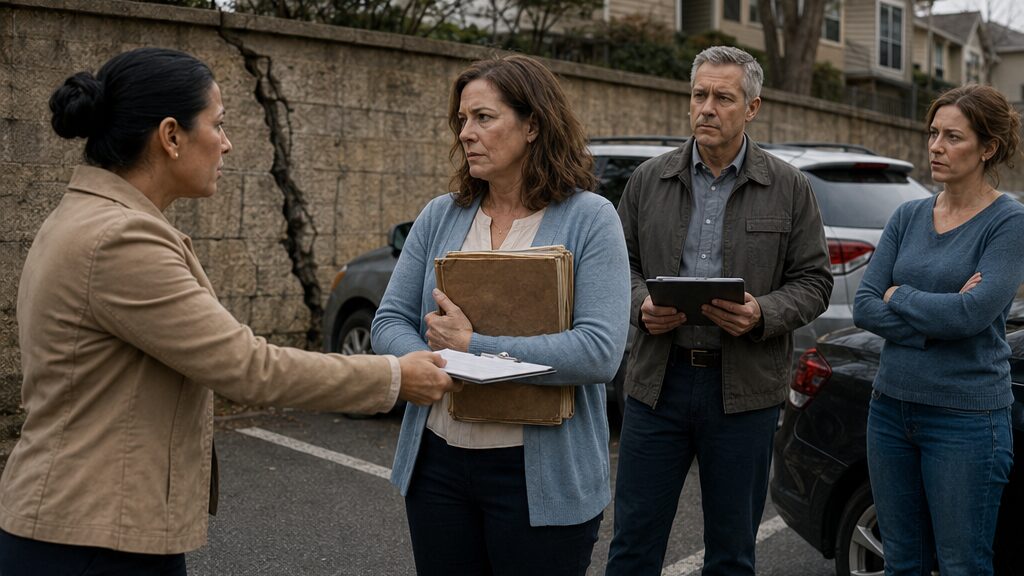
The clipboard nearly touched Emily Clark’s chest before she realized Jennifer Rivera had stepped directly into her path.
Emily had just locked her car. Her grocery bags were still on the passenger seat. The late-afternoon HOA parking lot behind the townhouse complex was half full, residents coming and going after work.
Jennifer wasn’t smiling.
Neither was George Robinson, who stood a few feet behind her.
A contractor Emily vaguely recognized from a previous inspection stood beside the retaining wall that separated the parking area from a lower drainage slope.
The wall stretched nearly forty feet.
A crack ran through part of it.
Emily looked from Jennifer’s face to the papers clipped to the board.
“What is this?”
Jennifer thrust it closer.
“A repair estimate.”
Emily took it.
The first thing she saw was the total.
$14,800.
For a second she honestly thought she had misread it.
Then she looked again.
Still fourteen thousand eight hundred dollars.
She laughed once.
Not because it was funny.
Because it was absurd.
Jennifer didn’t laugh.
“The damage originated from your side of the property.”
“My side?”
“The contractor explained it.”
Emily looked toward the wall.
Then toward the narrow strip of landscaping beside her townhouse.
A few shrubs.
A small flower bed.
Nothing dramatic.
“What exactly am I supposed to have done?” Emily asked.
Jennifer folded her arms.
“The roots. The grading. The water runoff. Pick one.”
Emily stared at her.
“You don’t actually know.”
William Campbell cleared his throat.
“I’m not saying I know for certain.”
Jennifer turned sharply.
“You told us the pressure appears to come from that direction.”
William shifted uncomfortably.
“I said it appears consistent with movement from that side.”
“Which is her property.”
Emily looked at him.
“Did you inspect the entire wall?”
“Not yet.”
“Did you inspect drainage records?”
“No.”
“So this is an estimate.”
“Yes.”
Jennifer pointed at the total.
“And if we don’t move quickly, it could get worse.”
George stepped forward.
“The board wants to resolve this before additional structural damage occurs.”
Emily turned toward him.
“The board wants me to pay fourteen thousand dollars because someone thinks a crack might have started near my shrubs?”
George hesitated.
“No final determination has been made.”
Jennifer immediately interrupted.
“It doesn’t matter. We all know where this started.”
Several residents had slowed nearby.
Nobody openly stared.
But everyone was listening.
Emily hated scenes.
She hated public arguments.
She hated being the center of attention.
Normally she would have found a way to leave.
Offer a polite response.
Promise to review things later.
Avoid confrontation.
That habit had followed her through most of her life.
Through her marriage.
Through her divorce.
Through years of agreeing to things just to keep peace.
Jennifer apparently expected the same thing.
“You can sign acknowledgment today,” Jennifer said. “We can work out payment afterward.”
Emily looked down at the paper again.
There was a signature line.
A surprisingly official-looking one.
She felt something cold move through her stomach.
Not because she believed she was responsible.
Because she knew how much damage a signed document could do.
“Why would I sign this?”
Jennifer blinked.
“Because it’s the responsible thing to do.”
“No.”
Jennifer frowned.
“No?”
Emily handed the clipboard back.
“I won’t sign anything.”
Silence settled between them.
A small silence.
But a meaningful one.
Jennifer clearly hadn’t expected resistance.
“You haven’t even reviewed it.”
“I’ve reviewed enough.”
George shifted his weight.
“Emily, nobody’s asking you to admit fault.”
She looked at the signature line.
“Then why is there a signature line?”
George didn’t answer immediately.
Jennifer spoke first.
“You’re making this harder than it needs to be.”
Emily felt heat rise into her face.
Not anger.
Something closer to embarrassment.
The assumption beneath Jennifer’s confidence.
The certainty that she would simply accept it.
Pay it.
Apologize.
Move on.
“Has anyone shown me an inspection report?” Emily asked.
“No.”
“Drainage records?”
“No.”
“Engineering assessment?”
“No.”
Jennifer exhaled dramatically.
“We don’t need to overcomplicate this.”
Emily almost laughed again.
Fourteen thousand eight hundred dollars.
Overcomplicate.
The contractor quietly stepped back.
A smart decision.
The discussion was no longer about construction.
It was about pressure.
Jennifer lowered her voice.
“Look, Emily. If insurance gets involved, this could become much worse.”
There it was.
The real threat.
Not the wall.
The process.
The paperwork.
The fear.
The possibility that a claim could follow her.
A mark attached to her property.
Higher premiums.
Endless phone calls.
Stress she could not afford.
Jennifer knew exactly where to press.
Emily looked past her toward the crack.
Something about it bothered her.
Not the damage itself.
The familiarity.
She had seen it before.
Hadn’t she?
A thin line running diagonally across the concrete.
Not new.
Older.
She couldn’t place the memory.
But it lingered.
Jennifer mistook her silence for uncertainty.
“You know this is the right thing.”
Emily met her eyes.
“No.”
For the first time, Jennifer seemed genuinely irritated.
“What do you mean, no?”
“I mean I didn’t cause it.”
“You don’t know that.”
“Neither do you.”
The words landed harder than Emily expected.
George looked away.
William stared at the wall.
Jennifer’s expression hardened.
“Fine. Then we’ll proceed through formal channels.”
Emily nodded.
“Do that.”
Jennifer took back the clipboard.
“You may regret this.”
Emily picked up her car keys.
“Maybe.”
Then she paused.
“Or maybe someone should actually find out what happened before asking me for fourteen thousand eight hundred dollars.”
Nobody answered.
Emily walked away.
She could feel eyes following her.
Neighbors.
Residents.
People already deciding who was right.
Who was difficult.
Who was guilty.
The walk from the parking lot to her townhouse felt longer than usual.
Inside, she placed her groceries on the counter.
Then she stood motionless for nearly a minute.
The estimate sat folded beside her purse.
She hated conflict.
She hated every second of what had just happened.
Part of her wanted to call Jennifer.
Smooth things over.
Find some compromise.
Offer something.
Anything.
Make it stop.
That impulse had cost her before.
She knew it.
Slowly she walked toward the hallway closet.
Opened the door.
Reached for a thick blue folder resting on the highest shelf.
The folder was old.
Its corners were worn.
Inside were years of paperwork she had never thrown away.
Property documents.
Repair receipts.
Photographs.
Inspection notes.
Things most people forgot existed.
She carried it to the kitchen table.
Set it down.
Opened it.
A photograph slipped partially free.
Emily froze.
Her eyes narrowed.
Then she pulled it completely from the folder.
The retaining wall stood in the background.
And running through it—
long before today’s accusation—
was the same crack.
Chapter 2: Photographs Older Than the Story
The crack was there.
Emily sat at her kitchen table staring at the photograph under the yellow light above her.
The image had been printed years ago.
Not recently.
Not altered.
Not blurry.
The retaining wall stood behind several parked vehicles during a neighborhood barbecue.
Children were visible near folding tables.
Decorations hung from temporary posts.
And through the concrete wall ran the same thin fracture.
Smaller.
But unmistakable.
Emily turned the photograph over.
A date had been written in faded pen.
Four years earlier.
She leaned back in her chair.
For the first time since the parking lot confrontation, her breathing slowed.
The damage existed long before Jennifer’s theory.
That mattered.
The problem was that it didn’t prove enough.
Not yet.
The crack could have started years ago and still worsened because of something Emily had done later.
Jennifer would argue exactly that.
Emily knew it.
She opened the folder wider.
Stacks of papers spread across the table.
Property tax documents.
Maintenance receipts.
Insurance correspondence.
Photographs she barely remembered taking.
She had always kept records.
Part habit.
Part anxiety.
After her divorce, every unexpected expense felt dangerous.
Keeping documentation became a way of feeling prepared.
Sometimes she wondered if it bordered on obsession.
Tonight she was grateful for it.
She found more photographs.
One showed holiday decorations.
Another showed visitors parked beside the wall.
A third showed landscaping work near the townhouse entrance.
Again and again the crack appeared.
Always present.
Always ignored.
Emily arranged the photographs in chronological order.
The fracture gradually widened over time.
Not dramatically.
Just enough to notice when comparing years.
Her phone buzzed.
A text from Jennifer.
We need resolution quickly.
The board won’t wait forever.
Emily stared at the message.
Then set the phone face down.
No response.
For once she wasn’t going to rush into a conversation she wasn’t prepared to have.
She continued sorting.
Near the bottom of the folder she found an inspection report from shortly after purchasing the townhouse.
The document mentioned minor settlement cracking in common retaining structures.
Not severe.
Not urgent.
Just noted.
Her pulse quickened.
She reread the sentence twice.
Minor settlement cracking.
Common retaining structures.
The wall.
The report didn’t identify the exact section.
But it was another piece.
Another small contradiction.
Not proof.
A direction.
By midnight the kitchen table looked like an archive room.
Photographs.
Receipts.
Notes.
Sticky markers.
Emily rubbed her eyes.
Then noticed something odd.
A gap.
The photographs covered nearly every year except one.
The year Jennifer moved into the neighboring unit.
Strange.
Emily remembered taking pictures then because of landscaping changes nearby.
Yet none were in the folder.
She searched again.
Nothing.
A missing piece bothered her more than an absent answer.
She made a note.
Find landscaping photos.
The next morning she drove to the municipal records office before work.
The clerk behind the counter looked unsurprised when Emily explained she needed old permit information.
Apparently neighborhood disputes generated plenty of similar requests.
The clerk disappeared into a back room.
Returned with a small stack of records.
Most were routine.
Property updates.
Minor approvals.
Drainage references.
Emily paused.
Drainage.
The word appeared more than once.
She requested copies.
The clerk printed them.
Nothing immediately proved anything.
But several references involved maintenance discussions years earlier.
Again the wall appeared in the background of the story.
Not as the center.
Just nearby.
Like a detail everyone assumed would always remain standing.
As she left the office, Emily felt a cautious optimism.
The accusation no longer felt solid.
But uncertainty remained.
Evidence wasn’t the same as persuasion.
People often preferred simple stories.
Jennifer had one.
The crack started near Emily’s property.
Emily’s landscaping caused movement.
Emily should pay.
Simple.
Easy.
Comforting.
Reality rarely worked that way.
By late afternoon another letter arrived.
This one wasn’t from Jennifer.
The return address belonged to an insurance company.
Emily opened it standing beside her mailbox.
Inside was a request for information regarding a reported property-damage claim.
Reported by Jennifer Rivera.
Emily read the page twice.
The claim had already begun moving forward.
Without her.
Without a full investigation.
Without anyone asking for her records.
The pressure she had felt in the parking lot suddenly became real.
Official.
A timeline had started.
Deadlines.
Forms.
Decisions.
Consequences.
Emily folded the letter carefully.
Then looked back toward the retaining wall.
For a moment she imagined how easily this could have ended.
Sign the estimate.
Accept partial responsibility.
Avoid conflict.
Pay something.
Move on.
That version of herself still existed.
The woman who preferred peace to confrontation.
But another thought followed.
If she signed something she knew was wrong, the story wouldn’t end.
It would become true.
And once it became true, no photograph would matter.
No record would matter.
No memory would matter.
She returned inside.
Placed the insurance letter in the folder.
Then added the dated photographs beside it.
The folder had started as storage.
Now it felt like a defense.
She closed it.
A sharp knock sounded at her door.
Emily opened it.
George Robinson stood outside.
His expression was cautious.
“I thought you’d want to know,” he said.
“Know what?”
“The insurance adjuster requested copies of the inspection materials.”
Emily nodded.
“Good.”
George hesitated.
“Jennifer already submitted hers.”
The pause lingered.
“What inspection materials?” Emily asked.
George frowned slightly.
“The contractor summary.”
Emily stared at him.
“There wasn’t an inspection.”
George’s expression changed.
Only slightly.
But enough.
And for the first time since the accusation began, Emily wondered whether everyone involved had been working from assumptions instead of facts.
Chapter 3: The Inspection Nobody Questioned
“The contractor summary isn’t an inspection report.”
Emily said it twice before George finally stopped looking at her like she was arguing semantics.
They stood on her front porch.
The evidence folder rested under her arm.
George adjusted his glasses.
“It’s the document Jennifer provided.”
“It’s an estimate.”
“Based on observations.”
“Not an inspection.”
The distinction sounded small.
Yet the more Emily examined the paperwork, the larger it became.
George accepted the folder when she handed him a copy of William Campbell’s estimate.
He skimmed the first page.
Then the second.
His forehead tightened.
“No engineering review.”
“No drainage study.”
“No structural analysis.”
George turned another page.
“Just site observations.”
“Exactly.”
For several seconds neither spoke.
Emily watched him arrive at a conclusion he clearly didn’t enjoy.
The HOA had treated an estimate like evidence.
George finally closed the papers.
“I’ll bring this up.”
“You should.”
His discomfort deepened.
“That doesn’t mean the claim disappears.”
“I know.”
George left without another promise.
Which was probably the most honest thing anyone had done so far.
The following afternoon, residents gathered near the retaining wall for a scheduled review.
Not an official hearing.
Just another step in the process.
Jennifer arrived carrying a binder.
William Campbell stood beside the damaged section.
Several neighbors lingered nearby pretending not to watch.
Emily recognized Amy Lewis among them.
Amy offered a small nod but said nothing.
Jennifer immediately took control.
“As everyone can see, the crack continues to spread.”
The wall looked exactly as it had two days earlier.
Emily said nothing.
William crouched beside the concrete.
Jennifer gestured toward Emily’s side of the property.
“The movement originates there.”
William looked up.
“I didn’t say originates.”
Jennifer’s smile tightened.
“You said the pressure appears consistent with that direction.”
“That’s different.”
A brief silence followed.
Several neighbors exchanged glances.
Emily noticed it immediately.
The first visible fracture in Jennifer’s certainty.
Not the wall.
The narrative.
Jennifer pressed forward.
“Either way, we need repairs.”
“Absolutely,” William said.
“Then somebody needs to pay.”
William stood.
“I only estimate repairs.”
Not causes.
He didn’t say the last part loudly.
But everyone heard it.
Jennifer folded her arms.
Emily saw frustration flash across her face.
For a moment she almost felt sympathy.
Almost.
Jennifer looked exhausted.
Tense.
Like someone carrying more weight than she admitted.
Then Jennifer caught Emily watching.
The sympathy vanished.
“You keep acting like you’re being targeted.”
Emily answered calmly.
“I keep acting like nobody has shown evidence.”
The neighbors became very interested in the conversation.
Amy stared at the wall.
George checked his phone.
William suddenly found his clipboard fascinating.
Jennifer stepped closer.
Not threatening.
Just determined.
“If you have something proving otherwise, show it.”
Emily’s fingers tightened around the folder.
This was the moment.
Part of her wanted to spread every photograph across the hood of a nearby car.
End the argument immediately.
But she stopped herself.
The evidence wasn’t complete.
And revealing everything now would only trigger new arguments before she understood the whole story.
So she said something else.
“I have photographs.”
Jennifer’s expression flickered.
Only for a second.
Then confidence returned.
“Photographs of what?”
“Older damage.”
Jennifer laughed.
“A crack isn’t the same thing as structural failure.”
“No.”
“It proves nothing.”
“Maybe.”
The answer irritated Jennifer more than a direct argument would have.
Because Emily wasn’t retreating.
Yet she wasn’t revealing her hand either.
The conversation ended without resolution.
People drifted away.
The wall remained.
The crack remained.
The accusation remained.
But something had changed.
For the first time, uncertainty no longer belonged only to Emily.
That evening she sat at her dining table reviewing the documents again.
A detail caught her attention.
One permit reference appeared twice.
Drainage maintenance.
Three years earlier.
Associated with a contractor authorization number.
The number didn’t appear anywhere else in her records.
Curious, she searched through the estimate Jennifer had circulated.
Nothing.
She checked municipal copies again.
Still there.
Same authorization number.
Why would drainage maintenance appear repeatedly without corresponding work details?
Emily wrote the number down.
Then highlighted it.
Her phone buzzed.
A message from Amy Lewis.
Unexpected.
Can I ask you something?
Emily stared.
Then replied.
Sure.
The response arrived almost immediately.
Did the crack really start recently?
Emily sat upright.
Why?
Several minutes passed.
Long enough that Emily thought Amy might have changed her mind.
Then another message appeared.
Because I remember hearing people talk about repairs a few years ago.
Not wall repairs.
Something underneath.
Emily looked again at the authorization number she had just highlighted.
Drainage.
Underneath.
Her pulse quickened.
Before she could type a response, Amy sent one final message.
I might be remembering wrong.
But something about this doesn’t make sense.
Emily read the words twice.
Then a third time.
Because for the first time since Jennifer had handed her that estimate in the parking lot, someone else had started asking the same question.
If Emily didn’t cause the damage—
who had been worried about that wall years earlier?
Chapter 4: The Drainage Work Jennifer Forgot
The invoice surfaced because Emily stopped looking for proof that she was innocent and started looking for proof that someone else already knew there was a problem.
She spread municipal records across her dining table before sunrise.
The drainage authorization number Amy had unintentionally pointed her toward appeared again.
And again.
The references were small.
Easy to overlook.
One involved an approval request.
Another mentioned excavation near the retaining wall.
A third referenced drainage redirection.
The dates all clustered around the same period.
Three years earlier.
Emily circled them with a red pen.
Then she noticed a contractor company name partially visible on one photocopied page.
Not William Campbell’s name.
The company.
A company William had worked for before starting his own business.
By midmorning she was parked outside the municipal records office again.
The same clerk recognized her immediately.
“Back already?”
“I think I missed something.”
The clerk smiled sympathetically.
“Property disputes usually work that way.”
Emily showed him the authorization number.
The clerk disappeared into the archives section.
When he returned, he carried a thin file.
“That’s all we have.”
Emily opened it.
The file wasn’t dramatic.
No confession.
No smoking gun.
But buried among routine paperwork was an invoice summary.
Drainage correction work.
Excavation.
Water diversion.
Retaining wall proximity.
The client name sat at the top.
Jennifer Rivera.
Emily stared at it.
For several seconds she simply stared.
Not because it proved Jennifer caused the damage.
It didn’t.
But it changed the shape of the story.
Jennifer wasn’t some neighbor suddenly surprised by a crack.
Jennifer had dealt with drainage concerns years earlier.
Near the same wall.
Near the same area now being blamed on Emily.
“Can I get copies?”
The clerk nodded.
Emily left carrying fresh paperwork tucked into her folder.
For the first time, the folder felt heavier.
Not physically.
Emotionally.
Because every new document increased the possibility that Jennifer wasn’t merely mistaken.
She might be protecting herself.
That afternoon George called.
“I heard you found additional records.”
Emily almost laughed.
News traveled quickly in the community.
“I found drainage permits.”
Silence.
Then George asked, “Related to the wall?”
“Related enough.”
George exhaled.
“Jennifer didn’t mention those.”
“No.”
Another pause.
“Can you send copies?”
“I can.”
She forwarded them that evening.
Within an hour Jennifer appeared at her front door.
Not a text.
Not an email.
Not a phone call.
A knock.
Sharp and impatient.
Emily opened the door halfway.
Jennifer stood holding her phone.
“You went digging through records?”
Emily blinked.
“You filed an insurance claim against me.”
“That’s not an answer.”
“It actually is.”
Jennifer’s jaw tightened.
For a moment neither woman spoke.
The tension felt strangely familiar.
Like the parking lot.
Only quieter.
More dangerous.
Jennifer finally held up her phone.
“The drainage work has nothing to do with this.”
“Maybe.”
“It was routine maintenance.”
“Then why didn’t you mention it?”
Jennifer looked away briefly.
Just briefly.
Long enough for Emily to notice.
“Because it wasn’t relevant.”
“How do you know?”
Jennifer’s frustration rose visibly.
“Because I paid for it.”
The words escaped before she seemed ready to say them.
Emily remained silent.
Jennifer continued.
“The contractor told me the issue was fixed.”
“Which contractor?”
Jennifer hesitated.
Another small thing.
Another crack.
“The company that handled the drainage work.”
“You still have the reports?”
“No.”
The answer came too quickly.
Emily watched her.
Jennifer crossed her arms.
Defensive now.
Not confident.
Defensive.
For the first time Emily saw something beneath the accusations.
Fear.
Real fear.
Not fear of Emily.
Fear of the bill.
Fear of the wall.
Fear of what happened if responsibility landed back where it started.
Jennifer rubbed her forehead.
“You don’t understand.”
Emily almost asked her to explain.
Almost.
But Jennifer stepped backward.
The moment closed.
“You should stop chasing paperwork and focus on fixing the problem.”
Then she turned and walked away.
Emily watched until she disappeared around the corner.
The conversation should have reassured her.
Instead it raised a larger question.
Why had Jennifer become so emotional over a drainage invoice from three years ago?
That evening Emily called the contractor company listed on the permit records.
Most records were archived.
The receptionist transferred her twice.
Eventually someone promised to search older files.
Emily wasn’t optimistic.
Three years was a long time.
Companies lost things.
People retired.
Computers changed.
Records vanished.
Still, she left her contact information.
The next morning a message waited in her inbox.
Not a complete file.
Not yet.
Just a brief response.
Archived material exists.
Request under review.
Additional documentation may be available.
Emily reread the message.
Then opened her folder.
Photographs.
Insurance letters.
Permit records.
Drainage approvals.
Each piece answered one question while creating another.
She placed the new email inside.
A few minutes later her phone rang.
Amy.
“Sorry to bother you.”
“You’re not.”
Amy hesitated.
“I remembered something.”
Emily sat down immediately.
“What?”
“There was construction behind Jennifer’s unit.”
“When?”
“A few years ago.”
“The drainage work?”
“Probably.”
Amy sounded uncertain.
“But I remember hearing someone say the water wasn’t going where it was supposed to.”
Emily’s pulse quickened.
“Who said it?”
“I don’t know.”
“You heard it yourself?”
“Yes.”
Amy paused.
“Emily, I stayed out of this because I thought it was obvious.”
“Obvious?”
“That the crack came from your side.”
Emily waited.
Amy sighed.
“I don’t think it’s obvious anymore.”
After the call ended, Emily stared at the retaining wall through her kitchen window.
The crack no longer looked like a mystery.
It looked like a timeline.
And somewhere inside that timeline was a decision nobody wanted examined.
Two days later another email arrived.
This one contained an attachment.
Archived file located.
Inspection notes available.
Emily opened the attachment.
The document was incomplete.
Aged.
Partially scanned.
But it contained something far more valuable than a repair estimate.
A field report.
Written years before.
And across the top sat a familiar name.
William Campbell.
Chapter 5: What the Contractor Wrote Three Years Earlier
William’s name changed everything.
Emily printed the report immediately.
The pages emerged slowly from her printer.
One sheet.
Then another.
Then another.
When the final page slid into the tray, she spread them across her table.
The report wasn’t intended for public arguments.
That became obvious immediately.
It wasn’t polished.
It wasn’t written for insurance companies or HOA meetings.
It was a working document.
Notes.
Observations.
Recommendations.
The kind of thing people wrote when they expected only coworkers to read it.
Emily scanned the first page.
Drainage review near retaining wall.
Water accumulation observed.
Potential long-term pressure concerns.
She sat down.
Her heart pounded.
Not because she had won.
Because she finally had something real.
The report continued.
Subsurface moisture may contribute to future structural movement if corrective measures are delayed.
Emily read the sentence twice.
Then three times.
Future structural movement.
Three years earlier.
Before Jennifer’s accusation.
Before the insurance claim.
Before anyone blamed Emily.
The report didn’t identify a culprit.
But it clearly documented risk.
Known risk.
She flipped to the next page.
Handwritten notes appeared along the margins.
One sentence stood out.
Client informed that additional monitoring recommended.
Emily leaned closer.
The client.
Jennifer.
Or someone acting for her property.
The implication was unavoidable.
Someone had been warned.
The wall wasn’t suddenly failing.
The possibility existed years ago.
Emily carefully placed the report inside the folder.
Then called William Campbell.
To her surprise, he answered.
“William speaking.”
“Mr. Campbell, this is Emily Clark.”
Silence.
Then recognition.
“Oh.”
Not enthusiasm.
Recognition.
“I found an old field report.”
More silence.
“Three years ago,” Emily continued.
“Drainage work near the retaining wall.”
William exhaled slowly.
“I was wondering when that might surface.”
Emily sat straighter.
“You remember it?”
“Some of it.”
The answer was cautious.
Not evasive.
Just careful.
“Did you write the notes?”
“Probably.”
“You don’t sound surprised.”
William laughed quietly.
“In this business? Old paperwork usually comes back eventually.”
Emily didn’t laugh.
“People are trying to hold me responsible.”
“I know.”
“You know?”
“George called me.”
That made sense.
Of course he had.
The entire community seemed trapped inside the same conversation.
William became quiet.
Then said something unexpected.
“My estimate was never intended to determine liability.”
Emily closed her eyes briefly.
Finally.
Someone saying it plainly.
“Then why does everyone treat it that way?”
“I can’t answer that.”
She suspected he could.
But chose not to press.
Instead she asked, “Did the drainage work solve the issue?”
A longer silence followed.
Too long.
“Not completely.”
The answer landed heavily.
“What do you mean?”
“It reduced water accumulation.”
“Reduced?”
“Yes.”
Emily waited.
Eventually William spoke again.
“The recommendation was continued monitoring.”
“And?”
“I don’t know if anyone followed through.”
The call ended politely.
But Emily couldn’t stop thinking about one detail.
Not completely.
The repairs hadn’t fully solved the problem.
The risk remained.
Which meant Jennifer might not be hiding some dramatic secret.
She might have convinced herself the issue was resolved because believing otherwise was expensive.
Human.
Understandable.
Wrong.
But understandable.
That realization unsettled Emily more than outright dishonesty would have.
Because it complicated everything.
That afternoon an official update arrived from the insurance company.
The claim remained under review.
No decision.
No closure.
No relief.
Emily read the notice at her kitchen counter.
Months of savings still felt vulnerable.
The pressure remained real.
Even with evidence accumulating.
Later that evening George visited.
He looked tired.
“You’re causing problems.”
Emily nearly smiled.
“Interesting choice of words.”
“You know what I mean.”
He accepted a copy of William’s report.
Read several pages.
Then rubbed his forehead.
“This should’ve been reviewed earlier.”
“Yes.”
George looked embarrassed.
Not personally guilty.
Institutionally embarrassed.
The kind of discomfort produced when a system realizes it accepted assumptions as facts.
“We’re scheduling a formal HOA review.”
Emily nodded.
“When?”
“Next week.”
The words settled heavily between them.
Not because she feared the meeting.
Because she knew what it represented.
Everything becoming public.
The documents.
The accusations.
The timeline.
Jennifer.
George stood.
Then paused at the door.
“There is something else.”
Emily waited.
“The insurance company requested additional records from Jennifer.”
“Related to the drainage work?”
“Probably.”
“And?”
George hesitated.
“She hasn’t provided them.”
The silence that followed felt larger than any previous discovery.
Because missing records could mean many things.
Lost paperwork.
Poor organization.
Or documents someone preferred not to discuss.
After George left, Emily opened the folder again.
The folder no longer contained random records.
It contained a chronology.
A story.
Not a complete story.
But enough to challenge the version everyone had accepted.
Near midnight her phone buzzed.
A community email.
Formal HOA hearing scheduled.
Attendance expected.
Property-damage review.
Supporting documentation welcome.
Emily stared at the screen.
Then looked at the thick folder beside her.
The confrontation she had spent weeks avoiding was no longer avoidable.
Chapter 6: The Meeting Where the Timeline Broke Apart
Every chair in the HOA meeting room was occupied.
Emily stopped in the doorway and immediately understood this wasn’t about a retaining wall anymore.
It was about a neighborhood story.
People wanted to know who had been telling the truth.
George sat at the front beside several board members.
Jennifer occupied a chair near the center.
A binder rested on her lap.
Emily carried her folder.
The same folder that had sat forgotten in a closet only weeks earlier.
Now it felt like the center of the room.
Conversations quieted as she entered.
She hated that.
Always had.
But instead of retreating, she walked to an empty seat.
The meeting began.
George reviewed procedures.
Insurance status.
Property concerns.
Repair estimates.
The familiar version of events appeared first.
The crack.
The wall.
The alleged connection to Emily’s property.
Jennifer spoke confidently.
Not aggressively.
Not this time.
Almost tired.
“The damage worsened over recent years,” she said.
“The contractor observed movement from Emily’s side.”
Several heads nodded.
George thanked her.
Then looked toward Emily.
“Would you like to respond?”
The room became still.
Emily stood.
Her hands felt steady.
Surprisingly steady.
She placed the folder on the table.
Opened it.
And began.
Not with accusations.
Not with conclusions.
With photographs.
One by one.
Dated images.
Holiday gatherings.
Community events.
Routine snapshots.
Each showing the crack.
Each older than the accusation.
The photographs moved down the table.
Board members examined them.
Neighbors leaned forward.
The room changed.
Not dramatically.
But noticeably.
George frowned at one image.
“This date is correct?”
“Yes.”
“Four years ago?”
“Yes.”
A murmur spread.
Jennifer remained silent.
Emily continued.
Inspection references.
Maintenance notes.
Municipal records.
Drainage permits.
Nothing explosive.
Just a growing timeline.
A timeline that no longer began with Emily.
George turned pages slowly.
Then stopped.
“Drainage correction work.”
Emily nodded.
“Three years ago.”
Jennifer finally spoke.
“That doesn’t prove anything.”
Emily looked at her.
“No.”
Jennifer seemed relieved.
Then Emily continued.
“It doesn’t prove who caused the damage.”
The relief disappeared.
“It proves the problem existed earlier than claimed.”
Silence.
Emily placed William’s field report beside the permits.
George read several sections.
One board member asked for a copy.
Another requested the recommendation page.
The room grew quieter with every document.
Not because Emily had delivered a dramatic reveal.
Because the story was becoming complicated.
And complicated stories are harder to blame on one person.
Jennifer shifted in her chair.
“The repairs were completed.”
“Partially,” Emily said.
Heads turned.
Jennifer stared.
“What?”
Emily slid forward the report containing William’s notes.
Water accumulation reduced.
Monitoring recommended.
Not completely resolved.
George read the sentence aloud.
The room fell silent.
Jennifer looked genuinely stunned.
Not performatively.
Genuinely.
As if she hadn’t remembered the wording herself.
Then Amy stood.
Nobody expected it.
Least of all Amy.
“I should probably say something.”
Every eye turned toward her.
Amy swallowed.
“I stayed out of this because I thought Jennifer was right.”
Jennifer looked at her.
Confused.
Hurt.
Amy continued.
“I remembered construction near the wall years ago.”
She looked toward the board.
“I also remember concerns about drainage.”
The statement wasn’t dramatic.
But it mattered.
Because Amy had nothing to gain.
No bill.
No claim.
No side.
Just a memory.
A human one.
The room absorbed it.
Slowly.
Carefully.
Jennifer’s shoulders slumped.
For the first time she stopped arguing.
George looked down at the documents spread across the table.
The photographs.
The permits.
The reports.
The notes.
The folder.
The timeline.
Then he said the sentence nobody had heard before.
“I don’t think responsibility has been established.”
A board member nodded.
Another agreed.
The shift was immediate.
Not toward Emily’s innocence.
Toward uncertainty.
And uncertainty was enough.
Because the original accusation depended on certainty.
Jennifer closed her eyes briefly.
When she opened them, she looked exhausted.
“I can’t afford this repair.”
The admission surprised everyone.
Including Emily.
No anger.
No accusation.
Just honesty.
Jennifer stared at the table.
“The insurance company said coverage might be denied.”
Nobody spoke.
“The drainage work cost more than I expected.”
Her voice softened.
“I thought this was connected.”
Emily watched her.
Finally understanding.
Jennifer hadn’t invented the fear.
She had simply directed it at the wrong person.
George ended the discussion shortly afterward.
No determination.
No assignment of liability.
Additional review required.
Insurance decision pending.
As neighbors slowly filed out, the room buzzed with quiet conversations.
The accusation had not survived intact.
But the story wasn’t finished.
Near the exit Jennifer stopped beside Emily.
For a moment neither woman spoke.
Then Jennifer glanced at the folder.
“The photographs.”
Emily waited.
“I’d forgotten how old that crack was.”
It wasn’t an apology.
Not quite.
But it was closer than anything before.
Jennifer walked away.
Emily watched her leave.
Then looked down at the folder resting in her hands.
The same folder everyone assumed contained weakness.
Instead it had dismantled an entire timeline.
Yet one question remained.
What would the insurance company do now?
Chapter 7: The Claim That Returned to Its Owner
The envelope arrived on a Tuesday morning.
Emily saw it sticking out of her mailbox before she reached the sidewalk.
The insurance company’s logo was visible through the windowed section of the envelope.
For a moment she simply stood there.
Not opening it.
Not moving.
Weeks earlier she would have rushed inside.
Opened it immediately.
Prepared herself for the worst.
Now she felt something different.
Not confidence.
Just readiness.
Whatever was inside, she had done everything she could do.
She carried the envelope into her kitchen.
The evidence folder sat on the counter where it had lived for nearly a month.
Its edges looked more worn than before.
As if the conflict had somehow left marks on it.
Emily set the envelope beside the folder.
Then opened it carefully.
The letter was shorter than she expected.
She read the first paragraph.
Then the second.
Then started again from the beginning.
After further review of submitted documentation…
Additional records and historical maintenance information…
Liability determination revised…
The claim would not proceed against Emily Clark.
Responsibility could not be assigned based on the original accusation.
The demand against her was withdrawn.
Emily lowered the paper slowly.
The kitchen remained silent.
No celebration.
No dramatic relief.
Just quiet.
The kind that arrives after carrying tension for too long.
She sat at the table and read the letter one more time.
The financial threat that had been hanging over her for weeks was gone.
No payment.
No admission.
No responsibility.
The story Jennifer had presented had finally collapsed under its own missing pieces.
Emily expected triumph.
Instead she felt tired.
A knock sounded at the door.
She almost laughed.
So much of this conflict had arrived through knocks.
She opened it.
George Robinson stood outside.
This time he looked relieved.
“You got the letter.”
Emily nodded.
“Just now.”
George smiled faintly.
“The insurance company copied the HOA.”
“So it’s over?”
“The claim against you is.”
Against you.
Not completely over.
Just redirected.
George seemed to understand the question she didn’t ask.
“They’ll continue reviewing repair responsibility separately.”
Emily nodded.
The wall still existed.
The crack still existed.
Repairs would still be necessary.
Reality hadn’t disappeared.
Only the accusation had.
George glanced toward the folder on the kitchen table.
“That thing saved you.”
Emily looked at it.
“No.”
George raised an eyebrow.
“The records did.”
He smiled.
“Fair point.”
After he left, Emily returned to the table.
The folder no longer felt defensive.
No longer felt like armor.
It felt like a record of choices.
Some hers.
Some not.
A little after noon another knock came.
This one surprised her.
Jennifer stood outside.
No clipboard.
No binder.
No estimate.
Just Jennifer.
For a few awkward seconds neither woman spoke.
Then Jennifer held up an envelope.
“I got one too.”
Emily nodded.
Neither needed to explain which letter.
Jennifer looked older than she had a month earlier.
Not physically.
Just worn down.
The way people look after spending too much time fighting something.
“The claim’s gone,” Jennifer said.
“Yes.”
Another silence.
Jennifer looked toward the retaining wall visible between the buildings.
“I kept thinking the problem had to be somewhere else.”
Emily said nothing.
Jennifer laughed once.
A tired laugh.
“That’s probably obvious.”
“No.”
“It is.”
Jennifer folded her arms.
Then unfolded them again.
The defensive posture seemed automatic now.
“I really thought it came from your side.”
Emily believed her.
That surprised her.
Weeks earlier she would have assumed manipulation.
Now she saw something more complicated.
Jennifer hadn’t invented every concern.
She had simply chosen the explanation that protected her.
And once she chose it, she stopped looking elsewhere.
“We all do that sometimes,” Emily said.
Jennifer looked at her.
A flicker of gratitude appeared.
Then disappeared.
“The board’s going to be furious.”
“Probably.”
“They may decide the drainage work contributed.”
“Maybe.”
Jennifer stared at the pavement.
“The contractor warned me.”
Emily didn’t answer.
Jennifer shook her head slowly.
“I remembered after the meeting.”
The admission landed harder than an argument would have.
Not because it proved wrongdoing.
Because it proved denial.
Years earlier someone had warned her.
Not dramatically.
Not urgently.
Just enough.
Enough that she should have kept watching.
Should have followed up.
Should have asked questions.
Instead she had wanted the problem to be finished.
So she treated it as finished.
Jennifer looked up.
“I should’ve listened.”
Emily thought about all the choices that had brought them here.
The estimate.
The accusation.
The pressure.
The insurance claim.
The months of avoiding inconvenient facts.
Not just Jennifer’s choices.
Her own too.
She had spent years avoiding conflict.
Avoiding difficult conversations.
Avoiding moments when saying no felt uncomfortable.
If she had signed that estimate in the parking lot, none of this evidence would have mattered.
The accusation would have become reality.
Jennifer shifted awkwardly.
“I’m not good at apologies.”
Emily almost smiled.
“I noticed.”
Jennifer laughed softly.
This time it sounded genuine.
“I’m sorry anyway.”
The words hung between them.
Simple.
Incomplete.
Real.
Emily nodded.
“Thank you.”
Jennifer looked relieved.
Not forgiven.
Not restored.
Just relieved.
A few moments later she left.
Emily watched her walk back toward her townhouse.
The distance between them wasn’t large.
Yet it felt different now.
Not repaired.
Just honest.
Over the next week the neighborhood gradually moved on.
The wall remained a topic of discussion.
Repair plans continued.
Board meetings continued.
Life continued.
But something had changed.
People no longer looked at Emily as the woman who damaged the wall.
The story attached to her name had disappeared.
Amy stopped by one evening carrying coffee.
“You were right.”
Emily laughed.
“I wasn’t right.”
“You know what I mean.”
Amy sat at the kitchen table and pointed toward the folder.
“You should keep that forever.”
“I probably will.”
“You know what’s funny?”
“What?”
“I thought that folder contained proof.”
Emily looked at it.
“It did.”
Amy shook her head.
“No.”
She smiled.
“It contained patience.”
After Amy left, Emily sat alone in the quiet kitchen.
The folder remained where it always seemed to end up.
Near her.
Within reach.
The photographs still sat inside.
The permits.
The letters.
The reports.
The estimate that had started everything.
She opened it one final time.
The fourteen-thousand-eight-hundred-dollar demand remained clipped to the front section.
Jennifer’s certainty.
The HOA’s assumptions.
Her own fear.
All preserved on a few sheets of paper.
Emily removed the estimate.
Folded it carefully.
Then placed it at the very back of the folder.
Not because she wanted to remember the accusation.
Because she wanted to remember the refusal.
The moment in the parking lot when everyone expected her to sign.
The moment she finally didn’t.
Outside, someone was walking home from work.
A car door closed.
A dog barked somewhere in the complex.
Ordinary sounds.
The sounds of a place continuing.
Emily closed the folder.
The wall would be repaired eventually.
Some relationships might not.
Jennifer would still live nearby.
Community meetings would still happen.
Awkward encounters would still occur.
Vindication had solved the financial threat.
It had not erased the cost.
But as Emily turned off the kitchen light, she realized something important.
The most valuable thing she kept wasn’t inside the folder.
It was the certainty that she had not surrendered the truth simply because someone demanded it.
And that, unlike the wall, no repair would ever be necessary for.
The story has ended.