She Counted Every Tow Until the Morning They Tried Taking Her Daughter Too
Chapter 1: The Hook Struck Before Samantha Could Reach the Door
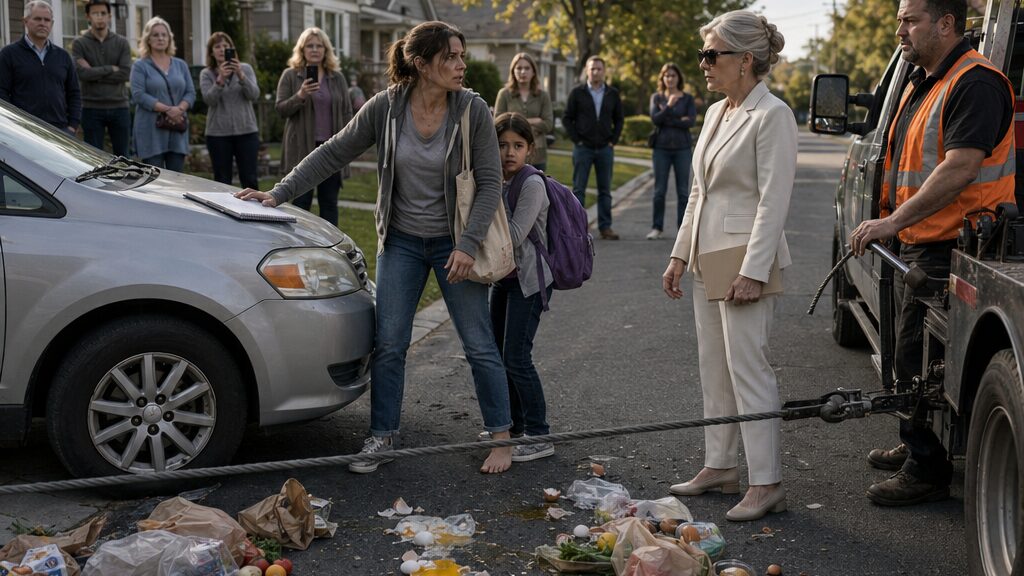
The tow cable snapped tight while Amy’s face was still visible through the rear window.
Samantha heard the metallic crack from inside the house. She had been halfway across the kitchen, one shoe on, her hospital badge clenched between her teeth, when the sound cut through the hum of the refrigerator.
She ran outside without the second shoe.
The silver minivan jerked backward six inches. Amy sat buckled into her booster seat, one hand pressed against the glass, her mouth open in confusion.
“Stop!” Samantha shouted.
The tow operator glanced over his shoulder but did not release the controls. He wore an orange safety vest over a black T-shirt, and his broad forearm rested casually against the truck’s control panel.
“My daughter is inside.”
He looked through the minivan window, then back at Samantha.
“You need to step away from the equipment.”
“She is seven years old.”
“I heard you.”
The cable tightened again.
Samantha crossed the driveway so quickly that gravel bit into the sole of her bare foot. She reached for the passenger door, but the van had shifted too close to the tow arm for it to open fully.
Amy’s eyes widened.
“Mom?”
“I’m here.” Samantha forced her voice lower. “Keep your hands in your lap.”
At the curb, Betty Anderson stood with her arms folded over a cream-colored jacket. Her silver hair was pinned neatly behind her head, and her sunglasses reflected Samantha’s house in two dark, polished rectangles.
“This could have been avoided,” Betty said.
Samantha looked at her. “You told him to move a car with a child in it?”
“I authorized removal of a vehicle in violation.”
“She was inside.”
“And you left her unattended.”
“I carried groceries ten feet.”
Betty’s mouth tightened as though Samantha had confirmed something disappointing. “This is your forty-third documented violation.”
The number hung in the street.
A garage door across from them stopped halfway open. Farther down the block, a man paused beside his mailbox. Samantha felt the neighborhood becoming aware of her one window at a time.
“Matthew,” Betty said, “finish securing it.”
The tow operator reached for another lever.
Samantha stepped between him and the minivan.
He gave a short laugh. “Lady, you don’t want to do that.”
“No,” Samantha said. “You don’t.”
Her hands were shaking. She tucked them against her sides before Amy could see.
“Release the tension so I can open the door.”
Matthew looked toward Betty.
Betty lifted her chin. “The vehicle is already under tow.”
“There is a child inside it.”
“That is not an HOA matter.”
For one dangerous second, Samantha saw herself grabbing the lever. She saw Matthew knocking her hand away, the neighbors filming only the moment she lost control, Amy watching from behind glass.
She stepped back instead and pulled out her phone.
“What are you doing?” Betty asked.
Samantha photographed the cable where it crossed the painted curb line. She photographed the rear tire’s position, the tow arm, Amy behind the window, and the small orange survey mark near the storm drain.
Matthew’s expression changed.
“You can take pictures from over there.”
Samantha took another.
Then she called 911 on speaker.
“My daughter is inside a vehicle being moved by a tow truck,” she said. “The operator has been told she is inside and has not released the cable.”
Matthew swore under his breath.
Betty moved closer. “That is a gross mischaracterization.”
The dispatcher asked whether Amy was injured.
“Not that I can see.”
“Can the door be opened safely?”
“Not while the cable is under tension.”
Matthew leaned toward the control panel. This time he eased the lever back. The minivan settled with a soft groan.
“There,” he said. “Happy?”
Samantha opened the rear door and unfastened Amy with fingers that would not work properly. Amy climbed out clutching her purple backpack.
“Did I do something wrong?” she whispered.
“No.”
“Then why are they taking our car?”
Samantha could not answer without frightening her more.
She carried Amy toward the front step. As she passed the van, the paper grocery bags in the open hatch tipped from the angle. A carton struck the asphalt. Eggs rolled beneath the bumper and cracked one after another, yellow spreading into the rough gray pavement. Apples followed, bumping against the gutter.
Matthew looked down at the mess and shrugged.
“You should’ve unloaded before parking illegally.”
Samantha put Amy on the porch.
“Go inside and lock the door.”
Amy did not move. “Are you coming?”
“In a minute.”
The child studied her face, then obeyed.
By then five neighbors were visible. Two stood openly on their lawns. Another watched from behind a curtain. The man at the mailbox had lifted his phone.
Betty noticed him.
“There is no need to turn a routine enforcement action into a spectacle,” she said loudly.
Samantha bent and picked up one unbroken egg. A thin crack ran along its shell. She set it gently on top of the ruined carton.
“Where is the authorization?” she asked.
Betty tapped the folder beneath her arm. “The covenants permit removal after repeated notice.”
“From association property.”
“This curb serves the association.”
“That isn’t what I asked.”
Betty removed one sheet and held it out without letting Samantha take it. The notice bore the HOA letterhead, Samantha’s address, and a list of dates. Some she recognized. Two nights when she had parked too close to the mailbox. One afternoon when her tire had touched the grass after an ambulance blocked the lane.
Others were only numbers.
“Forty-three,” Betty said again. “We have been more than patient.”
Samantha looked past her at the curb. The asphalt changed shade near the drain. The county had repaired that strip the previous spring. She remembered the orange paint, the survey crew, the board email telling residents the work had nothing to do with HOA maintenance.
“Which recorded parcel includes this section?” she asked.
Betty’s face remained still, but one hand tightened around the folder.
“You have received sufficient notice.”
“That isn’t a parcel number.”
Matthew hooked his thumbs into his vest. “Can we get on with this?”
Samantha walked to the minivan’s passenger side and reached through the open door for her canvas tote. Beneath her lunch container and Amy’s library book lay a spiral notebook with a bent blue cover. The corners had gone soft from two years of being carried between work, home, board meetings, and school pickup.
Betty gave a quiet, incredulous laugh.
“Are you going to read us your diary?”
Samantha placed the notebook on the warm hood beside the vibrating cable.
The street had become so quiet she could hear yolk dripping from the bumper.
She opened to a page marked with a folded pharmacy receipt.
“No,” she said. “I’m going to read you yours.”
Chapter 2: Forty-Three Violations and One Page Betty Never Expected
“April ninth,” Samantha read. “Brenda Smith. Nine hundred dollars assessed after her nephew’s car was towed from the north curb during an overnight medical visit.”
Across the street, a curtain moved.
Betty’s laugh disappeared.
“This has nothing to do with your vehicle.”
“The tow invoice lists Lot Fourteen.”
“That is association property.”
Samantha turned the notebook so Betty could see the small map she had drawn beneath the entry.
“The county repair marker puts the north curb outside Lot Fourteen.”
“You drew that yourself.”
“I copied it from the recorded plat.”
Matthew shifted beside the tow controls. “I don’t care who owns what. I got a signed authorization.”
“From her?” Samantha asked.
“From management.”
“Did management tell you a child was in the vehicle?”
His eyes flicked toward the neighbors.
Betty stepped between them. “The child has been removed. Stop performing for an audience.”
Samantha looked down at the page.
The handwriting was cramped, each incident compressed into lines: date, time, plate, amount, curb, caller, result. Some entries had question marks. Others had names underlined twice.
She did not read the uncertain ones.
“March third,” she continued. “Blue sedan, plate ending six-one-four. Towed from the west curb. Owner charged three hundred twenty-five dollars. County maintenance patched that curb eleven days later.”
“That proves nothing,” Betty said.
“It proves the association didn’t maintain it.”
“Maintenance responsibility and enforcement authority are different matters.”
“Sometimes.”
The answer made Betty pause.
Samantha turned two pages. “June seventeenth. Delivery van warned by the property manager but not towed. Same curb. Same time restriction.”
“A commercial service vehicle.”
“Owned by a resident’s brother.”
“You do not know the circumstances.”
“No,” Samantha said. “That’s why the entry has a question mark.”
For the first time, one of the neighbors lowered his phone slightly.
Betty had expected accusation. Samantha could see that now. She had expected shouting, exaggeration, something she could reduce to emotion.
Instead Samantha kept her finger on the lines she could prove.
Matthew cleared his throat. “Police coming?”
“The dispatcher said an officer was being sent,” Samantha replied.
He reached for the control panel and released another measure of tension. The steel cable sagged.
Betty turned sharply. “What are you doing?”
“I’m not towing with a police call pending.”
“You have authorization.”
“And now I have a child-safety complaint.”
“She was never in danger.”
Matthew looked at the broken eggs beneath the bumper. “That’s not what her pictures are going to look like.”
The words landed harder than Samantha expected. Not because he believed her, but because he feared the image.
Betty lowered her voice. “You were contracted to remove the vehicle.”
“I was contracted to remove unoccupied vehicles.”
“You knew she was inside,” Samantha said.
Matthew stared at her. “Not when I hooked it.”
“I told you before you tightened the cable.”
He looked away.
Betty opened her folder and pulled out a stack of glossy photographs.
“Since we are presenting records,” she said, “perhaps the neighbors should see yours.”
She held up the first image.
Samantha’s van sat angled near the community mailbox, its rear tire over the painted line.
The second showed it facing the wrong direction overnight.
The third showed one wheel pressed into the grass beside her driveway.
Samantha remembered every picture. The mailbox photograph had been taken after a double shift when she had fallen asleep in her uniform before moving the van. The wrong-direction photograph was from the night Amy had a fever. The grass photograph came from the afternoon the ambulance blocked half the road.
Explanations rose in her throat.
She swallowed them.
“Those three are valid,” she said.
Betty blinked. “Excuse me?”
“I parked improperly in those photographs.”
A woman on the next lawn folded her arms, listening.
Samantha touched the page in front of her. “That does not make every later charge valid. It does not move the county line. And it does not authorize towing a vehicle after you are told a child is inside.”
Betty’s cheeks colored beneath her makeup.
“You want special treatment because you rent.”
“No. I want the same rule applied to the same curb.”
“You have received leniency for months.”
“I have received notices.”
“Forty-three of them.”
“Some for the same incident. Some without photographs. Six issued on days when my van was at the hospital garage.”
Betty opened her mouth, but Samantha continued.
“I work scheduling at County Memorial. My badge records entry and exit. I can prove where the van was.”
The neighbor with the phone raised it again.
Samantha felt the balance change—not toward her, exactly, but away from certainty.
She turned to a page near the back.
“Parcel reference C-1187-B,” she said. “Storm-drain easement from the southeast corner of Lot Twelve to the utility access behind Lot Sixteen.”
Matthew stared at her. “You memorized that?”
“I got tired of looking it up.”
Betty’s sunglasses no longer hid the tension around her mouth.
“That document does not cancel the covenants.”
“I didn’t say it did.”
“What exactly are you accusing me of?”
Samantha looked at the notebook, then at the faces around them.
This was the place where anger wanted a larger sentence. Fraud. Extortion. Illegal towing. Two years of pressure collapsed into one word.
But Frank Garcia had warned her on the phone three days earlier not to label what she could not yet establish.
So she said, “I am saying you ordered vehicles removed from land whose enforcement authority you had reason to question. I am saying charges were inconsistent. And I am saying I have records.”
A patrol car turned into the subdivision.
Matthew stepped away from the controls.
Betty recovered first. She slid the photographs back into her folder and faced the arriving officer with the composed expression she used at annual meetings.
“This is an internal parking matter,” she said.
The officer looked at Amy through the front window of the house, then at the tow cable and the groceries on the street.
“It stopped being only that when a child was reported inside.”
He instructed Matthew to disconnect the van until ownership and authorization could be verified. The hook came free with a dull clang.
Samantha’s knees weakened at the sound.
The van was staying.
For today.
Betty waited until the officer moved toward Matthew’s truck before leaning closer.
“You think this notebook protects you?”
Samantha closed it.
“No.”
“Good. Because the board will address your access to association parking at an emergency hearing Thursday evening. Your landlord will be notified. If the board determines that your repeated conduct creates a safety or insurance risk, your vehicle privileges can be suspended.”
“This curb may not be yours to suspend.”
“The clubhouse lot is.”
Samantha felt the trap immediately. Without access to the curb or association lots, she would have nowhere inside the development to park. Her lease required compliance with HOA rules. Her landlord had mentioned renewal only once, and not warmly.
Betty replaced her sunglasses.
“Bring your drawings,” she said. “Bring your diary. Bring whatever helps you feel prepared.”
She walked away before Samantha could answer.
On the porch, Amy opened the door a few inches.
“Are they taking the car?”
“Not today.”
The words should have sounded like victory.
Instead Samantha looked at the emergency-hearing notice Betty had left on the hood, her landlord’s name printed beneath her own.
The notebook had stopped the tow.
It might also cost them the house.
Chapter 3: The County Map Helped Her and Exposed Her Silence
The blue boundary line passed directly beneath the place where Matthew’s tow hook had rested.
Samantha leaned over the county records counter until her badge lanyard dragged across the map. The clerk had enlarged the parcel image on a monitor, layering the subdivision plat over the county storm-drain easement.
The painted curb outside Samantha’s house sat in a narrow gray strip between them.
“Is that county property?” she asked.
The clerk adjusted her glasses. “That is not what this map says.”
“What does it say?”
“It says the county holds an easement across privately platted land. Ownership, maintenance, and enforcement are separate questions.”
Samantha straightened.
The answer was less clean than she had hoped.
“So the HOA can tow there?”
“I didn’t say that either.”
The clerk printed three pages and circled the instrument number. “You need compliance or county counsel. Records can show you what was filed. We cannot interpret authority for you.”
By three that afternoon, Samantha sat across from Frank Garcia in a county office with no decorations except a faded evacuation map. Her notebook lay open between them beside the printed plat.
Frank studied the photographs from the tow. He was careful with them, enlarging the storm-drain marker and the position of the rear tire.
“The hook crossed the easement boundary,” he said.
Relief came so quickly Samantha nearly smiled.
Then he added, “That alone does not prove the HOA lacked authority over the vehicle.”
Her relief closed again.
“You told me the curb was disputed.”
“It is.”
“They have to stop towing there.”
“I can recommend a temporary suspension while we review the governing documents and the contractor’s authorization. I cannot declare every tow illegal because one line appears on a map.”
Samantha tapped the notebook. “There are fourteen incidents.”
“There are fourteen entries.”
“I have plate numbers.”
“Do you have invoices?”
“Some.”
“Owner statements?”
“Two.”
“Photographs?”
“Seven incidents.”
“And the rest?”
“I saw them.”
Frank folded his hands. “Your notes are useful. They are not self-proving.”
The phrase hurt because it was reasonable.
Samantha looked toward the closed office door. “Betty knew there was a boundary issue.”
“What makes you say that?”
“She stopped answering when I gave the parcel reference.”
“That proves she did not want to argue with you in the street.”
“There was a county survey crew last year.”
Frank turned to his computer. After several minutes, he found an email logged under the association’s management address. It concerned signage near the storm-drain easement and requested clarification of enforcement boundaries.
The response had been sent eleven months earlier.
Frank read silently.
“What?”
“The county told the property manager that towing from the marked easement should be suspended until private counsel reviewed the plat and covenants.”
Samantha stared at him. “Then she knew.”
“We know the association’s management address received it.”
“Betty is the president.”
“We do not yet know who read it, what counsel advised, or whether the board interpreted the location differently.”
“She kept towing people.”
“That is what we need to establish carefully.”
He printed the email.
It was not the decisive weapon Samantha had imagined. It was better than suspicion and weaker than certainty. A door, not a verdict.
Frank placed a complaint form beside her notebook.
“We can open a compliance review. That may support referrals involving towing regulations or consumer charges, but you need corroboration.”
“I have Brenda’s fine.”
“Then start with Brenda.”
Samantha’s hand remained on the form.
Frank watched her for a moment. “You wrote that entry more than a year ago.”
“Yes.”
“Did Brenda file a complaint then?”
“No.”
“Did you give her your photographs?”
Samantha looked down at the date.
April ninth.
She remembered Brenda standing beside an empty curb in house slippers, one hand gripping the belt of her robe. Her nephew had driven overnight because Brenda had fallen in the kitchen. The visitor tag had slipped from the dashboard.
Samantha had photographed the tow truck from behind her blinds.
Later, Brenda had knocked on her door asking whether she had seen anything.
Samantha had said only that she had been getting Amy ready for school.
“Why not?” Frank asked.
“My landlord had called me the week before.”
“About what?”
“Complaints.”
“What complaints?”
“Betty said I was interfering in association business.”
Frank waited.
Samantha hated him a little for not rescuing her from the silence.
“We lost our last apartment after I reported mold,” she said. “The landlord called it nonrenewal. Amy was five. We stayed in a motel for three weeks.”
“And you thought helping Brenda would risk your lease.”
“I thought keeping records would let me help later.”
“Did it?”
Samantha closed the notebook.
Frank’s expression did not soften, but his voice did. “Fear explains delay. It does not make your notes useless. It does mean some residents may question why you waited.”
“I know.”
“No,” he said. “You know they should be grateful you wrote things down. That is not the same question.”
He slid the complaint form closer.
Samantha signed it.
By Wednesday evening, county compliance had issued a temporary request that the HOA suspend towing from the disputed curb pending review. It was not an order, and Betty’s attorney could challenge it, but Matthew’s truck did not return.
Samantha copied the relevant notebook pages at the hospital library during her lunch break. She attached the county email, her photographs, and a short note to Brenda.
I should have given you these when it happened. I was afraid. That does not excuse it. I am asking whether you will speak with the county now.
She walked the packet across the street after dinner.
Brenda opened the door but left the chain fastened.
Her gray hair was wrapped in a scarf, and a television murmured behind her.
“I’m not signing anything,” she said before Samantha could speak.
“I’m not asking you to sign tonight.”
“You brought papers.”
“They’re copies of what I recorded when your nephew’s car was towed.”
Brenda’s face changed, not toward gratitude.
“You had records?”
Samantha held out the envelope.
Brenda did not take it.
“You saw them take his car?”
“Yes.”
“And when I asked you, you said you were busy with your little girl.”
“I was afraid Betty would contact my landlord.”
Brenda stared at her through the narrow opening.
“My nephew paid that bill on a credit card,” she said. “It took him eight months to clear it. I sold my wedding ring to cover the fine.”
Samantha had not written that part down. She had recorded nine hundred dollars, overnight guest, north curb, plate number, tow company.
Not the ring.
“I’m sorry.”
“You’re sorry now because they came for you.”
The words were quiet enough that no neighbor could hear them.
That made them worse.
Samantha lowered the envelope.
“I should have helped you then.”
“Yes.”
“I cannot change that.”
“No.”
“I can tell the county what I saw.”
“You can tell them whatever helps you keep your car.”
Brenda began closing the door.
Samantha placed the envelope on the porch mat rather than forcing it into her hands.
“There’s a hearing tomorrow,” she said. “Betty is trying to suspend my parking access.”
Brenda looked at the packet but did not bend for it.
“And you want me to save you?”
Samantha thought of the answer that would sound best. That this was bigger than her. That they could protect other residents. That Betty had counted on everyone being isolated.
All of it was true.
None of it answered Brenda.
“No,” Samantha said. “I wanted you to have what I should have given you last year.”
The door shut.
Samantha returned home under the white porch lights that made every house look evenly cared for.
Amy sat at the kitchen table coloring while the county map covered half the counter. Samantha placed the notebook beside it and began marking which entries had photographs, which had invoices, and which depended only on her memory.
A soft scrape came from the front porch.
She opened the door.
The envelope lay against the threshold, still sealed.
Across the street, Brenda’s curtains were closed.
Chapter 4: Betty’s Rules Were Built Around a Fear No One Saw
Residents entered the clubhouse carrying photographs of Samantha’s van.
Betty had arranged the chairs in straight rows facing a folding table where the board sat beneath the association seal. On each seat lay a packet clipped at the corner. The first page showed Samantha’s minivan angled near the community mailbox. The second showed it facing the wrong direction. The third showed one tire pressed into the grass.
No county map appeared in the packet.
Samantha stopped in the doorway.
The property manager looked up from a laptop. “Sign in, please.”
Amy was staying with a coworker from the hospital. Samantha had told her the meeting was about parking. Amy had asked whether adults needed meetings because they could not agree where a car had been.
Samantha signed her name.
Betty watched from the center seat, composed in navy instead of cream. Two board members sat beside her. One kept flipping through the packet. The other avoided Samantha’s eyes.
The landlord stood along the back wall.
That frightened Samantha more than the photographs.
Betty called the meeting to order at seven. She began with insurance exposure, emergency access, declining compliance, and the board’s responsibility to preserve community standards.
She never mentioned Amy inside the van.
“The resident before us has accumulated forty-three notices,” Betty said. “She now claims that a technical question about one curb invalidates a documented pattern of disregard.”
Several heads turned toward Samantha.
Betty held up the mailbox photograph.
“This is not disputed county land. This is a safety zone used by every resident.”
Samantha felt the explanation forming: twelve-hour hospital shift, exhaustion, Amy’s fever, the ambulance that had blocked the lane.
She stood.
“That photograph is valid.”
The room changed by a fraction.
Betty lowered the page. “You admit the violation?”
“I admit three of the photographs show violations.”
A man in the second row glanced at his packet again.
Samantha continued before fear could pull her backward.
“I parked across the mailbox line once. I parked facing the wrong direction once. I put a tire on the grass when an ambulance blocked my driveway. The reasons explain what happened. They do not erase the rules.”
The board member who had avoided her eyes looked up.
Betty’s fingers tightened around the photograph.
“Then this hearing should be straightforward.”
“No,” Samantha said. “Because those three photographs do not establish forty-three separate violations. They do not establish authority over the curb outside my house. And they do not justify moving a vehicle after the operator was told a child was inside.”
A murmur passed through the room.
Betty tapped the microphone, though it was already working.
“The vehicle was not moved after the child was identified.”
Samantha took out her phone. “The emergency call recorded the cable tightening after I told him.”
The property manager leaned toward Betty and whispered something.
Betty’s expression hardened. “This is not a trial.”
“No,” Samantha said. “It is a hearing about whether I lose parking access.”
“And whether your conduct continues to endanger shared property.”
A resident near the aisle raised his hand. “Can we see the county document?”
Betty answered without looking at him. “The county has not determined ownership or enforcement authority.”
“That isn’t what he asked,” Samantha said.
The property manager opened a folder. “There is an easement inquiry under review.”
“Was there an earlier inquiry?” Samantha asked.
The room went quiet.
Betty looked at her directly. “You are here to address your conduct.”
“Did the county contact the association eleven months ago?”
One board member turned toward the property manager.
Betty spoke first. “There was routine correspondence about signage.”
“Did it recommend suspending towing from that curb?”
“That recommendation was not binding.”
The board member beside her leaned closer. “I never saw a recommendation.”
Betty covered the microphone with one hand. Their exchange was too low to hear, but the strain in her face was visible.
Samantha should have felt satisfaction.
Instead she noticed the papers stacked beside Betty’s elbow. Past-due assessment reports. Repair estimates. Photographs of cracked retaining walls and dead grass around the drainage pond.
Betty uncovered the microphone.
“This association is facing more than eighty thousand dollars in deferred work,” she said. “Nearly one household in five is behind on assessments. Our insurance carrier has warned us about inconsistent enforcement. Every exception becomes evidence that the board has abandoned its obligations.”
Her voice did not tremble, but something underneath it had changed.
“We do not have the luxury of deciding that rules matter only when enforcement feels pleasant.”
A woman in the front row nodded.
Samantha understood the argument. The pond fence was rusting. The clubhouse roof leaked. Last winter, a child had slipped on an untreated walkway.
But Betty had not applied every rule evenly.
“You waived fines for some people,” Samantha said.
“When circumstances warranted.”
“And doubled them for others.”
“When repeated conduct warranted.”
“Who decided which was which?”
“The board.”
The board member on Betty’s left spoke quietly. “Often the president between meetings.”
Betty turned to him. “Because delays cost the association money.”
The property manager projected a financial slide. Landscaping overruns. Legal fees. Unpaid assessments. A line item for an emergency drainage contract included a personal guarantee.
Samantha read the name beneath it.
Betty Anderson.
For the first time, Betty looked older than her polished clothes.
“The contractor required assurance,” Betty said. “The board could not wait while the drainage slope failed behind six homes.”
“You guaranteed it yourself?” a resident asked.
“I protected the association.”
“And if the association cannot pay?”
Betty did not answer.
The pressure in the room rearranged itself. Her control no longer looked like pure appetite. It looked partly like fear made rigid.
Then Betty looked at Samantha and chose harm anyway.
“Whatever the board’s financial circumstances,” she said, “this resident has repeatedly violated documented rules and is using a jurisdictional ambiguity to avoid accountability.”
Samantha felt anger rise again, cleaner now because she had seen the fear and also the choice.
“I am not asking you to erase the three violations I committed.”
Betty paused.
“I will pay those fines if they were assessed correctly,” Samantha said. “I am asking you to separate them from notices issued when my van was not present, from duplicate notices, and from towing on disputed land.”
A few residents nodded.
The man near the aisle closed Betty’s packet and set it aside.
The small shift did not change the vote.
After twenty minutes in closed discussion, the board returned. Two members approved a temporary suspension of Samantha’s access to association parking areas until the county review concluded. One abstained.
The curb outside her home remained disputed, but the clubhouse lot and visitor spaces were now unavailable to her. The property manager warned that any vehicle associated with Samantha found there could be removed.
Her landlord followed her into the parking lot.
“I cannot have the property dragged into litigation,” he said.
“I have not sued anyone.”
“Not yet.”
“The county opened a review.”
“And the lease requires HOA compliance.”
“You saw what happened.”
“I saw a mess.”
He rubbed a hand over his jaw. “Renewal is in six weeks. Please do not make this harder.”
Samantha watched him walk away.
Inside her van, the notebook lay on the passenger seat beneath Betty’s packet. Someone had highlighted the three valid photographs in yellow.
Her phone vibrated.
The message came from an unfamiliar number.
A photograph loaded first: a screenshot of a text conversation. Betty’s name appeared at the top.
Tow first. Let them appeal after the vehicle is off-site.
Below it, another message read:
County line is still under review. Do not discuss that with residents.
Then a final text appeared beneath the image.
She knew the curb was disputed.
The sender identified himself with two words.
Matthew Rivera.
Chapter 5: The Tow Driver’s Messages Did Not Make Samantha Innocent
“Tow first and let them appeal.”
Matthew held his phone flat on the diner table as though the message might slide away if he tilted it.
Samantha did not touch the device.
The diner sat beyond the subdivision near a gas station and a tire shop. At seven in the morning, the booths were filled with contractors and night-shift workers. Matthew had chosen the rear corner, facing the door.
“When did she send that?” Samantha asked.
“February.”
“Before Brenda’s tow?”
“After another one.”
He scrolled.
There were messages about specific addresses, call-out times, and which residents would likely pay quickly. Some were procedural. Others were blunt.
Use the violation history if they argue.
Do not leave until the vehicle is hooked.
The county has not ruled. We continue under the covenants.
Samantha photographed the screen.
Matthew pulled it back. “Not all of them.”
“You asked me to come because you wanted me to see them.”
“I asked because the licensing officer called me.”
There it was.
“What do you want?”
“I want you to tell the county I stopped when I learned the kid was inside.”
“You did not.”
“I released the tension.”
“After the cable moved the van.”
His jaw tightened. “I didn’t see her at first.”
“I told you.”
“And then I stopped.”
“You tightened it once after I told you.”
Matthew looked toward the counter. “You think they care about one lever pull? They are checking every HOA tow I made in eighteen months.”
“Maybe they should.”
He leaned across the table. “You want the messages or not?”
Samantha thought of Frank warning her that records were not self-proving. Matthew had direct communications, invoices, and dates.
But he was not offering truth. He was trading exposure.
“What protection do you think I can give you?”
“Tell them Betty controlled the calls.”
“Did she control your fees?”
He sat back.
Samantha opened her notebook to the charges she had recorded. “Three hundred twenty-five. Three hundred eighty. Four hundred ten. Same company. Similar distance.”
“Storage.”
“Two owners recovered their cars the same day.”
“After-hours release.”
“One was at two in the afternoon.”
Matthew’s face closed.
“You increased charges,” Samantha said.
“Fuel went up. Insurance went up. People think trucks run free?”
“Did Betty know?”
“She knew the base amount.”
“Did she receive any part of the tow fees?”
“No.”
The answer came quickly and sounded true.
“What did she receive?”
“Leverage.”
He pushed the phone toward her again.
“She had people behind on assessments. A tow gets attention faster than a letter. Some paid everything at once to get back in good standing.”
“And you got the call.”
“I got paid for work.”
“You got paid more than the work required.”
Matthew’s fingers curled around his coffee cup.
“My second truck needed a transmission. My insurance doubled after one of my drivers hit a gate. Betty gave me steady calls. I didn’t ask why she picked one car and ignored another.”
“That was useful to you.”
“Yes.”
The honesty was narrow, but it was there.
Samantha copied the message dates onto a clean page. She did not promise him anything.
“If you give the county the original thread and invoices,” she said, “I will state exactly what happened at my house. Including when you loosened the cable.”
“And when I stopped.”
“After you were warned twice.”
He gave a humorless laugh. “You keep records like a priest keeps sins.”
“No,” Samantha said. “Priests hear confessions before the damage.”
She left him with the check.
At the hospital library that afternoon, she placed the notebook beneath a scanner. Page after page appeared on the screen: neat entries, hurried entries, coffee rings, corrections, question marks.
She paused at Brenda’s page.
For months, Samantha had imagined the notebook as protection against someone changing the past. Now she saw what else it preserved—every point at which she had chosen to wait.
She scanned the page without removing or hiding it.
On Saturday morning, she carried a digital copy on a flash drive and the original notebook to Brenda’s porch.
Brenda opened the door without the chain this time.
“I heard your parking was suspended,” she said.
“Yes.”
“Then I suppose you need me more urgently.”
Samantha accepted the accusation. “I met with the tow driver.”
“That man who took my nephew’s car?”
“Yes.”
“He helping you now?”
“He is helping himself.”
Brenda looked past Samantha toward the curb. “At least he is consistent.”
Samantha held out a printed screenshot.
Brenda read Betty’s instruction to tow first. Her mouth tightened, but she did not reach for the paper.
“I saw your car being taken,” Samantha said.
“I know.”
“I photographed it.”
“I know that now too.”
“I told myself I was waiting until I had enough evidence.”
“You told yourself a lot.”
“My landlord had warned me. We had already lost one place after I reported mold. Amy and I lived in a motel. I thought if I kept quiet until I could prove a pattern—”
Brenda raised one hand.
Samantha stopped.
“You are explaining again.”
The porch boards creaked beneath them.
Samantha looked at the notebook in her hands.
“You are right.”
Brenda’s expression shifted slightly.
“I was afraid,” Samantha said. “And I let that fear cost you money. I watched, wrote it down, and did not help when you asked. I am sorry.”
No promise followed. No claim that she would repair everything.
Brenda looked at her for a long moment.
“My husband gave me that ring after we had been married twenty-seven years,” she said. “We could not afford one when we started. I sold it because my nephew had put the tow charge on his card, and he had two children.”
Samantha had no line for the notebook.
“I didn’t know.”
“You didn’t ask.”
“No.”
Brenda opened the door wider but did not invite her inside.
“What do you want from me now?”
“The county needs your invoice and statement. The board needs to hear what happened. But I do not want you to do it for me.”
“Then for whom?”
“For yourself, if you choose. For the next person, maybe.”
Brenda looked at the notebook.
“And you keep all the evidence?”
“I made scans.”
“That is not what I asked.”
Samantha waited.
“If I join this,” Brenda said, “you do not get to decide which pages matter. You do not get to be the only one who speaks. And you do not carry the original around like it makes you the owner of what happened to everyone else.”
The demand struck deeper than Samantha expected.
The notebook had slept beside her bed. It had gone to work in her tote. During storms, she placed it in a plastic freezer bag. Giving it away felt less like sharing paper than surrendering the one thing she had controlled.
Brenda held out her hand.
Samantha looked down at the bent blue cover.
Then she placed the notebook in Brenda’s palm.
Brenda’s fingers closed around it.
“I’ll call you,” she said.
“When?”
“When I have read what you wrote about the rest of us.”
The door shut gently.
Samantha stood on the porch with empty hands.
Chapter 6: The Notebook Became Stronger When It Stopped Belonging to Her
Brenda returned the notebook with six colored tabs protruding from its pages and three neighbors behind her.
They arrived at the community room ten minutes before Samantha’s scheduled meeting with Frank. One neighbor carried a folder of bank statements. Another held a tow receipt folded into quarters. The third had printed emails in a grocery bag.
Brenda set the notebook on the table.
“You missed two dates,” she said.
Samantha opened to the first tab.
Beside her original entry, Brenda had written the actual date her nephew recovered his car. Another resident had added a plate number. A third note corrected Samantha’s estimate of a fine from six hundred dollars to four hundred fifty.
The pages no longer looked private.
Frank entered carrying a county file box. He stopped when he saw the group.
“This is more useful,” he said.
For three hours, they separated memory from documents.
An entry about a landscaper’s truck failed because no one could identify the owner. A towing charge Samantha had marked as excessive matched the posted after-hours fee. One resident admitted that his guest had blocked a fire lane.
Samantha drew a line through each unsupported claim.
The act hurt less than she expected.
By noon, twelve incidents remained. Each had at least two independent supports: an invoice and a photograph, an email and a bank charge, a witness and a plate record. Seven involved the disputed curb. Five showed inconsistent treatment or duplicate penalties.
Frank arranged the files into separate stacks.
“This is no longer one resident’s allegation,” he said.
Brenda glanced at Samantha. “It never was.”
The words carried no warmth, but they no longer closed a door.
A resident near the window hesitated before speaking. “Betty waived a fine for me once.”
Everyone looked at him.
“My wife was in hospice. Her sister parked overnight without a tag. Betty removed the notice herself.”
Brenda’s mouth tightened. “That supposed to excuse the others?”
“No. I’m saying she was not always like this.”
The room quieted.
The resident rubbed the edge of his receipt. “After the drainage contract, she changed. Every late payment became a threat. Every exception became money the association might lose.”
Frank opened the county file box.
Inside was a copy of the email sent eleven months earlier advising the association to suspend towing from the disputed easement until legal review. The distribution record showed it had gone to the property manager and the board president.
Not the full board.
Samantha felt the deeper structure settle into place. Betty had not invented the financial crisis. She had responded to it by narrowing information, centralizing decisions, and turning uncertainty into pressure.
Frank tapped the email.
“This matters. It does not prove criminal fraud by itself. It may support civil enforcement, towing-license action, and claims for improper charges.”
“What about the board?” Brenda asked.
“That is your governance process.”
The door opened.
Betty entered without knocking.
She looked at the folders, the residents, and the notebook covered in tabs.
“I reserved this room for association business at two,” she said.
“It is one forty,” Samantha replied.
Betty placed a sealed envelope on the table.
“For you.”
Samantha did not open it immediately.
Betty’s gaze moved to Brenda. “You should understand that challenging enforcement does not eliminate the association’s debt. Refunds come from homeowners.”
“So did the fines,” Brenda said.
“Those fines funded shared obligations.”
“Some were not yours to collect.”
“That remains disputed.”
Frank stood. “The county review is active. Direct communication with complainants should not include retaliation.”
Betty’s eyes sharpened. “I am delivering a settlement proposal through management.”
Samantha opened the envelope.
The offer canceled every fine attached to her address, restored her parking access, reimbursed the tow-related grocery loss, and promised no adverse recommendation to her landlord.
In exchange, she would withdraw her county pattern complaint and acknowledge that the curb dispute resulted from conflicting interpretations rather than selective enforcement.
The room seemed to contract around the page.
Her lease renewal was six weeks away. The van needed brakes. Amy had started asking whether they would have to pack again.
Betty lowered her voice.
“This resolves your problem.”
Samantha looked at the twelve corroborated files.
“My problem?”
“Your penalties. Your parking. Your housing concern.”
“And Brenda’s nine hundred dollars?”
“That requires separate review.”
“The other eleven?”
“Separate review.”
Betty’s expression remained controlled, but exhaustion showed beneath it.
“You are risking assessments for every owner in this room,” she said. “The retaining wall still needs repair. The drainage contract still exists. The county will not pay our bills because a line on a plat is unclear.”
Samantha believed she was afraid.
That no longer made the offer fair.
“If I sign this,” Samantha said, “nothing changes except my name disappears from the list.”
“Your complaint is the basis of the review.”
“No. These records are.”
She pushed the offer back.
Betty did not take it.
“You are a tenant,” she said. “You will leave eventually. These homeowners will remain with the cost.”
The old fear moved through Samantha—the motel key card, Amy sleeping beside a suitcase, a landlord calling displacement a business decision.
She looked at Brenda.
Brenda did not nod. She did not rescue her.
That mattered.
Samantha folded the settlement once and returned it to the envelope.
“I will pay the three valid fines,” she said. “I will correct every claim we cannot prove. I will not withdraw the pattern complaint.”
Betty’s face went still.
“Then what do you want?”
“An open recall meeting. Full financial records. The county letter disclosed to every owner. And a vote on whether the board president still has authority to act alone between meetings.”
One of the neighbors inhaled sharply.
Betty picked up the envelope.
“You believe public anger will repair a retaining wall?”
“No,” Samantha said. “But hidden decisions did not repair it either.”
Betty walked to the door. Before leaving, she looked once at the tabbed notebook.
It was no longer in Samantha’s hands.
That seemed to trouble her most.
Frank gathered the corroborated files for copying. Brenda began assigning each resident a set of pages to verify. Samantha stood at the end of the table, listening as other people corrected dates, claimed their own records, and refused uncertain entries.
Her phone rang.
It was her landlord.
She let it ring once, twice, then answered.
“I heard you rejected an agreement,” he said.
“Yes.”
“You understand what this may mean for renewal?”
“Yes.”
“Do you?”
Samantha looked at the blank recall petition Frank had printed from the county website.
“I understand enough.”
She ended the call, signed her name as the requesting resident, and passed the petition to Brenda.
By the time Betty’s reserved hour began, seven signatures filled the first page.
Chapter 7: At the Recall Meeting Samantha Refused the Easiest Victory
“I committed three of the violations in Betty’s packet.”
Samantha’s voice carried farther than she expected.
The clubhouse was full enough that residents stood along the back wall and near the doors. Folding chairs pressed close together. The property manager had placed a microphone at the center aisle, but Samantha stood behind the front table instead, beside twelve indexed files and the original blue notebook.
The notebook remained closed.
Betty sat three chairs away with both hands folded over a legal pad. The strain of the previous weeks showed around her eyes, though her jacket was pressed and her silver hair was pinned as carefully as ever.
Samantha continued.
“I parked across the mailbox line. I parked facing the wrong direction. I drove onto the grass when an ambulance blocked the lane. I have paid those three fines.”
A low murmur moved through the room.
Betty leaned toward her microphone. “Then we agree that enforcement was necessary.”
“We agree that some enforcement was valid.”
Samantha opened the first indexed file.
“What we do not agree on is whether valid rules gave the board permission to issue duplicate notices, tow from a disputed easement, or conceal the county’s written warning.”
The property manager shifted in his chair.
One board member stared at the stack of copies. The other kept glancing toward the residents who had signed the recall petition.
Betty raised a hand.
“Before this becomes a performance, every homeowner should understand the consequences. The association owes money on the drainage contract. The retaining wall is deteriorating. Insurance premiums have increased. Removing the president does not remove those obligations.”
“No one said it would,” Samantha replied.
“Some people in this room seem to believe refunds appear from nowhere.”
A resident near the front called out, “They came from somewhere when you collected them.”
The property manager struck the table lightly with a wooden gavel.
“Please direct comments through the chair.”
Betty looked around the room.
“For four years, I have done the work others declined to do. When the drainage slope began moving, I found a contractor. When owners fell behind, I spent evenings making payment plans. When the insurer warned us about inconsistent parking enforcement, I enforced the rules.”
Her voice tightened.
“I personally guaranteed part of the emergency contract because no one else would accept the risk.”
Several residents lowered their eyes. Samantha saw the argument reaching them. It had reached her too.
Betty had not invented the broken fence, the drainage problem, or the unpaid dues. If the recall succeeded, those costs would remain.
Samantha touched the closed notebook.
“This is not a vote on whether Betty ever helped the neighborhood,” she said. “She did.”
Betty looked at her sharply.
“She waived a fine when a resident’s wife was in hospice. She negotiated with the drainage contractor. She took responsibility when other board members did not.”
The room grew still.
“And then,” Samantha said, “she began deciding that because some of her choices were necessary, all of them were justified.”
Betty’s mouth flattened.
Samantha lifted one of the indexed files.
“This charge was issued twice for the same overnight parking incident. This tow occurred after the county advised the association to suspend removals from the easement. These four penalties were applied to residents behind on assessments while similar violations by residents in good standing received warnings.”
“You cannot know every circumstance,” Betty said.
“That is why we removed every complaint we could not independently verify.”
Samantha turned toward the room.
“We began with twenty-one entries. Nine did not have enough support. They are not in these files.”
A man standing by the wall nodded slowly.
Betty flipped a page on her legal pad. “And the tow contractor? The man whose inflated fees you now use as evidence?”
“Matthew benefited from the arrangement.”
“So his messages are trustworthy only when they help you?”
“No.”
Samantha looked at the county investigator seated against the side wall.
“His messages were compared with invoices and board communications. Some of his claims were false. Some were verified. He is responsible for his part.”
She paused.
“So am I.”
Brenda sat in the front row with the original notebook resting on her lap.
Samantha had prepared this sentence at the kitchen table and hated it each time she practiced.
“I watched Brenda’s nephew’s car being towed,” she said. “I photographed it. When Brenda asked whether I had seen anything, I did not tell her the truth.”
No one moved.
“I was afraid my landlord would refuse to renew my lease. I told myself I was protecting my daughter until I had stronger proof. What I actually did was leave Brenda alone with a charge I might have helped challenge.”
Betty’s expression changed—not triumph, exactly, but recognition of an opening.
“You admit that your records were withheld selectively.”
“Yes.”
“And now you ask this community to trust you.”
“No,” Samantha said. “I ask you to trust the records we verified together.”
She pointed to the files.
“That is why the notebook is closed.”
Brenda stood.
She carried it to the table and placed it beside Samantha.
“When she first came to me,” Brenda said, “I sent the pages back unopened.”
Her voice was rough but steady.
“She had watched them take my nephew’s car. She said nothing. I did not forgive that because she arrived with county forms.”
Samantha kept her eyes on the table.
“But she came back,” Brenda continued. “She did not explain the fear away. She gave me the original notebook and let the rest of us correct it. She crossed out claims that could not be proved, even when those claims helped her.”
Brenda looked toward Betty.
“I am not voting because Samantha is innocent. I am voting because no one person should control which rules apply, which warnings are hidden, and whose hardship counts.”
The property manager called for the recall vote.
Ballots were distributed to eligible homeowners. Samantha could not vote. As a tenant, she could speak, organize, document, and risk her housing, but the final decision belonged to owners.
She sat beside Brenda while the board members counted.
Amy’s purple backpack rested beneath Samantha’s chair. She had asked to bring it for luck, then gone home with the coworker before the meeting began.
The property manager counted twice.
“Twenty-eight votes in favor of recall,” he said. “Twenty-eight opposed.”
The room erupted.
Betty remained motionless.
A tie meant the recall failed.
One board member leaned toward the property manager. “The bylaws require a majority of votes cast.”
“That is correct.”
Betty closed her legal pad.
“Then the motion does not carry.”
Residents began talking over one another. A woman near the door demanded a recount. Someone accused the board of pressuring absentee owners. The property manager struck the gavel again.
Samantha felt the old instinct return: gather the files, protect the notebook, go home before the anger found a target.
Betty looked across the table.
“You had your public hearing,” she said quietly. “Now we need to govern.”
The board member who had previously abstained stood.
“I need to correct the record.”
The room quieted unevenly.
He held a sealed envelope.
“When Samantha asked about the county correspondence at the first hearing, I said I had never seen it. That was true. Yesterday, I searched the archived board mailbox.”
Betty’s face lost color.
He removed a printed letter.
“This was sent to the president and the property manager eleven months ago. It states that towing from the marked easement should be suspended until counsel reviewed jurisdiction.”
“We discussed that verbally,” Betty said.
“No,” the board member replied. “You told us the county inquiry concerned signage.”
“The recommendation was nonbinding.”
“You withheld it from the board.”
“I prevented an unnecessary interruption of enforcement during a financial emergency.”
The board member looked toward the property manager.
“I cast the association’s unit vote as opposed because I believed the evidence showed confusion, not concealment.”
He placed the letter beside the closed notebook.
“I change that vote.”
The property manager examined the bylaws, then the ballot record.
“One board-held unit vote may be corrected before adjournment,” he said.
Betty stood.
“You cannot rewrite a completed vote because the room dislikes the result.”
“I am correcting my own vote based on information you withheld.”
The property manager recounted.
“Twenty-nine in favor. Twenty-seven opposed.”
The gavel came down.
“The recall carries.”
No one applauded at first.
The silence was heavier than celebration.
Betty remained standing behind the table she had controlled for four years. Her eyes moved from the county letter to the indexed files and finally to Samantha.
“You have removed me,” she said. “You have not removed the bills.”
“I know,” Samantha answered.
Betty gathered her legal pad.
As she passed, she looked at the closed notebook.
“What do you think that repairs?”
Samantha looked around the room at residents who were relieved, angry, frightened, and already arguing about what came next.
“Not enough,” she said.
Chapter 8: After the Vote the Cracked Things Still Needed Repair
The refund check was for six hundred forty dollars.
Samantha read the amount twice at the curb where the tow truck had once hooked her minivan.
The association had canceled the disputed fines attached to her address and reimbursed the groceries destroyed during the tow. It had not compensated her for missed work, legal-copy fees, or the weeks she parked outside the development and walked Amy home after dark.
Across the street, a contractor measured the drainage slope.
The recall had not paused the repairs. Instead, every homeowner had received notice of a special assessment.
Some blamed Betty for hiding the true finances. Others blamed the residents who had forced refunds. A handwritten sign appeared near the mailbox one morning:
ACCOUNTABILITY IS EXPENSIVE.
It was removed before noon, but Samantha saw Amy reading it.
“Did we make everything cost more?” Amy asked.
“The repairs already cost money.”
“But did we?”
Samantha folded the refund check into her purse.
“We made people look at where the money was coming from.”
Amy considered this.
“That sounds like yes and no.”
“It usually is.”
The county review ended without handcuffs or a dramatic criminal case. The records did not prove Betty had personally taken towing money. They did show that the association had continued disputed enforcement after receiving the county warning and had applied several charges inconsistently.
A civil settlement required refunds for verified improper penalties, new towing procedures, public board records, and outside review of contracts. Matthew’s company paid separate licensing penalties and lost its association contract.
Betty agreed to the settlement without admitting fraud.
Samantha saw her once at the courthouse after the final conference. Betty stood alone near a vending machine, holding a paper cup of coffee.
For a moment, both women considered pretending not to notice the other.
Betty spoke first.
“The retaining wall estimate increased by twelve thousand dollars.”
“I heard.”
“Three owners are considering selling.”
“I heard that too.”
Betty looked down at the coffee.
“I used to think every problem had a point where it could still be controlled.”
Samantha waited.
“When dues fell behind, I pushed harder. When people challenged a fine, I thought they were testing whether the board would weaken. When the county sent that letter, I saw another delay we could not afford.”
“You could have shown it to the board.”
“Yes.”
The word came without defense.
Betty’s fingers tightened around the cup.
“I told myself I was protecting the people who paid on time. Then I began sorting residents into those who deserved patience and those who did not.”
Samantha thought of the waived hospice fine.
“You did help people.”
“That made it easier to believe I was fair.”
The courthouse doors opened and a family entered, talking too loudly for the quiet hallway.
Betty lowered her voice.
“When you said the child was inside, I thought you were doing what you always did—making a circumstance into an exception.”
“I had not always done that.”
“No.”
Betty looked at her.
“But sometimes you had.”
Samantha felt the truth of it and did not resist.
“Yes.”
“I had stopped distinguishing between an excuse and a warning.”
She dropped the paper cup into the trash.
“That was my choice.”
It was not an apology large enough to repair Brenda’s ring, Matthew’s greed, Amy’s fear, or the months Samantha had hidden behind her own handwriting.
It was still more than Samantha had expected.
Three days later, her landlord asked to meet at the house.
He stood in the kitchen while Amy completed homework at the far end of the table. He placed a lease renewal beside the county map.
The new parking clause identified the driveway, the county-easement curb, and the association lot separately. It required notice before towing except in emergencies and prohibited removal of an occupied vehicle.
“The board’s temporary policy uses the same language,” he said.
Samantha read every line.
“You are renewing?”
“For one year.”
“Why?”
He glanced toward Amy.
“Because the association’s attorney said retaliatory nonrenewal would create a separate problem.”
At least he was honest.
“And because,” he added, “you paid rent on time for four years.”
Samantha signed.
The renewal did not feel like mercy. That made it easier to accept.
The new board met twice a month in the clubhouse. The meetings were longer and less orderly than Betty’s. Residents argued about landscaping bids, repayment schedules, visitor parking, and whether meeting minutes should include individual names.
Brenda attended every session.
Samantha could not vote, but the board created a resident records committee open to tenants. Frank helped them design a complaint form that required dates, documents, and a clear distinction between observed fact and personal conclusion.
The worn spiral notebook sat inside a plain wooden records box in the clubhouse.
Its pages had been scanned. The original remained only because Brenda insisted history should retain the corrections, stains, crossed-out assumptions, and different handwriting.
Behind it, Samantha added a new spiral notebook.
The cover was blue.
The pages were blank.
One Saturday morning, Amy helped carry the box from Samantha’s van to the clubhouse. At the curb, she stopped near a pale stain on the asphalt.
“Is that where the eggs broke?”
Samantha looked down.
Rain and tires had erased most of it, but a faint dark patch remained near the gutter.
“Yes.”
Amy shifted the records box against her chest.
“Did Betty pay for new ones?”
“The settlement did.”
“That means everybody paid a little.”
“Yes.”
Amy frowned. “That is strange.”
“It is.”
They continued inside.
Brenda was arranging copies on the meeting table. She had brought a carton of eggs from the grocery store and placed it beside the coffee urn.
“I bought too many,” she said.
Samantha knew she had not.
She took the carton and set it in the clubhouse refrigerator.
Amy opened the records box and saw the new notebook.
“Why are there blank pages?”
“For anything that needs to be recorded later.”
Amy looked concerned.
“So you expect more trouble?”
Samantha sat beside her.
“No system stays fair because people promise it will.”
“That sounds like yes.”
“It means something will go wrong eventually. A fee. A rule. A decision. Maybe by accident. Maybe because someone is afraid.”
Amy touched the clean first page.
“Then somebody writes it down?”
“Somebody checks it.”
“And tells everyone?”
“When it matters.”
Amy looked at the old notebook, swollen with receipts and corrections, then at the new one.
“Why do we need both?”
Samantha thought of the motel room years earlier, Brenda’s unopened envelope, Betty’s hidden letter, and the morning she had photographed a tow cable before she dared to challenge the person who ordered it.
“The old one shows what happens when one person keeps the truth alone,” she said.
“And the blank one?”
Samantha placed a pen in the box.
“It means no one has to do that again.”
The story has ended.