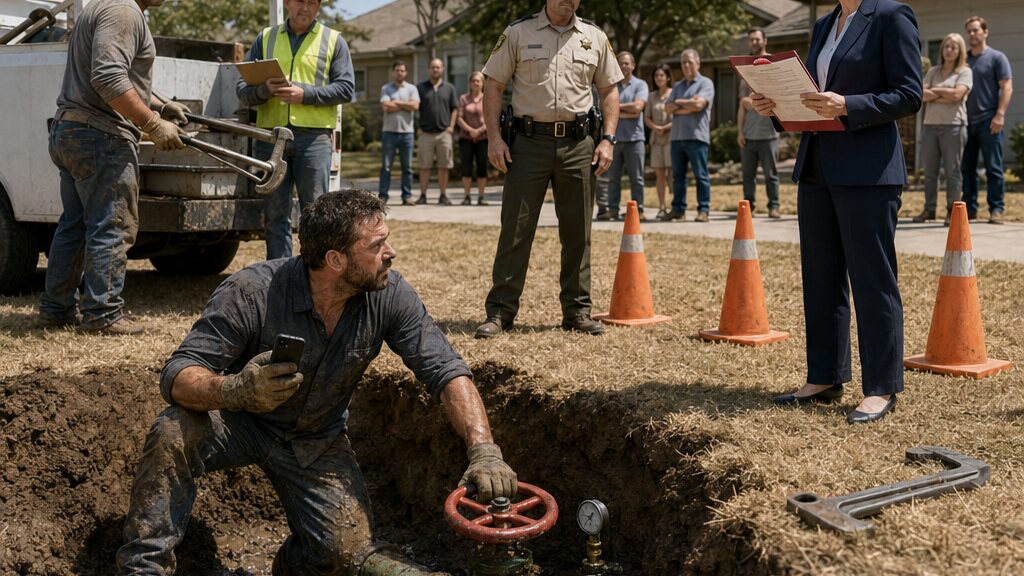
The HOA Called His Water Repair a Violation Until the Red Valve Proved Whose Land It Crossed
Chapter 1: The Crew Was Already Pulling Up the Valve Brace
The first thing Ryan Harris saw when he came out the front door was a worker lifting his steel valve brace into the back of a white truck.
For one second, he did not move. The morning light hit the exposed green pipe in the trench, the red valve wheel sitting above it like a warning sign. Orange cones stood around the open dirt, and the pressure gauge George Lopez had installed the night before trembled just above forty pounds.
It had been fifty-two when Ryan went inside to rinse the mud off his hands.
“Put that down,” Ryan said.
The worker looked over his shoulder. He was young, wearing safety glasses and gloves, and he froze with the brace halfway over the tailgate. A second worker stood near the trench with a shovel, its blade already biting into the pile of loose dirt.
“Sir, you need to step back,” the crew supervisor said. He held a clipboard flat against his chest, not quite making eye contact. “We’ve been authorized to secure the site.”
Ryan walked across the dry grass in his work boots, still damp at the cuffs from the leak. The lawn had gone yellow in strips where the underground line had been sweating for weeks, softening the soil beneath the brittle surface. Every step sounded wrong to him, hollow and dusty over wet ground.
“That brace is mine,” Ryan said. “It’s holding pressure off a cracked valve housing. You remove it, you’re not securing anything.”
The supervisor glanced toward the street.
Ryan followed his eyes. A navy SUV had parked at the curb. Samantha King stepped out in a fitted blue blazer, her hair pinned back, a red folder tucked under her arm. Behind her, a deputy in a tan uniform closed his cruiser door and adjusted his hat before walking up the drive.
Neighbors had already begun to gather. Two stood near a mailbox. Another watched from behind a half-open garage. Debra Roberts stood on the sidewalk with her arms folded, her face set in the guarded expression Ryan had seen at board meetings when someone wanted to look fair without choosing a side.
Ryan stepped down into the trench.
“Sir,” the supervisor said quickly, “don’t do that.”
Ryan planted one boot beside the green pipe and rested his gloved hand on the red valve wheel. The metal was warm from the sun. Under his palm, he could feel the faint shiver of water moving through the line.
“Until somebody shows me a court order,” Ryan said, “no one touches this valve.”
Samantha reached the edge of the cones and stopped as if the orange plastic marked a border she did not intend to cross. She opened the red folder and pulled out a paper with the HOA seal printed at the top.
“Ryan, this work is unauthorized,” she said. “You were notified that exterior excavation and modification to shared utility infrastructure require board approval.”
“I was notified after I sent you pictures of the leak for three weeks.”
“You sent an incomplete request.”
“I sent pressure readings, photos, and a plumber’s note.”
“You did not receive approval.”
The deputy raised one hand, not toward Ryan exactly, but toward the space between all of them. “Let’s keep this calm.”
Ryan looked at him. “Deputy, I’m calm. I’m standing on my property beside a failing water valve while a private crew removes the only brace keeping it from shifting.”
Samantha’s jaw tightened. “That valve does not serve only your property.”
There it was. The sentence changed the shape of the morning.
Ryan looked from Samantha to the neighbors, then down at the pipe. The green line entered from the easement strip near the curb, crossed under his front yard, and bent toward the row of houses behind him. He had known it was old. He had known it served more than his hose bib and kitchen sink. But the HOA had always treated it like a ghost: important when they needed access, invisible when it needed maintenance.
“Then why am I the only one fixing it?” he asked.
Samantha held out the notice. “You are being issued a violation for unauthorized excavation, unauthorized alteration of common utility components, and failure to obtain written approval before commencing work.”
Ryan did not take the paper.
The pressure gauge clicked softly. George had told him the gauge made no sound unless something moved fast. Ryan heard it now, a tiny metallic tick over the idling truck engine.
The crew supervisor shifted. “Ma’am, if he won’t step out, we can’t backfill.”
“You were not asked to backfill around me,” Ryan said. “You were asked to remove my repair before I got home.”
Samantha’s eyes flashed toward the supervisor, then back to Ryan. “A notice was left on your door.”
“When?”
“This morning.”
Ryan pointed to the brace in the worker’s hands. “This morning when the crew was already here?”
Debra’s expression changed. Not much, but enough. Her arms loosened.
The deputy looked at Samantha. “Do you have paperwork authorizing entry onto the property?”
“The association has authority over common utility access,” Samantha said.
“That’s not what I asked.”
Dennis Perez would have answered better, Ryan thought. Dennis always had language that sounded like a door closing gently in your face. Samantha had procedure, confidence, and a folder. But under the deputy’s question, her answer thinned.
She looked at Ryan. “This is not a personal attack. If that line is damaged, multiple homes could lose water. You are not licensed to alter it.”
“I hired George Lopez. Licensed plumber. He pulled the temporary brace because the valve housing is cracked.”
“Mr. Lopez was not approved by the association.”
“He was available before the thing blew.”
The worker still holding the brace lowered it slightly. “Boss?”
The supervisor frowned at him. “Hold on.”
Ryan pulled his phone from his shirt pocket and started recording. He angled it so the frame caught the red valve, the gauge, the brace, Samantha’s notice, and the deputy standing beside the cones.
“For the record,” Ryan said, keeping his voice level, “this is my yard, my emergency repair materials, and a failing water valve that the HOA was notified about in writing. I am asking for the legal order authorizing removal.”
Samantha’s face went still in the way people go still when they know every word may be replayed.
“You are creating liability,” she said.
“No,” Ryan said. “I’m documenting it.”
The deputy stepped closer to the trench and looked down at the pipe. “How bad is it?”
Ryan pointed to the lower seam behind the red wheel. A dark crescent of moisture had gathered there, too steady to be leftover from last night. “It opens when the pressure dips and comes back. George says the housing could split if somebody shifts the line wrong.”
The deputy crouched slightly but did not enter the trench. “And that brace?”
“Keeps torque off the cracked side.”
The crew supervisor cleared his throat. “We were told the assembly was unauthorized.”
“It is,” Samantha said. “That is the issue.”
Ryan looked up at her. “The issue is you keep saying authorized like water waits for your monthly agenda.”
A neighbor made a low sound, almost a laugh, then swallowed it.
Samantha heard it. Her cheeks colored, but she kept her posture. “You were instructed not to proceed.”
“My kitchen tap ran brown yesterday. My pressure dropped under forty twice this week. The ground around this pipe is wet while every lawn on this street is drying out.”
“Then you should have waited for emergency review.”
“I asked for emergency review.”
“You did not submit a complete utility impact statement.”
Ryan stared at her. Behind him, inside the house, the morning routine he had built his life around had already been interrupted: the filled jugs on the kitchen counter, the taped note above the sink reminding no one to run the washing machine, the bathroom faucet that coughed air before water. He had not told the neighbors. He had not told the board what the water loss would mean inside his house. He had believed pictures of a leaking valve would be enough.
That had been his mistake.
The pressure gauge clicked again.
This time the needle moved.
It fell from forty-one to thirty-eight in a slow, visible drop while everyone was looking at it.
The worker holding the brace set it down on the truck bed with a dull clang.
Ryan tightened his hand around the red valve wheel. Samantha stopped speaking. The deputy looked from the gauge to the damp seam under the valve.
The needle dropped one more line.
Chapter 2: The First Warning Was Marked Incomplete
The word INCOMPLETE sat across Ryan’s leak photo in red capital letters, as if the water spreading under his yard had failed to fill out the right part of the form.
He stood at his kitchen counter three mornings earlier, one hand on the laptop, the other wrapped around a glass of tap water that had gone faintly cloudy near the bottom. Outside the window, the same strip of dry grass cut across the yard in a pale line, but near the valve box the dirt had turned dark. That contradiction had bothered him more than the first sputter from the faucet. Dry lawn, wet ground. Low pressure, higher bill. Something underground was wasting water while the house rationed it.
He clicked open the HOA portal again.
Request returned for missing documentation.
Ryan leaned closer, jaw tight.
He had attached eight photos: the sunken patch near the curb, the exposed valve cover, the pressure gauge George had loaned him, the hairline crack visible after Ryan brushed mud off the housing. He had attached a short note from George: valve assembly unstable, recommend immediate excavation and temporary brace pending replacement.
Below Samantha’s response, a checklist showed two boxes unchecked.
Utility impact statement.
Board-approved contractor.
Ryan had stared at those words until the laptop screen dimmed.
His phone buzzed beside the cloudy glass. George Lopez.
“Tell me you’re not waiting on them,” George said when Ryan answered.
“I’m trying to keep this clean.”
“Clean is good. Flooded is not.”
Ryan looked toward the hallway. The house was quiet except for the refrigerator and the faint hiss in the pipes that had started the day before. “They marked it incomplete.”
“For what?”
“Utility impact statement and approved contractor.”
George made a short sound. “Ryan, they don’t have an approved contractor list for underground water valves. They have a landscaping vendor and a pool guy they use for clubhouse work.”
“That’s not what the form says.”
“The form says what it says so nobody has to decide anything before a meeting.”
Ryan closed his eyes. He was tired of people making delay sound neutral.
George softened his voice. “What’s the pressure now?”
Ryan looked at the small gauge George had temporarily fitted to the exterior bib the day before. “Forty-six.”
“What was it at six?”
“Fifty-two.”
“That’s not a normal swing. If the housing shifts, it could rupture. You might not get a polite leak. You might get a break.”
Ryan turned the glass in his hand. The cloudiness had begun to settle into a fine line of grit.
“How long?” he asked.
“I wouldn’t wait the week. I wouldn’t wait two days if that seam is wet.”
Ryan did not answer.
George knew the silence. “You’re thinking you can patch around it yourself.”
“I’m thinking I can expose enough for you to brace it.”
“That is not the same as approval.”
“I’m not asking you to replace the association’s line. I’m asking you to keep it from breaking.”
“And I’m telling you if Samantha King decides to make an example out of this, she’ll say I altered shared infrastructure without authorization.”
Ryan looked at the hallway again. At the closed door. At the note taped by the sink in thick black marker: Fill pitcher before running dishwasher. He had written it like a household reminder, not a warning. He hated that difference.
“I sent the photos,” he said. “I sent the readings.”
“Send them again.”
“I did.”
“Then print them.”
Ryan laughed once, without humor. “Print them?”
“Print everything. People like that trust paper more than water.”
That afternoon, Ryan printed the whole chain. He laid it across the kitchen table in order: first report, first photo, first pressure reading, Samantha’s acknowledgment, his second warning, George’s note, the returned request. He wrote dates in the margins. He circled the pressure numbers. He clipped the pages under a binder clamp and set them beside the cloudy glass.
By evening, the faucet in the downstairs bathroom coughed hard enough to rattle the pipe behind the wall.
That was when Ryan went to the garage.
He had told himself he was only going to uncover the valve box. Then only widen the access. Then only dig enough for George to see. Each step had felt reasonable because the alternative was waiting for a committee to decide whether water moving under his house counted as urgent.
George arrived after sunset, work light in one hand, tool bag in the other. He did not look pleased.
“You already dug half of it,” he said.
“You said expose it.”
“I said don’t let me catch you doing something stupid alone.”
Ryan climbed out of the trench and handed him the flashlight. “Then don’t let me do it alone.”
George knelt, wiped mud from the green pipe, and went quiet.
Ryan knew enough to dislike that silence.
George traced a gloved finger around the valve housing below the red wheel. “It’s worse than the photo.”
“Can you brace it?”
“I can brace it temporarily. I don’t want to turn it hard. I don’t want anybody bumping it. And I really don’t want a crew coming out here thinking they can yank this loose and toss dirt over it.”
Ryan looked at him.
George sat back on his heels. “That’s not a figure of speech.”
They worked under the harsh work light until the steel brace was seated and the pressure stopped its slow fall. George tagged the temporary assembly with orange tape and wrote DO NOT SHIFT on it in marker. The red valve stood above the brace, still old, still cracked beneath, but steadier.
For the first time in two days, the kitchen faucet ran clear.
Ryan sent Samantha one more email before midnight.
Temporary emergency brace installed by licensed plumber to prevent failure. Full replacement still requires coordination. Please confirm emergency review first thing in the morning.
The reply came at 6:14 a.m.
Mr. Harris, your installation constitutes unauthorized alteration of community utility infrastructure. Removal and site restoration will proceed.
Ryan had read that sentence three times before he noticed the attachment.
Violation Notice.
Now, standing in the yard with Samantha’s paper in front of him and the pressure gauge dropping in real time, Ryan could see the shape of his own mistake. He had believed documentation was the same thing as forcing an answer. He had believed urgency would be obvious if he made the evidence clear enough.
George arrived at the curb in his work truck just as the deputy asked who had installed the brace. His eyes moved from the crew truck to the trench to the gauge.
“Oh, no,” George said.
Samantha turned toward him. “Mr. Lopez, you should be aware the association has not approved you to perform work on this system.”
George looked at Ryan, then at the wet seam. “That system is going to make its own approval process if you keep pulling parts off it.”
The deputy stepped aside to let him near the trench. George crouched, checked the gauge, and swore under his breath.
Samantha heard him. “Is there an immediate failure?”
“There is an immediate risk.”
“That is not what I asked.”
“It’s the answer you get before failure.”
Ryan almost smiled, but the feeling died when George brushed dirt away from the lower pipe and stopped.
“What?” Ryan asked.
George pointed to a faded survey stake half-buried near the far edge of the trench, then to a thin scrap of old marking tape caught below the soil line.
“You still have your closing survey?” George asked.
“In the file cabinet.”
“Get it.”
Samantha’s eyes narrowed. “Why?”
George did not look at her. He looked at Ryan.
“Because unless I’m reading this wrong,” he said, “this valve might not be in the utility strip. It might be inside your lot line.”
Chapter 3: Samantha Called It Community Infrastructure
“Deputy, he is interfering with shared water service,” Samantha said, loud enough for the neighbors to hear.
Ryan was halfway out of the trench with mud on his jeans and the old survey folder tucked under his arm. He stopped on the ladder rung and looked at the small crowd by the sidewalk. The sentence had landed exactly where Samantha meant it to land. Shared water service. Not cracked valve. Not ignored warnings. Not emergency brace. Shared water service.
Debra Roberts took one step back from the curb.
A man near the mailbox shook his head. Someone whispered, “That’s why the pressure’s been bad?”
Ryan felt the shift. Until that moment, the open trench had been a curiosity. Now it was a threat, and he was standing inside it.
He climbed out slowly. “Say the whole thing,” he said.
Samantha turned from the deputy. “Excuse me?”
“Say that I reported the leak. Say I sent photos. Say George warned the valve housing was unstable.”
“This is not the place to litigate your incomplete application.”
“This is exactly the place if your crew is taking my repair apart in front of my house.”
The deputy moved closer to the cones. “Let’s keep voices down.”
Ryan made himself breathe through his nose. He could feel his temper looking for a place to go. Samantha’s folder. The truck bed. The brace lying loose where it should not have been. He pictured himself grabbing it, shoving past the worker, dropping back into the trench. That was what anger wanted. Anger wanted a clean action. But the deputy was watching, and so were the neighbors, and Samantha had already chosen the frame.
Interfering.
Unauthorized.
Shared.
Ryan opened the survey folder instead.
The paper inside was creased and soft at the folds, the lot lines printed in fading black. He had bought the house seven years earlier, when the neighborhood was still selling itself as quiet and stable, the kind of place where lawns were trimmed and people waved from driveways without knowing one another too well. The survey had sat in a drawer with closing papers, warranties, and the instructions for appliances he no longer owned.
George stood beside him and pointed at the front boundary. “This line here is the property edge. Utility easement should run five feet in from the sidewalk.”
Samantha barely glanced at it. “The association records show this valve as part of the common water distribution system.”
“Common doesn’t mean yours,” Ryan said.
“It means you cannot alter it unilaterally.”
“I didn’t alter it. I braced it to keep it from cracking open.”
Debra stepped off the sidewalk. “Samantha, is that valve connected to our side of the loop?”
Samantha looked irritated by the question. “The water system layout is not the point right now.”
“It is if my house is on it,” Debra said.
A few neighbors shifted again, this time toward Debra.
Ryan looked at her. “You’ve had pressure drops?”
Debra hesitated. Her face carried the reluctance of someone who had arrived ready to disapprove and now found herself holding the wrong facts. “My kitchen faucet has been sputtering for three days.”
Samantha closed the red folder. “That could be unrelated.”
“It could be,” Debra said, but her voice had lost certainty. “But the upstairs shower ran brown yesterday morning.”
Ryan looked down at the pressure gauge. Thirty-seven. Not falling fast now, but not right.
George folded his arms. “That’s not unrelated.”
Samantha’s mouth tightened. “Mr. Lopez, unless you are retained by the association, I would caution you against making broad statements about community infrastructure.”
George looked at the deputy. “Is caution a legal order now?”
The deputy did not smile, but his eyes moved down briefly.
Samantha turned to the crew supervisor. “Secure the trench perimeter. Do not remove anything further while law enforcement is present.”
Ryan heard the careful wording. Not canceled. Not stopped. While law enforcement is present.
The supervisor nodded and told the workers to set the brace down beside the cones. One worker did it gently now, as if the metal had become evidence instead of scrap.
Samantha pulled another sheet from her folder and held it toward Ryan. “You are also being notified that daily fines will begin tomorrow if the unauthorized excavation remains open and the unapproved assembly is not removed.”
Ryan stared at the page. “You’re fining me for not letting you bury a leak.”
“I am enforcing the governing documents.”
“You’re enforcing them around the part where the ground is wet.”
“This community cannot allow homeowners to dig up shared systems whenever they personally decide something is urgent.”
Ryan almost told her then. He almost said who was inside the house, why the jugs were lined along the counter, why losing water was not an inconvenience he could wait out with a hotel room and patience. The words came close enough that he felt them in his throat.
Then he saw the neighbors watching.
Some curious. Some annoyed. Some frightened that their own water might depend on the man in the muddy boots. He had spent years keeping his private life behind the front door. He had learned how quickly a community could turn need into gossip, and gossip into judgment disguised as concern.
So he swallowed the truth.
“My pressure is dropping,” he said instead. “Debra’s water is brown. George says the valve is unstable. What else do you need before this becomes emergency work?”
Samantha looked at him for a long second. Something moved behind her expression—not softness, not exactly. Pressure. Calculation. Fear of choosing wrong in public.
Then it vanished.
“I need proper approval,” she said.
Debra looked away.
The deputy took the notice from Samantha and read the first page. “Ms. King, this authorizes fines. It doesn’t authorize me to remove him from his property.”
“I asked you here to prevent escalation.”
“And I’m doing that.”
Ryan felt a small, hard piece of relief. It was not victory. The brace was still out of place. The trench was still open. The fine was now official. But for the moment, nobody was forcing him out of the hole.
Samantha seemed to understand the same thing. She turned to Ryan, lowering her voice enough that only those closest could hear.
“The crew will return tomorrow at eight. If you have documentation that changes the association’s authority, provide it before then.”
Ryan looked at the old survey in his hand. “And if I don’t?”
“Then the violation proceeds.”
George glanced at him sharply. Debra stared at the damp trench. The neighbors began murmuring again, reshaping the story before it had finished happening.
The deputy stepped beside Ryan as Samantha walked back toward her SUV.
“I can keep the peace,” he said quietly. “I can ask questions. But if they come back tomorrow with a civil order or stronger paperwork, you’ll need more than that survey copy.”
Ryan looked at the red valve, the loosened brace, the needle sitting too low, and the wet seam darkening the soil beneath it.
“How much more?” he asked.
The deputy folded the notice and handed it back.
“Enough to prove they don’t have the right to do what they’re planning.”
Chapter 4: The Easement Map Had One Missing Page
“The map is here,” the county records clerk said, “but the attachment that explains this line is missing.”
Ryan stood at the counter with mud still dried along the seams of his boots. He had not gone home to change. The old survey from his file cabinet lay open beside the clerk’s thicker county folder, and both showed the same thing in different ways: a thin utility line bending across the front of his lot before disappearing toward the neighboring houses.
The clerk turned another page, frowned, and checked the screen beside her. “There should be a recorded maintenance attachment after this easement description.”
“Should be,” Ryan repeated.
She looked up, not unkindly. “It’s referenced. That doesn’t mean it scanned properly.”
Ryan put both hands on the counter. Through the glass entrance behind him, he could see his truck parked crooked in a visitor space, the violation notice on the passenger seat where he had thrown it. The crew would return at eight the next morning. That gave him less than twenty-four hours to turn a missing page into enough proof to stop a truck, an HOA chair, and whatever stronger paperwork Samantha found between now and then.
“What does the part you do have say?” he asked.
The clerk angled the folder toward him. “This section grants utility access across lots six through nine for the original development water loop.”
Ryan looked down. Lot seven. His lot.
His thumb found the crease in his closing survey where the red valve sat in his mind, not drawn in color, not marked with danger, just a small utility symbol near the front yard. He had walked over that spot for seven years. Mowed around it. Pulled weeds near it. Let the HOA landscapers pass by it when they checked sprinkler overspray after complaints. The valve had been treated like a shared thing when convenient and like his problem when wet soil appeared around it.
“Who maintains it?” he asked.
“That’s probably in the missing attachment.”
“Probably doesn’t help me by tomorrow morning.”
The clerk pressed her lips together. She had the careful patience of someone used to angry people discovering that public records were not as complete as they expected. “There may be a paper copy in archive storage, but that request takes time.”
“How much time?”
“Two to five business days.”
Ryan gave a short laugh. “The pipe may not last two days.”
She paused at that. Her fingers hovered over the keyboard. “I can print what we have.”
“Print everything.”
While the printer warmed behind her, Ryan checked his phone. Three missed calls from George. One email from Samantha with the subject line Final Notice of Site Restoration. He opened it.
Mr. Harris, unless documentation is provided demonstrating lawful authorization for the alteration, the Association will proceed with removal and restoration tomorrow at 8:00 a.m. The Association’s position remains that your excavation presents a hazard and unauthorized modification risk to shared water service.
Below that was a copied line from Dennis Perez.
Avoid language suggesting maintenance admission until easement responsibility is confirmed.
Ryan stared at those words.
Not safety. Not water. Not the pressure gauge dropping in front of witnesses. Maintenance admission.
He scrolled up, making sure he had not misread. Dennis had been included on an internal reply by mistake, or maybe Samantha had forwarded too much in haste. The line sat there, neat and careful, the kind of sentence written by someone who knew exactly which words could cost money later.
The clerk returned with a stack of pages warm from the printer.
Ryan held up his phone. “If the association attorney is telling them not to admit maintenance responsibility, does that mean they know there’s a responsibility to avoid admitting?”
The clerk’s face closed slightly. “I can’t give legal advice.”
“I’m not asking for advice. I’m asking if that line means what it sounds like.”
“It means you should keep that email.”
Ryan almost smiled. It was the closest thing to an opinion she could give.
He paid for the copies, carried them outside, and spread them across the hood of his truck. The dry heat hit the paper immediately, lifting the corners. He weighted one side with his phone and the other with the cloudy water bottle he had brought from the kitchen that morning.
The map showed the main water loop running under the front easement, then cutting inward at his property. The line looked wrong now that he knew where the trench sat. It did not hug the sidewalk as Samantha had implied. It crossed his yard at an angle, as if the original developer had chosen the easiest path and left later homeowners to inherit the consequences.
George called again.
Ryan answered. “I found the easement.”
“Good.”
“Not good enough. The maintenance attachment is missing.”
George was silent for a beat. “Of course it is.”
“And Dennis Perez accidentally copied a line saying they should avoid maintenance admission until responsibility is confirmed.”
“That’s something.”
“It’s not enough.”
“It might be enough to make the deputy cautious.”
“Cautious doesn’t keep them from bringing a crew.”
George exhaled. “What does the map show?”
Ryan described the angled line, the lot number, the utility access language. George listened without interrupting.
“That matches the old marker tape,” George said. “The valve is inside your lot, not the strip.”
“But if it serves the loop, they’ll say they have access.”
“Access isn’t ownership. Access isn’t permission to bury a failure.”
Ryan folded one page, then unfolded it because the crease cut through the line. His hands were too rough for paper this thin.
“I should have pulled this file years ago,” he said.
“Most people don’t study buried water easements until water starts coming out of places it shouldn’t.”
Ryan looked through the windshield at the violation notice on the passenger seat. “I knew that valve was strange. Every time they wanted to inspect it, they came through my yard. I let them. I didn’t ask questions because I didn’t want to be difficult.”
“You’re allowed to ask questions about things under your grass.”
Ryan did not answer.
He thought of all the times he had stayed quiet because quiet kept life moving. When the HOA sent notices about trash cans visible from the street, he moved the cans. When Samantha asked to inspect the valve box after a neighborhood pressure complaint two years ago, he opened the side gate. When a neighbor parked across his curb cut during a block party, he let it go. There had always been something else more urgent inside the house, something that made arguing feel expensive.
Now the cost of not arguing had reached the red valve.
He drove home with the records on the passenger seat and stopped at the curb before pulling into the driveway. The trench was ringed in caution tape. The brace had been placed back near the pipe but not fully seated. George had refused to leave it loose and had reinstalled enough support to keep the line from shifting, but he had warned Ryan not to trust it under pressure.
Ryan sat in the truck and watched two neighbors slow their walk near his yard. They did not wave.
His phone buzzed.
A message from Debra Roberts.
For a moment he did not open it. Debra had stood with her arms crossed that morning. She had repeated board phrases at meetings before, talking about consistency and neighborhood appearance. Ryan had expected her to send some careful message about process.
Instead, the screen showed a photo.
A white kitchen sink. Brown water running from the faucet in a thin, ugly stream.
Below it, Debra had typed: This was 6:10 this morning. Samantha told me not to connect it to your valve until review is complete. Why would she say that if they don’t know?
Ryan looked from the phone to the trench, then back to the message.
Debra sent another line before he could answer.
I’m on the board. I want to see what you have before tonight.
Chapter 5: The Board Offered a Pause Instead of Water
Ryan’s trench photo appeared on the clubhouse screen under the words UNAUTHORIZED EXCAVATION AND UTILITY ALTERATION.
The picture had been taken from across the street, probably by Samantha or someone standing beside her. In it, Ryan looked smaller than he had felt that morning: a man in muddy jeans standing in a hole, one gloved hand on the red valve, the loosened brace visible near his boot. The photo did not show the pressure gauge clearly. It did not show the wet seam under the housing. It did not show the cloudy water glass, the emails, the old survey, or the way the needle had dropped while everyone stopped talking.
It showed a violation.
Samantha stood near the projector with a remote in her hand. Dennis Perez sat at the end of the board table, suit jacket open, legal pad centered in front of him. Debra sat two chairs away from Samantha, the printed photo of her brown tap water face down beside her agenda.
Ryan sat in the first row with the county records folder on his lap. George sat behind him, arms folded, jaw working as if he were chewing back words.
“The association’s position,” Samantha said, “is not that Mr. Harris’s concerns are irrelevant. The position is that no homeowner may excavate and modify components of a shared utility system without review, approval, contractor verification, and risk assessment.”
Ryan watched the board members nod at familiar language. Review. Approval. Verification. Assessment. Words that made delay sound like care.
Samantha clicked to the next slide. A close-up of the trench filled the screen. Orange cones. Exposed green pipe. Red valve.
“An open excavation also creates a hazard,” she continued. “If the association ignores an unauthorized alteration and a failure occurs, the entire community may bear the cost.”
Ryan raised his hand.
Samantha looked at him as if she had hoped he would not. “Homeowner comments will be taken after the board discussion.”
“You’re discussing my yard.”
“You will have time to speak.”
“Will the water line wait too?”
A few chairs shifted behind him. Dennis looked up from his legal pad.
Samantha’s voice stayed even. “Mr. Harris, this is exactly why process matters.”
Debra turned her face slightly toward Ryan but said nothing.
The board discussion moved like a slow machine. One member asked whether the crew could restore the site without touching the valve. Samantha said removal of unauthorized supports was part of restoration. Another asked whether Ryan could be required to cover costs. Dennis said reimbursement language should be preserved. Debra finally lifted her head.
“Before we talk about billing Ryan,” she said, “can we talk about the pressure complaints?”
Samantha paused. “They are logged separately.”
“Why separately?”
“Because we don’t yet have confirmation they relate to this valve.”
Debra turned over the photo of her sink and slid it across the table. “This is my kitchen yesterday morning. I’m three houses down from Ryan. He reported pressure drops. I reported sputtering. Two other homes emailed last week. Why were those not included in tonight’s packet?”
The room changed.
It was not dramatic. Nobody gasped. Nobody stood. But Ryan saw shoulders tighten and eyes move toward Samantha.
Samantha looked at the photo, then at Dennis. “Those complaints were not excluded. They were not yet evaluated.”
“By whom?” Debra asked.
“The water vendor has not completed review.”
George leaned forward behind Ryan. “What water vendor?”
Samantha’s eyes moved to him. “Mr. Lopez, this is a board meeting.”
George sat back, but he did not look away.
Ryan opened his folder. The paper edges shook slightly, not from fear but from the effort of holding back too long. “I submitted photos on the third, pressure readings on the fifth, George’s note on the sixth, and a follow-up on the seventh. Every time, the response was incomplete. Not denied after review. Not sent to an emergency contractor. Marked incomplete.”
Samantha’s fingers tightened on the remote. “Because you failed to provide required documentation.”
“You asked for a utility impact statement. How was I supposed to provide a utility impact statement for a system the HOA controls?”
Dennis set his pen down. “Mr. Harris, it is important to separate practical frustration from legal authority.”
Ryan looked at him. “I am separating them. Practically, the valve is failing. Legally, your email says not to admit maintenance responsibility.”
Dennis went still.
Samantha’s head turned sharply. “What email?”
Ryan pulled the printed page from the folder and held it up. “The one forwarded to me this morning.”
Debra reached for it first. Ryan handed it to her. She read the line, then passed it to the board member beside her.
Dennis did not reach for it. “That was privileged discussion inadvertently included in correspondence.”
“You sent it to the homeowner you’re fining,” Ryan said.
“That does not change its nature.”
“It changes mine. I know now this was not just about a missing form.”
Samantha stepped away from the projector. For the first time that evening, her confidence seemed strained by more than irritation. “The association has to be careful. If we authorize work and that work causes damage to the loop, every homeowner could be assessed. If we admit responsibility for a component without confirming the easement, every homeowner could be assessed. People in this room expect us to protect them from avoidable costs.”
Debra looked at her. “People in this room also expect water.”
The sentence landed harder because Debra did not raise her voice.
Ryan looked down at the folder. He had not planned to say anything about the inside of his house. He had planned to keep it to maps, pressure, emails, the valve. Hard facts. Things that did not invite pity. Things that did not let neighbors picture his private rooms.
Then Samantha clicked back to the trench photo, and the red valve filled the screen behind her.
He stood.
“My house can’t go without water,” he said.
Samantha’s expression tightened with impatience. “No house should have to go without water, Mr. Harris.”
“No,” Ryan said. “You’re hearing inconvenience. I mean can’t.”
The room quieted.
He kept his eyes on the board table, not on the neighbors behind him. “There is someone in my home who depends on running water for daily care. Not bottled water. Not ‘we’ll wait until next week.’ Running water. Clean water. When the faucet runs brown, it is not a nuisance. When the pressure drops, it changes what can happen safely in that house.”
He stopped there. It was more than he wanted to give and less than the whole truth.
George looked down at the floor. Debra’s face softened, then steadied.
Samantha’s voice was quieter when she answered. “You did not include medical necessity documentation in your request.”
Ryan laughed once, and the sound surprised him. “I sent you a leaking pipe.”
Dennis leaned toward his microphone though he did not need it in the small room. “The board may consider a temporary pause on daily fines while documentation is gathered.”
Ryan looked at him. “And the repair?”
Dennis glanced at Samantha.
Samantha said, “The association cannot approve emergency work tonight without the missing easement attachment, contractor verification, and a written scope acceptable to counsel.”
George stood behind Ryan. “I can write the scope before I leave this room.”
“And you are not an association-approved contractor,” Samantha said.
“There is no association-approved contractor for this valve.”
Dennis tapped his pen once. “That is one of the items requiring review.”
Debra pushed her chair back slightly. “So we pause the fine but still let the crew return tomorrow?”
Samantha did not answer quickly enough.
Ryan knew then that the decision had been made before the meeting. The discussion was not about whether the repair was necessary. It was about how much risk the board wanted attached to the word yes.
A motion came, shaped by Dennis and read by Samantha: daily fines paused for forty-eight hours if Ryan removed himself from the work area and permitted site restoration; emergency repair authorization deferred pending complete documentation; no admission of maintenance responsibility by the association.
Debra voted no.
It was the only no.
Ryan closed his folder slowly while the other votes settled into the room.
Samantha would not look directly at him when she said, “Mr. Harris, if you locate the missing easement attachment before eight tomorrow, submit it immediately.”
“And if I don’t?”
Dennis answered instead. “Then the association proceeds under the authority currently available.”
Ryan looked at the red valve on the screen, enlarged behind them all, bright and simple against the dark soil.
Outside, his phone buzzed again. He expected George, or maybe Debra. But the message was from the county records clerk, sent after hours from an official address.
Found reference to separate utility attachment filed under original developer name. Not same folder. May relate to your lot. You can view in person tomorrow after 8:30.
Ryan read the time twice.
Tomorrow after 8:30.
The crew was coming at eight.
Chapter 6: The Red Valve Was Never Theirs Alone
The crew restarted the pump at 8:03, and the pressure gauge above Ryan’s red valve began to tremble before anyone said good morning.
Ryan was already in the trench.
He had slept in his clothes for two hours, maybe less, then woken before sunrise to line the county printouts in plastic sleeves and seal them in a folder against the damp. George’s truck was parked halfway across the driveway, blocking the crew from backing closer. The deputy’s cruiser sat at the curb. Samantha’s navy SUV idled behind it.
The removal workers stood near the cones, waiting for instruction. One held a shovel. The other held the steel brace Ryan had reinstalled before dawn, both hands around it now, as if afraid to be caught either holding it or letting it go.
A hose ran from the crew’s pump toward the trench edge. They had said they were removing standing water before backfill. George had said the water was not standing; it was coming from the seam.
The gauge needle flickered at thirty-six.
“Turn that pump off,” Ryan said.
The crew supervisor looked toward Samantha.
Samantha stepped up beside the cones, a folder in one hand and her phone in the other. Her face showed the strain the meeting had left behind, but her voice was controlled. “Mr. Harris, you were instructed not to enter the work area.”
“It’s my yard.”
“It is an unsafe excavation involving shared infrastructure.”
“It became unsafe when your crew started moving parts.”
George stood at the trench edge with his tool bag closed at his feet. That bothered Ryan more than the deputy, more than Samantha, more than the neighbors gathering again along the sidewalk. George’s tools were closed because he would not touch the valve without written permission. Not after Dennis’s warnings. Not after the board’s motion. Not with Samantha watching for one more violation.
Ryan did not blame him. That made it worse.
“George,” Ryan said quietly, “look at the gauge.”
George did. His face hardened.
Samantha noticed. “Mr. Lopez, the association has not authorized repair work.”
“I’m not working,” George said. “I’m watching a bad decision build pressure.”
The deputy moved closer to Samantha. “Do you have anything beyond the HOA notice today?”
Samantha handed him a document. “Formal site restoration directive, approved by the board.”
The deputy read it, one page, then the next. “This is association paperwork.”
“It authorizes the association to correct violations related to common utility components.”
“It authorizes fines and restoration. It doesn’t look like a court order.”
Samantha’s mouth tightened. “Deputy, are you refusing to enforce association rules?”
“I’m saying I’m not dragging a homeowner out of a trench over a civil document unless there’s a clear legal order.”
The pump coughed. The gauge bounced down to thirty-four, then back up to thirty-five.
George crouched and pointed without touching anything. “That seam is opening.”
A dark bead of water formed beneath the valve housing. It gathered, swelled, then ran down the green pipe in a thin line.
The worker holding the brace took a step back.
Samantha saw it. For a moment, the procedural mask slipped. Fear crossed her face—not fear of Ryan, but of the line failing in front of witnesses, phones, and a deputy who had already questioned her authority.
Ryan pulled the plastic-sleeved folder from inside his shirt to keep it dry. “I don’t have the missing attachment yet,” he said. “County found it under the developer name. They won’t open the office record until eight-thirty.”
Samantha’s answer came too fast. “Then you do not have documentation.”
“I have the easement map. I have the email from Dennis. I have Debra’s water photo. I have three weeks of pressure readings. I have George standing here telling you the valve is failing. And I have this line crossing my lot.”
“Access rights exist for precisely this reason,” Samantha said. “So the association can protect the system.”
“Then protect it.”
The words left Ryan before he could polish them. He heard the anger in them, but also the truth.
Samantha looked at the pipe.
Her phone rang. She checked the screen and turned slightly away. “Dennis, I’m on site.”
Ryan could not hear Dennis’s words, only the rhythm: short, controlled, legal. Samantha’s shoulders drew tighter as she listened.
Debra arrived while Samantha was still on the call. She wore board-meeting clothes from the night before, as if she had not slept either, and carried a folded paper in one hand. She did not stop by the neighbors. She came straight to the trench.
“I went to the old utility access box behind my fence,” she said.
Samantha covered the phone. “Debra, not now.”
“Yes, now.” Debra held out the paper to Ryan, then seemed to remember where he was standing and gave it to the deputy instead. “There’s a laminated emergency contact sheet inside the access box. It lists the original developer’s utility attachment number. Same number the clerk sent Ryan.”
The deputy read it. “Where did this come from?”
“HOA utility access box,” Debra said. “Locked with the board key.”
Samantha’s face changed. “You opened an association access box?”
“I’m on the board.”
“That sheet is not a governing document.”
“No,” Debra said. “But it proves we knew where to look.”
Ryan looked at the paper in the deputy’s hand. It was old, sun-faded at the edges, but the attachment number was legible. The same number from the clerk’s message. Not the missing page itself. Not full proof. But no longer nothing.
George pointed again. “Needle.”
Thirty-two.
The bead under the valve became a thin spray.
Everyone heard it when it started. A sharp hiss, almost delicate, like air escaping a tire. Water misted against the dirt wall of the trench and darkened Ryan’s boot.
The crew supervisor stepped back. “We’re not backfilling over that.”
Samantha lowered her phone.
Ryan looked at her. He no longer cared about winning the argument over whose paperwork had failed first. The spray tapped his jeans in a cold pattern, and inside the house the sink would already be coughing if pressure kept falling. He thought of the person behind the closed door, the careful routine built around water being there when needed. He thought of the jugs on the counter and the way he had turned his private promise into silence, then expected strangers to understand the urgency without being told.
“My household cannot lose water,” he said.
No one spoke.
He kept his hand on the red valve wheel, but he did not turn it. “Not for comfort. Not for a lawn. For care. There are things in that house that require clean running water, and I should not have had to say that in the street to make a leaking pipe real to you.”
Samantha looked away first.
It was not victory. It was only the first sign that the words had gone somewhere she could not file them under incomplete.
Dennis’s voice still sounded faintly from her phone. She lifted it back to her ear, listened, then said, “If we authorize emergency stabilization only, without prejudice, does that preserve position?”
Ryan almost laughed. Even now, she needed a phrase that protected the board from the simple act of stopping water from spraying into dirt.
The deputy handed the old access sheet back to Debra. “Ms. King, I can’t tell your board what to approve. But I can tell you what I’m seeing. There is an active leak. The homeowner is on his property. Your order is not a court order. And your own board member has produced a reference tying this valve to records not reviewed yet.”
George picked up his tool bag, then stopped himself. “I need written authorization before I touch it.”
Ryan looked at him sharply.
George’s face was tight with apology. “I’m not refusing you. I’m refusing to let them make me the next violation.”
Ryan understood. He hated that he understood.
The spray strengthened, ticking against the plastic sleeve in Ryan’s hand. The pressure gauge slid to thirty.
Neighbors stepped back from the curb as if the whole line might burst upward through the grass.
Samantha stood between the deputy, Debra, the crew, the watching street, and the trench she had tried to turn back into a compliance issue. Her folder was damp at the bottom from mist drifting out of the hole. Her phone remained against her ear, but she was no longer speaking.
Ryan raised his voice just enough to carry.
“You can enforce the denial,” he said, “or you can authorize the repair and write down exactly why. But if you stand here and watch this fail because the missing page opens at eight-thirty, that will be your decision, not mine.”
The red valve hissed under his hand.
Samantha looked at the pressure gauge, then at the water spreading around Ryan’s boots, and for the first time since she arrived, she had no ready sentence.
Chapter 7: The Repair Order Named the Land and the Need
“You can authorize stabilization verbally,” Samantha said, “and we can document it after.”
Ryan did not move his hand from the red valve.
The spray had grown steadier, no longer a mist but a thin angled line striking the trench wall and cutting a small groove through the dirt. Water gathered around his boots, brown at first, then clearer as it ran over the exposed green pipe. The pressure gauge sat just under thirty and trembled there, as if deciding whether to fall.
“No,” Ryan said.
George looked at him from the trench edge. “Ryan.”
Ryan glanced up. George’s tool bag was open now. One wrench lay across the top, ready. The old instinct rose in Ryan to say, Fine, do it, fix it, we’ll deal with the rest later. It was the same instinct that had put him in the trench without written acknowledgment, the same stubborn belief that the emergency itself would protect him from people who preferred forms.
It had not.
Ryan looked back at Samantha. “In writing. Before George touches it.”
Samantha’s lips parted, then closed. Behind her, Debra had her phone out, thumb moving fast. The deputy stood near the cones, arms at his sides, watching the water cut deeper into the trench wall.
“Mr. Harris,” Samantha said, carefully now, “we are trying to prevent further damage.”
“That’s what I was doing yesterday.”
“This is not the time to argue.”
“It’s exactly the time to write down what everyone is agreeing to before somebody changes the words later.”
The deputy nodded once, almost to himself.
Samantha saw it. Her eyes flicked to him, then to Debra, then to the neighbors gathered along the curb. The crew supervisor had stepped away from his truck and was staring at the leaking seam with the anxious attention of a man who did not want to be named in any report.
Samantha unlocked her phone. “Dennis, draft emergency stabilization authorization. No admission of ownership. No admission of maintenance responsibility. Limited scope only.”
Ryan shook his head. “Not enough.”
She lowered the phone slightly. “Excuse me?”
“Name the land.”
“Ryan—”
“Name the land,” he repeated. “Lot seven. My property. Exposed valve within disputed easement area. Emergency stabilization only. Existing leak. Medical household need. George Lopez authorized to stabilize and replace the failing valve housing today. Violation paused pending record review. No removal crew touching the assembly.”
Dennis’s voice buzzed faintly from the phone, too small to catch.
Samantha’s expression hardened at “medical household need,” but she did not challenge it in front of the deputy. “We cannot include private medical language without documentation.”
“You don’t need the diagnosis. You need the need. Clean running water required for household care. That’s true.”
Debra stepped closer. “Put it in as homeowner-stated need if you have to.”
Samantha looked at her. “Debra, this is not how board approvals are handled.”
Debra held up her own phone. “Then call it an emergency vote. I’ve reached two other board members. They saw the video of the leak. They saw my water photo. They both approve stabilization if the scope is limited and documented.”
Ryan looked at her. “You sent them the video?”
“I sent them the part where the valve started spraying while we argued about whether it was urgent.”
Samantha’s face flushed. “That should have gone through the board channel.”
“It did,” Debra said. “You weren’t answering.”
For a moment, the only sound was the hiss of the leak and the pump idling beside the crew truck.
Then Samantha turned away and spoke into the phone again, lower this time. Ryan caught pieces: emergency conditions, temporary vote, homeowner-stated need, preserve legal position. She paced three steps toward the sidewalk, stopped, and pressed two fingers to the bridge of her nose.
Ryan looked down at the red valve.
It was strange how small the wheel seemed now. Yesterday it had felt like the center of a fight over land and authority, his hand wrapped around it because stepping back meant surrender. Now the red paint was chipped, water ran beneath it, and it looked less like a symbol than what it had always been: a working part that needed to work.
George crouched at the edge. “When that email hits, I’ll need the brace back in place before I loosen the housing.”
Ryan nodded.
“You’re going to have to climb out.”
“I know.”
George studied him. “Do you?”
Ryan looked at the water around his boots and gave a tired half-smile. “I’m learning.”
The authorization arrived eight minutes later.
Samantha did not hand him her phone. She forwarded the email to Ryan, Debra, George, and the deputy while standing three feet from the trench. Ryan opened it with wet gloves, wiped the screen against his sleeve, and read every line.
Emergency stabilization authorized for exposed water valve assembly located at Lot 7, Harris property, within disputed utility easement area.
Licensed plumber George Lopez authorized to perform immediate stabilization and replacement of failing valve housing as needed to prevent service interruption.
Association violation and site restoration action paused pending review of easement attachment and maintenance responsibility.
Homeowner-stated household water necessity noted.
No removal or backfill work to proceed until stabilization complete.
Ryan read it again.
The words were not warm. They did not apologize. They did not undo the meeting or the notice or the neighbors watching him stand in muddy water to prove that a leak was a leak. But they named the land. They named the need. They stopped the crew.
He looked at George. “Do it.”
This time, Ryan climbed out of the trench.
The step felt harder than standing his ground had. George jumped down in his place, already issuing short instructions. The crew supervisor, eager now to be useful on the safer side of the decision, handed back the steel brace. One worker shut off the pump. The deputy helped move the cones farther out. Debra stood near the sidewalk, phone pressed to her ear, confirming the emergency vote in a voice that shook only when she thought no one was listening.
Samantha remained by the trench, arms folded around the red folder. Water speckled the toe of one polished shoe.
George worked fast, but not hurried. He reseated the brace, reduced pressure, cut out the failing housing, and replaced it with a new assembly from his truck. Ryan watched every movement, fighting the urge to step in, hand over tools, tighten something himself. Once, George looked up and said, “Let me work,” and Ryan stepped back without arguing.
That, too, felt like repair.
At 9:17, the county records clerk sent the scanned attachment.
Debra opened it first. Her mouth tightened as she read. She showed Samantha, then Ryan.
The attachment did not give the HOA ownership. It granted maintenance access across the affected lots and required the association, as successor to the developer’s water loop responsibility, to maintain shared components crossing private lots. The language was old and awkward, but it was clear enough to change the air around them.
Samantha read the page twice. “This still needs counsel review.”
Ryan nodded. “Review it.”
She looked up, surprised by the lack of fight.
“But the violation gets withdrawn,” he said. “Not paused. Withdrawn. And the line gets inspected past my yard. Debra’s water didn’t turn brown because of my paperwork.”
Debra said, “I’ll make the motion.”
Samantha looked at the repaired valve, then at the crew truck, then down at the damp folder in her hand. Her face was tired now in a way Ryan had not seen before. Not defeated. Not transformed into sudden kindness. Just forced to stand inside the consequences of a decision she had tried to manage from clean rooms and careful language.
“I thought if we admitted anything before the records were complete, we would open the whole association to costs we couldn’t cover,” she said.
Ryan wiped mud from his wrist with a rag. “So you opened my yard instead.”
She took that without answering.
George turned the red valve slowly.
Everyone watched the pressure gauge rise.
Thirty-two. Thirty-eight. Forty-four. Forty-nine.
It steadied just above fifty.
No hiss followed. No spray cut the dirt. The green pipe sat braced and quiet beneath the red wheel, ordinary again in the way only a repaired thing can be ordinary.
Ryan went inside after George finished the first pressure test. He did not invite anyone. He walked past the folder on the entry table, past the muddy boot prints he would clean later, and into the kitchen.
He turned on the faucet.
Air coughed once. Then water ran hard, cloudy for two seconds, then clear.
Ryan stood with both hands on the edge of the sink and watched it fill the glass. The sound moved through the house, simple and steady. From the hallway came the soft shift of someone waking behind the closed door.
He filled the pitcher first.
When he returned to the yard, George was packing his tools. Debra and Samantha stood near the sidewalk with the deputy, discussing the emergency inspection order that would go to the full board that afternoon. The removal crew was loading their unused shovels back into the truck.
Samantha approached him with a single sheet of paper.
“Written withdrawal of the site restoration action,” she said. “Temporary, pending formal board ratification.”
Ryan read it.
“Violation withdrawn,” he said.
She hesitated, then took the paper back and wrote the words in the margin before initialing them. “Violation withdrawn pending formal correction in the system.”
It was not perfect. It was not clean. But it was in writing.
Ryan accepted the paper.
Samantha looked toward the trench. “The association will need access for inspection.”
“With notice,” Ryan said. “Written.”
“Yes.”
“And no one comes onto my property with a crew before I’m notified.”
She nodded once. “Yes.”
Debra watched the exchange, then looked at Ryan. “I’m sorry I didn’t ask better questions yesterday.”
Ryan folded the withdrawal and tucked it into his shirt pocket. “You asked them today.”
The deputy left first. The crew followed. Debra walked back toward her house with the attachment copy in her hand, already talking about pressure complaints and emergency procedures. Samantha remained a moment longer at the curb, looking at the dry yellow grass cut by the dark scar of the trench.
Ryan did not ask her for an apology.
George joined him beside the open hole. “I’ll come back tomorrow to check the pressure again.”
“Send an invoice.”
“To you or the association?”
Ryan looked at the red valve.
It sat above the repaired housing, chipped paint bright against green pipe and wet soil. The wheel turned easily now, not as a weapon, not as proof of pride, but as the small working center of a home that could keep going.
“The association,” Ryan said. “Copy me.”
George smiled faintly. “Now you’re learning.”
By late afternoon, the trench was still open, the grass still ruined, and the yard still looked like a wound. But inside the house, the pitcher was full. The bathroom tap ran clear. The pressure gauge held steady each time George checked it.
Ryan stood at the edge of the trench after everyone had gone and turned the red valve one careful inch, then back again.
It moved smoothly.
Water flowed where it was supposed to flow, beneath his land, toward homes that had nearly let a rule bury the problem. Ryan looked at the written order in his hand, then at the dark marks the crew tires had left in the dry grass.
The yard would take time to heal.
This time, he would make sure the repair was documented before anyone tried to cover it over.
The story has ended.