The HOA Called My Workshop Illegal After Their Drainage Project Flooded Everything I Had Built
Chapter 1: The Water Rose Past the Pencil Mark Before Sunrise
The walnut cabinet door floated past my boots at 5:17 in the morning.
For one stupid second, I watched it as though it belonged there.
The panel turned slowly in the brown water, one corner lifting over a submerged extension cord, the grain catching the yellow light from the emergency fixture above my bench. I had spent eleven hours matching that door to three others for a built-in library wall. Black walnut, hand-selected. Straight grain through the center. A narrow curl at the rail that I had rejected twice before deciding it gave the set character.
Then the current took it under the assembly table.
I lunged after it.
Cold water filled my right boot.
“Damn it.”
The door struck the leg of the table and vanished into the murk.
By then the water was nearly halfway up my shins.
I stopped.
Not because of the door.
Because I could hear more water coming.
The sound was wrong for rain. Rain hit the metal roof in a flat roar. This was lower and heavier—a rushing sound from behind the workshop, as if someone had opened a valve uphill.
I climbed onto the bottom brace of my lumber rack and looked through the rear window.
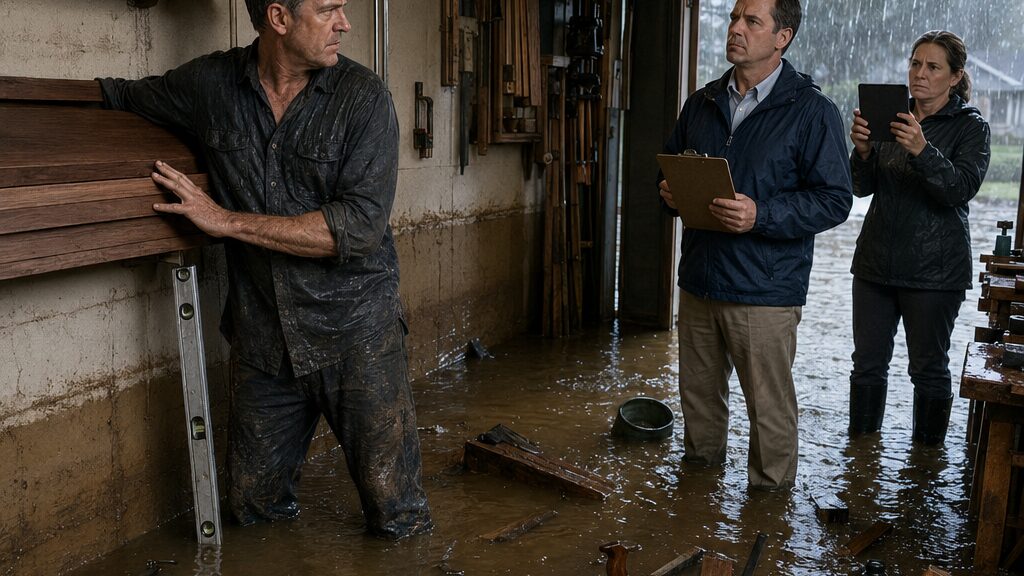
A sheet of muddy runoff poured through the narrow strip between my retaining stones and the property fence. It struck the back wall, split around the foundation, and entered through the low service door where the weather seal had already surrendered.
That strip of ground had carried water before. Every property carried water somewhere.
But not like this.
I dropped back into the flood and started moving what I could.
The lower walnut stack was already wet. I slid boards one by one onto the upper arms of the rack, though the weight pulled at my shoulders and my hands kept slipping on the soaked faces. A chisel roll floated open beside the planer. Two clamps knocked against each other under the water with a hollow metal sound.
My phone buzzed on the bench.
Elizabeth.
I looked at her name and let it ring.
There was no point calling my daughter at five in the morning so she could drive across town and stand in water with me. I had pumps. I had tools. I had handled worse things than a wet floor.
That was what I told myself.
The pump near the side door coughed, sucked air, then died.
I waded to it and found a rope of wet sawdust wrapped around the intake.
By the time I cleared it, the water had climbed another inch.
On the drywall beside my finishing cabinet was an old pencil mark I had made years earlier after a minor storm backed water under the door. Barely four inches above the slab. I had written the date beside it, more as a joke than a record.
The new muddy line had already passed it.
I stared at that for longer than I should have.
Then somebody knocked on the glass.
Mark Lewis stood outside on the raised gravel path.
He wore a navy rain shell over a pressed shirt, and he had one of those stainless travel mugs in his hand. Behind him, on higher ground beyond the fence, the common slope rose toward the neighborhood entrance road.
I shoved open the side door.
Water surged around the threshold.
Mark looked down at it and took one step back.
“Joseph.”
“Don’t stand there,” I said. “Help me move the walnut.”
His eyes went past me into the shop. For the first time, his expression changed.
Then it closed again.
“I came because a neighbor reported water crossing the rear lots.”
“No kidding.”
“I can see you’ve got a serious problem.”
I laughed once. I could not help it.
“A serious problem.”
“I’m not minimizing it.”
“Then put the mug down.”
He did not.
Instead he looked toward the lower corner of my lot, where muddy water spread through the grass.
“This is the low side of the development,” he said.
I thought I had misheard him.
“What?”
“The lower lots have always collected runoff. You know that.”
“Not through my shop.”
“I’m saying we need to be careful about assigning blame before anyone knows what happened.”
Another board slid off the lower rack behind me and struck the water flat.
Mark flinched at the sound.
I pointed through the rear window.
“You finished drainage work up there four days ago.”
“The association completed erosion control near the entrance.”
“And now I have a river.”
“It rained all night.”
“It has rained before.”
His jaw tightened.
Mark had lived in the neighborhood six years. Long enough to know every rule number and every reserve account balance, not long enough to remember when the vacant slope above me had been mostly scrub and clay. He was not a fool. That was what made arguing with him worse.
He glanced at the detached workshop.
“Was this structure always used commercially?”
I went still.
“What does that have to do with water?”
“I’m asking because once insurance gets involved, there may be questions.”
“From insurance?”
“From several directions.”
The rain hammered the roof between us.
I stepped closer.
Mark lowered his voice.
“Joseph, I’m telling you as a courtesy. The board has received complaints before about deliveries, customer traffic, equipment noise. If you’re going to allege association liability, management will review the property file.”
There it was.
Not a threat exactly.
Something cleaner.
A sentence built so nobody could quote it later and call it one.
Behind me, water reached the base of a finished cherry cabinet.
I turned away from Mark and waded toward it.
“Close the door.”
“Joseph.”
“Close it.”
He stayed another moment, then pulled the door shut.
Through the glass I watched him walk uphill without getting mud on his shoes.
For the next three hours, I worked alone.
I saved the cherry cabinet. Lost two walnut slabs. Lost the lower drawer bank beneath the bench. The moisture meter went under. A custom vanity carcass swelled at the corners until the joints opened.
At eight-thirty, Elizabeth arrived anyway.
She came through the door in rubber boots, carrying contractor bags and coffee.
“You didn’t answer.”
“I was busy.”
She looked around the shop.
Her face emptied.
“Dad.”
“Don’t.”
“I wasn’t going to say anything.”
“You were.”
“I was going to ask why you’re standing in contaminated water with a cut on your hand.”
I looked down. Blood ran from my thumb, diluted pink almost instantly.
She set the coffee down.
For the next hour she photographed everything I had been too angry to photograph.
Every ruined board.
Every tool.
Every swollen joint.
Every muddy line.
At the back wall, she held her phone beside the old pencil mark.
“This one was from when?”
“Seven years ago. Storm in April.”
“And this?”
“Today.”
She photographed the new stain.
Then she crouched near the rear door.
“Dad.”
I followed her outside.
The rain had weakened. With the noise reduced, the source became easier to hear.
Water moved along the rear edge of my property in a defined current.
Not broad runoff.
A channel.
We followed it uphill as far as the fence allowed. At the corner, the flow entered from the HOA common strip through a depression that had not been there the week before.
Fresh straw lay flattened against the mud.
Beyond it, higher on the slope, orange construction netting trembled in the wind.
Elizabeth looked at me.
“That’s where they were working?”
“Yes.”
“Do you have pictures from before?”
“No.”
“Of course you don’t.”
“I built cabinets. I didn’t document dirt.”
Her phone buzzed.
She looked at the screen.
“One of your neighbors sent me something.”
“Which one?”
“She didn’t say I could give you her name.”
That irritated me enough that I almost refused to look.
Elizabeth turned the phone anyway.
The photograph had been taken from an upstairs window two evenings earlier. The image was grainy but clear enough.
A small excavator sat near the upper common road.
Beside it was a long ridge of raw brown soil.
Not the short erosion-control feature I had seen described in the HOA notice.
This ran farther downhill.
Much farther.
At the lowest edge of the photograph, just before the frame ended, the fresh earth bent toward the slope above my property.
I enlarged the image with two fingers.
There were tire tracks.
A stack of straw wattles.
And a dark cut in the ground that pointed downhill like an arrow.
Elizabeth watched my face.
“What?”
I handed the phone back.
“That wasn’t there last week.”
Chapter 2: The Board Answered My Damage Claim With a Violation Notice
The certified envelope contained no mention of my ruined walnut.
I read it twice at the kitchen counter before understanding what it was.
NOTICE OF POTENTIAL COVENANT AND USE VIOLATIONS.
The management company logo sat at the top. My property address beneath it. The letter identified possible unapproved exterior modifications, possible commercial use inconsistent with residential restrictions, and an apparent discrepancy between county records and the current footprint of the detached accessory structure.
There was a response deadline.
Ten business days.
Elizabeth stood across from me with both hands around a mug.
“They sent that after your damage claim?”
“Apparently.”
“Exactly how long after?”
I checked the date.
“Three days.”
She gave a small nod that meant she was trying not to say what she thought.
I folded the letter.
“Don’t.”
“I haven’t said anything.”
“You’re about to.”
“I’m about to ask whether the workshop is legal.”
“It’s a workshop.”
“That was not my question.”
I put the envelope beside the sink.
For two weeks, I had been doing nothing but numbers.
Twenty-six thousand dollars in walnut I knew I could not recover. More if the stickered boards developed mold deeper into the stack. Three active commissions delayed. One vanity cancelled. A library installation pushed indefinitely because the matched doors had been damaged.
The sixty-thousand-dollar number Elizabeth had assembled included inventory, damaged work, tools, cleanup, and contract exposure. It was not a number I liked saying aloud because the moment you said a large number, people assumed you were inflating it.
The insurance adjuster had walked through the shop with a tablet and careful sympathy.
Then the carrier sent a reservation letter.
Surface water and runoff damage might be excluded unless a covered event or liable third party could be established.
In other words: prove where the water came from.
I had sent the HOA photographs, invoices, the neighbor’s picture of fresh earth, and a written timeline.
Their answer was on my kitchen counter.
Elizabeth tapped the envelope.
“Dad.”
“The original shop was permitted.”
“Original.”
I looked toward the back window.
She caught it.
“What did you add?”
“Nothing major.”
Her eyes closed briefly.
“That phrase has never once led to good news.”
“An eight-foot extension.”
“When?”
“Six years ago.”
“Permitted?”
“I pulled the permit.”
“Closed?”
I said nothing.
She set down the mug.
“You did not close it.”
“The framing inspection passed.”
“That’s not what I asked.”
“The final never happened.”
“Why?”
“Because I was working.”
She stared at me.
I hated the look—not judgment, exactly. Recognition.
She knew me too well.
After my first business failed years earlier, I had built the second one around a private rule: never owe anyone enough that they could decide whether I survived. I paid suppliers early. I kept cash reserves. I fixed my own equipment. I did not ask family to cover gaps.
The workshop extension had been the same kind of thinking. The framing passed. The electrical work was done properly. I started moving machines before the final inspection and told myself I would schedule it after a large order shipped.
Then another order came.
Then six years passed.
Elizabeth opened the folder of county papers I had placed on the table.
One sheet was missing.
Her gaze lifted.
“You took something out.”
“No.”
“Dad.”
“It wasn’t relevant to drainage.”
“That is not the same as no.”
She walked past me toward the small office off the kitchen. I followed.
“Elizabeth.”
She opened the scanner tray.
The permit-status page was still there.
I had removed it from the claim packet and forgotten the scanner had saved a copy.
She picked it up.
For a long moment, she said nothing.
Then, quietly, “You’re demanding all their records while hiding yours.”
My face went hot.
“I’m not hiding anything from the county.”
“You hid it from me.”
“This is my property.”
“And I’m the one calling clients to explain why their cabinets are late.”
That landed.
She left the page on the desk and stepped away.
I could have apologized.
Instead I said, “The permit didn’t cause the flood.”
“No. But your silence might help them make people forget that.”
She went home before lunch.
At two, I drove to the HOA management office.
The representative met me in a conference room with fake wood furniture and a framed photograph of the subdivision entrance.
I placed the certified notice on the table.
“You inspected my file after I reported damage.”
“The association has an obligation to investigate potential compliance concerns.”
“Who raised them?”
“I can’t discuss individual complaints.”
“Were there complaints before my claim?”
She paused.
“I would need to review the record.”
“So review it.”
“Mr. Thompson—”
“Joseph.”
Her expression tightened.
I slid over a printed request.
“Meeting minutes. Contracts. Approved plans. Change orders. Anything related to drainage work along the upper entrance and common slope.”
“You’re requesting association records?”
“Yes.”
“Some documents may be privileged.”
“Then identify what you’re withholding.”
That surprised her.
Good.
I had spent the previous night reading the association’s own records-access policy.
For once, being angry had made me useful.
Three days later, I received a digital folder.
Most of it was useless: invoices, landscaping emails, board agendas, photographs of erosion near the entrance road.
Then I found a line in meeting minutes from six weeks before the flood:
Emergency drainage stabilization approved to prevent continued undermining of common entrance pavement.
Mark had moved the motion.
Debra Green had seconded it.
The attached plan showed a shallow diversion swale and a short compacted berm.
I printed the drawing and took it to the workshop.
The shop smelled like wet wood and disinfectant. Fans ran constantly. On the rear wall, the muddy waterline had dried into an uneven brown stain.
I taped the approved plan beside Elizabeth’s photograph.
Something bothered me.
I turned the photograph clockwise.
Then back.
The plan showed the berm ending near a cluster of three mature trees.
The photograph showed fresh soil continuing beyond them.
I drove uphill.
The common area was technically open to residents. I stayed on the walking path and counted the trees.
One.
Two.
Three.
The berm did not stop.
It extended past the third tree, around a utility marker, then curved toward the lower slope.
Toward me.
I took photographs from three angles.
The next morning, I went to the county permit counter.
A records clerk pulled the association drainage file and my property file after I filled out the request forms.
The HOA plan matched the copy I had received.
Short berm.
Shallow swale.
Nothing extending toward my lot.
Then the clerk opened my workshop record.
There it was.
Permit issued.
Framing approved.
Electrical noted.
Final inspection: not completed.
Status: open.
The clerk turned the screen slightly toward me.
“You’ll probably need to speak with inspections if you intend to close this.”
“Can it still be closed?”
“Possibly. Depends on current condition and what changed.”
I looked at the date.
Six years.
The number felt worse on an official screen.
My phone buzzed.
An email from the HOA attorney.
The subject line read: PROPERTY COMPLIANCE AND PENDING CLAIM.
I did not open it yet.
Instead I unfolded the approved drainage drawing on the counter and placed my phone beside it.
On the screen was the neighbor’s photograph.
Short approved berm on paper.
Long fresh berm in reality.
The clerk leaned forward before catching herself.
“That’s the same project?”
“That,” I said, “is what I’m trying to find out.”
Chapter 3: They Came to Inspect My Workshop While the Water Was Rising Again
I heard Mark’s shoes on the stairs before I saw the clipboard.
Hard soles.
Measured steps.
Completely wrong for a morning when muddy water was already spreading across my workshop floor.
I was standing on a ladder, moving walnut boards to the top rack, when the side door opened.
Mark came in first.
Behind him was the management-company representative in knee-high rubber boots, holding a tablet.
I looked from her boots to Mark’s shoes.
“You planned for water,” I said.
Mark ignored that.
“Joseph, we notified you yesterday that we needed access for the compliance inspection.”
“And I told you today was not acceptable.”
“The notice provides a reasonable inspection window.”
A stream of water crossed the floor between us.
The representative stepped around it.
I climbed down.
Outside, the second storm in three weeks drove rain across the side yard. The repaired pump near the rear door ran continuously, but the water was gaining.
Mark opened a folder.
“We’re here to document the current structure, exterior modifications, and apparent business use.”
I stared at him.
“You came to photograph violations while I’m flooding.”
“We came at the scheduled time.”
“You picked the time.”
“The weather is not under association control.”
I almost hit him.
The thought arrived cleanly enough to frighten me.
Not because I believed I would do it.
Because for a second, it seemed simpler than every paper, every email, every invoice, every careful sentence I had written while he stood there protected by procedure.
Then a board shifted behind me.
I turned.
The upper walnut rack held.
The anger passed just enough.
I walked to the finishing cabinet and took down my four-foot level.
Mark watched.
“What are you doing?”
I carried it to the rear wall.
The first flood stain was still visible. Elizabeth had made me preserve it before cleanup by marking the crest in pencil and writing the date beside it.
The new water had not reached it yet.
I set the level horizontally against the wall.
The representative raised her tablet.
“Are you recording this inspection?” I asked.
“We document site conditions.”
“Good.”
I took out my phone and started recording too.
Mark’s face changed.
“Joseph, let’s not turn this into theater.”
“I agree.”
I placed a fresh pencil mark at the current water height.
Then I measured from the slab.
“Seven and three-eighths.”
I wrote the number on blue painter’s tape and stuck it to the wall.
The representative glanced at Mark.
He said, “A water mark doesn’t establish source.”
“No.”
I set the level on the bench.
“It establishes height.”
I went back to moving lumber.
For twenty minutes, they measured the workshop.
The representative photographed the extension.
The side wall.
The electrical panel.
The exterior doors.
The area where I stored finished work.
Every click of her tablet sounded deliberate.
Meanwhile the water rose.
I stopped pretending not to watch it.
At 9:14, it reached the first storm’s lower stain.
At 9:37, it passed it.
I picked up the level again.
Mark exhaled.
“Joseph.”
I ignored him.
I measured.
Nine and one-quarter inches.
Nearly two inches above the first crest.
The rain intensity had already begun to weaken.
I checked the time, photographed the wall, then stepped toward the rear door.
Outside, the current along the property edge ran fast enough to bend the grass flat.
“Come here,” I said.
Neither moved.
I looked at the representative.
“You’re documenting conditions.”
She hesitated, then followed.
Mark came after her.
We stood beneath the narrow roof overhang.
Water entered from the HOA common strip in a concentrated path. Not everywhere. One path.
I pointed uphill.
“The first storm came four days after your drainage work. This one came after the berm was extended farther downslope.”
Mark’s eyes sharpened.
“According to whom?”
I took the approved plan from a plastic sleeve on the workbench.
“According to this.”
Rain spotted the clear plastic.
I indicated the three trees.
“The approved berm ends here.”
Mark glanced at it.
“And?”
I pointed through the rain.
“The dirt on your property doesn’t.”
“That may be temporary stabilization.”
“Where is it on the plan?”
“I’m not the engineer.”
“You’re the board president.”
“The board authorizes work. Contractors handle field conditions.”
“Then why did the second flood crest higher after the temporary extension?”
The representative stopped typing.
Mark looked at the wall.
At the two marks.
At my phone.
For the first time since entering, he seemed aware that the scene around him could exist outside his control.
He said, “You’re assuming causation from two storms of different intensity.”
“Maybe.”
That answer surprised him.
I continued.
“Maybe I’m wrong. Show me the authorized location of the extension.”
He looked down at the drawing.
I waited.
Three trees.
Short line.
End point.
The actual earthwork was visible beyond the third tree from where we stood.
Mark handed the plan back.
“I don’t carry construction records.”
“But you brought my property records.”
His mouth tightened.
The representative looked away.
Nobody spoke for several seconds.
Then Debra Green appeared at the top of the side steps.
I had not seen her come through the yard.
She wore a hooded raincoat and held a closed umbrella. As HOA treasurer, she had spent most of the previous two weeks answering my emails with versions of: The board is reviewing the matter.
Now she looked at the water in my shop.
Her face went pale.
“Mark,” she said.
He turned.
“I thought this was an exterior inspection.”
“The access notice covers the accessory structure.”
“In this?”
“That’s enough,” I said.
All three looked at me.
I did not raise my voice.
“Finish whatever you came to do. Then get out.”
Mark started to respond.
Debra interrupted him.
“Mark.”
Something in her tone stopped him.
The representative completed two more photographs. Mark signed something on the tablet. They moved toward the stairs.
Debra stayed behind.
I picked up a soaked offcut and tossed it into the salvage pile.
She waited until Mark was out of hearing distance.
Then she said, “Request the contractor change records.”
I looked at her.
“What?”
“Not just invoices.”
Rain drummed against her hood.
“Daily logs. Field directives. Change records.”
“Why?”
Her gaze moved toward the upper slope.
“I’m telling you what to request.”
“No. You’re telling me there’s something there.”
“I didn’t say that.”
“You came down here during an active flood to watch them inspect me. Now you’re whispering about contractor logs.”
Her jaw worked once.
“You think everybody on that board agrees about how this has been handled?”
“I think everybody on that board signed the same letters.”
Pain flickered across her face, but she controlled it.
“Request the records, Joseph.”
Then she left.
I stood in the doorway until she disappeared uphill.
By noon, the water stopped rising.
I marked the final crest.
Nine and five-eighths inches.
Two dated lines now crossed the wall: one brown stain, one fresh pencil mark above it.
Elizabeth arrived carrying plastic totes.
She saw the new mark and swore softly.
I told her about the inspection.
She stopped unloading.
“They did what?”
“Later.”
“No, not later.”
“Elizabeth.”
She looked ready to argue, then saw my phone in my hand.
“What are you doing?”
“Requesting records.”
I wrote the email at the bench.
Contractor daily logs.
Field directives.
Change orders.
Site instructions.
Any communication concerning extension, modification, relocation, or temporary continuation of the approved berm or swale.
Elizabeth read over my shoulder.
“Who told you to ask for that?”
“Debra.”
That silenced her.
The management company acknowledged the request before the end of the day.
Two days passed.
Then four.
On the fifth afternoon, a download link arrived.
Most files were ordinary.
Equipment hours.
Material deliveries.
Crew notes.
Weather delays.
I opened each one and printed anything that mentioned the slope.
At 6:40 that evening, I found a daily log from the week before the first flood.
The entry was only three lines.
Crew extended compacted berm beyond plan limit due continued entrance runoff. Field direction received from board representative. Additional diversion toward lower swale completed 4:25 p.m.
I read it again.
Elizabeth stood at the opposite end of the bench, sorting damaged invoices.
“What is it?”
I turned the page toward her.
Her eyes moved over the entry.
“Board representative,” she said.
“Yeah.”
“Does it say who?”
“No.”
I checked the next page.
Nothing.
Then the previous day.
Nothing.
I went back through the folder until I found a scanned handwritten note attached to an equipment ticket.
The writing was cramped. Two words were nearly illegible.
But the final line was clear.
Proceed per board direction.
Beside it were initials.
M.L.
Elizabeth leaned closer.
Neither of us said Mark’s name.
We did not need to.
The question had changed.
It was no longer whether someone had extended the berm.
Someone had.
Now I needed to know why Mark Lewis had ordered work beyond the approved plan—and what he had been told before he did it.
Chapter 4: The Old Map Helped Me Until My Own Secret Broke the Case Open
The drainage sheet was older than the subdivision name.
I found it under a plastic cover at the county records office, folded into quarters and stamped with a date from the 1990s. The paper had yellowed along the creases. Blue contour lines crossed parcels that no longer existed in the same shape, and a narrow dashed channel ran downhill from the upper ridge.
It did not run through my workshop.
It passed east of my lot.
I bent closer.
The county records clerk glanced over from the next table.
“Need a larger copy?”
“Yes.”
She carried the sheet to a wide scanner while I stood there trying not to decide too quickly what I had found.
The old channel curved through land that later became the subdivision entrance, crossed what was now common property, then followed a shallow natural draw toward a drainage corridor beyond my rear boundary. My workshop sat close to it, but not inside it.
I thought of Mark standing in my flooded doorway.
Low side of the development.
Natural runoff.
I took out my phone and photographed the map.
For the first time since the flood, I felt something close to certainty.
By noon I was sitting across from Daniel Rivera in a county engineering office with the old drainage sheet spread between us.
Daniel wore a light-blue work shirt with the sleeves rolled once and had a mechanical pencil tucked behind one ear. He studied the map without giving me the reaction I wanted.
Finally he said, “Interesting.”
“That’s all?”
“It’s a historical drainage plan.”
“It shows the water bypassing my building.”
“It shows an intended or observed drainage path at that time.”
“Before the subdivision.”
“Yes.”
“And now the water comes through my shop.”
“Yes.”
“So they changed it.”
He leaned back.
“Maybe.”
The word hit harder than I expected.
I pointed to the dashed channel.
“The map is right there.”
“It proves historical context. It does not prove what caused your two floods.”
I stared at him.
Daniel turned the sheet around so I could see it from his side.
“You have at least three separate questions. What was the historic path? What was later approved? What was actually built?”
“I have all three.”
“No. You have pieces.”
I took out the approved HOA drawing and the photograph of the berm.
Daniel aligned them.
His expression sharpened slightly.
“That extension isn’t on this plan.”
“Exactly.”
“But a photograph doesn’t give me exact coordinates.”
“I can show you where it is.”
“I believe you can show me a dirt ridge. I still need to know whether it materially altered concentrated flow.”
The certainty I had carried into his office began to leak away.
“So the old map means nothing?”
“I didn’t say that.”
“It sounds like you did.”
Daniel looked at me for a moment.
Then he tapped the historical channel.
“This tells you where to look. It does not finish the argument.”
I gathered the papers too quickly.
The old sheet caught at a crease.
Daniel put one hand on it before I tore it.
“Mr. Thompson.”
“Joseph.”
“Joseph. If you walk into a hearing saying this map proves the HOA flooded you, their attorney will take you apart.”
I stopped.
Not because of the attorney.
Because he was right.
I had already written exactly that in my first complaint draft.
Daniel released the paper.
“Measure. Compare. Build the sequence.”
I folded the map carefully.
Outside, in the parking lot, I sat in my truck with the air conditioner off and read my own complaint on my phone.
The language looked different now.
They redirected stormwater into my property.
Their illegal berm caused catastrophic flooding.
The association knowingly altered the natural drainage path.
I had written conclusions where I had evidence for suspicion.
Elizabeth had warned me about that too.
I called her.
She answered on the second ring.
“What happened?”
“You always assume something happened.”
“With you? Yes.”
“I found an old drainage sheet.”
Silence.
“And?”
“It shows a channel bypassing the shop.”
“That sounds good.”
“Daniel says it proves history, not causation.”
Another silence.
This one was longer.
“You sound disappointed that the engineer is being an engineer.”
“I’m not disappointed.”
“Dad.”
I looked at the old folded map on the passenger seat.
“Can you meet me tonight?”
“At your place?”
“No. Yours.”
She understood enough not to ask why.
Before I left the county complex, I drove past the upper common area with a measuring wheel borrowed from a surveyor I knew through cabinet work.
I did not enter restricted ground. I stayed along the common walking path and used visible fixed points from the approved drawing: utility marker, three trees, curb inlet, edge of pavement.
The berm continued farther than the plan showed.
Not by a few feet.
By more than forty.
I measured twice.
Then I compared the field location to the drawing scale.
The extension curved downslope toward the lower swale—the same swale feeding water toward my property.
That was something.
Not the whole case.
Something.
At Elizabeth’s kitchen table that night, I spread everything out.
Old drainage map.
Approved HOA plan.
Photographs.
Measurements.
Contractor log.
The note with M.L.
She listened without interrupting until I finished.
Then she pushed one sheet toward me.
My open workshop permit.
“I talked to the county inspections desk.”
I looked up.
“You what?”
“You asked me to help with business paperwork.”
“I did not ask you to call them about that.”
“No. You hid it.”
My voice hardened.
“Elizabeth.”
“They said it may be fixable. They’ll need an inspection, probably updated electrical confirmation, maybe corrections depending on what changed.”
“I know how inspections work.”
“Then why haven’t you scheduled one?”
“Because I am dealing with a flood claim.”
“You were not dealing with a flood claim six years ago.”
I looked away.
She did not raise her voice.
That made it worse.
“You keep saying Mark is using procedure to avoid the truth,” she said. “What are you doing?”
“The permit has nothing to do with drainage.”
“I agree.”
“Then stop combining them.”
“I’m not. They will.”
I pushed back from the table.
The folded old map shifted under my elbow.
“Do you think I caused this?”
“No.”
“Do you think the board gets to flood my shop because I missed a final inspection?”
“No.”
“Then what exactly are we arguing about?”
Her eyes were wet, though her voice stayed level.
“We’re arguing about whether you want to win this case or keep pretending nobody gets to see you make a mistake.”
I stood there with no answer.
My phone buzzed on the table.
An email.
The subject line carried the HOA attorney’s name and the words SUPPLEMENTAL COMPLIANCE NOTICE.
I opened it.
The message was short.
The association had obtained county records indicating the workshop addition remained under an open permit. Pending clarification, the board reserved all rights concerning unapproved modifications and prohibited uses.
There was an attachment.
A copy of the permit-status page.
The same page I had removed from my own packet.
Elizabeth read over my shoulder.
“They know.”
“Yes.”
The next morning, Mark called me directly.
I nearly let it go to voicemail.
Then I answered.
“Joseph.”
“What?”
“I’d like to resolve this before it gets more expensive for everyone.”
I said nothing.
Mark continued.
“The board is prepared to suspend active enforcement while you work through your permit issues.”
“In exchange for what?”
A pause.
“You withdraw the drainage complaint.”
There it was.
No lawyerly fog.
No vague courtesy.
I gripped the phone.
“You’re offering to ignore my violation if I ignore yours.”
“That is not what I said.”
“It’s exactly what you said.”
“I’m offering a practical resolution. Your structure has issues. The association faces disputed allegations with no final technical finding. We can stop escalating.”
I looked through the workshop window.
The two waterlines crossed the wall.
One stain.
One pencil mark above it.
“What happens to my damage?”
“You pursue whatever coverage is available to you.”
“And the berm?”
“The board maintains that the work was necessary emergency stabilization.”
“Even the part beyond the plan?”
Another pause.
Then Mark said, “Think carefully before you turn a complicated property matter into a public fight.”
The line went quiet after he hung up.
I stood with the phone against my ear.
On the bench, the old map lay folded beside my open permit record.
For the first time, I understood that I could probably make one problem disappear.
All I had to do was abandon the other.
Chapter 5: The Woman Who Defended the Board Finally Told Me What They Feared
“I voted for it.”
Debra Green said the words before I had taken off my jacket.
The diner was nearly empty, too late for breakfast and too early for lunch. She had chosen a booth in the back where the coffee machine hissed louder than the conversations.
I remained standing.
“For the extension?”
“For the emergency work.”
“That isn’t the same answer.”
“No.”
She looked tired.
Not guilty in the theatrical way I had imagined guilty people looking. Just older than she had seemed at board meetings.
I sat across from her.
Debra had a folder beside her coffee but kept one hand on top of it.
“Mark told me you offered a deal,” I said.
“He told the board he was exploring resolution.”
“He offered to suspend enforcement if I withdrew the drainage complaint.”
Her mouth tightened.
“That was not put to a vote.”
“So he acts alone when it matters.”
“That’s not fair.”
I almost laughed.
“Fair.”
She looked toward the window.
Then back at me.
“You think we built that berm because we didn’t care what happened downhill.”
“I think you built it and my shop flooded.”
“Yes.”
The directness stopped me.
Debra drew a breath.
“Last winter, the entrance road started settling near the east curb. We patched it twice. Then the storm in March washed material from under the edge.”
“I saw the cones.”
“The first engineering estimate for a full drainage correction was more than the reserve account could absorb.”
“How much?”
She told me.
The number was high enough that I understood why she had asked for the back booth.
“A special assessment?” I said.
“That was one option.”
“How much per house?”
She looked down.
“Enough to hurt people.”
I thought of the upper homes with fresh stone facades and three-car garages.
Then I thought of the older section. Retired couples. Single-income families. People who complained when dues rose twenty dollars.
Debra read my face.
“Not everybody here is rich, Joseph.”
“I know.”
“Do you?”
The question irritated me because I did.
She continued.
“We had one homeowner already behind. Another had medical bills. The management company warned us that a large assessment could become a collection problem.”
“So you chose my shop.”
“No.”
“You chose something.”
“We approved emergency stabilization. Short berm. Shallow diversion. Temporary work until we could fund a permanent correction.”
I took the approved plan from my bag and unfolded it.
“Then this part happens.”
I pointed beyond the three-tree endpoint.
Debra did not pretend not to understand.
“The first work didn’t stop the erosion.”
“So Mark extended it.”
“Eventually.”
“Eventually?”
Her fingers tightened on the folder.
“The contractor contacted us from the site.”
“Us?”
“Mark, me, management.”
“And said what?”
She slid the folder across the table.
Inside was a printed email.
The contractor’s language was blunt.
Additional berm extension may protect entrance pavement during peak runoff; however, continued diversion toward lower swale may increase concentrated discharge to downstream lots. Recommend engineer review before extending beyond plan limit.
I read it twice.
The coffee machine hissed behind the counter.
“You had this before the extension.”
“Yes.”
“And you approved it anyway.”
Debra’s face went still.
“I approved keeping the crew on site that day.”
“That isn’t what I asked.”
“No.”
She swallowed.
“I did not approve the final direction Mark gave them.”
“But you voted for the emergency work.”
“Yes.”
“You knew there was risk downhill.”
“Yes.”
The anger came back, but it had nowhere clean to land.
I had wanted her to be a coward.
That would have been easier.
Instead she opened the folder again and took out a reserve summary.
“You see this line?”
I did.
“After road stabilization and the retaining-wall repair last year, that was what we had left. The full fix would have emptied almost everything.”
“Then assess us.”
“You say that now.”
“I would have paid.”
“Maybe. Some people could not.”
“So you gamble with the lower lots?”
Her eyes flashed.
“You think I don’t know what we did?”
The words were quiet.
She looked away at once, as though ashamed of raising her voice.
I sat back.
For several seconds neither of us spoke.
Then she said, “Mark believed we had forty-eight hours before another storm. He said the warning was conservative contractor language. He said if the entrance failed, emergency access and property values became bigger problems than possible runoff.”
“That sounds like Mark.”
“It also sounded reasonable at the time.”
I looked at her.
She met my eyes.
“That is the part you don’t want to hear.”
She was right.
I did not.
I wanted the decision to have been made by someone laughing over coffee while pointing water at my roof.
Not in a meeting where people discussed cracked pavement, reserve balances, elderly owners, insurance deductibles, and a forecast.
Debra traced the approved line on my folded map with one finger.
“Mark was afraid.”
“Of what?”
“Being the president who announced a special assessment after promising during the election that dues could remain stable.”
There it was.
Not just money.
Status.
She continued.
“He had pushed to delay the full project the year before. If the entrance failed, everyone would know.”
“And if my shop flooded?”
She stopped tracing.
“I think he believed it wouldn’t.”
“After the warning?”
“I think he believed what he needed to believe.”
The sentence stayed between us.
I turned the contractor email over.
“Why are you giving me this?”
“Because after the first flood I asked him to suspend the extension and get an engineer.”
“And?”
“He said pulling it back would look like an admission.”
I felt something cold settle beneath my ribs.
“After the second flood?”
“I asked again.”
“And he sent inspectors to my shop.”
Debra did not answer.
She did not have to.
I folded the map, but badly. The creases missed each other.
She reached across and straightened one corner.
“I’m not your witness,” she said.
“I didn’t ask.”
“You will.”
“Will you tell the county?”
She withdrew her hand.
“I don’t know.”
I stared at her.
She flinched but did not look away.
“My signature is on the emergency vote. If this becomes a liability claim, the association could face costs we still cannot cover.”
“My business already faced costs I cannot cover.”
“I know.”
“No. You know the number.”
That landed.
Debra picked up her coffee, realized it was cold, and put it down.
“I came because Mark’s deal changed things.”
“How?”
“He’s no longer trying to contain a bad decision. He’s trying to make your silence part of the solution.”
We left the diner separately.
I drove past the common entrance before going home.
The pavement looked ordinary.
Cars entered beneath trimmed trees and a stone neighborhood sign. The section the board had feared losing was dry, intact, almost invisible.
I parked near the common path.
Debra arrived ten minutes later.
She had said there was one thing I needed to see.
At the upper berm, she unfolded my property map on the hood of her car.
The wind lifted one edge.
She held it down with her palm and traced the approved diversion.
“Here.”
Then the contractor’s proposed continuation.
“Here.”
Finally she pointed toward the lower swale.
“Mark gave the field direction after the warning.”
“You saw him?”
“No.”
“Then how do you know?”
“Because he called me first.”
I looked at her.
Debra’s voice dropped.
“He asked whether the reserve could cover another mobilization if they stopped and brought the engineer back.”
“And you said?”
“No.”
The answer was barely audible.
“I told him it could not.”
The neat categories in my head broke apart.
Mark had ordered the extension.
Debra had made the financial answer that helped him do it.
The contractor had warned them.
And none of that erased what came next.
The denial.
The inspection.
The deal.
Debra folded the map.
“I am not innocent in this.”
“No.”
She nodded as though she had needed me not to rescue her from that.
At home, Elizabeth was working at my kitchen table when I arrived.
I placed the contractor warning in front of her.
She read it.
Then I told her everything Debra had said.
When I finished, Elizabeth asked, “What are you going to do?”
I looked toward the office where my open permit file sat.
For weeks I had thought the danger was Mark exposing it.
Now I saw the deeper danger.
If I waited, every admission I made would look forced.
I pulled the permit page from the folder.
“Call inspections.”
Elizabeth studied me.
“You’re sure?”
“No.”
That made her almost smile.
I took out a blank sheet of paper.
At the top I wrote:
Disclosure of unresolved workshop permit status.
My hand stopped after the first line.
Then I continued.
Before I asked the county to judge what the HOA had hidden, I was going to put my own unfinished record on the table.
Chapter 6: I Admitted My Own Violation Before Asking the County to Judge Theirs
“My workshop addition was not properly closed out.”
The hearing officer looked up before I reached the second sentence.
Across the room, Mark did too.
I stood at a narrow table with my documents stacked in front of me. Elizabeth sat behind my left shoulder. Daniel Rivera had a separate place near the wall, there as county technical staff rather than my advocate.
The HOA attorney stopped writing.
I continued.
“The framing inspection passed. The electrical work was documented. I moved equipment into the addition before the final inspection, failed to reschedule it, and allowed the permit to remain open for approximately six years.”
Mark leaned toward his attorney.
I did not look at him.
“I disclosed that to county inspections before this review. I have requested corrective inspection and will comply with any required work.”
The hearing officer adjusted her glasses.
“Mr. Thompson, are you stating this issue voluntarily?”
“Yes.”
“Has the association alleged it?”
“Yes.”
“But you are not contesting the permit status today?”
“No.”
The word cost less than I had expected.
I placed the permit page on top of my submission.
“My position is that my failure does not answer the drainage question.”
The HOA attorney stood.
“It answers a credibility question.”
There it was.
Mark looked directly at me for the first time that morning.
The attorney continued.
“Mr. Thompson initially submitted extensive accusations against the association while omitting a material compliance defect on his own property.”
My face warmed.
The hearing officer looked at me.
“Is that accurate?”
I could have qualified it.
I could have explained that the permit was unrelated.
I could have said I never lied to the county.
Instead I said, “I left the page out of the packet I gave my daughter when she was organizing the claim.”
Elizabeth did not move behind me.
“Why?” the hearing officer asked.
“Because I was ashamed of it.”
The room went very still.
The HOA attorney glanced at Mark.
I continued before anyone could rescue me.
“And because I thought if I admitted a mistake, the board would use it to avoid discussing the water.”
“Which you now believe occurred?”
“Yes.”
“And did they use it?”
“Yes.”
The attorney rose again.
“Objection to characterization.”
The hearing officer held up one hand.
“This is an administrative review, counsel. I can separate argument from evidence.”
She turned to me.
“Proceed with the drainage sequence.”
I opened my field log.
Not the old map first.
Daniel had cured me of that.
I began with dates.
Date of approved HOA plan.
Date of contractor mobilization.
Date of field extension.
Date of first flood.
Date of inspection.
Date of second crest.
I entered photographs showing the approved three-tree endpoint and the actual berm extending beyond it.
Then the contractor daily log.
Then the note marked M.L.
The HOA attorney challenged the initials.
“No full name appears.”
“That’s correct,” I said.
“So you cannot establish who gave the direction.”
“Not from that note alone.”
Mark shifted in his chair.
I moved to the next document.
The contractor warning.
The attorney objected that the email did not prove the association adopted the contractor’s prediction.
“I agree,” I said.
That surprised him.
“It proves they were warned about possible concentrated discharge before extension.”
The hearing officer read the email.
Mark whispered something to his attorney.
Then came the storm records.
Elizabeth had helped me obtain rainfall totals and timing from the nearest public gauge. The second storm had not simply been larger in every respect. Its peak rainfall period was shorter than the first, yet the workshop crest rose nearly two inches higher.
I showed the two waterlines.
First flood.
Second flood.
Dated measurements.
Photographs.
Video from the inspection.
The HOA attorney stood again.
“Mr. Thompson is not a hydrologist.”
“No,” I said.
“He cannot interpret comparative rainfall events.”
“No.”
“He cannot establish causation from stains on a wall.”
“No.”
The attorney paused.
I looked at the hearing officer.
“That is why I kept measuring.”
I entered the field coordinates I had taken from fixed visible points.
Not survey-grade.
I said so.
Then photographs showing the extension relative to the plan.
Then the historical drainage sheet.
Only then.
The old map had stopped being my magic answer.
It had become one part of the sequence.
The hearing officer turned to Daniel.
“Mr. Rivera, can you comment on the historical document?”
Daniel approached the table.
“It suggests a prior drainage alignment bypassing the immediate workshop footprint.”
“Does it prove the association caused flooding?”
“No.”
Mark sat back.
For one second, I saw relief in his face.
Daniel continued.
“It does, however, provide context for evaluating later modifications. More significant to me are the apparent differences between the approved stabilization plan and field conditions.”
The relief vanished.
The HOA attorney said, “Apparent differences based on homeowner measurements.”
Daniel nodded.
“Which is why I would not recommend a final technical finding without site verification.”
Mark leaned forward.
“But the approved project itself was compliant.”
Daniel looked at him.
“The approved plan appears facially compliant from the documents provided.”
A murmur moved through the few homeowners seated behind us.
My stomach tightened.
That sentence was exactly the false ending I had feared.
Approved plan compliant.
Case closed.
The attorney seized it.
“So the county engineer confirms the association’s approved drainage project complied.”
Daniel’s expression did not change.
“I confirmed the drawing appears compliant. I did not confirm the work installed in the field matches the drawing.”
The hearing officer wrote something down.
Mark stood.
“May I respond?”
His attorney tried to stop him, but the hearing officer allowed it.
Mark buttoned his jacket.
“Mr. Thompson has spent weeks portraying the board as if we deliberately targeted his property. We were responding to an emergency affecting a common entrance used by every resident, including fire and ambulance access.”
His voice was controlled, but I heard strain beneath it.
“The association had limited reserves. We relied on contractors in active field conditions. Now a homeowner with an unresolved commercial structure wants the board blamed for every inch of water on a low lot.”
He pointed—not at me, but at the documents.
“He admits he concealed his own noncompliance.”
The word concealed struck exactly where he meant it to.
I saw Elizabeth lower her eyes.
Mark continued.
“If he withheld that, why should anyone trust his measurements?”
I stood.
The hearing officer told me to wait.
Before she could speak again, Debra rose from the back row.
Mark turned.
I had not known she was coming.
Her face was colorless.
“I need to correct something.”
The HOA attorney stood immediately.
“Mrs. Green, please consult counsel before—”
“No.”
One word.
Debra walked to the front.
Mark stared at her.
She did not stare back.
The hearing officer asked her role.
“HOA treasurer. Board member.”
“And what do you wish to correct?”
Debra clasped her hands.
“The emergency work was not Mark Lewis’s decision alone.”
Nobody moved.
“I voted for it. I supported keeping the contractor on site. When Mark asked whether reserves could cover demobilizing and bringing the engineer back before additional work, I told him no.”
Mark’s face hardened.
“Debra.”
She finally looked at him.
“I’m not blaming you for my vote.”
Then she turned back to the hearing officer.
“We received a warning that additional diversion could increase discharge toward lower lots. I believed the risk was temporary and manageable. I was wrong.”
The room stayed silent.
The surprise was not that she had evidence.
It was that she refused the easier story.
She did not hand Mark over and walk away clean.
The hearing officer asked, “Did the board formally approve the extension beyond plan limits?”
Debra hesitated.
“Not in a recorded vote.”
“Who authorized it?”
“I know Mark communicated with the contractor. I also know my financial advice contributed to the decision to keep work moving.”
Mark stood abruptly.
“This is being stripped of context.”
His attorney touched his arm.
He shook it off.
“We had pavement failure. We had another storm forecast. We had residents threatening the board over property values. Everyone wants perfect procedure after the emergency is over.”
For the first time, his anger did not look like arrogance.
It looked like fear that had been held too long and turned hard.
I understood it.
I did not forgive it.
The hearing officer called for a recess.
In the hallway, Elizabeth came to stand beside me.
“You okay?”
“No.”
“Good.”
I looked at her.
She gave me the faintest smile.
“Means you’re not pretending.”
At the far end of the corridor, Mark stood alone for a moment before his attorney joined him.
Debra remained inside.
Daniel emerged carrying my waterline log.
He stopped near me.
“You did one thing right today.”
“Only one?”
“You separated what you know from what you think.”
I nodded toward the hearing room.
“Is it enough?”
“No idea.”
The answer almost made me laugh.
When the review resumed, the hearing officer did not issue a final ruling.
Instead she ordered an immediate supervised site test and field inspection.
Approved plan.
Installed berm.
Lower swale.
Workshop elevations.
All to be examined against actual flow behavior.
The HOA attorney requested delay.
Denied.
Mark requested that any testing include conditions on my property.
Granted.
That part mattered.
If my grading worsened the flood, they would look at it.
I signed the inspection consent.
Mark signed the access authorization for the common area.
The hearing officer set the test for the first available window.
As I gathered my papers, I saw the old folded map beneath the waterline log.
For weeks I had wanted one document to prove I was right.
Now the county was going to put water into the system and watch where it went.
And for the first time since the cabinet door floated past my boots, I was no longer certain the answer would belong entirely to me.
Chapter 7: The Water Followed the Route Nobody Wanted on the Record
The green dye vanished into the upper swale at 9:12.
For ten seconds, nothing happened.
Then a thin fluorescent line appeared where Mark had insisted water could not go.
It slid beneath flattened grass, crossed the edge of the extended berm, and collected in a shallow depression that angled toward the lower slope.
Nobody spoke.
Daniel Rivera stood beside the swale with a tablet in one hand and a survey rod planted near his boot. A county field technician watched the tracer movement while another checked elevations from the approved plan.
Mark was farther uphill with the HOA attorney.
Debra stood apart from both of them.
Elizabeth had come with me but remained near the workshop because access around the test area was limited. From where I stood, I could see the gray roof of the shop below the trees.
The same roof I had watched rain pound while walnut floated inside.
Daniel pointed.
“Mark that time.”
The technician did.
The dye moved faster after it entered the lower swale.
Not like a broad sheet.
A narrow concentration.
It followed the grade until the ground dropped near the back of my property.
Mark came down the path.
“That does not replicate a storm.”
Daniel did not look at him.
“No one said it did.”
“You’re introducing water artificially.”
“We’re tracing connectivity.”
Mark looked at me as if I had arranged the laws of gravity personally.
The HOA attorney said, “The association reserves objection to any interpretation beyond the scope of the test.”
Daniel finally turned.
“Noted.”
They added water in measured intervals.
The tracer brightened.
At the point where the approved plan showed the berm ending, flow behavior changed. The short designed feature would have directed water toward a broader spread area. The built extension narrowed the route and pushed it beyond that break.
Toward the lower swale.
Toward me.
I watched the dye enter the grass above my property line.
My chest tightened.
There it was.
Not a theory.
Not an old map.
Not initials on a note.
Water.
Moving.
The technician called out another time.
Daniel wrote.
I started downhill.
“Joseph,” he said.
I stopped.
“Let them track it.”
Every part of me wanted to follow.
Instead I stood still.
That was harder than I expected.
For months I had been moving toward answers with my hands—lifting boards, measuring stains, unfolding plans, pointing at dirt. Now the most useful thing I could do was stay out of the way.
The dye reached the rear edge of my property.
It split.
Most followed the channel I had been documenting.
Some spread across my grading.
Daniel noticed immediately.
He walked downslope.
I followed at a distance.
The tracer pooled near the side of the workshop before entering the low service-door area.
But not all of that pooling came from the HOA flow path.
A shallow ridge of compacted gravel along my side yard slowed lateral escape.
I knew the ridge.
I had put it there.
Years earlier, I had regraded the side access so delivery carts would stop sinking into mud. I had added crushed stone, compacted it, and raised the path a few inches.
Daniel studied the level.
“When was this built?”
I said nothing.
He looked at me.
“Joseph.”
“Several years ago.”
“Before the workshop addition?”
“Around then.”
The HOA attorney had followed us.
He heard every word.
Mark’s expression changed.
Not triumph exactly.
Relief.
The kind a man feels when a problem finally becomes shared.
Daniel crouched near the gravel edge.
“This may be holding water against the structure.”
Mark said, “So the flooding is his own grading.”
Daniel stood.
“I did not say that.”
“But it contributes.”
“Possibly.”
The word hit me with the same force it had in Daniel’s office weeks earlier.
Possibly.
I looked at the green water collecting near my wall.
The extended berm had directed concentrated flow downhill.
My grading had made some of the final pooling worse.
Both things could be true.
I hated that.
Not because it was unfair.
Because it was fair.
The test continued.
The county crew measured elevations from the upper entrance to the lower swale. They compared the built berm against the approved drawing. The discrepancy was not subtle.
The extension went beyond plan limits.
Its crest angle changed the runoff path.
Daniel explained none of this dramatically. He used ordinary words.
“Concentration.”
“Peak discharge.”
“Field deviation.”
“Secondary pooling.”
Every term reduced months of anger into something measurable.
At the workshop wall, the fluorescent trace reached the lower portion beneath my marked waterlines.
I stood beside the stain.
First flood.
Second flood.
Now a narrow green track approaching the same area under controlled observation.
The technician photographed it with a measuring scale.
Elizabeth came closer when the county allowed it.
She looked at the tracer, then at me.
“You all right?”
“No.”
She nodded.
“Still good.”
I almost laughed.
The preliminary findings meeting happened that afternoon in a county conference room.
Daniel spoke first.
“The field inspection indicates the installed berm extends beyond the approved endpoint and alters flow concentration toward the lower swale.”
Mark stared at the table.
The HOA attorney wrote continuously.
Daniel continued.
“The tracer test confirms hydraulic connectivity between the extended diversion area and the lower drainage path adjacent to Mr. Thompson’s property.”
My hands went cold under the table.
Then Daniel added, “The inspection also indicates grading along Mr. Thompson’s side access contributes to localized retention near the workshop.”
Nobody looked at me.
That made it worse.
The hearing officer asked, “Can you allocate exact percentages of responsibility?”
“No,” Daniel said.
“Can you determine whether the HOA field deviation materially increased concentrated runoff toward the lower property?”
“Yes.”
Mark finally spoke.
“How much?”
Daniel looked at him.
“Enough that the deviation requires correction.”
The room went silent.
Not victorious.
Just silent.
The county’s preliminary corrective direction was practical and expensive.
The HOA would have to remove or reconfigure the unapproved extension, restore broader drainage dispersion, and complete engineered work consistent with the approved system or submit a new design.
My property would require its own correction.
The gravel ridge needed relief.
The workshop permit had to be closed.
The side grading had to be adjusted so water could move away from the structure rather than sit against it.
The HOA attorney objected to language implying sole causation.
The hearing officer revised none of the technical findings.
Mark asked whether work could be delayed until the next budget cycle.
“No,” the hearing officer said.
“Then we may need a special assessment.”
“That is an association governance matter.”
I looked at Debra.
She closed her eyes briefly.
There was no applause.
No one in the room smiled.
Justice, when it arrived, looked like invoices.
Afterward, the management-company representative gave me a separate packet.
My compliance case.
The board had agreed to withdraw the retaliatory language tying enforcement to the drainage claim, but the county permit problem remained mine.
I read the first page.
Inspection.
Corrections if required.
Closeout.
A deadline.
Mark stood near the door.
For a moment, neither of us moved.
Then he said, “You got what you wanted.”
I looked at him.
“No.”
His jaw tightened.
“What else could you possibly call this?”
I thought of the ruined walnut.
The cancelled vanity.
The months I could not get back.
The warning email.
The permit page I had hidden from my daughter.
“I call it what happened.”
He looked away.
“I was trying to keep the entrance from failing.”
“I know.”
That surprised him.
I continued.
“You were warned.”
His face closed.
“Yes.”
“You could have stopped after the first flood.”
He said nothing.
That was the answer.
At the county inspections desk downstairs, I asked for the correction agreement before I could change my mind.
The clerk printed it.
I read every line.
Open workshop addition.
Inspection access.
Potential electrical updates.
Possible grading correction.
No guarantees.
Elizabeth stood beside me.
“You don’t have to sign today.”
“Yes, I do.”
“Why?”
I looked toward the elevator, where Mark had disappeared with his attorney.
“Because I’m done asking for rules that apply only when they help me.”
I signed.
The ink looked small on the page.
The clerk stamped my copy.
Only then did I return upstairs.
The final HOA corrective order waited in a folder on the hearing-room table.
I stood over it without opening it.
For months I had imagined this moment as a clean one.
Proof.
Vindication.
Someone else’s wrongdoing made official.
Instead my own signed correction agreement was still warm from the copier in my hand.
I placed it beside the county order.
Then I opened the folder and began to read.
Chapter 8: I Left One Muddy Line on the Wall After the Workshop Dried
“Stop.”
The painter froze with the roller six inches from the wall.
Elizabeth nearly walked into the back of him.
I pointed at the brown line.
“That stays.”
The painter looked from me to the stain, then back.
“You want me to paint around water damage?”
“Not all of it.”
The workshop smelled different now.
Primer instead of mildew.
Fresh-cut pine instead of wet insulation.
Three months had passed since the site test. The county correction order had become engineering drawings, contractor schedules, excavated common ground, and arguments over bids.
The unapproved berm extension was gone.
A broader drainage feature now crossed the upper common area under an engineered plan.
On my property, the compacted gravel ridge had been cut with relief points and the side grade reshaped. The workshop addition had survived its inspection, though not without corrections. I replaced two electrical components, opened a section of wall for verification, and paid fees I should have paid years earlier.
The permit was finally closed.
I had framed the signed certificate nowhere.
It sat in a file cabinet where such things belonged.
The painter lowered his roller.
“How much stays?”
I took a pencil from my pocket.
The first flood stain had been partly cleaned away during repairs. The second crest line remained clearer, a narrow brown mark above the older one.
I drew two short vertical lines on either side of a section about three feet long.
“Leave that.”
Elizabeth stared at me.
“You’re serious.”
“Yes.”
The painter shrugged.
“Your wall.”
He returned to work.
Elizabeth waited until he moved to the opposite side of the shop.
“Why?”
I looked at the line.
Months earlier, I would have had an answer ready.
Evidence.
Proof.
Record.
Now the case no longer depended on it.
The photographs were filed.
The field test was documented.
The county order was final.
“It’s useful,” I said.
She laughed.
“There he is.”
“What?”
“The man who has to disguise feelings as shop equipment.”
“I said it’s useful.”
“For what?”
I did not answer.
She smiled and carried a box of cabinet hardware toward the new shelving.
The financial settlement had taken longer than the drainage ruling.
The HOA’s insurer had not paid everything.
Not close.
They disputed portions of the walnut valuation, several contract losses, and some labor. My own property modifications complicated the final numbers. Lawyers could turn any object into three versions of itself: what it cost, what it was worth, and what somebody was willing to prove.
In the end, the settlement covered a meaningful portion of the physical damage and some lost income.
Not the cancelled commission.
Not every ruined board.
Not the two months when I woke before dawn because I thought I heard water.
I accepted it.
Elizabeth had asked whether I was sure.
I told her no.
That had become easier to say.
The neighborhood changed more slowly.
The special assessment came.
Debra called me before the notice went out.
“It’s going to be ugly.”
“How much?”
She told me.
I leaned against the workbench.
“That is ugly.”
“Yes.”
“You voting for it?”
“Yes.”
“No emergency shortcut?”
A pause.
“I deserved that.”
“I know.”
She surprised me by laughing.
At the next HOA meeting, she presented the reserve shortfall openly. No softened language. No promise that dues could remain untouched. The permanent drainage work, reserve rebuilding, and deferred common-area repairs all appeared on one page.
Some homeowners were furious.
One accused the board of incompetence.
Another demanded resignations.
A third asked why lower-lot owners should have been expected to absorb risk so the entrance road could stay pretty.
Debra did not defend herself with excuses.
She explained the numbers.
Then her vote.
Then the warning.
Then the failure to stop.
I watched from the back.
Mark’s chair was empty.
His resignation had arrived that morning.
No public apology.
No final confrontation.
Just a letter stating that continued service was no longer in the best interest of the association.
Part of me had wanted more.
I had imagined him standing in front of the neighborhood and saying I was right.
The fantasy embarrassed me once I recognized it.
Mark had not been wrong about everything.
The entrance really had been failing.
The reserves really had been inadequate.
Some residents really could not easily afford the assessment.
What he had done was worse in a quieter way.
He had taken real pressure and used it to justify hiding consequences from the people forced to bear them.
Then, when the consequences became visible, he had tried to make my silence part of the repair.
His resignation changed none of that.
It also did not make him a monster.
That was harder to live with than hatred.
A week after the meeting, Debra came to the workshop.
She stopped at the preserved stain.
“You left it.”
“Yes.”
“Why?”
“Everybody asks that.”
“Maybe your answer is bad.”
“It’s a reference mark.”
She gave me the same look Elizabeth had.
I ignored it.
Debra walked through the repaired space.
The new lower cabinets were on legs rather than solid bases. Electrical outlets had been raised where practical. Finished work no longer sat on the floor.
“You changed a lot.”
“Apparently I learn.”
“Slowly.”
“Get out.”
She smiled.
At the door, she paused.
“The reserve plan passed.”
“I heard.”
“Barely.”
“That still counts.”
“Some people blame me.”
“They should.”
She looked back.
I added, “Not forever.”
Her face changed slightly.
Then she nodded and left.
The shop returned in pieces.
First the machines.
Then dry lumber.
Then orders.
A customer brought in a damaged dining chair and apologized for the small job as though I had become too important for repairs. I fixed it anyway.
A contractor ordered built-ins.
A couple waited three months for walnut shelves because I no longer promised dates I could not meet.
Elizabeth reorganized the business accounts with backup files, clearer deposits, and more insurance than I wanted.
I let her.
Mostly.
One afternoon, she found me moving a heavy cabinet alone.
She stood in the doorway.
“Want help?”
“No.”
She crossed her arms.
I looked at the cabinet.
Then at her.
“Yes.”
That single word irritated me for the rest of the day.
It also saved my back.
By late fall, the common slope had settled under new grass.
The widened drainage feature was not beautiful. It looked engineered because it was. Stone check points interrupted the grade. The lower swale had been reshaped. During the first hard rain after completion, I stood under the workshop overhang and watched.
Water moved downhill.
But not as a narrow rush.
It spread.
Slowed.
Separated.
The pump never started.
Elizabeth came outside beside me.
“You going to measure?”
I had the tape measure in my hand already.
She looked at it.
I put it away.
“No.”
She said nothing.
The rain continued.
Inside, one unfinished walnut cabinet stood against the wall.
A new commission.
Not a replacement for the ruined library job. Something else.
That mattered.
After the rain passed, I returned to the cabinet.
The client wanted the lower rail set at a precise height.
I carried the tape to the wall and extended it from the floor.
My eyes stopped at the preserved muddy line.
For months it had meant damage.
Then evidence.
Then responsibility.
Now it was simply there.
I made a pencil mark several inches above it for the cabinet reference.
The two lines sat together.
Old brown stain.
New graphite.
Elizabeth was working at the desk near the front.
“Did you just use the flood line as a measurement reference?”
“Yes.”
She laughed.
“I knew it.”
I picked up the square.
“You know nothing.”
“Sure.”
I drew the line across the cabinet side.
Straight.
Level.
Useful.
Then I wrote t