She Called It HOA Gas Until The Ramp She Ordered Removed Left Ruth Trapped Inside
Chapter 1: The Orange Truck Was Already Running
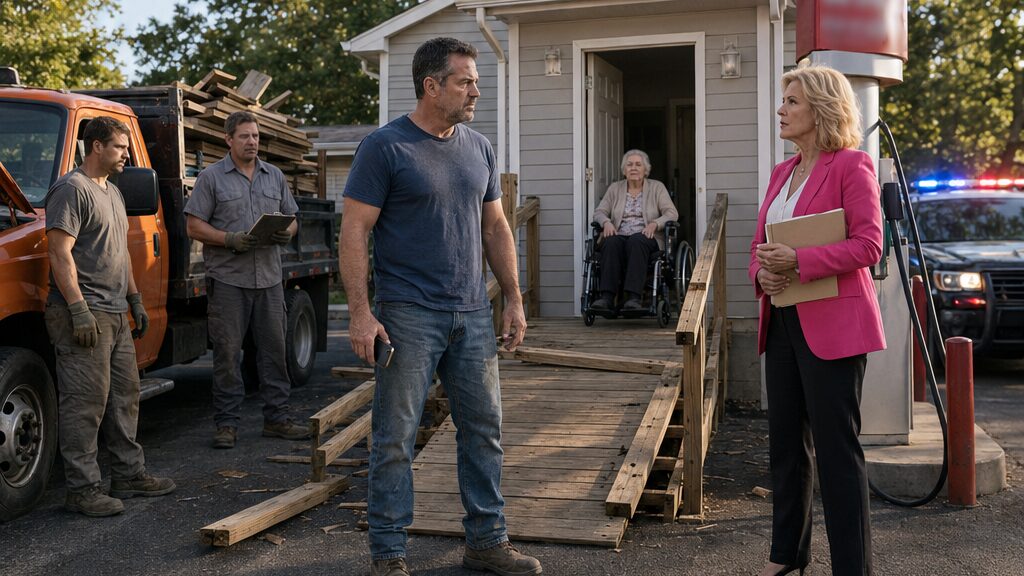
The orange truck was already running when Michael Anderson opened the front door, and one of the men in work gloves had Ruth’s handrail loose from the porch post.
The sound came first: a metallic scrape, a drill whining against screws, the hollow knock of lumber dropping onto a truck bed. Michael stepped out barefoot onto the cold porch boards and saw two orange cones placed across his driveway as if his own house had become a job site.
“Stop,” he said.
The worker with the drill looked over his shoulder but did not lower the tool.
At the bottom of the temporary ramp, Paul Wright stood with a clipboard tucked under one arm. He wore a faded gray work shirt, scuffed boots, and the careful expression of a man trying not to become part of somebody else’s argument.
“Morning,” Paul said. “We’re here on behalf of the association.”
“That ramp is not association property.”
“No, sir. But the order says it’s an unauthorized exterior structure.”
Michael looked past him. One section of the ramp had already been detached. The side rail Ruth gripped every time he guided her down to the car lay across the orange truck’s bed, its screws still sticking out like broken teeth.
He pulled his phone from his pocket and started recording.
Paul noticed. So did the two workers. The drill finally went quiet.
“I need to see the removal order,” Michael said.
Paul shifted his clipboard. “You’ll have to take that up with the board.”
“I’m taking it up with the person removing it from my house.”
Behind the orange truck, beside the community service lane, the HOA fuel pump sat under its red-and-white sign: PRIVATE PROPERTY — AUTHORIZED USE ONLY. The black hose hung from the pump, still looped and locked in place. Michael had been planning to use it after he checked Ruth’s oxygen backup and the generator outside the garage. He had the printed disaster memo in the truck. He had the receipts. He had the emails.
He did not have time for this.
From inside the house, Ruth’s voice carried thinly through the open door. “Michael?”
He turned halfway. “Stay there, Mom.”
“I heard tools.”
“I know.”
He kept his voice level, but his hand tightened around the phone. Ruth’s wheelchair was just inside the entryway, angled toward the place where the ramp should have met the threshold. Without that ramp, the front door was not an exit. It was a ledge.
A sharp voice cut across the driveway.
“Mr. Anderson, you need to step away from the structure.”
Kimberly White came from the service lane in a bright pink suit that looked too clean for a demolition morning. Her blonde hair was set neatly around her face. In one hand she held a folder. In the other, a folded notice with the HOA seal printed at the top.
Michael kept recording.
“Mrs. White,” he said, “tell your crew to stop.”
“It is not a crew. It is an authorized contractor carrying out a lawful association enforcement action.”
“Then show me the authorization.”
She lifted the folded paper but did not hand it to him. “You were given notice.”
“When?”
“It was posted according to procedure.”
“Posted when?”
Kimberly’s eyes flicked toward Paul. Paul looked down at his clipboard.
Michael took one step off the porch, careful not to touch the loosened rail. “This ramp is for my mother. She uses a wheelchair. You have my application.”
“What we have,” Kimberly said, “is an incomplete exterior modification request and an unapproved structure visible from the common lane.”
“My mother cannot leave the house without it.”
“You should have waited for approval.”
“She couldn’t wait thirty days to get through her own door.”
One of the workers bent toward the remaining ramp section. Michael moved before the man could lift the drill. He stepped between the worker and the ramp, not close enough to shove, not far enough to ignore.
“Do not touch another screw.”
Paul raised both hands slightly. “Sir, don’t make this harder.”
“It got harder when you put my mother’s ramp in that truck.”
Kimberly’s mouth tightened. “You are interfering with authorized work.”
“I’m asking for a written order.”
“You have one.”
“I have not been handed one.”
She unfolded the paper and held it high enough for the camera but far enough that he could not read the date.
Michael kept his phone steady. “Read the time it was posted.”
Kimberly did not answer.
A beep sounded from inside the house. Faint, regular, mechanical. Ruth’s backup unit warning tone. Michael’s head turned before he could stop himself.
Kimberly saw the movement. “If there is equipment in the house, that is exactly why unauthorized electrical and fuel modifications are a liability.”
“The generator is not a decoration,” Michael said.
“The generator setup is also unapproved.”
“It’s temporary until the main line is repaired.”
“And the association has not approved exterior storage of fuel containers or generator equipment.”
Michael looked toward the pump. The small utility truck he used for supplies sat nearby, its tank nearly empty. Beside it, his red fuel can was strapped upright. He had planned to top off the generator can from the emergency allotment listed in the neighborhood disaster policy. The memo said medically necessary backup power could be supported during outage-related repairs. It did not say how to survive an HOA president who treated the word “authorized” like a locked gate.
He stepped toward the pump cabinet.
Kimberly moved fast, cutting across his path with the folded notice raised like a badge. “Absolutely not.”
“I need fuel for the generator.”
“That is HOA gas.”
“It is emergency fuel.”
“It is not yours.”
“My mother’s oxygen backup is beeping.”
“Your personal circumstances do not entitle you to take community property.”
Michael felt heat rise behind his eyes, but his voice stayed quiet. “Say that again while I’m recording.”
Kimberly looked straight into the phone. “This is HOA gas. It is for authorized association use only. You are already in violation for an unauthorized ramp, unauthorized generator placement, and now attempted fuel misuse.”
Paul shifted his weight. One of the workers looked toward the house.
The beeping continued.
Michael lowered the phone just enough to look Kimberly in the face. “My mother is inside that house. That ramp is how she leaves. That fuel keeps the backup running while the electrical repair is unfinished. You have my request.”
“You submitted a general exterior change request,” Kimberly said. “Not a complete accommodation packet. Not an approved generator plan. Not a fuel authorization form.”
“Because no one answered.”
“The board has thirty days.”
“She didn’t have thirty days.”
Kimberly’s expression flickered, not into pity, but into something more guarded. “Rules do not stop applying because someone is impatient.”
Michael took a breath. The word impatient landed harder than he wanted it to. He thought of Ruth at the threshold, one hand on the wheel, trying to pretend she did not mind being carried. He thought of the promise he had made after her last fall: You are not losing this house one inch at a time.
He looked at Paul. “Put the rail back.”
Paul did not move.
“Put it back,” Michael repeated.
Kimberly lifted her phone. “I am calling the police.”
“Good,” Michael said. “Tell them to bring someone who knows the difference between an HOA order and a court order.”
Her eyes narrowed. She made the call anyway, stepping closer to the pump sign as if the red-and-white letters supported her better than the ground did.
Michael turned toward the house. “Mom, stay inside.”
Ruth had rolled closer to the doorway. Her gray hair was pulled back, her cardigan hanging loose over one shoulder. She looked smaller in the frame of the open door than she had looked at the kitchen table that morning, but her eyes were clear.
“They’re taking it?” she asked.
“Not all of it.”
“That is not an answer.”
He had no good one.
Behind him, Kimberly spoke loudly into her phone. “Yes, I need an officer at the Maple Gate service lane. We have a homeowner interfering with enforcement and attempting to access association fuel.”
Michael turned back as Paul’s worker lifted the detached rail farther into the orange truck.
“Don’t load that,” Michael said.
The worker froze.
Paul rubbed the back of his neck. “Sir, please don’t put my guys in the middle.”
“They’re standing on my property.”
Kimberly ended the call and pointed toward the pump. “The police are on their way. Until they arrive, you are not to touch that fuel cabinet, and you are not to obstruct the removal.”
Michael raised his phone again. “And until they arrive, no one touches the rest of the ramp.”
For a few seconds, nobody moved. The generator hummed weakly near the garage. Ruth’s warning tone pulsed through the open door. The orange truck idled with her handrail in the back.
Then the first police siren chirped at the gate.
Kimberly turned toward the flashing lights coming down the service lane and pointed straight at Michael.
“That’s him,” she said. “He’s stealing HOA gas.”
Chapter 2: The Approval Request No One Answered
Four weeks earlier, Michael refreshed his email for the sixth time while Ruth waited in her wheelchair at the front door, her hands folded in her lap as if patience were something she could physically hold in place.
The threshold was only six inches high.
Six inches had become a wall.
“Anything?” Ruth asked.
Michael did not answer right away. The inbox showed a hardware-store receipt, a power company outage notice, and one message from the HOA’s automated system thanking him for his submission. Nothing from the architectural committee. Nothing from the board. Nothing from Jessica Hall except the auto-confirmation that said requests were reviewed in the order received.
“Not yet,” he said.
Ruth looked at the doorway, then at the narrow portable ramp Michael had borrowed from a neighbor. It was too short for the height. Too steep for her chair. He had tried it once with her behind the wheels and his hands braced on both handles. She had said she was fine. He had felt the whole chair tip under his palms.
“You have errands,” she said. “I can wait.”
“You need your appointment.”
“I have missed appointments before.”
“That’s not the goal.”
She gave him the look she used when he was twelve and had tried to hide a broken window behind the garage. “Do not use that contractor voice on me.”
He almost smiled. Almost.
On the kitchen table behind him, the application packet sat in a neat stack: exterior modification form, sketch of a temporary ramp, photo of the front threshold, generator placement diagram, electrical repair estimate, and a short note from Ruth’s clinic. He had scanned everything the night before. At least, he thought he had. He remembered placing the papers one by one on the printer glass while Ruth dozed in the living room. He remembered the machine coughing out a confirmation page. He remembered thinking the medical note was too personal to send broadly, then telling himself the board needed enough to understand.
He opened the submission portal again.
Status: Received.
No reviewer assigned.
“Thirty days,” he muttered.
Ruth heard him. “Thirty days for what?”
“For them to decide whether wood is offensive.”
“Michael.”
“I know.”
But he did not know what else to call it. The HOA rules had pages for fence colors, porch light styles, mailbox posts, permitted gravel, prohibited awnings. The ramp section was less than twelve feet long and built from pressure-treated lumber he could remove once the permanent one was approved. He had stained it dark brown to match the porch. He had measured the slope twice. It was not beautiful, but neither was watching Ruth study her own front door like it belonged to someone else.
A warning beep sounded from the portable oxygen unit hanging from the back of her chair.
Ruth reached for the battery indicator. “It does that.”
“It does that when it’s low.”
“It does that when it wants attention.”
He crossed the room and checked it. Low enough to matter. Not urgent, but close. Since the electrical short in the garage subpanel, half the circuits near the front of the house had been unreliable. The contractor had said he could repair the line, but the generator would need to carry backup equipment while the power was shut down.
Michael had already submitted that too.
Generator placement: side of garage, away from windows.
Fuel need: temporary, documented, emergency only.
He opened the HOA disaster preparedness memo, the one buried on the community website under storm resources. He had found it at midnight after searching “generator,” “medical,” and “fuel.”
Residents with documented medical backup power needs may request limited emergency access to association fuel reserves during outage or infrastructure repair conditions.
He read the sentence again, then printed it. The paper came out warm. He clipped it to the fuel receipts from the week before, then added it to the folder.
“There,” he said.
Ruth watched him. “There what?”
“They have a policy.”
“Will they follow it?”
He paused.
Ruth nodded once, as if that had been the answer.
The first week, he waited. He sent one polite follow-up to the architectural committee. The auto-reply said the board had thirty days. He called the management number and reached a voicemail that promised a response within three business days. He marked the days on a yellow pad beside the coffee maker.
On day nine, Ruth canceled her appointment.
On day twelve, the contractor came by to look at the electrical repair and said, “I can do the work, but I need safe access. I’m not carrying panels over a wheelchair ramp that isn’t built right.”
“It isn’t built yet,” Michael said.
The contractor looked at the portable ramp and said nothing.
On day fifteen, Ruth tried to roll backward from the threshold and caught her wheel on the rug. Michael caught the chair before it tipped. She snapped at him for grabbing too hard. He snapped back that he would rather bruise her pride than watch her hit the floor.
They did not speak for half an hour.
That night, he stood in the garage beside the lumber he had already bought and read the HOA rules again. Temporary emergency repairs were allowed when delay would create immediate risk, but owners were required to notify the board and submit documentation “as soon as practicable.”
He had notified them.
He had submitted documentation.
He told himself the ramp was temporary. He told himself nobody reasonable would object once they saw the file. He told himself the rules were written for people building sunrooms without permission, not for a woman trapped behind six inches of painted trim.
The next morning, he started cutting boards.
Ruth sat inside with the door open, pretending to read a magazine. Every time the saw stopped, she looked up. Every time he fitted a board, she looked away before he could catch her.
“You do not have to watch,” he said.
“I am supervising.”
“You are judging.”
“That too.”
He installed the first rail with more care than the plans required. He sanded the edges smooth where Ruth’s fingers might slide over them. He checked every screw. By evening, the temporary ramp stretched from the porch to the driveway, simple and sturdy, its new wood bright against the older steps.
Ruth rolled to the top and stopped.
“You don’t have to try it tonight,” he said.
“Yes, I do.”
He stood behind her, hands open but not touching, while she moved forward inch by inch. The wheels rolled. The chair stayed steady. At the bottom, Ruth put one hand on the rail and looked back at the house.
“Well,” she said, “that is better than being luggage.”
Michael laughed once, quietly, because the alternative was something else.
Two days later, he drove to the HOA service pump with the printed disaster memo in the passenger seat. The red-and-white sign stared down at him: PRIVATE PROPERTY — AUTHORIZED USE ONLY. The pump cabinet was locked, but the maintenance key hung in the emergency box beside it, the same place the memo described. He signed the log, took only enough fuel for the generator test and repair day, and left a copy of the receipt in the HOA drop box.
He expected a call.
He got silence.
For a while, silence looked like permission.
Then, on the twenty-third morning after his first submission, Michael opened the front door and found a white envelope taped to the glass at eye level. The HOA seal sat at the top. Below it, in bold letters, the notice read:
UNAUTHORIZED EXTERIOR STRUCTURE — IMMEDIATE CORRECTION REQUIRED.
Ruth rolled up behind him. “Is that the approval?”
Michael peeled the tape slowly from the door.
“No,” he said. “It’s something else.”
Chapter 3: Section 7.4 Did Not Mention Breathing
Kimberly White opened the HOA meeting with a photograph of Michael’s ramp enlarged across the clubhouse wall, and for one strange second he saw his mother’s handrail presented like evidence from a crime.
The photo had been taken from the service lane, slightly low, making the ramp look longer and more intrusive than it was. A red circle had been added around the side rail. Another around the generator housing near the garage. In the bottom corner, half of Michael’s fuel can was visible.
“Item four,” Kimberly said. “Unauthorized exterior modification, generator placement, and possible improper access to association resources.”
Michael sat in the front row with his folder on his knees. He had worn a clean blue shirt and brought every paper he could find. He had also left Ruth at home, even though she had wanted to come. The clubhouse had steps at the side entrance, and the accessible door near the rear was blocked by a stack of folding chairs the last time he checked.
He told himself that was not why he had asked her to stay home.
Kimberly stood beside the projected photograph in a bright pink blazer, one hand resting on the board table, the other holding a laser pointer. Jessica Hall sat at the end with a laptop open, her face lit by the screen. Other board members sat in a shallow row, already looking tired.
“Mr. Anderson,” Kimberly said, “you were sent notice to restore the exterior to its prior condition. We have not received confirmation of compliance.”
“You haven’t received confirmation because I’m not removing the ramp.”
A murmur moved through the room.
Kimberly’s pointer clicked off. “Then we should be clear about the consequences.”
Michael opened his folder. “Before we get to consequences, I want the board to acknowledge my application.”
Jessica looked up.
Kimberly turned slightly. “The board received an exterior modification request. It was incomplete.”
“It included a ramp plan, generator placement diagram, contractor estimate, and the clinic note.”
Jessica’s fingers paused over the keyboard.
Kimberly said, “The packet available to the board did not include a completed accommodation form.”
“I wasn’t sent an accommodation form.”
“It is available through the management portal.”
“I submitted under exterior modification because that’s what the ramp is.”
“That is why it is incomplete.”
Michael looked at the projected image again. The ramp boards were clean, the handrail straight. In the photo, no one could see Ruth waiting inside. No one could hear the oxygen unit’s low beep. No one could know that six inches had changed the shape of her life.
“I am telling you now,” he said. “It is for medical access.”
Kimberly’s expression did not change. “Then the proper medical accommodation process should be followed.”
“It was in the note.”
Jessica leaned toward Kimberly and spoke quietly, but the room was small enough for Michael to hear.
“I don’t see the medical note in the file.”
Michael’s hand tightened on the folder.
Kimberly did not look at him. “Exactly.”
He pulled out his copy. “It’s here.”
“Your copy being here does not mean it was submitted correctly.”
“I scanned the packet.”
“Apparently not completely.”
The words were not loud. That made them worse. If she had shouted, he could have met anger with anger. Instead, she placed each sentence on the table like a rulebook, clean and flat and indifferent.
Michael looked at Jessica. “You have the ramp drawing?”
Jessica checked the screen. “Yes.”
“The generator placement?”
“Yes.”
“The contractor estimate?”
“Yes.”
“The photo of the threshold?”
She scrolled, then nodded. “Yes.”
“But not the medical note.”
“I’m not seeing it,” Jessica said, and there was something apologetic in her voice that made Michael dislike her less than he wanted to.
Kimberly folded her hands. “That means the board had no basis to treat this as a medical accommodation.”
“You had a photo of a wheelchair threshold.”
“We had a photo of a doorway.”
“With a ramp drawn to it.”
“A homeowner may request a ramp for many reasons.”
Michael stared at her. “Name one that matters more than getting someone in and out of her home.”
Kimberly’s jaw tightened. For the first time, the polished procedure in her voice thinned. “Mr. Anderson, we have had three unapproved exterior structures in this community in the last eighteen months. One collapsed during a storm. The association is still dealing with the insurance consequences. We cannot allow residents to build first and justify later.”
“This isn’t a deck.”
“The rules do not classify need by emotion.”
“No,” Michael said. “They classify it by forms.”
A board member shifted in his chair. Jessica looked down.
Kimberly picked up the printed notice in front of her. “Section 7.4 of the Maple Gate exterior standards prohibits unapproved ramps, platforms, generator housings, visible fuel storage, and structural additions affecting the front elevation.”
“Section 7.4 does not mention breathing.”
The room went quiet.
Michael had not meant to say it like that. He had meant to be precise. He had meant to keep Ruth’s details limited, clean, private. But the word sat there now, stripped of paperwork.
Kimberly recovered first. “If there is a breathing-related medical issue, submit the proper documentation.”
“I tried.”
“You did not complete the process.”
“You did not answer.”
“The board has thirty days.”
“My mother doesn’t.”
Another murmur. This one softer.
Kimberly’s eyes moved around the room, measuring the change. Michael saw it and understood something he had missed: she was not only arguing with him. She was holding the line in front of everyone who might someday build first and ask later. To her, if Michael won without the right form, the rules weakened.
To him, if she won, Ruth lost the front door.
Jessica cleared her throat. “There may be a way to table enforcement until the accommodation packet is completed.”
Kimberly turned toward her. “The structure is already installed.”
“Temporarily,” Jessica said.
“Without approval.”
Michael saw Jessica’s shoulders draw in slightly.
Kimberly looked back at him. “The board cannot reward noncompliance. You have until tomorrow morning to restore the exterior. If the structure remains, the association will proceed with correction and assess costs to your account.”
“Correction,” Michael repeated.
“Removal.”
He let the word settle.
“So you will remove a ramp before reviewing the medical reason for it.”
“We will remove an unapproved structure while you submit the correct documentation.”
“And my mother?”
“That is not how this process works.”
Michael put the medical note on the table. He slid it forward with two fingers. “Then change the process.”
Kimberly did not take it. “Submit it through the portal.”
He left the note there anyway.
As the meeting moved to the next item, Jessica reached for the paper, hesitated, and placed it beside her laptop rather than into Kimberly’s folder. Michael noticed. Kimberly noticed too.
Outside, the clubhouse parking lot lights had come on. Michael walked to his truck with the folder under one arm and the feeling that he had lost something by trying not to say too much. He had protected Ruth’s privacy so well that Kimberly had turned her absence into a weakness.
Behind him, near the side door, Kimberly spoke into her phone.
“Paul,” she said. “Be ready at first light.”
Chapter 4: This Is HOA Gas
“This is HOA gas,” Kimberly said again as the first police car stopped beside the service lane, its blue lights flashing across the red-and-white sign above the pump.
Michael kept his phone raised.
The male officer stepped out first, one hand low near his belt, eyes moving from Michael to Kimberly to the orange truck with Ruth’s handrail lying in the back. The female officer came around the passenger side and took in the scene more slowly: the loosened ramp, the drill in the worker’s hand, Ruth’s wheelchair framed in the open doorway.
Kimberly walked toward them before either officer could ask a question.
“He is interfering with an authorized HOA enforcement action,” she said, “and he attempted to access association fuel without permission.”
The male officer looked past her. “Who called?”
“I did. Kimberly White, Maple Gate HOA president.”
The officer nodded once, then turned to Michael. “Sir, put the phone down for me.”
“I’m recording for my records,” Michael said. “I’m not approaching anyone.”
The female officer said, “That’s fine as long as you keep your hands visible.”
Michael adjusted his grip so his empty left hand showed. “My hands are visible.”
A second vehicle rolled in behind the first. It was unmarked except for city plates and a small light mounted near the windshield. George Brown got out wearing a dark jacket over his uniform shirt. Michael recognized him only because George had spoken at the community storm meeting the previous year, when he explained evacuation routes and backup power rules to a room of residents who mostly wanted to know when the gate cameras would be repaired.
Kimberly recognized him too. Her posture changed, not relaxed exactly, but sharpened. “Chief Brown. Thank you for coming.”
George looked at the ramp first, not at her. “I was nearby.”
Kimberly pointed to Michael. “He was at the fuel cabinet.”
Michael said, “Because the generator is low.”
“For an unapproved generator setup,” Kimberly snapped.
George held up one hand. “One at a time.”
The beeping from inside the house carried faintly into the gap between them. George turned his head toward the sound.
“Who’s inside?” he asked.
“My mother,” Michael said. “Ruth Anderson. She uses a wheelchair, and the backup unit is running low because the electrical repair isn’t finished.”
Kimberly crossed her arms. “That may be what he says, but the association has rules about fuel access.”
George walked closer to the pump sign. The blue lights washed over the words AUTHORIZED USE ONLY until the letters looked as if they were blinking. He read the sign, then looked at the locked cabinet.
“Did he break into it?”
“No,” Kimberly said.
“Did he remove fuel?”
“He was about to.”
Michael said, “I signed the emergency fuel log last week. I left receipts. The disaster memo allows documented medical backup power needs.”
Kimberly’s head turned sharply. “That memo does not give residents the right to take fuel whenever they want.”
“I didn’t say whenever.”
“You did not have board approval.”
“I had no board response.”
George looked at Kimberly. “Do you have the emergency fuel policy with you?”
She blinked once. “Chief, this is primarily an association matter.”
“You called us for theft.”
“It is theft if he takes association fuel.”
“It is not theft because someone stands near a locked cabinet.”
The words landed quietly. Paul looked down at his clipboard again.
Kimberly recovered. “Then trespass. He is obstructing an authorized crew.”
George turned to the ramp. “Who authorized removal?”
“The HOA board.”
“Court order?”
Kimberly stiffened. “An HOA enforcement order.”
“That is not the same thing.”
Michael heard his own words come back in George’s voice, and for one second relief moved through him so quickly he nearly mistook it for victory.
Kimberly’s cheeks colored. “The governing documents permit the association to correct violations and assess costs.”
“Maybe they do,” George said. “Maybe they don’t. That’s not something I’m deciding in a driveway. What I am deciding is whether there’s a crime happening in front of me.”
The female officer walked toward the porch, keeping a respectful distance. “Ma’am?” she called gently. “Are you all right inside?”
Ruth’s voice came from the doorway. “I would be better if they stopped taking my way out.”
The worker holding the drill lowered his eyes.
Michael swallowed, but kept the phone steady.
Kimberly’s voice hardened. “The ramp is not safe. It was installed without inspection.”
Michael turned. “You called it unattractive two days ago.”
“I called it unapproved.”
“You projected a photo of it on a wall like I built a casino.”
George looked at Michael. “Mr. Anderson, I understand you’re upset. Don’t make my job harder.”
Michael took one breath. Then another. “I’m not trying to.”
“Then tell me exactly what you need right now.”
“I need them to stop removing the ramp. I need fuel for the generator until the electrician can finish the repair. And I need someone to explain why an HOA order lets them strand my mother inside her house.”
George’s expression did not soften, but something in his eyes shifted toward attention. “Do you have the policy you mentioned?”
Michael pointed to his truck. “Passenger seat. Folder labeled generator.”
The female officer retrieved it with his permission. She handed it to George, who opened it on the hood of the patrol car. The printed disaster memo was on top, clipped to receipts and a handwritten log entry.
George read the paragraph once. Then again.
Kimberly said, “That policy was intended for storm emergencies.”
“It says outage or infrastructure repair conditions,” Michael said.
“It says documented medical backup power needs,” Kimberly said. “Not unverified personal claims.”
Michael looked toward Ruth. She had not moved from the doorway, but her face had gone still in the way it did when she wanted everyone to forget she was listening.
He had the clinic note. He had copies. He could pull it out now. He could say more than Ruth wanted strangers to know. He could turn her condition into a shield in front of police, workers, and a neighbor who had drifted to the edge of his driveway pretending to check the mail.
He hesitated.
Kimberly saw it. “Exactly.”
Michael’s fingers tightened around the phone.
George closed the folder. “Here is where we are. I am not arresting Mr. Anderson for theft. No fuel has been taken today, and there is a written policy that at least raises a legitimate access question.”
Kimberly started to speak.
George looked at her. “I’m not finished.”
She stopped.
“I’m also not ordering the HOA to rebuild a ramp right now. That dispute is civil unless there is immediate criminal conduct or an emergency access violation that requires another agency. What I can tell you is that continuing removal while the resident is disputing medical access is going to create a record none of you may like.”
Paul shifted. “Chief, we’re just here on a work order.”
“Then I’d be careful what time that work order says you started.”
Paul glanced at Kimberly.
Michael caught it.
Kimberly folded the notice and put it back into her folder. “We will pause removal pending further review.”
“Put back what you removed,” Michael said.
“That is not what I said.”
“My mother can’t use half a ramp.”
Kimberly looked toward the orange truck, where the handrail lay among loose boards and bolts. “The removed materials will be secured until the board determines next steps.”
Michael stared at her. “Secured where?”
“In association custody.”
“You mean you’re taking them.”
“They are part of a violation correction.”
George said, “Mrs. White.”
She turned to him. “Chief, unless you are instructing me that the association cannot secure removed noncompliant material, we will follow counsel’s standard process.”
George’s jaw worked once. “Mr. Anderson, file the accommodation packet today. Send it certified, email it, and copy the city accessibility office. Put everything in writing.”
“So she gets to take the ramp.”
“I’m telling you how not to lose the next step.”
It was not enough. It was also the first useful thing anyone in authority had said that morning.
Kimberly walked to the pump cabinet, took a key from her blazer pocket, and turned the lock with a clean metallic snap. Then she removed the key and held it in her palm.
“Until fuel authorization is formally determined,” she said, “this cabinet remains locked.”
Michael looked past her to the sign. AUTHORIZED USE ONLY. The words no longer looked like a warning. They looked like a question no one wanted to answer.
Paul signaled to his crew. They did not touch the remaining ramp section, but one worker closed the orange truck’s tailgate over Ruth’s handrail.
As the police lights dimmed and George stepped back toward his vehicle, Kimberly climbed into the passenger side of the orange truck. It pulled away slowly, carrying the boards Ruth had trusted under her hands.
Chapter 5: The Form That Proved Too Little
Ruth’s front wheels stopped at the lip of the doorway that evening, and the empty bolt holes where the ramp had been looked too small to explain why she could not leave.
Michael stood outside on the porch with one hand on the doorframe, the other hovering uselessly near the chair. The remaining half of the ramp began three feet too far down. Without the removed section and rail, it was not a ramp. It was a broken sentence.
“I can lift the front wheels,” he said.
“No.”
“I’ve done it before.”
“And I hated it before.”
The generator coughed near the garage, then steadied. He had bought fuel from the station outside the subdivision after George left, paying more and losing almost an hour. Ruth had not complained. That made it worse.
“I can get the portable ramp from the garage.”
“That little silver thing?”
“It’s better than nothing.”
“It nearly threw me sideways last time.”
He did not argue because she was right.
Ruth looked past him toward the driveway where the rail had been. “They took the piece I used.”
“I’ll get it back.”
“You say that like it is in the shed.”
Michael stepped inside and shut the door. The house instantly felt smaller. The hallway, the chair, the oxygen unit, the folder under his arm—everything seemed crowded against the missing ramp.
In the garage office, he spread every paper across the workbench. Application form. Ramp sketch. Generator placement. Contractor estimate. Threshold photo. Fuel receipts. Disaster memo. Violation notice. Meeting agenda. Removal notice he had finally been handed after the police came, still smelling faintly of Kimberly’s perfume.
He opened his laptop and pulled up the scanned file he had submitted to the HOA portal. The PDF loaded slowly, page by page.
Page one: application.
Page two: ramp sketch.
Page three: front threshold photo.
Page four: generator placement.
Page five: contractor estimate.
Page six—
He leaned closer.
There was no page six.
The clinic note sat in the folder on the table beside him, paper-clipped to the back of the original packet. He stared at it until the words blurred. He remembered placing it on the printer glass. Or he remembered deciding to. He remembered Ruth sleeping in the living room with her cardigan pulled up around her shoulders. He remembered thinking the note said too much.
He opened the scanner folder on his computer.
There it was.
Clinic_Note_Ruth_Access.pdf.
Scanned two minutes after the packet. Saved separately. Never uploaded.
Michael sat back so hard the old chair creaked.
The HOA had not lost it.
He had failed to attach it.
For a few seconds, anger had nowhere to go. Not to Kimberly. Not to Jessica. Not to Paul. It circled once and came back to him.
Ruth called from the hallway. “You found something.”
He looked toward the door. “Yes.”
“Bad or useful?”
“Both.”
He carried the laptop to the kitchen table and turned it so she could see the file list. Ruth read slowly, lips pressed together.
“You didn’t send the note,” she said.
“I thought I had.”
“Did you?”
He rubbed his face. “No.”
She nodded once, not accusing him, which somehow hurt more.
“I didn’t want them passing it around,” he said. “I didn’t want your condition discussed in a board packet next to fence stains.”
“It is my condition.”
“I know.”
“Do you?”
He looked at her then.
Ruth’s hands rested on the wheels. The skin at her knuckles was thin, the veins raised. Those hands had packed his lunches, painted the kitchen cabinets, planted roses along the walkway, slapped the table during card games, signed the mortgage papers after his father died. He hated that a clinic note could shrink all that into diagnosis, limitations, equipment requirements.
“I was trying to protect you,” he said.
“I know. That is the problem.”
His phone chimed before he could answer.
The email was from Kimberly White. Subject: FINAL RESTORATION DEADLINE AND DAILY FINES. He opened it, and the first line was as clean as a blade.
Mr. Anderson, because partial correction remains incomplete, daily fines will begin tomorrow at 8:00 a.m. unless all unauthorized exterior modifications, generator equipment, and visible fuel storage are removed.
Attached were photographs taken after the crew left: the half-ramp, the generator housing, the fuel can beside the garage.
Ruth watched his face. “How much?”
“Two hundred a day.”
“For needing to leave?”
“For not restoring the property.”
“That is a fancy way to say it.”
Michael forwarded the email to himself, printed it, and added it to the growing stack. Then he opened a new message addressed to the HOA board, Kimberly, Jessica, the management office, and the city accessibility office George had mentioned. He attached the clinic note. He attached the disaster memo. He attached photographs of the empty bolt holes and the removed rail. He attached the video from the morning.
His cursor blinked in the blank body of the email.
He started with: My mother is disabled and requires—
Then stopped.
Ruth rolled closer. “Say my name.”
He looked at her.
“Not ‘resident.’ Not ‘occupant.’ Not ‘family member.’ Say Ruth Anderson.”
His throat tightened. “Mom.”
“If they are going to make decisions about whether I can cross my own front door, they can read my name.”
He typed it.
Ruth Anderson requires wheelchair access through the front entrance of her home and backup power support during electrical repair conditions.
The sentence sat there, plain and undeniable.
Ruth read it and nodded. “Good.”
“I should have sent this first.”
“Yes.”
He looked down.
She reached across the table and tapped the back of his hand with two fingers. “Do not look like that. You made a mistake. They made a choice.”
He let the words settle, but they did not absolve him. They gave him something sharper: a line between error and harm.
Ruth looked toward the front door. “When your father got sick, I made everything quiet. Bills, appointments, bad nights. I thought if you did not see all of it, you would be spared.”
“You were trying to protect me.”
“And you still found out. Then you thought you had to become the kind of man who handles everything alone.” She gave a small, tired smile. “That was not the lesson I meant to teach.”
Michael could not answer.
The oxygen unit beeped again, softer now after the battery change, but still enough to pull both of their eyes toward it.
He finished the email with a formal request for immediate temporary restoration pending review. He asked for the work order, the notice timestamp, the fuel access procedure, and confirmation that fines were paused until the accommodation was heard.
Before sending, he turned the laptop toward Ruth. “Read it.”
She did. Slowly. Every line. When she reached the clinic note attachment, she looked at the filename for a long moment.
Then she said, “Send it.”
Michael clicked.
For the first time all day, the action felt like more than defense.
Ruth rolled back from the table, then stopped where the hallway opened toward the front door. The porch light fell across the threshold and the bare screw holes beyond it.
“Michael,” she said.
“Yes?”
“Do not make me disappear just to protect my pride.”
Chapter 6: Kimberly Thought Rules Were The Mercy
Michael watched Paul Wright sign the fuel log beside the same orange truck that had carried Ruth’s handrail away, and this time Michael took a photograph before anyone could tell him not to.
The HOA service yard smelled of gasoline, cut grass, and wet plywood. The pump cabinet was still locked. The red-and-white AUTHORIZED USE ONLY sign hung above it, unchanged, while Paul filled out the log on a clipboard chained to the wall.
Paul glanced up when he heard the phone camera click. “You’re allowed to ask for copies, you know.”
“I am asking.”
“You’re taking pictures.”
“I’m doing both.”
Paul capped his pen and looked toward the maintenance shed. “Mrs. White know you’re here?”
“She’s about to.”
Michael had sent the formal accommodation request the night before. At 7:41 that morning, Jessica had replied with a short message: Received. Board review pending. At 8:03, Kimberly’s fine notice posted to his account anyway.
Two hundred dollars.
The amount looked almost modest until he imagined it multiplying quietly while Ruth sat behind the threshold.
Paul tore off the top sheet of a carbon-copy work order and folded it. “I don’t want trouble with you.”
“Then don’t hide the paperwork.”
“I’m not hiding anything.” He looked uncomfortable. “I get a job order. I show up.”
“What time did you show up yesterday?”
Paul did not answer.
Michael lowered the phone. “Paul.”
The crew supervisor rubbed the bridge of his nose. “We were told to be on site by seven.”
“The notice said eight-thirty.”
“The notice was posted after we arrived.”
The words came out like he had been holding them under his tongue all morning.
Michael felt the first solid piece of the ground shift under him. “Who posted it?”
“Not me.”
“Kimberly?”
“I saw her tape something to the door. I didn’t check the time.”
“After your crew had already started?”
Paul looked at the orange truck. “We had loosened the rail.”
Michael took another photograph of the work order in Paul’s hand. Paul did not stop him.
“I need a copy of that.”
“You’ll have to request it from the office.”
“I am requesting it from the man holding it.”
Paul gave a short, humorless laugh. “You really don’t let go.”
“My mother doesn’t get out if I do.”
That quieted him.
Paul looked at the truck bed, empty now except for straps and a shovel. “My sister used a ramp after her surgery. Temporary one. Ugly as anything.”
Michael waited.
“Her landlord hated it. Said it blocked the walkway. I thought he was being a jerk.” Paul looked back at the work order. “Different when you’re the guy paid to remove one.”
“Different how?”
“Easier not to think.”
Michael did not soften. “Thinking is free.”
Paul accepted that without protest. He unlocked the cab, leaned in, and came back with a yellow copy of the work order. “This is all I have. Don’t say I gave it to you.”
“I won’t lie if asked.”
Paul almost smiled. “That’s not comforting.”
“No.”
The HOA office sat behind the clubhouse, a narrow room with glass walls and a counter high enough to make everyone on the visitor side feel like they were applying for permission to breathe. Jessica sat at the desk when Michael entered, two binders open in front of her. Kimberly stood near the printer, phone pressed to her ear, pink jacket draped over the back of a chair as if she had been there for hours.
Jessica looked up first. “Mr. Anderson.”
Michael placed the yellow work order on the counter. “I’m requesting the full removal file, notice timestamp, fuel logs from the last thirty days, and board communications related to my property.”
Kimberly ended her call. “Association records requests must be submitted in writing.”
“I did. Last night. This is in person because fines started this morning.”
Jessica opened a folder. “I saw the request.”
“Then you saw the clinic note.”
A small pause.
“Yes,” Jessica said.
Kimberly came to the counter. Without the pink jacket, she looked less like a performance and more like someone who had not slept well. “Mr. Anderson, your medical documentation is being reviewed. That does not erase the fact that you installed first.”
“It explains why I installed.”
“It may explain. It does not authorize.”
“Your crew started before proper notice.”
Kimberly’s eyes flicked to the yellow copy.
Michael saw it. “You knew?”
“I knew enforcement was scheduled.”
“Before notice?”
“Emergency correction is permitted when an unsafe condition exists.”
“The ramp was unsafe yesterday morning because you called it unsafe yesterday morning.”
“The association cannot accept liability for unapproved structures.”
“You accepted liability for removing access.”
Her mouth tightened. “You keep saying access as if that word cancels every rule.”
“No. I’m saying your rules had a process for access, and you skipped to removal before finishing it.”
Kimberly looked past him toward the window facing the service yard. For a moment, the office held only the hum of the printer and the distant sound of the orange truck backing up near the shed.
“You were not here two years ago,” she said.
Michael said nothing.
“A resident built a second-story deck without approval. Said it was temporary. Said his contractor knew what he was doing. It collapsed during a storm. Nobody died, but a neighbor was injured, and the lawsuit named every board member personally.” Her voice stayed measured, but the strain showed around the edges. “Since then, every unapproved structure is a liability until proven otherwise.”
“My mother’s ramp was not a second-story deck.”
“No. But the next person will say their exception matters too.”
“Maybe it will.”
Kimberly looked at him then, and for the first time he saw the fear under the polished certainty. Not fear of him. Fear of losing control of a system she believed kept worse things from happening.
It did not excuse the orange truck. It explained why she had ordered it.
Jessica cleared her throat. “Kimberly, the accommodation request changes the category.”
“The complete request arrived last night,” Kimberly said.
“The phrase medical access appears in his earlier email.”
Kimberly turned slowly. “What?”
Jessica looked at her screen, then at Michael, then back down. She did not look eager. She looked trapped by the record in front of her.
“I’m reviewing the old thread,” Jessica said. “The first submission was incomplete, yes. The clinic note was not attached. But his follow-up email before the meeting said, ‘This is for medical access and temporary generator support during repair.’”
Michael’s pulse changed.
Kimberly came around the counter. “Show me.”
Jessica angled the laptop. Kimberly bent over it. Michael could see only the reflection of text in the glass wall.
“When was that sent?” Michael asked.
Jessica’s voice was quiet. “Three days before the removal.”
“And who received it?”
Jessica did not answer immediately.
Kimberly straightened. “A phrase in an email does not create approval.”
“No,” Michael said. “But it creates notice.”
Kimberly’s face closed again. “The structure remained unapproved and potentially unsafe.”
“Potentially,” Michael said. “So you removed it before asking the one question that mattered.”
Jessica clicked something. Her shoulders drew tight.
Michael watched her expression change, not dramatically, but enough. A person recognizing that a clean file was not clean after all.
“There’s another email,” she said.
Kimberly turned. “Jessica.”
“It’s timestamped the morning before removal.” Jessica did not raise her voice. “Forwarded from the management office to you. Subject line says Anderson — medical access concern.”
The office went still.
Michael put both hands flat on the counter, because if he did not hold onto something, he might say too much.
Kimberly looked at Jessica, and whatever passed between them was not friendship or anger. It was a warning, and then a choice.
Jessica looked down at the screen and said, “I need to print this for the record.”
Chapter 7: The Hearing Behind The Closed Gate
Kimberly began the hearing by calling Ruth’s doorway “an unauthorized alteration site,” and Michael felt Ruth’s hand tighten around the arm of her wheelchair beside him.
They had placed the board table at the front of the room and the residents’ chairs in rows below it, as if the clubhouse were a small courtroom no one wanted to admit they were using. The rear accessible entrance had been cleared this time. Michael had checked it twice before bringing Ruth in. A folding chair still leaned against the wall nearby, and he had moved it himself without asking.
Kimberly wore the pink blazer again. Not the same one, Michael thought, or maybe it was. Under the fluorescent lights it looked less bright than it had beside the gas pump, but it still drew every eye in the room.
She tapped a stack of papers into alignment.
“We are here regarding the Anderson property,” she said. “Unauthorized alteration, generator placement, visible fuel storage, and improper association fuel access.”
Michael set his folder on the table in front of him. On top were two photographs: one of the red-and-white pump sign with police lights reflecting across it, the other of the empty bolt holes at Ruth’s threshold.
Ruth looked at the photos and said quietly, “That one makes the house look lonely.”
Michael did not know which one she meant.
Jessica sat at the end of the board table with a binder open and a printer-warm packet beside her. She had not spoken to him since the office. But when Michael entered, she had looked up and given one small nod, not friendly, not apologetic, but real enough that Kimberly noticed.
A board member asked Michael to present his response.
He stood because sitting made him feel as if he were asking permission.
“This is not about whether I like the HOA rules,” he said. “It is not about whether I should have filed a different form first. I should have. I filed the exterior request and failed to attach the clinic note to the original packet. That was my mistake.”
Kimberly’s pen paused.
Michael kept his eyes on the board, not on Ruth. “But the board had notice before removal that this was medical access. The ramp was temporary. The generator support was temporary. The fuel access I requested was under the community’s own disaster memo for documented medical backup power needs.”
He placed copies of the memo, email thread, clinic note, removal work order, and fine notice on the table.
Kimberly leaned forward. “Mr. Anderson, the issue is not whether your mother has needs. The issue is whether residents may construct first and seek approval after.”
Ruth’s chair creaked softly beside him.
Michael looked down once. Her hand had moved from the armrest to the folder in her lap. She had insisted on holding her own copy of the clinic note. He had tried to carry it for her. She had looked at him until he let go.
“I understand that concern,” Michael said. “But the association did not simply deny a project. It removed part of an access route after receiving notice that access was medical. It locked the fuel cabinet after I cited the emergency policy. It fined the property while the accommodation request was pending.”
Kimberly lifted her chin. “The completed accommodation request was not pending until the evening after removal.”
Jessica turned a page in her binder.
Michael said, “The words medical access were in the email three days earlier.”
Kimberly’s voice sharpened. “An informal phrase does not override section 7.4.”
“No,” Michael said. “But it should have stopped you long enough to ask what would happen if you were wrong.”
The room held that.
Then Ruth said, “I would like to speak.”
Michael turned. “Mom—”
“Not for you to decide.”
The words were quiet. They struck harder than if she had raised her voice.
Kimberly looked uncomfortable for the first time. Not defeated. Not ashamed. Uncomfortable in the way people become when a subject stops being a file and starts looking at them.
The board member at the center said, “Mrs. Anderson, you may speak.”
Ruth rolled forward. Michael stepped back from habit, then forced himself not to touch the handles.
She placed her clinic note on the table.
“My name is Ruth Anderson,” she said. “I have lived in that house for twenty-seven years. I chose the paint color before there was a committee for paint colors. I planted the roses beside the walkway, and I know the cracks in my porch better than most people know their own kitchen drawers.”
No one moved.
“I do not enjoy being discussed as equipment.” Her hand rested on the clinic note. “I do not enjoy my son having to prove that I am real enough to need a ramp. But I enjoy less being trapped inside while adults argue over whether the paper was submitted in the proper order.”
Michael looked at the floor.
Ruth went on. “My son should have attached the medical note. He knows that. I know that. But someone here saw the words medical access before a crew came to my house. Someone here decided the safe thing was to remove first and understand later.”
Kimberly’s face closed.
Jessica looked at her binder.
Ruth turned slightly toward Kimberly. “I am not asking you to ignore safety. I am asking why safety only began to matter when the ramp was already helping me.”
For a while, only the hum of the lights answered.
Kimberly drew in a measured breath. “Mrs. Anderson, I regret that the situation caused distress. But I have a duty to protect the association from unsafe structures. Two years ago, this board faced litigation because an unapproved structure failed. We cannot govern by exceptions made under pressure.”
Ruth nodded. “Then govern before the pressure. Do not wait until someone is at the door with a drill.”
A board member cleared his throat. “Jessica, do we have confirmation on the timing?”
Jessica opened the packet she had printed. “Yes.”
Kimberly turned toward her.
Jessica did not look away this time. “The initial exterior request was incomplete. The medical note was not attached. However, a follow-up email from Mr. Anderson to the management office and the board inbox stated the ramp and generator were for medical access and temporary backup during electrical repair. That email was forwarded to Kimberly the morning before removal.”
She slid a printed email forward.
Kimberly said, “I did not interpret that as a completed accommodation request.”
“No,” Jessica said. “But it was notice of possible medical access.”
The word notice changed the room. Michael saw it move from person to person, not dramatically, but enough. Procedure had been Kimberly’s wall. Jessica had put a crack in it.
Kimberly picked up her pen again. “The board may consider a temporary approval going forward, but the fines and removal cost remain valid because the structure was installed before approval.”
Michael felt Ruth shift beside him.
Kimberly continued. “I propose the following: Mr. Anderson submits engineering details for a compliant ramp within fourteen days. The board will review at the next scheduled meeting. Fuel access remains suspended until documentation is complete. Fines already assessed remain on the account, but future fines may be paused if the noncompliant materials are not reinstalled.”
Michael stared at her. It was the kind of offer designed to sound reasonable if no one imagined Ruth at the doorway for another two weeks.
“No,” he said.
Kimberly looked up. “Excuse me?”
“No.”
The room stilled.
He had spent years avoiding scenes. Fix the problem quietly. Keep Ruth’s name out of the room. Don’t let strangers turn care into spectacle. But privacy had become another locked cabinet, and he had been holding the key too tightly.
“I will submit engineering details,” he said. “I will work with whatever city accessibility official you want. I will make the permanent ramp meet code. But I will not accept fines for a removal that began before proper notice. I will not accept a fuel suspension while medical backup power is documented. And I will not wait until your next meeting for my mother to enter and leave her house.”
Kimberly’s eyes flashed. “You are not in a position to dictate terms.”
“I’m not dictating. I’m asking you to vote.”
A board member frowned. “Vote on what?”
Michael placed the photo of the empty bolt holes in front of them.
“Vote tonight on whether Ruth Anderson gets temporary access restored while the permanent review happens. Vote tonight on whether emergency medical generator fuel is available under your own policy. Vote tonight on whether those fines stand after the board had notice.”
Kimberly shook her head. “That is not on the agenda.”
Jessica closed her binder.
“It can be,” she said.
Kimberly turned slowly. “Jessica.”
Jessica’s voice remained careful, but it did not retreat. “The governing documents allow emergency agenda amendments when delay creates property damage, safety concern, or legal exposure. This qualifies as at least two of those.”
Michael felt Ruth exhale beside him.
Kimberly looked from Jessica to the board, then to Ruth, then to the photographs. The fight was not gone from her face. It had simply changed shape. She could still win a version of this. She could make it procedural again. She could say counsel needed to review. She could bury the ramp under another packet.
Michael did not give her the silence to do it.
He rested both hands on the table. “I am asking the board to decide whether my mother can get through her own front door before your next meeting.”
Chapter 8: The Sign Changed Before The Ramp Dried
The orange truck returned one week later with new lumber strapped in the back, and Michael stood in the driveway until he saw that Ruth’s old handrail was riding on top.
Paul stepped out first, slower than usual, carrying a work order folded in half. This time, he did not walk toward the ramp site as if the house belonged to the paper in his hand. He walked to Michael.
“Temporary restoration and code-compliant replacement,” Paul said. “No removal. No funny business.”
Michael took the work order and read every line.
Paul waited.
After the third line, Michael glanced up. “You want me to initial this before you start?”
“I want you to know what I’m doing before I start.”
That was not an apology. It was better than one.
Ruth watched from inside the doorway, her chair angled toward the porch. The temporary boards Michael had installed after the hearing were safe enough for the week, braced with metal plates and inspected by the city accessibility official, but they still bore the marks of emergency work. The new ramp would be wider, lower, and fitted with rails Ruth could grip without twisting her wrist.
At the edge of the service lane, the HOA fuel pump cabinet was open.
That stopped Michael more than the truck.
Above the pump, the old red-and-white sign had been removed. It leaned against the shed wall, still bearing its blunt warning: PRIVATE PROPERTY — AUTHORIZED USE ONLY. In its place, a new sign was being tightened into the metal frame by a worker on a ladder.
AUTHORIZED ASSOCIATION USE ONLY
EMERGENCY MEDICAL GENERATOR ACCESS BY DOCUMENTED AUTHORIZATION
SEE LOG AND CONTACT PROCEDURE INSIDE CABINET
Michael read it twice.
Jessica stood beneath the sign with a binder under one arm. She wore no expression of victory. If anything, she looked tired. When she saw Michael looking, she gave the same small nod she had given at the hearing.
The vote had not been unanimous. Kimberly had argued for counsel review, engineering submission, liability language, everything that could slow a decision without saying no. But Jessica had read the email into the minutes. Ruth had spoken. Michael had refused to accept a compromise that left access delayed and fines intact. By the end, the board approved temporary restoration, paused and then withdrew the fines pending review, and opened emergency fuel access under documented conditions.
Not forgiveness. Not kindness.
A decision.
Michael had learned to respect the difference.
Paul’s crew began unloading boards. The old handrail came down carefully, not thrown, not dragged. One worker placed it near the porch where Ruth could see it.
“That piece is scarred,” Ruth called.
Paul looked at it. “Yes, ma’am.”
“It should stay somewhere.”
Michael turned. “You want it reused?”
“No,” Ruth said. “I want it remembered.”
Paul glanced at Michael, unsure whether to smile.
Michael said, “We’ll keep it in the garage.”
The generator hummed beside the house, powered from fuel signed out properly that morning. Michael had written his name, Ruth’s name, the quantity, the purpose, and the authorization number in the log. The same gas nozzle Kimberly had accused him of stealing from had clicked once in his hand and filled the can without drama. That almost made him angrier than the accusation had. The whole thing could have been this simple.
Near the pump, Kimberly White stood apart from the work.
She wore a pale jacket, not pink. Her hair was still neat, her folder still in hand, but she looked less like someone arriving to win a scene. She waited until the workers were measuring the slope before walking toward Michael.
“Mr. Anderson.”
He did not invite her closer. He did not move away.
“Mrs. White.”
“I wanted to tell you the enforcement review has been reassigned to the full board until the policy revisions are complete.”
“I saw Jessica’s email.”
Kimberly looked toward Ruth’s doorway. “The board should have paused once medical access was raised.”
“Yes.”
She accepted the word without flinching. “I should have paused.”
Michael looked at her then. Behind her, the new sign caught the light. Beyond it, Paul’s crew fitted the first rail post into place.
Kimberly continued, “The prior lawsuit made the board cautious. That does not excuse the timing.”
“No,” Michael said. “It doesn’t.”
Her fingers tightened around the folder. “I regret the distress caused to your mother.”
Ruth’s voice came from the doorway. “I heard that.”
Kimberly turned.
Ruth rolled closer to the threshold, stopping just before the temporary plate. “If you regret it, write better rules.”
Kimberly opened her mouth, then closed it.
Ruth’s face was calm. “Do not make me the lesson people mention sadly at meetings. Make the next person’s door easier.”
Jessica, still by the pump, looked down at her binder.
Kimberly gave a small nod. “The policy revision is already drafted.”
“Good,” Ruth said. “Then I accept the policy.”
Michael almost laughed, but Ruth was not joking.
Kimberly looked back at him. “The permanent ramp approval will require final drawings.”
“You’ll have them by Friday.”
“And the generator enclosure needs screening.”
“As long as the ventilation remains safe.”
Jessica spoke from the service lane. “The city official already noted that. Screening cannot interfere with operation.”
Kimberly glanced toward her, then back to Michael. “Then that will be included.”
The conversation ended not with warmth, but with fewer weapons on the table.
By afternoon, the new ramp had its full shape. The boards were still raw and pale. The concrete anchors at the bottom were fresh, and the rails smelled of sawdust. Paul checked the slope twice, then stood aside.
Michael went inside.
Ruth was waiting with her cardigan straightened and both hands on the wheels. She had put on lipstick. Not much. Just enough for him to notice and understand not to mention it.
“Paperwork first?” she asked.
He looked toward the kitchen table, where the approval packet, inspection note, fuel log copy, and revised policy draft sat in a stack.
Then he looked at the ramp.
“No,” he said. “You first.”
She gave him the smallest smile. “Finally learning.”
He opened the door and stepped aside.
Ruth rolled forward. The front wheels crossed the threshold without catching. The chair moved onto the ramp, steady under her, the new rail close enough for her fingers to curl around without strain. Michael walked beside her but did not touch the handles.
Halfway down, she stopped.
“Do not hover.”
“I’m not.”
“You are hovering with your whole face.”
He stepped back.
Ruth continued to the bottom. The chair reached the driveway, all four wheels level on the concrete. She looked toward the roses along the walkway, then toward the service lane where the new sign hung over the pump.
For a moment, nobody spoke. Paul’s crew quieted. Jessica closed her binder. Kimberly stood near the edge of the driveway with her folder held against her side.
Ruth turned her chair slightly toward the old handrail lying by the garage.
“Keep that one,” she said to Michael. “Not because they took it. Because we got it back differently.”
Michael nodded.
Later, after the crew packed up and the orange truck rolled away empty, Michael walked to the pump cabinet with the copied authorization in his hand. The new sign was fixed firmly in place. The old one was gone from the shed wall, loaded into the maintenance office for disposal or records. He did not know which.
He touched the cabinet lock once, then let his hand fall.
Inside the house, Ruth called his name, impatient and alive.
Michael turned from the sign and went back up the ramp.
The story has ended.