The HOA Brought an Excavator for the Hill, but Scott Knew What Their Maps Had Erased
Chapter 1: The Excavator Arrived Before the Neighbors Woke
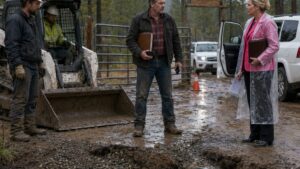
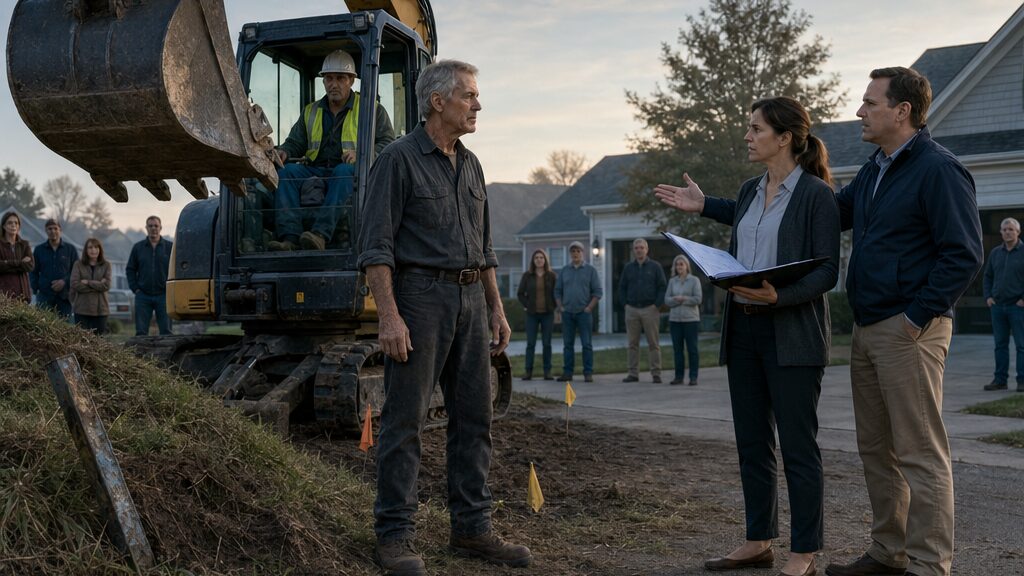
The excavator bucket swung over the grassy rise just as Scott Adams stepped beneath it.
The operator stopped the machine so sharply that the bucket rocked on its hydraulic arm. Diesel fumes drifted across the common lawn, mixing with the smell of cut grass and damp soil. Scott stood with both hands visible at his sides, his boots planted between two orange survey flags.
“Back away from the equipment,” Elizabeth Roberts called.
She crossed the lawn in a navy windbreaker with an HOA clipboard tucked against her chest. Behind her, Brian Jackson spoke quietly to three residents who had come out in slippers and jackets to watch. More faces appeared in windows along the curved street.
Scott looked up at the suspended bucket. Its steel teeth were clean.
“They haven’t touched the ground yet,” he said. “That’s why I’m here.”
Elizabeth stopped several yards away. “The contractor has county approval. The board gave notice. You had thirty days to submit an objection.”
“I submitted three.”
“You submitted questions.”
“They were questions you needed answered.”
Brian gave a humorless laugh. “This is exactly what we discussed. He doesn’t want the court, so now there’s some emergency under the grass.”
Scott turned his eyes toward the rise. It was not much to look at—an uneven swell in the lawn, perhaps four feet higher than the drainage strip behind it. Honeysuckle crowded one side. Near the base, half hidden by weeds, a weathered metal marker leaned backward on a bent post.
The new project signs called the area Future Recreation Commons.
The old marker called it something else.
Elizabeth stepped closer. “Scott, people paid a special assessment for this. Families have been asking for a shared amenity for years. We cannot let every board project become a personal referendum.”
“This isn’t about pickleball.”
“That is what you said at the meeting.”
“I said the proposed grading line crosses land your plan does not identify correctly.”
She opened the clipboard. A laminated contractor map sat on top, marked with a bright blue rectangle and a dashed access route. “The site was surveyed.”
“Not below grade.”
“It is shallow grading.”
Scott pointed past her. “Ask him where the twelve-inch storm line turns.”
The operator leaned out of the cab. He was middle-aged, with hearing protection resting around his neck.
Elizabeth glanced up. “Do you know?”
The operator looked at the printed plan taped beside his controls. “Line runs along the back edge.”
“No,” Scott said. “It enters behind the second house, angles toward the rise, then turns east beneath that flag.”
He pointed to a yellow flag nearly twenty feet inside the planned grading area.
Brian folded his arms. “Convenient.”
Scott ignored him. “There should also be a capped inspection riser four feet north of it. It was buried when the final grade was raised.”
The operator looked again at his plan, then at the ground. “That riser isn’t shown.”
“Neither is the turn.”
Elizabeth’s expression tightened. Years earlier, before Scott retired, she had called him whenever water pooled near the south entrance. She had once praised him at an annual meeting for knowing every drain in the development. Now that knowledge seemed to irritate her.
“You worked on the old drainage system,” she said.
“Yes.”
“That does not give you authority over this site.”
“No. It gives me reason to tell you your map is incomplete.”
Brian raised his voice for the neighbors. “The county approved this plan. We are not letting one retired employee invent buried hazards because he dislikes change.”
A woman near the sidewalk murmured that the court had already cost too much. Another neighbor asked whether the delay would increase the assessment. Brian answered before Elizabeth could.
“Every lost day costs the association money.”
Scott watched the concern move through the small crowd. No one looked at the marker. They looked at him.
The operator shut down the engine.
The sudden silence made the street feel exposed.
Elizabeth turned toward the cab. “Why did you do that?”
“I’m not digging over an unmarked utility until somebody clears it.”
Brian shook his head. “You just rewarded him.”
The operator climbed down. A loose ignition key hung from a short rubber tag in his hand. “Company policy. If a resident identifies infrastructure missing from the plan, I stop until the client signs off.”
Elizabeth extended her clipboard. “I’ll sign.”
Scott stepped out from beneath the bucket.
For a moment, Elizabeth seemed to think he had surrendered. Then Scott took the key from the operator’s open palm and pressed it flat against the top page of her clipboard.
He did not close his fingers around it.
“If you sign,” he said, “sign while holding the thing that starts the machine.”
Elizabeth looked down at the key.
A phone rose among the neighbors, but the man holding it lowered it when she stared at him.
Brian walked forward. “Give that back.”
“It is back.” Scott removed his hand. The key remained on the paper between Elizabeth’s fingers. “Power is not the same thing as clearance.”
“You’re being theatrical,” Brian said.
“No. Theatrical would be waiting until the bucket hit something.”
Elizabeth’s face had lost color, but her voice remained controlled. “What exactly do you believe is under that rise?”
Scott’s gaze moved to the leaning marker. The metal face was mottled with rust and lichen. From where they stood, its stamped lines could not be read.
He could have answered.
Instead he said, “More than your map shows.”
Brian laughed again, louder this time. “There. Nothing specific. Just another warning designed to stop us.”
Scott felt the familiar pressure behind his ribs—the urge to say only enough to prevent harm, never enough to expose what had happened before. For years, that habit had seemed disciplined. This morning it sounded evasive even to him.
Elizabeth removed the key from her clipboard and returned it to the operator.
“You will not restart,” she said, “until I tell you.”
The operator nodded.
Brian stared at her. “We have a mobilization window.”
“And now we have an unmarked line.”
“That line has nothing to do with the hill.”
Scott looked at him. “You don’t know that.”
Brian turned to the neighbors. “He has had weeks to bring evidence. He brought none. He waited until the machine arrived because he wanted an audience.”
The accusation landed because part of it was true. Scott had waited. Not for an audience, but because he had hoped the board would discover the problem without forcing him to explain how he knew.
Elizabeth closed the clipboard.
“No grading until noon,” she said. “That is the pause. Not a cancellation, not an open-ended investigation. Scott, bring me county documentation showing either a utility conflict or a protected feature inside the work area.”
“And if the archive takes longer?”
“Then you should have started earlier.”
Brian looked satisfied. The neighbors began drifting back toward their houses, carrying versions of the scene with them.
Scott walked to the marker and pushed weeds away from its base. Most of the inscription had faded, but one stamped date remained visible beneath the rust.
Elizabeth followed him halfway.
“What does it say?” she asked.
Scott straightened without turning around.
“It says someone knew this hill mattered before any of us had an HOA.”
“At noon,” she said.
When he looked back, the excavator key was in her hand.
Chapter 2: The Marker Had Been Moved Once Before
Laura Sanchez laid the old photograph beside the metal marker and measured the distance twice.
“Thirty-one feet,” she said.
Scott stood at the entrance to his garage, watching her stretch a tape from the marker’s present location toward a shallow patch of bare ground near the rise. The photograph had been taken in late autumn. The trees were thin, the homes unfinished, and the marker stood upright beside a wooden survey stake.
In the photograph, the hill filled the background.
In the present, the angle was wrong.
“You said it might have shifted when they landscaped,” Laura said.
“I said markers get moved.”
“This one didn’t wander.”
She reeled in the tape and held up the photograph. Scott recognized the county survey truck at the edge of the frame and the heavy field coat worn by a man whose face had been cut off by the image. He remembered the cold that morning. He remembered frozen mud clinging to the shovel blade.
He did not say so.
Laura slipped the photograph into a clear folder. She had inherited none of his patience for half-answers. At forty-one, she carried herself with the neat, economical movements of someone accustomed to fragile records and impatient researchers.
“Where did you get this?” she asked.
“Your mother kept it.”
“That was not my question.”
“In the garage cabinet.”
“Why did she keep a picture of an old marker?”
Scott reached for his truck keys. “The county archive opens at nine.”
Laura did not move. “Dad.”
“We have less than two hours.”
“You knew it was in the wrong place.”
“I knew it had been moved.”
“By whom?”
He opened the truck door.
Laura stood between him and the driver’s seat. “If you want me to help prove the board’s map is wrong, you cannot keep deciding which facts I’m allowed to know.”
He looked toward the rise beyond the row of backyards. The excavator’s arm showed above a privacy fence like a yellow crane waiting at water.
“I need the 1978 survey,” he said.
“That is not an answer.”
“No.”
Her mouth tightened. She stepped aside, but the disappointment followed him into the truck.
At the county archive, the planning clerk recognized Laura and let them use a side table near the map drawers. The building smelled of toner, dust, and old carpet warmed by fluorescent lights.
Laura searched the catalog while Scott sat with his hands folded around his reading glasses.
“Subdivision name changed in 1996,” she said. “Before that it was filed under the original developer.”
“I know.”
She glanced at him. “Of course you do.”
The clerk brought a gray archival box and placed it on the table.
Inside were rolled plats, correspondence, inspection photographs, and a thin survey report dated October 1978. Laura put on cotton gloves and unfolded it.
The first page described drainage, soil stability, and proposed residential access. The second page contained a hand-drawn contour map. A small triangle marked the rise.
Beside it, typed in faded ink, were the words Recorded Cultural Feature—Avoid Disturbance Pending Review.
Laura read the line twice.
“So it was documented.”
Scott nodded.
“This is enough to stop them.”
“No. It is enough to make them ask why later maps do not show it.”
“Which is also useful.”
She turned the page.
A routing slip listed copies sent to the developer, county engineer, and state review office. At the bottom was a reference to Supplemental Sheet 4-B.
Laura searched the folder.
There was no Sheet 4-B.
She checked the box again, lifting every page by its edge. “It’s missing.”
Scott leaned forward despite himself.
“You expected it to be here,” she said.
“I expected the file to be complete.”
“That is not the same thing.”
The clerk returned when Laura asked about removed sheets. She examined the routing slip, then typed the reference number into an older database.
“There was a supplemental map,” the clerk said. “It was checked out internally during the 2008 stormwater project.”
“Returned?” Laura asked.
The clerk frowned. “The record says incorporated into revised field documentation.”
“Where is that documentation?”
“Different file series. Federal assistance projects.”
Scott felt the room narrow.
Laura heard the change in his breathing. “What?”
“Nothing.”
The clerk printed an index page and handed it over. “You’ll want box SW-08-114. Some of those materials were scanned.”
Laura took the page.
At first she studied the project title: Emergency Stormwater Mitigation, South Residential Basin. Then her eyes moved down the list of contributors and field reviewers.
She stopped.
Near the bottom, beside the initials S.A., appeared the name Scott Adams.
The clerk looked from the sheet to Scott. “That was you?”
“I worked drainage for the city.”
“You were the field reviewer?”
“One of them.”
Laura removed her gloves carefully, finger by finger. “You told me you only knew the line because you maintained it.”
“I did maintain it.”
“You also reviewed the project that absorbed the missing supplemental sheet.”
Scott reached for the index, but she held it away.
“We need the 2008 file,” he said.
“We need the truth.”
People at the next table looked over. Laura lowered her voice, though her anger did not.
“Did you change the map?”
“No.”
“Did you approve a changed map?”
Scott looked toward the archive windows. Across the parking lot, the county flag hung almost still.
He remembered the original marker upright against bare trees. He remembered another morning years later, standing in floodwater to his knees while residents carried boxes out of basements. Between those memories lay a choice he had spent sixteen years calling practical.
Laura placed the 1978 photograph on top of the index.
The marker in the image stood thirty-one feet from where it stood now.
“Did you move it?” she asked.
Scott took off his glasses.
The clock over the map drawers clicked toward ten.
Chapter 3: The Grant That Reached Beneath Every Backyard
“The federal grant may overlap the recreation site.”
The county planning clerk said it without emphasis, as though she were reading a setback requirement. Elizabeth Roberts felt every person in the small conference room turn toward her.
Scott sat at one end of the table beside Laura. Brian occupied the chair to Elizabeth’s right, his project binder open before him. The clerk had spread three maps across the table: the 1978 survey, the 2008 stormwater grant plan, and the current court layout.
Elizabeth leaned closer. “May overlap?”
“The older project boundary is not drawn consistently across the file set.”
“That does not answer the question.”
“No,” the clerk said. “It means the question requires review.”
Brian tapped the newest map. “The court is privately funded. No federal money is involved.”
“The court may be private,” the clerk replied, “but the ground was part of a federally assisted drainage project. If the work affects resources that should have been reviewed then, or if the earlier undertaking carried unresolved conditions, the state preservation office may need to determine whether consultation applies.”
Elizabeth looked at Scott.
He had offered no explanation for his name in the index. Laura had barely spoken since they arrived. Something had changed between them, but Elizabeth could not afford to study it.
“How long does a determination take?” she asked.
The clerk’s expression became apologetic. “I cannot estimate for another office.”
“Days?”
“I cannot say.”
“We have a contractor mobilized.”
“I understand.”
“No, you understand a file. I have one hundred and twelve households who paid an assessment based on a schedule the county permitted.”
Scott spoke quietly. “A permit based on an incomplete map.”
Elizabeth turned on him. “You have not established that.”
“The 1978 survey establishes the feature.”
“It establishes that someone typed three words beside a triangle nearly fifty years ago.”
Laura looked up. “Recorded Cultural Feature.”
“I can read.”
“Then read the part that says avoid disturbance.”
Brian slid his binder between them. “The current site plan does avoid the recorded point.”
Scott’s eyes settled on him. “Because the recorded point moved.”
The room became still.
Elizabeth waited for Scott to say more. He did not.
That silence angered her more than an accusation would have. He knew something and expected everyone else to halt a contracted project while he decided how much truth to release.
The clerk pointed to the 2008 map. “This is the broader drainage undertaking. Federal funds were used for emergency mitigation after repeated flooding.”
Elizabeth remembered that year. Water had entered garages along the southern curve. One family lived in a hotel for six weeks. Scott had worked through nights while residents stacked ruined carpet at the curb.
“The project saved houses,” she said.
Scott looked down.
The clerk nodded. “That may be true. It also created federal documentation requirements.”
Brian closed his binder. “We are turning an emergency repair from sixteen years ago into a permanent restriction on common land.”
“No one has said permanent,” the clerk replied.
“They don’t have to. Delay is enough.”
Outside the conference room, a printer started and stopped. Elizabeth checked the time. Eleven twenty-three.
At noon, the operator expected a decision.
She pictured the annual meeting six months earlier. Residents had argued over dead landscaping, rising insurance premiums, and the lack of amenities compared with newer developments. Elizabeth had stood beneath harsh clubhouse lights and promised that the court would be one visible improvement completed on time.
The special assessment had passed by six votes.
Three board members had opposed it. One had resigned.
She had told everyone the new board would stop studying problems and start finishing things.
Now a rusted marker and an inconsistent line threatened to prove every critic right.
“What is the fastest lawful path?” she asked.
The clerk gathered the edge of one map. “Submit the file to the state preservation reviewer and request an expedited opinion. Do not disturb the disputed area until you receive one.”
Brian’s jaw tightened. “The disputed area keeps expanding every time Scott speaks.”
Scott looked at him. “That is what happens when the original area was reduced on paper.”
Again, no explanation.
Elizabeth stood. “We will take this to the clubhouse. The association attorney can join remotely.”
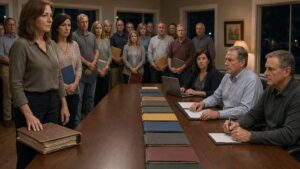
By one fifteen, the HOA meeting room was full.
Residents occupied every folding chair and lined the back wall. The excavator remained visible through the windows, parked beside the rise. Its silence had become its own kind of pressure.
The HOA attorney appeared on the wall-mounted screen. He listened while Elizabeth summarized the archive findings, then asked to see the grant boundary and current site plan.
Brian held both pages before the camera.
“The new court has no federal financing,” the attorney said. “That matters. A prior federal project does not automatically federalize every later private improvement.”
A murmur moved through the room.
Elizabeth felt air return to her lungs.
“What about the recorded feature?” Laura asked.
“That requires separate analysis. The legal question is whether the present work constitutes a federal undertaking or affects an unresolved protected resource within the prior undertaking’s area.”
“So we pause,” Scott said.
The attorney adjusted his glasses on-screen. “A cautious board might pause the disputed portion while verifying the boundary.”
Brian leaned toward Elizabeth. “The contractor can begin on the western edge.”
Scott shook his head. “Not until the drainage turn is marked.”
“We can mark utilities,” Brian said. “That is ordinary site work.”
Elizabeth looked through the windows. The operator sat on the excavator track eating from a paper bag. Every hour of delay felt visible.
Then Brian slid a single-page contract amendment toward her.
She read the clause twice.
“What is this?”
“The mobilization and grading deposit.”
“I know what it is. Why is it marked nonrefundable upon commencement?”
“Because that was the price reduction.”
Elizabeth lowered her voice. “You told the board the deposit was recoverable if permits failed.”
“If permits failed before mobilization. The machine is here.”
“You authorized this language?”
“As treasurer, within the approved budget.”
“How much?”
He named the amount.
It was large enough to consume most of the association’s emergency reserve if the project collapsed.
Elizabeth looked around the room at residents who had already complained about the assessment. Brian’s face showed strain now, not confidence. He had not hidden the clause because he wanted a court at any cost. He had hidden it because admitting the risk would expose how badly he had wanted the board to look competent.
Scott watched her from the front row.
For one brief, unwelcome moment, Elizabeth understood him. Both of them were withholding something because they believed disclosure would make the situation impossible to control.
The attorney asked Brian to place the grant map closer to the camera.
Brian did.
A thick black boundary curved along the drainage basin, then narrowed near the rise. The current court rectangle sat just outside it by several feet.
“There,” Brian said. “The mound is not inside the federal project.”
Scott stood.
“That is not the field boundary.”
Brian held the page higher. “It is the filed boundary.”
“The field work crossed farther north.”
“According to what?”
Scott’s answer came too slowly.
Elizabeth heard the neighbors shifting again.
Brian placed the map flat on the table with the satisfaction of a man who had finally found solid ground.
The court, the marker, and nearly the entire rise appeared outside the shaded federal area.
Elizabeth touched the line with one finger.
“If this plan is accurate,” she said, “the grant does not reach the hill.”
Scott stared at the map as if recognizing an old lie.
But he still did not tell them who had drawn it.
Chapter 4: Scott’s Signature Was Under the Missing Line
Laura found the signature at 8:17 the next morning.
It sat beneath a narrow revision box in the scanned 2008 field report, dark and unmistakable against the gray copy.
Scott Adams.
Below it, in smaller type, the revised boundary excluded the rise.
Laura stared at the screen until the letters stopped looking like her father’s name and became only evidence.
The library had not opened yet. Fluorescent lights hummed above the local-history room, and the heating vent clicked as if something inside it were trying to expand. On the desk beside her lay the 1978 survey photograph, the archive index, and three printed versions of the drainage map.
The original contour line curved around the rise.
The revised line cut beneath it.
She printed the page, folded it once, then unfolded it again.
Scott was waiting outside her office when she opened the door. He had not called first. He stood with his cap in one hand and a paper cup in the other.
“You found it,” he said.
Laura placed the report on the table between them.
“You signed it.”
He looked at the page without sitting.
“You told everyone the board’s map was wrong,” she said. “You didn’t tell us it came from your work.”
“It came from a revision.”
“With your approval.”
“The emergency work had already started.”
“That is not an answer.”
Scott set down the cup. Coffee trembled against the plastic lid.
Laura tapped the revision note. “Recorded feature excluded from active mitigation boundary. Marker relocated for maintenance access. That is what it says.”
“I did not write that sentence.”
“You signed beneath it.”
“I signed the field package.”
“Which included that sentence.”
He looked toward the closed glass door. Beyond it, empty reading tables waited under rows of lights.
Laura lowered her voice. “Did you move the marker?”
Scott sat at last.
“Yes.”
The word was so quiet she almost asked him to repeat it.
She did not.
“With whose permission?”
“There was no formal permission to move it.”
“Then why?”
“It was in the excavation path.”
“So you moved the evidence instead of moving the trench.”
“We were dealing with flooded houses.”
“That does not explain why the map changed.”
“The map changed because the drainage alignment changed.”
“And the mound disappeared from the boundary by coincidence?”
Scott’s jaw tightened. “I did not erase the hill.”
“You made it easier for everyone after you to pretend it wasn’t there.”
He reached for the report. Laura kept her hand on it.
“What happened in 2008?” she asked.
“We had six houses with water in the lower levels. Two retaining walls had failed. The southern basin was overtopping every hard rain. The federal assistance came with deadlines, and the city had already warned us that review could delay the work.”
“Review of the mound?”
“Review of everything.”
“That still does not explain the marker.”
Scott looked at his hands. His knuckles were broad and scarred from years of valves, pipe wrenches, frozen covers, and concrete edges.
“The contractor needed access for a trench box. The marker was leaning into the route. We moved it.”
“Thirty-one feet.”
“Yes.”
“Toward the property line.”
“Yes.”
“Outside the later project boundary.”
He did not answer.
Laura stood and walked to the window. On the street below, a delivery truck stopped at the curb. The driver carried two boxes into the building next door. Ordinary movement. Clear purpose. No hidden pages.
Behind her, Scott said, “People were losing their homes.”
“And who decided their homes mattered more than whatever the marker represented?”
“No one said it that way.”
“That is how decisions like this are made, Dad. Nobody says the thing out loud.”
He picked up the photograph of the marker in 1978.
“Your mother said we should stop.”
Laura turned.
Scott’s thumb rested against the clear sleeve.
“She knew?”
“She knew the marker had been moved. She knew the report was vague.”
“And you both kept it from me.”
“She wanted me to correct it after the emergency.”
“Did you?”
Scott looked again at the photograph.
Laura felt her anger shift. It did not lessen. It became heavier.
“You’ve been standing in front of that excavator like the only honest man in the neighborhood,” she said.
“I never said I was.”
“You let everyone assume it.”
“I was trying to stop them.”
“Without admitting why they had the wrong map.”
“If I gave them this before we had the older records, Brian would use my signature to discredit everything.”
“He will use it anyway.”
Scott pushed back from the table. “Then we submit the 1978 survey first.”
“No.”
He looked at her.
Laura gathered the pages into a single stack.
“I will submit a complete file or no file. The original survey, the missing reference, the federal grant, the revision, and your signature.”
“If you do that before the preservation office reviews the old map, the board will turn this into a personnel issue.”
“It is a personnel issue. It is also a preservation issue. One does not cancel the other.”
“They will say I fabricated the concern to cover myself.”
“Did you?”
Scott’s face hardened.
The silence gave her an answer she had not expected: not yes, but the realization that part of him had feared exactly that accusation because part of him still wanted to control how he appeared.
Laura slid the report toward him.
“I believed you knew the truth,” she said. “I did not understand that you meant only the part you were willing to tell.”
He stood slowly.
“I need your help.”
“You need my access.”
“That is not fair.”
“No. It isn’t.”
His eyes lifted to hers, wounded but restrained.
Laura almost softened. Then she saw the signature again.
“I will not hand the board a clean story about you,” she said. “Not even to save the hill.”
Scott picked up his coffee. It had gone untouched.
At home, he placed the printed report on the kitchen table and sat across from it. The house had been quieter since his wife died, but that morning the quiet felt occupied.
He opened the drawer where she had kept rubber bands, takeout menus, and spare batteries. At the back was a small envelope with no writing on it.
Inside lay a brass key to the garage cabinet.
He closed the drawer without taking it.
At ten thirty, the HOA sent a neighborhood email.
Emergency Site Update.
Scott read it standing at the kitchen counter.
The board stated that county records did not conclusively place the proposed court inside the federally assisted area. The contractor would remain paused while the association completed legal review.
The final paragraph was from Elizabeth.
Unless new controlling documentation is received, limited grading will resume tomorrow at sunrise.
Scott read the sentence twice.
His phone rang. Laura’s name appeared on the screen.
He answered.
“I sent the complete file to the state office,” she said.
Scott closed his eyes.
“You included my signature.”
“Yes.”
A pause.
Then Laura added, “Brian already has it.”
Chapter 5: Consultation Was Not Another Box to Check
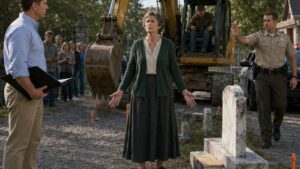
Samantha Torres turned the weathered marker face down before the emergency meeting began.
The metal struck the folding table with a flat, hard sound that silenced the room.
Scott stood near the back wall. Elizabeth sat at the center of the board table with Brian on her right and an empty chair on her left. Residents filled every seat. Several remained in the doorway, arms folded, expressions sharpened by the notice that grading would resume at sunrise.
Samantha kept one hand on the marker.
“I was told this was being used as proof,” she said. “Before we discuss proof, I want everyone to understand that this object is not the site.”
Brian leaned toward his microphone. “No one said it was.”
“You moved the proposed court because of where the marker sits.”
“We shifted the footprint as a precaution.”
“A precaution against what?”
Brian glanced at Elizabeth.
The HOA attorney appeared on the wall screen. His voice came through the speakers with a slight delay.
“The board is attempting to avoid the recorded point while legal review continues.”
Samantha looked at the current plan. “The recorded point is not the same as the cultural area.”
Elizabeth folded her hands. “We understand that concern. We are proposing to shift the court twenty-five feet west and restrict grading depth.”
“You are proposing a design change before consultation has begun.”
“We are trying to find a practical solution.”
“Consultation is not a box you check after choosing the solution.”
The room remained quiet.
Scott watched Elizabeth absorb the rebuke. She did not roll her eyes or look toward Brian for rescue. She looked at the marker lying face down.
Samantha continued. “A historic property is not protected because one piece of metal was planted in exactly the right location. The marker can be wrong. The old map can be incomplete. The visible mound can be only part of a larger area. That is why the process exists.”
A resident near the door asked, “Are you saying there are graves there?”
“I am saying no one in this room has enough information to answer that.”
“Then why shut down a project over something that might not exist?”
Samantha turned toward him. “Because excavation is how uncertainty becomes permanent damage.”
The answer settled over the room.
Scott felt the pressure of Laura’s absence. She had refused to sit beside him, though she had sent the records. He had seen her car outside and knew she was somewhere in the building, perhaps near the rear doors.
Elizabeth spoke next.
“The board is willing to pause work in the revised footprint for seventy-two hours while the state office determines whether formal consultation is required.”
Brian turned sharply. “That is not what we agreed.”
“It is what I am proposing now.”
“The contractor will walk.”
“Then he walks.”
A murmur rose from the residents.
Brian lowered his voice, but the microphone caught every word. “And the association loses the deposit. Then what? Another assessment?”
Elizabeth’s jaw tightened. “We are not discussing the contract in open session.”
“We are discussing the reason you are changing direction.”
Scott saw something in her face then—not surrender, but fear. She had spent months presenting the court as evidence that the board could function. Pausing it publicly meant admitting that control had always been thinner than it appeared.
Samantha looked toward Scott.
“Mr. Adams.”
He straightened.
“You worked on the 2008 drainage project?”
“Yes.”
“Was the tribe contacted before the marker was relocated?”
Scott felt every chair turn toward him.
“No.”
“Was the state preservation office contacted?”
“There were discussions.”
“That was not my question.”
“No.”
“Did anyone assess whether moving the marker altered the apparent site boundary?”
Scott swallowed.
“Not formally.”
Samantha’s expression did not change, but her hand lifted from the marker.
“So the current board is relying on a location created during work that was never properly reviewed.”
The attorney interrupted from the screen. “We should avoid legal conclusions until the agencies determine jurisdiction.”
Samantha looked at him. “I made a factual statement.”
Brian opened his binder.
Scott recognized the report before Brian raised it. The revised 2008 field package had a yellow tab attached to the signature page.
“Since we are discussing facts,” Brian said, “the person now demanding that we trust the old record is the same person who approved the new one.”
Elizabeth looked at him. “Brian.”
He held up the page for the room.
“Scott Adams signed the revision that excluded the hill.”
Several residents began talking at once.
Scott heard his name, then the words liar, cover, and personal liability. A woman in the second row turned to look at him with open disbelief.
Elizabeth struck the table once with the side of her hand.
“Enough.”
Brian lowered the paper but did not sit back.
“He waited until the machine arrived,” he said. “He let this board spend the assessment. He let us sign the contract. Now he wants to present himself as the only person protecting the neighborhood.”
Scott looked toward Laura.
She stood near the rear exit, holding a folder against her chest. Her face showed no surprise. She had known this moment would come.
Samantha did not defend him.
That hurt more than the accusations.
She simply asked, “Is the signature yours?”
“Yes.”
“Did you approve the boundary?”
Scott looked at the residents. Some had lived there during the floods. A few had carried furniture through water while he and the city crew opened blocked drains. He had told himself for years that those nights justified what followed.
Elizabeth watched him without triumph.
She looked exhausted.
“The revised boundary was part of the emergency field package,” Scott said.
Brian spread his hands. “There it is.”
“That is not all of it.”
“Then say all of it.”
Scott looked at Laura.
She gave him nothing—not permission, not forgiveness, not rescue.
For the first time, he understood that her refusal was not abandonment. She was leaving the truth where it belonged.
With him.
He walked toward the board table.
The marker lay between Samantha and Elizabeth, face down, its bent post extending over the edge.
Scott placed both hands on the table.
“I knew the marker had been moved,” he said.
The room quieted again.
“I knew the revised map did not show the full area from the 1978 survey.”
Brian’s expression shifted.
Scott continued before fear could close his throat.
“I helped make the map they are using.”
Chapter 6: The Truth Scott Buried to Save the Street
Scott opened the field notebook at 1:42 in the morning.
He had promised himself never to show it to anyone.
The notebook lay inside the locked garage cabinet behind old valve charts, a corroded pipe gauge, and the orange safety vest he had worn during the 2008 floods. Its green cover had faded almost gray. Black tape reinforced one corner.
He carried it to the kitchen table and placed it beneath the overhead light.
On the first pages were ordinary records: pipe diameters, basin elevations, pump hours, addresses where water had entered foundations. Farther in, the handwriting grew hurried. Rain totals. Failed walls. Emergency calls. Notes from residents asking whether the city would pay for ruined furnaces.
Then came the sketch of the rise.
Scott had drawn the original marker location, the trench route, and the proposed drainage turn. A red line marked the adjustment made after the contractor said the original route would require a delay.
Beside the marker, Scott had written:
Move temporarily. Restore after work.
He turned the page.
The next entry contained no restoration note.
Only a revised distance and the initials he had later placed on the official field package.
The kitchen seemed to tilt around him.
He had remembered the choice as something forced by time. The notebook showed smaller choices after that: days when he could have corrected the marker, weeks when he could have reopened the file, meetings when he could have said the map was incomplete.
He had not made one mistake.
He had renewed it.
A folded sheet of stationery slipped from the back cover.
Scott recognized his wife’s handwriting before he opened it.
You keep saying you moved only the sign.
Underneath, in darker ink:
But when people can no longer see where something belongs, they begin to believe it never belonged there.
He sat very still.
A second line had been added later.
Do not let the hill become another thing we protected by refusing to name what we did.
Scott pressed the paper flat.
He remembered the argument in the garage after the flood project. She had wanted him to send a correction to the county. He had said residents were exhausted, the city was threatening cost recovery, and reopening the file might delay reimbursements. She had asked how long he intended to wait.
He had said until things settled.
Nothing ever settled. The basements dried. The walls were rebuilt. New families moved in. The marker leaned in weeds.
His promise to her had come years later, after she became ill. He had told her no one would disturb the rise.
At the time, he believed that promise was honorable.
Now her note showed him what it had really been: another private substitute for public truth.
At two thirty, Scott called Laura.
She answered on the fourth ring.
“I found the notebook,” he said.
Silence.
“Is it complete?”
“Yes.”
“Does it show the original location?”
“Yes.”
“And your revision?”
“Yes.”
Laura exhaled. “Bring it to me.”
“No.”
Her voice hardened. “Dad.”
“I’m not asking you to carry it.”
“What are you going to do?”
“Submit it myself.”
“The state office is closed.”
“I’ll scan it.”
“Then call the reviewer’s emergency number. It is in the email.”
Scott looked at the notebook.
“Laura.”
“What?”
“I’m sorry.”
She did not answer immediately.
“For moving the marker?” she asked.
“For teaching you that I would rather protect my reasons than trust you with them.”
Her breath caught, but when she spoke, her voice remained controlled.
“Call the reviewer.”
At three fifteen, Scott scanned every page.
At three forty, he sent the file to the state preservation office, the county clerk, Samantha, Elizabeth, the HOA attorney, and the full board.
He included one paragraph.
I approved the 2008 field revision after the marker was moved during emergency drainage work. The attached notebook shows the recorded feature extended into the area excluded from the final map. I did not correct the record. The omission was mine.
He did not explain the floods.
Not yet.
At four ten, the state reviewer returned his call.
“I received the notebook,” she said. “This is significant.”
“Can you issue a stop-work order?”
“Not based on an unverified personal record alone.”
“It is my field record.”
“I understand, but I need to establish the agency connection and authenticate the materials.”
“The machine starts at sunrise.”
“I have requested an immediate voluntary hold.”
“Elizabeth may not agree.”
“Then the county may need to act under its permit authority.”
“How long?”
“I cannot promise before sunrise.”
Scott closed his eyes.
“What can I do?”
“Preserve the originals. Do not interfere with equipment. Do not enter an active work zone.”
The call ended.
At five, headlights moved across the kitchen wall.
The excavator operator’s truck passed Scott’s house toward the common area.
Scott put the notebook into a clear plastic sleeve. Beside it on the table lay a printed copy of his wife’s note.
He folded the note and placed it in his shirt pocket.
Outside, the neighborhood was dark except for porch lights and the work lamps around the mound.
Elizabeth stood near the excavator with her clipboard. Brian spoke to the operator beside a row of newly placed cones. Several residents watched from the sidewalk, wrapped in coats.
Laura’s car was parked across the street.
She met Scott at the end of his driveway.
“You sent everything,” she said.
“Yes.”
“Why did you change the boundary?”
He looked toward the rise.
“In 2008, three storms hit within five weeks. Water went through six homes. One retaining wall cracked beside a child’s bedroom. The federal grant had a work deadline, and the state review office warned that expanding the cultural boundary could require redesign.”
“So you excluded it.”
“I told myself the trench would miss the rise if we shifted the line. The contractor said the marker had to move for access. I signed the revision because delaying the drainage work could have left those homes exposed through another storm.”
Laura listened without interrupting.
“The repair saved the street,” Scott said. “That part is true.”
“And the rest?”
“The rest is that I could have corrected the record after the emergency. I did not.”
“Why?”
“Because then I would have had to admit what I had done when everyone was calling the project a success.”
Laura looked toward the mound.
“That is what you need to tell them.”
“I know.”
The excavator’s work lights came on.
Brian raised one arm, signaling the operator.
Elizabeth saw Scott and walked toward him.
“The state requested a voluntary hold,” she said.
“Are you taking it?”
“The attorney says the request is not binding.”
“That was not my question.”
Her face tightened. “The board voted four to three to resume limited grading outside the mapped federal boundary.”
“The mapped boundary I altered.”
“You sent that statement after midnight.”
“It is still true.”
Elizabeth glanced at the notebook in his hands.
“Is that the original?”
“Yes.”
“Give it to the county.”
“I will.”
“Then stay outside the cones.”
Behind her, Brian called, “We need to begin.”
Elizabeth turned.
For a second, Scott thought she might stop him.
Instead she said, “Only the western cut. No work within ten feet of the revised marker location.”
Scott looked past her at the survey flags.
The western cut crossed the original line in his notebook.
He held up the page.
“That restriction still enters the recorded area.”
Brian walked over. “According to your private sketch.”
“According to the field measurements your filed map replaced.”
“The reviewer has not authenticated them.”
“No.”
“Then you have no authority to stop this.”
Scott looked at the excavator.
The operator climbed into the cab.
Laura touched Scott’s sleeve. “Do not step in front of it.”
He remembered the reviewer’s warning.
Do not interfere with equipment.
Do not enter an active work zone.
The engine turned once, coughed, then started. Diesel noise rolled across the street. The bucket lifted slowly into the work lights.
Scott put the notebook beneath his arm and walked toward the rise.
Elizabeth moved after him.
“Scott.”
He crossed the first cone line.
“Scott, stop.”
The excavator’s bucket swung toward the grass as he continued forward.
Chapter 7: He Stopped Asking Them to Believe Him
Scott placed the field notebook on the grass beneath the raised excavator bucket.
The operator saw it first. His hands came off the controls, and the machine’s arm stopped with a faint hydraulic shudder.
Scott stepped back outside the bucket’s reach.
“I am not blocking the equipment,” he called over the engine. “That notebook contains the original measurements, the marker location, and my signed revisions. I have sent copies to the county and the state. The original is here.”
Brian pushed through the cones. “Move it before it gets damaged.”
Scott looked at him. “That is the point.”
Elizabeth reached them a moment later, breathing hard. “You cannot put documents inside an active work zone.”
“The work zone was drawn from my false boundary.”
“Then let the agencies determine that.”
“They are trying.”
The operator leaned from the cab. “Am I proceeding or not?”
Brian answered immediately. “Western cut only.”
Elizabeth did not.
The excavator idled between them, filling the dawn with its low mechanical pulse. Residents had gathered along both sidewalks. No one spoke. Laura stood near the first cone with her arms folded tight against the cold. Samantha’s car turned onto the street but had not yet reached the site.
Brian moved closer to Elizabeth.
“If we stop again, the contractor leaves,” he said. “The deposit is gone. We will have nothing to show for the assessment except legal bills.”
Elizabeth looked toward the houses. Scott knew what she saw: residents who had trusted her promise, board members who had warned the project was too risky, families already complaining about dues. He could almost see her calculating how many explanations a neighborhood would tolerate before deciding its president had failed.
Then she looked down at the notebook.
Its taped corner lifted slightly in the engine wash.
“Scott,” she said, “tell them now.”
He understood.
Not the agencies. Not later. Not in a carefully written statement.
Now.
Scott turned toward the residents.
“In 2008, the southern basin failed during repeated storms,” he said. “Six houses took water. The city secured emergency federal assistance to replace the drainage line and stabilize the slope.”
A man near the sidewalk called, “We know that.”
“You know the repair happened. You do not know what we changed to finish it quickly.”
Brian looked toward the operator. “This is not a public hearing.”
Elizabeth raised one hand without taking her eyes from Scott.
He continued.
“The original review documents showed the rise as a recorded cultural feature. The proposed trench and access route came too close to it. A full redesign could have delayed the drainage work while more storms were expected.”
He could hear his own breathing between sentences.
“The contractor moved the marker for access. I approved a revised field package that placed the active project boundary south of the rise. I told myself the drainage line would miss the feature and the marker could be restored when the emergency passed.”
Laura watched him without blinking.
“I did not restore it,” Scott said. “I did not correct the map. When the repair succeeded, I let the filed version remain because admitting the truth would have changed what people believed about the project—and about me.”
A woman who had lived in one of the flooded houses lowered her eyes.
Scott looked toward Samantha as she approached the cones.
“I stopped this machine because the map is unreliable,” he said. “It is unreliable because of me.”
The words did not produce the relief he had imagined during the night. There was no clean release. The residents looked uncertain, angry, or embarrassed. Someone asked whether the association could sue him. Someone else asked whether the old drainage project was illegal.
Scott did not defend himself.
Brian did.
“This is exactly why his notebook cannot control a current permit,” he said. “He has admitted the records are compromised. We need official findings, not guilt.”
Samantha stopped beside the notebook but did not pick it up.
“He is not asking you to accept the notebook as a final finding,” she said. “He is telling you the current boundary cannot be treated as reliable enough to justify disturbance.”
Brian pointed toward the court plan. “The state still has not issued an order.”
As if summoned by the sentence, Elizabeth’s phone rang.
She looked at the screen and answered.
“Yes, this is Elizabeth Roberts.”
Everyone watched her face.
She listened, asked the caller to repeat something, then turned away from the excavator. Her responses became shorter.
“I understand.”
“No ground disturbance.”
“Yes.”
When she ended the call, Brian stepped toward her. “County?”
“The state reviewer authenticated enough of the notebook against the archived project records to request an immediate county permit suspension.”
“Request?”
“The county is preparing the notice.”
“So it has not been issued.”
Elizabeth looked at him.
“No.”
Brian spread both hands. “Then we can finish the western cut before it is.”
Scott saw the instant in which Elizabeth could still choose procedure as shelter. The machine was running. The contractor was present. The county had not yet sent the document. She could claim later that the board had acted under the permit it possessed.
Her eyes moved to the ignition.
“Turn it off,” she said.
Brian stared at her. “Elizabeth.”
She raised her voice toward the cab.
“Shut down the machine.”
The operator killed the engine.
Silence rolled across the lawn, deeper than before.
Brian’s face tightened. “You just exposed the association to the full cancellation charge.”
“No,” Elizabeth said. “The contract did that.”
“You approved the contract.”
“I approved the version you summarized to the board.”
His expression changed.
Laura stepped forward. “What version?”
Elizabeth looked at Brian. “The attorney’s email last night included an earlier preservation inquiry from the contractor’s insurer. It was sent to the treasurer’s account three weeks before mobilization.”
Brian’s mouth opened, then closed.
Scott remembered the confidence with which Brian had produced the favorable boundary map. Not certainty, he realized. Selection.
“You knew there was a question,” Elizabeth said.
“It was not a formal objection.”
“You withheld it.”
“I was trying to keep a rumor from destroying the project.”
Samantha looked from Brian to Scott. “Different reasons. Same choice.”
Neither man answered.
The county suspension arrived eleven minutes later. The operator printed it from his truck and handed the page to Elizabeth. She read it, signed acknowledgment, and passed it to the contractor.
Only then did Samantha lift the notebook from the grass.
She held it carefully by the plastic sleeve.
“This will not settle what the site is,” she told Scott.
“I know.”
“It may take months.”
“I know.”
“And consultation will include more than your account.”
“It should.”
She studied him for a moment, then nodded once.
The excavator was moved that afternoon to the paved visitor area, its bucket lowered and resting flat. Elizabeth kept the ignition key until the contractor loaded the machine onto a trailer two days later. When the operator asked for it, she placed it in his palm rather than handing it to Brian.
The weeks that followed were neither quiet nor easy.
The association lost a large portion of the grading deposit. Insurance covered none of it. At a special meeting, residents voted to use part of the landscape reserve and defer two cosmetic projects rather than impose another immediate assessment.
Brian resigned before the board could remove him. The audit later confirmed that he had withheld the insurer’s inquiry and minimized the cancellation clause. He sent no apology to Scott.
Scott did not expect one.
The state review did not declare the rise a burial mound. It found that the site had been inadequately documented, that the 2008 work had altered the apparent boundary, and that further noninvasive study and tribal consultation were required before any ground disturbance.
Samantha rejected the board’s first proposal, which offered a decorative plaque beside a narrower court.
“A marker is not protection,” she said.
Elizabeth did not argue the second time.
The court was relocated to a flatter strip near the clubhouse parking area. It was smaller than planned and required noise screening along two homes. Several residents remained unhappy. Others were relieved that the project survived at all.
At the meeting approving the new site, Elizabeth addressed the room without a prepared statement.
“The board treated uncertainty as an obstacle to manage rather than information requiring disclosure,” she said. “That failure belongs to the board, and it belongs to me.”
She did not ask to be forgiven. She remained president only until the next election.
Scott attended every consultation session. He answered questions about the drainage work, surrendered the original notebook to the public archive, and signed a statement correcting the 2008 record. The city informed him that the age of the project and the emergency circumstances made formal discipline unlikely, but the correction would remain attached to the file.
Laura prepared the archive description.
She showed it to him before publication.
“You included everything,” he said.
“Yes.”
His field notes, the moved marker, the emergency repair, the altered boundary, his delayed correction.
Scott touched the edge of the page. “Good.”
Months later, he stood beside the rise while a small crew reset the weathered marker near its documented location. No soil was opened beyond the approved post hole. Samantha supervised the placement. Laura held the old photograph, aligning the background trees and rooflines.
Elizabeth arrived carrying a new interpretive plaque approved through consultation. It described the recorded cultural landscape, the history of incomplete documentation, and the obligation to preserve the area while study continued.
At the bottom was a list of participating offices and organizations.
Scott’s name was not there.
Elizabeth noticed him reading it.
“The board asked whether you should be included,” she said.
“I told Laura no.”
“You did stop the machine.”
“I also helped point it there.”
Elizabeth looked toward the relocated court. Its surface was visible beyond the clubhouse, pale beneath the afternoon sun. Two children rolled a ball along the fence while an adult adjusted the net.
“We both thought finishing something would prove we had done the right thing,” she said.
Scott looked at the marker.
“Sometimes stopping is the finished thing.”
She gave a tired half-smile. “That sounds like something you had time to prepare.”
“I have had a few months.”
Laura called from the rise. “It is straight.”
Scott walked over and placed one hand against the marker’s edge. The metal was still scarred and rusted. They had not polished it. Samantha had insisted that its condition was part of the record.
The post stood firm beneath his palm.
Laura checked the old photograph one final time. “This is as close as we can establish without disturbing anything.”
Scott stepped back.
The marker no longer functioned as his private warning or his private promise. It stood where anyone could see it, beside a plaque that did not hide the mistakes made in protecting the street or the history nearly lost because of them.
Laura slipped her arm through his.
“You all right?” she asked.
Scott looked across the rise, past the drainage line, toward the homes that had stayed dry since 2008.
“No,” he said.
She waited.
“But I’m here.”
Together they watched Samantha secure the final bolt.
The marker remained upright after everyone let go.
The story has ended.