She Put a Repair Bill on His Dock and Assumed He Would Sign
Chapter 1: The Bill She Dropped on the Dock
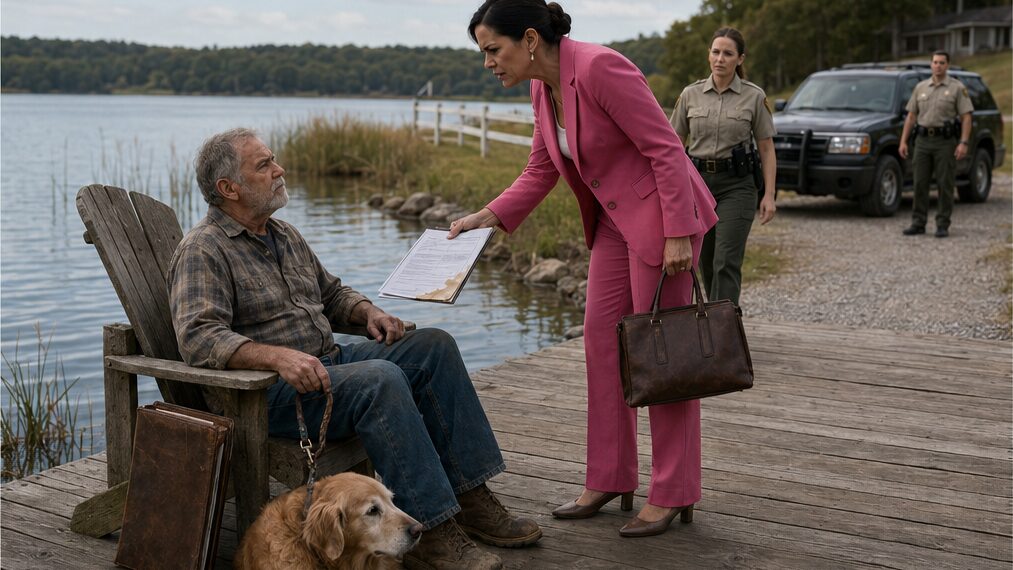
The repair estimate hit the arm of William Carter’s dock chair hard enough to make his golden retriever lift his head.
Cynthia Rivera stood over him in a bright pink suit that looked too polished for the weathered planks, the lake mud, and the damp smell of reeds. One corner of the paper curled in the breeze. A metal clip held several pages together, and the top sheet had a number printed in bold near the bottom.
$21,780.
William did not touch it at first.
He kept one hand on the dog’s leash and the other around the chipped enamel cup resting on his knee. The lake behind Cynthia was calm enough to mirror the white fence along the shoreline. A pair of ducks moved past the dock posts, uninterested in human money.
“I need you to sign acknowledgment,” Cynthia said. “Today.”
William looked from the paper to her face.
Her jaw was set, but her eyes kept flicking toward the gravel turnoff behind the dock trail, as if she expected an audience and wanted to be ready for it.
“Morning to you too,” William said.
“This is not a neighborly visit.” Cynthia tapped the estimate with two fingers. Her nails were pale and glossy, each tap sharp against the paper. “Samuel Adams inspected my shoreline yesterday. The damage came from your side. Your runoff, your fence line, your old culvert. My rental dock is unsafe, and I have guests canceling.”
William let the name settle without reaction.
Samuel Adams.
He had seen that name on trucks before, seen it stenciled on magnetic signs that always seemed temporary enough to be removed when work went bad.
“I didn’t ask Samuel to inspect my side,” William said.
Cynthia gave a short laugh. “Your side caused the damage.”
The dog rose then, not growling, just standing with his body pressed against William’s leg. William ran his thumb once over the leash. It was an old habit. Keep the dog calm first. Keep yourself calm second.
Cynthia leaned closer. “Do you understand what I’m saying? This is not optional. I have the estimate, I have photographs, and I have a statement from the contractor. If you sign acknowledgment, we can keep this between us and the carriers.”
“Carriers,” William repeated.
“Insurance,” she said, as if explaining a simple word to a child. “Mine and yours.”
William finally picked up the top page. A faint brown water stain cut across the lower corner. The estimate smelled lightly of printer ink and lake damp. He scanned the contractor’s header, the date, the line items: shoreline stabilization, dock support replacement, fence debris removal, emergency drainage correction. Words that sounded official because they cost money.
He did not read the accusation aloud.
Cynthia did it for him.
“Damage attributed to uncontrolled flow from adjoining property,” she said. “That is your property, William.”
He looked toward the fence. The paint had gone chalky in places, but the posts still stood straight where he had set them with his own hands years ago. Beyond it, the shoreline bent toward Cynthia’s rental cottage. Her place had new deck lights, a firepit, and a sign near the driveway that said Lakeside Weekend Retreat in scripted black letters.
William folded the first page back down.
“I’m not signing this.”
Cynthia’s expression changed so quickly that for a second he saw fear underneath the anger. Then the anger came back harder.
“You don’t get to just sit here and pretend you don’t understand.”
“I understand enough not to sign something that isn’t true.”
A door slammed behind them.
William did not turn right away. He heard tires crunching gravel, then a second door, then the low murmur of a radio. Cynthia straightened like a person stepping onto a stage.
Two county SUVs had stopped near the gate. The female deputy came down the dock trail first, one hand resting near her belt, eyes moving from Cynthia to William to the dog. A second deputy stayed higher on the bank.
“Ms. Rivera?” the deputy called.
Cynthia raised her hand. “I’m here. He’s refusing to cooperate.”
The deputy slowed at the edge of the dock. “Sir, can you keep the dog close?”
“He’s close,” William said.
The retriever sat immediately, as if proving the point.
Cynthia pointed at William so sharply that the deputy’s gaze followed her finger. “I reported property destruction. I told dispatch he was refusing responsibility.”
William’s mouth tightened, but he did not stand. Standing would make Cynthia step back. Cynthia stepping back would make it look like he had advanced. He had learned long ago that some people wanted your movement more than your words.
The deputy looked at the estimate in his hand. “Sir, what’s your name?”
“William Carter.”
“This your property?”
“Yes.”
“Ms. Rivera says there’s been damage to her adjoining shoreline.”
“So she says.”
Cynthia spoke over him. “Not so I say. So the contractor says. The washout starts at his fence line. His old culvert is sending water across my property, and now I have a dock I can’t rent, a shoreline I have to rebuild, and a neighbor who thinks being elderly means rules don’t apply.”
The second deputy’s eyes shifted at that.
William felt the words land, felt the old familiar pull to lower his gaze and let the moment pass. It was easier to let people believe what they wanted when the truth required too much explaining. Easier did not mean cheaper. Not this time.
He slid the estimate beneath the flap of the brown dock folder he kept beside his chair. The folder was warped from years of damp air and old receipts. He used it for lake permits, dock repairs, fence invoices, notes to himself, things nobody cared about until somebody cared too much.
Cynthia saw him put the papers away and snapped, “That is not yours to keep.”
“You put it on my chair.”
“I put it there for you to sign.”
“And I told you no.”
The deputy stepped between them before Cynthia could move closer. “This sounds like a civil dispute. Nobody is signing anything on this dock because we showed up.”
Cynthia turned toward her. “With respect, Deputy, I called because he has been warned before about that fence.”
William looked up. That was new.
The deputy glanced at him. “Have you?”
“No.”
Cynthia reached into her leather bag and pulled out another sheet. “Lake association concern notice. Sent last fall.”
William recognized the paper but not the meaning she was giving it. Last fall’s notice had been about trimming reeds near the common path, not water damage. He had trimmed them two days later. He had the receipt for the brush hauling in the house.
Cynthia held the page just far enough that the deputy could see a letterhead and not the small print.
William almost corrected her. The words rose and stopped behind his teeth.
If he argued every twisted sentence, he would become the argument. Cynthia knew that. Her suit, the papers, the deputies, the sharp little phrases—everything was arranged to make his quiet look like confusion.
The deputy took the page, read longer than Cynthia expected, and handed it back.
“This does not mention property destruction.”
Cynthia’s lips pressed together. “It establishes a pattern.”
William gave one breath that might have been a laugh if he had let it live.
The dog leaned against his knee.
“Mr. Carter,” the deputy said, softer now, “are you willing to exchange insurance information?”
“No,” William said.
Cynthia’s eyes flashed.
William lifted the folder slightly. “Not until I know what happened. Not until somebody inspects both sides. Not until the dates make sense.”
“What dates?” the deputy asked.
Cynthia cut in. “He’s stalling.”
William opened the folder again and looked at the top of Samuel’s estimate. The inspection date was printed clearly: Thursday, May 16. Cynthia had just said she discovered the damage after weekend renters complained on May 19.
He did not point that out yet.
He had learned something from mending fences. You did not pull on a loose wire until you knew which post was holding the tension.
“The date on this estimate,” he said, “is one I’ll want to understand.”
Cynthia’s face tightened again, not much, but enough.
The deputy noticed. William could tell because she stopped writing.
Cynthia recovered. “Fine. Understand it with your insurance company. Ruth Miller already has the preliminary notice. If you don’t cooperate, she’ll proceed with what she has.”
The name brought the first real chill into William’s chest. Police on the dock were noise. Insurance was paper that could outlive a conversation.
“You sent this already?” he asked.
“I told you,” Cynthia said. “This is not optional.”
The deputy looked unhappy now. “Ms. Rivera, you need to stop representing this as a police matter if it’s an insurance matter.”
“It became a police matter when he refused to take responsibility.”
“No,” William said.
It was not loud. It did not need to be.
Cynthia turned back toward him.
William stood slowly, not toward her, but beside his chair. His knees objected before the rest of him did. He kept the folder in his left hand and the leash in his right. The dog stood with him.
“No,” he said again. “It became a police matter because you wanted witnesses when you handed me a bill.”
For a moment, no one spoke. The lake made its small sounds under the dock. A duck beat its wings near the reeds. The deputy’s pen paused above her notebook.
Cynthia’s face flushed above the collar of her pink jacket. “You think this makes you look calm. It makes you look guilty.”
William looked down at the estimate through the open edge of the folder.
Samuel Adams Construction & Shoreline Repair.
The printed name sat under the water stain like something half-buried and waiting.
William closed the folder carefully, pressing his palm over the clip until the metal stopped trembling.
Chapter 2: The White Fence Everyone Pointed At
“That is where his water came through,” Cynthia said, pointing at the broken white fence board as if the wood itself had confessed.
William stood three steps behind the deputy and said nothing.
By afternoon, the quiet dock had become a walking tour of accusation. Cynthia led them along the narrow strip where William’s fence followed the lake, her pink jacket bright against the pale boards and cattails. The female deputy walked beside her, notebook open. The second deputy lingered near the top of the slope, watching the ground more than the people. Two lake association members had appeared at the gravel turnoff without admitting they had come to watch.
William’s retriever padded beside him, nose low, occasionally stopping to sniff where rainwater had carved shallow channels through the grass.
Cynthia stopped at the damaged section of fence. One board had cracked near the bottom rail, not fresh enough to show bright wood, not old enough to disappear into the rest of the weathering. A strip of orange survey ribbon had been tied to the nearest post. William had not tied it.
“See?” Cynthia said. “His fence debris washed into my side, and the water followed this path.”
The deputy crouched near the board. “Mr. Carter, do you know when this broke?”
“No.”
Cynthia laughed. “Convenient.”
William looked past the fence to the swale between their properties. It had always been there, a shallow natural dip that carried hard rain toward the lake. His late wife used to call it the lake’s little wrinkle. Every spring, William cleared leaves from it so water would not pool against the fence.
Cynthia had disliked the swale since she bought the rental cottage. She wanted clean slopes, manicured grass, straight lines for listing photos. Natural drainage did not photograph well.
“You’ve had runoff issues for years,” she said.
“I’ve had rain for years.”
The second deputy looked down, hiding something close to a smile. Cynthia saw it and stiffened.
“This is serious,” she said. “Samuel said the flow pattern is obvious.”
As if summoned by his name, a white pickup rolled down the gravel lane and stopped near Cynthia’s cottage. Magnetic signs on the doors read Samuel Adams Construction & Shoreline Repair. Samuel got out with a clipboard tucked under one arm and a measuring tape clipped to his belt. He was younger than William had expected, maybe mid-forties, with a sunburned neck and boots too clean for a man who wanted to look busy.
Cynthia waved him over. “Samuel, please explain what you found.”
Samuel took in the deputies, the association members, William, and the dog. His expression shifted into professional seriousness.
“The washout pattern runs from this side toward Ms. Rivera’s dock,” he said. “Old culvert, compromised fence line, saturated soil. Once that last rain hit, it opened up the bank.”
William watched his hands. Samuel pointed broadly when he described William’s side, precisely when he described Cynthia’s damage.
The deputy asked, “Did you inspect Mr. Carter’s culvert?”
Samuel tapped the clipboard. “Visual inspection from accessible areas.”
“Meaning Cynthia’s side,” William said.
Samuel looked at him for the first time. “Meaning I did not trespass.”
“You were comfortable naming my property as the cause without setting foot on it.”
Cynthia stepped in. “Because the evidence is visible.”
William looked at the swale again. There was something visible, but not what she meant. Near Cynthia’s side, where the grass thinned before the lakebank dropped, a dark green stain marked the soil along a shallow cut. Algae. Not new. It had dried and darkened through more than one cycle of sun and water.
William walked toward it.
Cynthia snapped, “Do not cross onto my property.”
He stopped at the fence line and pointed with the toe of his boot. “That staining was there before last weekend.”
Samuel’s eyes followed the mark, then moved away.
The deputy noticed that too.
“How would you know?” Cynthia demanded.
“Because algae doesn’t grow that dark in three days.”
Samuel cleared his throat. “Staining can remain after a sudden washout.”
“It can,” William said. “But that cut has edges packed by more than one rain.”
Samuel’s grip tightened on the clipboard.
Cynthia turned to the deputy. “He is not an engineer.”
“No,” William said. “I’m the one who clears the swale.”
The words came out sharper than he intended. Not loud, but edged. The dog looked up at him.
Cynthia seized on it. “Exactly. He alters drainage.”
William regretted the sentence the moment it left him. He had meant maintenance. She had heard admission.
The deputy wrote something down.
He felt the cost of silence and the cost of speech arrive together. For years he had believed the safest thing was to say as little as possible. Now every word he withheld became emptiness for Cynthia to fill, and every word he offered could be bent.
Samuel stepped forward with the confidence of a man returning to prepared ground. “The practical next step is simple. Mr. Carter acknowledges potential responsibility, carriers sort it out, and temporary repairs can start before more damage occurs.”
“Temporary repairs by you?” William asked.
Samuel’s jaw shifted. “I gave an estimate.”
“After inspecting one side.”
“I inspected the damage.”
“Not the cause.”
Cynthia held up both hands, palms outward, performing patience for the deputies. “William, this is why I tried to handle this privately. You make everything difficult.”
Privately, he thought. On my dock. With deputies.
The female deputy closed her notebook. “This remains civil. I can document the complaint and the conditions observed. I cannot determine liability.”
Cynthia’s voice rose. “But you can document that he’s refusing access.”
“I haven’t been asked for proper access,” William said.
Samuel looked at Cynthia. “We don’t need to complicate this with dueling inspections.”
William turned fully toward him. “I do.”
A small breeze moved through the fence grass. The orange survey ribbon fluttered against the post, bright as a warning.
The deputy asked Samuel, “Would you object to a second inspection?”
Samuel gave a practiced shrug. “That’s up to Ms. Rivera. She’s my client.”
Cynthia answered too quickly. “I object to delays. Every day that shoreline sits open costs me bookings.”
There it was, William thought. Not the fence. Not the lake. Bookings.
One of the association members near the lane murmured to the other. Cynthia heard the sound and looked back. Her cheeks colored, but when she faced William again, her voice softened into something almost reasonable.
“I don’t want this to become ugly,” she said. “But I cannot absorb twenty-one thousand dollars because you won’t maintain your side.”
William almost told her about the photos in the house, the yearly fence receipts, the county rain advisories he kept because the lake had moods and memory. He almost said Samuel had been near that swale before. He almost opened the dock folder right there.
Instead, he looked down at the algae stain and said, “Then get the cause right.”
The deputy documented Cynthia’s complaint. She photographed the broken board, the swale, the orange ribbon, and the slope toward Cynthia’s cottage. William asked if she wanted his statement. She said she could take a brief one.
He gave her less than he should have.
“I dispute responsibility,” he said. “I request proper inspection of both properties.”
The deputy waited as if expecting more.
William did not give it.
Cynthia smiled faintly, and he hated that the smile felt earned.
By the time the deputies left, the association members had gone too, carrying the story with them in the careful silence of people who planned to repeat it later. Samuel loaded his clipboard into the truck. Cynthia stood near her cottage, phone already in hand.
William untied the orange ribbon from his fence post and folded it into his pocket. He did not know why. Maybe because it had been placed there without permission. Maybe because it had made his fence look guilty.
His own phone rang halfway back to the dock.
Emma’s name filled the screen.
He answered, and before he could say hello, his daughter said, “Dad, why is there a letter from Ruth Miller saying your property has been named in an insurance claim?”
William stopped beside the broken fence board and looked toward Cynthia’s cottage, where Samuel’s truck had not yet moved.
Chapter 3: The Letter That Made Silence Expensive
Emma read the phrase “potential liability” twice, and the second time her voice broke on the last word.
William sat at the kitchen table with the dock folder between them. The insurance notice lay beside his coffee, clean and flat and far more dangerous-looking than the damp repair estimate. Emma had driven over before breakfast, still in work clothes, her hair twisted back in a hurry, her purse dropped on the chair like she had expected to stay five minutes and already knew she would not.
“Potential liability pending review,” she read again, lower now. “Dad, this means they can involve your carrier. This can affect premiums. It can affect renewal. It can—”
“I know what it can do.”
“Do you?”
He looked up.
Emma pressed her lips together, then set the letter down with forced care. “I’m sorry. I just mean this is not Cynthia yelling on the dock anymore.”
The retriever lay under the table with his chin on William’s boot. Every time Emma’s voice rose, the dog’s eyebrows twitched.
William pulled the repair estimate from the folder and placed it beside Ruth Miller’s letter. The estimate looked rougher now, its water stain dried into a brown crescent along the corner. Cynthia’s demand had seemed almost theatrical on the dock. Ruth’s letter made it official without raising its voice.
Emma pointed at the amount. “Twenty-one thousand seven hundred eighty. And that’s before rental loss?”
“That’s what Cynthia said.”
“She said there’s rental loss too?”
“She said a lot.”
Emma stood and paced to the sink. Through the window, the lake showed a strip of hard blue between the cottonwoods. The dock chair was visible from there, empty now. So was the place where Cynthia had stood over him.
“You should have called me yesterday.”
“You were at work.”
“That is not a reason.”
“It was a civil complaint.”
“It is a financial claim.”
William opened his mouth, then closed it. Emma was right, and he disliked that his first instinct had been to defend the omission instead of admit it.
She turned from the sink. “What did you tell the deputy?”
“That I dispute responsibility and want proper inspection.”
“That’s it?”
“That’s it.”
“Dad.”
The word carried years inside it. Not anger exactly. Fear wearing anger’s coat.
William looked down at his hands. The knuckles had thickened over the years. He could still mend a hinge, clean a culvert, pull a half-rotted post out of wet ground, but paperwork had a way of making his hands look old.
“I didn’t want to feed the show,” he said.
“What show?”
“Cynthia’s.”
Emma sat again, slower this time. “I understand not wanting to argue in front of people. But silence is not the same as proof.”
The sentence landed harder because she had not meant it cruelly.
William reached for the dock folder. The cardboard had gone soft at the spine, but the metal clip inside still held. He opened it past the estimate, past old dock permit renewals, past a receipt for fence paint, past a folded lake association notice from last fall about reeds near the common path.
Emma watched the stack grow.
“You kept all of that?”
“Your mother did first.”
The kitchen changed after he said it. Not visibly. The same sunlight struck the same table. The same dog breathed under his boot. But Emma’s shoulders lowered a fraction.
William pulled out a paper envelope with faded blue ink on the front: Fence / shoreline photos. He had written it four summers ago after a storm took two boards from the south bend. Inside were drugstore prints, because his wife had never trusted phones to keep anything important.
He spread them across the table.
The first showed the white fence in spring, reeds high, lake low. The second showed the swale after heavy rain, water running where it always had, away from the posts and toward the lake. The third showed Cynthia’s cottage before she repainted it, before the rental sign, before the new deck lights.
Emma leaned over the third photo.
“Is that the same broken board?”
“No,” William said. “Same section. Board was replaced after that.”
He found another photo. Late autumn. The fence line bare, the swale visible, Cynthia’s shoreline showing a dark strip near the water.
Emma picked it up carefully. “This staining is already there.”
“Yes.”
“Date?”
“Back.”
She flipped it over. His wife’s handwriting sat neat and slightly slanted: October 12. Lake low after storm. Fence still holding.
Emma swallowed.
For the first time since she arrived, she looked less like she wanted him to pay and more like she wanted to fight. Then she looked closer at the photo, and the caution returned.
“This helps, but it doesn’t show the drainage cut she’s blaming you for.”
“No.”
“And it doesn’t show Samuel doing anything.”
“No.”
She put the photo down. “Then it proves she had old shoreline issues. It does not prove you didn’t add to them.”
William gathered the prints but did not put them away. “You sound like Ruth Miller.”
“I sound like someone who doesn’t want you walking into this with half-proof and pride.”
The word pride made him look at her.
Emma did not take it back.
“You think if you keep your voice calm, everyone will eventually see who’s telling the truth,” she said. “But Cynthia is sending letters. She is using contractors. She is using the association. She is using the fact that you don’t want to look like you’re begging anyone to believe you.”
William’s first response was irritation. It rose quick and hot, surprising him. He wanted to say she did not know what it felt like to be talked down to on land you had paid for board by board. He wanted to say he had handled harder things than Cynthia Rivera with a pink jacket and a stack of paper.
Instead he reached for his coffee and found it cold.
Emma softened. “I’m not saying pay because she’s right.”
“You said settle.”
“I said maybe we need to consider whether settlement is cheaper than a fight.”
“There’s a difference?”
“There can be.”
“Not to me.”
She looked tired then. Older than he liked seeing her look. “Dad, if this turns into a carrier dispute and they decide against you, it won’t just be twenty-one thousand. It could be lawyers, deductibles, premium increases. It could be months.”
“I didn’t cause it.”
“I believe you.”
He looked at her sharply.
“I do,” she said. “But believing you doesn’t file the right papers.”
The dog pushed his head up under William’s hand. William scratched behind his ear, buying himself a moment.
Emma pulled the lake association notice from the stack. “Cynthia showed this to the deputy?”
“Yes.”
“This is about reeds.”
“Yes.”
“She made it sound like a prior warning?”
“Yes.”
“Then we start there. We make a timeline. We scan everything. We request Samuel’s full estimate file. We ask Ruth what she has and what she still needs.”
William stared at the papers. “You said we?”
Emma gave him a look. “Don’t make me regret it.”
It was the closest either of them came to smiling.
They worked through the next hour with the awkward rhythm of people who loved each other and annoyed each other in the same breath. Emma made piles: photos, receipts, notices, permits, letters. William corrected her when she put a dock invoice in the fence pile. She corrected him when he tried to keep three unrelated county newsletters because they “might matter.”
At the bottom of the folder, beneath a folded receipt for gravel, Emma found a narrow piece of yellow legal paper.
“What’s this?”
William knew before she read it.
The handwriting was his, rougher than his wife’s, written in pencil after a morning he had not wanted to remember.
Emma read it aloud.
“Samuel trenching before storm — ask Jeffrey.”
She looked up slowly.
William took the note from her, but the words had already entered the room.
“Dad,” Emma said, “who is Jeffrey, and why didn’t you mention this yesterday?”
William folded the note once along its old crease and looked out toward the white fence, where the lake kept shining as if it had not remembered everything.
Chapter 4: The Neighbor Who Saw Too Much
“I didn’t see enough to sign anything,” Jeffrey Campbell said before William had even stepped inside the boat shed.
William stopped with one hand still on the sliding door. The shed smelled of gasoline, old rope, damp life jackets, and cedar boards that had spent too many summers breathing lake air. Jeffrey stood beside a half-covered pontoon, a rag in one hand, a wrench in the other, as if tools could make him too busy for the truth.
William looked at him for a long second.
“I didn’t ask you to sign.”
Jeffrey gave a humorless little nod. “No. But you were going to.”
The retriever waited outside in the shade, leash looped over a post. Beyond the shed, the lake glittered behind the broken angles of docks and boat lifts. From here, William could see the white fence from the side, not the way Cynthia had displayed it to the deputies. From this angle, the fence did not look like the start of anything. It looked like a line someone else had decided to use.
William stepped in and slid the door halfway closed behind him.
“Then tell me what you saw.”
Jeffrey wiped the same clean spot on the wrench. “I saw a crew. That’s all.”
“Samuel’s crew?”
Jeffrey did not answer quickly enough.
William waited. Silence had failed him on the dock and along the fence, but here it had weight. Jeffrey was not Cynthia. He did not want an audience. He wanted a way out.
Finally, Jeffrey tossed the rag onto the pontoon seat. “They were over there the week before that hard rain. Two men, maybe three. White truck. Samuel walking around with that clipboard of his.”
“Where?”
Jeffrey pointed with the wrench, not toward William’s property, but toward Cynthia’s side of the drainage swale. “Near the little dip behind her deck. They had a trenching machine for half a morning.”
William felt the old note in his shirt pocket like it had warmed against his chest.
“Did they cross the fence line?”
“I don’t know.”
“You saw them trenching.”
“I saw dirt moving.”
“Before the storm.”
Jeffrey’s mouth tightened. “I’m not putting my name on that.”
William did not speak. He could hear a boat engine far across the water, whining high before settling into a low growl. He had known Jeffrey almost twelve years. They were not close friends. Lake neighbors often confused proximity with trust. They waved. They borrowed hose clamps. They noticed who replaced boards and who only painted over rot. That was not the same as loyalty.
“Cynthia says my runoff cut her bank,” William said.
“I heard.”
“She’s posted about it?”
Jeffrey looked away.
That was answer enough.
William walked to the open side of the shed. From there, Cynthia’s rental cottage appeared between trees, neat and bright, with its black-lettered sign near the gravel drive. A pair of renters stood on the deck with coffee cups, watching the shoreline like people who had been told there was something to see.
“She’s telling people I’m the reason her dock is unsafe,” William said.
Jeffrey came to stand beside him but kept a careful distance. “She’s upset.”
“She handed me a bill for twenty-one thousand dollars.”
Jeffrey exhaled through his nose. “I heard twenty-five.”
“Already growing.”
“Rental loss, maybe.”
William turned to him. “Is that why you won’t sign?”
Jeffrey looked offended for half a second, then tired. “You think I’m scared of Cynthia?”
“I think everybody is scared of something.”
The wrench hung loose in Jeffrey’s hand. He stared at the rental cottage, and his face gave away what his mouth had been working to protect.
“She rents my overflow slips,” he said.
William had not expected that. He knew Jeffrey let neighbors tie up during holiday weekends sometimes, but he had not known money changed hands.
“How long?”
“Two summers. Her guests come in with boats bigger than her dock can handle. I let them use the far slips when I’m not full.”
“And if you cross her?”
“I lose a decent chunk of July and August.”
William looked back at the white fence, at the strip of land Cynthia had turned into a story. “So you saw enough to remember, but not enough to risk.”
Jeffrey flinched. “That’s not fair.”
“No,” William said. “It’s accurate.”
The words came out harder than he meant. Jeffrey’s face closed. William felt the old reflex to apologize, to smooth the edge so no one could accuse him of being difficult. He did not. The repair estimate had taught him something ugly: other people were willing to price his quiet. He had to be careful not to discount it for them.
Jeffrey set the wrench down on a shelf. “You know, Cynthia didn’t start out trying to hurt you.”
William said nothing.
“She got herself stretched thin,” Jeffrey continued. “That rental cottage costs her more than she admits. New deck, new dock lights, the listing service, cleaners driving in from town. Every empty weekend hits her. Then the storm tears up the bank and Samuel tells her the cause is next door. You think she’s going to say, ‘Maybe my own work caused it’? Not when she’s got guests canceling.”
“That explains why she wants me responsible. It doesn’t make me responsible.”
“I didn’t say it did.”
“No. You only won’t say anything that matters.”
Jeffrey looked toward the open shed door, where the retriever lay with his chin on his paws. “I can tell you what I remember. Off record.”
“Off record doesn’t answer Ruth Miller.”
“It might help you know what to ask.”
William hated that it was true.
Jeffrey moved deeper into the shed and pulled a folding chair away from a stack of oars. He did not offer it. He seemed to need something to hold between them.
“Samuel’s truck came Monday,” he said. “Not the Monday after the storm. The Monday before. They cut a shallow line from Cynthia’s back slope toward the swale. I remember because I thought it was late to be messing with drainage when rain was forecast. One of the crew had to move her patio chairs. She was there. Pink blouse that day, not the suit.”
William pictured Cynthia at the dock, confident because she had already arranged the shape of the story. “Did Samuel finish?”
Jeffrey shook his head. “They left after lunch. Came back Wednesday. Then the storm hit Thursday night.”
“And after?”
“After, the bank looked bad. Worse than I’d seen it. But from my side, it looked like water came through that fresh cut and jumped the old swale.”
William closed his eyes briefly. Not relief. Not yet. A memory without a statement was only a shadow.
“Why didn’t you say this when Cynthia started telling people?”
Jeffrey’s laugh had no humor. “Because by the time I heard how she was telling it, she already had Samuel’s estimate. People trust paper.”
William looked down at his own hands. “Not all paper.”
“You have something?”
“Photos. Notices. Dates. Not enough.”
Jeffrey seemed to consider him. “You still keep that old folder?”
William touched the edge of it under his arm. “Yes.”
“Your wife used to bring that thing to association meetings.”
“She liked records.”
“She liked not being surprised.” Jeffrey’s voice softened. “She’d have handled Cynthia better than either of us.”
The mention of his wife moved through William like a hand over still water. For a second he almost said what he had not said to Emma: that he had promised not to let the place become a battlefield, that every dispute near the lake felt like failing her twice. Instead he looked at Cynthia’s cottage.
“She would have told me to open the folder sooner,” he said.
Jeffrey did not argue.
William turned to leave. At the door, Jeffrey spoke again.
“I can’t sign a statement.”
William’s hand tightened on the rail.
“But if you request lake association maintenance notes,” Jeffrey said, “look for the complaint about muddy water near Cynthia’s dock. Somebody reported it before the storm.”
“Who?”
Jeffrey shook his head. “Not me.”
“Cynthia?”
“I don’t know. Ask the clerk. Ask for shoreline committee notes, not general minutes. People forget those are separate.”
William studied him. It was not courage, not exactly. But it was not nothing.
“Why tell me that?”
Jeffrey picked up the rag again. “Because you didn’t cause it. And because I don’t want to watch her make you pay for being quiet.”
Outside, William untied the retriever and started back along the lake path. By the time he reached his gate, his phone buzzed with a message from a lake association number. The subject line read: Notice to Residents Regarding Uncontrolled Runoff and Shared Shoreline Damage.
He opened it standing beside the white fence.
Cynthia had attached a photo of his broken board.
Chapter 5: The Contractor Clipboard Changed Hands
Samuel Adams set the end of his measuring tape against William’s fence before he looked once at Cynthia’s washed-out bank.
William saw Ruth Miller notice it too.
The insurance adjuster stood on the slope in dark slacks and flat shoes that were already gathering mud along the edges. She had a tablet under one arm and a face trained into professional neutrality. Cynthia hovered beside her in a cream blouse and pink scarf, less theatrical than the dock suit but no less visible. Three lake association members had gathered near the gravel lane, pretending to examine the view.
Samuel crouched by the fence post with his clipboard balanced on one knee.
“Starting from the apparent source,” he said.
William stood on his side of the fence with the dock folder under his arm. The retriever was back at the house; this was no place for him. Without the dog beside him, William felt both lighter and less anchored.
“Apparent to whom?” he asked.
Samuel did not look up. “To the flow pattern.”
Ruth tapped her tablet awake. “Mr. Adams, for clarity, today’s site review is not a determination. I’m here to compare submitted materials and document conditions.”
“Of course,” Samuel said, in the voice of a man who heard only what benefited him.
Cynthia crossed her arms. “We appreciate urgency. Every day this sits unresolved costs money.”
William looked at her then. “Whose money is why we’re here.”
Her eyes narrowed. “Yes. Mine.”
The tape hissed as Samuel pulled it from the fence to the swale. He spoke while he moved, naming slope, saturation, failure point, debris line. The words came smooth, familiar, rehearsed. He showed Ruth where water could leave William’s property. He showed her the cracked board. He showed her the old culvert opening half-hidden in grass.
He did not show her the dark algae stain until William stepped toward it.
“This mark was here before the weekend Cynthia named,” William said.
Samuel’s jaw worked. “Residual staining is common after major flow.”
Ruth looked at the ground. “Do either of you have dated images of this area before the reported damage?”
“I do,” William said.
Cynthia answered at the same time. “He has old pictures that don’t prove anything.”
Ruth looked between them. “I’ll review whatever is submitted.”
William opened the folder, but did not remove the photos yet. He had learned from the dock. Paper shown at the wrong time became a target instead of a tool.
Samuel moved to Cynthia’s side of the fence. “The bank failure is here,” he said, pointing with his pen. “You can see undermining under her dock supports. That’s why I recommended immediate stabilization.”
Ruth stepped carefully closer. “Your estimate included emergency drainage correction.”
“Yes.”
“Correction of what, specifically?”
Samuel paused. “The path created by runoff.”
“From Mr. Carter’s side?”
“That’s my assessment.”
William watched the clipboard. There were papers clipped beneath the top sheet, corners uneven. One had a work order number printed near the edge. Samuel’s thumb covered it each time Ruth’s eyes moved down.
“Was this your first work on Ms. Rivera’s drainage?” William asked.
The question changed the air.
Cynthia’s head turned sharply. Samuel stood, slow enough to look deliberate.
“This inspection concerns storm damage,” he said.
“That wasn’t my question.”
“It’s not relevant.”
Ruth looked up from her tablet. “It may be. Prior work can affect cause assessment.”
Cynthia stepped in. “Samuel has done general maintenance for me. Everyone on this lake uses contractors.”
“Not everyone gets billed for someone else’s work,” William said.
A murmur moved through the association members. Cynthia’s face tightened, and William regretted the satisfaction he felt. He had not come to perform. He had come to ask the right question. The old pull toward silence tugged again, but this time it felt less like dignity and more like retreat.
Ruth addressed Samuel. “Do you have prior work orders for this property?”
“I’d have to check.”
William looked at the clipboard. “What’s the first work order number?”
Samuel’s thumb pressed harder over the lower page. “I said I’d have to check.”
“It’s under your hand.”
Cynthia snapped, “This is harassment.”
Ruth’s voice remained even. “Mr. Adams, please don’t cover documents during a site review.”
Samuel lifted his hand. Only slightly. Enough for William to see the printed fragment: 514-B.
Ruth saw something too, though William could not tell if it was the number or Samuel’s reluctance.
“I’ll need copies of prior work orders on the property for the last thirty days,” she said.
Cynthia’s tone sharpened. “Why? The claim is against his property.”
“The claim includes cause,” Ruth said. “Cause requires context.”
For the first time that day, Cynthia looked less like she was steering the process and more like she was being carried by it. But then she recovered. People like Cynthia did not need control of every fact if they could keep control of the pressure.
“Fine,” she said. “Review whatever you want. But I’m amending the claim to include lost rental income. I had two cancellations this week because that dock can’t be used.”
William looked at her. “You invited people to rent a dock you say is unsafe?”
Color rose in her neck. “The cancellations were after the damage.”
“After Samuel inspected on May 16 or after your renters complained on May 19?”
Ruth’s fingers stopped on the tablet.
Cynthia stared at him.
William felt the risk of the sentence. He had released one thread from the folder before knowing where it tied. Still, it was out now.
“Mr. Carter,” Ruth said, “explain the date issue.”
William removed the repair estimate and handed it to her. “This inspection date is May 16. On my dock, Ms. Rivera said she discovered the damage after weekend renters complained. That would have been May 19.”
Cynthia gave a brittle laugh. “I noticed preliminary issues before the renters. The full extent came later.”
“Then why call it renter-discovered in your letter?” William asked.
“I was summarizing.”
Ruth read the estimate, then glanced at Cynthia. “I’ll need a written timeline from both parties.”
Samuel shifted his clipboard to his other arm. His boots had left a print in the damp soil near the algae stain.
William noticed the tread because it cut across an older mark. Beneath the new print, the soil was packed in a narrow line toward Cynthia’s slope. Not a natural wash. Not proof by itself. But direction.
Ruth handed the estimate back to William. “Mr. Carter, submit your photos, any maintenance records, and your timeline within five business days. I will hold final determination until then.”
It was the first official sentence that had not leaned entirely against him.
Emma would call it a small win. William knew better than to trust it, but he let himself breathe once.
Cynthia was already reaching into her bag. “Then you’ll also want this.”
She handed Ruth another document.
Ruth scanned the first page. “This is a supplemental demand?”
“Lost bookings, emergency mitigation, and administrative time,” Cynthia said. “If we’re going to delay repairs, then the cost of delay should be documented.”
William looked at the amount but could not see it from where he stood.
Ruth did not announce it.
She did say, “This changes the exposure.”
Cynthia looked at William, and the fear he had glimpsed on the dock flashed again behind her eyes. It was not fear of him. It was fear of the hole she had dug becoming visible before she had filled it with someone else’s money.
Samuel packed his tape too quickly.
William slid the estimate back into the dock folder. For the first time, the folder felt less like storage and more like something he was building.
By late afternoon, Emma was at his kitchen table with a scanner app open on her phone, turning old photographs into files. William stood at the counter, rinsing two mugs neither of them had used.
“Dad,” she said.
He turned.
She had a county webpage open on her laptop. Her finger rested on a line of text.
“There was a storm runoff advisory issued May 13,” she said. “Three days before Samuel’s estimate. It specifically mentions lakebank saturation along your road.”
William dried his hands slowly.
Emma looked up at him, eyes bright with worry and possibility. “If the county knew the banks were unstable before Cynthia says you caused anything, we need that record.”
Chapter 6: The Date the Lake Remembered
The county clerk stamped the storm runoff advisory with the same week printed on Samuel’s hidden work order.
William watched the ink darken on the page: May 13. Received copy. County Records Office.
The sound of the stamp had been small, almost dull, but it struck him harder than Cynthia’s estimate had on the dock chair. Paper against paper. Date against date. The lake, for once, had been made to speak in ink.
Emma stood beside him at the counter, holding the dock folder open so the clerk could slide the certified copy inside without disturbing the old photographs. The folder was thicker now. Repair estimate, association notice, fence receipts, storm advisory, photos with his wife’s handwriting on the backs. Its warped spine strained around the stack.
The county records clerk adjusted her glasses and turned back to her computer. “You said Rivera property?”
“Yes,” Emma said. “Any drainage permits or shoreline disturbance permits in the last sixty days.”
William did not correct her. Two days earlier, he would have said it was asking too much, sounding too official, making enemies where they still had to live. Now he let Emma ask.
The clerk typed slowly. “There’s a permit request started.”
William looked up.
“Started?” Emma asked.
“Not completed.” The clerk frowned at the screen. “Looks like an online application opened May 10 for minor drainage correction near private lake access. No payment attached. No inspection scheduled. No approval issued.”
“Can we get a copy?” William asked.
The clerk hesitated. “It’s incomplete.”
“But it exists.”
“Yes.”
Emma leaned forward. “Does it identify the contractor?”
The clerk clicked twice. “Applicant listed as property owner. Contractor field says Adams Shoreline.”
William felt Emma glance at him, but he kept his eyes on the clerk’s screen. Adams Shoreline. Not quite the magnetic sign on Samuel’s truck, but close enough to follow.
The clerk printed the incomplete request with a look that said she was not sure whether she was helping or getting pulled into something unpleasant. When she stamped it, the sound was quieter than before.
“Just so you understand,” she said, sliding the pages across, “an incomplete request doesn’t prove work was performed.”
“No,” William said. “It proves someone thought work might need permission.”
The clerk looked at him then, really looked, and softened. “Keep your originals clean. Make copies of everything you submit.”
“My wife used to say that.”
“She was right.”
William placed the permit request behind the storm advisory. For a moment, his thumb rested on the old envelope of photos. His wife had written dates because she trusted time more than memory. He wondered what she would think of him now, arriving late to a fight she would have organized on the first day.
Outside, Emma did not speak until they reached the truck.
“You okay?” she asked.
He opened the passenger door and put the folder on the seat before answering. “I should have done this sooner.”
“Yes,” she said.
He looked at her.
She did not apologize for it. “But you’re doing it now.”
On the drive back, the road followed the lake in broken glimpses. Between trees, he saw docks, roofs, the white flash of boats under covers. Every property looked peaceful from a distance. Up close, every one of them had drainage lines, old repairs, neighbor agreements, handshake promises, things that could turn sharp if money touched them.
Emma’s phone rang as they passed the marina. She put it on speaker after seeing Ruth Miller’s name.
“This is Emma with William Carter,” she said.
Ruth’s voice came through clipped but not unfriendly. “I received the initial photo scans. Thank you. The dates on the backs are helpful, but I’ll need either metadata, third-party records, or corroborating documentation if you’re using them to establish preexisting conditions.”
William stared through the windshield. “They’re drugstore prints.”
“I understand.”
“My wife dated them.”
“I’m not questioning your wife,” Ruth said. “I’m telling you what can survive a coverage review.”
Emma glanced at him, one hand tight on the wheel. “We have certified county records now. Storm advisory from May 13. Incomplete permit request opened May 10 for Cynthia Rivera’s property, contractor field Adams Shoreline.”
There was a pause.
“That is relevant,” Ruth said.
William let himself breathe.
Then Ruth continued. “But it still does not prove the work was completed or that it caused the damage. It may support further review. It does not, by itself, determine liability.”
Emma’s fingers tightened again. “So what do you need?”
“A timeline from Mr. Carter. Any records showing his maintenance of the culvert and fence. Any independent confirmation of the condition before and after the storm. And if you are alleging prior drainage work by Ms. Rivera’s contractor, documentation tying that work to the damage path.”
William almost said Jeffrey’s name. He did not.
Ruth added, “Ms. Rivera has submitted a supplemental demand including rental loss. That increases the importance of responding by the deadline.”
“How much?” Emma asked.
“I’m not comfortable discussing her full submission by phone without sending the formal packet, but it is substantially higher than the repair estimate.”
William closed his eyes.
The truck tires hummed over the road seams.
Ruth’s voice softened by a fraction. “Mr. Carter, silence will not help you here. If you disagree, put it in writing. Dates, locations, what you observed, what you dispute. Keep it factual.”
William opened his eyes.
“Yes,” he said.
Emma ended the call only after confirming the deadline. The quiet in the truck afterward was not peaceful. It had edges.
“She’s right,” Emma said.
“I know.”
“You have to write it.”
“I know.”
But knowing was not writing. Writing meant taking everything he had refused to say on the dock, along the fence, inside Jeffrey’s shed, and putting it where Cynthia could read it, Ruth could weigh it, Samuel could challenge it, and neighbors could whisper over it.
At home, Emma spread the certified records across the kitchen table. William placed the repair estimate at the top, then the storm advisory, then the incomplete permit request, then the old photographs. The water stain on Cynthia’s estimate now touched the edge of the county paper, as if the false accusation had leaked onto everything.
They built the timeline in short, plain lines.
May 10: permit request opened for Rivera property drainage correction.
May 13: county storm runoff advisory.
May 16: Samuel Adams estimate inspection date.
May 19: Cynthia claims renters discovered damage.
William wrote each line by hand before Emma typed it. His handwriting looked stiff at first, then steadier.
Near dusk, while Emma scanned the certified copies, William stepped out to the fence alone. He carried the incomplete permit request folded in his shirt pocket. The lake had gone gray-blue, and Cynthia’s cottage lights glowed through the trees. Someone laughed on her deck, renters maybe, or association people invited to hear her version with wine in hand.
He stood at the broken board and looked toward the swale.
The county record proved weather came before accusation. The permit request proved Cynthia had considered drainage work before the storm. The photos proved old staining. Together they made Cynthia’s certainty look less clean.
But Ruth was right. They did not yet prove enough.
His phone buzzed.
For a moment, he expected Emma from the kitchen or Cynthia with another demand. Instead, the screen showed Jeffrey Campbell.
William answered.
Jeffrey’s voice was low. “I can’t sign anything.”
William said nothing.
“I mean it,” Jeffrey continued. “I can’t get in the middle.”
“You called to repeat that?”
“No.” A pause. “Look at Cynthia’s rental listing photos. Not the new ones. The older set from before Memorial Day. She forgot what was in the background.”
William turned slowly toward the glowing cottage across the fence.
“What am I looking for?”
Jeffrey exhaled. “The broken board. And the stain by the bank. They were there before she says your runoff damaged anything.”
Chapter 7: The Photograph She Forgot to Remove
Emma enlarged the rental photo until the white fence blurred into squares, and then she froze with two fingers still spread on the laptop trackpad.
“There,” she said.
William leaned closer over the kitchen table. The screen showed Cynthia’s cottage from a flattering angle: deck chairs straightened, lake shining behind them, string lights looped along the rail. It was the sort of picture meant to make strangers imagine easy weekends and clean towels. But in the far left background, beyond a planter and the edge of the deck, a section of William’s white fence cut through the frame.
One board was already cracked.
Below it, near Cynthia’s bank, a dark stain marked the slope.
Emma did not breathe for a moment. “That’s it.”
William touched the edge of the laptop as if touching the photo itself might make it disappear.
The listing date sat beneath the image: May 11.
Five days before Samuel’s estimate. Eight days before Cynthia claimed renters first discovered the damage.
Emma clicked to the next photo, then back again. “She forgot to take this down.”
“Or didn’t see it.”
“She saw enough to point at your fence in front of deputies.”
William did not answer. He stared at the small broken board in the background. In Cynthia’s picture, it was not an accusation. It was scenery. A flaw too ordinary to hide until money needed it to mean something else.
Emma downloaded the image, saved the page, took screenshots, then took photos of the laptop with her phone.
William watched all of it with a strange, distant discomfort.
“This is good,” Emma said. “This is very good.”
“It’s a picture from the internet.”
“It’s her picture. Her listing. Her date.”
“She’ll say it shows the damage came from my side earlier than she realized.”
Emma looked at him. “Then she admits the timeline she gave Ruth was wrong.”
The old habit rose in him, looking for weakness before Cynthia could. He saw how she would move. The cracked board could still be his cracked board. The stain could still be water from his side. The photo helped, but it did not free him by itself. Nothing seemed to free him by itself.
Emma printed the image, then printed it again larger. The printer groaned on the counter, spitting out color in slow bands. The fence emerged line by line. The dark stain grew. The cheerful rental deck became evidence without changing its smile.
William placed the enlarged photo beside the county storm advisory and the incomplete permit request. The dock folder lay open like a mouth that had finally been forced to speak.
Emma dragged a chair close and opened a blank document. “We need your statement now.”
“I can give you the dates.”
“No. Ruth said your statement. Not my summary.”
“You type faster.”
“I’ll type. You talk.”
William sat across from her. The retriever rested near the back door, his eyes moving between them. Outside, Cynthia’s cottage lights glowed faintly through the trees. The lake had gone dark enough to turn windows into mirrors.
Emma placed her hands on the keyboard. “Start with May 10.”
William looked at the folder. “I didn’t see the permit request on May 10.”
“Then don’t start there. Start with what you personally know.”
He hated the phrase personally know. It sounded like court, like challenge, like somebody asking an old man to prove he had seen what he had seen.
“I maintain the swale,” he said.
Emma typed.
“Not alter. Maintain. Leaves, dead reeds, branches after storms. I keep it clear so water follows the natural line to the lake.”
She typed that too.
He continued slowly. May 13, county advisory. May 16, Samuel’s inspection date. May 19, Cynthia’s claimed renter complaint. He described the dock confrontation without calling Cynthia names. He described the broken fence board and the algae stain. He described Samuel measuring from his fence first and covering the lower page on his clipboard. He did not mention Jeffrey by name beyond saying a neighbor had directed him to public listing photos.
Emma’s fingers paused. “You should name him.”
“No.”
“Dad.”
“He said he can’t sign.”
“That doesn’t mean you pretend he doesn’t exist.”
“It means I don’t use him where he won’t stand.”
Emma leaned back. “You are protecting him while he protects himself.”
William looked at her, and the irritation returned—not because she was wrong, but because she had struck close enough to hurt.
“He gave me the photo.”
“He gave you a hint. There’s a difference.”
“It was enough.”
“No. You are doing it again.” Emma’s voice tightened. “You’re making yourself smaller so nobody else has to be uncomfortable.”
The printer clicked behind them, cooling.
William stood too quickly. The chair legs scraped the floor. “I’m not asking people to risk their money because mine is under attack.”
Emma stood too. “But you’re willing to risk yours because you don’t want to look like you need help.”
The room went still.
The retriever lifted his head.
William looked toward the window, but the glass only gave him back his own face, older and more tired than he expected. He thought of the dock, Cynthia standing over him, the deputies watching, neighbors carrying the story up the gravel lane. He had told himself silence was restraint. Sometimes it was. Sometimes it was pride dressed as peace.
Emma’s voice softened. “I know you hate this. I know you don’t want to be the old man holding papers in a room full of people, asking them to believe you. But Cynthia is counting on that.”
William sat back down.
For a while, neither of them spoke.
Then he pulled the legal pad toward him. “Read back what we have.”
Emma sat too, but she did not touch the keyboard yet. “Are you going to sign it?”
“I’m going to write it first.”
He took the pen and began again, this time in his own hand. The words came stiffly, but they came. He wrote that he disputed the claim. He wrote that he had not authorized Samuel Adams to inspect or attribute cause from his property. He wrote that he had maintained, not altered, the drainage swale. He wrote that Cynthia’s own rental listing showed the complained-of fence damage and shoreline staining before her stated discovery date.
When his hand cramped, Emma did not offer to take over. She slid him a glass of water and waited.
Near nine, Ruth Miller called.
Emma put the phone between them on the table.
“I’ve reviewed the county documents you sent,” Ruth said. “They are relevant. The listing photo is also relevant if you can preserve the page source and date.”
“We did,” Emma said.
“Good. But I need a signed statement from Mr. Carter by tomorrow morning. Not just attachments. I need his timeline, his dispute, and his position on access for inspection.”
William looked at the unfinished page.
Ruth continued, “Ms. Rivera has requested that the lake association allow her to present the revised demand at tomorrow’s emergency shoreline meeting. I’ll be attending remotely unless the association insists on in-person review.”
“She’s taking this to the room,” Emma said.
“She already has,” Ruth replied.
After the call ended, William signed the bottom of the statement, but the signature looked wrong to him. Too cramped. Too defensive. He turned the page over and began a clean copy.
The next morning, the lake association room smelled of coffee and carpet glue. Folding chairs faced a long table where Cynthia had already placed a stack of papers.
She wore the same bright pink suit from the dock.
When William entered with Emma beside him and the dock folder under his arm, Cynthia looked not surprised, but prepared. She lifted a revised demand letter and set it on the table with two fingers.
“Good,” she said. “Now everyone can see what delay costs.”
Chapter 8: The Folder He Finally Opened
“He had a week to do the right thing,” Cynthia said, placing the revised demand beside the old estimate, “and every day he refused made the damage more expensive.”
William heard a chair shift behind him. Someone whispered near the back of the association room. Emma stood at his left, close enough that he could feel her wanting to reach for the folder, wanting to manage the papers, wanting to protect him from the room and from himself.
He kept the dock folder closed.
Not yet.
Cynthia’s pink suit looked brighter under the fluorescent lights than it had on the dock. On the table in front of her were the revised demand, Samuel’s estimate, several photographs, and a typed summary with bold headings. She had organized the accusation into columns. Emergency repair. Lost rentals. Administrative time. Mitigation delay.
The lake association chair cleared their throat. “Ms. Rivera, we are not here to assign legal liability. This meeting is to address shoreline concerns between adjoining properties and documentation submitted to the association.”
Cynthia nodded as if she had been reasonable all along. “Of course. But the association needs to understand that one property owner’s neglect affects everyone.”
William looked down at his folder.
The water-stained estimate was clipped inside, first page on top. Beneath it were his photos, the storm advisory, the incomplete permit request, the listing photo, and the statement he had rewritten twice before dawn.
Ruth Miller’s voice came from a laptop at the end of the table. “Before anyone characterizes the claim further, I need to confirm that Mr. Carter has submitted a response.”
Emma shifted.
William opened the folder himself.
The metal clip gave a small scrape as he lifted the first page. The sound was ordinary, but the room quieted around it.
“I have,” he said.
His voice came out rougher than he wanted. He cleared his throat, not loudly, and placed the signed statement on the table.
Cynthia’s eyes dropped to it, then returned to his face. “I’m sure it says he disagrees.”
“It says more than that,” William said.
Emma looked at him quickly.
He did not look back. If he did, he might let her take over.
Ruth’s voice came through the laptop. “Mr. Carter, would you summarize the timeline in your own words?”
Cynthia made a small sound of impatience. “The timeline is very simple. My property was damaged after water came through his—”
“No,” Ruth said. “I asked Mr. Carter.”
William felt every face in the room turn toward him. He hated it more than he expected. Not because he feared speaking, but because speaking made need visible. It showed that Cynthia’s accusation had reached him. It showed that he cared what the room believed.
He placed one hand flat on the dock folder.
“May 10,” he began, “an online permit request was opened for drainage correction on Cynthia Rivera’s property. It listed Adams Shoreline in the contractor field. It was not completed.”
Cynthia’s mouth opened. Samuel, seated two chairs from her with his clipboard on his lap, looked down.
William continued before either could interrupt.
“May 13, the county issued a storm runoff advisory for lakebank saturation along this road. I have a certified copy. May 16, Samuel Adams inspected Cynthia’s property and prepared an estimate attributing damage to my property. May 19, Cynthia stated renters discovered the damage. Those dates do not line up with the story I was given on my dock.”
Cynthia leaned forward. “Because early concern and full discovery are not the same thing.”
William nodded once. “That may be. So I looked for what was visible before May 19.”
He slid the enlarged rental listing photo across the table.
The association chair pulled it closer. Emma had circled nothing, marked nothing. She had insisted the image speak cleanly. There was the cheerful deck. There was the lake. There, small but clear, was the white fence with the cracked board. Below it, the dark stain near Cynthia’s bank.
“This was published May 11,” William said. “By Cynthia’s rental listing.”
Cynthia’s face changed. Not collapse. Not confession. Something tighter and more frightened: calculation losing time.
“That photo does not prove cause,” she said.
“No,” William said. “It proves condition. Before the date I was told.”
Ruth’s voice came through the laptop. “Ms. Rivera, did you provide this image with your submission?”
“No. Because it is a marketing photo, not an inspection document.”
“Did you know the fence board and staining were visible in it?”
Cynthia looked at Samuel. The glance lasted less than a second, but it carried enough weight that even the association chair noticed.
Samuel shifted in his chair. “Existing staining doesn’t mean his drainage didn’t worsen it.”
William turned a page in the folder. “Then your prior work matters.”
Samuel stiffened.
William placed the incomplete permit request beside the photo. “This request was opened before the storm. Contractor field says Adams Shoreline.”
Samuel looked at Ruth’s laptop instead of the paper. “People open permit requests all the time. It doesn’t mean work happened.”
William nodded again. “That is why I’m not saying it proves work happened.”
Emma’s hands closed at her sides. He could feel her willing him to push harder.
He did not.
“I am saying,” William continued, “that Cynthia had drainage concerns on her property before she accused mine. That the county warned of saturated lakebanks before Samuel wrote his estimate. That her listing showed visible damage before the date she gave me. And that no one inspected my side before putting my name on a twenty-one-thousand-dollar bill.”
The room was quiet enough now that the laptop fan seemed loud.
Ruth said, “Mr. Adams, have you provided prior work records for the Rivera property?”
Samuel’s jaw moved. “Not yet.”
“Why not?”
“I needed to confirm what was relevant.”
Cynthia turned toward him. “Samuel.”
There was warning in her voice. He heard it. So did William.
Samuel looked at the clipboard in his lap, then at the people in the room. For the first time, he seemed less like a contractor defending an estimate and more like a man realizing that neat language could become a trap.
“I did preliminary drainage work,” he said. “Not full correction.”
Cynthia’s chair scraped. “You told me the problem was coming from his side.”
“I said water was entering the swale.”
“You said his property was the cause.”
“I said it could be a contributing source.”
“That is not what your estimate says,” Ruth said.
Samuel rubbed the side of his face. “The estimate was written for emergency stabilization. It wasn’t a full causation report.”
William looked at the old estimate. Damage attributed to uncontrolled flow from adjoining property.
Words that had landed on his dock like a verdict were now being pushed backward into possibility.
Cynthia’s fear broke through as anger. “So now I’m supposed to absorb all of this because a contractor used the wrong phrase?”
“No,” William said.
Everyone looked at him.
He had not meant to speak so quickly, but the word was there now, the same word he had used on the dock.
Cynthia turned on him. “Don’t pretend you care what I absorb.”
“I care what I’m asked to carry.”
Her face reddened. “My bank is damaged. My dock is unsafe. I have people canceling. Do you think I invented the repair bill for fun?”
“No.”
The answer seemed to disarm her more than an accusation would have.
William closed his folder halfway, then opened it again. “I think you were afraid of paying for damage that might not be covered. I think Samuel gave you language that pointed away from your property. I think once that language pointed at me, you pushed it harder than the facts allowed.”
Cynthia’s eyes shone, but she did not cry. “You don’t know what I’m carrying either.”
“No,” William said. “I don’t.”
For a moment, the room held something more complicated than blame. Cynthia was still wrong. She had still brought deputies to his dock, twisted notices, posted his fence for neighbors to judge, and tried to turn uncertainty into debt. But she was not a monster in that moment. She was a woman who had bought too much, promised too much, and reached for the nearest person who looked easier to bill than a mistake.
Ruth broke the silence. “Based on the submitted documentation, the claim cannot be sustained against Mr. Carter as presented. The timeline and prior-condition evidence require correction before any liability determination. Ms. Rivera, your carrier will need to review your contractor’s prior work and the permit issue separately.”
Cynthia sat back as if the chair had moved beneath her.
William did not smile.
Emma let out a breath beside him, but she did not touch him.
The association chair gathered the papers with careful hands. “Then the association will close the runoff notice pending proper engineering review. No resident notice will name Mr. Carter as responsible.”
At the back of the room, someone murmured. This time the sound did not travel like gossip. It stopped at the walls.
Cynthia turned toward Samuel, voice low and shaking. “You said he was the path.”
Samuel looked at his clipboard. “I said there was a path.”
Ruth’s voice sharpened. “That distinction should have been in writing from the start.”
Cynthia’s eyes moved to William then. For one second, he saw the impulse in her: blame Samuel fully, step aside, make him the villain in the room so she could leave cleaner than she arrived.
William could have helped her do it. It would have felt good for a few breaths.
Instead, he slid Samuel’s estimate back into the folder.
“I’m not here to decide who pays yours,” he said. “I’m here to make clear it isn’t mine.”
That was all.
It disappointed some people. He could feel it. They wanted a sharper ending, a collapse, an apology, maybe a deputy at the door the way the dock scene had promised spectacle. William had no use for spectacle. Spectacle was how Cynthia had started this.
Ruth asked him to send the signed statement and copies again by email before noon. Emma said they would. William corrected her gently.
“I will.”
She looked at him, then nodded.
Outside, Cynthia did not speak to him. She walked to her car with the revised demand folder held against her chest, pink suit bright against the gravel, head high enough to remain proud and low enough to avoid every eye. Samuel stayed behind near his truck, talking quietly into his phone.
William and Emma walked down to the dock without discussing it. The retriever met them halfway from the house, tail wagging with relief at a conflict he could understand: people had been gone, and now they were back.
At the dock chair, William sat slowly. His knees ached. His hands did too. Emma stood beside him, looking across the water toward Cynthia’s cottage. The white fence ran between the properties, not innocent, not guilty, just weathered wood holding a line.
“You did it,” Emma said.
William rested the closed folder on his lap. The water-stained estimate was still inside, but it no longer sat on top like a demand. It had become one page among many, one piece of a record that had finally been opened.
“We did enough,” he said.
Emma looked at him. “You did more than enough.”
He did not argue, though part of him wanted to. The part that distrusted praise. The part that believed needing help weakened the truth. He put his hand on the retriever’s head instead.
Across the fence, Cynthia’s deck was empty. No pink suit on the shoreline. No pointed finger. No deputies. No repair bill on his chair.
Only the lake moving under the dock, touching every post, remembering dates no one had bothered to write down until money made them matter.
William closed his palm over the folder and watched the ducks pass through the reflection of the white fence.
The story has ended.