The HOA Condemned Her From One Cropped Image Before Hearing What Happened Outside
Chapter 1: The Photograph They Treated Like A Verdict
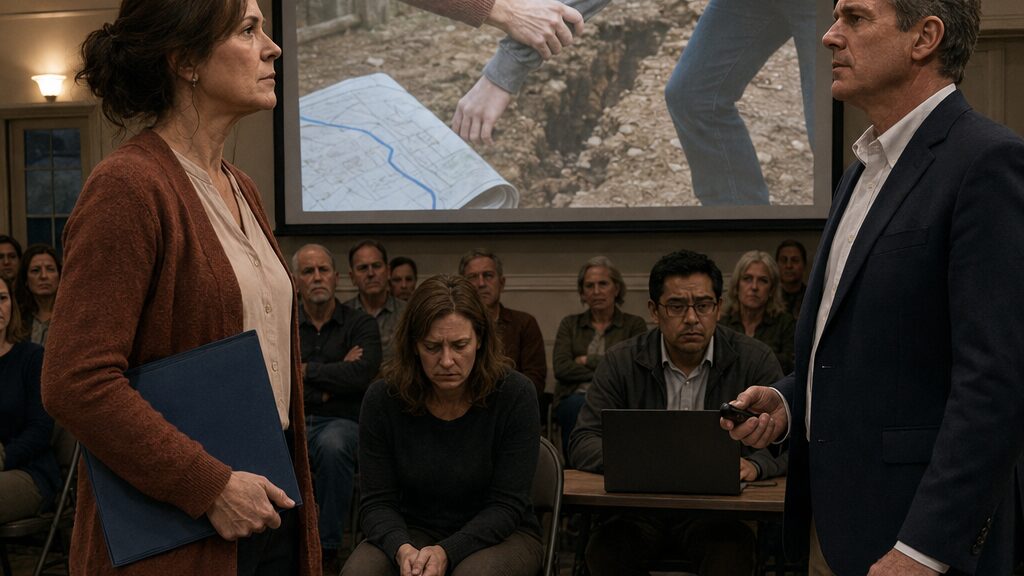
Catherine Mitchell’s hand was twelve feet tall on the clubhouse wall.
The projector had enlarged every pale knuckle around Amy Garcia’s sleeve, every crease in the girl’s gray sweatshirt, every clump of dark soil scattered beside the trench. Catherine’s face had been cut away. So had the lower half of Amy’s body. All anyone could see was an older
Chapter 4: What Jennifer Could Not Afford To Admit
The water appeared beneath Jennifer’s basement door as a dark, wavering thread.
She stood on the bottom step in socks, staring as it crossed the concrete and touched the corner of a cardboard box. For one suspended second, she did nothing. Then she lunged forward, dragged the box away, and felt cold water soak through both feet.
Upstairs, rain hammered the kitchen windows.
“Amy!” she called. “Bring every towel from the hall closet.”
The girl appeared at the basement door, took one look at the floor, and vanished without answering.
Jennifer shoved an old bath mat against the threshold. Water pushed beneath it almost immediately.
Her phone lay on the workbench beside a stack of unopened envelopes. She called the contractor. The line rang until it went to voicemail.
“This is Jennifer Adams. The basement is taking water. I need you here now.”
She hung up and called again.
Voicemail.
The next call went to the property-management office. A recorded message informed her that emergency calls involving fire, gas, or active structural collapse should be directed to public services.
Water spread around her knees in a thin sheet.
Amy returned with towels.
“Put them along the wall,” Jennifer said.
“Mom, this isn’t going to stop it.”
“I know that.”
“Should I call Mrs. Mitchell?”
Jennifer straightened so quickly that pain tightened across her lower back.
“No.”
“She said this would happen.”
“I said no.”
Amy dropped the towels near the foundation crack. The blue chalk mark the contractor had drawn across the wall was now half submerged.
Jennifer saw her daughter looking at it.
“It would have worked if he had finished,” she said.
Amy did not answer.
The water deepened around the bath mat.
Jennifer climbed the stairs, opened the back door, and looked across the narrow space between the houses. Rain blurred Catherine’s kitchen window. The orange restriction notice flapped against the shared gate.
Jennifer hated that notice. She hated that Catherine had made it necessary. She hated even more that she had used it as proof that the board believed her.
Another trickle slid beneath the basement door.
Jennifer crossed the kitchen and called Catherine.
She answered at once.
“How high is it?”
Jennifer gripped the phone. “How did you know?”
“I can see the window well filling.”
“It’s coming under the basement door.”
“Turn off the power to the basement outlets if you can reach the panel without stepping through water.”
“I know where the panel is.”
“Do that first. I have a utility pump.”
“You’re not allowed on my property.”
There was a brief silence.
“Then carry it from the gate yourself.”
Jennifer closed her eyes.
“Just come over.”
Catherine arrived wearing a raincoat and rubber boots, carrying a compact pump, two lengths of hose, and an extension cord looped over one arm. She stopped at the gate.
“The notice says I cannot enter.”
Jennifer tore the plastic sleeve from the latch and pulled the paper free.
“There. Now come in.”
“That does not remove the restriction.”
“I’m the homeowner. I’m inviting you.”
Catherine looked toward the basement window, where water pressed against the plastic cover.
Then she stepped through.
They worked without discussing the meeting.
Catherine placed the pump at the lowest point in the basement and ran the discharge hose toward the front driveway, away from both foundations. Jennifer held a flashlight while Catherine checked the electrical connection from the dry stair landing.
When the motor started, the hose jerked in Jennifer’s hands. Muddy water surged through it.
The level stopped rising.
Amy stood two steps above them, silent.
Catherine crouched near the foundation crack. Her gloved finger followed the blue chalk line, then moved to the joint where the floor met the wall.
“This is not only surface runoff,” she said. “Water is being held against the outside foundation.”
Jennifer leaned against the stair rail. “Can we keep the pump running?”
“For now.”
“For how long?”
“Until the trench is closed correctly or redirected.”
The answer carried no triumph. That made Jennifer angrier than if Catherine had said I told you so.
“I couldn’t afford the other bids,” Jennifer said.
Catherine looked up.
“The contractor the HOA recommended wanted almost nine thousand dollars. Another one wanted eleven.” Jennifer folded her wet arms across her chest. “This man said he could do it for thirty-eight hundred if I paid cash.”
“Did he show you a drainage plan?”
“He showed me where he would dig.”
“That is not the same thing.”
“I know that now.”
The pump rattled as a clump of grit passed through it.
Jennifer stared at the envelopes on the workbench. One carried the insurance company’s logo. Another came from her mortgage servicer. She had turned both facedown before Catherine arrived, but the damp air had curled their corners upward.
“My insurance renewal was denied,” she said.
Catherine did not move.
“They gave me sixty days to correct the water intrusion or find another carrier. The mortgage company requires coverage. The last quote I got was almost three times what I pay now.”
“Why didn’t you tell the board?”
“And say what? That I can’t afford the approved contractor? That I may lose the house because a crack in the basement is worth more attention than everything I’ve paid for fifteen years?”
“They might have arranged a payment schedule.”
Jennifer gave a short, bitter laugh. “You believe procedures work because you understand them.”
“No,” Catherine said. “I believe they leave records.”
“That is exactly what I mean.”
Amy stepped down one stair.
“Mom—”
“Not now.”
Jennifer looked at Catherine. “You walked into my yard and shut down the only repair I could pay for. Then you stood at that meeting with your folder and made me look dishonest.”
“I did not know about the insurance.”
“You did not ask.”
Catherine’s face changed slightly.
Jennifer saw the words land because they were true.
“I should have asked,” Catherine said.
The admission left Jennifer with nowhere easy to put her anger.
The pump continued drawing water across the floor. Slowly, the concrete began to reappear.
Catherine checked the hose connection. “The complaint still says I entered after you objected.”
“You entered without asking me.”
“That is not the same statement.”
“No, it isn’t.”
“Will you correct it?”
Jennifer looked toward Amy.
Her daughter’s shoulders rose.
The meeting photograph returned to Jennifer’s mind: Catherine’s hand on Amy’s sleeve, the broken trench edge, the contractor shouting. Jennifer had not taken the image. A neighbor had sent it to the board after hearing the argument. Eric had asked whether it represented what happened. Jennifer had said yes.
It did represent part of what happened.
That had been easier than describing the rest.
“If I withdraw the complaint,” Jennifer said, “they’ll say I approved what you did.”
“I’m not asking you to withdraw everything. I am asking you to correct what is false.”
“And then what? You get cleared and I get every violation?”
Catherine stood.
“No.”
“You don’t know that.”
“I know Eric wants a clean answer.”
“He wants someone responsible.”
“There may be more than one.”
Jennifer glanced at the pump, then toward the window above the workbench. Catherine’s low retaining wall was barely visible through the rain.
“You keep saying my trench changed the drainage,” Jennifer said. “Your yard isn’t exactly original.”
Catherine’s eyes moved toward the same window.
“No,” she said. “It isn’t.”
The answer was too quiet to be defensive.
Jennifer understood then that Catherine was carrying something of her own.
The water level dropped below the blue chalk mark.
By dusk, the immediate flooding had stopped. Catherine left the pump behind with written instructions taped to the handle. She did not mention the access restriction when she crossed back through the gate.
Jennifer stood under the porch roof while Amy watched Catherine return home.
“You emailed her, didn’t you?” Jennifer asked.
Amy went still.
Jennifer did not need an answer.
“What did you tell her?”
“I told her the basement smelled wet again. And that the man digging said he didn’t need to see the old plans.”
“You went behind my back.”
“I was scared.”
“So you called her?”
“She knows how this stuff works.”
The words struck with the precision of an insult, though Amy had not meant them that way.
Jennifer turned toward the house.
“Mom, she didn’t tell them because I asked her not to.”
Jennifer stopped.
The rain had softened, but water still ran along the trench in a narrow line.
“I don’t want you involved in the hearing,” Jennifer said.
“I already am.”
“No. You’re not.”
Amy stepped off the porch and walked toward the shared gate before Jennifer could stop her.
Catherine was coiling the extension cord on the other side.
“Mrs. Mitchell,” Amy called.
Catherine looked up.
Amy held her phone with both hands.
“I’m ready to show them the whole picture.”
Chapter 5: The Missing Edge Of The Picture
Amy slid her phone across the community-office table as though it might break something simply by reaching the other side.
Catherine did not touch it.
Jonathan sat beside the window with the case file open. Jennifer remained standing behind Amy’s chair, one hand resting on its back. Eric had arrived five minutes late and had not removed his coat.
“What exactly are we reviewing?” he asked.
Amy looked at Catherine.
“The original image,” Catherine said. “With Amy’s permission.”
Eric pulled out a chair. “The photograph in the file came from a resident witness.”
“It came from a message thread,” Amy said. “The resident sent my mom a full image. My mom forwarded it to the board.”
Jennifer’s fingers tightened around the chair.
“I forwarded what I had saved.”
Amy unlocked the phone and opened the file.
The full photograph filled the screen.
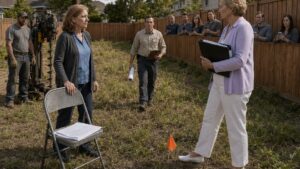
The cropped version had shown Catherine gripping Amy’s sleeve beside torn soil. The original extended nearly twice as far to the right. It showed Amy’s left foot at the edge of the trench, the ground beneath it split in a dark crescent. Catherine’s other arm was braced against the fence post. Behind them, a section of unsupported soil had begun folding into the excavation.
The contractor stood farther back, one hand raised.
Catherine remembered the sound more clearly than the image: roots snapping beneath the soil, Amy’s sharp breath, the hollow collapse after Catherine pulled her away.
Jonathan enlarged the right side of the photograph.
“There,” he said.
A gap had opened exactly where Amy had been standing.
Eric leaned toward the screen. “A still image cannot establish sequence.”
“No,” Catherine said. “But neither could the cropped one.”
He looked at her, then away.
Jonathan placed a printed copy of the board’s original exhibit beside the phone. The difference was almost crude. The cropped frame removed the failing trench edge, Catherine’s braced arm, and Amy’s exposed footing. It turned a rescue into a restraint.
Jennifer sat down.
“I didn’t ask anyone to crop it,” she said.
“Who did?” Jonathan asked.
Eric answered before she could. “The image was formatted for presentation.”
Jonathan’s voice remained neutral. “By the board?”
“By me.”
The room held that answer for several seconds.
Eric removed his coat and folded it over the back of his chair.
“I believed the physical contact was the relevant issue.”
“You decided the context was irrelevant,” Catherine said.
“I decided a safety complaint involving a minor required a focused review.”
Amy turned toward him. “I wasn’t afraid of her.”
Eric’s expression softened, though not enough to become an apology. “You may feel that now.”
“I felt it then.”
Jennifer put a hand on Amy’s shoulder. Amy shifted slightly but did not pull away.
Jonathan opened the email recovered from the spam filter.
“With permission,” he said, “I would like the record to reflect that Amy contacted Mrs. Mitchell before the contractor arrived.”
Jennifer looked at her daughter. “You sent the management office the same message?”
“I copied them because Mrs. Mitchell said there should be a record.”
Catherine remembered standing in her kitchen while Amy whispered that the contractor had laughed when she asked whether he had checked the old drainage plans. Catherine had told her to email the office and her mother.
Amy had sent only one of those messages.
“What did you ask Mrs. Mitchell to do?” Jonathan said.
Amy swallowed.
“Look at the trench before they dug any farther.”
“Why not ask your mother?”
“Because she already paid the deposit. And because every time I mentioned the basement, she looked like she couldn’t breathe.”
Jennifer’s hand dropped from her shoulder.
Catherine spoke before the silence could turn cruel.
“Amy asked me to inspect the location. She did not ask me to confront anyone.”
“Why did you enter the yard?” Eric asked.
“The gate was open. The contractor had removed the easement stake and started excavation. Amy was standing beside the trench while he operated equipment from the other end.”
“Did Mrs. Adams authorize your entry?”
“No.”
“Then the trespass finding remains supportable.”
Jonathan looked at him. “The intimidation finding does not.”
“The board can amend that portion.”
“And the destruction allegation?” Catherine asked.
“Pending.”
Catherine placed the original plans on the table. The thin blue line ran across both properties.
“The contractor’s route would have concentrated runoff against Jennifer’s foundation. The city confirms no inspection was requested. The original survey marker was removed.”
Eric folded his hands.
“I am prepared to recommend withdrawal of the intimidation fine and reduction of the access suspension.”
Jennifer looked up sharply. “Reduction?”
“In exchange,” Eric continued, “Mrs. Mitchell would sign an acknowledgment that she entered without permission and that Mrs. Adams independently authorized an unapproved contractor.”
Catherine read the document he pushed toward her.
The first paragraph cleared her of intentional intimidation. The second assigned responsibility for the drainage work entirely to Jennifer.
It was a cleaner story than the photograph had been.
Catherine looked across the table.
Jennifer’s face had gone pale.
“If I sign this,” Catherine said, “the association will use it to recover every inspection and repair cost from Jennifer.”
Eric did not deny it. “The association cannot absorb private-owner violations.”
“What about the board’s failure to verify approval?”
“The homeowner hired the contractor.”
“What about my inspection request?”
“We are reviewing communication records.”
Jonathan’s eyes moved toward Eric.
Catherine noticed but did not press him.
Eric tapped the document. “This resolves the allegation against you.”
For several days, Catherine had wanted exactly that sentence. She had imagined the record corrected, the restriction removed, the neighbors who avoided her forced to reconsider.
Now the path was open.
All she had to do was let the false story narrow around someone else.
Jennifer spoke without looking at her. “You should sign it.”
Amy turned. “Mom.”
“It’s true that I hired him.”
“It isn’t all true,” Catherine said.
Jennifer gave her a tired, furious look. “You don’t have to save me.”
“No. I have to stop pretending my own plans are clean.”
Catherine opened her blue folder and removed the violation notice Jonathan had issued.
She placed it beside Jennifer’s complaint.
“When my retaining wall was installed, I moved it eight inches from the approved location. I did not submit an amendment.”
Eric stared at the notice.
Catherine unfolded the old sketch beneath the current drainage plan. The blue line intersected the wall.
“The change narrowed the runoff channel between our lots. It did not justify this trench, but it contributed to the pressure that made Jennifer think she needed one.”
Jennifer looked from the sketch to Catherine.
“You knew?”
“I confirmed it two days ago.”
“And you said nothing.”
“I was deciding how much truth I could afford.”
The words sounded ugly once spoken.
Catherine let them remain.
“I will accept the scheduled fine for my alteration,” she said. “I will not sign a statement placing all liability on Jennifer. The board must review the contractor’s work, my wall, the missing inspection request, and the altered photograph as one record.”
Eric’s face hardened. “You understand that your admission weakens your objection.”
“It weakens my innocence. Not my evidence.”
Outside the office window, the unfinished trench was visible beyond the parking lot, covered by sagging plastic.
Jonathan closed the unsigned liability form.
“A full hearing is required,” he said.
Eric looked at him. “That is a board decision.”
“It becomes a management obligation when multiple drainage violations affect common infrastructure.”
The power in the room shifted by only a few inches, but Catherine felt it.
Eric gathered his coat.
“Then we will call an emergency hearing.”
Catherine folded both plans together. For the first time, the blue line did not separate one property from the other. It connected their mistakes.
Chapter 6: The Board Wanted One Guilty Homeowner
Catherine placed her own violation notice beside Jennifer’s complaint before anyone called the emergency hearing to order.
The two pages lay at the center of the clubhouse table, one accusing Jennifer of unauthorized drainage work, the other citing Catherine’s unapproved retaining-wall alteration. Between them, Catherine spread the original subdivision plan and a new tracing sheet.
A blue line crossed both properties.
Eric entered through the side door, saw the arrangement, and stopped.
“That table is reserved for board materials.”
“These are board materials,” Catherine said.
Homeowners filled the same folding chairs they had occupied during the first hearing. This time, no photograph dominated the wall. The projector displayed a neutral title: DRAINAGE AND EASEMENT REVIEW.
Jennifer sat beside Amy near the aisle. Jonathan occupied his usual seat at the table, though a thick printed packet rested in front of him. The municipal drainage inspector stood near the rear doors with mud on his boots.
Eric called the meeting to order.
“We are here to determine responsibility for unapproved alterations affecting the drainage easement between Lots 18 and 19.”
“Responsibility or repair?” Catherine asked.
“Both.”
“The inspector has already stated the repair cannot wait.”
“And the association must know who will pay for it.”
There it was: the question Eric could make fit inside a box.
One guilty homeowner. One invoice. One record neat enough to defend at renewal meetings and insurance reviews.
Catherine stood.
“My wall altered the original drainage channel. Jennifer’s contractor excavated an unsafe trench. The board failed to verify the project before describing it as approved. Management issued notices before inspecting the site. Those facts do not cancel one another.”
A homeowner in the second row whispered something. Eric raised his hand.
“We will maintain order.”
The drainage inspector stepped forward and placed photographs on the table. They showed the trench after the rain, the foundation crack, the narrowed channel near Catherine’s wall, and the empty hole where the easement stake had been.
“The current condition is unstable,” he said. “Another significant storm could undermine the fence footing and increase water pressure along the Adams foundation.”
“How soon must it be corrected?” one board member asked.
“Excavation should begin within forty-eight hours. The trench needs to be reopened, graded, and tied into the common basin under supervision.”
Jennifer leaned toward Amy. “Forty-eight hours?”
The inspector continued. “The retaining-wall offset must also be addressed. It may not require removal, but the channel must be widened or supplemented.”
Eric looked at Catherine. “So your alteration contributed.”
“Yes.”
“And Mrs. Adams’s contractor created the immediate hazard.”
“Yes.”
“Then we have two owner violations.”
“And a failed approval process,” Catherine said.
Eric’s voice tightened. “There was no formal approval.”
“At the first meeting, you said there was.”
“I clarified that the board was aware of maintenance work.”
“You used the word approved when residents questioned you.”
Eric glanced toward the meeting secretary. “The minutes will reflect the precise record.”
Jonathan opened his packet.
“I need to address that record.”
Eric turned. “Now?”
“Yes.”
Jonathan distributed copies to the board members. Catherine recognized the first page before it reached her: her original request for an emergency site inspection, sent four days before the public meeting.
The email chain continued beneath it.
Jonathan spoke carefully.
“Mrs. Mitchell’s message was received by management and forwarded to the board president. She identified the removed survey stake, the proposed drainage route, and the risk to the neighboring foundation. She requested that work be paused until inspection.”
Eric did not touch his copy.
One board member read the date twice. “This was before the photograph?”
“Yes,” Jonathan said.
“Why wasn’t it in the original packet?”
Jonathan looked toward Eric.
“I prepared a draft packet that included it. I was instructed to limit the hearing materials to the conduct complaint because the drainage issue was described as separate.”
The room changed.
It was not outrage. It was something quieter and more damaging: people rereading what they thought they understood.
Eric removed his glasses.
“The initial hearing concerned physical confrontation. Combining technical claims before they were verified would have confused the issue.”
“You presented the contractor’s work as legitimate,” Catherine said.
“I presented it as homeowner-authorized maintenance.”
“You knew I had challenged its safety.”
“I knew you had made an allegation.”
“And you removed that fact from the hearing.”
Eric looked at the residents.
“We had a visible confrontation involving a minor. The board had been criticized for delayed enforcement in previous disputes. I chose to address the immediate conduct first.”
Amy raised her hand.
Eric hesitated, then recognized her.
“The immediate conduct was Mrs. Mitchell pulling me away from collapsing dirt.”
Eric’s mouth flattened.
“The amended image will be included in the final record.”
“Included where?” Amy asked. “After the picture that made her look guilty?”
Jennifer touched her daughter’s wrist, but Amy kept her gaze on Eric.
Catherine understood then that correction was not the same as restoration. A false image could be replaced in a file. It could not be pulled back from every person who had already believed it.
She turned to the new tracing sheet.
“This is the proposed repair.”
The blue line no longer followed Jennifer’s contractor’s diagonal trench. It curved behind Catherine’s wall, widened through the shared easement, and connected both downspouts to the common basin through a graded channel.
“The line requires work on both lots,” Catherine said. “I will pay the portion needed to correct the effect of my wall. Jennifer should be responsible for work directly tied to her downspout connection. The association should cover inspection, easement restoration, and costs caused by the failure to stop unapproved work after receiving notice.”
Eric gave a humorless breath. “You have assigned yourself the least expensive portion.”
“No. My portion includes design and widening behind the wall.”
The inspector examined the tracing sheet.
“This is conceptually sound,” he said. “Final dimensions would need field verification.”
Jennifer spoke from the aisle. “I can’t pay for half of a supervised excavation in forty-eight hours.”
Eric spread his hands. “That is why liability must be determined.”
“No,” Catherine said. “That is why the association has an emergency-maintenance reserve.”
One board member looked toward Eric. “Can it be used for easement protection?”
Jonathan answered. “Yes, with a board vote. Owner shares can be assessed afterward based on verified responsibility.”
Eric turned toward him. “That is not the preferred sequence.”
“It is the sequence that allows work to start tomorrow.”
The second board member flipped through the packet. “Why was the reserve option not presented earlier?”
Eric did not answer immediately.
Catherine saw how he had reached this point. A board once accused of doing nothing. A president determined never to appear indecisive again. A cropped photograph that offered a clear offender. A frightened homeowner who had hired the wrong contractor. A woman with a folder who made every disagreement feel like an audit.
Each pressure was understandable.
Together, they had produced harm.
Catherine faced Jennifer.
“I should have told you what Amy asked me to inspect before I entered your yard.”
Jennifer’s expression closed.
“You should have come to me.”
“Yes.”
“You treated me like I couldn’t handle the truth.”
“I treated the problem like a drawing. I thought if I could prove the slope was wrong, the rest would take care of itself.”
“It didn’t.”
“No.”
Catherine’s admission seemed to unsettle the room more than another accusation would have.
She turned back to the board.
“I am not asking to be declared blameless. I am asking you to correct the record and authorize the repair before another storm.”
Eric stared at the signed minutes from the first hearing.
The inspector checked his phone.
“Forecast now shows heavy rainfall in three days,” he said. “If excavation does not begin tomorrow, I recommend temporary shoring and continuous pumping.”
Jennifer lowered her face into one hand.
One board member made the motion: release emergency funds, authorize supervised excavation, assign costs after engineering review, suspend all current drainage fines, and amend the intimidation finding based on the full image and Amy’s statement.
The other board member seconded it.
Eric remained silent.
“As chair,” Jonathan said quietly, “you need to call the vote.”
Eric put his glasses back on.
“All in favor?”
Both board members raised their hands.
Jonathan recorded the votes.
Eric’s hand remained flat on the table.
The motion had passed without him, but one issue remained.
Catherine lifted the first meeting’s written finding. Eric’s signature appeared beneath the statement that she had initiated unwanted physical contact with a minor during interference with approved work.
“The repair vote does not correct this,” she said.
Eric looked at his own name.
The room waited.
He could call the wording outdated. He could refer it to counsel. He could let the amended evidence sit behind the original judgment and claim procedure had been satisfied.
Instead, he picked up his pen.
“The chair will entertain a motion to rescind the original finding and replace it with a statement reflecting the complete image, the safety hazard, and the board’s failure to review the prior inspection request.”
No one applauded.
The secretary simply opened a new page in the minutes.
Outside, through the clubhouse windows, the orange restriction notice was still fastened to the shared gate, softened by rain and curling at the corners.
Chapter 7: The Line They Finally Drew Together
The excavator bucket lifted a strip of wet soil and exposed the place where both yards had been sending water toward the same crack.
For a moment, no one spoke.
The municipal inspector stepped closer to the trench. Catherine stood beside him with the revised plan folded under one arm. Jennifer watched from her back steps, holding a paper cup she had not touched.
Three weeks had passed since the emergency hearing. The orange restriction notice was gone from the gate. The clubhouse record had been amended. The contractor’s original trench had been reopened under supervision, widened, and redirected toward the common basin.
None of that made the ground simple.
Beneath Catherine’s retaining wall, a narrow channel had been compressed almost flat. On Jennifer’s side, the abandoned downspout connection had created a pocket where runoff collected before pressing toward the foundation.
The inspector pointed with the end of his measuring rod.
“There. That’s the convergence point.”
The landscaping contractor crouched beside the exposed soil. “Water from both grades was meeting here.”
Jennifer came down the steps.
“So it wasn’t only my trench.”
“No,” the inspector said. “The trench made the immediate problem worse, but the restricted channel behind the wall had been contributing for years.”
Jennifer looked at Catherine.
Catherine did not reach for the plans.
“Yes,” she said. “My wall was part of it.”
The admission no longer felt like surrender. It felt like setting down something heavy enough that she could finally use both hands.
The contractor marked the revised grade with stakes. A flexible drain line would carry water from both downspouts toward the basin. The channel behind Catherine’s wall would be widened and reinforced. Jennifer’s foundation would be sealed only after the soil outside had dried.
It was not the cheapest repair.
It was also not assigned to one guilty homeowner.
The HOA emergency reserve covered the common easement and inspection costs. Catherine paid for the channel correction behind her wall. Jennifer received a payment plan for her connection and foundation work. The board approved the arrangement after two tense meetings and several revisions from the association’s insurer.
Practical justice, Catherine had learned, came with forms, invoices, and compromises nobody enjoyed.
Amy stood near the fence with her phone in her pocket.
She had not photographed the excavation.
Catherine noticed that.
The contractor called for the water level. The inspector gave him the corrected elevation, and the crew adjusted the trench by less than an inch.
Less than an inch had caused half the argument.
Jennifer watched them work.
“I knew his plan was questionable,” she said quietly.
Catherine turned.
Jennifer kept her gaze on the trench.
“Not technically. I didn’t understand the grade. But when I asked whether he needed HOA approval, he told me people only asked permission when they could afford delays.”
Catherine waited.
“He said the trench would be covered before anyone noticed. I wanted to believe that was the same as saying it was safe.”
“You were under pressure.”
“That doesn’t make it a good decision.”
“No.”
Jennifer looked at her sharply, perhaps expecting Catherine to soften the answer.
Catherine did not.
After a moment, Jennifer nodded.
“I hated you for stopping him.”
“I know.”
“I hated you more after the meeting.”
“I know that too.”
“You stood there like none of it touched you.”
Catherine looked toward the clubhouse roof visible beyond the trees.
“It touched me.”
“You didn’t show it.”
“No.”
The old reflex rose in her—to explain that composure made facts easier to hear, that anger turned people against evidence, that precision had kept her useful for most of her life.
She let the explanation pass.
“I was afraid that if I spoke about Amy, I would betray her,” Catherine said. “And I was afraid that if I admitted my wall was part of the problem, no one would listen to anything else.”
Jennifer rubbed the seam of the paper cup with her thumb.
“So you chose what to hide.”
“Yes.”
“Just like I did.”
Catherine looked at her.
“Yes.”
The shared truth did not make them friends again. It did not erase the complaint, the cropped image, or the way Jennifer had allowed the board to use it.
But it removed one lie between them.
The contractor laid the new drain line into the trench. Unlike the blue pencil mark on Catherine’s old plans, the line in the ground did not belong to one property. It curved through the easement, accepted water from both houses, and carried it toward the basin.
By afternoon, the first section was covered.
The final board session took place that evening.
The clubhouse was less crowded than before. The homeowners who attended sat farther apart, no longer drawn by a photograph large enough to condemn someone from across a room.
Eric sat at the center of the board table. His tone remained formal.
“The record will reflect that the prior intimidation finding against Catherine Mitchell has been rescinded in full.”
The meeting secretary typed the sentence.
“The record will also reflect,” Eric continued, “that the image used in the original hearing omitted material context and should not have been presented as complete evidence.”
Catherine watched him sign the amendment.
He did not apologize publicly.
She had stopped expecting that.
Jonathan distributed the revised enforcement procedure. Future emergency disputes involving physical conditions would require a site review before sanctions unless there was an immediate threat. Photographs would need to be preserved in original form. Relevant communications could not be excluded from a hearing packet without written explanation.
The changes were ordinary.
That was why they mattered.
Jennifer raised her hand.
Eric recognized her.
“I need to correct my complaint.”
The room quieted.
Jennifer placed both hands on the back of the chair in front of her.
“I said Catherine grabbed my daughter during an argument. I left out that the trench edge was collapsing and that Catherine pulled Amy away from it.”
Amy looked down.
Jennifer continued, “I was angry, embarrassed, and afraid the board would blame me for hiring the contractor. None of that made the omission fair.”
She sat before anyone could respond.
There was no applause.
Catherine was grateful for that.
The meeting moved to final cost allocations. One homeowner objected to use of the reserve. Another asked whether the board planned to reimburse Catherine’s legal consultation fee. Catherine had never hired a lawyer, and the correction took several minutes.
By the time the meeting adjourned, the room had returned to what it had always been: a place where neighbors argued over budgets, maintenance, and rules.
Outside, Amy waited near the shared gate.
“My mom didn’t want me to send that email,” she said.
“I know.”
“I thought asking you was the right thing.”
“It was reasonable.”
“Was it right?”
Catherine considered the difference.
“You should not have had to solve an adult problem in secret.”
Amy looked toward her house.
“Are you still mad at her?”
“Yes.”
The girl seemed surprised by the answer.
“But being angry does not decide what happens next,” Catherine said.
Amy nodded slowly and went home.
Catherine remained beside the gate until Jennifer came out carrying the corrected drainage plan.
“I think this is yours,” Jennifer said.
Catherine took it, unfolded it on the fence rail, and checked the final markings. The permanent line had been drawn in blue.
Jennifer watched her.
“Still wrong?”
“No.”
“That sounded painful.”
“It is a good plan.”
Jennifer gave the smallest hint of a smile, then lost it.
“I don’t know if we go back to how things were.”
“We probably don’t.”
“I’m not ready to pretend the meeting didn’t happen.”
“I’m not asking you to.”
“And I’m still angry that you let Amy carry this alone.”
Catherine folded the plan along its existing creases.
“You should be.”
Jennifer’s eyes narrowed. “You’re making it difficult to argue with you.”
“I’ve been told I make arguing very easy.”
That almost brought the smile back.
Catherine held out the plan.
Jennifer did not take it immediately.
“What am I supposed to do with this?”
“Keep it with your house records.”
“You’re the one who keeps everything.”
“This belongs to both properties.”
Jennifer accepted the folded sheet.
There was no acknowledgment form attached. No signature line. No demand that she confirm receipt or accept responsibility.
Only the corrected blue line crossing from one yard into the other.
Jennifer held the plan against her chest.
“I’ll make a copy for you.”
“I already have one.”
“Of course you do.”
They stood on opposite sides of the open gate while water from the afternoon test flowed beneath the new grate and disappeared toward the basin.
Neither woman called the other forgiven.
Neither closed the gate.
The story has ended.