The Neighbor Who Demanded Silence Was the One Crossing His Yard Every Night
Chapter 1: The Green Lights Came On Again
The green lights swept across Samuel Allen’s backyard at 1:58 in the morning.
They appeared one after another in the wet grass, low and cold, tracing movement from the rear fence toward the cedar gate. Samuel sat upright in bed before the bedside receiver completed its first vibration.
No siren sounded. No bell rang. The house remained silent except for the ceiling fan and the faint ticking of the cooling ducts.
Someone was crossing his yard again.
Samuel pulled on work pants over his sleep shirt and reached for the flashlight beside the bedroom door. He did not turn on the hall lights. From the kitchen window, he could see the narrow green points shifting between the hydrangeas and the old stone border his wife had laid years earlier.
The movement stopped near the gate.
Samuel waited.
A shadow passed behind the cedar slats. The gate gave a small wooden knock, though the latch held. Then the green lights disappeared in reverse order, one after another, retreating toward the rear corner of the property.
By the time Samuel stepped onto the back porch, the yard was empty.
He crossed the damp grass, checked the latch, and ran one hand along the upper rail. The cedar had grayed with age, but the joints remained tight. He had built the gate himself, cutting each board in his workshop while his wife held the level and told him the opening looked too narrow.
“It’s a gate,” he had answered. “It isn’t supposed to invite traffic.”
She had laughed and made him widen it by two inches.
Samuel pushed the memory aside and inspected the ground. The soil beneath the gate showed a heel mark, shallow but fresh.
Three hard knocks struck the front door.
Samuel straightened.
The knocks came again, louder and faster.
He walked through the dark house and looked through the side window. Pamela Harris stood beneath the porch light in floral pajama pants, slippers, and a pale robe pulled tight around her. Her blonde hair was flattened on one side as though she had just left bed, but her face was fully awake with anger.
Samuel opened the door only as far as the chain allowed.
“Turn that alarm off,” Pamela said. “It’s waking up the entire neighborhood.”
“It isn’t an alarm.”
“Don’t play games with me, Samuel. It goes off every night.”
He studied her through the narrow opening.
“What goes off?”
“The lights. The beeping. Whatever you installed back there.”
“There is no beeping.”
“I can hear it from my house.”
“You live across the rear lane and two lots east.”
“That doesn’t mean I’m deaf.”
Samuel glanced past her. No porch lights had come on across the street. No curtains moved. The subdivision lay quiet beneath the streetlamps.
“The system doesn’t make sound outside my bedroom,” he said. “It sends a vibration to a receiver.”
Pamela’s mouth tightened.
“Well, something is disturbing people.”
“Who?”
“People in the neighborhood.”
“Which people?”
“I’m not going to give you a list at two in the morning.”
Samuel looked at the digital clock on the wall behind him. “One fifty-eight.”
“What?”
“You said it goes off every night. Tonight it activated at one fifty-eight.”
Pamela blinked once. “It’s usually closer to two.”
The words landed between them.
Samuel did not move, but his grip tightened on the edge of the door.
Pamela seemed to hear herself a second too late. She folded her arms.
“Everyone knows when those ridiculous lights come on,” she said. “They sweep half the block.”
“They shine six inches above my grass.”
“They’re aggressive.”
“They detect movement.”
“Movement where?”
“In my yard.”
Pamela gave a short, humorless laugh. “That strip behind your gate has been used as a shortcut since before you put up half those bushes.”
“The bushes have been there fourteen years.”
“You know what I mean.”
“I know someone has crossed my property at roughly two in the morning five times in nine days.”
Her expression changed, not enough for anyone unfamiliar with her to notice. Samuel had known Pamela for nearly twenty years. She had brought casseroles when his wife was ill and organized the meal calendar after the funeral. She knew how to soften her voice when she wanted something and sharpen it when she wanted witnesses.
Now she lowered it.
“You’re making this into something it isn’t.”
“Then tell me what it is.”
“It’s a path.”
“It’s grass.”
“It connects the rear homes to the main sidewalk.”
“It cuts through my lot.”
“People use it.”
“That doesn’t make it public.”
Pamela stepped closer to the door. “You have become very difficult to live beside.”
Samuel felt the sentence strike exactly where she intended. He kept his face still.
“I’m going back to bed.”
“You’ll hear from the association.”
“You said the system was waking the neighborhood. It makes no sound.”
“You’re missing the point.”
“No,” Samuel said. “I think I’ve finally found it.”
He closed the door before she could answer.
For several minutes he stood in the entryway with his hand on the deadbolt. Pamela’s slippers scuffed across the porch. Her steps reached the sidewalk, paused, then continued toward the corner.
Samuel returned to the kitchen and opened the monitoring application on his phone. The screen displayed a simple grid of times and sensor zones. Five recent activations clustered between 1:54 and 2:06 a.m.
He enlarged the map of his backyard. Each detector was marked by a small green dot. Tonight’s path began at the rear corner, crossed diagonally behind the workshop, and stopped at the cedar gate.
It was almost identical to the previous four.
Samuel opened the exterior camera feed. The image was grainy because the camera faced away from the brightest porch light. A figure moved along the rear fence, partly hidden by the hydrangeas. The hood or hair, the height, even the clothing were difficult to distinguish.
He froze the image.
The figure carried something small in one hand.
A bag, perhaps.
The camera angle did not show the face.
Samuel saved the clip in a folder labeled with the date and printed the activation log. He told himself this was ordinary caution. Documentation. Nothing more.
But before returning to bed, he checked the gate twice.
At six thirty, he found a white envelope wedged beneath his front door.
The property manager’s logo appeared in the upper left corner. The letter inside was marked PRELIMINARY NUISANCE WARNING.
Samuel read it once while standing in the entryway.
The association had received complaints regarding “repeated overnight illumination, electronic disturbance, and hostile monitoring of a commonly used pedestrian route.” He was instructed to suspend the system pending review.
Near the bottom, the notice stated that three separate resident complaints had been received.
Samuel turned to the attached complaint summary.
All identifying information had been removed, but the filing times remained.
The first complaint had been submitted at 4:17 the previous afternoon.
The second at 5:03.
The third at 8:41.
Pamela had not knocked on his door until 2:03 that morning.
Samuel looked through the front window toward the empty sidewalk. She had not come to warn him that people were upset.
She had come after the complaints were already in place.
Chapter 2: A Shortcut Nobody Had Permission to Use
The cedar gate stood open six inches when Samuel entered the yard the next morning.
He stopped on the back step.
He had locked it after Pamela left. He remembered the click of the latch, the second check, the pressure of his palm against the upper rail.
Now the latch hung loose.
Samuel crossed the grass and examined it. Nothing was broken. Someone had reached through the narrow gap beside the post and lifted the mechanism from the inside.
A shoe print marked the soft earth beyond the gate. Smaller than his. Beside it, a bicycle tire had left a thin line through the dew.
Samuel closed the gate and threaded a temporary steel clip through the latch.
At nine, he carried the nuisance warning to the HOA office. The property manager sat behind a counter stacked with pool permits and architectural request forms. She read the notice without looking surprised.
“I’m requesting the complaints,” Samuel said.
“They’re confidential.”
“I’m requesting the specific rule I violated.”
She rotated her computer screen slightly away from him. “The board can investigate conduct that interferes with residents’ peaceful enjoyment.”
“My system is silent.”
“There are also concerns about illumination.”
“The lights remain on my property.”
“And monitoring.”
“Of my property.”
The manager exhaled through her nose. “This is why there’s going to be a hearing.”
“There wasn’t a hearing mentioned yesterday.”
“Steven Miller requested one this morning.”
Samuel looked through the glass wall into the small conference room. Steven sat at the far end of the table with a neighborhood map spread before him.
Steven noticed him and motioned him inside.
He was in his mid-fifties, neatly dressed even on informal office days, with the practiced calm of a man who preferred every dispute to arrive with numbered sections. A yellow highlighter lay beside his hand.
“We can resolve this without turning it into a property war,” Steven said.
“It became a property issue when the notice called my yard a commonly used route.”
Steven tapped the map. Someone had drawn a red line from the rear row of homes, across Samuel’s lot, to the sidewalk on the opposite side.
“That route has been used for years.”
“By permission?”
“By custom.”
“Custom isn’t an easement.”
“I didn’t say it was.”
“Then remove that phrase from the notice.”
Steven leaned back. “Several residents depend on the connection.”
Samuel studied the map. The red line passed directly behind his workshop, through the hydrangeas, and out the cedar gate.
“Who drew this?”
“It came with one of the complaints.”
“Which one?”
“You know I can’t disclose that.”
“Pamela?”
Steven’s silence lasted half a second too long.
Samuel folded the map and pushed it back. “Schedule the hearing.”
Outside, two residents waited near his mailbox. One was a night-shift nurse he recognized by sight. The other was a teen holding a bicycle helmet.
The nurse spoke first. “Are you really locking the back way?”
“It crosses my yard.”
“I use it at six in the morning after my shift. The street route adds twelve minutes.”
The teen lifted one shoulder. “It’s how we get to the bus stop.”
“Did either of you ask me?”
The teen looked away.
The nurse said, “No one thought we had to.”
That answer followed Samuel home.
By noon, he had received four messages through the neighborhood portal. One accused him of blocking children from school. Another said the route had existed before he moved in, which was untrue; Samuel and his wife had purchased the house when the subdivision was new.
A third message said Pamela was “only trying to keep the peace.”
Samuel printed every message.
At dusk, Amanda Clark approached while he adjusted the rear detector. She stopped outside the gate rather than opening it.
“My daughter used this path for three years,” she said.
Samuel tightened the sensor bracket. “Without asking.”
“Yes.”
He looked up.
Amanda did not retreat from the admission. She wore work clothes and carried a grocery bag against one hip.
“I should have asked,” she said. “But the main sidewalk runs beside the retention pond, and part of it floods. This way kept her off the road.”
“That makes it convenient.”
“It made it safer.”
“For her.”
“For several kids.”
“And because several people did it, my permission became unnecessary?”
Amanda’s jaw shifted. “That isn’t what I said.”
“It’s what everyone means.”
“No. It’s what you hear.”
Samuel set down the screwdriver.
Amanda glanced toward the detector. “For what it’s worth, I don’t cross at night.”
“I didn’t ask whether you did.”
“You were going to.”
She stepped closer to the gate but remained outside it.
“I used it in the mornings,” she continued. “The nurse uses it after work. A delivery driver cuts through sometimes. Teenagers do it in the afternoon. But whoever crosses around two moves differently.”
Samuel said nothing.
“I’ve seen the lights from my kitchen,” Amanda said. “Most people trigger the first two, then the ones near the gate. The night person activates the row behind your workshop too.”
Samuel pictured the logs. She was right. The daytime tracks wandered. The night pattern was narrow and direct.
“How often are you awake at two?” he asked.
“More often than I’d like.”
“Did Pamela ask you to complain?”
Amanda’s expression closed.
“That’s not an answer.”
“She said the system could be used to record children.”
“It doesn’t point toward your house.”
“I know that now.”
“So you filed one.”
“I filed a question through the portal. I didn’t call it hostile monitoring.”
Samuel looked past her toward the rear homes. “Who did?”
“I don’t know.”
She shifted the grocery bag. “But Pamela called several people before she came to your door.”
There it was: not proof, but shape.
The complaints had not risen independently. They had been assembled.
The following afternoon, Steven delivered the hearing notice in person. He stood on Samuel’s porch with a folder tucked beneath his arm.
“Next Thursday,” he said. “Seven p.m.”
“Fine.”
“The board will also review whether the route constitutes an established community access.”
“Based on what document?”
“Based on use.”
“Use you never authorized.”
Steven’s mouth tightened. “I’m trying to keep this from becoming expensive.”
“For whom?”
“For everyone.”
Samuel signed the delivery acknowledgment and handed it back.
Before Steven left, an older man called from the sidewalk.
William Robinson approached carrying a rolled plan inside a cracked plastic sleeve. He had worked as a survey technician before retirement and still walked the subdivision with the measuring patience of someone who distrusted fences installed by eye.
“I heard people arguing about an easement,” William said.
“They’re arguing about a shortcut,” Samuel replied.
“Same argument, once someone prints a map.”
William unrolled the plan across Samuel’s porch table. It was an early subdivision plat, faded along the folds. Property lines ran in dark ink. Drainage strips were crosshatched. Near Samuel’s lot, a thin dashed line passed between two rear parcels and stopped at his boundary.
William placed one finger beside a barely readable notation.
PROPOSED PEDESTRIAN CONNECTION.
Samuel leaned closer.
The line did not clearly cross his property. It ended at the edge, then reappeared near the front sidewalk in a lighter, broken mark.
“Is that an easement?” Samuel asked.
William shook his head. “Not on this copy.”
“Then what is it?”
“A plan someone may have abandoned. Or revised. Or failed to record.”
Steven had paused at the foot of the driveway. He turned back toward them.
William looked from Steven to Samuel.
“You’re both arguing from maps,” he said. “But neither of you has the map that decides it.”
Chapter 3: The Woman in the Night Footage
“I have never crossed Samuel Allen’s yard after dark.”
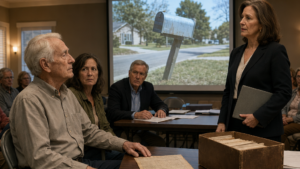
Pamela’s statement carried cleanly through the HOA clubhouse.
Nearly forty residents sat in folding chairs beneath fluorescent lights. The board occupied a long table at the front, with Steven beside the HOA president and the property manager arranging documents into careful stacks.
Samuel sat alone at a smaller table facing them.
Pamela stood at the public-comment microphone in a rose-colored blouse and dark slacks. Her hair was neatly styled. Nothing about her resembled the woman in slippers who had pounded on Samuel’s door at two in the morning.
She rested both hands on the lectern.
“This is not personal,” she continued. “Residents are concerned about lights sweeping their homes, electronic surveillance, and a homeowner who has decided that ordinary community use is some kind of threat.”
A few heads nodded.
Samuel looked down at the printed activation log before him. Each time was highlighted in pale green.
1:56.
2:04.
1:59.
2:02.
1:58.
Pamela glanced toward him. “I’m asking the board to enforce the nuisance provision until the system is removed.”
The HOA president cleared his throat. “Mr. Allen will have an opportunity to respond.”
Pamela stepped away from the microphone but did not sit. She took a position near the front row, where everyone could see her.
Steven adjusted his glasses. “Mr. Allen, the board has received five written complaints.”
“Three were filed before Pamela came to my door.”
A murmur moved through the room.
Steven said, “The timing does not invalidate them.”
“No. It tells me the confrontation was organized.”
Pamela gave a small shake of her head.
Samuel continued. “The notice says my system creates an electronic disturbance. It doesn’t. The exterior units make no sound. The receiver vibrates inside my bedroom.”
The property manager slid a page toward the board president. Samuel could see photographs printed on it—green points in darkness, enlarged until they looked brighter than they were.
“What about the illumination?” Steven asked.
“The lights remain below knee height and within my property line.”
“Residents describe them as intimidating.”
“They activate when someone crosses my yard.”
Pamela spoke without returning to the microphone. “People cross a path.”
The president raised one hand. “Ms. Harris, please wait.”
Samuel turned toward her. “You’ve called it a path six times. On what recorded document?”
“It has been used for years.”
“That wasn’t my question.”
Steven intervened. “The access status is under separate review. Tonight concerns the system.”
“They are the same issue,” Samuel said. “If no one enters my property, the lights do not activate.”
A board member asked, “Are you recording residents?”
“I record movement in my yard.”
“Children?”
“Anyone who enters it.”
That answer produced another stir.
Amanda sat in the third row. She did not nod with the others this time. William stood against the rear wall with the old plat tucked beneath one arm.
Pamela returned to the microphone.
“This is exactly the problem,” she said. “He speaks as though every neighbor is an intruder. People are trying to get to work. Children are trying to reach the bus stop. I have never used the path at night, but even if someone did, that does not justify treating the community like criminals.”
Samuel felt the room tilt toward her. Not because her facts were stronger, but because she had given everyone a role they preferred: ordinary neighbors burdened by one rigid man.
He could have told them about the heel mark. The gate. The five nights.
He could have told them why he woke before the receiver finished vibrating.
Instead, he placed his phone on the table.
“Ms. Harris,” he said, “would you repeat what you just said?”
Pamela stared at him.
“That you have never crossed my yard after dark.”
Her lips pressed together. “I haven’t.”
“Not once?”
“No.”
“Not around two in the morning?”
“No.”
Steven shifted in his chair. “Samuel, if you have evidence, present it.”
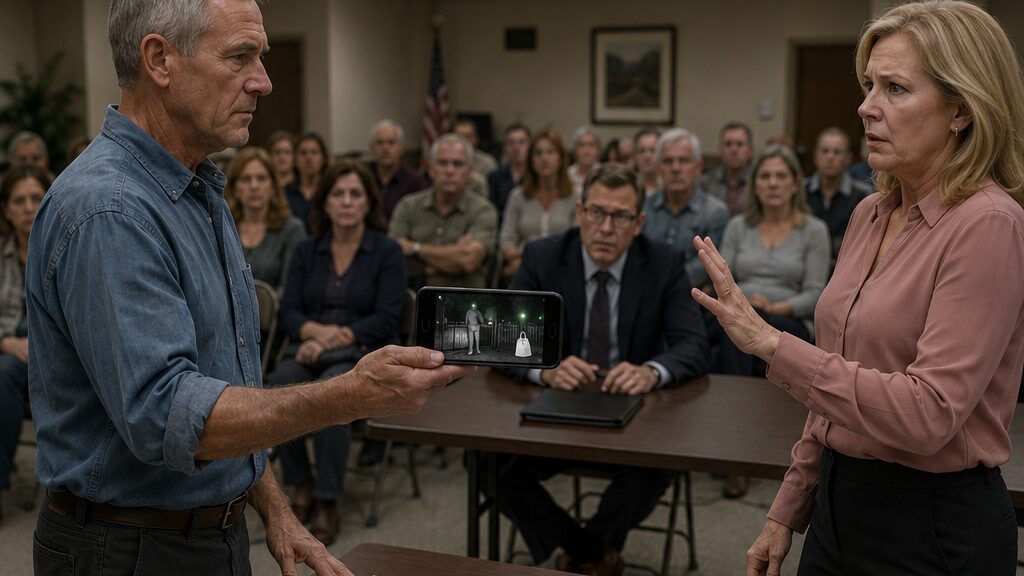
Samuel connected his phone to the small display monitor used for meeting agendas. The screen at the front of the room turned black, then showed a frozen image of his backyard.
The footage was grainy. The cedar gate appeared pale under infrared light. The hydrangeas formed a dark mass beside the workshop.
Samuel set the printed log next to his phone.
“This clip begins at one fifty-eight last Tuesday.”
He pressed play.
Green points appeared across the lower edge of the image. A figure entered from the rear corner and moved quickly behind the workshop. The person wore a light coat or robe over darker clothing. One hand held a small white pharmacy bag.
The figure reached the gate, lifted the latch from inside, and passed through.
For one second, the face turned toward the camera.
Pamela’s face filled the monitor.
No one spoke.
The clip ended.
Samuel did not look at Pamela immediately. He let the black screen remain at the front of the room.
Then he opened a second clip.
“This was three nights earlier.”
Pamela crossed again, moving along the same route. The bag in her hand was darker this time, but her gait and profile were unmistakable.
A third clip began.
Pamela stepped away from the microphone.
“That’s enough.”
Samuel stopped the video.
The silence that followed was different from the earlier murmurs. It had weight. Several residents looked down. One of the board members removed his glasses and cleaned them though the lenses appeared clear.
Steven leaned toward the microphone. “Ms. Harris, did you file a complaint concerning Mr. Allen’s system?”
Pamela’s voice came out lower. “I expressed concerns.”
“Did you state that the lights were activating without cause?”
“I said they were disturbing residents.”
“Were you the person causing those activations?”
Pamela looked around the room as though searching for a face willing to rescue the distinction she wanted to make.
“I was using the route.”
“The route across his property,” Samuel said.
She turned on him. “You have no right to display me like that.”
“You asked the board to fine me for recording movement you denied making.”
“I wasn’t harming anything.”
“You unlatched my gate.”
“Because you locked a path people need.”
The HOA president struck the table lightly with his gavel. “Both of you, stop.”
Pamela’s face had flushed, but beneath her anger Samuel saw something else. In each clip she had moved with urgency, never pausing, never looking toward the house. And in every recording she had carried a pharmacy bag.
Not groceries. Not mail. Not a purse.
A pharmacy bag.
Samuel had expected satisfaction when the room saw her face. Instead, he felt the clean edge of certainty begin to dull.
Steven conferred quietly with the president and the property manager. After a minute, he addressed the room.
“The nuisance enforcement action will be suspended pending further review.”
A few residents shifted as though waiting for a final declaration.
Steven continued. “However, the board will open a formal access review concerning historical use of the route and the proposed pedestrian connection shown on an early development plat.”
Samuel looked toward William.
William did not appear surprised.
Pamela returned to her chair but remained standing beside it. “So he gets to keep filming everyone?”
“The board has not ruled on the system,” Steven said. “Only the immediate fine.”
“That isn’t a solution.”
“No,” Samuel said. “It isn’t.”
For the first time that evening, Pamela looked directly at him without an audience-facing expression. Her anger remained, but her eyes had gone bright.
The meeting ended twenty minutes later with no final vote. Residents gathered in low clusters. Some avoided Samuel. Others offered brief nods that felt less like support than acknowledgment that the easy version of the story had failed.
Samuel packed the activation logs into his folder.
Amanda approached. “You were right about her crossing.”
Samuel slid the phone into his pocket. “That doesn’t make me right about everything.”
Amanda looked toward Pamela, who stood alone near the exit.
“No,” she said. “It doesn’t.”
Samuel carried his folder outside. The clubhouse parking lot was nearly empty when Pamela caught up to him beneath the entry light.
“You enjoyed that,” she said.
“No.”
“You waited until the room was full.”
“You asked the room to punish me.”
Her voice broke at the edge, then hardened again. “You could have come to me.”
“You came to my door and lied.”
“You don’t understand.”
“Then explain it.”
Pamela looked toward the dark line of houses beyond the clubhouse. For a moment, Samuel thought she might.
Instead, she gripped the strap of her bag.
“You have no idea who I was trying to reach,” she said.
Then she walked away before he could ask the question that followed him all the way home.
Chapter 4: The Path That Existed Only on Paper
“The association has been using the wrong map for eighteen years.”
The municipal records clerk said it without drama, one hand resting on a flat archival drawer. Samuel stood across the counter beside William Robinson, while Steven Miller stared at the photocopy he had brought from the HOA office.
The clerk pulled out a second sheet protected by cloudy plastic.
“This is the recorded final plat,” she said. “That one is a preliminary development plan.”
Steven looked down at his copy. “It came from the association’s original files.”
“That doesn’t make it recorded.”
Samuel leaned over the counter. The paper smelled faintly of dust and old adhesive. Lot lines were printed in heavy black. Drainage easements were shaded. Utility access ran behind the rear homes.
No pedestrian route crossed his property.
William pointed to a faint dashed line ending at Samuel’s rear boundary. “There.”
The clerk adjusted her glasses. “Proposed pedestrian connection.”
“Proposed,” Samuel repeated.
“Not dedicated. Not recorded. The final approval removed it.”
“Why?”
She traced the line toward the retention pond. “The grade changed during construction. The developer appears to have shifted the connection to common land on the west side.”
Steven frowned. “There is no path on the west side.”
“There was supposed to be.”
Samuel looked at him. “So the association let residents create one through my yard instead.”
Steven’s jaw tightened. “The board didn’t create anything.”
“You published maps showing it.”
“We published what was in the files.”
“Without checking whether it was legal.”
The clerk slid the final plat toward Samuel. “You can order a certified copy. Title records should also confirm whether any separate easement was recorded later.”
William shook his head. “There wasn’t one. I checked the index yesterday.”
Steven turned sharply. “You checked without informing the board?”
“I checked public records.”
“This is an active association matter.”
William rolled the preliminary map and secured it with a rubber band. “Then the association should have looked before sending a nuisance notice that described private land as a common route.”
The clerk glanced between them, then stepped away to process the copy request.
For the first time since the hearing, Samuel felt something close to relief. Not triumph. Something steadier.
The line was his.
The gate was his.
The right to decide who crossed was his.
Then Steven said, “This may not end where you think it does.”
Samuel faced him.
“The attorney believes long-term community reliance could support an access claim.”
“On land with no recorded easement?”
“I said a claim, not a guaranteed result.”
William gave a dry laugh. “A lawsuit can claim the moon.”
Steven ignored him. “The board has children using that route, shift workers, residents with mobility concerns. If we close it without an alternative, we take on safety exposure.”
“You already had an alternative,” Samuel said. “You failed to build it.”
“That does not remove the present problem.”
“No. It moves the cost of your mistake onto me.”
Steven folded his copy of the preliminary plan with more force than necessary.
“You think I enjoy this?” he asked. “Two years ago, the association paid nearly forty thousand dollars after a resident tripped beside the pool because no one wanted to authorize a repair. Every time the board delays, someone says we were negligent. Every time we act, someone says we overreached.”
“That explains the pressure,” Samuel said. “It doesn’t justify the notice.”
Steven looked toward the records clerk, then lowered his voice.
“The board knew residents had complained about that route before.”
Samuel held still.
“When?”
“Years ago. Before I joined.”
“And no one checked the title?”
Steven hesitated.
“That’s what I thought.”
“The old manager treated it as a neighbor issue. The board assumed the route matched the development plan.”
“Assumed.”
“Yes.”
The word sounded smaller than the consequences it carried.
Outside the municipal building, the afternoon heat pressed against the pavement. William stood beside Samuel’s truck while Steven remained near the entrance, talking on his phone.
“You got what you came for,” William said.
“A certified map.”
“And proof the board was careless.”
Samuel opened the truck door but did not get in. “That should end it.”
William studied him. “Should.”
“You don’t agree.”
“I agree no easement crosses your lot.”
“That’s the question.”
“That’s one question.”
Samuel closed the truck door again.
William looked across the parking lot toward a strip of undeveloped grass between the municipal building and a drainage ditch.
“People have been using your yard because the connection they were promised disappeared,” he said. “Doesn’t give them the right. But it explains why they stopped seeing the line.”
“They never asked.”
“No.”
“They opened my gate.”
“Yes.”
“They complained about a system that only activated because they were trespassing.”
William nodded. “Also yes.”
Samuel waited.
William slipped the rolled plan beneath his arm. “Being right does not make the next decision simple.”
“I didn’t ask for simple.”
“No. You asked for a boundary.”
They drove back separately.
At the subdivision, Samuel parked near the western greenbelt instead of going home. The common strip was narrow and overgrown, running beside a drainage swale toward the main sidewalk. Blackberry vines crowded the fence. The ground sloped sharply near the rear homes, but it was not impossible terrain.
He paced it slowly.
From the westernmost rear lot to the sidewalk, the distance was longer than the route through his yard but shorter than going around by road. A proper path would require grading, drainage, and a small retaining edge.
Money.
Approval.
Maintenance.
All the things the association had avoided by allowing residents to wear a line through Samuel’s grass.
A car door closed behind him.
Amanda Clark approached from the curb. “Steven told the board there’s no easement.”
“He works quickly when liability changes direction.”
“He also said the association attorney is reviewing condemnation.”
Samuel turned. “Condemnation?”
“An emergency access easement. Or whatever language makes it sound less like taking part of your yard.”
“They cannot declare an emergency because people prefer a shortcut.”
“I know.”
“Do you?”
Amanda absorbed the accusation without flinching. “I know I used it. I know I should have asked. I also know my daughter walked beside moving cars when the pond path flooded.”
“That was the association’s failure.”
“And mine. I chose the easier answer.”
Samuel looked back at the greenbelt.
Amanda followed his gaze. “That was supposed to be the route, wasn’t it?”
“Yes.”
“Could it still be?”
“That depends on whether the board wants to solve the problem or win the argument.”
She rubbed one thumb against the grocery-store receipt in her hand. “Pamela won’t support it.”
“Why not?”
Amanda’s eyes shifted toward the rear houses.
Samuel waited.
“Because it comes out too far west.”
“That adds three minutes.”
“Not for everyone.”
He looked at her.
Amanda lowered her voice. “Pamela’s son lives in the house directly behind your rear fence.”
Samuel pictured the footage again: the quick stride, the lifted latch, the pharmacy bag swinging in her hand.
“You’re sure?”
“I’ve seen her there during the day. She brings him groceries. Picks up his mail when he doesn’t come outside.”
“Why didn’t she walk around by the street?”
“It’s nearly a mile from her house to his front door.”
“And through my yard?”
“Less than two hundred yards.”
The greenbelt seemed to narrow before Samuel’s eyes.
Amanda continued. “He keeps to himself. People say things.”
“What things?”
“I’m not repeating them.”
“Then why tell me any of this?”
“Because the map answered the legal question.” She looked toward Samuel’s rear fence. “It didn’t answer why Pamela was willing to lie in front of forty people.”
Chapter 5: What Pamela Would Not Say Publicly
Pamela arrived at Samuel’s workshop carrying the same white pharmacy bag from the footage.
She did not knock on the front door. She came through the side driveway at dusk and stopped beneath the open workshop door, where the overhead light showed every line of strain in her face.
Samuel remained at his workbench.
Pamela placed the unopened bag between his measuring square and a row of sharpened pencils.
“There,” she said. “That’s what you wanted to know about.”
Samuel glanced at the printed label. The patient’s name had been folded underneath.
“You could have told me at the hearing.”
“You could have turned off the screen.”
“You had just asked the board to fine me.”
“And you made sure everyone watched me cross your yard.”
“You told them you never had.”
Pamela’s fingers tightened against the edge of the bench. “My son has panic episodes.”
The green detector light outside swept once across the workshop window, triggered by a squirrel near the hydrangeas. A faint reflection moved over the pharmacy bag.
Samuel said nothing.
Pamela looked toward the window until the light faded.
“He’s thirty-four,” she continued. “He lives alone. Most weeks he manages. He works from home, orders groceries, sees a therapist online. Then something happens—a sound, a power outage, a message he misunderstands—and he believes he cannot breathe.”
“What’s in the bag?”
“Medication his doctor prescribed for emergencies. Sometimes electrolyte packets. Sometimes nothing more important than antacids, because if I arrive carrying a pharmacy bag, he believes help has arrived with me.”
Samuel looked at her.
“That sounds foolish to you.”
“No.”
“It sounds private.”
“Yes.”
Pamela pressed her lips together. “He doesn’t want neighbors knowing. He already hears people call him strange when they think he isn’t listening.”
“Amanda knows he’s your son.”
“Amanda knows because her daughter used to leave homework at his door. She doesn’t know about the episodes.”
Samuel folded his arms. “How many times did you cross?”
Pamela stared at the bag. “More than what you showed.”
“How many?”
“Nine since June.”
“The system logged eleven late-night crossings.”
“Two may have been someone else.”
“Why didn’t you ask for a key?”
“Because you would have said no.”
“You never gave me the chance.”
“You locked the gate after your wife died.”
The words struck with quiet accuracy.
Samuel turned away and moved a block of cedar from one side of the bench to the other, though it did not need moving.
Pamela continued more softly. “Before that, she let people through.”
“She let children through in daylight.”
“She let me through when I was taking soup to him.”
“With permission.”
“Not every time.”
Samuel faced her again. “That distinction matters.”
“To you.”
“To anyone whose yard it is.”
Her shoulders lifted. “I was not stealing from you. I wasn’t damaging anything. I was trying to reach my son before he called an ambulance he couldn’t afford or ran into the street because he thought the walls were closing.”
“And that gave you the right to open my gate?”
“It gave me a reason.”
“A reason is not permission.”
“No. Apparently only paperwork matters to you now.”
Samuel’s hand settled on the edge of the workbench. “You filed complaints before coming to my door.”
Pamela looked away.
“You called people,” he said. “You told them the lights were recording children. You described a silent system as an alarm.”
“I needed it gone.”
“You needed access.”
“Yes.”
“Then why not ask for temporary access?”
“Because temporary access can be taken away.”
“So you tried to make it impossible for me to refuse.”
“I tried to keep a route open that people already depended on.”
“That is not the same thing.”
“It was to me.”
Samuel pushed the pharmacy bag back toward her.
Pamela did not take it.
“What happens tonight?” he asked.
“He’s stable.”
“And tomorrow?”
“I don’t know.”
“I will not give you unrestricted access through my yard.”
Her face hardened at once, as if she had been waiting for the sentence.
“I came here and told you the truth.”
“You came here after the footage forced you to.”
“I am asking now.”
“You are asking for a standing right to cross whenever you decide.”
“I’m asking you not to make me take a fifteen-minute drive when he may be alone and terrified.”
“You live close enough to see his roof from your upstairs window.”
“And far enough that every locked street between us feels like a wall when he calls.”
Samuel looked toward the cedar gate visible through the workshop window. The upper rail caught the last amber light of evening.
He understood urgency.
That was not the same as trust.
“If he calls tonight,” Samuel said, “phone me. I’ll open the gate.”
Pamela stared at him. “You expect me to ask you for permission during a crisis.”
“I expect you not to enter my property without it.”
“What if you don’t answer?”
“I will.”
“You cannot promise that.”
The receiver inside the house sat beside his bed. The phone charger. The flashlight. The routines he had built so he would not miss anything again.
“I will answer.”
Pamela gave a small, bitter laugh. “That is what people say before they fail.”
Samuel’s breath shortened.
She saw the reaction but did not know its source.
“Your wife would never have made this so hard,” Pamela said.
“Do not use her to win this argument.”
“I knew her too.”
“You knew the part she showed the neighborhood.”
“And you think grief made you the only person who lost her?”
The workshop seemed suddenly too small.
Pamela snatched up the pharmacy bag. “You value a property line more than people.”
Samuel’s voice remained low. “And you value your need more than anyone else’s consent.”
For several seconds neither moved.
Then Pamela turned and walked out through the driveway.
The green lights activated as she passed beside the yard, staying outside the fence this time. Their glow traveled parallel to her steps before disappearing at the corner.
Samuel stood at the bench long after her car started.
He wanted to remain angry. Anger kept every fact in its proper place. Pamela had lied. She had organized the complaints. She had used her son’s suffering as a reason to deny Samuel any choice.
But the pharmacy bag had left a pale rectangle in the dust on his workbench.
Samuel reached for a cloth to wipe it away.
Behind the pencils, his hand struck an old manila folder. It slid from a shelf and opened on the floor.
Receipts spilled out. Installation instructions. A warranty card for the first exterior motion light he had purchased years earlier.
Samuel crouched and gathered the papers.
One sheet was a handwritten test log. Dates ran down the left side, followed by activation times and brief notes in his own writing.
He recognized the month before he recognized the year.
The month his wife died.
Samuel sat back on his heels.
Near the bottom of the page, one date had been circled twice.
Beside it, in his handwriting, were four words:
NO ACTIVATION—CHECK REAR UNIT.
He knew what had happened that night.
He had spent years remembering the fall.
He had forgotten that the light had failed.
Chapter 6: The Night Samuel Failed to Hear Her
The old log proved that nothing had alerted Samuel when his wife needed him.
He placed it flat beneath the workshop lamp and read the line again.
NO ACTIVATION—CHECK REAR UNIT.
The date was exact. So was the time written beneath it: 10:43 p.m.
Samuel opened the cabinet under the bench and removed the original motion light. The plastic casing had yellowed. A crack ran beside the sensor eye, and one screw was missing from the mounting plate.
He had replaced it the morning after the fall.
He had never thrown it away.
Outside, the cedar gate shifted softly in the wind.
His wife had gone into the yard to bring in a tray of seedlings before rain. Samuel had been in the workshop with a small sander running. Not loud. He had told himself that detail many times.
Not loud enough to excuse anything.
She had slipped near the gate, striking her hip against the stone border. Her illness had weakened her, though she still resisted being watched. She had called his name.
He had not heard.
When he finally entered the house and noticed the back door open, she had been outside for nearly forty minutes.
The injury had not caused her death. Doctors had said so plainly. Her condition had already advanced. The fall had accelerated nothing they could measure.
But Samuel remembered her face when he found her.
Not anger.
Relief.
That had been worse.
He turned the old light in his hands. After the funeral, he had installed a better unit. Then another. Motion zones. A silent receiver. A camera. Logs.
He had called it security.
The word had allowed him to avoid another one.
Punishment.
Every unidentified movement became a failure waiting to happen. Every open gate became proof that he had not paid enough attention. He had built a system that demanded certainty from a yard where certainty had failed him once.
A knock sounded against the workshop frame.
Samuel looked up too quickly.
Amanda stood outside with William behind her. Neither entered.
“The board posted the agenda,” Amanda said.
She handed him a printed notice.
EMERGENCY ACCESS REVIEW AND AUTHORIZATION OF LEGAL REMEDIES.
Below the heading, the proposed action allowed the board to fund legal proceedings for “establishment or acquisition of a necessary pedestrian easement.”
The vote was scheduled for the following evening.
“They’re calling it necessary now,” Samuel said.
William stepped into the workshop and placed the certified final plat beside the old log. “Steven has enough votes to authorize the attorney. Whether they can win is another matter.”
“They don’t need to win,” Amanda said. “They need to make it expensive.”
Samuel read the notice again.
William noticed the old motion light. “That the first one?”
Samuel nodded.
Amanda glanced between them. “First what?”
Samuel could have put it away.
Instead, he set it on the bench.
“My wife fell near the gate,” he said.
Neither of them spoke.
“It was late. I was working in here. The rear light was supposed to activate if anyone crossed the yard.”
Amanda’s gaze moved to the handwritten log.
“It didn’t,” Samuel said. “I didn’t hear her.”
William lowered himself onto the wooden stool by the wall.
Samuel kept his eyes on the cracked sensor casing. “Afterward, I installed another unit. Then added zones. Then the receiver. I told myself I was protecting the property.”
“You were,” Amanda said.
“Not only that.”
The admission left him exposed in a way the hearing had not.
He continued before he could close again.
“When the lights come on, I know something happened. I don’t have to wonder whether I missed it. I don’t have to find an open door and realize the night changed while I was sanding a piece of wood.”
Amanda folded the board notice once along its existing crease.
“I’m sorry,” she said.
Samuel looked at her. “That doesn’t give me the right to treat your daughter like an intruder.”
“She crossed without asking.”
“I made no distinction. Child, nurse, delivery driver, Pamela. I put all of you in the same column.”
William tapped one finger against the final plat. “A boundary can be clear without every person on the other side being an enemy.”
Samuel almost rejected the sentence. Then he looked at the old light again.
“What about Pamela’s son?” Amanda asked.
“She told me.”
“All of it?”
“Enough.”
“Then you understand why she crossed.”
“I understand why she wanted to.”
“That sounds like a carpenter splitting a hair.”
“It is the difference between need and permission.”
Amanda nodded slowly. “Yes.”
The agreement unsettled him more than another argument would have.
William unrolled a current parcel map over the workbench. “The board has framed this as two choices. Keep using your yard or close the connection.”
“They prefer choices that make someone else responsible,” Samuel said.
“What would a third choice require?”
Samuel looked toward the side window. Beyond the fence, the western greenbelt lay hidden by shrubs and the grade change.
He pulled a pencil from the bench.
“The common strip is thirty-two feet wide at the narrowest point,” he said. “The swale takes twelve.”
William leaned over the map.
“You’d need five feet for an accessible path,” Samuel continued. “More near the turn. A low retaining wall here.”
He marked the western boundary.
Amanda moved closer. “It would come out beside the mail kiosk.”
“Not directly beside it. Ten feet north.”
“That’s still safer than the road.”
William studied the contour lines. “The slope is the problem.”
“It can be stepped down with two landings.”
“Drainage?”
“A raised edge and a culvert at the low point.”
Samuel’s pencil moved faster.
The old training returned through his hand: measure, load, drainage, clearance. Problems became dimensions. Dimensions could be worked.
Then the line reached the rear corner of his lot.
He stopped.
The new route would need to pass beside the cedar gate. To create enough turning space without crossing Samuel’s property, part of the projecting fence return would have to be removed.
Three cedar panels.
The hinge post his wife had held level.
Amanda saw where his pencil had stopped. “Does it fit?”
Samuel stared at the corner.
“It can.”
William followed the line. “You’d lose part of the gate structure.”
“The gate would remain.”
“But not as it is.”
Samuel set down the pencil.
The board notice lay beside the old detector log: one threat from the present, one command from the past.
Amanda said, “You don’t have to solve their mistake for them.”
“No.”
“You could fight.”
“Yes.”
“You would probably win.”
William shook his head. “Eventually.”
Samuel looked through the workshop door toward the grass. The modern detectors sat low between the garden stones. They had activated for trespassers, children, neighbors, animals, and one frightened mother carrying medicine.
The lights had done exactly what he designed them to do.
He was the one who had decided what every activation meant.
Samuel pulled a fresh sheet of drafting paper from beneath the bench.
William watched him align it with the edge.
“What are you doing?”
“Giving them a choice they didn’t offer.”
For the next two hours, they worked without leaving the workshop. William checked the grades. Amanda listed the residents who could explain why a safe route mattered without defending trespass. Samuel drew the retaining edge, the drainage crossing, and the connection to the existing sidewalk.
At ten thirty, the neighborhood portal sent a new notification.
Steven had added a proposed closed-session negotiation before the vote.
Samuel read the message and turned his phone face down.
“What does that mean?” Amanda asked.
“It means they want me alone before the room fills.”
“To pressure you?”
“To offer something.”
William rolled his shoulders. “You going?”
“Yes.”
Samuel completed the final line, then marked the property boundary in dark pencil. Beside it, he traced the alternate route in green.
The path did not enter his yard.
It did not require residents to walk beside traffic.
It did require him to remove part of what he had spent years protecting.
Samuel folded the design carefully along the center.
The next evening, when the board tried to force him to choose between surrender and isolation, he would place a third answer on their table.
Chapter 7: He Refused Both Choices They Gave Him
“Before we begin,” Steven Miller said, “the board has enough votes to authorize legal action for an access easement.”
The clubhouse was fuller than it had been at Samuel’s hearing. Residents lined the back wall after the folding chairs filled. The community attorney sat beside the HOA president with a closed laptop and a yellow legal pad. Pamela occupied a seat near the aisle, her hands folded tightly around her purse.
Samuel remained standing at the smaller table with his folder under one arm.
Steven gestured toward the hallway. “The board would like to speak with you privately.”
Samuel followed him into the property manager’s office. The door closed behind them, muting the low conversations in the meeting room.
The community attorney opened a folder.
“We believe there is a resolution that avoids litigation,” she said. “The association will withdraw the nuisance matter and take no further action concerning your security system.”
“In exchange for what?”
Steven answered. “You grant limited access through the existing route.”
“To whom?”
“Pamela, initially. Additional residents could apply based on need.”
Samuel set his folder on the desk. “You want a private agreement that turns trespass into permission without admitting the board used an unrecorded map.”
The attorney’s expression did not change. “We want a practical solution.”
“For the board.”
“For the community.”
Samuel looked at Steven. “You told them you could make this disappear.”
Steven lowered his voice. “I told them we might avoid spending reserve money on lawyers.”
“And if I refuse?”
“The vote proceeds.”
Samuel glanced at the closed door. Beyond it waited the residents who had used his yard, defended Pamela, condemned Pamela, or simply wanted someone else to settle the inconvenience.
“Put the offer in writing,” he said.
The attorney reached for her pen.
“So I can reject it in writing.”
Steven exhaled. “Samuel.”
“You are offering to stop punishing me if I quietly give the board what it could not prove it owned.”
“We are offering certainty.”
“No. You’re offering silence.”
He picked up his folder and returned to the meeting room.
The HOA president called the meeting to order. Steven summarized the proposed authorization, describing the route as a long-used pedestrian connection important to resident safety. He did not mention the private offer.
When public comment opened, several residents spoke in favor of securing access. The night-shift nurse described the flooded sidewalk near the retention pond. A parent discussed children walking beside traffic. No one defended opening Samuel’s gate without permission, but nearly everyone spoke as though the only available choices were continued use or complete closure.
Pamela did not approach the microphone.
Then Amanda Clark stood.
“I used Mr. Allen’s yard without asking,” she said. “My daughter did too. We called it a path because that made it easier not to call it his property.”
The room became still.
Amanda continued. “The neighborhood does need a safe connection. But need doesn’t turn the wrong route into the right one.”
She looked toward Samuel.
“He has another proposal.”
Samuel carried his folder to the display table and unfolded the drawing. William Robinson joined him, placing the certified final plat beside it.
A narrow green line ran along the western common strip, curved around the drainage swale, and connected the rear homes to the main sidewalk.
“This route stays on association land,” Samuel said. “It avoids the road, preserves drainage, and does not cross any private lot.”
Steven leaned forward. “The grade is too steep.”
“Not with two level landings and a retaining edge.”
“The cost—”
“Will be less than filing an easement action you may lose.”
The attorney studied the drawing. “Who prepared this?”
“I did. William checked the measurements.”
William spoke from beside the table. “The concept fits the recorded boundary and available width. It still needs a licensed survey and engineering review.”
The HOA president traced the route with one finger. “Where does it meet the rear row?”
“Beside Samuel’s northwest corner,” Amanda said. “Near the mail kiosk.”
Pamela finally rose. “That does not help everyone equally.”
Samuel met her eyes. “No route does.”
“It adds time.”
“Three minutes from your house.”
Her mouth tightened.
“And how much from my son’s?” she asked.
The room shifted at the word.
Samuel did not answer for her.
Pamela looked toward the board, then the residents. “My son lives behind Samuel’s fence. I used the yard because he sometimes needs me at night.”
A few people looked down. Others watched her with a curiosity that confirmed the fear she had carried.
Pamela drew a breath.
“He has panic episodes. He asked me not to tell people. I decided protecting that secret mattered more than asking Samuel’s permission.”
Her fingers tightened on the microphone.
“So I filed complaints. I said the system disturbed people when what I wanted was for it to be removed. I let residents believe Samuel was watching children because I knew that would make the board act faster.”
Steven sat very still.
Pamela looked directly at Samuel. “That was dishonest.”
No applause followed. No one rushed to comfort her. The admission entered the room and remained there.
Samuel felt no satisfaction this time. Only a hard easing, like a clamp loosened one turn.
The HOA president asked the attorney whether the alternative route could be evaluated before litigation.
“It could,” she said. “But the board would need to suspend the easement authorization and commission a survey.”
Steven looked at the projected cost sheet. “The reserve fund can cover design and construction if the retaining work remains limited.”
One board member frowned. “Why should all residents pay because Mr. Allen refuses access?”
Amanda answered before Samuel could. “Because the original developer failed to build the common path, and the association used the wrong map for eighteen years.”
Steven rubbed one hand over his forehead.
The president called for discussion. Arguments followed—cost, maintenance, lighting, liability, the flooded pond route. This time the conflict did not center on whether Samuel was unreasonable. It centered on what the association had failed to provide.
At last, Steven said, “There is one physical problem.”
He pointed to the northwest corner on Samuel’s drawing.
“The turning radius overlaps the fence return.”
Samuel nodded. “Three panels and the projecting post have to come out.”
William looked at him. They had discussed the measurement, but not the meaning in public.
Pamela glanced toward the drawing. “The cedar gate?”
“The gate stays,” Samuel said. “Part of the side return does not.”
The memory came with exact details: his wife holding the post level, one hand above the other; cedar dust on her sleeve; her laughter when he accused the bubble of lying.
He had spent years keeping that structure unchanged because change felt too much like consent to loss.
The HOA president asked, “Are you willing to remove it?”
Samuel placed his palm over the green line.
“I’m willing to remove what the new path requires. I am not willing to grant access through my yard.”
The attorney whispered to Steven. He nodded reluctantly.
The president called for two motions: first, to suspend legal action; second, to commission the alternate path using association funds and adopt written access rules.
Before the vote, Samuel raised his hand.
“I will support the proposal on one condition.”
Steven looked wary. “What condition?”
“The meeting record must include Ms. Harris’s admission that the complaints were knowingly misleading. The nuisance warning must be formally withdrawn, not merely suspended.”
Pamela’s face tightened, but she did not object.
The president asked her, “Do you agree that your statement should enter the record?”
Pamela looked at Samuel for a long moment.
“Yes.”
The first motion passed unanimously. The second passed with one opposing vote.
When Samuel’s turn came, he said, “Yes.”
The word committed the association’s money, ended the immediate threat to his property, and sentenced three cedar panels to removal.
After the meeting, residents gathered around the drawing. Amanda discussed volunteer planting along the route. William warned everyone that volunteer enthusiasm did not replace drainage calculations.
Samuel packed his papers slowly.
Pamela stopped several feet from him.
“I meant what I said,” she told him.
“So did I.”
“I don’t expect you to forgive me.”
“Good.”
The answer hurt her. He saw it, but he did not soften it into something false.
She nodded once and left.
Samuel carried the drawing outside. In the parking lot, the green line showed faintly through the folded paper beneath the overhead lamp.
He had protected the boundary.
To do it, he would have to cut into the gate he had once believed must never change.
Chapter 8: The Lights No Longer Meant Intrusion
At 1:57 in the morning, Samuel’s receiver vibrated beside his bed.
He opened his eyes and watched the display.
Zone four activated near the rear homes. Then zone five along the new western path. The movement continued toward the sidewalk but stopped before reaching his boundary.
No light crossed the grass behind the workshop.
Samuel remained in bed until the receiver went still.
Six weeks earlier, that same signal would have pulled him upright before he was fully awake. Now he listened to the house settle around him and pictured the low green guide lights tracing the new path beside his property instead of through it.
The route had opened three days before.
A surveyed strip of compacted gravel curved along the common greenbelt, supported by a short retaining wall at the steepest grade. The association had installed drainage beneath the low point and planted ground cover along the outer edge.
Samuel had built the two wooden handrails himself.
He had also removed the three cedar fence panels.
The projecting post had resisted the saw longer than expected. When it finally loosened, he found an old pencil mark beneath the lower hinge plate—his wife’s handwriting, faint but legible.
LEVEL ENOUGH.
He had laughed once, alone in the yard, then sat on the overturned post until the ache passed.
The cedar gate still stood. It opened only into Samuel’s yard. Beside it, the new path turned away toward the sidewalk, clearly separate and fully lit.
At eight the next morning, Samuel carried coffee to the workshop. Children used the path on their way to the bus stop. The night-shift nurse walked home with her shoulders bent from fatigue. Each person remained on the other side of the new low fence.
The detector recorded movement.
The lights no longer accused anyone.
Near noon, a figure stopped at the cedar gate.
Pamela stood outside holding a brass hinge in both hands.
She did not touch the latch.
Samuel crossed the yard but stopped several feet away.
“What is it?”
“One of the workers found this beneath the removed post.” She held it up. “I thought you might want it.”
“I do.”
She waited.
Samuel looked at the gate, then back at her.
“You can come in.”
Pamela opened the latch carefully and stepped onto the grass. The green detector nearest the gate illuminated for two seconds, then dimmed.
She noticed it.
“So they still work.”
“Yes.”
“You didn’t remove the system.”
“No.”
She handed him the hinge. Cedar dust remained packed around one screw hole.
“I’m sorry,” she said.
Samuel turned the metal piece in his palm.
“For crossing?”
“For crossing. For the complaints. For telling people you were unstable because grief had made you difficult.”
He looked up.
Pamela’s face tightened. “I said that to Steven. I knew it would change how the board interpreted everything you did.”
Samuel closed his hand around the hinge.
“You used my wife against me in the workshop.”
“Yes.”
“And at the meeting, before the footage, you knew I was telling the truth.”
“Yes.”
The apology did not erase the nights, the false complaints, or the way the room had looked at him before the video played.
Pamela seemed to understand that.
“My son uses the new path during the day,” she said. “Not often. But he walked to the mail kiosk yesterday.”
“That’s good.”
“He says the green lights help him see where the path turns.”
Samuel glanced toward the low guide fixtures. “They’re less harsh than the old ones.”
“He asked whether you chose green because of the detector.”
“I did.”
Pamela nodded. “He said that made sense.”
A child called from the path, and the gate light flickered as a shadow moved beyond the fence. Samuel did not turn toward it.
Pamela noticed that too.
“I explained myself,” she said, “but I know that doesn’t excuse what I did.”
“No.”
“I thought if people knew about my son, they would reduce him to the worst night he ever had. So I reduced you to the worst version of your grief first.”
Samuel looked at the brass hinge in his hand. The metal had darkened where rain had reached it over the years.
“My wife used to let you through,” he said.
“She did.”
“That made you think the gate was hers to give away.”
Pamela lowered her eyes. “Maybe.”
“It wasn’t. But I also acted as if keeping it unchanged could keep everything else unchanged.”
She looked toward the missing fence return. The new path was visible through the open space, though a low barrier still marked the boundary.
“Do you regret removing it?” she asked.
“Some mornings.”
“Today?”
Samuel considered the children, the nurse, the quiet figure who had passed at 1:57 without entering his yard.
“Not today.”
Pamela gave a small nod.
When she reached the gate, she paused. “May I use this entrance again if I need to speak with you?”
“Knock at the front door.”
For a moment, surprise crossed her face. Then she almost smiled.
“All right.”
She left through the gate and turned onto the official path.
Samuel carried the hinge into the workshop. He set it beside the old cracked motion light rather than reinstalling it. One belonged to the gate as it had been. The other belonged to the promise he had made after it failed.
Neither needed to control what came next.
That evening, he opened the detector settings on his phone.
The system still offered three modes: warning, record only, and boundary illumination.
Samuel selected the third.
At dusk, the low green lights came on along the edge of his yard. They did not sweep across the grass or follow anyone’s steps. They formed a steady line from the cedar gate to the rear corner, bright enough to show where his property began and soft enough not to make the boundary feel like a threat.
On the other side, the guide lights marked the path the neighborhood had finally built for itself.
Samuel stood on the porch and watched both lines glow beside each other.
One protected his home.
The other allowed people to pass.
For the first time, he did not mistake those purposes for opposites.
The story has ended.