My Neighbor Reported My Cedar Fence, Then Learned His Wall Had Been on My Land for Years
Chapter 1: The Notice Was Already Taped to His New Fence
The violation notice was taped at eye level to the newest cedar board.
Matthew Adams saw it before he reached the side gate. The white page lifted and slapped softly against the fence in the morning breeze, held in place by four strips of blue painter’s tape. Someone had drawn a red line beneath the amount near the bottom.
$150.
He set down his travel mug and pulled the notice free.
The homeowners association had received a complaint alleging that his newly installed fence extended approximately four inches beyond his property boundary. He had seventy-two hours to provide proof of compliance or begin corrective work. After that, the association could assess a $150 fine and additional penalties under the neighborhood covenants.
The fence had been finished Friday afternoon.
Matthew read the page twice, then looked through the narrow gap between the last board and the gatepost. On the other side, Thomas Baker stood beside his driveway in pressed khaki pants and a brown sport coat, as if he had dressed for a meeting rather than trash pickup.
“You put this here?” Matthew asked.
Thomas glanced at the paper without moving closer. “The association did.”
“That wasn’t my question.”
“I reported the problem. They handled it.”
Matthew folded the notice once, carefully, though his fingers wanted to crush it.
The cedar still smelled sharp and clean. He had paid to replace a leaning privacy fence damaged by winter wind, and the contractor had followed the sketch approved by the association. Matthew had kept the approval email, the invoice, and every photograph taken before construction. He kept paperwork because his father had not.
Years earlier, his father had accepted a handshake over a drainage strip behind a small rental house. By the time the disagreement reached attorneys, the other owner remembered the agreement differently. Matthew’s father lost the strip, the sale, and most of what he had saved for retirement.
Matthew had learned the lesson too well: if it mattered, it went in writing.
“You could have knocked on my door,” he said.
Thomas’s expression tightened. “I tried to discuss the drainage before you built. You never returned my message.”
Matthew remembered the voicemail. Thomas had complained that runoff from Matthew’s downspout reached the retaining wall after heavy rain. Matthew had intended to call after the fence project was finished. Then work became busy, the contractor arrived early, and the message remained unanswered.
“That was about drainage,” Matthew said.
“It was about the property line.”
“No. It wasn’t.”
Thomas walked toward the narrow strip between the properties. He stopped beside the fence and pointed to the base of a post.
“The line is here. Your fence is there.”
The distance between his finger and the post looked smaller than the width of Matthew’s palm.
“You measured it?”
“I have the original site plan.”
“You had a survey done?”
“I have what I need.”
A car door closed at the curb.
Michelle Wilson, the HOA president, approached with a dark folder tucked against her blouse. Two nearby homeowners had paused near a mailbox across the street. Neither pretended not to watch.
Matthew felt the heat rise under his collar. He disliked public arguments, especially the kind in which one person arrived carrying a folder and everyone else assumed the folder contained truth.
Michelle gave him a professional smile. “I wanted to make sure you received the notice.”
“I received it.”
“Thomas supplied documentation showing a possible encroachment.”
Thomas returned to his garage and came back with a folded sheet protected inside a clear plastic sleeve. He opened it across the hood of his car.
The drawing showed both houses, the rear corners of the lots, and a narrow line between them. Someone had written several measurements in the margins. A darker mark had been added near Matthew’s new fence.
“Four inches,” Thomas said. “Possibly a little more near the rear.”
Matthew leaned over the page. The title block carried the subdivision name and an old date. It looked official enough to persuade someone who wanted a quick answer.
But there were no surveyor’s stamps. No iron-pin references. No coordinates. The boundary was represented by a single clean line running between simplified house shapes.
“Where did this come from?” Matthew asked.
“It was part of the purchase documents.”
“That doesn’t make it a survey.”
Michelle opened her folder. “The association is not determining ownership. We’re enforcing the placement standard based on the information available.”
“You approved this placement.”
“We approved the architectural appearance and the submitted plan.”
“The submitted plan showed this exact line.”
“Approval does not guarantee boundary accuracy.”
Matthew looked at her. “Then what exactly did you approve?”
Her smile disappeared. “You have seventy-two hours to provide contrary documentation. I can’t suspend a compliance matter because you disagree with the complaint.”
Thomas folded his drawing. “He should have checked before building.”
The sentence landed harder than it should have. It sounded like the sort of thing Matthew told contractors when they missed a dimension, the sort of clean judgment that made every mistake belong entirely to the person standing nearest it.
Across the street, one of the homeowners finally moved on. The other remained by the mailbox.
Matthew unfolded the violation notice and placed it against the fence. He took out a pen and wrote beneath the red amount:
Site plan has no survey markers.
Michelle watched him. “What are you doing?”
“Keeping track of what we actually know.”
Thomas gave a short, humorless laugh. “What we know is your fence is over.”
Matthew wanted to answer. He wanted to point toward Thomas’s retaining wall, which began near the front corner and ran beside the properties in a long gray tier. He wanted to say that Thomas had spent six years changing the grade of the land and had never once produced a survey.
Instead, Matthew picked up his coffee.
“I’ll get the records,” he said.
Thomas stepped closer. “The deadline still applies.”
“I heard her.”
By eight-thirty, Matthew had spread his permit folder across the kitchen table. The contractor’s invoice sat beside the HOA approval email. He found the site sketch he had submitted and compared it with a county parcel diagram downloaded when he bought the house.
At first the drawings seemed nearly identical.
Then he aligned the rear corners.
The HOA sketch placed the shared line against the outer edge of Thomas’s retaining wall. The county diagram showed a second line running several inches inside it.
Matthew used a ruler, moving it slowly from the front corner toward the rear of the lots.
For almost the entire length of the side yard, the county boundary appeared to pass beneath Thomas Baker’s wall.
Chapter 2: Two Property Drawings Could Not Both Be True
“The crew never located the pins,” the fence contractor said.
Matthew held the phone away from his ear for a moment, certain he had misunderstood.
“You told me you followed the approved plan.”
“We did.”
“Without locating the property line?”
“We built from the dimensions you submitted. The association stamped them.”
“That drawing came from their records.”
“And it matched your old fence.”
“The old fence was leaning.”
“But the posts were already there.”
Matthew looked through the kitchen window. The cedar boards stood straight in the morning light, every post evenly spaced. Beyond them, only the upper edge of Thomas’s retaining wall was visible.
“So you replaced uncertainty with new lumber,” Matthew said.
The contractor exhaled. “That’s not fair.”
“No. It isn’t.”
After the call, Matthew printed both drawings at the same scale. He placed them over the glass top of the kitchen table and shone a work light underneath. The houses aligned. The street aligned. The rear lot corners did not.
One boundary line touched the wall.
The other passed beneath it.
He photographed the mismatch, gathered the originals, and drove to the county records office before lunch.
The clerk behind the counter listened without reacting. Property disputes, Matthew realized, probably arrived there every day disguised as emergencies.
“I need the recorded parcel documents for both lots,” he said.
“Recorded plats are public. Individual surveys may not be on file.”
“I need anything showing the original pins or dimensions.”
She entered the subdivision name and lot numbers, then disappeared into a back room. When she returned, she carried a thin packet and a larger rolled sheet.
“This is the recorded plat,” she said. “This one is a permit attachment from six years ago. It may not reflect final construction.”
The permit attachment showed Thomas’s retaining wall as a shaded rectangle along the boundary. A handwritten note beside it read: verify setback before placement.
Matthew felt a brief, sharp satisfaction.
Then he noticed the note had no completion mark beside it.
“Was this approved?” he asked.
“The permit file will show the status. You’ll need a separate request for that.”
He paid the copying fee and called Jessica Lee from the parking lot.
His cousin answered on the fourth ring. “If this is about free surveying, the answer is no.”
“It’s about contradictory drawings.”
“That is usually how free surveying begins.”
“I have a recorded plat, an HOA sketch, and a permit attachment.”
“Send photographs.”
He did. She called back less than five minutes later.
“Where are you?”
“County offices.”
“Come by after three.”
Jessica’s workroom occupied the back of a small surveying firm near an industrial park. Rolled plans stood upright in bins. Metal tripods leaned against one wall beside cases marked with equipment labels. She cleared a drafting table and spread Matthew’s documents beneath a weighted straightedge.
“You built without ordering a boundary survey,” she said.
“The HOA approved the plan.”
“That answers a different question.”
“You sound like Michelle.”
“I sound licensed.”
She aligned the recorded plat with the permit attachment, then traced the parcel line with the edge of a pencil. Matthew watched it pass through the shaded wall footprint.
“So I’m right.”
Jessica did not look up. “You may be right about his wall.”
“And my fence?”
She switched to the association sketch.
“The fence is close to the property line. Very close.”
“That was allowed.”
“Maybe by the county. Your HOA rules could require an inward setback even when the county does not.”
Matthew crossed his arms. “They approved the placement.”
“Architectural approval isn’t a boundary certification.”
“That’s convenient for them.”
“It’s also common.”
She measured between the drawn fence and the recorded boundary, checked the scale, and repeated the calculation.
“If these documents are accurate, Thomas’s wall may cross the property line. Your fence may still violate the association’s setback.”
“How can both be violations?”
“Because they’re different rules.”
The answer irritated him because it was simple.
Jessica moved the straightedge from the front of the property toward the rear. “How long is the wall?”
“Most of the side yard. Forty feet, maybe more.”
“And how old?”
“Six years.”
“Any recent grading?”
“No.”
“Any chance a pin was disturbed during the fence work?”
Matthew hesitated. The contractor had removed several rotted posts, dug new holes, and hauled away soil. He had not watched every hour.
“I don’t know.”
Jessica met his eyes. “Then don’t accuse anyone yet.”
“He accused me.”
“That does not improve your evidence.”
Matthew looked down at the plat. “Can you inspect it?”
“I can look. I won’t certify a survey involving family property. You need an independent firm for that.”
“The deadline is tomorrow morning.”
“A preliminary check might convince the HOA to pause. It will not settle ownership.”
“That’s enough.”
“No,” Jessica said. “It’s enough to slow people down. That is not the same thing.”
They drove to Matthew’s house just after four. Thomas’s car was gone, but Ruth Baker stood near the retaining wall with a garden hose curled at her feet. She watched Jessica carry a measuring tape and pin finder into the side yard.
“Thomas didn’t tell me anyone was coming,” Ruth said.
“This isn’t a formal survey,” Jessica replied. “I’m only reviewing visible conditions with Matthew’s permission.”
Ruth looked toward the wall. “You’ll need ours if you cross over.”
“I won’t.”
Her tone was calm, but Matthew noticed the way she gripped the hose nozzle.
Jessica located a metal response near the front corner, then another near the rear. She did not uncover either marker completely. Instead, she recorded the positions and measured reference distances from fixed points.
At the rear, she crouched beside the wall and studied the permit attachment.
“What?” Matthew asked.
“The wall is farther over than the sketch suggests.”
“How far?”
“I am not giving you a legal measurement.”
“An estimate.”
She stood. “Enough that Thomas’s four-inch complaint may become the smaller issue.”
Matthew turned toward Ruth. She had not moved, but the water from the hose ran unnoticed into the grass.
“Did Thomas ever have this surveyed?” he asked.
Ruth shut off the nozzle. “You’ll need to ask him.”
“You live here too.”
Her face changed—not into surprise, but caution.
“Ask Thomas,” she repeated.
Jessica packed away the finder. “The HOA should bring a neutral technician tomorrow. Then you order a formal boundary survey.”
“You saw it,” Matthew said.
“I saw reasons to measure.”
She placed the recorded plat back into his hands.
“And Matthew—there’s something else.”
He waited.
“If the association setback is six inches from the legal boundary, your fence is probably too close even if it never crosses onto Thomas’s land.”
The satisfaction he had carried from the county office drained away.
Jessica agreed to return for the HOA inspection, but before leaving she made him promise not to describe her preliminary check as a survey.
“You wanted certainty,” she said. “Tomorrow may give you two problems instead of one.”
Chapter 3: The Survey String Passed Under Thomas Baker’s Wall
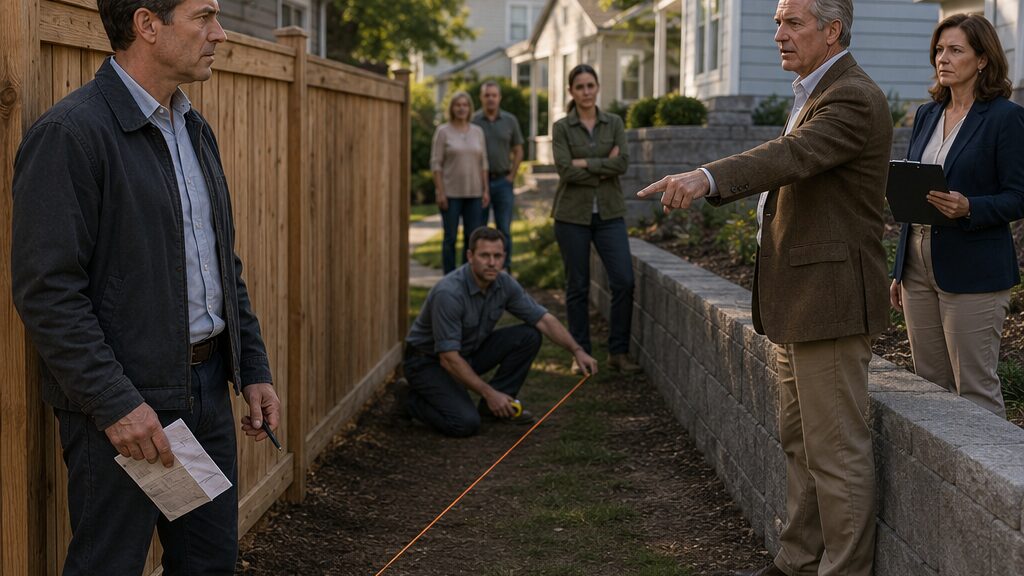
The orange string brushed the bottom edge of Matthew’s new fence, continued toward the rear yard, and vanished beneath Thomas Baker’s retaining wall.
No one spoke.
The HOA technician stood near the front pin holding the reel. Jessica remained several feet away with her arms folded, present only as an observer. Michelle held a clipboard against her chest. Thomas had positioned himself beside the gate before the measurements began, close enough to direct the process without appearing to interfere.
Two homeowners watched from the sidewalk.
Thomas broke the silence first. “That rear marker has been disturbed.”
The technician looked toward him. “I haven’t made that determination.”
“It wasn’t exposed before the fence crew came.”
Matthew felt every face turn toward him.
“I didn’t expose it,” he said.
“Your contractors dug along this entire line.”
“They replaced existing posts.”
“And moved soil.”
Michelle stepped between them. “Let the technician finish.”
The string ran taut from a metal reference point near the front of the lots to the rear marker. For the first twenty feet, it passed close enough to Matthew’s fence that the cedar cast a thin shadow across it. Near the midpoint, the retaining wall widened around a change in grade.
The orange line disappeared beneath the first concrete block.
The technician measured from the string to the visible face of the wall.
“Approximately nine inches here,” he said.
Thomas shook his head. “That is impossible.”
The technician moved six feet farther back and measured again.
“Ten and three-quarters.”
Matthew unfolded the HOA notice he had carried in his pocket. Beneath the printed threat of the $150 fine, he wrote the number.
Thomas saw him. “You think this is funny?”
“No.”
“You’re taking notes like you planned this.”
“I’m writing down what he says.”
The technician proceeded toward the rear lot. At each interval, the wall remained beyond the string: ten inches, eleven inches, ten and a half. The encroachment did not disappear after one misplaced block. It continued.
Jessica quietly asked, “How far from the front corner?”
The technician checked his tape. “Just over forty-one feet to this point.”
They moved to the final section.
“Forty-two feet, three inches,” he said.
One of the homeowners on the sidewalk whispered something to the other. Matthew could not hear the words, but Thomas did. His shoulders rose.
“This is not a certified survey,” Thomas announced.
“No,” Jessica said. “It is not.”
Thomas pointed at her. “And you’re related to him.”
“I haven’t touched the equipment.”
“You told him where to look.”
“The recorded plat told him where to look.”
Michelle lowered her clipboard. “Thomas, your complaint relied on a site sketch. Matthew has now produced a recorded plat that conflicts with it. Until a formal boundary survey is completed, I am suspending the fine.”
“The fence is still too close.”
“That issue remains open.”
“You gave him seventy-two hours.”
“And new information has changed the situation.”
Thomas’s face reddened. “The new information came from his cousin.”
“The technician is contracted by the association.”
“He used a pin Matthew’s crew could have moved.”
The accusation was louder this time.
Matthew folded the notice along its original crease. He had imagined this moment since finding the county diagram: the instant when Thomas’s certainty failed in front of the same people who had seen the accusation. He had expected relief.
Instead, he felt the situation narrowing around him.
If the pin had been disturbed, every measurement could be challenged. If Thomas convinced the HOA that Matthew’s contractor had altered a marker, the dispute would no longer concern a fence and a wall. It would concern intentional interference.
“I want that allegation included in the record,” Matthew said.
Michelle stared at him. “Are you sure?”
“Yes. Word for word.”
Thomas looked briefly uncertain.
Matthew continued. “And I want the formal survey to verify both pins independently.”
Jessica’s expression softened by a degree. It was the first sign of approval she had given him all afternoon.
The technician released the tension on the string. It dropped against the grass, no longer a clean boundary but a loose orange curve between the two properties.
Thomas stepped across it.
“You should have called me before you built,” he said.
Matthew looked at the wall behind him. “I should have returned your message.”
Thomas seemed surprised by the admission.
“But you should have waited before filing the complaint,” Matthew added.
“I had no reason to.”
“You had a wall sitting beside a line no one had confirmed.”
“I had purchase documents.”
“The same kind of sketch the HOA approved for me?”
Thomas’s jaw tightened. “My wall has been there six years.”
“That doesn’t tell us where the property line is.”
“It tells us no one objected.”
“My silence doesn’t transfer ownership.”
Thomas moved closer. “Your father taught you that phrase?”
The words were quiet enough that Michelle did not react, but Matthew heard them clearly.
Thomas knew about his father’s dispute. Matthew had mentioned it once, years earlier, during a conversation over the mailbox when they had still spoken without documents between them.
Matthew’s hands closed around the folded notice.
Jessica stepped forward. “We’re done here.”
Thomas gave her a thin smile. “You don’t decide that.”
“No. But I decide whether I remain while this becomes personal.”
Matthew wanted to answer Thomas with the wall measurements, the permit attachment, and every expense the dispute might now place on him. He wanted to make the forty-two feet sound like a sentence.
Instead, he turned to Michelle.
“When can the formal survey be done?”
“The firm will send availability this afternoon.”
“And the fine?”
“Suspended, not withdrawn.”
Thomas laughed once. “Because the fence is still wrong.”
Michelle faced him. “And your wall may be wrong. I suggest neither of you describe this as a victory.”
The homeowners finally walked away.
The technician reeled in the orange string. As it emerged from beneath the wall, dirt clung to several feet of it, darkening the bright fibers. Matthew watched the line wind back onto the spool until no visible boundary remained between the lots.
By six that evening, the association had emailed written confirmation that enforcement was paused pending a certified survey.
At seven-twelve, another message arrived.
It came from a law office Matthew did not recognize. The subject line read: Notice of Suspected Boundary-Marker Interference.
Thomas’s attorney alleged that recent fence construction might have displaced or exposed a survey monument and demanded that Matthew preserve all contractor records, photographs, excavation notes, and communications.
The final paragraph warned that intentional alteration of a property marker could carry civil consequences beyond the HOA dispute.
Matthew read the letter twice.
Then he opened the folder containing the photographs taken before construction and began searching for a metal pin he had never known he needed to see.
Chapter 4: Winning the Survey Did Not Clear Matthew’s Fence
The certified survey arrived with eleven inches printed in black beside Thomas Baker’s retaining wall.
Matthew read the number before he read anything else.
The document had been emailed at 7:06 Tuesday morning by the independent firm Michelle had selected. A signed cover letter stated that both original monuments had been recovered and verified through recorded subdivision control points. Neither showed recent movement. The line established between them placed the outer face of Thomas’s retaining wall across Matthew’s boundary for forty-two feet and three inches, varying from nine and a quarter inches to eleven inches.
The accusation about the disturbed pin had collapsed in three paragraphs.
Matthew printed the report and laid it beside Thomas’s attorney’s letter. For several seconds he allowed himself to enjoy the contrast.
Then he turned the page.
A second line ran parallel to the legal boundary. It was labeled HOA REQUIRED FENCE SETBACK: 6 INCHES.
The surveyor had measured Matthew’s cedar fence between one and three inches inside the property line. It did not cross onto Thomas’s land, but it did not sit six inches inward either.
His phone rang before he finished reading.
It was Michelle.
“You received the report?”
“Yes.”
“We need to meet tonight.”
“About Thomas’s wall?”
“About both violations.”
Matthew looked through the kitchen window. The fence stood exactly where it had stood the day before, but the black lines on the survey had changed what it meant.
“You threatened to fine me for encroachment,” he said.
“The original notice cited placement and boundary compliance.”
“The complaint said I was four inches on his property.”
“And the survey says you are not.”
“So withdraw it.”
“I intend to withdraw the encroachment allegation. The setback issue still requires correction.”
“You approved the plan.”
“I understand your position.”
“That sentence usually means nothing is changing.”
There was a pause.
“Seven o’clock,” Michelle said. “Association meeting room.”
The formal survey crew returned that afternoon to place temporary stakes along the verified boundary. Matthew watched from the driveway as one technician set a wooden marker near the front corner and another checked the rear monument.
Thomas came outside only once. He stood on his patio with his arms crossed, watching the crew place a bright flag beside the retaining wall. Ruth remained behind the screen door.
Matthew expected Thomas to say something about the attorney’s accusation. He did not.
The fence contractor arrived shortly before five. He studied the survey, paced the side yard, and pressed his thumb against one of the cedar posts.
“We can move the rear section inward,” he said. “Front run too, if the association insists. We’ll reuse most of the boards.”
“You built it from their approved drawing.”
“And from the old post locations.”
“You never checked the setback.”
“You never gave me the covenant sheet.”
“You do fences in this neighborhood.”
The contractor looked at him. “You want me to say I should’ve asked? Fine. I should’ve asked. You also could’ve ordered a survey.”
Matthew heard Jessica’s voice in the answer.
“How much?”
The contractor named a figure that was less than replacement but more than Matthew wanted to hear.
Matthew folded the estimate and put it in his pocket.
At seven, the association room smelled of stale coffee and dry-erase cleaner. Michelle sat at the center of a folding table with the compliance coordinator beside her. Thomas occupied a chair near the wall. His attorney had sent a written statement but did not attend.
Michelle placed enlarged copies of the certified survey in front of them.
Two parallel lines crossed the page. One marked ownership. The other marked the association’s required fence setback.
“The board relied on incomplete information when it issued the initial notice,” she said. “The allegation that Matthew’s fence encroached onto Thomas’s parcel is not supported. The threatened $150 fine is withdrawn.”
Matthew looked at Thomas.
Thomas kept his eyes on the survey.
Michelle continued. “However, Matthew’s fence does not meet the six-inch setback established by the covenants. He will have thirty days to correct that condition without penalty.”
“Why thirty days?” Thomas asked. “You gave him seventy-two hours before.”
“Because the original deadline was inappropriate.”
“Or because the result changed.”
Michelle’s mouth tightened. “The board is correcting its procedure.”
Thomas tapped the wall measurement with one finger. “This survey is still subject to challenge.”
“The monuments were independently verified,” the compliance coordinator said.
“My attorney disagrees with the method.”
“Your attorney may pursue whatever review you choose,” Michelle replied. “The association will rely on the certified report unless a court orders otherwise.”
Matthew should have felt victorious. Thomas’s accusation had failed. The fine was gone. The wall was exactly where the orange string had shown it to be.
But the second line remained.
“I’ll move the fence,” Matthew said.
Thomas looked up.
Michelle nodded once. “We’ll need the contractor’s completion confirmation.”
“I’ll provide it.”
“You’re admitting it was wrong?” Thomas asked.
Matthew turned toward him. “I’m admitting it doesn’t meet the setback.”
Thomas gave a faint smile. “After all this.”
“The property line and the setback are different rules.”
The smile disappeared. Thomas had used certainty as pressure; Matthew could have done the same now. Instead, he gathered his copy of the survey.
“What happens with the wall?” he asked.
Michelle folded her hands. “That is primarily a private property matter. The permit status may involve the county. The association can require documentation if the structure violates our standards, but ownership remedies must be handled between you.”
“So the board can threaten my fence in three days but can’t address forty-two feet of wall?”
“We can address covenant compliance. We cannot grant Thomas rights over your land.”
The distinction was legally neat and emotionally useless.
Outside, Thomas caught up with Matthew in the parking lot.
“You should be careful what remedy you ask for,” he said.
Matthew stopped beside his car. “Is that advice?”
“It’s reality. That wall holds the grade beside my foundation. You start pulling blocks, you affect both properties.”
“I’m not pulling anything.”
“You’re already talking to attorneys.”
“You accused me of moving a survey pin.”
“Because your contractors dug there.”
“The formal report says the monument wasn’t moved.”
Thomas looked past him toward the dark windows of the meeting room. “Reports can be disputed.”
“So can old sketches.”
For a moment, neither spoke.
Then Thomas said, “The wall has been there six years. It hasn’t harmed you.”
“It has occupied my land for six years.”
“You didn’t know until last week.”
“That doesn’t make it yours.”
Thomas opened his mouth, then closed it. He walked to his car without another word.
The next morning, Matthew’s attorney explained the available remedies. Matthew could demand removal, negotiate compensation, or grant a recorded easement allowing the wall to remain under defined conditions. If Thomas refused, litigation might decide the issue.
“How much would removal cost?” Matthew asked.
“That depends on engineering, access, drainage, and reconstruction.”
Matthew sent the survey to the contractor who had built the wall’s type of block system. The estimate arrived by late afternoon.
Removal, excavation, drainage correction, and rebuilding entirely within Thomas’s parcel would cost between $8,700 and $9,400.
Matthew stared at the figure.
The wall had turned from eleven inches on paper into nearly $9,000 of leverage.
Chapter 5: Thomas Had Seen the Questionable Wall Plan Years Earlier
The county archive packet contained a correction notice Thomas had never completed.
Matthew found it clipped behind the original retaining-wall permit application two days after the survey meeting. The page was faded around the edges, but the handwritten instruction remained clear:
Verify property line and required setback prior to wall placement. Submit corrected site plan before final inspection.
Beneath the note were two signature lines.
The inspector’s line was initialed.
The owner’s acknowledgment line was blank.
A second sheet showed the wall’s proposed footprint. Someone had drawn a faint pencil line through the shaded blocks, then erased most of it. Under the fluorescent lights, the old graphite still crossed the plan at a slight angle.
Matthew placed the certified survey over the drawing.
The lines nearly matched.
The records clerk stood behind the counter while he compared them.
“Was there ever a final inspection?” he asked.
She searched the permit number. “The file shows an open correction and no recorded closure.”
“So the wall was never finally approved.”
“I can tell you what the record shows. I can’t interpret legal effect.”
“Was the owner notified?”
“The correction was mailed to the applicant address.”
Thomas’s address.
Matthew requested certified copies.
By the time he reached the parking lot, anger had simplified the decision. Thomas had known there was a question. Maybe he had never known the exact eleven inches, but he had been told to verify the line and had not done it. Six years later, he had used an unofficial sketch to accuse Matthew of carelessness.
Matthew called his attorney.
“I want the removal demand prepared.”
“Before mediation?”
“He knew.”
“That may strengthen your position. It does not require you to choose the most expensive remedy.”
“He gave me seventy-two hours.”
“You now know that deadline was unreasonable.”
“That didn’t stop him.”
His attorney was quiet for a moment. “Are you trying to protect your property or reproduce the pressure?”
Matthew looked at the correction notice lying on the passenger seat.
“I’ll call you back.”
When he drove home, Ruth was standing at the end of Thomas’s driveway beside a dark sedan. A cardboard box sat on the hood. She was sorting envelopes into two piles.
Matthew intended to walk past.
“Did you find the old permit?” she asked.
He stopped.
Thomas’s garage door was closed.
“Yes.”
Ruth folded an envelope and placed it in the box. “Then you know he should have followed up.”
“You knew?”
“I knew there was a question. Thomas said the contractor had handled it.”
“The file says otherwise.”
“I’m not arguing with you.”
“That would be new.”
Her face tightened, but she did not leave.
Matthew held up the certified copies. “He accused me of moving a property marker while knowing his own wall had never cleared inspection.”
“He didn’t know where the line was.”
“He knew enough to order a survey.”
“So did you.”
The answer landed cleanly.
Matthew lowered the papers.
Ruth looked toward the house. “You both built from drawings that made you comfortable.”
“He filed the complaint.”
“Yes.”
“Why?”
She pressed one hand against the box as if steadying it. “Because the appraiser was coming.”
Matthew waited.
“We’re refinancing. Or trying to.” She looked down at the envelopes. “There are medical bills. Not one emergency. Just years of things insurance called partial, optional, or out of network.”
She did not describe the treatment. She did not need to. The box contained statements with hospital logos and red payment dates visible through envelope windows.
“Thomas thought my fence would affect the appraisal?” Matthew asked.
“He thought an unapproved boundary issue would. Then he saw the new posts and started asking where the line actually was.”
“And instead of checking his wall, he reported me.”
“He believed if your fence was moved first, the old line would remain accepted.”
Matthew stared at her.
“He knew,” he said.
“He suspected.”
“He rushed the complaint before anyone could measure.”
Ruth closed the box. “Yes.”
The admission gave him what he had wanted, but not in the form he had imagined. There was no triumphant confession from Thomas. Only Ruth, tired beside a car, acknowledging a choice made from fear.
“He could have spoken to me,” Matthew said.
“So could you.”
“I ignored one voicemail.”
“You ignored him for three weeks.”
“It was about drainage.”
“It was about control. He wanted it. You avoided it. Then you both found documents.”
Matthew looked toward the retaining wall. From the driveway it appeared solid and ordinary, each block aligned. Nothing about it looked like nearly $9,000.
“If I require removal,” he said, “that’s not revenge. It’s my right.”
Ruth nodded. “It is.”
Her agreement unsettled him more than an argument would have.
“What happens to the refinance?” he asked.
“It probably fails.”
“And the bills?”
“We keep paying what we can.”
She lifted the box.
“I’m not asking you to give us your land. I’m asking you not to mistake Thomas’s fear for proof that he feels no fear.”
She carried the box inside.
That afternoon, Matthew met his attorney. Two draft letters lay on the desk. One demanded removal within sixty days. The other proposed mediation over an easement.
“Which one?” the attorney asked.
Matthew placed the old correction notice beside them.
“He was warned.”
“That matters.”
“He used a sketch he had reason to doubt.”
“That matters too.”
“Then why shouldn’t I make him move it?”
“You can. The question is whether removal serves your property or your anger.”
Matthew studied the draft demand. Its language was restrained: cease encroachment, restore the parcel, provide engineering plans, indemnify for damage. No insult appeared anywhere. A person could use calm words to impose enormous pressure.
His attorney slid the mediation proposal closer.
“A recorded easement would preserve ownership, establish maintenance duties, control access, allocate liability, and create compensation.”
“How much compensation?”
“That is negotiable.”
“Six hundred a year.”
The attorney raised an eyebrow. “Why that number?”
“One hundred fifty quarterly.”
“The same amount as the fine?”
Matthew did not answer.
“Be careful,” the attorney said. “Symbolism can clarify a settlement or turn it into humiliation.”
Matthew left both drafts unsigned.
Thomas was waiting beside the retaining wall when he returned home. He wore no sport coat this time, only a pale work shirt with the sleeves rolled above his forearms.
“I heard you pulled the permit file,” Thomas said.
“Public record.”
“You spoke to Ruth.”
“She spoke to me.”
Thomas’s jaw moved. “Our finances are not part of this.”
“You made them part of it when you tried to preserve an appraisal by filing against my fence.”
“That is not what happened.”
“She said you suspected the wall.”
“She had no right to discuss it.”
Matthew felt his anger sharpen again. “That’s your response?”
“My response is that you’re using private information to pressure us.”
“You accused me of altering a survey marker.”
“Because the timing was suspicious.”
“The certified survey cleared it.”
Thomas stepped closer to the wall. “Then file whatever you’re going to file.”
“I offered mediation through my attorney.”
“I’m not paying rent for my own yard.”
“It isn’t your yard.”
“It has functioned as part of my property for six years.”
“Because no one measured.”
“Because no one objected.”
Matthew unfolded the removal draft, though he had not meant to show it. Thomas read the heading from several feet away.
“You want the wall gone?” he asked.
“I want the encroachment resolved.”
“Then order it removed.”
The words were flat, almost challenging.
“You know what it costs.”
“I know what you want it to cost me.”
Matthew held the paper between them.
“I gave you another option.”
“A payment to remind me four times a year that you won.”
“No. A recorded right to keep your wall where it is.”
Thomas shook his head. “You can call it proportionate. It is still you collecting money because the line moved on paper.”
“The line didn’t move.”
Thomas looked at the concrete blocks, then back at Matthew.
“Then make me move them.”
He turned and walked inside, leaving Matthew with the unsigned demand in his hand and the choice Thomas had forced into its most brutal form.
Chapter 6: The Easement Offer Drew a Boundary Around Revenge
Matthew placed two folders on the mediation table.
The first was labeled REMOVAL.
The second was labeled EASEMENT.
Thomas looked at them but did not sit.
The mediator occupied the chair at the end of the table. Ruth sat beside Thomas’s attorney, her hands folded over a closed notebook. Matthew’s attorney had arranged copies of the certified survey, permit correction, contractor estimate, and proposed easement in precise stacks.
“No one is required to agree today,” the mediator said. “But everyone should understand the alternatives.”
Thomas pulled out his chair. “I understand them.”
“Then sit down,” Ruth said.
He did.
Matthew opened the removal folder first.
The contractor estimate listed excavation, drainage protection, block disposal, reconstruction, landscaping repair, and engineering review. The midpoint estimate was just over $9,000.
Thomas glanced at the total and pushed the page away.
“My contractor says it can be done for less.”
“Your contractor can submit a plan,” Matthew said.
“My wall is stable.”
“That isn’t the dispute.”
“It becomes the dispute if you order removal.”
The mediator turned to Matthew. “Is removal your preferred remedy?”
A week earlier, he would have said yes just to watch Thomas hear it. Now the answer required more care.
“No,” Matthew said. “It is the remedy if we cannot establish enforceable terms.”
Thomas gave a dry laugh. “There it is.”
Matthew opened the second folder.
The easement exhibit showed the certified property line in black and the wall’s encroaching footprint in gray. He had marked the affected strip with a narrow red border. The agreement allowed the wall to remain, required Thomas to maintain drainage and structural stability, prohibited expansion, granted access only with notice, assigned liability for failure, and required disclosure upon sale or refinance.
The annual payment was $600, due in four quarterly installments of $150.
Thomas read the amount twice.
“You chose that because of the fine.”
Matthew did not deny it. “It is also a reasonable annual amount for a permanent private encroachment of this size.”
“Permanent?” Ruth asked.
“Recorded against both properties,” Matthew’s attorney said. “It would continue unless the wall is removed and the easement formally released.”
Thomas leaned back. “So every three months I write him a check.”
“Payment can be automated,” the mediator said.
“That isn’t the point.”
“No,” Matthew said. “The point is that your wall remains on land you do not own.”
Thomas’s attorney turned a page. “The maintenance provisions are strict.”
“They need to be,” Matthew replied. “The wall holds grade beside both houses.”
“You require access for inspection.”
“With notice.”
“You prohibit replacement without written approval.”
“I prohibit expansion farther onto my property.”
Thomas closed the folder. “You’ve designed a leash.”
Matthew felt the old impulse rise: answer every accusation with a clause, every insult with a document. He forced himself to look at the survey instead.
“I’m moving my fence six inches inward,” he said.
Thomas looked at him.
“The contractor starts Monday. I’ll pay for the correction.”
“That has nothing to do with my wall.”
“It has everything to do with how I’m handling this. The HOA rule applies to me, so I’m complying. The property line applies to you.”
Michelle was not in the room, but her distinction had followed them there.
Thomas tapped the payment schedule. “You could grant the easement without charging.”
“I could.”
“You don’t need the money.”
“That is not the standard.”
“What is?”
“That using part of someone else’s property is not free because admitting it is uncomfortable.”
Ruth lowered her eyes.
The mediator asked whether the amount was negotiable.
Matthew’s attorney looked toward him. They had discussed a range. He could have reduced the payment and still protected the title. He could also have increased it.
“The amount stays,” Matthew said. “I’ll waive any claim for the past six years. No retroactive payment. No reimbursement for legal fees if the agreement is signed this week.”
Thomas’s attorney whispered to him. Thomas listened, then shook his head.
“What if we challenge the survey?” Thomas asked.
“You can,” Matthew’s attorney said. “If you lose, removal and damages remain available.”
“And if we win?”
“Then the easement is unnecessary.”
Thomas opened the removal folder again. He did not look at the estimate this time. He looked at the diagram showing excavation near his foundation.
Ruth touched his wrist. He pulled his hand away.
“I will not pay him to keep a wall I already paid to build,” he said.
“You paid to build it in the wrong place,” Matthew replied.
Thomas stood so quickly that his chair struck the wall.
“This is humiliation dressed as paperwork.”
Matthew stayed seated.
“No. Humiliation was taping a notice to my fence before asking where the line was.”
“You ignored me.”
“I did. That was wrong.”
Thomas paused.
Matthew continued before he could retreat into the admission.
“But ignoring your call did not give you the right to file a claim you knew might expose your own wall.”
Thomas looked at Ruth.
She did not rescue him.
The mediator said, “Mr. Baker, leaving does not remove the available remedies.”
Thomas picked up neither folder.
“Then let him order the wall removed.”
He walked out.
The door closed without slamming, which made the room feel even quieter.
Ruth remained seated.
Thomas’s attorney gathered his notes. “I need to speak with my client.”
“You should,” Ruth said.
He hesitated, then left after Thomas.
The mediator looked between Ruth and Matthew. “We can adjourn.”
Ruth opened her notebook. Inside was a list of numbers written in narrow columns: mortgage balance, appraisal target, medical payments, estimated closing costs. She turned it so Matthew could see.
“Thomas thinks accepting this means admitting he failed,” she said.
“He did fail.”
“So did you.”
Matthew looked at the first line of the notebook rather than at her.
“I’m moving the fence.”
“I know.”
“That does not erase what he did.”
“No.”
She closed the notebook.
“He has spent six years telling himself the contractor settled the wall issue. When the new fence went up, he looked at the old drawing and saw the possibility that it hadn’t been settled. He could have ordered a survey. Instead, he tried to make your fence establish the line he wanted.”
Matthew heard no excuse in her voice. Only a description.
“Why did you stay silent?” he asked.
“Because I was afraid the refinance would fail. Because I knew what removal might cost. Because silence seemed cheaper.”
“And now?”
“Now it has a price too.”
She stood.
Matthew slid the easement folder toward her. “He has until Friday.”
Ruth took it.
“What happens after that?”
“I authorize the removal demand.”
She nodded, as if she had expected nothing else.
That evening, Matthew met the fence contractor in the side yard. They marked the new post positions six inches inward from the verified boundary. For the first time, the distance was not imagined or copied from an old sketch. The contractor stretched a white string between two temporary stakes.
Matthew stood on his side of it.
Thomas did not come outside.
At dusk, Matthew found someone waiting on his porch.
Ruth held the easement folder against her chest. Thomas’s signature line remained blank.
“He won’t sign it,” she said.
Matthew looked at the folder, then at the dark house next door.
“Why are you here?”
“Because he told me to throw it away.”
She held it out.
“And I decided he does not get to make that choice alone.”
Chapter 7: The First Check Arrived After Both Men Moved Something
Thomas appeared while the fence contractor was lifting the first cedar panel out of its posts.
He stood on his side of the yard in a gray sweatshirt and work boots, watching two men carry the panel six inches inward. The white string marking the corrected setback ran between temporary stakes, straight and bright against the grass.
Matthew had expected Thomas to stay inside.
Instead, Thomas walked to the edge of the retaining wall and stopped where the survey marker rose beside the concrete blocks.
“You’re really moving it,” he said.
Matthew held the contractor’s revised plan against his thigh. “That was the agreement with the association.”
“You haven’t signed anything with me.”
“No.”
The contractor loosened another post. Cedar scraped against metal, then settled with a dull knock on the lawn.
Thomas looked toward his house. Ruth stood behind the screen door, one hand resting on the frame.
“She brought you the folder,” he said.
“She did.”
“She had no authority to negotiate.”
“She didn’t negotiate.”
“What did she say?”
“That you didn’t get to decide alone.”
Thomas looked down at the permanent survey marker. The independent crew had replaced the temporary wooden stakes with capped metal monuments at both corners of the property. There was no string between them now, only two fixed points and the measurements recorded at the county.
“I told her we could challenge it,” he said.
“You still can.”
“And then what?”
Matthew folded the contractor’s plan. “You spend more money establishing the same line, or a different one if your surveyor can prove it.”
Thomas gave a tired laugh. “You make everything sound simple when it’s written down.”
“It usually isn’t simple. It’s just harder to change later.”
The contractor called Matthew over to inspect the first corrected post hole. When Matthew returned, Thomas had moved closer to the fence.
“The quarterly payment stays?” Thomas asked.
“Yes.”
“One hundred fifty dollars.”
“Yes.”
“You could have chosen any number.”
“I could have.”
Thomas waited for him to explain.
Matthew did not.
The contractor set the post and checked it against the string. It stood six inches inside the legal boundary and square with the house.
Thomas watched the level bubble settle.
“I wanted the fence moved before the appraiser came,” he said.
Matthew said nothing.
“I thought if the new fence followed the old position, it would become the line everyone relied on. Then if anyone questioned the wall, I could point to your fence.”
“You filed the complaint before ordering a survey.”
“Yes.”
The word came quietly.
It was not an apology. It was the first direct admission Thomas had given him.
“Why accuse me of moving the pin?” Matthew asked.
“Because I needed there to be a reason the measurements were wrong.”
“Even if that reason damaged me.”
Thomas pressed his lips together. “Yes.”
Behind him, Ruth opened the screen door but did not step outside.
Matthew looked at the wall, then at the corrected fence line taking shape several inches away. Both structures would remain. Both mistakes would be recorded.
“Your attorney has the final easement,” Matthew said. “The offer expires tomorrow.”
Thomas nodded once and walked back toward his house.
By late afternoon, the contractor had reset every post. The fence looked almost unchanged unless Matthew stood near the front corner and noticed the narrow strip of grass now visible beyond it. The correction cost him money, but the line no longer depended on anyone’s memory or convenience.
Michelle arrived before the crew packed up.
She carried a one-page completion form and examined the fence from both ends.
“This satisfies the setback,” she said.
Matthew signed the contractor’s certification.
Michelle added her initials beneath his. “The board will formally close the violation at Thursday’s meeting.”
“Not suspend it?”
“Close it.”
She hesitated before returning the form to her folder.
“We’re also changing the review procedure. Boundary-related complaints will require a recorded survey or professional verification before an enforcement deadline is issued.”
“That should have been the rule already.”
“Yes.”
The admission seemed to cost her something.
“What about Thomas’s wall?” Matthew asked.
“The association will record the survey in its property file. Any easement or removal agreement remains between you.”
“You were faster when the complaint was against me.”
Michelle met his eyes. “We were too fast.”
It was not an apology either, but Matthew accepted it for what it was.
The following morning, his attorney called.
“They signed.”
“Both of them?”
“Thomas and Ruth. Their attorney witnessed it. The payment provision is unchanged.”
Matthew sat down at the kitchen table.
“What changed?”
“I didn’t ask.”
He thought of Ruth standing on his porch with the unsigned folder. “When do we record it?”
“Tomorrow, if you can meet at the county office.”
The recording room was smaller than Matthew expected. A clerk checked the legal descriptions, compared the survey exhibit with the parcel numbers, and placed the easement beneath a scanning arm.
Thomas stood beside Ruth on the opposite side of the counter. He had signed each required page in dark blue ink. His signature was firm, but the final stroke on the payment schedule trailed lower than the others.
The clerk asked whether all parties understood that the easement would run with the properties and remain effective after sale.
“Yes,” Matthew said.
Ruth answered at the same time.
Thomas waited half a second longer.
“Yes.”
The clerk stamped the instrument and entered the recording number.
The sound was smaller than Matthew had imagined. A mechanical click, a brief electronic tone, then the document slid back across the counter.
Years of uncertainty had become a numbered public record in less than a minute.
Outside, Thomas stopped near the courthouse steps.
“Ruth told me she would not sign the refinance documents unless I signed this first,” he said.
Matthew glanced toward her. She had already started toward the parking lot.
“So she changed your mind.”
“She removed one of my choices.”
“That is not the same thing.”
Thomas looked at the recorded copy in his hand. “No. It isn’t.”
He folded it once.
“I still think you could have granted it without charging.”
“And I still think you could have called before filing the complaint.”
“I did call.”
“You called about drainage. I should have returned it.”
Thomas looked up.
Matthew continued. “But you chose the notice after that.”
“Yes.”
There was nowhere else for the conversation to go. They had reached the part where facts remained true even after motives became understandable.
Thomas extended his hand.
Matthew looked at it, then shook it once.
The gesture did not make them friends. It did not erase the attorney’s letter, the public accusation, or the weeks spent measuring inches as if character could be established with a tape.
It only ended the conversation without another document.
Two weeks later, Matthew opened his mailbox and found a plain white envelope among the advertisements.
Inside was a check for $150.
The memo line read: Quarterly easement payment.
There was also a small card, unsigned, with one sentence printed in Ruth’s narrow handwriting:
Payment made under recorded agreement.
Matthew carried the check to the side yard.
The retaining wall remained where it had always been, solid and gray. His cedar fence stood six inches inside the boundary, the boards already beginning to lose their fresh golden color. Between them lay a narrow strip of land that was legally his and practically occupied by both households’ decisions.
The bright survey string was gone.
Only the permanent markers remained, low in the ground and easy to miss unless someone knew where to look.
Thomas came outside carrying a bag of yard waste. He saw the envelope in Matthew’s hand, then looked toward the wall.
Neither man mentioned the check.
Thomas gave a brief nod.
Matthew returned it.
The line between them had not disappeared. It had become accurate, recorded, and finally honest enough for both of them to live beside.
The story has ended.