They Used My Gravel Lot as HOA Parking Until Fourteen Cars Became Evidence
Chapter 1: By Seven O’Clock, My Gravel Lot Was Full Again
The volunteer looked straight at my private-property sign and waved the SUV past it anyway.
The driver barely slowed. She turned off the clubhouse pavement, bumped across the shallow lip of the curb, and rolled onto my gravel as if the orange vest on the volunteer had granted her permission.
I stood beside my mailbox with a garden hose in one hand and watched her park.
That made seven cars.
It was 6:18 on a Friday evening.
The pool behind the clubhouse was already loud with children, splashing water and the hollow slap of flip-flops against concrete. Folding tables had been set up beneath the pavilion. Someone was carrying foil trays through the side doors. The HOA held enough summer events that I had learned the rhythm without trying: early arrivals around six, families at six-thirty, the parking lot full before seven.
Then my property became the overflow lot.
I shut off the hose.
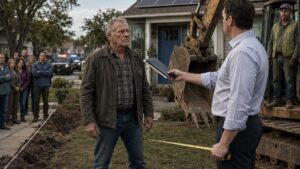
The gravel strip ran along the eastern side of the clubhouse, sixty feet of packed stone that looked like nothing worth arguing about. One end touched the road. The other narrowed beside my backyard fence. Near the center stood an old wooden survey stake, gray from years of rain, driven into the soil before half the newer houses had been built.
Most people never noticed it.
I did.
I walked toward the volunteer.
He saw me coming and lowered his hand before he could direct the next car.
“That section isn’t HOA parking,” I said.
He glanced at the gravel behind him.
“I was told we could use overflow.”
“Not there.”
He looked toward the clubhouse as if someone inside might rescue him from the conversation.
“We’ve always parked there.”
That sentence had become more irritating than the cars.
I pointed at the white sign mounted beside the entrance to the strip. “That went up three weeks ago.”
He read it. Or pretended to.
A minivan was waiting behind us.
The volunteer gave me an apologetic shrug. “You’ll have to talk to Deborah.”
Then he stepped around me and waved the minivan forward.
I moved out of its path.
Arguing in front of traffic would have made me look exactly like what some of the neighbors had already decided I was: an older man with too much time, angry because children and families were enjoying themselves.
So I took out my phone instead.
Photograph one: the minivan entering.
Photograph two: the sign in the same frame.
Photograph three: the license plate.
By 6:37, there were ten vehicles.
At 6:51, twelve.
At 7:03, I counted fourteen.
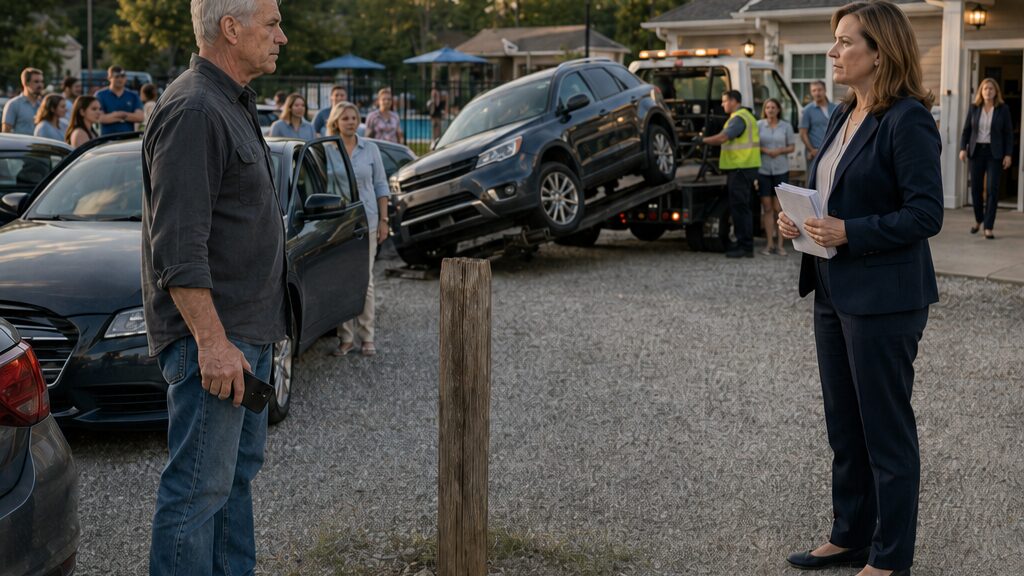
Two rows had formed on the gravel. SUVs, sedans, a pickup, a crossover with a child’s bicycle rack on the back. The wooden boundary stake was almost invisible between the tires of a dark blue SUV and the bumper of a white sedan.
I stood there longer than I should have, staring at that small piece of wood.
A resident carrying a cooler passed me.
“Big turnout,” he said cheerfully.
“For somebody.”
He either missed the point or chose not to hear it.
Deborah Mitchell finally came outside at 7:20.
She moved with the brisk purpose she brought to board meetings, one hand holding her phone, the other smoothing the front of a light summer jacket. Deborah had been HOA president for almost three years. She was not foolish, and she was not usually rude. That made our arguments harder rather than easier.
“Andrew,” she said. “I heard there’s a problem.”
“You heard correctly.”
She looked toward the gravel.
“Those cars?”
“Those cars.”
She exhaled through her nose. “We’re over capacity tonight.”
“That doesn’t change where my property line is.”
“We’ve used that strip for years.”
“There it is again.”
“What?”
“Used it. That’s not the same as owning it.”
Her expression tightened.
Behind her, someone opened the clubhouse door and music spilled outside for a few seconds before the door closed again.
Deborah lowered her voice.
“People genuinely believe that’s association overflow.”
“Then the association has been letting them believe something that isn’t true.”
“We have old site drawings, Andrew.”
“I have a deed.”
“I’m not trying to fight with you.”
“Then stop sending cars onto my land.”
She looked past me toward the wooden stake.
“For tonight, can we just get through the event?”
I almost said yes.
That was the old reflex. Avoid the scene. Handle it tomorrow. Let one night pass because making fourteen families move their cars would turn a property dispute into a neighborhood spectacle.
Then I looked at the sign.
Cars had parked on both sides of it.
“No,” I said.
Deborah studied me for a moment. “What do you want me to do?”
“Tell them they need to move.”
“All fourteen?”
“All fourteen.”
Her mouth hardened.
“I’m not clearing half the event parking in the middle of dinner based on a disagreement over a strip everyone has treated as shared for years.”
“It isn’t shared.”
“That’s your interpretation.”
“No. It’s the county’s.”
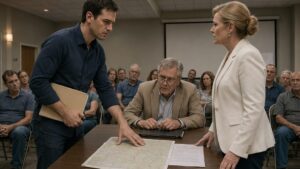
I went inside my house and returned with the folder I had already started keeping on the matter.
The first page was a copy of the parcel map.
I held it out.
Deborah did not take it.
So I opened it myself and pointed to the narrow rectangular parcel beside the clubhouse tract. Separate parcel number. Separate tax assessment. Separate boundary.
“My name,” I said. “My tax bill. My gravel.”
Deborah finally looked down.
For a second, something changed in her face.
Not surrender.
Recognition.
Then she looked back toward the clubhouse.
“I’ll review it with the property manager.”
“You can review it tonight.”
“I said I’ll review it.”
“And the cars?”
“They’ve been parking there for years, Andrew.”
She turned before I answered.
That sentence followed me back to my house.
For years.
I put the folder on the kitchen counter and watched through the window as families came and went. The first car left at eight-thirty. The last one pulled off my gravel a little after ten.
No one knocked.
No one apologized.
The next morning I went outside before breakfast.
The gravel was empty.
Crushed stone had been pushed into shallow ridges where tires had turned. A paper napkin lay against the fence. Near the road, fresh tracks crossed the narrow patch where one of my two warning signs had stood.
The metal post was still there.
The sign was gone.
Chapter 2: The Sign Vanished, So Andrew Started Keeping Records
Two tire tracks ran directly across the bare patch beneath the empty signpost.
I crouched beside them and touched the disturbed gravel.
The sign had not fallen.
The bolts were gone.
Someone had removed it.
I photographed the post before I touched anything else. Then the tire marks. Then the remaining sign farther down the strip. I took a wider photograph showing the clubhouse in the background and the old wooden boundary stake in the foreground.
Years working municipal maintenance had taught me something simple: if a disagreement might become official, memory was useless compared with dates.
By nine that morning I had created a folder on my computer.
I named it after the parcel number.
Inside went every photograph, every email, and every date I could reconstruct.
The first complaint I had made to the HOA.
The response saying the property manager would “look into parking patterns.”
The second complaint.
The photograph of six cars.
Then nine.
Then fourteen.
I printed the important pieces and added them to the paper folder on my kitchen counter.
The folder was already thicker than the dispute deserved.
On Monday I drove to the county records office.
The clerk pulled up the subdivision maps, then the later parcel records. She enlarged the section containing my property and the HOA common parcel.
“There,” she said, tapping the screen.
A clean boundary line ran between them.
The gravel strip was mine.
The clubhouse parcel stopped several feet short of it.
I asked whether there was any recorded easement granting the HOA parking or access.
She searched again.
“Nothing under this parcel.”
“You’re sure?”
“I can tell you what’s recorded. If there’s some private agreement that was never recorded, that’s different.”
That qualification stayed with me.
I bought certified copies anyway.
On the drive home, I should have felt finished with the question.
Instead, I kept thinking about Deborah’s phrase.
For years.
That afternoon I reset the remaining warning sign and installed a replacement for the missing one.
I put the new sign beside the wooden boundary stake rather than near the road.
Anyone parking there would have to pass within a few feet of it.
Then I mounted a weatherproof camera on my fence corner.
The second went beneath the eave of my garage, angled toward the entrance of the gravel strip.
I tested both from my phone.
The image showed the road clearly enough to capture vehicles entering and leaving. The timestamp appeared in the corner.
I did not feel triumphant.
I felt ridiculous.
A retired man installing cameras because neighbors could not leave sixty feet of gravel alone.
At four-thirty, my phone chimed.
Deborah had emailed.
The message was formal now.
The association, she wrote, disputed my “characterization of the historical use and status of the parking area.” The board possessed prior development materials showing the strip as part of general neighborhood access.
I read the sentence twice.
Then I called the property manager.
“What development materials?”
“I’d have to check what the board has.”
“You sent me a position based on documents you haven’t checked?”
“I’m relaying the board’s position.”
“That wasn’t my question.”
A pause.
“Deborah has an older site plan.”
“Recorded?”
“I don’t know.”
“Surveyed?”
“I don’t know.”
“Then what exactly does it show?”
Another pause.
“I think you should direct those questions to the board.”
So I did.
Deborah sent me a scanned copy that evening.
I printed it and spread it beside the county map.
The difference was obvious.
The county record showed separate parcels and precise boundary lines.
The HOA drawing was older and simpler. The clubhouse, pool, road, and open areas were sketched as part of a general site concept. The gravel strip appeared shaded similarly to the common parking area.
There were no parcel numbers on that portion.
No ownership notation.
But if you were a resident who had seen that map pinned in the clubhouse for years, you could easily assume the gravel belonged to the association.
I leaned back from the table.
For the first time, the problem became more complicated than people ignoring a sign.
Someone had given them a reason to believe they were allowed there.
I called a towing company the next morning.
The dispatcher did not promise anything.
She asked for the address, ownership documentation, photographs of signage, and whether there was a dispute over the parcel.
“There’s a dispute because the HOA says they’ve used it for years.”
“Use isn’t the only question,” she said. “We need clear authorization and compliant notice before we touch anything.”
That answer reassured me more than immediate agreement would have.
I sent the requested documents.
Two hours later she called back.
“If your signage stays posted and the parcel information matches what you provided, we can establish a private-property authorization. But if the association obtains an injunction or gives us evidence of a legal access right, we stop until it’s resolved.”
“Fair.”
“You also need to understand something.”
“What?”
“The first tow changes the dispute. Before that, people think you’re complaining. After that, they know you’re enforcing.”
I looked out the kitchen window at the empty gravel.
“That’s the idea.”
But after we hung up, I kept staring at the HOA site plan.
That afternoon, Sandra Hill walked over.
Sandra had served as treasurer longer than Deborah had been president. She and my wife had once organized neighborhood food drives together. Since my wife’s death, Sandra had been kind in the careful way people become kind when they do not know whether mentioning someone will help or hurt.
She stopped beside the wooden stake.
“I saw the new sign.”
“The old one disappeared.”
“I heard.”
“You know who took it?”
“No.”
She sounded genuine.
Then she looked toward the clubhouse.
“Andrew, this is getting bad.”
“It was bad before I put up the sign.”
“You know what I mean.”
I folded my arms.
She hesitated.
“There are people saying you’re trying to take back HOA property.”
“Then those people are wrong.”
“I know what the deed says.”
That caught me.
“You’ve seen it?”
“Deborah showed the board.”
“And?”
“And I think the board needs to be more careful than it’s being.”
It was the first time anyone connected to the HOA had said that.
But Sandra did not leave.
Instead, she looked down at the weathered stake.
“When was the last time you looked through the old summer-event files?”
“I haven’t.”
“You might want to.”
“Why?”
She raised her eyes to mine.
“Do you remember what your wife promised the neighborhood about this strip?”
Chapter 3: Fourteen Cars Arrived Before the First Tow Truck Did
The fourteenth vehicle was a silver crossover.
At 7:06 Friday evening, it rolled past both warning signs while an HOA volunteer pointed the driver toward the last open space on my gravel.
I stood inside my garage with my phone in my hand and watched it happen on the camera feed.
Fourteen.
Exactly the same number as the week before.
The difference was that this time every one of them had entered after the association received my certified parcel record, my written notice, photographs of the signs, and the towing-company information.
Deborah had not answered my last email.
Sandra had not explained her question about my wife.
I had spent six days avoiding the box of old HOA papers in the top shelf of my closet.
That was my mistake, though I was not ready to call it that yet.
At 7:12 I walked outside.
The clubhouse lawn was crowded with folding chairs. Children moved between the pool gate and pavilion. Someone had set up a portable speaker near the back patio.
The volunteer at the gravel entrance recognized me.
His arm dropped.
“Andrew.”
“Were you told not to direct cars onto this parcel?”
He shifted his weight.
“We were told there was still a dispute.”
“That wasn’t my question.”
His eyes flicked toward the clubhouse.
“Deborah said not to get into arguments with anybody.”
“So you’re directing them here.”
“We needed overflow.”
I nodded.
Then I photographed the silver crossover.
He watched me photograph the next plate.
“You’re really doing this?”
“I’m documenting vehicles on my property.”
“That’s going to make people angry.”
“They were given notice.”
A woman returning toward the clubhouse stopped when she heard us.
“Is there a problem with parking?”
The volunteer answered before I could.
“Mr. King says this is private.”
She looked around at the two rows of cars.
“I’ve parked here for eight years.”
There it was again.
Years.
I said, “That doesn’t make it yours.”
Her expression changed.
“I didn’t say it did.”
“No. But you parked beside two signs saying not to.”
She glanced toward the nearest one, and for the first time seemed to notice it.
“HOA told us to park here.”
“I know.”
That surprised her.
I walked away before the conversation could become the point.
At 7:28, I had photographs of all fourteen license plates.
At 7:31, I checked the camera archive to confirm entry times.
At 7:36, I opened the towing authorization form on my phone.
My thumb hovered over the submission button.
The dispatcher’s warning came back to me.
The first tow changes the dispute.
Through the clubhouse windows I could see Deborah moving between tables.
I could have walked inside.
I could have asked one more time.
That was how the last month had gone: one more request, one more email, one more chance for everyone to treat the boundary as optional.
I submitted the authorization.
The confirmation arrived at 7:38.
For seventeen minutes, nothing happened.
I watered a row of shrubs beside my driveway because I needed something ordinary to do with my hands.
At 7:55, a tow truck turned onto the street.
The engine sound changed the atmosphere before anyone understood why.
The truck slowed beside my gravel.
The driver got out, checked the plate number on his device, then approached the first vehicle.
A man carrying a paper plate of food stopped on the clubhouse sidewalk.
“What’s he doing?”
Nobody answered.
The driver positioned the truck behind a dark SUV near the entrance.
The hydraulic equipment lowered.
Metal clanked against pavement.
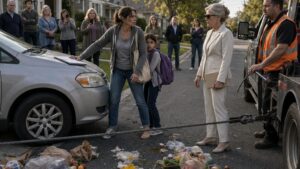
People began coming out of the clubhouse.
I stayed beside my fence.
Deborah appeared at the door just as the SUV’s front wheels lifted.
She froze.
Then she came toward me.
“Andrew.”
I could hear the difference in her voice.
This was no longer a disagreement scheduled for the next board meeting.
“Stop the tow.”
“I’m not operating the truck.”
“You authorized it.”
“Yes.”
A small group had gathered behind her.
The SUV owner pushed through them.
“That’s my car.”
The tow driver looked at him. “You’ll need to speak with the property owner and dispatch.”
The man turned toward me.
“Why are you towing my car?”
“Because it’s parked on private property after notice.”
“The HOA guy told me to park here.”
“I know.”
His anger shifted instantly toward Deborah.
“You told us this was overflow.”
Deborah raised both hands.
“Everyone stay calm.”
No one was shouting yet, but the humiliation in the situation had begun doing more work than shouting could.
The driver had trusted the HOA.
The volunteer had trusted Deborah.
Deborah had trusted—or chosen to rely on—years of habit.
And I had decided habit was no longer enough.
The SUV owner retrieved his keys and argued with the tow driver. After a call to dispatch and payment arrangements I could not hear, the vehicle was lowered.
But the message had already landed.
A second tow authorization was pending.
Then another.
People began moving toward their vehicles.
Doors slammed.
Engines started.
The gravel lot that had taken an hour to fill began emptying in minutes.
I should have felt satisfaction.
Part of me did.
For weeks, I had been treated as though ownership were an eccentric personal opinion. Now people were finally looking at the signs, the boundary, the gravel.
They were seeing it.
Then Deborah stepped closer and held her phone toward me.
“You think this settles it?”
“It settles tonight.”
“No. It escalates tonight.”
“Your volunteers were told.”
“Our residents were told they could park here.”
“By you.”
“Because the association has used this area for years.”
“Using it doesn’t create ownership.”
“I didn’t say ownership.”
That stopped me.
The last of the nearby residents were moving their cars. Headlights swept across the wooden boundary stake.
Deborah lowered her voice.
“We have counsel reviewing historical use.”
“Good.”
“We also have records.”
“So do I.”
“Not just maps.”
I looked at her.
Behind us, the tow truck pulled away without a vehicle, its lights reflecting briefly across the clubhouse windows.
Deborah continued.
“You keep presenting this like the HOA woke up one morning and decided to steal sixty feet of gravel from you.”
“That’s what it feels like.”
“That isn’t how it started.”
I thought of Sandra standing beside the stake.
Do you remember what your wife promised the neighborhood?
Deborah watched my face carefully.
She saw something.
“You do remember.”
I said nothing.
Her expression changed from anger to certainty.
“The board has summer-event records from before I was president. Your family authorized parking on that strip.”
“My family?”
“Your wife.”
The noise from the event seemed to recede.
Deborah turned her phone around.
On the screen was a photograph of an old sheet of paper. I could not read every line from where I stood, but I recognized the handwriting at the bottom before I recognized any words.
My wife’s initials.
Deborah looked at me.
“You knew there was more to this than a property line, Andrew.”
I stared at the screen.
For the first time since the argument began, I was not sure the neighborhood was the only side that had been leaving something out.
Chapter 4: The Permission His Wife Gave Was Not What Anyone Remembered
Sandra placed three yellowed sheets on my kitchen table and kept her hand on the top one.
My wife’s initials were in the lower corner.
I recognized the shape immediately—the long first stroke, the smaller second letter tucked beneath it. She had written her initials that way on grocery lists, school forms, birthday cards, everything.
For a moment, the dispute stopped being about gravel.
“Where did you get these?” I asked.
“Old event files. They were boxed in the records room.”
Sandra slid the first page toward me.
It was a planning sheet for a neighborhood food drive from years earlier. Most of the handwriting belonged to someone else. Beside a note about volunteer parking, someone had written that the King property could be used “with permission.”
My wife’s initials were beside it.
The second page was from a summer fundraiser.
Again, there was a note about parking.
Again, her initials.
The third was from a pool event.
Same thing.
Sandra watched me read.
“You knew she let people park there.”
I kept my eyes on the paper.
“Yes.”
The word came out quieter than I intended.
Sandra leaned back.
“So Deborah wasn’t wrong about everything.”
“No.”
That admission tasted worse than I expected.
For weeks, I had spoken as if the history were simple: my land, their cars, no permission.
That was true now.
It had not always been true.
I remembered my wife standing beside the old boundary stake one Saturday morning while neighbors carried folding tables toward the clubhouse.
A woman had asked if volunteers could park on our gravel for the afternoon.
My wife had looked at me.
“It keeps them out of the street,” she had said.
I had shrugged. “Fine with me.”
But that had been different.
At least that was what I told myself.
Sandra tapped the first sheet.
“Read the whole line.”
I did.
The note did not say permanent overflow.
It did not say unrestricted use.
It said parking could be used for that event, with homeowner permission.
The second page was even clearer.
“Ask King residence before opening side gravel.”
I looked up.
Sandra nodded.
“That’s what I remembered.”
“Then why is everyone acting like this became HOA property?”
“Because people forget the asking part.”
She said it without accusation.
That made it worse.
We spent the next hour going through the old records.
There were six events across several years where my wife had allowed parking.
Not every event.
Not every weekend.
And in the earliest notes, somebody had recorded a phone call or a door knock before each one.
Then the wording changed.
“King gravel available.”
Later:
“Overflow on east side.”
Later still, there was no note at all. The strip simply appeared on setup diagrams as if it had always belonged to the association.
Generosity had turned into routine one small omission at a time.
I rubbed my thumb over the edge of the oldest page.
“She never gave them permanent permission.”
“No.”
“She never signed an easement.”
“No.”
“She never said they could use it whenever they wanted.”
“No.”
Sandra hesitated.
“But you knew the history.”
I closed the folder.
“There’s a difference between knowing she helped them and knowing the HOA would use that against me.”
“You also never told Deborah.”
“I shouldn’t have had to.”
“That’s not the same as saying it wouldn’t have mattered.”
I looked at her.
Sandra folded her hands.
“Andrew, some people think you woke up after years of saying nothing and suddenly decided everybody was trespassing.”
“I put up signs.”
“Now.”
I pushed back from the table.
“You think this is my fault?”
“No.”
“Sounds like it.”
“I think you’re right about the property.”
“That should be enough.”
“For a deed? Yes. For the neighborhood? Apparently not.”
I hated that answer because I understood it.
Later that afternoon, Deborah, Sandra, the property manager, and I met in the HOA records room with counsel attending by speakerphone.
The room smelled faintly of paper and chlorine from the pool corridor.
Deborah had the old site plan open on the table.
I set the certified county map beside it.
The difference looked even more obvious side by side.
Counsel spoke carefully.
“The county records support Mr. King’s ownership.”
Deborah’s jaw tightened.
“But historical use can matter,” counsel continued.
I looked toward the speaker.
“In what way?”
“It depends on facts. Permission, duration, notice, state law, reliance. I’m not telling either side they have a guaranteed outcome.”
“Do they have an easement?”
“I have seen no recorded easement.”
“So they don’t.”
“I said I’ve seen no recorded easement.”
Deborah folded her arms. “But residents used it for years.”
“With permission at least some of the time,” Sandra said.
Deborah looked at her.
“That supports our position.”
Sandra shook her head.
“Not the way you’re saying.”
She opened the event records.
One by one, she pointed to the wording.
Ask first.
Permission.
Specific dates.
Volunteer parking.
Deborah became quieter as the pattern emerged.
Counsel asked for copies.
Then came the sentence none of us wanted.
“If this turns into litigation, historical use gives both sides arguments to make. It also gives both sides legal bills.”
The property manager stared at the table.
I said, “I’m not suing anyone.”
Deborah answered, “You’re towing residents.”
“After notice.”
“And if a resident sues the association?”
“That’s your problem.”
The words landed harder than I meant them to.
Sandra looked at me.
I knew immediately what she was thinking.
There it was again—my pride turning every opening into another wall.
I gathered my papers.
“I’m done for today.”
Outside, I stopped beside the boundary stake.
For the first time, I could picture my wife there more clearly than the cars.
She had never guarded that strip.
She had lent it.
That difference should have strengthened my position.
Instead, I felt ashamed that I had hidden the first half of the truth because I was afraid people would use it to erase the second.
Sandra came outside behind me.
“There’s something else.”
I turned.
She held the oldest event sheet against her chest.
“I told Deborah about these records months ago.”
My anger returned, but differently.
“When?”
“Before your first sign went up.”
“And what did you tell her?”
“That the permission looked limited. I told her we needed counsel before we kept treating the strip as HOA parking.”
I stared at the clubhouse doors.
“She knew?”
Sandra nodded.
“She knew there was a problem with the old permission.”
“Then why did she keep sending cars there?”
Sandra looked toward the empty gravel.
“That,” she said, “you need to ask Deborah.”
Chapter 5: Deborah Was Protecting the HOA From a Problem She Helped Hide
Deborah began the closed board meeting with the sentence she had avoided for weeks.
“We do not have a recorded easement.”
No one moved.
The conference table was crowded with copies of the county map, the old HOA site plan, event records, towing correspondence, and a photograph I had taken of the wooden boundary stake between two parked SUVs.
Deborah kept her hands flat on the table.
“That does not mean the association has no argument,” she continued. “It means we should stop pretending the argument is simpler than it is.”
A resident seated near the far end immediately objected.
“People have parked there for years.”
I almost laughed.
Instead, I looked at Deborah.
She did not use the phrase back.
Counsel had already explained the risk. Historical use might create arguments, but the old records repeatedly showed permission, not ownership. Nothing promised permanent access. Nothing said the association could direct cars there after I revoked consent.
The practical problem was uglier.
The clubhouse had thirty-eight marked spaces.
Summer events regularly brought fifty or sixty vehicles.
For years, the difference had disappeared onto my gravel.
Deborah finally said what she had refused to admit publicly.
“If we shut down overflow without another plan, we either reduce attendance, cancel larger events, or spend money we have not budgeted.”
The room shifted.
There it was.
Not property law.
Money.
Another resident asked, “What kind of money?”
The property manager named rough figures for leasing nearby overflow, modifying common property, or arranging event parking elsewhere.
No one liked any of them.
Deborah looked at me.
“When I became president, the strip was already being used.”
“And when Sandra warned you?”
Her eyes tightened.
“I thought the association had a defensible historical-use position.”
“That isn’t what I asked.”
She glanced around the table, suddenly aware that this answer mattered to more than me.
“I knew counsel had concerns.”
“How long?”
“A few months.”
The resident at the far end leaned back.
“You knew?”
Deborah’s voice sharpened.
“I knew there was uncertainty. I also knew what would happen if I told every homeowner we had spent years relying on parking we might not control.”
Silence.
She continued more quietly.
“People would ask why the board never fixed it.”
That was the first honest thing she had said to me about her motive.
Not entitlement.
Fear.
Fear of assessments.
Fear of canceled events.
Fear of admitting that something convenient had been allowed to become infrastructure without anybody formally securing it.
“You thought if you kept using it,” I said, “the problem would stay invisible.”
“I thought we had time to resolve it.”
“You directed cars there after I gave you the deed.”
“I told volunteers the area was disputed.”
“You let them park there.”
“Yes.”
The answer came without excuse.
That mattered.
It did not erase anything.
But it mattered.
Sandra opened another old file.
“There’s one more record we need to talk about.”
Deborah looked at her.
Sandra slid a handwritten board note across the table.
It was from years earlier.
My wife’s name appeared in the middle.
Sandra read the relevant line aloud.
“She asked the board to develop permanent overflow because she did not want the side gravel to become the default.”
I reached for the page.
The wording was simple.
No dramatic declaration.
No legal language.
Just a practical concern: occasional event parking was fine when arranged, but the association needed a long-term solution.
I read it twice.
For weeks I had been defending my wife’s boundary as if I were opposing her generosity.
She had already drawn the same distinction herself.
Help was not ownership.
Permission was not entitlement.
Deborah watched me.
“I hadn’t seen that note until this week.”
I believed her.
Sandra said, “But you knew enough to stop.”
Deborah nodded.
“Yes.”
The room stayed quiet.
Several residents still wanted the board to challenge me. One argued that giving up the gravel would hurt property values. Another said towing had humiliated families who had simply followed HOA directions.
That part landed.
They were right about the families.
I had known the volunteers were directing them.
I had towed anyway.
“I’ll reimburse no tow fees personally,” I said, “but I won’t object if the association chooses to reimburse residents it misdirected.”
Deborah looked surprised.
A resident asked, “So you admit the towing was wrong?”
“No. I admit the drivers were put in the middle.”
That distinction changed the room.
Until then, everyone had been trying to assign one guilty side.
There were too many smaller failures for that.
Deborah leaned toward me.
“What do you actually want, Andrew?”
“My property left alone.”
“We need more than that. We need something operational.”
“That’s your job.”
“It is.”
She took a breath.
“What if we restore temporary event parking while we develop another option? Just through the summer. Formal permission. Scheduled dates. No claim of permanent rights.”
For a moment, the offer sounded reasonable.
Then I looked at the photograph of the boundary stake surrounded by cars.
One more summer.
One more temporary arrangement.
One more excuse to postpone solving the problem that had already been postponed for years.
“No.”
Deborah’s expression hardened.
“Andrew—”
“No more informal parking.”
“I said formal.”
“Temporary arrangements are how this became permanent in everybody’s memory.”
She sat back.
“So you’d rather shut it down completely.”
“I’d rather make the boundary clear enough that nobody has to argue about what somebody meant ten years from now.”
A few residents muttered.
I closed my folder.
“My wife was generous. That doesn’t obligate me to repeat every favor forever.”
Sandra watched me carefully.
I looked at Deborah.
“If you want a solution, bring me one that doesn’t depend on pretending my land is your parking lot.”
For the first time, Deborah did not argue.
Chapter 6: Andrew Finally Explained Why the Boundary Mattered to Him
“I left something out.”
The mediation room went still.
Deborah sat across from me with counsel beside her. Sandra was two chairs down. The property manager had a draft agreement open in front of him.
I had brought the deed.
I had brought the county map.
But the first thing I placed on the table was neither.
It was an old photograph.
My wife stood beside the wooden boundary stake, one hand resting on the top of it while several folding tables were being carried toward the clubhouse behind her.
Sandra recognized the picture first.
“That was the food drive.”
I nodded.
Then I looked at Deborah.
“When this started, I told everybody the same thing. My property. My deed. My taxes. My gravel.”
“All true,” Deborah said.
“Not all of the truth.”
No one interrupted.
“My wife let people park there.”
Deborah’s expression changed slightly.
“I knew that,” I said. “Not every weekend. Not whenever the clubhouse filled up. But I knew she had said yes before.”
I looked down at the photograph.
“I didn’t tell you because I knew what would happen. The minute I admitted she once gave permission, somebody would say I was taking something away that she had given.”
Sandra lowered her eyes.
I continued.
“And maybe I was afraid of something worse.”
My throat tightened, but I kept going.
“For years, people around here remembered her as the one who said yes. Yes to the food drive. Yes to borrowing tables. Yes to somebody parking on the gravel for an afternoon. After she died, that generosity became one of the things people still mentioned to me.”
The room had lost its legal feeling.
That made speaking harder.
“I thought if I said no, people would hear that as me undoing her.”
Deborah did not look away.
“So I hid behind the deed,” I said. “Because a deed doesn’t require explaining yourself.”
Sandra spoke quietly.
“She also wanted the board to solve the parking.”
“I know that now.”
“You knew some of it then.”
“Yes.”
That was the part I had to own.
“I knew enough that I should have explained the difference instead of pretending the history didn’t exist.”
Counsel leaned forward.
“And what do you want the agreement to say?”
I opened my folder.
This time, the documents felt different.
Not ammunition.
Tools.
“No permanent parking rights. No overflow designation. No association signs, maps, or instructions suggesting the gravel is common property.”
The property manager typed.
“For events,” I continued, “the HOA uses whatever alternate arrangement it establishes. If you need temporary loading access on the edge of the strip while you transition, I’ll allow that for sixty days.”
Deborah looked at me.
“Loading only?”
“Loading. Drop-offs. No unattended vehicles.”
“And after sixty days?”
“It ends.”
“What about residents with mobility issues?”
“Use the clubhouse drop-off zone. If you need to improve it, improve it.”
The property manager made another note.
I added, “The HOA reimburses damage to the gravel shoulder from repeated turning and replaces the missing sign.”
Deborah almost smiled at that.
“You’re still on the sign.”
“Someone unbolted it.”
Sandra said, “Fair.”
Counsel asked about tow-related costs.
I looked at Deborah.
“The association directed residents onto disputed property after notice. If the board wants to reimburse people who incurred fees because they followed that direction, I won’t oppose it.”
Deborah studied me.
“You could demand more.”
“I could demand a lot of things.”
“Why aren’t you?”
Because I was tired.
Because winning every point would not bring my wife back.
Because I had spent weeks defending sixty feet of gravel as though the land were the only thing I feared losing.
I looked again at the photograph.
“She gave people room when they asked,” I said. “I can live with that memory without turning it into an easement.”
Sandra’s eyes shone, but she did not speak.
Deborah looked down at the draft.
“I should tell you something too.”
Counsel shifted slightly, but Deborah continued.
“I knew the legal claim was weak before the towing night.”
“I know.”
“Sandra told you?”
“Yes.”
Deborah nodded.
“I kept thinking I could solve the parking first and deal with ownership later.”
“Because?”
“Because every option costs money. And every time we raise assessments, people tell us the board is incompetent. Every time we reduce an event, they tell us we’re destroying the community. I thought if the parking continued another month, nobody would notice the underlying problem.”
“Until I made them notice.”
“Yes.”
She looked at the photograph.
“I also used your wife’s old permission as cover longer than I should have.”
That was not an apology.
Not exactly.
It was better than the versions we had been trading before.
Counsel reviewed the final terms.
No recorded or implied HOA parking right acknowledged by either party.
No future use without Andrew’s written permission.
Temporary loading access for sixty days.
Association reimbursement for documented surface damage.
A legitimate alternate overflow plan to be implemented before the next large event.
Updated internal maps and volunteer instructions.
The property manager turned the document toward Deborah.
Several residents had submitted objections in writing. Some wanted the board to litigate. Others wanted me fined for “interference with community operations,” though no one had identified a covenant I had violated.
Deborah read every page.
Then she looked at me.
“If I sign this, there will be people who say I gave away parking.”
“You can’t give away what the HOA never owned.”
“I know.”
That was the first time she said it without qualification.
She picked up the pen.
Sandra watched her.
So did I.
Deborah signed first.
Then she slid the agreement across the table.
I signed beneath her.
Nothing dramatic happened.
No applause.
No relief big enough to fill the room.
Just two signatures and a practical line where years of assumption finally stopped.
As we stood to leave, Deborah paused beside me.
“The next summer gathering is in three weeks.”
“I know.”
“We’ll have the alternate lot by then.”
“You’re sure?”
“No.”
She gave a tired half-smile.
“But this time, if it isn’t ready, we’ll reduce attendance.”
That answer told me more than another page of legal language could have.
Outside, I stopped beside the boundary stake.
The gravel was empty.
Sandra came through the clubhouse door and stood beside me.
“You know,” she said, “your wife would probably have hated all these meetings.”
I laughed before I could stop myself.
“She hated meetings.”
“She liked solving things.”
“That she did.”
Sandra touched the top of the old stake.
“You going to replace this?”
I looked at the cracked wood, gray and worn from years outside.
“No.”
“Why not?”
“Everybody knows where it is now.”
For once, that felt like enough.
Chapter 7: The Gravel Stayed Empty, but the Boundary Meant Something Different
The first car arrived at 5:41 and slowed beside my gravel.
For half a second, I thought the agreement had lasted exactly three weeks.
The driver turned his wheel toward the strip, saw the new directional marker near the clubhouse entrance, corrected, and continued down the street toward the overflow lot the HOA had leased behind a neighborhood church.
I stayed on my porch.
The gravel remained empty.
By six o’clock, cars were arriving steadily for the summer gathering. The clubhouse lot filled first. Then the spaces along the permitted side of the street. After that, drivers followed the temporary parking markers toward the alternate lot.
No volunteers waved anyone toward my property.
No tires crossed the edge.
The old wooden boundary stake stood exactly where it had always stood, gray and slightly crooked, with nothing parked close enough to hide it.
For the first time all summer, the gravel looked larger than sixty feet.
The HOA had done more in three weeks than I expected.
The property manager had sent residents a revised event-parking notice. The outdated clubhouse diagram had been removed. Volunteers received written instructions. The association paid to repair the rutted shoulder where repeated turning had pushed gravel into the grass.
They replaced my missing sign too.
I had almost told them not to bother.
Then I decided that was exactly the sort of small compromise that had caused the confusion in the first place.
So the sign stayed.
At 6:20, Sandra walked across the lawn carrying a foil-covered tray.
She stopped when she saw me.
“You’re monitoring us?”
“I’m sitting on my porch.”
“You’ve been sitting in the same chair for forty minutes.”
“I like the chair.”
She looked toward the empty gravel.
“Very scenic.”
I smiled despite myself.
“How’s the new parking?”
“People are complaining.”
“Good.”
Sandra laughed.
“They have to walk six minutes.”
“Tragic.”
“Someone suggested golf carts.”
“Of course they did.”
She shifted the tray to her other hand.
“The board approved a study for permanent overflow.”
“That sounds expensive.”
“It probably will be.”
“And yet somehow cheaper than pretending my land is free.”
She gave me a look.
“You’re getting difficult again.”
“I never stopped.”
Sandra started toward the clubhouse, then turned back.
“You could come over.”
“I can hear it fine from here.”
“That wasn’t what I said.”
Before I could answer, someone called her name from the pavilion.
She lifted the tray and kept walking.
I watched residents cross the lawn carrying coolers and serving bowls. A group of children ran past the pool fence. Folding chairs filled the shade beneath the pavilion.
The gathering looked almost exactly like the one from three weeks earlier.
Only the gravel was different.
Or maybe I was.
At 6:47, a dark SUV stopped near the clubhouse entrance.
The driver rolled down the window and pointed toward my property.
I could not hear the question from my porch, but I saw Deborah answer.
She was wearing the same orange volunteer vest that had irritated me on the first night.
She walked to the SUV and leaned toward the open window.
Then she pointed away from my gravel, toward the alternate lot.
The driver gestured toward the empty spaces beside my fence.
Deborah shook her head.
The driver tried again.
This time I heard her.
“That’s private property.”
Four words.
Nothing more.
The SUV continued down the street.
Deborah glanced toward my porch.
Our eyes met.
She did not wave.
Neither did I.
But something passed between us that had not required a deed, a camera, or a tow authorization.
She had corrected the assumption herself.
That mattered more than I expected.
A little after seven, the property manager came by carrying a clipboard.
“Shoulder repair look okay?”
I walked down to inspect it with him.
The fresh gravel had been compacted cleanly along the edge. The shallow tire cuts were gone.
“Looks fine.”
“We’ll send the final invoice record next week.”
“Keep it.”
He frowned.
“For your files.”
“I have enough files.”
That made him smile.
As he walked away, I stopped beside the boundary stake.
Up close, I could see an old crack running down one side.
Sandra had asked whether I wanted to replace it.
I had said no.
Now I understood why.
For years, I had thought of the stake as proof of separation.
My side.
Their side.
A line people should have understood without making me explain it.
But my wife had stood beside the same stake and still said yes when neighbors asked for help.
The wood had never meant isolation to her.
It meant there was a boundary—and because there was a boundary, permission actually meant something.
Without a line, generosity was just access.
With one, it became a choice.
“You planning to spend the whole evening talking to that stake?”
Deborah stood a few feet behind me.
“No.”
“Good. People are starting to wonder.”
“They already think I’m strange.”
“That part may survive the settlement.”
She stepped beside me.
For a moment we both looked toward the clubhouse.
The gathering was busy, but not crowded enough to spill into the road. The alternate lot had absorbed the extra cars. People were walking in small groups along the sidewalk.
Deborah said, “We reimbursed the residents who had actual towing charges.”
“I heard.”
“The board wasn’t unanimous.”
“I assumed.”
“Neither was the parking agreement.”
“I assumed that too.”
She folded her arms.
“There are still people who think I gave in.”
“And?”
“And three weeks ago that would have bothered me more.”
I looked at her.
She shrugged.
“The association should have solved the parking years ago. That’s true whether I enjoy saying it or not.”
I nodded.
After a moment, she added, “You could have told us about your wife sooner.”
There it was.
Not accusation exactly.
Not forgiveness either.
“Yes.”
Deborah seemed almost surprised I did not argue.
“I should have.”
“And I should have stopped directing cars there once counsel raised the issue.”
“Yes.”
“You don’t have to sound so pleased about that part.”
“I’m practicing honesty.”
She laughed once.
Then the clubhouse door opened and someone called for Deborah.
Before leaving, she said, “There’s food inside.”
“I know.”
“That was an invitation.”
“I know that too.”
She walked back across the lawn.
I stayed by the stake.
For several minutes, I watched people come and go.
Nobody entered my gravel.
Nobody tested the sign.
Nobody needed to.
The boundary had finally become ordinary again.
That should have been enough.
Three weeks earlier, it would have been everything I wanted.
But as I turned toward my house, I saw Sandra standing at the clubhouse door holding it open.
She did not call to me.
She simply waited.
Behind her, people were setting plates on tables. A chair had been left empty near the end of one row. Deborah was speaking with a resident beside the food table. The property manager was moving a cooler out of the walkway.
Nobody was applauding.
Nobody was waiting for me to make a speech.
It was just a neighborhood gathering.
I looked back once at the gravel.
The repaired surface caught the late light. My two signs stood at the entrance. Between them, the old boundary stake remained exposed and undisturbed.
I could protect what was mine without standing guard over it.
That had taken me longer to understand than any property map.
I left the stake where it was.
Then I crossed the lawn toward the clubhouse.
The story has ended.