The HOA President Ordered My Solar Panels Destroyed Over a Door Color Until Federal Agents Locked Down the Entire Neighborhood
Chapter 1: The Door That Failed Inspection
The knock hit the door so hard that the glass beside it rattled.
Thomas Miller looked up from his kitchen table.
Three more knocks followed before he could even stand.
Whoever was outside wasn’t asking to be let in. They were announcing themselves.
Thomas opened the door halfway.
A thick citation book slammed against the freshly painted wood inches from his face.
“Violation.”
Mark Davis held the book in one hand and a measuring tape in the other.
The tape dangled against his pressed shirt like a badge.
Thomas stared at him.
“Good morning to you too.”
Mark didn’t smile.
“The door color.”
Thomas glanced at it.
It was blue.
A calm, muted shade he had spent two weekends choosing.
His late wife had loved blue front doors.
He had repainted it three months after she passed.
“The color is not approved.”
“It’s blue.”
“It’s the wrong blue.”
Thomas folded his arms.
Mark opened the citation book.
“The approved palette lists Coastal Harbor Blue.”
“It is Coastal Harbor Blue.”
“No.”
Mark pointed to the door.
“That is Harbor Mist Blue.”
Thomas blinked.
“You’re joking.”
Mark pulled a laminated color sheet from the folder.
The two squares looked nearly identical.
“You see the difference?”
“No human being sees the difference.”
“The association sees the difference.”
Mark wrote something on a form.
Thomas felt a familiar heaviness settle in his chest.
Not anger.
Exhaustion.
This wasn’t the first violation.
Three years earlier they had complained about a garden bench.
Then a mailbox.
Then the height of his hedges.
Then a bird feeder.
Every time he fixed something.
Every time he paid a fine.
Every time he told himself it wasn’t worth fighting.
Mark tore off a copy and handed it over.
“You have fourteen days.”
Thomas looked at the paper.
Correction Required.
Potential Fine Schedule.
Inspection Review.
The usual language.
The usual threat.
“You came all the way over for this?”
Mark adjusted the measuring tape clipped to his belt.
“It’s my responsibility.”
“No.”
Thomas looked him directly in the eye.
“You enjoy it.”
For a moment Mark’s expression hardened.
Then it vanished.
“I’ll see you at the reinspection.”
He turned toward the sidewalk.
Then stopped.
His eyes moved upward.
Toward the roof.
Thomas noticed immediately.
The solar panels.
Eight glossy panels angled toward the sun.
Paid off after years of saving.
Installed with permits.
Completely legal.
Mark stared longer than necessary.
“What?” Thomas asked.
“Nothing.”
The answer came too quickly.
Mark made a note in the citation book.
Then he walked away.
Thomas stood in the doorway watching him leave.
The measuring tape bounced against Mark’s leg with every step.
A symbol of authority carried by a man who measured everything except reason.
The unease stayed with Thomas long after Mark disappeared.
By noon he was repainting a small section near the trim.
Not because he believed he was wrong.
Because he was tired.
The neighborhood had a way of wearing people down.
That afternoon Patricia Hernandez paused while walking her dog.
She glanced toward the ladder.
“Another violation?”
Thomas laughed without humor.
“Door color.”
Patricia winced.
“Ouch.”
“Apparently I’m a danger to civilization.”
She looked at the citation taped beside the porch.
“I heard they’re cracking down.”
“They’ve been cracking down for years.”
Patricia hesitated.
She wasn’t unfriendly.
Just careful.
Most neighbors preferred staying neutral.
Nobody wanted attention from the board.
“My brother had issues with an HOA once,” she said.
“He moved.”
Thomas climbed down the ladder.
“I’ve lived here twenty-two years.”
Patricia nodded.
Then looked at the roof.
“The panels still saving you money?”
“Every month.”
“Good.”
Her smile faded.
“Just be careful.”
“Careful of what?”
She looked toward the street.
Toward the direction Mark had gone.
“People say he’s looking for a fight.”
Thomas watched her leave.
The warning stayed with him.
That evening he sat on his porch.
The house glowed softly under sunset light.
The panels reflected gold.
The blue door looked exactly right.
His wife would have loved it.
The thought made him smile.
Then a truck rolled slowly past the house.
An HOA maintenance vehicle.
It didn’t stop.
But it slowed enough for Thomas to notice the passenger.
Mark.
Watching.
Not the door.
The roof.
The next morning an envelope appeared in his mailbox.
Official HOA correspondence.
Thomas opened it standing beside the curb.
The first page addressed the paint violation.
The second page did not.
NOTICE OF PROPERTY SYSTEM INSPECTION.
He read it twice.
Then a third time.
Inspection of rooftop energy installations.
Compliance review.
Scheduled next week.
Failure to cooperate may result in enforcement action.
Thomas stared at the page.
The solar panels were legal.
Approved.
Inspected.
Installed years ago.
Yet somehow they had become part of the conversation.
A cold feeling settled into his stomach.
Across the street, Patricia stepped outside to collect her mail.
“What happened?” she asked.
Thomas held up the notice.
Her eyes widened.
“Why would they inspect those?”
Thomas looked at the roof.
Then at the measuring tape printed beside Mark’s signature.
“I think that’s exactly what I need to find out.”
Chapter 2: The Inspection That Was Never About Paint
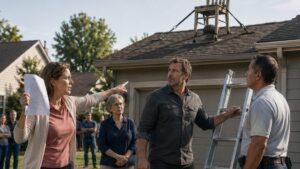
The inspection crew arrived fifteen minutes early.
Thomas saw them from the kitchen window.
A white pickup.
Two workers.
A clipboard.
And Mark Davis standing beside them with his citation book tucked under one arm.
The sight immediately told Thomas this had never been about paint.
He stepped outside before they reached the porch.
“What now?”
Mark checked his watch.
“Scheduled inspection.”
“You mean the solar panels.”
“The energy system.”
“They’ve been here six years.”
Mark shrugged.
“Policies change.”
The workers exchanged a glance.
Neither seemed excited to be there.
Thomas noticed.
One of them avoided eye contact completely.
The other looked embarrassed.
Mark, meanwhile, looked energized.
Like a man finally approaching the reason he had come.
“Let’s proceed,” he said.
The crew climbed onto the roof.
Thomas remained below.
For nearly an hour they inspected every panel.
Every mounting bracket.
Every cable.
Mark took notes constantly.
When the workers came down, one handed over a sheet.
Mark read it.
His jaw tightened.
Thomas noticed.
“Problem?”
No answer.
The worker cleared his throat.
“Everything appears functional.”
Mark continued reading.
“Proper permits?”
“Yes.”
“Installation records?”
“Yes.”
“Safety compliance?”
“Yes.”
The worker shifted uncomfortably.
“No issues.”
Thomas folded his arms.
The moment should have ended there.
Instead Mark closed the folder.
“Further review required.”
The worker looked surprised.
“Further review of what?”
Mark ignored him.
Thomas laughed.
“You couldn’t find anything.”
“This isn’t over.”
“You just inspected it.”
“The board will review the findings.”
Thomas watched the crew leave.
One worker glanced back.
The look on his face carried something close to sympathy.
That afternoon another letter arrived.
This one demanded attendance at a special board review.
Thomas nearly threw it away.
Instead he showed it to Patricia.
They stood beside the mailbox cluster while neighbors came and went.
“Special review?” Patricia said.
“For solar panels?”
“Apparently.”
“That doesn’t make sense.”
“No.”
Thomas folded the letter.
“It doesn’t.”
Patricia lowered her voice.
“I heard something.”
“What?”
She looked around.
“Last year a family challenged a violation.”
Thomas listened.
“The board backed down.”
“Okay.”
“People say Mark never got over it.”
Thomas frowned.
“Because he lost?”
“He says if residents start winning challenges, nobody respects the rules.”
Thomas stared toward the clubhouse.
The information didn’t explain everything.
But it explained enough.
This wasn’t enforcement.
This was reputation.
Authority.
A man trying to prove he still had control.
Two nights later Thomas entered the clubhouse meeting room.
Every chair was occupied.
The board sat behind a long table.
Mark in the center.
His citation book rested beside a stack of folders.
The sight annoyed Thomas more than it should have.
The meeting began with routine business.
Then his name appeared on the agenda.
Mark stood.
“The board has reviewed concerns regarding rooftop solar compliance.”
Thomas immediately spoke.
“There aren’t any concerns.”
Mark ignored him.
“The installation may negatively impact neighborhood aesthetics.”
Murmurs spread through the room.
Thomas looked around.
Several residents seemed confused.
One neighbor raised a hand.
“Those panels have been there for years.”
Mark continued.
“The board reserves authority to address visual violations.”
Thomas stood.
“So this has nothing to do with safety.”
“No.”
“Or permits.”
“No.”
“Or legality.”
Mark’s expression hardened.
“The board determines standards.”
The room grew quiet.
Thomas saw something in the faces around him.
Not agreement.
Discomfort.
People were beginning to notice.
The issue wasn’t the panels.
It was power.
Then Mark said something that changed everything.
“If necessary, removal will be ordered.”
Thomas thought he had misheard.
“Removal?”
“The board has that authority.”
A few residents gasped.
Even one board member looked startled.
Thomas stared at him.
“You want to destroy a functioning solar system because you don’t like how it looks?”
Mark never looked away.
“If compliance requires it.”
The room felt smaller.
Hotter.
Suddenly the door-color violation seemed irrelevant.
This had become something else.
Something far more dangerous.
The vote was postponed.
But as residents left, Thomas overheard a conversation near the board table.
A board member speaking quietly.
Mark answering.
“We can’t keep backing down.”
“Then don’t.”
“If we lose another challenge—”
“We won’t.”
The words followed Thomas all the way home.
The next morning a certified notice arrived.
He opened it on the porch.
His hands tightened around the paper.
ENFORCEMENT ACTION APPROVED.
Removal operations scheduled.
Equipment authorization granted.
Thomas looked toward his roof.
Then toward the quiet street.
The line had moved.
And for the first time, he realized they might actually try to do it.
Chapter 3: The Neighborhood Watches
The room erupted before Thomas even sat down.
“All in favor?”
Hands went up across the HOA meeting hall.
One after another.
Fast.
Almost automatic.
Thomas counted.
Then stopped.
It didn’t matter.
The vote was already lost.
Mark Davis stood at the front of the room, calm and composed, as if the outcome had been decided long before anyone entered.
“Motion approved.”
His gavel struck the table.
The sound echoed through the hall.
Thomas remained standing near the back wall.
“You’re approving destruction of private property.”
Mark looked up.
“We’re approving enforcement.”
“Call it whatever you want.”
Several residents looked away.
Nobody wanted attention.
Nobody wanted to become the next target.
Mark closed the folder.
“The board has spoken.”
The meeting should have ended.
Instead Thomas walked forward.
Years ago he would have stayed silent.
Years ago he would have paid the fine, repainted the door, apologized for existing, and hoped they moved on.
Not tonight.
“You keep saying enforcement.”
His voice carried through the room.
“What rule allows you to destroy solar panels that were legally installed?”
Nobody answered.
Mark adjusted the measuring tape hanging from his belt.
“The board has authority to maintain standards.”
“You keep repeating that.”
Thomas stepped closer.
“Authority isn’t the same thing as being right.”
A murmur moved through the audience.
The words landed harder than he expected.
For a brief moment uncertainty flickered across a few faces.
Then Mark opened his citation book.
“You’ve had violations before.”
The room became still.
Thomas immediately understood the strategy.
Public embarrassment.
Shift the discussion.
Make him look like the problem.
Mark began reading.
“Improper hedge height.”
A few people exchanged looks.
“Mailbox modification.”
More silence.
“Unapproved bird feeder placement.”
Someone coughed.
Thomas felt heat rise in his chest.
Not because the accusations mattered.
Because they were familiar.
The same pattern every time.
Make resistance look unreasonable.
Make compliance look inevitable.
He turned toward the audience.
“Do you know how many of those violations involved actual damage?”
Nobody answered.
“None.”
He pointed toward Mark.
“But now he wants heavy equipment brought onto private property.”
That finally got attention.
People shifted in their chairs.
Several whispered to each other.
The scale had changed.
Even those who avoided conflict could see it.
Patricia Hernandez slowly stood.
Thomas hadn’t expected that.
Neither had Mark.
She looked nervous.
Very nervous.
But she remained standing.
“I have a question.”
Mark’s smile tightened.
“Go ahead.”
Patricia looked toward the board.
“Have any independent inspectors said the panels need removal?”
Silence.
One board member glanced at another.
Another looked down at paperwork.
Mark finally answered.
“No.”
Patricia frowned.
“Then why are we doing this?”
A different board member spoke.
“The issue concerns community appearance.”
Even he sounded unconvinced.
Patricia sat down slowly.
But the damage had been done.
For the first time, doubt had entered the room.
Thomas noticed it immediately.
So did Mark.
The meeting ended minutes later.
People left in clusters.
Nobody lingered.
Nobody wanted to be seen taking sides.
Yet several neighbors nodded at Thomas on the way out.
Small gestures.
Quiet gestures.
But different from before.
Outside, under the parking lot lights, Patricia caught up with him.
“I probably shouldn’t have said anything.”
“Why?”
She laughed nervously.
“Because now he’ll remember my name.”
Thomas looked back toward the building.
Mark remained inside.
Visible through the glass doors.
Talking intensely with two board members.
“He remembers everybody’s name.”
Patricia sighed.
“My brother dealt with people like that.”
Thomas glanced at her.
“You mentioned that.”
“He challenged an HOA once.”
“What happened?”
“They fined him until he moved.”
The answer hung between them.
Neither spoke for a moment.
Then Patricia looked toward Thomas’s house in the distance.
“I thought maybe you were exaggerating.”
Thomas nodded.
Most people did.
Until they saw it themselves.
Patricia shoved her hands into her pockets.
“I don’t think that anymore.”
For some reason, that meant more than Thomas expected.
Not because it solved anything.
Because somebody finally believed him.
The next morning he woke to the sound of engines.
Heavy engines.
He stepped outside.
Three large vehicles rolled slowly down the street.
Contractor trucks.
Equipment trailers.
A high-pressure industrial paint sprayer mounted on one of them.
The dull gray nozzle pointed forward like a weapon.
Neighbors emerged onto porches.
Curtains moved.
Phones appeared.
The entire street seemed to wake at once.
Steven Garcia climbed from the lead truck.
He checked paperwork while workers unloaded equipment.
Mark arrived minutes later in a luxury sedan.
He stepped out carrying the same citation book.
The same measuring tape.
The same confidence.
Thomas walked toward the curb.
“What is this?”
Mark didn’t hesitate.
“Preparation.”
“For what?”
“Tomorrow.”
Thomas looked past him.
Workers were marking positions near the edge of his property.
Measuring.
Planning.
Treating the operation like construction.
Not enforcement.
Construction.
His stomach tightened.
This was real.
Not a threat.
Not a bluff.
Patricia appeared beside her mailbox.
Other neighbors gathered nearby.
Nobody spoke.
Everyone watched.
Steven pointed toward the roof while discussing access routes.
Another worker examined the side of the property.
Mark signed forms.
More paperwork.
More authority.
More escalation.
Thomas suddenly understood something.
The fight had moved beyond rules.
Beyond citations.
Beyond meetings.
Tomorrow, machinery would arrive.
Tomorrow, people would step across the boundary he had spent years maintaining.
And if he intended to stop them, words would not be enough.
Late that evening he stood on his porch alone.
The solar panels reflected the last traces of sunset.
The blue door glowed softly behind him.
The house felt smaller than usual.
Not weaker.
More precious.
He heard an engine outside.
A flatbed truck rolled slowly past.
Behind it sat the equipment scheduled for the morning.
The driver didn’t stop.
Didn’t wave.
Didn’t even look at him.
The machine simply passed by.
Huge.
Silent.
Inevitable.
Thomas watched until it disappeared around the corner.
Then he looked at the roof.
And for the first time since this started, he wondered whether standing his ground would actually cost him everything.
Chapter 4: One Step Past the Property Line
The hiss of the industrial paint sprayer reached Thomas before sunrise.
He stepped onto his porch and froze.
The machine sat at the curb.
Its dull gray nozzle pointed directly at his house.
Workers moved around it carrying equipment cases and coils of hose. A second vehicle waited behind it. Bright orange cones had already been placed along the edge of his lawn.
The operation looked less like an HOA enforcement action and more like a construction project.
Mark Davis stood near the street reviewing paperwork.
The measuring tape hung from his belt.
The citation book rested beneath his arm.
Thomas walked toward him.
“You brought a paint sprayer.”
“The door color must be corrected.”
“No one sprays an entire house because a door is the wrong shade.”
Mark barely looked up.
“The crew will determine the necessary work.”
Thomas glanced toward Steven Garcia.
The contractor was studying a site map with two workers.
Unlike Mark, Steven looked uncomfortable.
When he noticed Thomas watching, he quickly looked away.
More neighbors emerged onto porches.
Patricia stood across the street holding a coffee mug she clearly wasn’t drinking.
Nobody seemed willing to leave.
The entire neighborhood had become an audience.
Mark handed paperwork to Steven.
“Begin according to schedule.”
Steven nodded but didn’t move immediately.
Instead he walked toward the side of Thomas’s property.
Two workers followed.
Thomas trailed behind them.
They stopped near a narrow strip of ground beside the house.
One worker crouched.
“What’s that?”
Another pointed downward.
A faded utility marker protruded from the soil.
Steven bent closer.
His expression changed.
“There are lines running through here.”
“What kind?” one worker asked.
Steven shrugged.
“No idea.”
The marker looked old.
Partially hidden by grass.
Easy to miss.
Thomas had noticed it years ago but never thought much about it.
The workers continued examining the area.
A second marker appeared several feet away.
Then a third.
Steven straightened.
“We should verify before bringing equipment through.”
Thomas caught the concern in his voice.
For the first time all morning someone seemed interested in caution.
Mark arrived moments later.
“What is the delay?”
Steven pointed toward the markers.
“Utility lines.”
Mark barely glanced at them.
“So?”
“We should check.”
“We have approval.”
Steven hesitated.
“Still.”
Mark’s jaw tightened.
“We are not digging.”
“The equipment will cross near it.”
“The board authorized the work.”
The workers exchanged glances.
Nobody looked convinced.
Thomas stepped closer.
“Maybe you should listen to him.”
Mark ignored him completely.
Steven remained silent for several seconds.
Then he nodded reluctantly.
“Fine.”
The answer sounded forced.
The crew resumed preparations.
But Thomas noticed something.
Every worker now looked at the markers.
Nobody dismissed them.
The small detail lingered in the air like an unanswered question.
By late morning the crew had extended hoses across part of the yard.
The sprayer remained aimed toward the house.
Several workers climbed ladders to inspect access points near the roof.
Thomas stood near the porch watching every movement.
His shoulders ached from tension.
Patricia crossed the street.
“You okay?”
“No.”
“Me neither.”
They watched the crew together.
After a moment Patricia lowered her voice.
“Some people are talking.”
“About what?”
“The board.”
Thomas glanced at her.
“What are they saying?”
“That this is getting out of control.”
A small satisfaction flickered through him.
Not victory.
Recognition.
People were finally seeing what he had been dealing with for years.
Patricia looked toward Mark.
“He seems different today.”
Thomas followed her gaze.
Mark wasn’t enjoying himself.
He looked tense.
Restless.
As though backing down was no longer possible.
That realization unsettled Thomas more than anything else.
A person seeking control could stop.
A person afraid of losing control often couldn’t.
The afternoon dragged on.
No destruction occurred.
Only preparation.
Measurement.
Positioning.
Planning.
Each hour increased the pressure.
The waiting became its own weapon.
Near sunset Steven approached Thomas quietly.
Away from the others.
Away from Mark.
“Off the record?”
Thomas nodded.
Steven rubbed the back of his neck.
“I don’t like this job.”
“Then why do it?”
A humorless laugh escaped him.
“Contracts.”
He glanced toward the utility markers.
“You ever ask about those?”
“No.”
“You should.”
The statement surprised Thomas.
“What do you mean?”
Steven looked toward Mark.
Then back at the markers.
“I mean somebody should have checked them before today.”
Before Thomas could ask another question, Steven walked away.
The remark stayed with him.
That night the neighborhood finally grew quiet.
The equipment remained parked along the street.
Waiting.
Thomas stood beside the faded markers long after darkness settled.
He crouched and brushed dirt away from one.
Letters appeared beneath the grime.
Most were worn away.
Only fragments remained.
Enough to suggest importance.
Not enough to explain it.
He stared at the marker for several moments.
Then looked toward his house.
Toward the solar panels.
Toward the blue door.
The conflict had started with color.
Then expanded into property.
Now something hidden beneath the ground had entered the story.
For the first time, Thomas felt certain there was more happening here than anyone understood.
He returned to the garage.
Opened an old storage cabinet.
And pulled out a length of industrial chain he hadn’t touched in years.
Chapter 5: You’ll Have to Run Me Over First
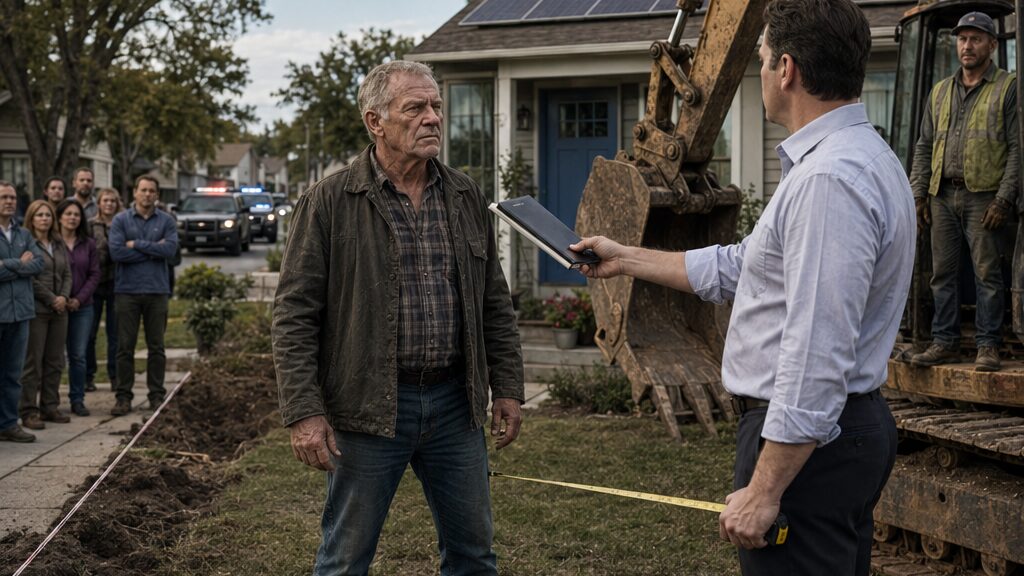
The excavator rolled onto the street at eight in the morning.
Thomas was already waiting.
Coffee untouched.
Hands shoved into his jacket pockets.
The chain rested inside the garage behind him.
Mark arrived moments later.
The measuring tape still hung from his belt.
The citation book was tucked beneath his arm.
Neither item looked ridiculous anymore.
They looked dangerous.
Because someone had decided they mattered more than common sense.
Workers unloaded equipment while neighbors gathered on sidewalks.
Patricia stood with several residents near the mailbox cluster.
Nobody hid their curiosity now.
This had become the neighborhood’s main event.
Steven Garcia climbed from the excavator.
His expression darkened when he saw Thomas standing near the property line.
“You don’t have to do this,” Steven said quietly.
Thomas looked at him.
“Neither do you.”
Steven didn’t answer.
Mark stepped forward.
“Final opportunity for compliance.”
Thomas laughed.
The sound surprised even him.
“You’ve got a machine pointed at my house.”
“You were given multiple notices.”
“You mean threats.”
“They were legal notices.”
Thomas looked toward the gathered neighbors.
Then back at Mark.
“Is that what this is now?”
Mark’s voice hardened.
“You’ve made this difficult.”
“No.”
Thomas shook his head.
“You made it impossible.”
The standoff stretched.
Neither man moved.
Finally Mark turned toward Steven.
“Proceed.”
The excavator engine rumbled.
A deep mechanical growl rolled across the street.
Workers moved toward the house.
One carried equipment toward the solar system.
Another approached the side yard.
Near the utility markers.
Steven noticed immediately.
“So did Thomas.
The worker stopped.
Looked down.
“These markers again.”
Another worker joined him.
They exchanged uneasy glances.
Steven walked over.
“What did you find?”
“Nothing.”
The worker pointed downward.
“But there’s definitely infrastructure here.”
Steven stared at the markers.
Then at Mark.
“We should stop and verify.”
Not again.
The same concern.
The same warning.
The same chance to slow down.
Mark looked irritated.
“We are not stopping.”
“Mark—”
“We’re proceeding.”
Several workers shifted uncomfortably.
Thomas saw hesitation spreading through the crew.
Not rebellion.
Doubt.
And doubt was dangerous when machinery was involved.
Steven lowered his voice.
“If something is buried here—”
“We have authorization.”
“From the HOA.”
The words landed harder than expected.
Several neighbors exchanged looks.
Mark stepped closer.
“Do your job.”
Silence followed.
Steven stared at him for a long moment.
Then looked away.
The excavator engine continued running.
The machine remained ready.
The crew remained uncertain.
And suddenly Thomas understood something.
Nobody else was going to stop this.
Not Patricia.
Not Steven.
Not the workers.
Not the neighbors.
If the line existed, nobody knew what it was.
If the equipment moved, nobody knew what would happen.
The only thing standing between the machine and his property was him.
The realization felt strangely calm.
He walked toward the garage.
Mark frowned.
“Where are you going?”
Thomas didn’t answer.
A moment later he emerged carrying the chain.
Several neighbors gasped.
Steven froze.
“What are you doing?”
Thomas kept walking.
The excavator sat motionless.
Huge steel gears exposed near the track assembly.
He wrapped the chain around one section.
Then around his own wrist.
Once.
Twice.
Three times.
Metal clinked loudly in the morning air.
Mark stared in disbelief.
“Thomas.”
Thomas ignored him.
He pulled a heavy lock from his pocket.
Clicked it shut.
The sound echoed through the silence.
Nobody moved.
Nobody spoke.
Then Thomas held up the key.
For a brief moment every eye followed it.
He looked at Mark.
At the machine.
At the workers.
At the house behind him.
Then he hurled the key into the storm drain.
The metal rattled against concrete.
Gone.
Patricia covered her mouth.
Steven cursed under his breath.
Mark’s face drained of color.
Thomas planted his feet.
The chain tightened.
And for the first time since the conflict began, he felt completely certain.
“You’ll have to run me over first.”
Silence.
Pure silence.
The excavator continued idling.
The engine vibrated beneath him.
But nobody moved.
Nobody knew what to do.
The situation had crossed into something new.
Not a violation.
Not an enforcement action.
A crisis.
Minutes passed.
Neighbors pulled out phones.
Someone called someone.
Then someone else made another call.
Workers argued quietly among themselves.
Steven repeatedly shook his head.
Mark paced.
The confidence that had carried him through months of escalation was gone.
In its place stood uncertainty.
Fear.
And something dangerously close to panic.
A worker approached Steven.
“What if he’s right?”
“About what?”
“The lines.”
Steven looked toward the markers.
Then toward the chained homeowner.
His expression tightened.
He walked away without answering.
Another fifteen minutes passed.
The crowd grew larger.
People from nearby streets began arriving.
The story was spreading.
Thomas remained exactly where he stood.
The chain dug into his wrist.
The machine vibrated constantly.
But he did not move.
Then a worker ran toward Steven holding a phone.
His face had gone pale.
“Someone responded.”
Steven grabbed the phone.
Listened.
His expression changed instantly.
“What?”
The worker nodded.
Steven looked toward the utility markers.
Then toward Mark.
Then toward the road leading into the neighborhood.
The color left his face.
In the distance, sirens began to wail.
Chapter 6: The Ground Beneath Their Feet
The sirens grew louder with every passing second.
Nobody spoke.
The crowd turned toward the neighborhood entrance.
Even Mark Davis stopped pacing.
Three black SUVs appeared first.
Then a fourth.
Then two additional government vehicles.
They entered the street fast enough to force parked cars aside.
The convoy stopped near Thomas’s property.
Doors opened immediately.
Men and women in dark jackets stepped out.
Not local police.
Not city inspectors.
Something else.
Their movements were too coordinated.
Too urgent.
One of them walked directly toward the utility markers.
Another approached Steven.
A third surveyed the property.
Within moments the entire atmosphere changed.
The HOA no longer controlled anything.
The neighborhood knew it before a single word was spoken.
Thomas remained chained to the excavator.
One of the officials stopped in front of him.
“You’re Thomas Miller?”
“Yes.”
The official glanced at the chain.
Then at the machine.
Then at Mark.
His expression hardened.
“Who authorized this operation?”
Nobody answered immediately.
Mark finally stepped forward.
“I am the HOA president.”
The official looked at him.
Not with respect.
Not with concern.
With disbelief.
“You approved excavation activity near this location?”
“We weren’t excavating.”
“The equipment crossed a protected zone.”
Mark opened his mouth.
Closed it.
The official pointed toward the utility markers.
“Did anyone verify the infrastructure designation?”
Silence.
The answer was obvious.
No.
They hadn’t.
Because they assumed they didn’t need to.
The official turned toward several agents.
“Lock down the area.”
The words rippled through the crowd.
Agents immediately began placing barriers.
Residents were moved back.
Workers stepped away from equipment.
Phones came out everywhere.
Nobody wanted to miss what happened next.
Patricia stood frozen on the sidewalk.
Her coffee mug had disappeared hours earlier.
Now she simply watched.
Like everyone else.
Trying to understand how a fight over solar panels had become this.
Thomas finally asked the question.
“What is down there?”
The official looked at him.
For a moment he seemed to consider whether he should answer.
Then he did.
“A classified military fiber-optic communications line.”
The street went silent.
Several neighbors actually laughed from shock.
They thought it was a joke.
It wasn’t.
The official continued.
“This corridor supports protected federal infrastructure.”
Mark stared at him.
“No.”
The response sounded desperate.
The official didn’t react.
“No?”
Mark pointed toward the ground.
“Nobody told us.”
“You ignored multiple utility markers.”
The words struck harder than any accusation.
Because they were true.
Thomas watched Mark search for an answer.
Any answer.
There wasn’t one.
Steven Garcia slowly lowered his head.
The contractor looked sick.
Not guilty.
Relieved.
Relieved that someone had finally confirmed his concerns.
Agents continued examining records.
Photographs were taken.
Measurements recorded.
Equipment documented.
The same kind of measurements Mark had obsessed over for years.
Only now someone else’s tape measure mattered.
The irony was impossible to miss.
One agent approached Steven.
Questions followed.
Then another agent approached a worker.
Then another.
The investigation expanded quickly.
Every conversation seemed to create three more.
Thomas noticed something strange.
Nobody was interested in him anymore.
Not because he was unimportant.
Because the center of gravity had shifted.
The HOA had become the subject.
The operation.
The decisions.
The approvals.
The escalation.
Everything Mark had built the conflict around was suddenly under scrutiny.
An agent finally approached Thomas with bolt cutters.
“We need to remove the chain.”
Thomas nodded.
The cutters snapped through the links.
For the first time in hours he stepped away from the excavator.
His wrist ached.
The skin beneath the metal was red.
But he remained standing.
Nearby, Patricia crossed the barrier.
One of the agents allowed her through after a brief conversation.
She stopped beside Thomas.
“You okay?”
“I think so.”
“You actually did it.”
Thomas laughed softly.
“I guess I did.”
Patricia looked toward the federal vehicles.
“Did you know about any of this?”
“No.”
“Neither did anyone else.”
They watched agents surround the work area.
The entire neighborhood felt different now.
Smaller.
The illusion of authority had cracked.
Mark seemed to understand it too.
His confidence had vanished completely.
An agent requested his documents.
Then another requested board records.
Then another asked for authorization paperwork.
Each question pushed him further backward.
Further away from control.
A short time later one of the officials addressed the board members who had arrived after hearing the news.
The conversation was too far away to hear.
But the reactions said enough.
Shock.
Fear.
Disbelief.
One board member sat down on a curb.
Another looked physically ill.
The consequences were beginning.
And they were larger than anyone expected.
The afternoon dragged on.
Investigators continued their work.
Equipment remained untouched.
The solar panels remained untouched.
The blue door remained untouched.
Everything the HOA had tried to alter still stood exactly where it belonged.
For the first time in months, Thomas felt something release inside him.
Not triumph.
Relief.
The fight was no longer about convincing people he was right.
Reality had done that on its own.
Then a sudden shout echoed from farther down the street.
Heads turned.
Workers were scrambling around the excavator.
Someone yelled.
Someone else waved frantically.
Steven ran toward the machine.
The excavator lurched unexpectedly.
And began rolling backward.
Chapter 7: The Cost of Crossing Boundaries
The excavator rolled backward faster than anyone expected.
A worker shouted.
Another jumped clear.
Steven Garcia sprinted toward the controls, waving his arms.
“Stop it! Stop it!”
The machine continued moving.
Not quickly.
But quickly enough.
Mark Davis turned just as the excavator’s rear track slammed into the front corner of his luxury sedan.
The sound echoed through the neighborhood.
Metal folded inward.
Glass exploded.
The hood crumpled like paper.
For a second nobody moved.
Then the excavator pushed harder.
The sedan shifted sideways.
A headlight shattered.
The front wheel collapsed.
A long scraping crunch filled the air.
Mark stared at his car in disbelief.
“NO!”
The shout tore out of him.
He ran forward.
Two agents immediately intercepted him.
“Sir, stay back.”
“That’s my car!”
The excavator finally stopped.
Silence followed.
The damaged vehicle sat crooked against the curb, destroyed by the very operation Mark had spent weeks forcing forward.
Several neighbors gasped.
Others simply stared.
No one laughed.
The moment felt too strange for that.
Steven reached the machine and shut it down completely.
He climbed down looking exhausted.
“I told them to verify everything.”
Nobody argued with him.
There was nothing left to argue.
The evidence surrounded them.
The utility markers.
The federal vehicles.
The investigation.
The ruined car.
The entire chain of consequences sat in plain view.
An agent approached Mark.
“Mr. Davis, we need you to remain available for questioning.”
Mark looked from the destroyed sedan to the investigators moving through stacks of documents.
For the first time since Thomas had met him, Mark looked small.
Not powerless.
Human.
A man watching the structure he trusted collapse around him.
Thomas expected satisfaction.
Instead he felt tired.
Very tired.
Patricia stepped beside him.
“That’s some karma.”
Thomas looked at the crushed vehicle.
“Maybe.”
She glanced at him.
“You don’t sound happy.”
He considered the question.
Across the street, workers packed equipment.
Board members stood in anxious groups.
Agents carried folders and photographs between vehicles.
Months of pressure had exploded into one chaotic afternoon.
Yet the victory felt different than he imagined.
“I didn’t want this.”
Patricia nodded.
“I know.”
And she did.
That mattered.
More than he expected.
The following week brought a steady stream of developments.
Investigators returned repeatedly.
Board records were requested.
Financial documents were reviewed.
Meeting notes were examined.
Residents who had spent years staying silent began talking.
One conversation became five.
Five became twenty.
Stories emerged.
Questionable fines.
Selective enforcement.
Threats disguised as policy.
People who had paid simply because fighting felt impossible.
Thomas heard things he had never known.
Not because he was uninformed.
Because everyone had suffered alone.
The realization bothered him.
He had believed his conflict belonged only to him.
His own private struggle.
He had been wrong.
One afternoon Patricia knocked on his door.
Not because of a violation.
Not because of a warning.
Just because she wanted to talk.
They sat on the porch.
The blue door behind them.
The solar panels gleaming above.
The same house.
The same property.
Yet everything felt different.
Patricia handed him a folder.
“What’s this?”
“Copies.”
Thomas opened it.
Statements.
Letters.
Records from other residents.
Many dated years earlier.
Some involved people who no longer lived in the neighborhood.
Others came from families he recognized.
One document caught his attention.
A complaint against Mark.
Another.
Then another.
The pattern became impossible to ignore.
“This has been happening a long time.”
Patricia nodded.
“People were afraid.”
Thomas looked down at the papers.
The answer struck harder than he expected.
Because it sounded familiar.
Fear.
That was always the real tool.
Not citations.
Not fines.
Not meetings.
Fear.
Fear of becoming the next target.
Fear of standing alone.
Fear of conflict.
The same fear that had kept Thomas quiet for years.
The same fear he finally rejected when he chained himself to the excavator.
A week later the HOA held another meeting.
Attendance overflowed into the hallway.
Every chair filled.
People stood along the walls.
The atmosphere felt nothing like previous meetings.
Nobody whispered.
Nobody avoided eye contact.
Residents asked questions openly.
Demanded answers openly.
The board members looked overwhelmed.
Mark sat near the end of the table.
Without the measuring tape.
Without the citation book.
Thomas noticed immediately.
The absence felt symbolic.
Not because those objects possessed power.
Because everyone had believed they did.
The meeting lasted nearly three hours.
By the end several board members announced resignations.
Independent reviews were approved.
New elections were scheduled.
Nothing was solved overnight.
But something fundamental had changed.
Authority would have to answer questions now.
When the meeting ended, Thomas stepped outside.
Mark emerged a few minutes later.
For a moment they stood alone beneath the parking lot lights.
Neither spoke.
Then Mark surprised him.
“I never planned for any of this.”
Thomas looked at him.
The statement sounded honest.
Not because it excused anything.
Because it revealed something.
Mark had believed every step was manageable.
Reasonable.
Necessary.
Until suddenly it wasn’t.
“You could have stopped.”
The words came quietly.
Mark stared toward the dark street.
“I thought backing down would make things worse.”
“There it is.”
Mark frowned.
“What?”
“The real reason.”
Silence followed.
Long enough to become uncomfortable.
Finally Mark nodded once.
A small movement.
Almost invisible.
Then he walked away.
Thomas watched him go.
For years he had imagined defeating him.
Humiliating him.
Winning.
Instead he felt something else.
Understanding.
Not forgiveness.
Understanding.
The difference mattered.
A month later the neighborhood looked normal again.
The federal vehicles were gone.
The equipment was gone.
The crowds were gone.
Only a few reminders remained.
A repaired curb.
Fresh patches of grass near the utility markers.
And one damaged measuring tape hanging inside a display case at the community office.
Residents had placed it there themselves.
Not as a trophy.
As a reminder.
Of what happened when rules mattered more than people.
One evening Thomas sat on his porch watching sunlight reflect from the solar panels.
The blue door stood behind him.
Exactly one shade outside the approved palette.
Nobody complained.
Nobody measured it.
Nobody cared.
Patricia waved while walking her dog.
Thomas waved back.
The neighborhood felt quieter now.
Not because conflict had disappeared.
Because fear no longer owned the space.
Thomas looked across the property line.
The same invisible boundary that had started everything.
He finally understood why he had fought so hard.
It was never about paint.
Never about panels.
Never even about the house.
It was about deciding where someone else’s authority ended.
And where his dignity began.
The story has ended.