The Seat No One Meant for Her
The Seat No One Meant for Her
Part I — The Woman at the Side Door
By the time the first guests began turning their heads, everyone in the ballroom had already decided the old woman did not belong.
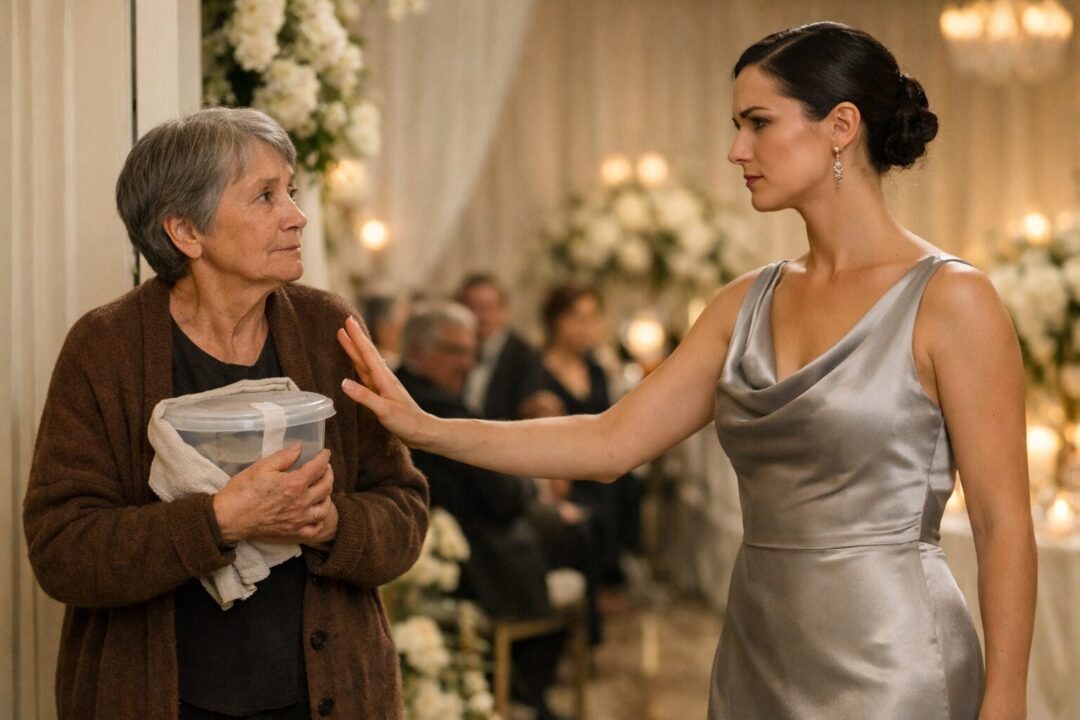
She stood just inside the side entrance of the Grand Halcyon Hotel, one hand gripping the strap of a faded handbag, the other cradling a plastic food container wrapped in a kitchen towel that had once been white. Around her, the wedding room gleamed with the kind of wealth that tried not to look like wealth and always failed. White orchids spilled from tall glass vases. Gold light floated down from chandeliers. Every chair wore silk. Every guest seemed polished to the point of friction.
And then there was her.
Her cardigan was brown and soft with age, the elbows worn thin. Her shoes were sensible black flats that had seen too many sidewalks. Her gray hair had been combed carefully, but the ride on the bus and the humid spring air had pressed it down again. She looked as though she had wandered in from the wrong life and taken three steps too far before realizing it.
Marlowe Gaines saw her first.
Marlowe was standing near the aisle, making final checks with the wedding coordinator even though she was not the coordinator and had no official role that required hovering. She had simply taken ownership of the event the way some people took ownership of a room by entering it. Tall, flawless, dressed in a silver satin gown that caught every light in the ballroom, she turned toward the side door and stiffened.
For one brief second, she only stared at the container in the woman’s hands.
Then she moved.
By then, several guests had noticed the interruption. Not enough to create a scene. Just enough to create pressure. Just enough for humiliation to grow roots.
“Excuse me,” Marlowe said, arriving with a smile so polished it almost qualified as kindness. “Can I help you?”
The older woman gave a small nod, uncertain whether she was being welcomed or stopped.
“I’m looking for him,” she said quietly.
The answer irritated Marlowe at once. The woman spoke as though there was only one him in the room worth naming, and perhaps there was. But on a day that had been coordinated down to the flower petals, vagueness felt offensive.
“This is a private ceremony,” Marlowe said. “Who invited you?”
The old woman tightened her hold on the container. “I made this for him.”
Something shifted in the air. Not loudly. Not enough for anyone to step in. But enough for a few nearby guests to exchange quick glances over their shoulders.
Marlowe’s smile thinned.
At the far end of the room, a quartet tuned their instruments. A photographer adjusted the angle of a white runner lined with candles. Ushers murmured in low voices. The wedding would begin in minutes. The bride was upstairs. The groom was supposed to be in the anteroom with his best man. Every piece of the day was moving toward perfection.
And here, at the edge of it, stood an old woman with a cheap plastic container wrapped in a dish towel, as though she had mistaken this wedding for a family kitchen.
“I’m sorry,” Marlowe said, though she did not sound sorry. “You can’t just walk in here.”
The woman’s shoulders folded in a little, like paper dampening at the edges. “I don’t want to stay,” she said. “I only wanted to give this to him.”
“What is it?”
“Soup.”
Marlowe blinked once, stunned less by the answer than by the sincerity with which it had been given.
Soup.
In a ballroom where each place setting probably cost more than the old woman earned in a week, she had brought soup.
Marlowe looked her up and down now, seeing what she had already decided to see: the cardigan, the lined face, the posture that seemed apologetic before anything had happened. An embarrassment waiting to happen in the precise center of a day built on photographs.
“Ma’am,” she said, lowering her voice in a way that made it sharper, not softer, “this is not your place.”
The old woman nodded once, as if accepting a truth she had feared all along.
“All right,” she whispered. “I can leave it here.”
She took one small step back.
And that should have been the end of it.
But from across the ballroom, just beyond the bank of orchids and the aisle dressed in white, someone said, “What is happening?”
The voice was low, male, and not loud at all.
Even so, the room seemed to hear it.
Part II — What He Saw
Elias Rowan had spent the morning being fastened into his own life.
He had stood still while a tailor adjusted the fall of his jacket. He had smiled through his best man’s jokes. He had answered questions about cufflinks, boutonnieres, seating charts, the photographer’s timing, the weather outside. All of it had felt less like preparing for marriage than being gently packaged for public consumption.
He loved Lila. He did. He had chosen this day willingly.
But weddings, he had discovered, had a way of making love look expensive.
The one thing he had wanted—truly wanted—had not fit neatly into anyone’s plans.
He had asked weeks ago if there was room in the front row for one more guest.
Not a donor. Not a client. Not a family friend with a useful surname. Just one more chair.
There had been confusion about who would fill it. He had not explained. Not properly. He had only said, “If she comes, she sits close.”
But he had not known whether she would come.
Nora Bell never liked making herself visible in places that treated visibility like currency. She had spent most of her life entering rooms from the edges. Kitchens. Laundries. Service doors. Waiting rooms. Church basements. Places where work mattered more than appearance and love rarely announced itself, only showed up and stayed late.
When Elias was eight, after his mother died and his father disappeared into the kind of grief that resembled abandonment, Nora had taken him in without ceremony. She was not his grandmother by blood. She had lived next door to his mother for years in a narrow duplex with peeling paint and a porch swing that creaked in the summer. She had watched him when his mother worked doubles. She had brought broth when they were sick, rent money when things went wrong, and the kind of practical mercy that never called itself sacrifice.
When the house emptied out after the funeral, she was the one who stayed.
She packed his school lunches. She learned the names of teachers. She sat through parent nights with her hands folded over a pocketbook that had once belonged to her sister. She did not talk to him about grief very much. Instead, she fed him. Chicken soup when he was ill. Rice and beans when money ran thin. Cornbread when he studied late. On every birthday, no matter how poor the month, she made the one thing he always asked for: a slow-cooked soup with dumplings so soft they nearly dissolved.
Love, in Nora’s hands, had always arrived warm.
Later, when Elias won scholarships and left for college, when he learned how to wear tailored jackets and answer interview questions and move through wealthy rooms as though he had been born to them, Nora had remained constant. She sent recipes written on the backs of church flyers. He called her every Sunday. When his first salary arrived, he bought her a new stove. She cried for an hour and then scolded him for wasting money.
She had never once asked to be honored for any of it.
So when Elias saw her now—small, uncertain, standing near the side door while Marlowe Gaines blocked her path—the entire morning collapsed into one clear fact.
Nora had come.
He crossed the ballroom before anyone could stop him.
Marlowe turned as he approached, visibly relieved, as if the rightful authority had arrived to tidy away an awkward detail.
“Elias,” she said, half-laughing in that brittle way people do when they believe they are about to be thanked. “There’s been a little misunderstanding—”
But he was not looking at her.
He was looking at the towel wrapped around the container. At Nora’s bent fingers. At the line of strain around her mouth that always appeared when she was trying not to inconvenience anyone.
“Nora,” he said.
That was all.
Her eyes lifted to his face, and the fear in them changed. It did not disappear. It softened around the edges. Recognition entered where shame had been.
“I’m sorry,” she said immediately. “I didn’t mean to interrupt.”
The sentence hit him harder than any insult Marlowe could have delivered. Nora apologizing. Nora, who had once worked two cleaning jobs and still found time to stand in the back row of his high school graduation because she refused to miss it. Nora, who had taught him that dignity did not need decoration.
He reached for the container first.
It was still warm.
“What did you bring me?” he asked, though he already knew.
Her mouth trembled into something like a smile. “Soup.”
A few guests nearby heard it. He saw the confusion flash across their faces. Soup again, that absurdly simple word in this gleaming room.
Then he took her other hand.
He felt Marlowe waiting for him to explain, perhaps to laugh, perhaps to smooth over the social wrinkle and relocate this old woman to someplace less visible. Instead, he held Nora’s hand a little tighter.
Marlowe tried once more. “She walked in through the service side. I was just making sure—”
“Don’t,” Elias said quietly.
The silence that followed was not dramatic. It was worse. It was attentive.
Part III — The Price of Looking Right
Marlowe Gaines had spent most of her adult life learning how to read rooms quickly and never lose her footing in them.
She knew the soft rules that governed elegant people: which errors were forgivable, which embarrassments were permanent, which details made everyone uncomfortable and therefore had to be controlled before they expanded. To her, this had not been cruelty. It had been management. Protection. Prevention.
She had seen an old woman in worn clothes carrying food into a luxury ceremony and interpreted the scene with perfect confidence.
Now that confidence cracked, but not all at once.
“I didn’t know,” she said.
It was true, but it was also useless.
Elias finally turned toward her, though only briefly. The expression on his face was not rage. Rage would have been easier for everyone. Rage could flare and vanish. What he carried instead was disappointment stripped of performance.
“She raised me,” he said.
The words seemed to alter the architecture of the room.
Marlowe’s posture changed first. Then the faces of the guests nearby. Suddenly the old woman was no longer random. The container was no longer shabby. The side entrance was no longer a sign of intrusion, but of someone trying not to disturb a world that had already decided how to see her.
Nora lowered her eyes at once, as if the attention itself was too much.
“It’s all right,” she murmured. “I was just leaving this.”
“No,” Elias said.
He said it gently, but there was no room inside the word.
He turned back to Nora. “You came.”
She gave a tiny shrug. “I almost didn’t.”
“Why?”
The answer took a moment. Not because she was searching for one. Because she was deciding how much truth the room deserved.
“I thought maybe this kind of place…” She glanced around the ballroom, at the orchids, the crystal, the rows of elegant guests. “I thought maybe you had become too grand for soup.”
Someone near the aisle laughed softly in disbelief, not at her but at the tenderness of the line. Then even that sound disappeared.
Elias felt his throat tighten.
“When have I ever been too grand for your soup?”
Nora looked down, blinking fast. “On television, maybe.”
It would have been easy then to make the moment sweet and contained, to walk her discreetly to a seat somewhere near the back, to preserve everyone’s composure while still doing the decent thing.
But that would have repeated the original insult in a gentler voice.
Nora had not been shamed privately. She had been judged in public. Her place in the room had been denied where everyone could see.
So Elias made his next choice with full awareness of what it meant.
He kept hold of her hand and faced the first row.
There was a single empty chair near the aisle, one he had insisted remain there despite repeated questions from planners and relatives. At the time it had been a logistical puzzle. Now it looked like prophecy.
“I asked them to leave that seat,” he said. “For you.”
Nora stared at him. “For me?”
“For you.”
“Oh no,” she said immediately, almost alarmed. “No, I can’t sit up there.”
“Yes, you can.”
“Elias—”
“You can.”
Her eyes filled then, but still she tried to retreat. That was Nora’s way. She had spent decades giving from places no one would think to search. To step into honor felt indecent to her, almost like theft.
Guests were watching openly now, and not with annoyance. With something rawer. Recognition, maybe. Or shame of their own.
Marlowe stood silent, her hands clasped too tightly in front of her. The silver of her gown now looked less like elegance than armor.
Nora glanced toward her, and something unexpected happened. The hardness in her face did not sharpen. It softened.
“She didn’t know,” Nora said.
It was a mercy none of them deserved.
Elias looked at Marlowe once more. “No,” he said. “She only knew what she saw.”
That sentence carried farther than any raised voice could have.
Because that was the whole wound of it. Not just Marlowe’s mistake, but the ease of it. The speed with which a room could measure worth by fabric, posture, accent, age. The way people trained themselves to trust appearances because it made their lives more efficient.
Nora had spent her life on the receiving end of that efficiency.
Not this time.
Part IV — The Front Row
He led her down the aisle slowly, not because she could not walk, but because the moment needed to be seen.
The quartet had stopped playing. The wedding coordinator had gone still. Guests shifted in their seats to follow them as though the ceremony had begun in a language no one had rehearsed. Elias walked in his black formal suit, one hand carrying the still-warm soup, the other holding Nora’s hand as though escorting royalty.
She looked both terrified and luminous.
With each step, some private history seemed to rise around them.
A small boy at a kitchen table with a fever and a bowl cooling under Nora’s patient hand.
A teenager in a borrowed tie pretending he wasn’t hungry because there wasn’t enough for both of them.
A college freshman opening a package with three jars of broth, two loaves of bread, and a note that said, Eat first. Panic later.
A young man in his first office, learning how money changed the way people listened to him and wondering whether change always cost something tender.
All of it seemed to arrive in the ballroom at once.
When they reached the front row, Elias set the food container carefully on the empty chair, then helped Nora sit. She moved like someone afraid the furniture might reject her. It didn’t. She settled into the seat, hands folded tightly in her lap, chin lowered.
From the staircase at the far end of the room, Lila appeared.
For one suspended second, it seemed possible the day might splinter under the weight of so much unrehearsed emotion. The bride had not been part of this moment. No one had prepared her. She stood in white silk and lace, one hand on the banister, taking in the room, the silent guests, her groom kneeling slightly beside an elderly woman in a brown cardigan.
Then Lila descended.
She did not ask anyone what had happened. Perhaps she understood enough from the look on Elias’s face. Perhaps some truths announced themselves more cleanly than explanations ever could.
When she reached them, she bent first toward Nora, not Elias.
“You came,” she said softly.
Nora nodded, flustered. “I hope I’m not causing trouble.”
Lila smiled in a way that transformed the whole room. “I think you may have just saved the ceremony.”
Nora looked puzzled enough to make Lila laugh.
Elias stood, and for the first time that day, the breath in his chest felt like his own. Lila slipped her hand into his, then glanced at the container on the chair.
“Is that the famous soup?” she asked.
Nora’s eyes widened. “He told you?”
“He talks about it like scripture.”
A ripple of laughter moved through the guests then, warm and relieved, releasing the tension without erasing what it had revealed.
Lila touched Nora’s shoulder. “We’re very glad you’re here.”
The distinction mattered: we.
Not Elias alone. Not a private loyalty hidden inside a polished event. A public claim. A place made official.
Nora looked from one face to the other, and some final resistance left her body. She did not suddenly become comfortable in the room. That would have felt false. But she stopped trying to disappear.
The ceremony began a few minutes later.
Those who had come expecting a flawless wedding got one, though not the kind they had imagined. The vows were beautiful. The music returned. Light moved across the polished floor. People cried at the right places. The photographer captured the formal images everyone wanted to keep.
But the true center of the day had shifted.
It was no longer the flowers or the couture or the carefully designed elegance. It was the fact that before any vow had been spoken, the groom had chosen to reveal who had made him possible.
After the ceremony, people approached Nora in small waves.
Some offered awkward apologies. Some only introduced themselves. An elderly aunt took the seat beside her and began chatting as if they had known each other for years. The best man brought tea. One of Lila’s cousins asked for the soup recipe and meant it. Even Marlowe came eventually, no longer wearing confidence like a second skin.
“I was wrong,” she said.
Nora, who had already forgiven her in her own heart, nodded once. “Yes,” she said. But there was no cruelty in it.
Marlowe swallowed. “I’m sorry.”
This time Nora let the apology rest between them. She did not rush to comfort the woman who had humiliated her. Mercy, Elias would later realize, did not always mean making others feel better right away. Sometimes it meant allowing truth to stand without polishing it.
By evening, the story had already spread through the reception in fragments. Some told it sentimentally, some reverently, some with embarrassment over how quickly assumptions had formed. But every version carried the same image: the old woman with the soup, and the groom who would not begin without her.
Much later, after the last dance and the final toast, Elias found Nora in a quieter corner near the terrace doors, the city lights scattered beyond the glass.
She had changed nothing about herself. She still sat in the same cardigan, hands around a cup of tea, looking both small and strangely unmovable.
“You all right?” he asked.
She nodded. “Tired.”
He sat beside her.
For a while neither of them spoke. They had never needed many words.
Then Nora said, “Your mother would have liked today.”
The sentence entered him gently and broke something open anyway.
“I wish she’d seen it,” he said.
“She did,” Nora replied, with the calm certainty of someone who had carried grief long enough to stop negotiating with it.
He looked down at his hands, then over at her.
“I should have come for you myself.”
“No,” she said. “I got here.”
It was such a Nora answer that he nearly laughed.
He reached for her hand, the same way he had in the ballroom. “Thank you for coming.”
She squeezed his fingers once. “I told you,” she said. “I made this for you.”
He smiled then, really smiled, the kind that belonged to the boy at the kitchen table and the man in the tailored suit at the same time.
Later that night, when the room had emptied and the flowers had begun their slow surrender to morning, the hotel staff clearing the front row found the food container gone.
Nora had insisted he take it home.
And sometime after midnight, in a quiet suite above the city, Elias and Lila sat side by side on the floor in wedding clothes gone slightly rumpled, eating soup from china bowls far too expensive for the meal and laughing each time they noticed the absurdity of that.
It tasted of garlic, pepper, broth, and years.
It tasted like every invisible thing that had carried him to that day.
For the rest of his life, when people asked Elias what he remembered most about his wedding, he rarely mentioned the flowers or the music or the hall.
He remembered a side door opening.
He remembered a tired woman in a worn brown cardigan, holding a warm container to her chest as though love still needed protecting.
And he remembered realizing, in a room built to celebrate the future, exactly who had carried him there.