The Dog in the Siren Road
The Dog in the Siren Road
Part I — The One That Wouldn’t Move
By the time the dog threw itself into the road, Nolan Reed had already been awake for nineteen hours.
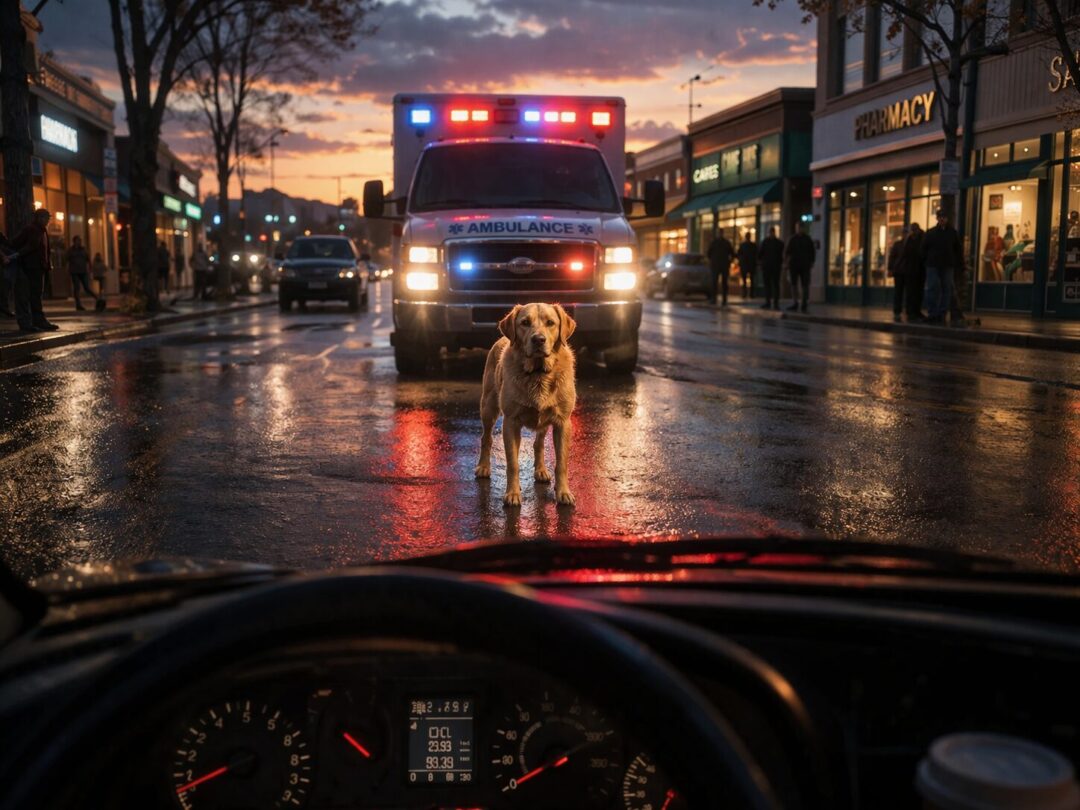
The siren was off, but the ambulance lights still pulsed against the shop windows, turning the quiet strip of late-afternoon storefronts into flashes of blue and white. Nolan had one hand on the wheel and the other wrapped around a paper cup of coffee gone cold. His shoulders ached. His jaw ached. Even his eyes felt tired.
Then something golden streaked across the lane.
He slammed the brake so hard the cup tipped in his grip and bitter coffee splashed over his wrist.
“Hey! Move!”
The words came out before he could stop them.
The dog stood squarely in front of the ambulance, paws planted, chest heaving. It was a yellow Labrador, full-grown and broad through the shoulders, the kind of dog people usually described as friendly before they said anything else. But there was nothing easy in the way this one looked at him. Its eyes were fixed and fierce. It did not flinch at the engine or the flashing lights. It did not dart away when Nolan leaned on the horn.
It just stared.
Traffic had thinned to almost nothing. A few people near the sidewalk turned, glanced, then kept going. The dog might as well have been the only thing in the world.
Nolan cursed under his breath and pushed open the driver’s door.
“What are you doing?”
The Lab sprang toward the side of the ambulance so suddenly Nolan took a step back. It didn’t growl. It didn’t bare its teeth. It pawed at the side panel, then jumped toward the open window line, whining in ragged bursts that sounded nothing like aggression. It was frantic. Intentional. It kept looking at him, then looking away, then back again, as if checking whether he understood.
Nolan had seen dogs panic before. After wrecks. House fires. Tornado warnings. Animals scattered from disaster in every direction, wild with fear. But this was different. This dog wasn’t fleeing. It was trying to pull him somewhere.
The realization came in a thin, unwelcome thread.
The dog dropped back to the ground, spun, and ran three yards down the street before stopping to look over its shoulder.
“Wait—come back!”
It ran again.
Nolan stood with one foot still half-turned toward the ambulance. He should have called it in as a delay and moved on. He should have gotten back behind the wheel and headed where he was supposed to go. His shift had been one long crawl of exhaustion and bad luck, and he had no room left in him for strange detours caused by somebody’s runaway pet.
But the dog had stopped again.
Waiting.
Not confused. Not wandering. Waiting.
Nolan looked up and down the street. The strip mall sat in the stale gold of evening. Beyond the last row of stores, the road bent toward a thin stretch of trees and an undeveloped lot that sloped toward the creek. No owners. No shouted name. No jangling leash.
The dog barked once, sharp and urgent.
Nolan let out a breath, grabbed the radio clipped to his chest more out of habit than intention, and muttered, “This better be something.”
Then he ran after it.
The dog took off the instant Nolan moved, not too fast, never far enough to lose him. It was leading, not escaping. That fact settled colder than the autumn wind.
By the time he reached the edge of the road, his pulse had climbed from fatigue into adrenaline. Gravel shifted under his boots. The sounds of the street thinned behind him. Branches moved softly overhead. The dog disappeared between two leaning trees and Nolan followed into a quiet so sudden it felt staged, as if the world itself were waiting for him to see what the animal had been trying to say.
Then he saw a shape on the ground.
At first it was only another body in the leaves, pale gold against brown dirt and exposed roots.
Then it moved.
Nolan stopped so hard his knee nearly buckled.
“Oh no,” he whispered, and the rest came out on its heels, harsher with understanding. “She’s pregnant.”
The second Labrador lay on her side in a hollow where the earth dipped toward the creek bank. Her belly was swollen and tight. Her breathing came shallow and fast. One paw twitched weakly when the other dog reached her, pressing close with a low, broken sound that seemed to come from somewhere deeper than the throat.
The male—the one who had stopped the ambulance—looked from her to Nolan with such raw expectation that Nolan felt a shame he hadn’t earned and yet somehow deserved.
The dog had trusted him before Nolan had done a single thing to deserve it.
He dropped to one knee in the leaves.
“It’s okay,” he said, though he had no idea whether that was true. “I got you.”
The female Lab’s eyes opened wider at the sound of his voice. She didn’t try to rise. She couldn’t. Her body quivered with effort and pain.
Nolan had delivered babies before—in ambulances, in homes, once in the back of a stalled pickup during a thunderstorm. Human babies, human fear, human fathers pacing and mothers cursing through labor. But here, in the darkening edge of a stand of trees, with one dog collapsed and the other staring at him as if the whole world rested on what he did next, his training felt both useful and strangely too small.
He reached for his radio, called in his location, and requested immediate assistance with a strained voice he barely recognized as his own.
The male dog did not move from beside the female.
Neither, Nolan thought, would he.
Part II — What Brought Them Here
Later, after people would tell the story as if it had started with a miracle, Nolan would remember that the truth had begun much earlier—with cold nights, with hunger, with the invisible margin where small abandonments become big ones.
The dogs had been seen around the neighborhood for weeks.
Not close enough for anyone to catch. Not long enough in one place for animal control to arrive before they vanished again. They showed up at the edges of parking lots, behind the grocery store dumpsters, near the church with the peeling white steeple, in the lot behind the laundromat where a man named Earl left scraps in a paper tray and pretended he hadn’t. Two yellow Labs together: the male leaner through the ribs, the female slower every week, her belly rounding until even people who knew nothing about dogs began to understand what was coming.
No one knew where they had come from.
Maybe they had slipped a yard and never found their way back. Maybe someone had driven them out past the county line and opened a truck door. Maybe they had belonged to a family who loved them in the easy way people love what asks for very little, right up until life got expensive or inconvenient or full. The world was crowded with the wreckage of small failures people preferred not to name.
What everyone agreed on was that the male stayed close to the female.
If she stopped, he stopped. If she ate, he watched until she finished before touching what was left. When kids approached too quickly, he moved between them—not snarling, not lunging, just warning with his body that she was not to be bothered. And when she lay down to rest in the patchy shade behind the hardware store, he circled twice before settling where he could see in both directions.
People called him smart.
People always said that when animals did what should have shamed humans.
Nolan didn’t know any of this when he found them. He learned it afterward, piece by piece, from neighbors who had noticed but not acted, from a cashier who had seen the female struggling that morning, from Earl at the laundromat, who wiped at his eyes with the heel of his hand while insisting there must be something wrong with the room.
But what Nolan understood in the woods required no witness and no explanation.
The female was in trouble.
He shrugged off his jacket and folded it under her head to keep her from the wet ground. His hands stayed steady because years of work had taught them to go calm before the rest of him caught up. The male paced a tight semicircle, then pressed in again, his body trembling. Every time Nolan shifted the female, the dog stiffened. Every time Nolan murmured to her, the dog seemed to listen too.
“You brought me here,” Nolan said quietly, not because he expected a response, but because saying it aloud made the moment feel less impossible. “All right. I’m here.”
The dog’s ears twitched.
Sirens sounded in the distance—not urgent now, but near enough. Backup. Good.
The female tried once to push herself upright and gave a low cry of pain that sliced through Nolan more cleanly than any human scream had in months. Burnout had done strange things to him. It had not made him cruel, but it had made him efficient in ways he did not like to examine too closely. Pain had become information. Panic had become management. Even gratitude sometimes washed off him too fast to leave a mark.
But this—this cut through every protective layer he had built around himself.
Maybe because the male dog didn’t understand triage or systems or policy. He only understood that the one creature he loved most in the world was failing in front of him, and he had done the only thing he could think of.
He had gone to find help.
When the rescue unit arrived, two firefighters stepped into the tree line with a stretcher and the kind of automatic confidence people wore when they had not yet seen the patient. Nolan looked up and said, “Easy. She’s weak. And he stays calm if we stay calm.”
The male dog stood over the female then, his chest lifted, eyes bright with fear and determination. One firefighter muttered, “You’ve got to be kidding me,” in a tone that wasn’t disbelief so much as wonder.
Together they slid the female onto the stretcher. She was lighter than she should have been. Malnourished. Dehydrated. Too far along and too tired and too close to a place where both she and the puppies might have simply slipped away unnoticed.
The male dog trotted alongside as they carried her out of the trees.
When they reached the road, he matched the stretcher step for step.
Nolan glanced down at him. “You’re not leaving her, huh?”
The dog looked straight ahead.
“No,” Nolan answered for him. “Didn’t think so.”
By the time they loaded her into the ambulance, dusk had dropped over the street in full. The lights strobed over the dog’s coat, turning him gold, then white, then blue, then gold again. Someone from the rescue unit had found a slip lead, but the dog refused to be pulled away from the open doors. He didn’t bite. He didn’t fight. He only dug in with a silent, stubborn grief that made restraint feel obscene.
So Nolan made a call no handbook had prepared him to make.
“He rides with us,” he said.
The firefighter blinked. “Reed—”
“He rides.”
The argument lasted less than two seconds.
Inside the ambulance, Nolan worked over the female while the male dog stood pressed against the rear bench, body rigid, eyes never leaving her. The monitor straps and oxygen setup looked surreal beside a panting dog and her watchful companion, yet somehow the space had never felt more honest. Two lives in danger. One life refusing to surrender the other.
Nolan kept talking because motion and voice kept panic from taking over.
“You did good,” he said once, glancing toward the male as he adjusted the female’s position. “You hear me? You did good.”
The dog’s chest lifted and fell. He did not break his stare.
At the veterinary emergency clinic on the other side of town, the staff met them at the bay doors. There was no time for wonder there. Only speed. Hands. Questions. A gurney. A technician with tired eyes and gentle fingers. The female disappeared through swinging doors under white light. The male tried to follow and was finally stopped, not roughly, but firmly.
He let out a sound then—a low, broken whine that made everyone in the room fall silent for a beat.
Nolan crouched in front of him.
“She’s in,” he said. “They’re helping her.”
The dog pressed his head once, hard, against Nolan’s chest.
It was the smallest movement.
It undid him.
Part III — The Longest Night
Nolan had not intended to stay.
He told himself that three separate times.
Once when the paperwork started and his shift supervisor called to ask why a routine return had become an incident involving two stray Labradors and a veterinary handoff. Once when a clinic receptionist offered him vending-machine coffee and he took it without tasting it. And once when he checked the time and realized the day had tipped so far into night that going home would mean sleeping just long enough to wake up tired again.
But every time he thought about leaving, he looked down.
The male dog was at his feet.
He had finally accepted a bowl of water. He had ignored food. He sat in the waiting room with his body angled toward the treatment doors, ears lifting at every footstep, every metallic rattle, every opening hinge. The fluorescent lights were unkind to everything human in the room, but somehow the dog still looked noble in them—worn thin by hunger and worry, yet held upright by will alone.
Nolan found himself talking quietly into the silence between updates.
He talked about nothing at first. About how cold it was getting at night. About how his apartment radiator clicked like it was haunted. About the diner on Elm that served terrible pie and the best eggs in town. It was the sort of aimless talk people used with babies or with patients waking from anesthesia, not because the words mattered, but because a human voice was sometimes the gentlest bridge across fear.
The dog listened.
Near midnight, a veterinarian came out in blue scrubs and sat beside Nolan instead of standing over him, which told him before she spoke that the news was complicated.
“We stabilized her,” she said.
Nolan closed his eyes briefly.
“But?”
“She was in labor and in distress. We had to intervene.” The vet’s face softened. “She made it. And the puppies made it.”
For a second the whole room seemed to widen.
“All of them?” Nolan asked.
The veterinarian smiled. “All of them.”
The sound that left Nolan was half laugh, half breath, the release of pressure he had been carrying for hours without admitting it. Beside him, the male dog rose so quickly his nails clicked against the tile.
The veterinarian looked at him. “He can see her in a minute.”
Nolan swallowed. “He’ll want that.”
The dog needed no leash this time. He walked beside Nolan down the hall as if ceremony had replaced panic. The exam room they entered was warm and dimmer than the waiting area, arranged for quiet recovery. The female lay on a padded bed, exhausted, eyes half-closed but open enough to follow the movement when they entered. Against her side, a cluster of newborn puppies rooted and squirmed, tiny bodies rising and pressing with blind certainty toward warmth and milk and life.
The male dog stopped in the doorway.
Nolan had seen people pause like that at hospital beds—afraid that relief itself might be too much to trust.
Then the dog crossed the room in three careful steps and lowered his head beside the female’s neck.
She exhaled.
It was just one breath, but the whole room changed with it.
The puppies continued their tiny, furious work. The female’s eyes drifted closed, then opened again. The male remained standing guard beside the bed, calmer now, though no less alert, as if after all the running and pleading and refusing to give up, he finally understood that the danger had passed.
Nolan stood at the foot of the bed with his hands hanging uselessly at his sides.
The vet glanced at him, then quietly slipped out.
So did the technician.
The room grew still.
He found himself smiling in a way that hurt his face.
“You saved her,” he said.
His voice came out rough.
The male dog turned his head slightly, not all the way, just enough for one eye to meet Nolan’s.
Nolan would never later claim that the dog understood the words. That would have cheapened the truth. Understanding was already there. It had been there from the first moment in the road. Not language. Not reason in the way people liked to reserve for themselves. Something older. Cleaner. A certainty about love and obligation that didn’t require being spoken to be real.
The dog looked back at the female and the puppies.
That was answer enough.
Part IV — The Morning After
Stories like that spread quickly in small towns, though rarely in the shape they first happened.
By morning, the version passing through the diner and the hardware store and the checkout lanes at the grocery had already grown brighter around the edges. The dog had “flagged down” the ambulance. The EMT had “followed him like something out of a movie.” The mother had been “seconds from death,” which may or may not have been true. By noon, one woman swore the dog had dragged a shopping cart into the road to stop traffic, though Nolan suspected that detail had been borrowed from imagination and grafted on because people liked miracles better when they came with props.
He didn’t correct them.
Some truths didn’t improve under too much handling.
The clinic posted nothing. Nolan told no reporters anything. The rescue unit kept the details quiet except where paperwork demanded otherwise. But word got out anyway, because that is what hope does when it stumbles into ordinary places—it refuses to stay private.
People began calling the clinic to ask about the dogs.
A local rescue offered to cover costs. Someone from the church sent blankets. Earl from the laundromat appeared with a bag of dog food large enough to feed a kennel, then stood awkwardly in the lobby until a technician took pity on him and let him look through the glass.
Nolan came back after sleeping four hours and waking up with the story still lodged under his ribs.
He told himself he was only checking in.
The receptionist smiled in a way that suggested she had heard that before. “They’re in recovery,” she said. “And before you ask, yes, he’s still guarding the door.”
Nolan found them in a larger room that afternoon. The female was stronger, though still weak. The puppies looked impossibly small and impossibly determined. The male dog had finally eaten. When Nolan stepped in, the dog lifted his head, watched him for a second, then thumped his tail once against the floor.
That small sound hit Nolan harder than applause would have.
The vet joined him a moment later, arms folded loosely. “We’re trying to arrange foster placement,” she said. “Maybe adoption if the right home comes through.”
Nolan nodded.
The vet studied him with the calm, unbearable accuracy of people who spent their lives reading pain where others tried to hide it. “You’re thinking about it.”
“No, I’m not.”
“You are.”
He looked at the dogs. At the female lying with the puppies tucked against her. At the male stationed so close he could touch all of them if he shifted his weight two inches. He thought of his apartment, too quiet except for the clicking radiator. Of the boxed dinners in his freezer. Of how many evenings he had spent staring at a television without hearing a word of it. Of how easy it had become to call numbness professionalism.
“I work too much,” he said.
“That can be true,” the vet replied, “and it can still be the right answer.”
He didn’t decide that day.
Maybe some part of him already had.
Over the next week, he came back every chance he got. He learned the puppies’ rhythms before he learned what tired hope felt like in his own body. He watched the female regain strength. He watched the male finally sleep deeply for the first time, sprawled across the floor of the recovery room with his paws twitching in dreams. He learned how quickly a room could become warmer just because life inside it no longer hung by a thread.
And slowly, painfully, he admitted something he had avoided for a long time.
He had not been only tired.
He had been disappearing.
The work had taken the brightest parts of him first—wonder, softness, surprise—until he had begun to confuse their absence with maturity. Then this dog had stepped into the road and refused to let him pass unchanged.
A week later, Nolan signed the papers for both adult dogs.
The puppies would go to carefully screened homes when they were old enough, a fact that made him unexpectedly sad until the vet reminded him that being loved widely was not the same thing as being lost.
He chose the name Orson for the male, because it sounded sturdy and a little old-fashioned, the kind of name that had weathered things. He named the female Marla because the sound of it felt gentler in his mouth than most words had in months.
It took longer for the dogs to learn the apartment than it did for the apartment to learn the dogs.
Orson checked every room twice before settling. Marla preferred the patch of sunlight near the balcony door. Nolan bought more food bowls than necessary, then laughed at himself and bought still more. He took them on early morning walks before shifts and late evening walks after. He began coming home not to silence, but to nails ticking across the floor and tails striking furniture in joy so complete it felt extravagant.
There were hard days. Nights when Marla woke restless. Shifts that ran too long. Mornings when Nolan questioned whether he had done something brave or simply impulsive.
Then Orson would press against his knee while he tied his boots, or Marla would sigh herself to sleep with one puppy tucked beneath her chin before they went to new homes, and the question would answer itself.
Part V — What Stayed
The first time Nolan drove the ambulance past that same stretch of road again, winter had begun to loosen.
He was alone in the cab. The trees were still bare, but the light had changed. It held the promise of green.
He slowed without meaning to.
The spot where Orson had stepped into his path looked ordinary now. Asphalt. Faded lane paint. The edge of the shopping strip. Nothing about it suggested that one exhausted paramedic had once had his life interrupted there by a dog who refused to accept helplessness.
Nothing, Nolan thought, except everything that came after.
That evening, when he opened his apartment door, Orson met him first. Not with panic now. Not with that same wild urgency. Just certainty. Marla looked up from her bed near the heater, eyes calm and soft. The puppies were long gone to homes that sent too many photos and never enough. Nolan complained about that to anyone who would listen and then secretly treasured every message.
He knelt to scratch Orson behind the ears.
“You know,” he said, “you could’ve picked somebody else.”
Orson leaned into his hand with all the quiet weight of a creature who no longer needed to prove anything.
Nolan smiled.
Maybe that was the part people never got right when they repeated the story. They liked the miracle because it was dramatic—a dog in the road, an ambulance, a race against time, newborn life waiting at the end of it all. They liked the shape of it, the clean uplift.
What mattered more was smaller.
A living thing had reached the limit of what it could do alone and gone looking for help.
Another living thing, tired and half-shut-down and tempted to keep driving, had chosen to stop.
That was all.
That was everything.
At night, when the apartment settled and the radiator clicked softly in the walls, Nolan sometimes watched Orson sleeping near Marla’s bed. Even in sleep, the dog kept himself angled toward her, as if love were still a form of guard duty.
Nolan understood that now better than he used to.
Not because love prevented fear.
Not because it promised safety.
Because love made you stand in the road anyway.