The Portrait That Stayed on the Table After the Room Went Quiet
Part I — The Room Went Still
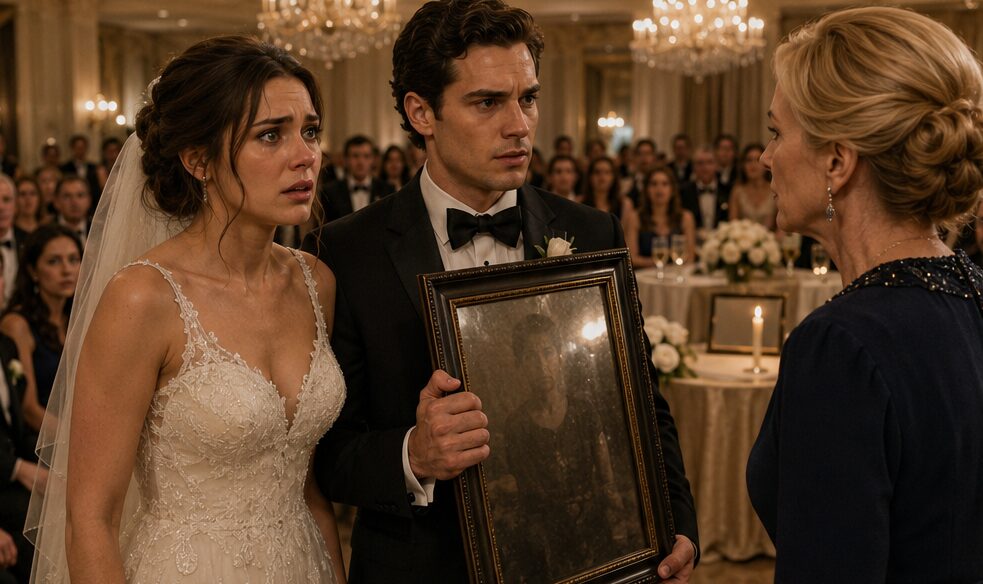
Emma stood beneath the chandelier in her wedding dress while Anthony held the portrait at his chest like he had carried it out of a burning house.
No one moved.
Not the waiters frozen beside the champagne flutes. Not the cousins with forks halfway lifted. Not Anthony’s father near the head table, pale and blinking. Not the women from Janet’s garden club, who had spent cocktail hour admiring the flowers and now stared as if the flowers had betrayed them.
Janet had one hand pressed to her cheek.
Emma’s palm was still hot.
The sound had been small. That was what stunned her most. In a room of two hundred people, under crystal lights and white roses and folded linen napkins, the slap had not sounded like the end of something.
It had sounded like a hand meeting skin.
Then everything after it had become enormous.
Anthony looked at Emma, then at his mother, then down at the frame in his hands. Behind the glass, Emma’s mother smiled from twenty-seven years ago, young and soft-faced, holding baby Emma against her shoulder in a yellow kitchen that no longer existed.
The portrait was crooked inside the frame now. One corner had slipped loose when Anthony grabbed it from the hallway.
Janet’s lips parted. For once, she seemed unable to find the right sentence.
Emma waited for someone to say it.
Difficult bride.
Ungrateful.
Unstable.
Too emotional.
She had been afraid of those words all day.
Now the room did not need to say them. It was wearing them on every face.
Anthony took one step toward the memory table.
His mother whispered, “Anthony.”
It was not loud. It did not need to be.
He stopped.
Emma’s breath caught so sharply her bodice tightened against her ribs.
There it was again. The old command. The invisible leash.
Anthony closed his eyes for half a second.
Then he kept walking.
He crossed the dance floor with the portrait in both hands, past the white rose arrangements Janet had ordered, past the gold chargers Janet had insisted were “more timeless,” past the table cards Janet had rewritten because Emma’s handwriting looked “too casual.”
He reached the memory table.
There was an ivory candle burning in a glass hurricane, a little card that said Those we love are with us today, and an empty space in the center where the portrait was supposed to have been all along.
Anthony set the frame down carefully.
No one clapped. No one breathed normally.
Emma watched her mother return to the room.
Only then did she feel what she had done.
Janet turned away first. Her navy dress shimmered as she moved toward the side doors, her palm still pressed against her cheek. Two women rose to follow her, then hesitated, not sure whether compassion would look like loyalty or gossip.
Anthony came back slowly.
“Emma,” he said.
Her name sounded different from his mouth now. Not softer. Not angry.
Awake.
She looked at him and wanted, terribly, to rewind the last minute.
She wanted to be the kind of woman who could endure one more sentence. One more correction. One more graceful theft.
But the portrait was back on the table.
And the whole room knew she had not imagined it.
Part II — The Memory Table
Three hours earlier, Emma had walked into the banquet hall and stopped so abruptly that Linda bumped into the back of her.
“What is it?” Linda asked.
Emma did not answer at first.
The room was beautiful. That was the problem. It was so beautiful it looked like someone had polished all the tenderness out of it.
White linens. White roses. Gold-rimmed plates. Tall centerpieces. A chandelier that made every glass sparkle like it had been placed by a hand that knew money could solve almost anything.
And at the far end of the room, near the guest book, the memory table had been “tidied.”
Emma knew that word before Janet said it.
Her mother’s portrait, which Emma had placed in the center that morning, was no longer in the center. It had been moved to the left corner, half-hidden behind a huge spray of white roses and eucalyptus. The candle sat in front of it like an apology. The little card was still there, but angled away, as though even grief should know not to call attention to itself.
Linda followed Emma’s gaze.
“Oh,” she said quietly.
Emma crossed the room before she could decide to be calm.
The portrait showed her mother at thirty-one, standing in a small yellow kitchen with baby Emma tucked into one arm. Her mother had flour on her cheek. Emma’s tiny fist had a grip on her necklace. It was not a formal portrait. It was not elegant. It was too bright, too lived-in, too much like somebody’s real life.
That was why Emma loved it.
Her mother had hated posed photos. “If I’m going to be remembered,” she used to say, “let me be remembered in motion.”
Janet appeared from behind a cluster of staff members, elegant in navy, her blonde hair arranged in a smooth twist that looked impossible to disturb.
“Oh, good, you’re here.” Janet smiled. “Doesn’t it look lovely?”
Emma looked at the half-hidden frame.
“It was in the center.”
Janet’s smile held. “I know, sweetheart. I just balanced the table a little. The photo was pulling focus.”
Linda’s mouth tightened.
Emma touched the back of one chair. Her fingers needed something solid.
“It’s the memory table,” she said. “It’s supposed to pull focus.”
Janet gave a tiny laugh, the kind people used when they wanted to make disagreement sound immature. “Of course. But guests will be coming in through those doors, and the first thing they’ll see is a very casual kitchen picture. It doesn’t quite match the tone.”
The tone.
Emma had learned that word over the last six months.
The tone of the invitations, which Janet had upgraded.
The tone of the bridesmaids’ earrings, which Janet had called “sweet, but not formal.”
The tone of Emma’s fatherless walk down the aisle, which Janet had gently suggested might be “less sad” if Anthony’s father escorted her halfway.
Emma had said no to that one.
She had said no so firmly that Anthony had looked surprised.
Now she looked at her mother’s face behind the roses and felt the old fear rise in her throat. Not anger yet. Fear.
Fear that if she objected too much, she would become exactly what Janet’s friends already suspected she was: grateful, lucky, and a little out of her depth.
Anthony came through the side entrance in his tuxedo, one cuff undone, phone in hand.
“There you are,” he said to Emma, smiling with relief. Then he saw her face. “What happened?”
Before Emma could answer, Janet said, “Nothing happened. I moved one photo two feet. Your bride is having a moment.”
Your bride.
Not Emma.
Anthony stepped closer to the table. “Mom.”
“It was clashing,” Janet said. “That’s all.”
Emma looked at him. “Can you please move it back?”
Anthony’s eyes flicked from Emma to Janet. There were already three staff members pretending not to listen.
“Of course,” he said quickly. “Yes. I’ll handle it.”
Janet inhaled through her nose.
“Anthony, the coordinator needs you to approve the revised toast order.”
“The what?” Emma asked.
Janet turned toward her with practiced gentleness. “I made one small adjustment. Your aunt is still speaking, don’t worry. I simply thought it made sense for family greetings to come before dinner. People get restless once plates are cleared.”
Linda said, “I was told I’d speak after the salad.”
“And you still can,” Janet said, “if that’s what we all think is best.”
That sentence did its work. It made Linda sound difficult before she had even objected.
Anthony rubbed his forehead.
“I’ll be right back,” he told Emma. “I swear. I’ll move it back before guests come in.”
“You promise?”
His expression softened.
“I promise.”
Emma nodded.
Then she did the thing she had done too many times already.
She smiled.
“I’m fine.”
Linda’s hand found hers as Anthony followed his mother toward the coordinator.
The portrait stayed behind the flowers.
“You don’t look fine,” Linda said.
Emma stared at her mother’s half-hidden face.
“I need to be,” she whispered.
Part III — Everyone Thanked Janet
By cocktail hour, the portrait was back in the center.
Not because Anthony had moved it.
Linda had.
She waited until Janet was busy correcting the angle of the escort-card display, then lifted the frame with both hands and placed it exactly where Emma had wanted it. She adjusted the candle beside it, smoothed the little card, and looked at Emma as if to say, There. Let them try again.
Emma nearly cried, which annoyed her.
She had survived the ceremony. She had walked alone down the aisle because she wanted to, holding a small white bouquet wrapped with a strip of her mother’s blue scarf. She had looked at Anthony and meant every vow. She had believed, for the length of those vows, that marriage could be a door and not a disappearance.
Then the reception began.
And everyone thanked Janet.
“Oh, Janet, the room is stunning.”
“You really pulled it together.”
“Such a classy affair.”
“What would these kids have done without you?”
Emma stood beside Anthony in the receiving line, smiling until her cheeks hurt, while Janet accepted compliments with a gracious tilt of her head.
“They did most of it themselves,” Janet said once, lightly touching Emma’s shoulder. “We just helped where we could.”
We.
Helped.
Emma felt the touch through the fabric of her dress.
Anthony squeezed Emma’s hand under the level of the table.
“She doesn’t mean it that way,” he murmured.
Emma kept smiling at an older couple she did not know. “She never does.”
A woman in pearls leaned forward and kissed Janet’s cheek. “You must be relieved. Now you can finally relax.”
Janet laughed. “I’ll relax when the cake is cut and nobody trips.”
Then she turned to Emma.
“Sweetheart, your train is catching on the chair leg.”
Emma looked down. It was not.
But the woman in pearls looked down too, and then another guest looked, and suddenly Emma was being inspected in the middle of her own receiving line.
“Thank you,” Emma said.
It was the safest response to almost everything Janet did.
Thank you.
Of course.
That’s thoughtful.
I’m fine.
Linda watched from nearby, holding a glass of water she had not drunk. She looked older than she had that morning. Or maybe grief always looked older under chandeliers.
When there was finally a break, Linda pulled Emma aside near the hallway.
“Your mother would’ve loved your dress,” she said.
Emma let out a breath she had been holding for hours.
“She would’ve said it needed pockets.”
Linda laughed once, and it almost undid them both.
Then her eyes shifted over Emma’s shoulder.
Janet was at the memory table again.
Not touching the portrait this time. Just standing in front of it with the photographer.
Emma moved closer.
“I think family photos would be better by the fireplace,” Janet was saying. “The light is warmer there.”
The photographer glanced at Emma. “Whatever the bride prefers.”
Janet smiled. “Of course.”
Emma said, “I prefer the memory table staying exactly how it is.”
The words came out calm.
Too calm.
Janet turned. “No one is moving the table.”
“You moved the portrait.”
Janet’s smile tightened. “And it was moved back.”
“Not by Anthony.”
Anthony appeared as if summoned by his own name. “What’s going on?”
Janet gave a small sigh. “Nothing. Emma is upset about the photograph again.”
Again.
There it was. One word, and Emma became repetitive. Emotional. Embarrassing.
Anthony lowered his voice. “Can we not do this here?”
Emma looked at him.
“Where should we do it?”
He glanced toward the guests.
“That’s not what I meant.”
But it was close enough.
Janet touched his sleeve. “The coordinator needs you for the entrance timing.”
Anthony did not move at first.
Emma waited.
It was such a small moment, too small for anyone else to notice. A groom between his bride and his mother. A portrait on a table. A room full of people laughing with champagne.
Anthony looked at Emma and said, “I’ll be right back.”
Again.
He left with Janet.
Linda stepped beside Emma.
“You can still tell him,” she said.
Emma watched Anthony walk away. “I have been telling him.”
“No,” Linda said gently. “You’ve been letting him hear the polite version.”
That landed harder than Emma wanted it to.
Because it was true.
She had said she was uncomfortable.
She had not said, Your mother makes me feel like a guest in my own life.
She had said the portrait mattered.
She had not said, If she removes my mother from this room, I don’t know what I’m marrying into.
She had said she was fine.
She had not said, I am disappearing and everyone keeps complimenting the person making it happen.
Across the room, Janet laughed at something the coordinator said.
Everyone loved a woman who could fix things.
No one asked what she had moved to make them fit.
Part IV — Before Dinner
The portrait disappeared at 6:12.
Emma knew the time because she had checked her phone after the photographer asked for one last shot of her bouquet near the head table.
When she looked back, the center of the memory table was empty.
The candle still burned.
The little card still stood there.
But her mother was gone.
At first, Emma did not move. Her mind rejected it the way a body rejects sudden cold.
Then she walked.
Not quickly. Not dramatically. Just straight across the ballroom, between tables where guests were finding their seats and staff were placing salads in neat, silent choreography.
Linda saw her and rose halfway from her chair.
“Emma?”
Emma reached the table and touched the empty space.
There was no dust outline. The staff had wiped the linen clean.
That hurt more than it should have.
A young banquet server approached with the careful expression of someone who knew she had been sent into trouble.
“Mrs.—I’m sorry. Ms.—”
“Where is it?”
The server swallowed. “The framed photo?”
“Yes.”
“It was moved to the service hallway for safekeeping.”
“By who?”
The server glanced toward the head table.
Emma did not need the answer.
Janet appeared beside her, calm as a folded napkin.
“Before you get upset,” Janet said, “it’s only temporary.”
Emma turned slowly.
“Temporary.”
“For the dinner service and formal photos. People don’t need to stare at grief while they eat.”
A chair scraped behind them. Linda.
Emma heard her aunt’s sharp inhale, but she could not look away from Janet.
“My mother is not grief,” Emma said.
Janet’s face changed, just a little.
Not guilt.
Impatience.
“Emma, please. You know what I mean.”
“No. I don’t think I do.”
Janet lowered her voice. “This is a wedding. It is supposed to be joyful. Your mother is honored. The candle is there. The card is there. But there is a point where remembrance becomes—”
She stopped.
Emma almost smiled.
“Becomes what?”
Janet’s eyes flicked toward the nearby tables. Guests were beginning to notice.
“Too much,” Janet said softly.
There it was. The true sentence.
Not clashing.
Not unbalanced.
Too much.
Emma looked at the empty table. The candle flame trembled in the air-conditioning.
Anthony arrived out of breath.
“What happened?”
Emma laughed once. It sounded wrong even to her.
“She took my mother out before dinner.”
Janet closed her eyes briefly. “I asked staff to put one picture in a safe place.”
Anthony looked at his mother. “Why would you do that?”
“Because no one could focus on anything else.”
“That was the point,” Emma said.
“Emma,” Anthony said carefully.
She turned on him so fast he flinched.
“Don’t.”
“I’m on your side.”
“Then stand there.”
He looked around. More heads had turned. His father was watching from the head table. The photographer was pretending to check her lens. Two of Janet’s friends whispered into each other’s shoulders.
Anthony stepped closer and lowered his voice.
“Mom was wrong,” he said. “She shouldn’t have moved it. I’ll get it back.”
“Now.”
“Yes. Now. But please—”
There it was. The word before the wound.
Please.
“Please what?” Emma asked.
“Please don’t make this the story of the wedding.”
Something in Emma went very quiet.
Janet looked relieved, as if Anthony had finally said the responsible thing.
Emma’s throat tightened.
“The story of the wedding,” she repeated.
“You know what I mean,” Anthony said.
“No. I really need everyone to stop saying that.”
His face softened with panic. “My dad is already anxious. Guests are seated. We’ve spent months planning this. People will talk.”
Emma stared at him.
People would talk.
Not you are hurting. Not this is wrong. Not I should have stopped her earlier.
People would talk.
Emma nodded once.
It frightened Anthony more than anger would have.
“I’ll get it,” he said quickly.
But Janet touched his arm.
“Anthony, dinner is starting.”
He pulled away from her touch.
For one second, Emma saw the choice beginning in him.
Then the DJ announced the wedding party entrance.
The room erupted into applause.
And the choice vanished under noise.
Part V — A New Mother
Janet did not wait for permission to take the microphone.
That was her gift. She knew exactly when a room would assume she belonged at the center.
The salads had been cleared. The lights had warmed. Champagne had been poured. Emma sat beside Anthony at the head table with her bouquet in front of her and an empty space burning across the room.
Linda was scheduled to speak after dinner.
Janet rose before dessert.
The DJ handed her the microphone because she smiled like the request had already been approved.
Anthony stiffened beside Emma.
“Did you know about this?” Emma asked.
“No.”
But he did not stand.
Janet tapped the microphone once.
“Good evening, everyone. I promise I’ll be brief.”
Everyone laughed softly, because Janet had the room. She always had the room.
Emma looked at the memory table.
Candle. Card. Empty linen.
Janet began by thanking the guests, the staff, the florist, the coordinator, the family who had traveled. She thanked Anthony’s father for “remaining calm despite all the excitement,” which earned another laugh. She thanked Emma’s aunt Linda for being there “on behalf of Emma’s side.”
On behalf.
Linda lowered her eyes.
Emma’s fork pressed into her palm beneath the table.
Then Janet turned toward Emma with a smile that looked tender from far away.
“And to Emma,” Janet said, “we are so happy to welcome you. I know today must be full of emotion for you, but I hope you know you are not losing anything by joining this family.”
Emma stopped breathing.
Anthony whispered, “Mom.”
Janet continued.
“In fact, I hope you feel you’re gaining what every young woman deserves. A home. A circle. And, if you’ll let me say it, another mother.”
The room melted.
That was the only word for it.
Faces softened. Women pressed hands to hearts. Someone at table eight murmured, “Beautiful.”
Anthony’s hand found Emma’s knee under the table.
Emma moved away.
Janet looked almost tearful now. Perfectly tearful. Tearful in a way that photographed well.
Emma heard the applause begin before Janet finished speaking.
Another mother.
The words did not enter Emma as an insult.
They entered as a replacement.
Her own mother had not been dramatic. She had been practical, funny, usually late, always warm. She had worked double shifts at a dental office and still made pancakes on Saturdays. She had kept grocery lists on envelopes. She had sung off-key while folding laundry. During the last week of her life, when her voice had thinned into almost nothing, she had touched the old kitchen photo and made Emma promise one thing.
“Don’t tuck me away because people get uncomfortable.”
Emma had promised.
Not loudly. Not heroically.
Just as a daughter.
Now Janet stood under the chandelier, accepting applause for offering herself as a replacement in a room where she had removed the woman she was replacing.
Emma stood.
Anthony grabbed her hand. “Where are you going?”
“To find my mother.”
The sentence was quiet.
That made it worse.
She stepped down from the platform and crossed the room while applause still fluttered behind Janet’s toast. People turned, confused, then curious.
The service hallway was bright and ugly after the ballroom. Stainless carts. Stacked trays. A gray rubber mat. A smell of coffee and butter.
And there was Anthony.
He stood near the staff entrance with the portrait in both hands.
For a second Emma could not speak.
He had found it.
The frame looked larger in the hallway light. More awkward. More real. Her mother’s yellow kitchen glowed behind the glass like a room inside another room.
Anthony’s face was stricken.
“I was bringing it back,” he said.
Emma looked at him.
“Were you?”
“Yes.”
She wanted to believe him so badly that it hurt.
Then Janet entered the hallway behind her.
“Anthony,” she said, breathless but controlled. “Do not carry that into the room right now.”
Anthony’s jaw tightened.
“It belongs on the table.”
“It was on the table all afternoon. I moved it for a reason.”
Emma turned around.
Janet looked at her, and for the first time all day, the polish slipped.
Not much.
Enough.
“You are making people uncomfortable,” Janet said.
Emma laughed softly. “No. You are. I’m just not hiding it anymore.”
Janet’s eyes flashed.
“This is not the time.”
“It was never the time.”
Anthony shifted the portrait higher against his chest. His hands tightened on the frame.
Emma looked at him.
“Are you going to put her back where she belongs?”
Janet made a sound of disbelief.
“Listen to yourself,” she said. “It’s a photograph.”
The hallway went still.
Anthony looked down at the glass.
Emma did not.
“No,” she said. “It’s the only mother I could bring with me.”
That line did something to Anthony. She saw it hit him. Not as an idea. As a fact he should have known before now.
He turned toward the ballroom.
Janet stepped in front of him.
“People will stare.”
“Let them,” Anthony said.
His voice shook, but he said it.
Janet’s face whitened.
For a moment, Emma thought it was over.
Not fixed. Not healed. But chosen.
Anthony walked past his mother and back through the ballroom doors.
Emma followed.
And the room noticed immediately.
The applause from Janet’s toast died in pieces. First the tables near the door. Then the center tables. Then the head table, where Anthony’s father slowly stood.
Anthony carried the portrait at chest height. He looked like a groom walking into a ceremony he had missed.
Emma walked beside him.
Janet followed behind them, fast and furious in her navy dress.
“Anthony,” she hissed. “Do not do this.”
He kept walking.
Guests turned in their chairs. Someone whispered. The photographer lowered her camera and forgot to raise it again.
They were halfway to the memory table when Janet reached them.
She did not grab the frame. She was too controlled for that.
She grabbed the sentence she knew would stop Emma.
“Your mother,” Janet said, loudly enough for the nearby tables to hear, “would not have wanted you making a spectacle of yourself.”
Emma turned.
There was no thought between the sentence and her hand.
Only all the times she had smiled.
All the times she had said she was fine.
All the times grief had been asked to be tasteful, smaller, quieter, easier to seat at dinner.
Her palm struck Janet’s cheek.
The room went silent so completely that Emma heard the microphone squeal where Janet had left it on the head table.
Janet touched her face.
Anthony stopped with the portrait in his hands.
Emma stared at Janet, horrified by herself and not sorry fast enough.
That was the worst part.
Not that she had done it.
That some broken, honest part of her had finally stopped begging permission to exist.
Part VI — What Stayed
No one knew what to do after a bride slapped her mother-in-law at a wedding reception.
There was no etiquette card for that.
The DJ cut the music that had not been playing. A waiter backed into a chair and whispered an apology to no one. Janet’s two closest friends stood, then sat, then stood again.
Anthony moved first.
He did not speak. He walked to the memory table and placed the portrait in the center.
This time, he did not angle it to fit the flowers.
He moved the flowers.
A small sound moved through the room. Not applause. Not approval.
Recognition, maybe.
Or discomfort becoming visible.
Janet stared at him as though he had slapped her too.
Then she looked at Emma.
For one second, Emma saw something raw behind the hurt. Not innocence. Not even guilt. Fear.
Janet had lost control of the room.
Worse, she had lost control of her son inside it.
She lowered her hand from her cheek. A red mark had begun to rise.
Emma’s stomach turned.
“Janet,” Anthony said.
His mother shook her head once.
Not dramatically. Not tearfully.
Just no.
She walked toward the side doors with her shoulders rigid, and two women hurried after her. Anthony’s father remained standing at the head table, looking older than he had that morning.
Nobody followed Emma.
Linda came to her instead.
Not quickly. Not with panic.
She crossed the ballroom in her practical shoes and stood beside Emma, facing the portrait.
“That was not how your mother would have done it,” Linda said quietly.
Emma flinched.
Then Linda took her hand.
“But she would have understood why you ran out of room.”
That was the sentence that broke her.
Not in front of everyone. Not fully.
Just enough that her mouth trembled and her eyes burned and she had to look away from the guests who were trying not to stare.
Anthony returned.
He stood close, but not too close. For once, he did not reach for her before knowing whether touch would help.
“I’m sorry,” he said.
The room waited for Emma to say it back.
She could feel it.
The hunger for balance. For two clean apologies. For a wedding restored to something guests could describe politely on Monday morning.
Emma looked at Janet’s empty chair.
Then at the portrait.
Then at Anthony.
“I’m not ready to apologize to her,” she said.
A rustle moved through the nearest tables.
Emma swallowed.
“But I know I crossed a line.”
Anthony nodded. His eyes were wet.
“I let her cross too many before it.”
That sentence did not fix anything.
But it changed the air.
Dinner did not resume exactly. Nothing resumed exactly. Plates were replaced. The cake was cut later than planned. The first dance happened under a quiet no one could disguise with music.
Janet did not return for it.
Anthony danced with Emma as if both of them were holding something breakable between them.
At the edge of the dance floor, Linda stood near the memory table. She did not touch the portrait. She only watched over it, as if her sister had finally been given a seat.
Guests came by in strange little waves.
Some looked at the photo and smiled sadly. Some avoided the table. One of Janet’s neighbors stood in front of it for a long time, then whispered to another woman, “I didn’t know.”
Emma heard her.
She wanted to turn and say, You didn’t ask.
She didn’t.
There would be time later for words, and some of them would be ugly. Janet would expect an apology. Anthony’s father would call. Someone would say Emma had ruined the reception. Someone else would say Janet had gone too far. Most people would soften the story until it fit whichever loyalty they already had.
By midnight, the banquet hall looked tired.
The flowers drooped. Half the candles had gone out. Champagne glasses stood abandoned on tables. The dance floor was scuffed. The beautiful room had become a room again.
Emma sat at a round table near the back with her shoes off under her dress.
Anthony sat beside her, jacket open, bow tie undone.
For a while, they said nothing.
Across the room, the portrait remained in the center of the memory table.
Anthony looked at it.
“She looks like you,” he said.
Emma almost laughed. “Everyone says I look like her. I don’t see it.”
“You do when you’re trying not to say what you mean.”
That hurt in a different way.
A better way, maybe.
Emma folded her hands in her lap. Her palm no longer burned, but she could still feel the shape of what it had done.
“I wasn’t fine,” she said.
Anthony’s face crumpled a little.
“I know.”
“No,” she said. “You know now. I need you to know sooner next time.”
He nodded.
“There can’t be a next time like this.”
“There will be next times,” Emma said. “Not this. But your mother will call something a suggestion. She’ll call it helping. She’ll call it tradition. And I need to know whether I’m going to be standing there alone, trying to prove I’m allowed to have a boundary.”
“You won’t be.”
She looked at him.
He did not rush to fill the silence. That was new.
Then he said, “I thought keeping the peace meant keeping everyone from being upset.”
Emma looked toward the empty chair where Janet had sat.
“Sometimes peace is just the name people give to the person who has to swallow it.”
Anthony closed his eyes.
“I don’t want our marriage to start with you disappearing.”
“Then don’t ask me to be easy when I’m being erased.”
He reached for her hand slowly, giving her time to refuse.
She did not refuse.
They sat there like that while staff cleared the room around them.
After a while, Linda came over with the portrait in both hands.
“I thought you might want to take her home yourselves,” she said.
Emma stood.
She touched the frame. The glass was cool. Her mother’s yellow kitchen shone under the banquet hall lights, stubborn and ordinary and alive in the only way it still could be.
Linda looked from Emma to Anthony.
“Your mother would’ve hated the slap,” she said.
Emma nodded, tears rising again.
“I know.”
“She also would’ve hated being hidden behind flowers.”
Emma laughed then. A small, broken laugh, but real.
Anthony took the portrait from Linda carefully.
Not like décor.
Not like a problem.
Like something entrusted.
Outside, the parking lot was damp from a rain Emma had missed. The night smelled like asphalt and roses packed into boxes. Somewhere behind them, a staff member rolled a cart over the threshold with a clatter that made all three of them turn.
The wedding was over.
The marriage had begun.
It had not begun cleanly.
Maybe the clean beginning had been Janet’s dream anyway. A room where everything matched, where grief stayed tasteful, where sons obeyed softly, where women smiled when they were being moved aside.
Emma stood beside Anthony under the awning while Linda went to bring the car around.
The portrait rested between them.
Anthony looked at the photo, then at Emma.
“What do we do tomorrow?” he asked.
Emma thought of Janet’s cheek. Of the guests. Of the calls waiting. Of the apology she owed and the one she was still owed in return.
Then she looked at her mother’s face.
“Tomorrow,” she said, “we tell the truth earlier.”
Anthony nodded.
He did not promise it would be easy.
That was why she believed him.
When Linda pulled up, Anthony opened the back door and set the portrait inside first. He buckled it in with the seat belt, awkwardly, carefully, as if the frame were a passenger.
Emma watched him do it.
For the first time all day, no one told her it was too much.