The Award He Carried Became Something No One Could Own
Part I — The Moment the Room Went Quiet
Brian was halfway across the graduation stage, one hand already closing around the framed Character Award, when he saw his grandfather in the front row clawing at his tie.
For one second, nobody else seemed to notice.
The principal was smiling. The school board members were clapping. The auditorium lights were hot enough to make Brian’s black gown stick to the back of his shirt. Somewhere above him, a banner read CLASS OF 2024 in blue and silver letters.
Then Brian saw his mother stand up.
Laura never stood up in public unless something was wrong.
His grandfather, Jerry, sat stiffly beside her in the front row, his navy suit pulled tight across his chest, his gray hair combed into place like he was waiting for a photograph. His face had gone red. One hand was at his throat. The other gripped the armrest so hard his gold watch flashed under the stage lights.
“Brian Hayes,” the principal was saying into the microphone, “has shown extraordinary commitment to service, leadership, and—”
Jerry coughed once.
It was small, almost polite.
The principal kept reading.
Brian’s fingers tightened around the edge of the award frame.
He had spent all morning trying not to look at Jerry. He had spent the whole ceremony pretending he could not feel the old man’s eyes on him from the front row, proud and hungry and loud even in silence.
Now Jerry’s mouth opened, but no sound came out.
Laura reached for him.
The applause was still floating around the room, confused and automatic.
Brian looked at the award in his hand. It was polished wood and glass, heavy for something that was supposed to mean goodness.
Then Jerry slumped backward.
And Brian moved before he could decide whether he wanted to.
Part II — A Picture for the Paper
That morning, Jerry arrived twenty-three minutes early.
Brian knew because the microwave clock said 8:07, and his mother had told everyone to be there at 8:30. Laura had a rule about mornings that mattered: no surprises before coffee, no guests before she had found both earrings, no family drama before breakfast.
Jerry broke all three.
He rang the doorbell twice, then opened the screen door and called, “Anybody decent?”
Laura froze with one hand on Brian’s collar.
Brian was standing in their small kitchen in his graduation clothes, trying not to sweat through the white shirt his mother had ironed twice. His cap sat on the table beside a half-eaten piece of toast. His honor cords were draped over a chair like they belonged to someone else.
Laura’s fingers were still pinching the fabric at his throat.
“Mom,” Brian said quietly.
“I know.” She let go too fast, as if she had been caught doing something embarrassing.
Jerry stepped into the kitchen holding his phone in one hand and his suit jacket over his arm. He looked ready for a campaign event. Navy suit. Pale blue tie. Shoes polished bright enough to reflect the linoleum. His hair was silver and careful, the kind of careful that made everything around him seem slightly underprepared.
“Well,” he said, looking Brian up and down. “There he is.”
Brian gave him a nod. “Morning.”
“Morning?” Jerry laughed. “That’s all I get? Big day like this?”
Laura moved toward the counter. “Coffee?”
“No time. We need pictures before the place gets crowded.” Jerry lifted his phone. “The local paper might run graduation highlights. They love scholarship kids.”
Brian felt the words land and sit there.
Scholarship kids.
Not graduates. Not students. Not his grandson.
Laura turned around with the coffee pot in her hand. “The paper doesn’t need pictures from us.”
Jerry waved that away. “You never know. Good news is good news.” He looked at Brian again, softer now, but not softer enough. “Family name finally getting cleaned up.”
The kitchen went still.
The refrigerator hummed. A car passed outside. Somewhere in the wall, the old pipes clicked.
Laura set the coffee pot down without pouring. “Brian earned today.”
Jerry’s smile stayed on, but it thinned. “That’s what I said.”
“No,” she said. “It isn’t.”
Brian picked up his cap from the table just to have something to do with his hands.
He had heard versions of this conversation his whole life, though rarely spoken so plainly. Jerry had not raised Laura. Not really. He had left when she was seventeen and pregnant, back when people in town still had enough time and cruelty to count months. He had mailed birthday cards when he remembered. He had shown up again when Brian started winning things.
Spelling bee. County science fair. Food pantry youth award. Scholarship announcement.
Jerry never came when the car needed a starter, or when Laura worked double shifts at the pharmacy, or when the roof leaked over Brian’s bed and they slept in the living room for three weeks.
But he came for certificates.
He came for photographs.
He came when there was a stage.
“Let me fix that,” Jerry said, stepping toward Brian.
Before Brian could move, Jerry reached for the gold honor cord at his shoulder and tugged it straight.
Laura’s hand twitched.
Brian stood still.
“There,” Jerry said. “You want to look sharp. People remember pictures.”
“They remember other things too,” Laura said.
Jerry pretended not to hear.
His own tie was knotted too high, pressing into the loose skin under his jaw. His face already looked flushed in the June heat.
“You should loosen that,” Laura said.
Jerry glanced down. “What?”
“Your tie. It’s tight.”
“It’s fine.”
“You’re red.”
“I’m proud,” Jerry said, and smiled at Brian like the line had been meant for someone watching.
Brian looked away first.
That was how Jerry won most rooms. He made disagreement look like bad manners. He made silence look like agreement. He made it easier to let him continue than to stop him.
Laura had mastered that kind of silence.
Brian hated that he had started learning it too.
At 8:29, Laura grabbed her purse and the folded graduation program she had printed from the school website. Brian carried the folding chair she insisted she would not need but always brought anyway. Jerry locked the screen door behind them without being asked.
On the porch, he put an arm around Brian’s shoulders.
“Quick one,” Jerry said, raising his phone. “Three generations.”
Laura stood on Brian’s other side because refusing would have made the morning bigger than it already was.
Jerry angled the phone so his own face was closest to the camera.
Brian smiled with his mouth closed.
The photo clicked.
“There,” Jerry said. “That’s one for history.”
Brian wanted to ask whose history he meant.
Instead, he walked to the car.
Part III — The Front Row
By the time they reached the high school, the parking lot had become a slow river of minivans, pickup trucks, balloons, grandparents, and girls carrying bouquets wrapped in grocery-store plastic.
Jerry loved it.
He rolled down his window before Laura had even parked.
“Is that Shirley Baker?” he said, leaning out. “Shirley! My grandson’s graduating today.”
Laura closed her eyes for half a second.
Brian saw it.
He always saw it.
Inside the school lobby, the air smelled like floor wax, perfume, and carnations. Teachers in summer dresses directed graduates one way and families another. A volunteer handed Laura two programs, though she already had one.
Jerry took both.
“Reserved section?” he asked.
The volunteer blinked. “Families can sit anywhere except the first two rows on the left. Those are for faculty and scholarship honorees.”
“Scholarship honorees,” Jerry repeated, as if tasting it. “That’s us.”
Laura said, “Jerry.”
He was already moving.
Brian caught his mother’s eye. She gave him a small smile that said, It’s fine.
It was never fine when she smiled like that.
A counselor named Mrs. Evans stopped Brian near the gym entrance. “There you are. We need you lined up with the senior leaders.”
Brian shifted the cap under his arm. “I thought I was with homeroom.”
“You are for walking in. But after the diplomas, stay near the side stairs. Principal Miller will call you up again.”
Brian frowned. “Again?”
Mrs. Evans glanced around, then lowered her voice. “For the Character Award. We told your mom in the email, didn’t we?”
His stomach sank.
He had deleted that email from his mother’s tablet before she saw it.
Not because he was ashamed.
Because he had known exactly what Jerry would do with it.
“He didn’t tell you?” Mrs. Evans asked.
Laura had turned back. Jerry was close enough to hear. Too close.
“Character Award?” Jerry said.
Brian felt the morning tilt.
Mrs. Evans smiled, unaware she had opened a door. “It’s a big honor. Faculty vote. Service, leadership, perseverance.”
Jerry’s eyes shone instantly. “Well, of course. Of course they did.”
Laura’s face softened toward Brian first, not Jerry. “Honey.”
“I was going to tell you after,” Brian said.
“After?” Jerry said. “You were going to keep this quiet?”
Brian did not answer.
Jerry placed a hand over his chest. “Your grandmother would’ve loved this. Seeing this family get its name back.”
Laura’s mouth tightened. “Brian earned the award. Not the family.”
A few parents glanced over.
That was all it took.
Laura saw the glances and stepped backward into herself.
Jerry saw them too, but he mistook attention for support.
“I’m just proud,” he said, louder than necessary. “A man can be proud of his grandson.”
Brian looked at his mother’s hand gripping the program until the paper bent.
Then he looked at Jerry’s tie, still too tight.
“Loosen it,” Brian said.
Jerry blinked. “What?”
“Your tie.”
Jerry laughed. “Now both of you?”
“You look hot.”
“I look dignified.” Jerry patted the knot. “Big difference.”
The graduates were called to line up. Brian had to leave them there.
As he walked toward the gym, he heard Jerry say to another parent, “He gets that grit from my side.”
Brian almost turned around.
He didn’t.
That was the first thing he hated himself for that day.
The second came ten minutes later, when he spotted Jerry in the front row.
Not just sitting there.
Holding court.
Jerry had somehow secured three seats in the scholarship family section, right in front of the stage. Laura sat beside him, knees angled inward, purse clutched in her lap. Jerry leaned across her to shake hands with a retired principal. Then he pointed toward Brian in the graduate rows.
That’s my grandson, his mouth formed.
My grandson.
My.
The gym had been transformed badly but earnestly. Blue curtains hid the basketball hoops. Folding chairs covered the floor. A rented stage stood under the banner. The band tuned in small nervous bursts. Families fanned themselves with programs.
Brian sat between two classmates and tried to breathe.
A hand touched his sleeve.
Katherine slid into the empty chair beside him, her decorated cap tilted sideways. She had written THANKS, MOM, I’LL TEXT BACK EVENTUALLY across the top in glitter paint.
“You look like you swallowed a battery,” she whispered.
Brian kept facing forward. “My grandfather found out about the award.”
“Ah.” Katherine glanced toward the front row. “Navy suit? Looks like he owns a bank in a movie?”
“That’s him.”
“He’s been telling people you inherited his work ethic.”
Brian gave a short laugh with no humor in it. “He left my mom with his work ethic too, apparently. She worked three jobs.”
Katherine’s expression changed.
She was usually quick with a joke, but she knew when not to waste one.
“You okay?” she asked.
“I don’t know.”
“That’s honest.”
“I thought about refusing it.”
“The diploma?”
“The award.”
Katherine leaned back. “That would be dramatic.”
“I’m serious.”
“I know. That’s why I’m not encouraging it.”
Brian looked at the stage. “He makes everything feel like I owe him something. Even things he wasn’t there for.”
Katherine was quiet for a moment.
Then she said, “Take the plaque and run.”
Despite himself, Brian smiled.
But Katherine wasn’t smiling when he looked at her.
“Listen,” she said. “Not letting someone own your goodness is different from not being good.”
The band began playing before he could answer.
Graduates stood.
Parents lifted phones.
The ceremony began.
Part IV — What People Chose to See
The first hour passed in pieces.
The superintendent spoke about futures. A student speaker cried halfway through a joke. Someone’s toddler screamed during the national anthem and then fell asleep before the diplomas started.
Brian crossed the stage for his diploma and heard Laura clap.
He could always find her clap. It was not loud, but it was steady.
Jerry stood.
Of course he stood.
He raised his phone high, blocking Laura for three full seconds while Brian shook the principal’s hand.
The crowd saw a proud grandfather.
Brian saw his mother leaning sideways, trying to see around the man who had missed most of her life and had now blocked this part too.
When Brian returned to his seat, Katherine whispered, “Still voting for taking the plaque and running.”
Brian stared at his diploma folder. “Maybe I just walk past him after.”
“Past who?”
“Jerry.”
She did not ask why he never called him Grandpa.
That was one of the reasons Brian liked her.
After the last diploma, the principal returned to the microphone. Programs rustled. Families prepared to leave. The air changed into that restless almost-over feeling.
Then Principal Miller said, “Before we conclude, we have one final honor.”
Brian’s throat tightened.
Laura turned in her seat.
Jerry leaned forward.
“The annual Character Award is given to a graduating senior whose conduct reflects service, humility, resilience, and concern for others.”
Brian heard the words and felt embarrassed by them. Not because they were false. Because they sounded too clean.
They did not include Laura falling asleep over bills at the kitchen table.
They did not include Brian fixing Mrs. Palmer’s porch steps because she was too proud to ask twice.
They did not include tutoring freshmen because he knew what it felt like to be too embarrassed to admit he did not understand something.
They did not include him lying awake at night, furious at a man in a navy suit for showing up at the finish line with both arms open.
“Brian Hayes,” the principal said.
The applause rose.
Jerry rose faster.
He was half-standing, clapping above his head, phone already recording. “That’s my grandson!” he called.
A few people laughed kindly.
Laura’s face flushed.
Brian stood because there was nothing else to do.
Every step toward the stage felt like walking into someone else’s version of his life.
The principal smiled and held out the framed award. The glass caught the stage lights. Brian could see his own face reflected in it, pale and stretched.
Principal Miller began reading from a note card.
“Brian has completed more than two hundred hours of volunteer service at the county food pantry…”
Brian looked past him.
Jerry was still standing halfway, phone high, blocking Laura again.
“…tutored underclassmen in math and science…”
Laura touched Jerry’s sleeve.
He brushed her off without looking.
“…helped organize student volunteers after the spring storms damaged several homes…”
Jerry’s smile trembled.
For one second, Brian thought he was crying because he had finally understood something.
Then Jerry turned his face slightly toward the people behind him, making sure they saw.
Brian’s anger sharpened so fast it almost steadied him.
There it is, he thought.
Even this.
Even tears.
Principal Miller kept reading.
“He is, by every measure, a young man who reminds us that character is not announced. It is lived.”
The line should have landed.
Instead, Jerry coughed.
Once.
Then again.
Laura looked at him.
Jerry sat down too quickly.
Brian’s anger flickered.
Jerry tugged at his tie.
Laura leaned closer. “Jerry?”
The principal turned toward Brian with the award.
“Congratulations,” he said.
Brian took it.
It was heavier than it looked.
The applause began.
Jerry coughed again, harder this time.
A woman behind him shifted away. A man nearby half-raised his hand, then lowered it, as if afraid to interrupt the ceremony with the wrong concern.
Laura stood.
“Jerry,” she said, louder now.
Brian’s hand closed around the frame.
For one terrible second, he did not move.
Because part of him was still angry.
Because part of him thought, Is this real?
Because Jerry had made performance and sincerity look so much alike that even danger had to prove itself.
Then Jerry’s mouth opened.
No air came.
His body tipped backward.
Laura screamed Brian’s name.
The auditorium went silent before Brian hit the floor.
Part V — The Award in His Hand
Brian did not remember deciding to jump.
He remembered the stage edge under his shoe.
He remembered someone saying, “Wait—”
He remembered the award frame banging against his thigh as he dropped down to the gym floor.
The landing shot pain up his ankle, but he kept moving.
Rows of people turned into a wall of knees, purses, shoes, programs, phones. The front row seemed both too close and impossibly far away.
“Move,” Brian said.
His voice did not sound like his.
People moved.
Not fast enough.
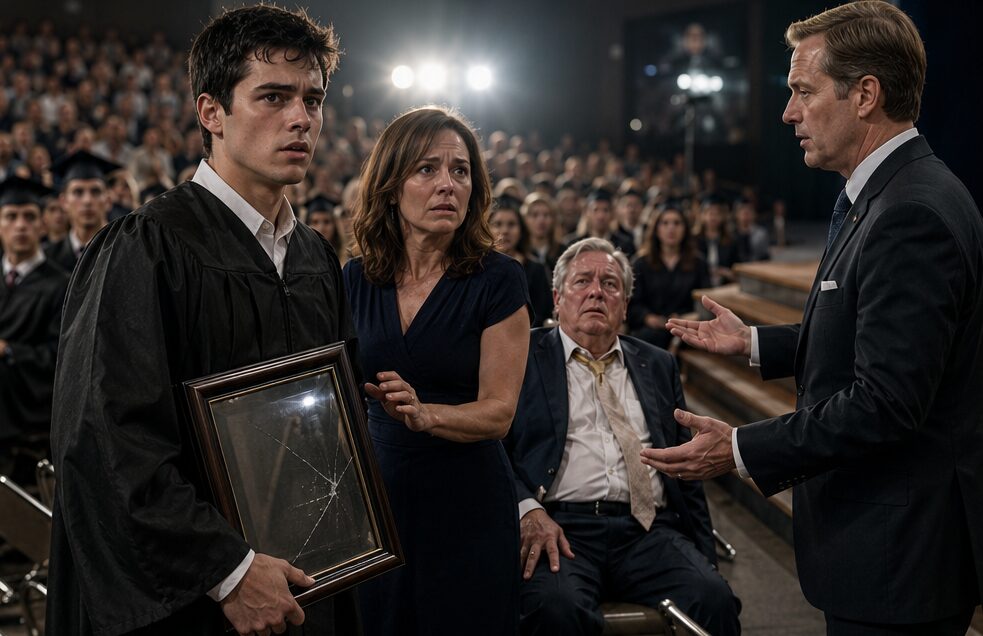
He pushed through the gap between two chairs, the award still clutched in his left hand. Jerry had slumped sideways against Laura, his face dark red, his hand still at his tie. Laura was trying to hold him up and call for help at the same time.
“Mom,” Brian said. “Let me in.”
She moved because she trusted that voice.
That was what broke him later.
Not the applause. Not the award. Not the crowd.
That his mother moved because, in that moment, she trusted him more than she trusted herself.
Brian dropped to one knee.
“Jerry. Look at me.”
Jerry’s eyes watered. His mouth worked silently.
Brian set the award down, but there was no room. The frame slid against the metal seat support and cracked with a bright, ugly sound.
Someone gasped as if that mattered.
Brian grabbed Jerry’s tie and pulled.
The knot held.
Of course it did.
Everything about Jerry had been tied too tight all day.
Brian hooked a finger under the fabric and yanked until the knot loosened. Then he worked open the collar button. Jerry’s skin was hot under his knuckles.
“Call 911,” Brian said.
“Already,” someone answered.
Laura was crying without sound.
Brian had seen her cry only twice before. Once when the roof repair estimate came in higher than expected. Once in the car after Jerry forgot Brian’s tenth birthday and then posted an old photo online like he had been there.
Now her face was open in a way he had never seen in public.
“Brian,” she whispered.
“I’ve got him.”
He did not know if that was true.
But he needed her to hear it.
He remembered the food pantry training. The laminated poster. The instructor saying, If they can’t cough, act. Don’t wait for permission from a room full of scared people.
So Brian acted.
The gym watched.
Hundreds of people. Maybe more.
Teachers. Parents. Old neighbors. Classmates with decorated caps. The retired principal Jerry had waved to. Everyone who had heard Jerry say family name and grit and my grandson.
They all watched Brian put one arm around the man who had spent the day claiming him.
They watched him help the man breathe.
Jerry coughed violently once, then again. A small piece of hard candy hit the floor near the chair leg.
Air came back into him in a rough, wet gasp.
The room exhaled.
Laura covered her mouth.
Brian stayed where he was, one hand on Jerry’s shoulder, the other still tangled in the loosened tie.
Jerry looked at him.
For once, he had no audience face left.
No polished line.
No story ready.
Just fear.
Just age.
Just the terrible humility of needing someone.
Paramedics arrived through the side doors minutes later, though it felt both instant and endless. They checked Jerry, spoke to him, lifted him carefully. He kept trying to sit up straighter.
“I’m fine,” he rasped.
Laura said, “Stop.”
The word was small.
It landed hard.
Jerry stopped.
Brian picked up the award from the floor.
The glass had cracked diagonally from one corner to the center, splitting his engraved name into two uneven halves.
Principal Miller came down from the stage, pale and shaken.
“Brian,” he said softly. “We can—we can restart, if you’d like. Give everyone a moment and present it properly.”
Properly.
Brian looked at the stage.
The microphone waited.
The banner waited.
The whole room waited to turn what had happened into something it could clap for.
He looked at the cracked award.
Then at his mother.
“No,” he said.
The principal blinked. “Are you sure?”
Brian nodded. “I got it.”
And that was enough.
Part VI — Not Like That
Outside, the afternoon sun was too bright.
The paramedics had Jerry sitting on the back step of the ambulance, checking him again while he argued weakly that he did not need to go anywhere. His tie hung loose around his neck, ruined in shape but still expensive. His suit jacket was folded beside him.
The graduation crowd had spilled onto the sidewalks in clusters, trying not to stare and staring anyway.
Phones were lowered when Brian looked over.
That was new.
People had been happy to record him when he was receiving something. They became embarrassed recording him after he had done something.
Laura stood near the curb, one hand wrapped around the strap of her purse, the other holding nothing. She looked smaller without a program to grip.
Brian walked to her.
For a moment, neither of them spoke.
Then she reached up and touched his cheek like she had when he was little and feverish. Her hand trembled.
“I’m sorry,” she said.
Brian frowned. “For what?”
“For letting you carry so much of it.”
The line went through him quietly.
He had imagined, more than once, that one day his mother would get angry in public. That she would tell Jerry exactly what he had missed. That she would stop protecting everyone from the truth.
He had not imagined this.
Her apology was not loud. It did not punish anyone. It did not fix anything.
It simply named the weight.
Brian looked down at the cracked award in his hand. “I didn’t want him to have today.”
“I know.”
“I didn’t even want him to matter.”
Laura’s eyes filled again, but she did not look away.
“That’s a hard thing to admit,” she said.
“I still helped him.”
“Yes.”
“I don’t know what that means.”
Laura touched the edge of the broken frame. “Maybe it means you get to decide.”
Behind them, Jerry cleared his throat.
He was standing now, despite the paramedic telling him to wait. He looked unsteady and embarrassed, which somehow made him seem more real than he had all morning.
“Brian,” he said.
The nearby conversations softened.
Not stopped.
Softened.
Jerry noticed. Brian saw him notice.
Even shaken, even weak, some part of him understood an audience.
He took one step forward. “I want to say something.”
Laura’s shoulders tightened.
Brian saw the speech forming. The proud-grandfather version. The grateful version. The one that would turn fear into redemption before anyone had time to ask whether redemption had been earned.
Jerry’s eyes shone.
“You saved me,” he said. “And I just want everyone to know—”
“Not here,” Brian said.
Jerry stopped.
The words had been quiet. They had still cut through the curbside noise.
Brian looked at him, not cruelly. That mattered. He was surprised by how little cruelty he felt now. The anger was still there, but it had changed shape. It no longer needed to prove it existed.
“Not like that,” Brian said.
Jerry’s mouth opened.
Closed.
For the first time that day, he seemed to understand that silence could belong to someone else.
The paramedic helped him back toward the ambulance. Laura went with him, not because all was forgiven, but because someone had to answer the questions and Jerry was still shaky enough to need help.
Before she climbed in, she looked back at Brian.
“You okay to drive home?”
He almost laughed.
After all that, she was still his mother.
“Yeah,” he said. “I’m okay.”
Katherine found him near the school sign ten minutes later. Her cap was in her hand, glitter smudged along one edge.
“So,” she said carefully, “you did take the plaque and run.”
Brian looked at the cracked frame.
“Didn’t get far.”
She stood beside him, watching the ambulance pull away without sirens.
For once, she did not joke.
After a while, she said, “You know everyone’s going to talk about this.”
“I know.”
“They’ll make it sound simple.”
“I know.”
“It wasn’t.”
Brian looked at her.
Katherine gave him a small, sad smile. “That’s all I meant.”
He nodded.
The school lawn was full of families taking pictures. Graduates threw caps. Parents cried. Younger siblings complained about the heat. Life kept arranging itself into scenes people could understand.
Brian held the broken award under one arm and walked to the car.
That evening, after the calls were made and the neighbors had stopped pretending they were only checking in about graduation, Brian and Laura came home to the quiet kitchen.
The same kitchen where the day had started.
The same table.
The same chair with one uneven leg.
Laura took off her shoes by the back door and leaned against the counter. For the first time all day, she looked tired without trying to hide it.
Brian set the award on the table.
The cracked glass caught the overhead light.
His name was still readable, though split by the fracture. The words CHARACTER AWARD curved above it, untouched.
Laura looked at it for a long time.
“I can get the glass replaced,” she said.
Brian thought about it.
The principal would probably offer. The school might order a new frame. Jerry might insist on paying, if he could turn it into a gesture. There were a dozen ways to make it look the way it had looked before.
“No,” Brian said.
Laura looked up.
“Leave it.”
She did not ask why.
That was how he knew she understood.
Later, Jerry would call. Not that night, but soon. He would start badly. He would say too much. He would try to thank Brian in a voice that wanted to become a speech. Brian would have to stop him again, maybe more than once.
Laura would have to learn how to let uncomfortable words stay in the room.
Brian would leave for college in August, and people in town would still tell the story wrong. They would say he was a hero. They would say his grandfather was lucky. They would say what a beautiful moment it had been.
They would not know about the kitchen.
They would not know about the tie.
They would not know that the hardest part had lasted only one second—the second when Brian was angry enough not to move, and moved anyway.
Laura came to stand beside him.
Without asking, she rested her hand over his on the back of the kitchen chair.
The award sat between them, cracked and shining.
Not ruined.
Not perfect.
His.