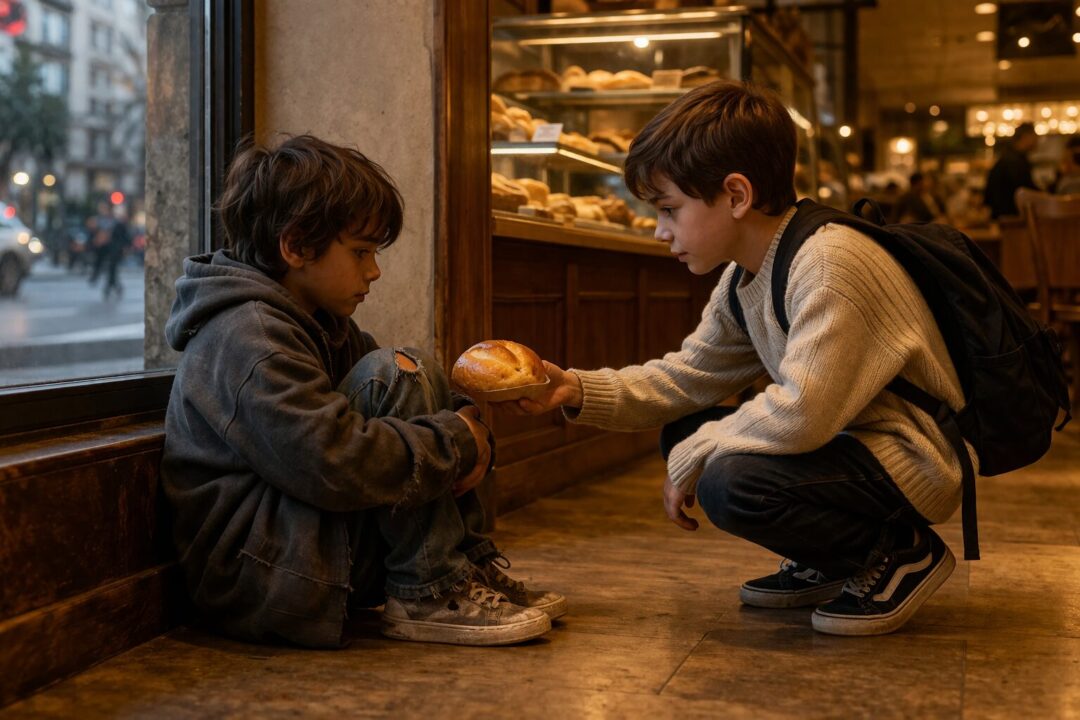
The Boy by the Bread Case
The Boy by the Bread Case
Part I — The Warmest Place in the Room
By the time the smell of fresh bread reached him, Niko had already decided he would not cry.
He stood just outside the glass display case in the bakery, one hand pressed lightly to his stomach as if he could quiet it that way. Inside, rows of golden rolls and small round loaves sat under warm lights that made them look softer than anything in the world. The bakery itself seemed built to comfort people. It glowed amber against the gray afternoon outside. Steam fogged the lower corners of the windows. Cups clicked against saucers. Someone laughed softly near the back.
Everything inside felt warm except Niko.
His hoodie hung off his small frame like it had belonged to someone taller first. The sleeves swallowed part of his hands. His sneakers had long ago given up pretending to keep water out. He kept his eyes on the bread because looking at the customers was worse. Customers had the easy posture of people who expected good things to happen to them. They walked in already deciding what they wanted. They didn’t need to calculate the price of each choice in their heads. They didn’t need to pretend they weren’t hungry.
Niko had learned that pretending could save a little dignity, even when it saved nothing else.
He told himself he had only stepped inside for warmth.
That was not entirely a lie.
The weather had turned colder than it should have for the season, and the damp wind had a way of slipping through fabric and going straight to the bones. He had been outside too long already, sitting near the bus stop across the street and watching people come and go with paper bags tucked under their arms. He had lasted nearly an hour before the smell dragged him across the road.
He was not supposed to be there at all.
His mother had left before dawn for another shift cleaning offices on the north side of the city. Some weeks she found enough work to come home with tired feet and a little money. Some weeks she came home with only tired feet. That morning she had kissed the top of his head while he was half asleep and whispered that there was rice left in the pot if he was hungry later. But by noon his younger sister had eaten the last of it, and Niko had told her he wasn’t hungry anyway.
He had gotten good at saying that too.
Now the bakery lights blurred for a second, and he blinked hard.
A man in a dark coat stepped beside him, close enough that Niko could smell cologne and rain on expensive wool. The man looked down at the shelves, then pointed at one of the round loaves. His voice was low and bored, the voice of someone who had never once wondered what it felt like to watch food from the wrong side of the glass.
Niko did not move. For one humiliating second, hope still flickered in him.
Sometimes adults noticed. Sometimes a woman would press a banana into his hand outside the market, looking embarrassed by her own kindness. Once, months ago, a delivery driver had bought him a hot bun without being asked. Those moments were dangerous because they taught the heart to expect rescue.
The woman behind the counter wrapped the loaf in paper and handed it over. The man paid, tucked the bread under his arm, and turned. His shoulder passed so close to Niko that the paper brushed the sleeve of Niko’s hoodie.
He did not look down.
He did not pause.
He walked out into the cold carrying warmth with him.
Something in Niko shifted then—not sharply, not dramatically. It was softer than that. It was the small internal movement of a door closing.
He stepped away from the display case.
Near the side wall, where the bakery kept two small wooden chairs and a bench for people waiting on takeout, he lowered himself to the floor instead. It was easier there. Easier to disappear below eye level. Easier not to stand like a question no one wanted to answer.
He drew his knees up and pressed his forehead to them for a moment. The floor was clean. The wall behind him was warm from the heaters hidden somewhere inside it. He listened to the rise and fall of voices, the hiss from the espresso machine, the bell over the front door opening and closing.
“It’s okay,” he whispered.
The words sounded thin, almost polite.
He was not sure whom he was trying to comfort.
Part II — What Adults Miss
Across the room, Eli had been waiting for his father to return from answering a phone call outside.
He sat at a small table near the window, his backpack hooked over one shoulder even though his father always told him to take it off indoors. There was a paper bag on the table in front of him. Inside it were two warm milk rolls his father had bought after school, the kind with soft centers and a sweet shine on top. Eli had already eaten one in three quick bites. The second was still in the bag, untouched.
He would remember later that he saw the boy near the bread case before he understood anything about him.
First he noticed the stillness.
In a bakery, everyone moved with purpose. Customers stepped forward, paid, collected bags, checked phones, looked for seats. Even the people waiting had a certain confidence in their waiting, as though they had every right to take up space until what they wanted arrived.
But the other boy stood too quietly. Not like he was choosing to wait. More like he was trying not to be noticed while wanting something desperately.
Eli had seen that look before, though not often.
His grandmother used to say that hunger changed a face in ways people mistook for bad manners. It made children stare too long at food. It made them slower to smile. It made them careful around generosity, as if kindness might be snatched back the same way it was given.
His grandmother noticed things adults rushed past.
When Eli had been younger, he once asked her why she always packed extra fruit in her bag. She said, “Because sometimes the person who needs it most won’t ask.”
Now, from his table, Eli watched the man in the dark coat buy the bread. He watched the boy hope. That part was visible, though only if you were looking for it. A tiny leaning forward. A quick brightening in the eyes. The body answering before life had given permission.
Then he watched the man leave.
The change in the boy was so small it might have escaped anyone who wasn’t already watching.
Eli felt a strange heat rise under his collar.
He looked toward the door, expecting his father to come back in any second. Through the window, he could see him pacing on the sidewalk with a phone pressed to his ear. His father talked with one hand, the other chopping the air in irritated little movements. He might be another minute. He might be five.
By the wall, the other boy sat down on the floor.
Eli looked at the paper bag on his table.
Then at the boy.
Then back at the bag.
There were moments in childhood when the world arranged itself with such painful clarity that not choosing felt like a choice too. Eli did not think of himself as particularly brave. He was just a boy in a cream sweater with a roll in a paper bag and a warm life waiting for him at home. But he knew, with the immediate certainty children sometimes have before adults complicate things, that if he sat there and ate while the other boy hugged his knees against the wall, something would go wrong inside him.
He slipped out of his chair.
The roll felt hot even through the paper.
As he crossed the bakery, no one stopped him. No one asked where he was going. A barista glanced up, then back down at the register. A woman in line adjusted her scarf. The room continued around him as though nothing important were happening.
Maybe that was what made the moment feel so sharp. The world did not pause for quiet suffering. It rarely did.
The boy on the floor heard Eli’s shoes before he looked up.
Up close, he seemed younger than Eli had first thought, though maybe that was only because hunger made him look so tired. His eyes were dark and guarded. His hoodie was too big. One of the drawstrings had come loose and frayed at the end. He looked like a child who had learned to make himself smaller than his actual body.
Eli knelt.
For a second, he worried he might do it wrong. He worried the other boy would think he was teasing him. He worried kindness, if offered badly, could humiliate as much as cruelty.
So he did the simplest thing he could.
He held out the bread.
“You can have this,” he said.
The boy looked at the roll, then at Eli’s face, as if one of them had to be lying.
“For me?” he asked quietly.
The question landed harder than Eli expected. Not because it was sad exactly, but because of how careful it was. As if being chosen was something that required verification.
Eli nodded. “Yeah.”
The boy’s hand came out slowly, then stopped midway, almost asking permission again without words.
Eli smiled a little, not wide enough to make the moment heavy. “Really. It’s yours.”
The fingers closed around the bread.
It should have ended there. That, after all, was the act: one boy giving another boy food.
But Eli had already understood something else while crossing the bakery. Hunger was only part of what he had seen by the bread case. The other part was loneliness. The kind that grows in public, in full view of people who do not mean to be cruel but do not stop being indifferent either.
So instead of standing up, Eli sat down beside him.
He opened the paper and broke the roll in half.
“We can share,” he said.
For the first time, the boy truly looked at him.
Part III — The Shape of Kindness
His name, Eli learned a little later, was Niko.
The name came after silence, after the first bite, after the tightness in Niko’s shoulders loosened enough for breathing to look ordinary again.
Before that there was only the sound of soft bread tearing, then chewing, then the strange gentle quiet that settles when a person begins to believe they are safe for at least one minute.
Eli held his half of the roll without eating at first. He wanted Niko to stop checking the piece in his own hand, to trust that no one was about to take it back. Children knew more about the fragility of good things than adults liked to admit.
Around them, the bakery kept moving.
The front bell rang. Cups clinked. Someone laughed too loudly near the window. The ordinary world continued to orbit their little patch of floor, and somehow that made the moment feel even more private. As if kindness was not a grand interruption after all, but a choice a person could make quietly while everyone else stayed busy.
Niko swallowed and looked down at the bread in his fingers.
“Thank you,” he said.
His voice was so soft that Eli almost missed it.
“You’re welcome.”
Niko nodded once, like he had received something too large to carry and was trying to hold it carefully.
Eli finally took a bite of his own half. The bread was still warm in the middle. Sweet. Too sweet, almost, for the heaviness of the moment. Yet that sweetness seemed to matter. Niko tasted it too, and something in his face changed. Not a smile exactly. More like surprise that softness still existed in the world.
“What’s your name?” Eli asked.
Niko hesitated, then answered.
Eli told him his own.
That might have been the end of it too—two names exchanged, a small mercy completed, a kindness that glowed briefly and vanished into memory.
But just then the bakery door opened, and Eli’s father stepped back inside.
He looked first toward the table by the window, saw it empty, and frowned. Then his gaze found Eli on the floor by the wall, sitting beside a boy in an oversized hoodie. Confusion crossed his face, followed by the quick alarm adults often feel when their children do something unscripted in public.
“Eli?”
Eli turned.
His father walked over, still holding his phone in one hand. His expression was not angry, not yet. Mostly startled. He looked from Eli to Niko, then to the torn bread between them.
For one horrible second, Niko’s hand tightened around his half.
Eli saw it happen. Saw the old reflex return, the instinct to guard what little had been given.
“This is Niko,” Eli said before his father could ask anything.
His father looked down at Niko more closely then, and something in his own face softened. It was subtle, but Eli saw it. Adults were not always blind. Sometimes they simply needed longer than children to arrive where the moment was asking them to go.
“Hi, Niko,” he said.
Niko gave the smallest nod.
Eli’s father crouched slightly so he would not tower over them. His eyes moved once over Niko’s clothes, the too-thin sleeves, the shoes that had seen too much weather. Then he looked at Eli again.
“You gave him your roll?”
Eli braced himself, though he wasn’t sure for what.
“We shared it,” he said.
His father stared at him for a beat, then let out a breath through his nose that could have become many things. Irritation. A lecture. A warning about strangers. Instead it became something quieter.
“Right,” he said.
He straightened, walked to the counter, and spoke to the woman there.
A minute later he came back with a larger paper bag and a cup of hot milk.
He handed the milk to Niko first.
Niko looked up with the same careful uncertainty as before, and Eli’s father, perhaps remembering that question without having heard it, added gently, “Yes. For you.”
The boy took it with both hands.
“What about his family?” Eli asked.
His father glanced at Niko. “Can you tell me where you live?”
Niko gave an answer in pieces at first, reluctant and embarrassed, but the warmth of the milk and the steady, matter-of-fact tone of Eli’s father slowly coaxed the details out. An apartment building three streets away. A mother at work. A little sister at home. No lunch. No complaint in any of it, which somehow made it worse.
Eli’s father listened without interruption.
Then he asked if Niko would let them walk him home.
Niko looked as if he wanted to refuse on instinct alone. Pride had survived where comfort had not. But he looked at the paper bag. At the milk. At Eli. Finally he nodded.
Outside, the cold met them all at once.
Eli walked on one side of Niko, his father on the other, though not so close that it felt like escorting a suspect. The city looked different now, sharper somehow. The people hurrying past seemed wrapped in separate lives, sealed against one another. Eli wondered how many of them had been in the bakery while Niko sat by the wall. How many had seen and not really seen.
Niko’s building was older than Eli expected, with peeling paint around the entrance and a mailbox panel that leaned slightly to one side. A little girl answered before they had fully knocked, as if she had already been waiting by the door. She was younger than Niko, with the same dark eyes and the same habit of trying to stand bravely when uncertain.
When she saw the food in Niko’s hands, her whole face changed.
Then their mother appeared behind her.
She was still wearing the uniform from work, her hair pinned back hastily, exhaustion visible in the set of her shoulders. At first alarm flashed across her expression—the instant fear of a parent seeing strangers at the door with her child. Then Niko spoke quickly, and her gaze moved from him to Eli to Eli’s father and finally to the bakery bag.
No one used the word need.
No one used the word charity.
That mercy mattered.
Eli’s father explained only that they had met Niko at the bakery and thought he might like something warm to eat. Niko’s mother listened with one hand pressed against the frame of the door. For a moment she looked as though she might apologize for the entire shape of her life.
Instead, she said, very quietly, “Thank you for seeing him.”
Not helping him.
Seeing him.
Eli felt those words settle somewhere deep in him, somewhere he knew he would keep them for a long time.
Part IV — What Stayed
After that afternoon, the city did not transform into a gentler place.
The bakery still filled with customers who hurried in and out. Cold days still came. Bills still arrived in homes that could not afford them. Eli’s father still took phone calls that made his forehead tighten. Niko’s mother still worked too much for too little. The world did not reward one loaf of bread by suddenly becoming fair.
But something had shifted.
Eli asked his father, the next day and then the day after, whether they might stop by Niko’s building again. The first time they brought soup from the deli and oranges from the market. The next time, one of Eli’s sweaters that no longer fit him. Then school supplies. Then nothing dramatic at all—just time, conversation, the steady refusal to let a door that had opened close again.
Niko remained cautious for weeks. Kindness had always come to him unpredictably, and unpredictable things were hard to trust. Yet he began to speak more. He laughed once at something Eli said, then looked startled by the sound of his own laughter. His little sister, Mira, trusted almost immediately. Children often did, once hunger loosened its grip.
By spring, Eli and Niko could no longer remember exactly when they had stopped being two boys who met in a bakery and become simply friends.
Sometimes they still went there together.
They never sat at the tables first.
They always paused by the bread case.
Not because of sadness alone, though some of that remained. Memory should remain, Eli thought. Otherwise comfort turns careless. They paused because that glass case had become, in its strange way, a border between two versions of the world. In one, people moved past each other carrying warmth away. In the other, someone stopped.
One afternoon, months later, Eli watched Niko buy a small roll with coins he had saved from helping an elderly neighbor carry groceries upstairs. As they turned to leave, a thin man stood near the entrance with rain on his sleeves and the hollow look of someone pretending not to be hungry.
Niko slowed.
He looked at the roll in his hand.
Then at Eli.
Nothing needed to be said.
Niko walked back, broke the bread cleanly in two, and held out one half.
The man blinked in surprise.
Niko smiled, just a little. “You can have this.”
Eli saw, in that instant, the full shape of what had happened in the bakery months earlier. Kindness had not ended with relief. It had moved. It had traveled from one hand to another, changing each person it passed through without ever announcing itself loudly enough to be called heroic.
On the walk home, Eli asked Niko if he remembered the first thing he had said while sitting by the wall.
Niko’s ears reddened. “No.”
“You said, ‘It’s okay.’”
Niko groaned softly, embarrassed. “I did not.”
“You did.”
They kept walking.
After a moment Niko kicked lightly at a crack in the sidewalk and said, “It wasn’t okay.”
“No,” Eli said. “It wasn’t.”
Niko glanced at him. “But then it was.”
The evening sun fell in strips of gold across the street ahead of them. People passed with grocery bags, umbrellas, tired faces, private plans. Somewhere nearby, bread was baking again.
Eli thought of the first time he had seen Niko by the glass case, all that hunger and silence held inside one small body. He thought of how close the day had come to ending there, in that quiet unnoticed corner, with a boy on the floor whispering comfort to himself because no one else had offered any.
Then he thought of what had followed: a kneeling child, torn bread, a shared seat by the wall, a mother at a doorway saying thank you for seeing him.
Some moments were small enough to fit inside a hand.
And still they could change the shape of a life.