The Wealthy Neighbor Who Tried To Evict The Old Fisherman From His Own Federal Shoreline
Chapter 1: The Garbage Bag Across The Fence
The garbage bag struck the hood of Daniel Young’s RV just as he lifted a silver fish from the water.
Plastic split across faded paint. Coffee grounds, eggshells, and wet paper slid down the windshield in a brown sheet. The fish twisted above the reeds, flashing once in the morning light before Daniel lowered it into the shallows and worked the hook free.
From beyond the old fence came a man’s voice.
“Get your junk off my view.”
Daniel released the fish. It vanished beneath the dark surface with one hard stroke of its tail.
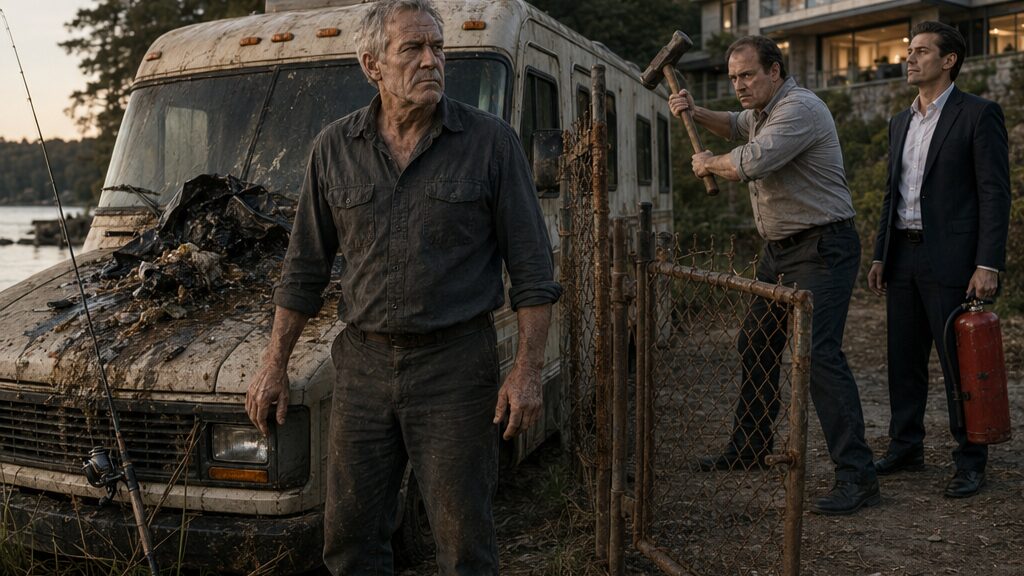
He stood slowly, not because he needed to, but because men watching an older body often revealed more when they believed it weak. He was sixty-eight, broad through the shoulders despite the slight bend in his back, dressed in a faded work shirt and trousers marked with river mud. His weathered RV rested beneath the trees behind him, its cream-colored panels streaked with age.
Across the fence, Gregory Moore stood in polished shoes that had never touched the shoreline. Behind him rose the glass walls and pale stone terraces of the mansion he had purchased three months earlier. Two contractors near the patio had stopped carrying outdoor furniture. Both were watching.
Gregory pointed at the burst garbage.
“That’s what this place looks like from my dining room.”
Daniel wiped his hands on a cloth and walked toward the hood.
The smell was sour and warm. A broken jar had left a scratch near the windshield seal. Daniel photographed the bag, the arc of debris, then Gregory standing on the other side of the fence.
Gregory gave a thin smile.
“You taking pictures of me?”
Daniel took one more.
“You threw it.”
“I’m cleaning my property.”
Daniel looked down.
The fence between them was old enough that rust had eaten pits into its top rail. Beyond Gregory’s shoes, weeds concealed a brass survey marker driven into stone. Daniel stepped closer and touched the rail with two fingers.
“Your property ends there.”
Gregory glanced down but did not see what Daniel meant.
“My property extends to the water. That was part of the sale.”
“No.”
The answer landed harder than Daniel intended. Gregory’s face tightened.
“You’ve been squatting here for weeks. The police won’t do anything because you sit there pretending to fish. I have investors coming Friday. They will not be looking at a rusted camper and a homeless man drinking coffee beside it.”
Daniel took hold of the torn bag and lifted it from the hood.
One contractor turned away. The other did not.
Gregory noticed.
“This is not complicated,” he said more loudly. “Move the vehicle. Today.”
Daniel carried the garbage to a metal bin beside the RV.
“I’m staying.”
The contractor who had kept watching lowered his eyes.
Gregory’s anger sharpened. It was not only Daniel’s refusal. It was the refusal delivered without argument, as though Gregory’s money, house, and witnesses had no weight at all.
“The property manager has already authorized removal,” Gregory said. “You’re trespassing.”
Daniel looked toward the hidden survey marker.
“Ask him which parcel.”
Gregory gave a short laugh. “You think numbers are going to save you?”
“Numbers usually decide where fences go.”
For the first time, Gregory followed Daniel’s gaze. Daniel pushed aside the weeds with the toe of his boot. The round brass marker showed beneath them, stamped with a parcel code.
Gregory stared at it.
His mansion’s lawn stopped six feet before the fence.
The strip between marker and rusted posts belonged to the shoreline parcel, not the development. It was narrow here, widening where Daniel’s RV sat beneath the trees. The distinction had been buried beneath landscaping plans and glossy sales language, but the ground still knew where it ended.
Gregory recovered quickly.
“That proves nothing.”
“It proves your landscaper crossed the line.”
Gregory looked toward the freshly cut strip of grass along Daniel’s side of the fence. A worker had trimmed it the previous afternoon.
“You’re trying to intimidate me with an old bolt in the ground.”
“It’s a survey monument.”
“And you are still leaving.”
An engine sounded on the road behind Gregory’s house. A white utility vehicle rolled down the private drive and stopped near the fence. Stephen Smith climbed out carrying a leather folder.
Stephen was younger than Daniel by perhaps fifteen years, but he moved like a man whose knees had begun sending warnings. His shirt bore the development company’s name. A ring of keys hung at his belt.
Gregory spread one hand toward Daniel.
“There. Now you can hear it from someone official.”
Stephen approached with a careful smile that did not reach his eyes.
“Mr. Young?”
Daniel noticed that Stephen knew his name.
“Yes.”
“I manage the residential properties adjacent to this waterfront.” Stephen opened the folder. “We have received repeated complaints concerning unauthorized occupancy, waste accumulation, visual nuisance, and obstruction of common shoreline access.”
Daniel looked at the garbage still dripping down the RV hood.
Stephen followed his gaze but did not acknowledge it.
“This is a formal notice to remove the vehicle within twenty-four hours.”
He slid a sheet through the fence.
The paper carried a raised seal, a property-management letterhead, and Daniel’s license plate number. It looked official enough to frighten anyone who did not read the smaller print.
Daniel did.
The parcel number belonged to a landscaped drainage strip two blocks inland.
“You posted the wrong land.”
Stephen’s smile faded by a fraction.
“The filing system was updated.”
“The parcel wasn’t.”
“The development holds access rights.”
“Show them.”
Gregory stepped forward. “Stop playing games.”
Daniel kept his attention on Stephen.
“Who gave you my plate number?”
“It’s visible.”
“Not from the road.”
Stephen folded his arms. “You have until tomorrow morning.”
Daniel held the notice by one corner.
Years of work had taught him that false authority usually depended on speed. A uniform, a seal, a raised voice, a deadline—each one designed to keep the other person from looking closely.
Stephen had all four except the uniform.
Daniel glanced at the keys on his belt.
One was long and silver, newer than the rest.
“Your office has access to this gate?”
Stephen’s hand moved unconsciously toward the key ring.
“For maintenance.”
“No maintenance agreement covers this parcel.”
Gregory shook his head in disbelief. “Listen to him. He lives in a rotting truck and thinks he’s a lawyer.”
Daniel did not answer. He watched Stephen instead.
The property manager stepped toward the gate.
The lock was thick, black, and partially hidden behind a steel shield. Daniel had been told only three authorized personnel possessed working keys. One was in his pocket. Another was secured inside the RV. The third was held by a federal facilities office more than forty miles away.
Stephen selected the long silver key.
Daniel’s hand tightened around the false notice.
“Don’t.”
Stephen inserted the key into the restricted lock.
It turned.
Chapter 2: The Notice With The Wrong Number
“He threatened me with a knife.”
Gregory said it before Officer Katherine Adams had fully closed her patrol-car door.
Daniel stood inside the fence with the false removal notice folded in one hand. He had heard no earlier accusation. Gregory had apparently prepared a better version of the morning while waiting for the police.
Katherine looked from Gregory’s tailored clothes to Daniel’s mud-stained boots.
“What knife?”
“He reached toward his belt and told me I’d regret coming near him.”
Daniel’s belt held a pair of pliers, a folding ruler, and a canvas sheath containing a fishing tool with a narrow blade.
He said, “He threw garbage at my vehicle.”
“That is not what I asked,” Katherine replied.
Her tone was controlled rather than hostile. She appeared to be in her early forties, with dark hair pulled firmly back and the tired attention of someone accustomed to arriving after everyone had already decided what had happened.
Stephen stood near the gate with his folder tucked beneath one arm. The silver key was no longer visible.
Katherine stopped outside the fence.
“Did you threaten Mr. Moore?”
“No.”
“Did you touch a knife?”
“I cleaned a fish.”
Gregory scoffed. “You see how he talks?”
Katherine ignored him.
“Did you tell him he would regret coming near you?”
“No.”
“What did you tell him?”
“That his property ends before the fence.”
Katherine glanced toward the brass marker exposed in the weeds.
Stephen moved quickly into the silence.
“Officer, the relevant issue is unlawful occupancy. My company manages this development, including shoreline access. We served Mr. Young with notice.”
Daniel held up the paper.
“Wrong parcel.”
Katherine extended her hand through the bars. Daniel passed it to her.
She read the first page, then the second. Gregory paced beside her, glancing toward his house where the contractors had resumed work but were clearly listening.
“This man has been here nearly a month,” Gregory said. “There’s wiring running from the vehicle, cameras, antennas. Children walk through this area.”
“No children walk through here,” Daniel said.
“It is supposed to be common access.”
“No.”
Gregory faced Katherine. “He says no to everything. That doesn’t make him right.”
Katherine examined the parcel number. “Mr. Smith, where is the map associated with this notice?”
“At the office.”
“You served an eviction-style demand without bringing a legal description?”
“It’s not an eviction. It is a removal notice.”
“Based on what authority?”
Stephen’s jaw shifted.
“Our management agreement.”
Katherine looked at the gate. “You unlocked this?”
“For inspection.”
Daniel said, “He did not enter.”
Katherine turned to him. “Because you stopped him?”
“Because he reconsidered.”
Stephen’s expression hardened, but he said nothing.
Katherine studied the fence. Its rust made it look neglected, but the posts were sunk in concrete and reinforced at irregular points with newer steel. She moved along it slowly, reading the ground.
Daniel knew what she would notice before she reached it.
A dark circle sat behind a flake of rust near one post, no wider than a shirt button.
She leaned closer.
“Camera?”
Daniel remained silent.
Gregory seized the opening.
“I told you. He records my home. He sits out here watching us.”
Katherine looked through the bars at Daniel. “Why is there a concealed camera in the fence?”
“It records the gate.”
“That camera faces more than the gate.”
“It covers my boundary.”
“Your boundary according to what?”
Daniel could have ended part of the dispute in less than a minute. The deed was locked inside the RV. A secure number could confirm his connection to the property. Another call could establish that Stephen had no right to cross the gate.
But each disclosure narrowed the space in which the operation could continue unnoticed.
He had made that calculation many times.
He had made it once, years ago, in the other direction.
He remembered frightened civilians, a shouted explanation, a light turning toward the reeds, and a man beside him falling before the warning had finished leaving Daniel’s mouth.
Katherine waited.
Daniel said, “A survey.”
“Show me.”
He went to the RV.
Gregory called after him, “Watch him. He could have anything in there.”
The door opened only far enough for Daniel to enter. He closed it behind him.
Inside, the smell changed from river mud and rotting garbage to warm electronics and metal. Dark monitors lined one wall beneath wood-grain panels designed to resemble cheap cabinetry. Locked compartments occupied the space where travelers would expect a bed.
Daniel opened a narrow drawer and removed an old survey map, its folds softened from years of handling.
He did not touch the secure files beneath it.
When he returned, Katherine was questioning Stephen about the parcel code.
Daniel spread the map against the fence.
The shoreline boundary ran in a crooked line from the road to the water. Gregory’s mansion sat outside it. The old fence followed that line almost exactly.
Katherine compared the map to the notice.
“This code ends in fourteen,” she said.
Stephen nodded. “Correct.”
“The notice ends in forty-one.”
“A clerical transposition.”
“The listed acreage is also wrong.”
Stephen’s face reddened. “The current digital record differs from these historical documents.”
Daniel pointed to the survey stamp. “The boundary was reaffirmed twelve years ago.”
Katherine looked at him. “How did you get this?”
“It came with the land.”
“Your land?”
Daniel folded the map once.
Gregory laughed, but the sound carried strain. “Now he owns the shoreline.”
Katherine did not laugh.
“Do you?”
Daniel looked toward the RV. A faint vibration traveled through the ground as an internal cooling unit changed speed.
“I have lawful control of this parcel.”
“That isn’t the same answer.”
“It is the answer I can give.”
Katherine’s eyes narrowed.
“You want me to believe you have lawful control, but you will not show a deed. You have concealed cameras. You live in a vehicle with covered windows. And you refuse to explain why a property manager has a key to your gate.”
“I don’t know why he has it.”
Stephen said, “Because my office has maintained this shoreline for years.”
Daniel turned toward him.
“Name one repair.”
Stephen opened his mouth, then closed it.
Katherine handed the notice back through the fence.
“I cannot enforce this paper as written. Mr. Smith, do not enter until ownership and access are verified. Mr. Moore, stop throwing anything over the fence. Mr. Young, I need identification.”
Daniel provided his driver’s license.
She checked it in the patrol car, returned, and spoke more quietly.
“You have no local warrants. The vehicle registration is valid. That does not explain the cameras.”
“No.”
“Or the gate.”
“No.”
Her patience thinned.
“Secrecy makes people nervous.”
“So do false notices.”
“That is not an answer either.”
Gregory stood a few yards away with his arms folded. Stephen had moved beside him, speaking under his breath. Daniel saw Gregory glance toward the RV and then toward the camera post.
Katherine returned Daniel’s license.
“I am documenting the complaint and the defective notice. If either side crosses that fence or damages property, this stops being a civil disagreement.”
She looked directly at Daniel.
“And if there is something dangerous in that vehicle, you need to tell someone before we find out the difficult way.”
Daniel slipped the license into his pocket.
Katherine left without accepting Gregory’s invitation to view the mansion security footage.
By late afternoon, the shoreline had gone still.
Daniel cleaned the RV hood, repaired the scratch near the windshield, and waited until Gregory’s contractors had departed. Then he entered the vehicle and sealed the door.
The false cabinets unlocked under his hand.
Three monitors came alive.
One showed the gate. Another displayed a map of the waterfront. The third held a dark field crossed by narrow lines of green.
A signal pulsed.
Daniel leaned closer.
It had appeared twice during Katherine’s visit and vanished before he could isolate it. Now it returned in a repeating encrypted burst.
The source marker moved along the map, then stopped.
Not at the water.
Not near the road.
It settled within the grounds of Gregory Moore’s mansion.
Chapter 3: What The Fishing Line Was Watching
The fishing float came out of the water with a crack running through its black casing.
Daniel held it above the reeds while droplets fell from the broken seam. The damage was not from a boat propeller or rock. One side had been flattened by a deliberate strike.
On Gregory’s dock, fifty yards downshore, a metal boat hook rested against a railing.
Daniel reeled in the remaining line.
The float looked ordinary from a distance—faded red paint, a chipped white band, a metal eyelet where the line passed through. Inside it sat a passive sensor no larger than a matchbox. It listened for short encrypted transmissions crossing the water and stored their direction, strength, and timing without sending a signal of its own.
Someone had hit it hard enough to fracture the housing.
Daniel carried it into the RV.
He placed the broken float beneath a work lamp and connected the sensor to the command console. Data scrolled across the screen. The unit had continued recording until the moment of impact.
A secure channel opened.
Jerry Thomas appeared on the monitor wearing reading glasses low on his nose. Gray had spread through his beard since Daniel had last seen him in person, but the impatience in his eyes had not changed.
“That is not normal wear.”
“No.”
“Boat?”
“Hook or pole.”
“Moore?”
“His dock.”
Jerry removed his glasses. “I asked whether he did it.”
“I don’t know.”
“You have six cameras and a directional array.”
“The dock is outside the perimeter.”
Jerry muttered something and leaned toward another screen.
They had worked together long enough that silence rarely meant agreement. Jerry used it now while examining the recovered data.
Daniel turned the float under the light. The crack resembled a thin black river across its surface.
“Signal returned yesterday,” Daniel said.
“I saw.”
“Source stopped near the mansion.”
“Near is not inside.”
“It held for nine seconds.”
“And then crossed two hundred yards in less than one.”
Daniel looked at the tracking map.
“Mobile relay.”
“Probably.”
“Vehicle?”
“Boat, drone, handheld repeater. We still don’t know.”
The operation had begun four months earlier after encrypted bursts appeared along the waterfront at irregular intervals. The transmissions were brief, difficult to triangulate, and always followed by movement across the river corridor. No single burst contained enough information to justify open action. Together, they suggested someone was using the shoreline to relay stolen federal access credentials.
The old RV had been placed where it could watch without appearing to watch.
Daniel had volunteered because the parcel was his.
Jerry had objected because the parcel was his.
“You need to preserve cover,” Jerry said. “No arguments with the neighbor. No displays. No reason for anyone to examine the vehicle.”
“He damaged an external sensor.”
“You can replace it.”
“He may have damaged it because he saw the line move against the current.”
“Or because he hates fishing floats as much as he hates your RV.”
Daniel set the cracked casing aside.
Jerry studied him.
“You want Gregory involved.”
“I want the signal explained.”
“You want his arrogance to mean something useful.”
Daniel said nothing.
Jerry’s face hardened. “Not every man who insults you is part of the operation.”
“I know.”
“Do you?”
A heavy sound struck the RV from outside.
Both men froze.
Another impact followed, then the wet slide of something across metal.
Daniel killed the monitor and moved to the side camera.
Gregory stood beyond the fence beside three black garbage bags. One was already split across the RV hood. Another had landed against the front panel. He lifted the third with both hands.
Daniel reached for the door.
Jerry’s voice came through the darkened speaker.
“Don’t.”
The third bag sailed over the fence.
It struck the hood near the windshield and burst. A glass bottle inside punched through the false ventilation grille beneath the paint. The grille concealed a communications housing.
A warning light flashed on Daniel’s console.
Signal amplifier fault.
He stood with one hand on the door latch.
Outside, Gregory shouted, “Twenty-four hours means twenty-four hours.”
Daniel could see him through the camera—expensive shirt open at the collar, face flushed, movements too energetic for the early hour. He was not simply angry. He was performing for someone.
On the mansion terrace, two men in business clothes watched beside a woman holding a tablet.
Gregory pointed toward the RV.
“This is what happens when local government refuses to act.”
The woman raised the tablet, perhaps recording.
Jerry said, “Stay inside.”
“He damaged the housing.”
“We can reroute.”
“He crossed from nuisance to interference.”
“He doesn’t know that.”
“That doesn’t undo it.”
Daniel opened the door.
The river wind carried the smell of spoiled food and detergent. Gregory stepped closer to the fence when Daniel emerged.
“Finally.”
Daniel walked to the hood. Brown liquid dripped from the damaged grille. A glass neck protruded through it.
“You broke something,” Daniel said.
Gregory spread his hands. “It’s garbage hitting garbage.”
The people on the terrace heard him. One smiled uncertainly.
Daniel pulled the bottle free. Beneath it, a fiber line had been cut.
He imagined crossing the fence, taking Gregory by the shirt, and walking him to the brass marker until polished shoes stood exactly where his property ended.
The image came easily.
So did another.
Reeds at night. Civilians crouched beside a drainage wall. Daniel speaking because they were frightened and would not move without an explanation. A light turning. The suppressed crack from across the water. His partner dropping against him before anyone understood what had happened.
Daniel placed the broken bottle on the ground.
“One warning,” he said.
Gregory leaned forward. “Or what?”
“Do not throw anything else over this fence. Do not open the gate. Do not touch the vehicle.”
The restraint in Daniel’s voice seemed to disappoint him.
Gregory looked back at his guests, then smiled.
“You hear that? The squatter is issuing rules.”
Daniel returned inside.
Jerry was waiting on the monitor when he restored the secure channel.
“You should have stayed in.”
“He needed a warning.”
“He had police instructions.”
“He needed mine.”
Jerry removed his glasses again. “You are too close to this.”
Daniel rerouted the damaged amplifier and watched the signal display stabilize.
“No.”
“You are sitting on land where you lost someone, watching a fence you have owned for years and barely visited, while a rich idiot throws garbage at you. You are not objective.”
“Objectivity isn’t required.”
“Judgment is.”
The signal pulsed again.
Both men turned toward the map.
This time the source appeared near the mansion, moved toward the dock, then vanished over the water.
Jerry leaned close to his screen.
“It is mobile. Confirmed.”
“If we relocate, we lose the pattern.”
“Yes.”
“If I disclose the site, we lose the pattern.”
“Yes.”
Daniel looked at the damaged float.
“And if Gregory keeps interfering?”
“We document it and maintain cover until command decides otherwise.”
Daniel ended the call without replying.
For the next two days, the shoreline became a contest of stillness.
Daniel replaced the float with a spare and cast it before dawn. Gregory hosted contractors, caterers, and lighting crews at the mansion. Stephen visited twice but did not approach the gate while Daniel was visible.
The false removal notice remained clipped beneath a wiper on the RV.
At night, Daniel reviewed the fence recordings.
Most showed nothing but reeds, raccoons, and Gregory’s landscape lights burning until sunrise.
On the second night, at 11:43, movement appeared near the road-side gate.
Daniel enlarged the image.
Stephen stood outside the fence. Gregory approached from the mansion carrying two glasses. He handed one to Stephen, and they spoke for several minutes beyond the camera’s microphone range.
Then Stephen looked toward the RV.
He removed a ring of keys from his pocket.
Not the ordinary ring Daniel had seen at his belt.
This one held three long silver keys.
Stephen selected one, pressed it into Gregory’s hand, and closed Gregory’s fingers around it.
On the da
Chapter 4: The Records Buried Beneath The View
Katherine found the altered number when the corner of Stephen’s notice lifted beneath her thumbnail.
The paper had been printed twice.
Under the dark ink of parcel forty-one, a paler number remained visible where correction fluid had failed to cover it completely. She held the page beneath the property office lamp and angled it toward the window.
Fourteen.
Stephen stood across the counter with both hands pressed flat against the laminate.
“It was corrected before service.”
“Why?”
“Clerical error.”
“You told me the digital system had changed.”
“It has.”
“Then why was the old number physically covered?”
Stephen glanced toward the office door. No one else was present. The development’s framed aerial photographs lined the walls behind him, each showing mansions arranged along the waterfront like polished stones. Daniel’s wooded parcel had been cropped from every image.
Katherine set the notice down.
“I need the management agreement, shoreline access records, and every service request connected to that gate.”
“That is an unreasonable demand over a neighborhood dispute.”
“A man with a key entered land he may not manage. Another man now has one of those keys. That stopped being a neighborhood dispute.”
Stephen’s expression shifted before he controlled it.
“You have proof I gave anyone a key?”
Katherine did not.
Not yet.
She had only Daniel’s account and the discomfort Stephen showed whenever the gate was mentioned. Daniel had refused to provide footage, saying he would preserve it if formally required. His careful answers bothered her almost as much as Stephen’s careless ones.
“Bring me the records,” she said.
Stephen leaned closer.
“Officer, people like Gregory keep this development alive. They pay the fees. They employ the staff. They bought waterfront homes based on promises this office is expected to protect.”
“Promises made by whom?”
His mouth tightened.
“By the development.”
“Then the development should have them in writing.”
While Katherine waited, Daniel sat inside the RV with a corporate archive open on the center monitor.
The interface looked older than parts of the vehicle. He entered a dormant ownership credential, answered two security questions no current manager would know, and watched folders populate across the screen.
The land corporation had been created twenty-two years earlier to hold the waterfront parcel and coordinate federal use. Daniel controlled the voting interest. For most of that time, professional managers had handled maintenance, taxes, and boundary notices.
He had signed reports without visiting.
He had trusted summaries.
Stephen’s name appeared in the archive twelve years back as an assistant property coordinator. Three years later, he became the senior manager responsible for the adjoining residential development.
Daniel opened the earliest shoreline disclosure.
The federal easement was clear. No residential owner possessed access beyond the crooked survey line. No dock, path, landscaping, or maintenance service could cross the fence without written authorization.
A later brochure described “continuous waterfront access.”
Daniel opened another file.
The easement page was missing.
A third contained a scanned acknowledgment signed by Stephen. Beside it was an email asking the marketing company to remove language concerning restricted shoreline use because it “created unnecessary buyer resistance.”
Daniel sat back.
The fence camera feed occupied one corner of the monitor. Across the water, workers assembled white tables on Gregory’s terrace. Tall heaters stood beside arrangements of glass and chrome. A temporary sign near the mansion entrance carried Gregory’s company emblem.
Jerry’s secure call appeared as a silent notification.
Daniel ignored it and kept reading.
The deeper he went, the less Stephen’s conduct resembled confusion. Buyers had asked about the fence. Stephen had replied that it marked an outdated service corridor. Maintenance crews had been given keys under a general-access code. Complaints about blocked shoreline paths had been redirected away from the corporation.
Daniel found annual reports bearing his own electronic approval.
The reports stated there were no unresolved boundary disputes.
He closed one file and opened the next.
A termination clause appeared near the end of the management contract. The land corporation retained immediate authority in cases of fraud, material nondisclosure, or unauthorized access to restricted property.
Daniel still held that authority.
The knowledge gave him no satisfaction.
His signature sat beneath the reports Stephen had falsified.
A knock sounded against the fence.
Katherine stood outside holding the altered notice in a clear evidence sleeve.
Daniel left the RV and walked to her.
“Stephen says his office cannot find the original access agreement.”
“He has it.”
“You know that?”
“I found the corporate copy.”
She studied him through the bars. “Your corporate copy.”
Daniel did not answer immediately.
Katherine exhaled through her nose.
“You make every useful fact harder than it needs to be.”
“The corporation owns the parcel.”
“And your relationship to the corporation?”
“I control it.”
Her eyes remained on him.
“That would have been relevant yesterday.”
“Yes.”
The admission seemed to surprise her more than a defense would have.
Daniel handed her a printed page through the fence. It showed the easement boundary and Stephen’s acknowledgment.
Katherine read it.
“This says no development personnel can enter without written authorization.”
“Correct.”
“And the fence line follows the easement?”
“Within inches.”
“Then why has the property office been giving out keys?”
“That is what I’m trying to determine.”
“You own the land and do not know who can open the gate?”
The question struck more cleanly than Gregory’s insults.
Daniel looked toward the old fence. Rust streaked the posts beneath newer steel caps. Someone had maintained it in pieces, repairing only what failed.
“I was absent.”
“For how long?”
“Too long.”
A burst of laughter carried from Gregory’s terrace.
He crossed the lawn toward them wearing a dark blazer over an open-collared shirt. Stephen followed several steps behind, carrying his folder.
Gregory stopped outside the fence.
“I’m glad you’re both here. Tonight matters to me, and this has gone far enough.”
Katherine folded the easement page.
“What happens tonight?”
“Investors. Partners. People who should not have to look at a derelict vehicle while they eat.”
Daniel said, “Then face the other direction.”
Gregory smiled without warmth.
“There it is. That smug little performance.”
Stephen spoke before Gregory could continue.
“We can resolve this quietly. Mr. Young removes the RV beyond the visible shoreline, and the management office suspends enforcement while title is reviewed.”
“You have no enforcement authority,” Katherine said.
Stephen’s cheeks colored.
Gregory turned on him. “You told me it was handled.”
“It will be.”
“You told me he had twenty-four hours.”
“The notice has a technical defect.”
Gregory stepped close enough that Stephen backed into the fence.
“I have spent six weeks preparing tonight. If those people see trash, tents, or some rusted command-post fantasy outside my windows, the valuation conversation changes. Do you understand?”
Stephen lowered his voice. “I am trying to protect the account.”
“Protect it faster.”
Katherine watched the exchange.
Gregory noticed and straightened.
“This is a private management matter.”
“No,” she said. “It is a documented boundary dispute involving false paperwork and restricted access.”
The word false made Stephen look at her sharply.
Daniel saw the fear beneath his irritation then. Not fear of Gregory. Fear of files.
He returned to the RV after they left and searched the archive by homeowner address.
The results widened the damage.
Several buyers had paid premiums for shoreline access they did not legally possess. Some had installed paths and small docks under approvals bearing Stephen’s signature. Correcting the record could affect loans, resale contracts, insurance, and years of fees collected under false assumptions.
Daniel could terminate Stephen with one call.
He could also trigger consequences for families who had trusted documents Daniel’s own corporation had failed to audit.
Jerry’s call returned.
This time Daniel answered.
“You found something,” Jerry said.
“Property fraud.”
“Related to the signal?”
“Not yet.”
“Then it is not our operation.”
“It is my land.”
“That is exactly why you should hand it off.”
Daniel glanced at the investor tables outside.
“I can remove Stephen.”
“Do it after we finish.”
“He has distributed restricted keys.”
Jerry went quiet.
“That changes the perimeter,” he said.
“It changes more than that.”
Before Jerry could respond, Daniel’s phone vibrated with an incoming video.
Gregory appeared on the screen beside the mansion’s service entrance. In one hand he held a thick red fire extinguisher. He struck its metal base against his palm.
“Sunset,” Gregory said into the camera. “If that wreck is still there, I’m cleaning the shoreline personally.”
The video ended.
Through the RV windshield, the old fence cut a crooked black line toward the water.
Daniel looked at the secure files, then at the fire extinguisher frozen on the phone screen.
Sunset was less than three hours away.
Chapter 5: The Warning Daniel Waited Too Long To Give
“Command has authorized immediate relocation.”
Jerry’s voice came through every speaker in the RV.
Daniel stood at the equipment rack with the broken communications housing open beneath his hands. Outside, staff carried trays across Gregory’s lawn. Music had begun near the mansion, soft and expensive, designed to disappear beneath conversation.
“I’m not relocating,” Daniel said.
“That was not a suggestion.”
“The source has returned to the same corridor four times.”
“And the perimeter is compromised.”
“Moving loses the pattern.”
“Staying may expose the vehicle.”
Daniel tightened a connector until the fault light changed from red to amber.
Jerry appeared on the center monitor. “You have a direct threat, unauthorized keys, damaged equipment, and civilians gathering twenty yards from an active surveillance site.”
“We can secure it.”
“We?”
Daniel looked at him.
Jerry leaned closer to the camera. “You are alone because you insisted on being alone.”
The words remained between them.
Outside, the fishing line curved from its rod tip into the water. The replacement float moved gently beyond the reeds, listening.
Daniel closed the equipment panel.
“You tolerated the arrangement.”
“Because you were effective.”
“I still am.”
“That is not the same as being right.”
Daniel ended the channel.
He left the RV carrying pliers and a coil of dark wire. Near the road-side gate, one strand of the old fence had pulled loose from its post. He had noticed it that morning but delayed the repair.
Now the gap seemed wider.
He knelt and threaded the wire through the rusted mesh.
His hands remembered another night at the same point on the shoreline, long before Gregory’s mansion existed. The fence had been newer then, the trees thinner. Daniel and his partner had been tracking a courier moving along the water.
Three civilians wandered into the restricted corridor from a broken-down boat. Frightened, confused, refusing to follow silent gestures.
Daniel had spoken.
Only a few words. An explanation meant to move them faster.
The courier’s lookout heard his voice.
A light turned from the opposite bank.
Daniel’s partner shoved one civilian down before the shot came. The impact folded him against the fence. Daniel caught him, feeling warmth spread beneath his hand while the civilians screamed.
The mission report said compromised position.
Daniel had written unnecessary verbal disclosure.
After that, he explained less.
Then less again.
Years later, silence had become something he wore even when no operation required it.
The wire cut into his glove.
“Mr. Young.”
Katherine stood beyond the fence in plain clothes, though her badge remained clipped at her belt. Her patrol car was parked farther up the road.
Daniel rose.
“You are off duty.”
“Not officially. I changed because Gregory’s guests are already filming everything with a pulse.”
She looked toward the mansion. Men in jackets and women in evening clothes crossed the terrace with drinks. Gregory moved among them, smiling too broadly.
“Stephen is there,” Katherine said. “They have both been drinking.”
“Stephen knows the notice is defective.”
“That has not made him reasonable.”
She stepped closer to the gate.
“I checked the development’s archived permits. Your easement is real. So is the restriction.”
Daniel said nothing.
“And I found three homeowner complaints that disappeared after being assigned to Stephen.”
“He concealed the boundary.”
“So it appears.”
“He also issued keys.”
“I need evidence.”
Daniel looked at the fence camera.
Katherine followed his gaze.
“You have it.”
“Yes.”
“Then give it to me.”
“Not yet.”
Frustration crossed her face.
“Your neighbor sent you a threat with a metal cylinder. The property manager may have falsified records. People are gathering next door. What exactly are you waiting for?”
“The signal.”
“What signal?”
Daniel did not answer.
She gave a short, disbelieving laugh.
“There it is again.”
He reached into his shirt pocket and removed a sealed card. A verification code was printed beneath a tamper strip.
He passed it through the bars.
“What is this?”
“Call the number. Read the code. It will confirm that this parcel is under restricted federal control and that I am authorized to secure it.”
Katherine’s expression changed.
“Federal control?”
“That is all the code will confirm.”
“What is inside the RV?”
“I cannot tell you.”
“Is anyone in danger?”
“Not if the fence remains closed.”
She looked toward the mansion again.
“That is no longer a reasonable condition.”
“No.”
The answer came before Daniel could retreat from it.
Katherine held the card carefully.
“You should have given me this yesterday.”
“Yes.”
“You should have posted a formal warning when the first key appeared.”
“Yes.”
“And you should have reported the threat instead of waiting for me to find you.”
Daniel looked down at the repaired wire.
“Yes.”
The repeated admission seemed to unsettle her.
“Why didn’t you?”
He could have offered procedure. Classification. Operational necessity.
Instead he said, “The last time I explained too much here, a man died.”
Katherine’s anger softened, but not into forgiveness.
“That does not make silence harmless.”
Music swelled from the terrace as Gregory raised a glass.
His voice carried across the lawn.
“Some of you noticed the unfortunate campsite near the water.”
A few guests turned toward the fence.
Gregory smiled.
“I was assured it would be removed before tonight. Our property manager has informed me the delay is temporary.”
Stephen stood behind him with a drink in one hand.
Daniel watched his shoulders tighten.
Gregory continued, “In fact, I expect the shoreline will be cleared before dessert.”
Laughter moved through the guests. Some looked uncomfortable. Others lifted phones.
Katherine’s jaw set.
“I’m calling in the verification.”
She walked toward her car.
Daniel returned to the RV.
Jerry was waiting on the monitor.
“You told her.”
“Enough.”
“Command still wants relocation.”
“Command can have it after the next cycle.”
“You are gambling.”
Daniel watched the signal map.
A burst appeared near the water.
Weak. Moving.
The replacement float registered direction, then lost it as music equipment at the mansion flooded the local spectrum with noise.
Jerry saw the failure.
“That event is degrading collection.”
“One more pass.”
“You said that yesterday.”
Daniel’s eyes moved to the gate camera.
Stephen had left the terrace.
Gregory followed him, carrying the fire extinguisher.
Both men disappeared behind the hedge bordering the private road.
Daniel enlarged the road feed.
Stephen emerged beside the fence with a sledgehammer resting across one shoulder.
He had removed his jacket. His shirt sleeves were rolled above the elbows. Gregory walked beside him, red extinguisher in both hands, speaking close to his ear.
Neither man looked toward the survey marker.
Stephen used his key.
The lock opened.
The chain fell against the gate with a heavy metallic rattle.
Daniel stood.
On the monitor, Stephen pushed the gate inward and stepped across the line.
Gregory entered behind him.
Chapter 6: The Hammer Stopped Before The Glass
Stephen swung before Daniel had fully cleared the RV doorway.
The sledgehammer rose over his shoulder and came forward in a flat, brutal arc aimed at the windshield.
Daniel moved once.
His left hand caught the wooden handle twelve inches below the steel head. The impact drove through his shoulder and twisted him half a step, but the hammer stopped inches from the glass.
Behind the windshield, the command console flashed red.
Stephen stared at Daniel’s hand.
For one suspended second, neither man breathed.
Then Stephen pulled.
Daniel pulled harder.
The handle tore free from Stephen’s grip.
Gregory dropped the fire extinguisher against his thigh with a hollow clang.
“What are you doing?” he shouted.
Daniel lowered the hammer.
“Leaving you one way out.”
Stephen’s face had gone pale beneath the alcohol flush.
“You attacked me.”
“You swung first.”
“I am executing a removal order.”
“You have no order.”
Gregory snatched up the extinguisher and advanced.
“Do you understand what you’ve done to my property value? My investors are watching this. My house is tied to this shoreline.”
Daniel stepped between him and the RV.
“Your house ends beyond the fence.”
Gregory glanced toward the terrace.
Guests had gathered near the lawn edge. Phones glimmered above the hedge. From that distance, they could see Daniel holding the sledgehammer and Gregory facing him with the extinguisher. They had not seen the first swing clearly.
Gregory realized it too.
His voice rose for the audience.
“He took the weapon! Call the police!”
Stephen reached for the handle.
Daniel turned the hammer sideways.
The wood was thick, reinforced beneath the head by a steel collar. He braced one end against his thigh and drove his hands in opposite directions.
The handle cracked.
Stephen flinched.
Daniel bent it again. The wood split cleanly in two with a sound sharp enough to silence the terrace.
He slid the steel head from the broken section and threw it toward the trees.
It crashed through branches and vanished into the dark undergrowth.
Gregory let the extinguisher fall.
The cylinder struck the ground, rolled once, and stopped against the RV tire.
Daniel dropped the two pieces of handle.
“Outside the gate.”
Neither man moved.
A soft mechanical pulse came from the RV.
External panels sealed across the ventilation ports. Antenna housings locked into place. The windshield darkened as protective glass activated over the command console.
Gregory stared.
The vehicle no longer looked merely old.
Lines hidden beneath the weathered paint became visible as reinforced seams. A concealed camera rotated above the mirror. Red indicators glowed behind the side windows.
Stephen backed away.
“What is this?”
Daniel touched the control pad beside the door. “Something you were warned not to strike.”
Gregory fumbled for his phone.
Daniel said, “Put it down.”
Gregory lifted it instead.
“I’m calling the police.”
“Do that.”
The confidence in Daniel’s answer unsettled him, but he made the call.
He spoke rapidly, turning toward the guests.
“There’s an armed trespasser attacking us on my property. He took a sledgehammer. He threatened to kill us.”
Daniel’s expression did not change.
Stephen looked at him.
“You heard no death threat,” Daniel said.
Stephen swallowed.
Gregory covered the phone. “Shut up.”
“You also know whose hand held the hammer.”
“I said shut up.”
The signal console sounded inside the RV.
A transmission burst had returned.
Daniel glanced through the doorway. On the center monitor, its source marker jumped from the water to the mansion grounds, then toward the road. The confrontation was costing them the cleanest tracking window they had seen.
Jerry’s voice came over the internal speaker.
“Daniel, lock down and disengage.”
Gregory heard it.
His eyes widened. “Who is in there?”
Daniel entered one command.
“Preserve the perimeter recording.”
“Already preserved,” Jerry replied. “Police are two minutes out.”
Stephen looked toward the open gate.
Daniel saw the thought before he moved.
“Stay where you are.”
Stephen stopped.
“I didn’t know what this was,” he said.
“You knew the gate was restricted.”
“I was told the access agreement covered maintenance.”
“You signed the agreement.”
“That was years ago.”
“You covered the parcel number yesterday.”
Gregory turned on him.
“What is he talking about?”
“Nothing.”
“You told me he was squatting.”
“He is manipulating records.”
Daniel looked at Stephen. “Then wait for the officer and explain them.”
Sirens approached along the private road.
Gregory straightened his blazer and stepped away from the extinguisher. He shifted quickly from frightened aggressor to injured homeowner.
“Everyone saw him break the hammer,” he said. “Everyone saw him throw it.”
No one answered from the terrace.
Katherine arrived first, stopping her car across the open gate. A second patrol vehicle pulled in behind her.
She stepped out with one hand near her holster.
“Hands where I can see them.”
Daniel raised his empty hands.
Stephen did the same.
Gregory pointed immediately.
“He attacked us. He grabbed the sledgehammer and destroyed it. He has some kind of armored vehicle full of weapons.”
Katherine’s gaze moved across the scene: broken handle, extinguisher, open restricted gate, sealed RV, Daniel standing between the vehicle and the intruders.
“Who entered first?”
Gregory said, “We were removing abandoned property.”
“Who entered first?”
Stephen looked at the ground.
Gregory answered, “The manager opened the gate under his legal authority.”
Katherine held up Daniel’s verification card.
“I confirmed the restriction.”
Gregory’s pointing hand lowered.
“What restriction?”
“This parcel is under federal operational control.”
Silence moved through the guests beyond the fence.
Gregory laughed once. “That is absurd.”
Daniel said, “Officer, I am releasing the perimeter footage.”
Jerry responded through the RV speaker.
“Authorization recorded.”
Daniel had spent years protecting information by withholding it. Every instinct told him to reveal the minimum, close the vehicle, and let the incident be handled through secure channels.
Then he looked at the broken hammer handle.
At the guests filming incomplete fragments.
At Katherine, who had warned him before the gate opened.
Silence had not prevented exposure. It had shaped exposure into something more dangerous.
Daniel entered a second code.
The RV door opened fully.
Interior panels brightened. Communication monitors lined one wall. Locked equipment cases were secured beneath them. Federal identification markings appeared inside the doorframe, invisible from the exterior until the seal released.
Katherine stepped closer but did not enter.
Daniel handed her his credential case and a document packet from the secure drawer.
“This confirms command authority, vehicle registration, land control, and the limits of what can be disclosed here.”
She checked his photograph, then the codes.
The second officer moved Gregory and Stephen apart.
Gregory’s face had lost color.
“He lives in it,” he said. “It looks abandoned.”
Daniel met his eyes.
“That was the point.”
Katherine read the property authorization, then looked toward Stephen.
“You were notified this land was restricted?”
“No.”
Daniel said, “His signature is in the packet.”
Katherine turned the page.
Stephen stepped forward before the second officer stopped him.
“That signature covered a draft easement. The final terms changed.”
Daniel released another file to Katherine’s tablet.
Years of documents populated the screen—access records, buyer disclosures, erased complaints, approvals for shoreline work.
Katherine’s attention sharpened.
She looked from the tablet to Stephen.
“Why does your signature appear on every concealed easement disclosure going back nine years?”
Stephen said nothing.
Beyond him, Gregory stood on the wrong side of the fence, finally looking down at the ground beneath his polished shoes.
Chapter 7: The Owner Who Finally Drew The Line
“You cannot fire me,” Stephen said.
His hands were restrained behind him, but he still spoke with the rigid certainty of a man trying to hold his position together through tone alone. The second officer stood beside him near the open gate. Gregory waited several yards away, no longer performing for the guests who had begun drifting back toward the mansion.
Daniel held his phone between himself and Stephen.
The corporate representative answered on the second ring.
“Authorization code?”
Daniel gave it.
A pause followed as the code was verified. Stephen stared at him, his breathing shallow.
Daniel said, “Terminate the residential management contract under the fraud and restricted-access provisions. Remove Stephen Smith’s authority immediately. Preserve all records and access logs.”
Stephen took one step forward before the officer stopped him.
“You do not understand the consequences,” he said. “That account covers the entire development.”
“I understand.”
“You have not been involved for years.”
“That is part of the problem.”
The representative’s voice returned through the speaker.
“Control status confirmed, Mr. Young. Termination is effective immediately. System credentials and gate permissions are being revoked.”
Stephen’s face changed.
It was not the arrest that reached him. It was the quiet electronic sentence stripping away the office, the account, and the authority he had used as armor.
“You cannot do this over one misunderstanding.”
Daniel ended the call.
“It was not one.”
Katherine stood beside the RV with the document packet open against the hood. The garbage stains had dried into pale streaks around the damaged grille. She had separated the records into three stacks: federal authorization, property ownership, and development disclosures.
Her expression remained serious.
“The perimeter footage supports criminal trespass and attempted property damage,” she said. “The first swing is clear. So is the fire extinguisher.”
Gregory looked toward the guests beyond the fence.
“He never touched me.”
“You reported an armed attack,” Katherine said.
“He took the hammer.”
“After Mr. Smith swung it at the vehicle.”
Gregory’s mouth tightened. “I was told the vehicle was abandoned.”
“You entered after being warned not to.”
“I relied on the property manager.”
Stephen turned toward him.
“You pressured me.”
Gregory laughed without humor. “You assured me you had authority.”
“I tried to stop this from becoming public.”
“You gave me the key.”
“You demanded a solution.”
Katherine stepped between their voices.
“You will both have opportunities to provide statements separately.”
The second officer led Stephen toward the patrol vehicle.
As he passed Daniel, Stephen stopped.
“There are families who paid for access,” he said. “You expose those files, and they lose more than I do.”
Daniel looked at the records spread across the RV hood.
Stephen had meant the words as leverage. They landed as an accusation Daniel had already begun making against himself.
Several homeowners had installed paths, paid annual shoreline premiums, and signed resale documents describing access that did not legally exist. Stephen had concealed the truth, but Daniel’s corporation had accepted reports without examining them.
A signature could be forged.
Neglect could not.
Katherine watched Stephen being placed in the patrol car, then turned to Daniel.
“He is right about one thing.”
Daniel waited.
“This is larger than tonight.”
“Yes.”
“You could terminate a contract and let federal counsel bury the rest.”
“I could.”
“Will you?”
Beyond them, temporary lights from Gregory’s event shone through the old fence in broken rectangles. Guests had lowered their phones, but a few remained near the terrace, watching the officers.
Daniel picked up the altered notice.
Correction fluid covered the original parcel number like a scar that had failed to hide.
“No,” he said.
Katherine closed the document packet.
“Your evidence is strong. The authorization is valid. The vehicle is registered exactly as you said.”
“But.”
She met his eyes.
“You waited too long.”
Daniel looked toward the broken hammer handle lying in the dirt.
“Yes.”
“Yesterday, you could have given me the verification code. You could have posted an enforceable warning. You could have notified local authorities that the gate was restricted.”
“Yes.”
“Instead, you let everyone guess.”
He did not defend himself.
Katherine’s voice softened, though her judgment did not.
“Whatever happened here before, silence did not protect anyone tonight.”
Daniel rested one hand against the RV hood.
The metal was cool now. Beneath it, the damaged communications housing continued operating on its rerouted line.
“I know.”
Katherine studied him for a moment, then nodded once.
“That matters only if you act like you know.”
She carried the evidence toward her patrol car.
Gregory remained near the fence under another officer’s supervision. Without his guests close enough to impress, he appeared smaller. His expensive jacket hung unevenly where the extinguisher had struck his leg.
He looked at Daniel.
“You could have told me.”
Daniel turned toward him.
“You could have asked without throwing garbage.”
“I did ask.”
“You ordered.”
Gregory glanced toward the mansion.
“The sales documents said waterfront access.”
“They should not have.”
“So I was lied to.”
“Yes.”
The answer seemed to unsettle him. He had expected Daniel to deny him everything.
“What happens to the house?”
“That depends on the review.”
Gregory stared at the ground beyond the fence, perhaps seeing the boundary for the first time rather than the obstacle.
“I paid for that view.”
Daniel looked past him to the illuminated glass walls.
“You still have it.”
By midnight, the guests were gone.
Federal personnel arrived in unmarked vehicles and secured the RV systems. The signal operation had been compromised, but the final burst had been preserved. Jerry appeared through the open command doorway while technicians replaced the damaged housing.
“You lost the mobile source,” he said.
“For now.”
“You also exposed a command vehicle.”
“Yes.”
Jerry folded his arms.
“That is a surprisingly easy conversation with you tonight.”
Daniel sat on the RV step.
The broken fishing float rested beside him.
Jerry looked toward the patrol cars, the temporary perimeter markers, and the old fence.
“Permanent reassignment is available,” he said. “Inland coordination. No shoreline. No field cover. You could leave this to legal and property staff.”
Daniel turned the cracked float in his hands.
It would be easy to leave.
The place held the shape of too many choices. The point where his partner had crossed the fence. The reeds where civilians had crouched. The silence Daniel had built afterward and mistaken for discipline.
“After the title review,” he said.
Jerry’s expression tightened. “That could take months.”
“Yes.”
“You are not required to fix every document Stephen touched.”
“No.”
“But you intend to.”
Daniel looked at the annual reports bearing his approval.
“I signed without looking.”
“You trusted a manager.”
“I stopped checking because this place was easier to own from a distance.”
Jerry leaned against the doorframe.
“Your partner never asked you to disappear behind duty.”
Daniel’s hand stopped on the float.
Jerry continued more quietly.
“He asked you to get those civilians out. You did. What happened afterward was not a commandment.”
Daniel looked toward the section of repaired wire near the gate.
For years, he had remembered only the cost of speaking.
He had not remembered why he spoke.
At dawn, survey crews arrived under corporate authorization. They placed temporary federal boundary markers beside the old fence, bright enough to be seen from the mansion and plain enough to be understood.
Daniel refused the suggestion to replace the fence immediately.
“It holds,” he said.
The surveyor pointed to the rust.
“Barely.”
“Repair it. Do not erase it.”
By sunrise, the patrol vehicles were preparing to leave. Gregory stood beyond the fence while an officer finished processing his release conditions. His hands were no longer cuffed, but he remained under instruction not to approach the parcel.
Stephen had already been taken away.
Daniel cleaned the RV hood with a bucket of water and a stiff cloth. The garbage stains lifted slowly. The scratch near the windshield remained.
Katherine approached before leaving.
“The title review request went through?”
“Yes.”
“For every affected homeowner?”
“Every one.”
“Even where it creates claims against your corporation?”
“Yes.”
She looked at the new markers.
“That will be expensive.”
“So was ignoring it.”
Katherine gave a small nod.
“No more hidden warnings.”
“No.”
She walked back to her patrol car.
Daniel repaired the fishing float with a spare casing, checked the sensor seal, and carried the rod to the water.
The line went out in a clean arc.
The float landed beyond the reeds and settled upright.
Across the fence, Gregory watched from the edge of his lawn. He did not speak. His gaze moved from the temporary markers to the old rusted posts, then to Daniel beside the weathered RV.
Daniel sat in his folding chair.
The shoreline was quiet again, but it was no longer the quiet of avoidance.
The fence still leaned in places. The RV still looked older than the houses above it. The scratch remained visible beneath the windshield.
Daniel rested one hand on the fishing rod and watched the line.
When the float moved, he was ready to answer.
The story has ended.