The HOA Tried To Tear Out His Lake House Ramp Before Learning He Owned The Road Under It
Chapter 1: The Boxes Beside The Lake Road
“Get out or I’m calling 911.”
George Walker stopped with both hands on the dolly handle.
The front wheel had caught in a shallow crack where his driveway met the private lake road, and the whole stack of taped cardboard boxes leaned toward him, heavy enough to make the metal frame complain. Behind the woman pointing a phone at his chest, Lakewood Estates looked the way it always did from the sales brochures: pine shadows over clean asphalt, log-sided homes tucked above the water, polished SUVs in curved drives, flags barely moving in the cool morning air.
Sarah Carter stood in the middle of his driveway as if she had been painted there to block him.
She wore a white tennis skirt, a zip-front jacket, and a visor pulled low over eyes that had already decided what he was. Her phone was angled toward his face. Not down at the boxes. Not toward the house. His face.
George glanced once at the screen.
“Ma’am,” he said, keeping his voice level, “you’re standing on my driveway.”
“That is exactly the kind of answer people give when they know they’re somewhere they shouldn’t be.” Sarah lifted the phone higher. “I asked who authorized you to bring materials into Lakewood Estates.”
George let the dolly rest against his boot. His left hand still had a smear of brown packing tape stuck to the knuckle. He had meant to wear gloves, but the clinic had called earlier than expected, and every small delay had started to feel like a door closing.
“I live here,” he said.
Sarah looked past him toward the house as if the house itself might correct him. It was old for Lakewood Estates, built before most of the newer lake homes began competing with one another for bigger windows and cleaner rooflines. George’s place sat lower, closer to the road, with cedar siding gone silver at the edges and a front path that dipped too steeply near the porch.
“You work here?” she asked.
“No.”
“You’re moving someone in?”
“No.”
“Then why are there boxes stacked on common-view frontage without an approved delivery window?”
George looked at the boxes. He had written on them in black marker, short labels only he and Kevin would understand: RAIL, BRACKETS, STRIPS, FRONT POST. To Sarah, they probably looked like moving cartons or contractor trash. To him, they looked like time.
“I’m unloading,” he said.
“You are not unloading anything until I see authorization.” Sarah’s smile was small and public, the kind meant for nearby windows. “We have had thefts. We have had unauthorized crews. We have rules for a reason.”
A neighbor slowed on the lake road in a golf cart and looked over. George saw the man’s eyes move from Sarah’s white visor to George’s old brown hat, then to the boxes. The cart did not stop, but it did not speed up either.
George inhaled once through his nose.
“Your rules don’t say I need permission to bring boxes to my own house.”
Sarah’s expression hardened at the word own.
“Lakewood Estates has exterior standards. Delivery standards. Worksite standards.” She tapped the phone screen without looking away from him. “And if you’re refusing to identify yourself, I’m calling this in.”
“My name is George Walker.”
She blinked, but only once. Something in the name landed. Not enough to soften her, just enough to sharpen the next question.
“Walker as in the old lot?”
“As in the house behind me.”
“That house is under Lakewood Estates HOA jurisdiction.”
“The house is in Lakewood Estates,” George said. “That isn’t the same sentence.”
Sarah lowered the phone just enough to study him properly. Work shirt. faded jeans. scuffed boots. old hat. A man pushing boxes instead of directing somebody else to push them. He saw her settle the picture in her head.
“You need to leave the materials where they are,” she said. “I’m notifying the board.”
George looked toward the front porch.
The temporary plywood strip Kevin had placed the night before was still there, angled wrong because they had not yet set the posts. It looked harmless from the road, like a half-finished project or a careless shortcut. But the porch step behind it was too high, and the old rail beside it had begun to wobble where rot had crept under the paint.
Anna would notice that wobble before she noticed anything else. She always noticed what he tried not to show her.
“I’m not leaving them in the road,” George said.
Sarah’s thumb moved on the phone. “Then I’m calling 911.”
He did not reach for her phone. He did not raise his voice. He did not tell her what was in the boxes. Part of him wanted to. Another part, older and more stubborn, refused to explain private need to someone performing suspicion for the neighborhood.
He pulled the dolly back an inch to straighten the wheel.
Sarah stepped closer.
“Do not move that.”
George’s jaw tightened.
A siren chirped once at the curve.
Not a full emergency sound. Just the small official bark of a patrol car announcing itself where the lake road narrowed between stone mailboxes. The cruiser rolled up behind Sarah’s parked SUV, lights flashing blue against the pine trunks.
Sarah turned with visible satisfaction.
George let the dolly settle again.
The police officer who stepped out looked younger than George expected, though old enough to be tired of neighborhood disputes. His gaze moved over the scene: woman with phone, man with boxes, dolly, driveway, house.
“Morning,” the officer said. “What’s going on?”
Sarah spoke before George could.
“This man is attempting to bring unauthorized materials into a restricted residential area. He refused to leave when asked. I’m Sarah Carter, HOA president.”
The title came out polished. Practiced.
The officer looked at George. “Sir?”
George reached slowly into the back pocket of his jeans and pulled out his wallet. “George Walker. This is my house.”
Sarah laughed once, not loud, but sharp. “He claims.”
George handed the officer his license, then pointed to the mailbox post beside the drive. The name WALKER was carved into a small weathered cedar plate, half-hidden under the newer Lakewood Estates numbering sign the HOA had required two years earlier.
The officer checked the license. “Address matches.”
Sarah’s smile faded, but she recovered quickly. “That doesn’t address the violation.”
“What violation?” the officer asked.
“Exterior modification materials. Possible unapproved construction. Possible obstruction of common-view frontage.” She turned toward George. “And he refused to explain what he’s doing.”
George almost answered then. He almost told the officer about Anna, about the clinic, about the ramp angle Kevin had measured three times because the porch sat awkwardly above the slope. But Sarah’s phone was still recording. The neighbor in the golf cart had stopped at the next driveway. Curtains had shifted across the road.
George opened the worn brown folder tucked between two boxes and took out only the deed copy, not the medical letter, not the old survey, not the notes Kevin had printed.
He handed the deed to the officer.
The officer read it long enough for Sarah to shift her weight.
“This confirms ownership of the residence and parcel,” he said.
George took the paper back.
Sarah folded one arm across her waist, phone still up. “Officer, with respect, ownership doesn’t exempt residents from Lakewood Estates rules.”
The officer looked at George. “This sounds civil unless there’s a trespass issue.”
“There is no trespass issue,” George said.
“No,” Sarah said, too quickly. “There is an HOA compliance issue.”
“Then handle it through the HOA,” the officer said. “Don’t use 911 for a homeowner unloading boxes at his own address.”
A small heat rose under Sarah’s cheeks. For the first time, she looked less like she had control of the scene and more like she had lost the first version of it.
George slid the deed back into the folder.
“May I finish moving these out of the road?” he asked.
The officer nodded. “I don’t see why not.”
Sarah did not move right away. Then she stepped aside, but only enough for the dolly to pass her shoulder. George pushed forward slowly. The boxes rocked. One corner brushed her sleeve.
She looked down at the labels.
“Rail?” she read.
George said nothing.
“Brackets?” Her eyes lifted to the porch. “So there is exterior work.”
George kept moving.
Sarah raised her phone and snapped three photos in quick succession: the boxes, the porch, the temporary plywood strip.
“George Walker,” she said, clear enough for her recording and the neighbor and the officer. “You are on notice. Any unapproved exterior modification can be ordered removed. If those materials touch that structure before approval, the board can require removal by morning.”
George stopped at the porch edge.
The box marked FRONT POST pressed against his thigh. Inside it, cedar waited in the dark, cut to hold weight that Anna could not safely carry anymore.
He looked back at Sarah.
“By morning,” she repeated.
Then she photographed the unopened boxes one last time, as if what mattered most was not what they were for, but that she had caught them before he could explain.
Chapter 2: The Ramp Was Never Decorative
“Tell me the truth,” Anna said through the phone. “Will I be able to get through the front door when I come home?”
George stood over the opened box marked BRACKETS with a utility knife in one hand and a strip of packing tape stuck to his sleeve.
For a moment, the lake house was so quiet he could hear the refrigerator hum inside and the faint tick of cooling metal from the temporary ramp plate outside. Through the front window, Sarah’s tire marks were still visible where her SUV had turned sharply out of the drive.
“You’ll get through,” he said.
“That wasn’t what I asked.”
George closed the knife. On the kitchen table, the clinic packet lay under his coffee mug, its top page stamped with instructions about fall risk and assisted entry. He had read it three times and still hated the phrase. Fall risk. Like Anna was a loose box on a shelf. Like the woman who had spent twenty-six years stepping barefoot down to the dock every morning now needed to be categorized before people would believe a step could become dangerous.
“Kevin’s on his way,” George said. “We’ll set the rail before you’re discharged.”
“George.”
He shut his eyes.
“I don’t know yet,” he said.
Anna’s breath changed on the line. Not a sob, not even close. Anna hated being handled gently. She hated pauses that made room for pity.
“Did someone come by?” she asked.
“Sarah Carter.”
“That woman from the board?”
“Yes.”
“She saw the boxes?”
“She saw enough.”
Anna was quiet.
George picked up one of the galvanized brackets and turned it in his palm. It was heavier than it looked, solid, practical, the kind of thing nobody noticed once installed correctly. The kind of thing only mattered when it was missing.
“She’ll make it about the outside,” Anna said.
“She already did.”
“Don’t fight everyone for me.”
That made him look toward the hallway, where Anna’s walking cane leaned unused against the wall from the day she insisted she did not need it. He had left it there on purpose, not as a reminder to her, but as a warning to himself. Do not pretend the house is the same just because she wants it to be.
“I’m not fighting everyone,” he said. “I’m fixing a rail.”
“You know what I mean.”
He did. That was the trouble.
A truck door slammed outside. Kevin Ramirez came up the drive carrying a tool bag and a rolled set of plans under one arm. He paused at the porch, looking at the plywood strip, then through the window at George.
George told Anna, “Kevin’s here. I’ll call you after we set the posts.”
“You’ll tell me if it gets worse?”
“I’ll tell you what you need to know.”
“That’s not the same thing either.”
The line clicked off before he could answer.
George stood there a second, phone still at his ear.
Kevin knocked once and came in through the open door. He was younger than George by twenty years, with sawdust on his boots and the wary look of a contractor who knew neighborhood rules could ruin a day faster than bad lumber.
“She already called me,” Kevin said.
“Sarah?”
“HOA office. Said any work I do here may be considered a violation.” He set the plans on the table. “She asked if I had a permit.”
“We don’t need a building permit for a handrail replacement and temporary access ramp under this size.”
“I told her that.”
“And?”
Kevin gave him a thin smile. “She said Lakewood Estates standards are stricter than minimum code.”
George looked down at the opened boxes.
They had packed everything carefully the night before: cedar rails cut smooth and sealed, traction strips for the ramp surface, anchor bolts, brackets, two short support posts, rubber threshold edging, a folded aluminum transition plate. No ornament. No flourish. Nothing that would make the house prettier from the road. Everything chosen so Anna could hold, step, pause, breathe, and not fall.
Kevin unrolled the plans and weighted the corners with a coffee mug and a box of screws.
“I found the email,” he said. “The one we sent.”
George looked up.
Kevin tapped his phone, then turned the screen around. “Four weeks ago. To the HOA architectural review address. Attached drawing, materials list, medical accommodation note you gave me, and requested expedited review.”
George took the phone, reading the timestamp.
Four weeks.
Not ignored by him. Not forgotten. Sent.
His shoulders loosened just a little.
“I knew we sent it,” Kevin said. “I don’t like being told I started work without paperwork.”
George handed back the phone. “Print it.”
“Already did.” Kevin pulled folded pages from his back pocket and placed them beside the clinic packet.
George stared at the stack. Submission receipt. Drawings. Materials list. Medical note. So many papers to prove that a door needed to be entered safely.
Outside, a breeze shifted through the pines. The lake flashed between trunks. George could see the road where Sarah had stood with her phone. He imagined her replaying the video, cutting the scene in her head until it showed only what she needed: old man, boxes, unapproved work.
Kevin followed his gaze.
“You want me to start?” he asked.
George opened the box marked FRONT POST.
“Yes.”
They worked without music. Kevin measured while George held the cedar steady. The old rail came away with less fight than it should have, one end soft with rot under paint that still looked acceptable from ten feet away. Kevin showed him the dark crumble inside the post base.
“She was leaning on this?” he asked.
“Not after I saw it.”
“You should’ve led with that this morning.”
George kept his eyes on the post hole. “Wasn’t her business.”
“It became her business when she called the police.”
George said nothing.
Kevin did not push, but the silence between them had weight.
By midafternoon, one new support post stood braced beside the porch. The lower rail lay across sawhorses, waiting for the final cut. The ramp plate was not permanent yet, but with the rail set, Anna could at least make it through with George beside her.
Then George’s phone buzzed.
The email subject was in all caps.
APPLICATION STATUS: INCOMPLETE / EXTERIOR MODIFICATION HOLD
George opened it while Kevin tightened a clamp.
The message was short, formal, and cold. The architectural review committee had determined that the application lacked aesthetic compatibility review, color matching documentation, road-facing elevation diagrams, and confirmation that the proposed ramp angle did not alter Lakewood Estates’ protected view corridor. Until a completed application was approved, all exterior work and stored materials were to be removed.
Kevin read over his shoulder.
“View corridor?” he said. “It’s a handrail, not a billboard.”
George scrolled down.
There was an attachment.
VIOLATION NOTICE – UNAPPROVED STRUCTURE AND MATERIAL STORAGE
Before he could open it, a hard knock hit the front door.
Kevin looked toward the porch.
George stepped around the boxes and opened the door.
No one stood there.
A cream-colored envelope had been taped to the glass pane at eye level. The Lakewood Estates logo sat at the top in dark green ink: pine tree, lake ripple, clean serif letters.
George pulled it free.
Inside was the same notice, printed and signed electronically by Sarah Carter.
All unapproved exterior materials, temporary structures, partial installations, and visible work components were to be removed from the front access area by 8:00 a.m. the following morning. Failure to comply would authorize corrective action at the owner’s expense.
George read the last line twice.
At the edge of the notice, the tape had picked up a splinter of old paint from the doorframe.
Kevin stood behind him. “George?”
Across the lake road, Sarah’s white SUV rolled slowly past without stopping.
George lowered the paper.
On the porch beside him, the new cedar post stood straight, braced but unfinished, holding nothing yet except the promise he had made too early on the phone.
Chapter 3: The Crew Started Before The Hearing
The saw bit into the first cedar post before George had both boots on.
Its sound came through the kitchen wall as a short, ugly scream, then a chew of metal teeth through wood. George moved fast enough that the chair scraped backward and struck the cabinet. Outside, morning had barely lifted over Lakewood Estates, pale light catching on the lake and the roofs of houses whose owners were not yet at their windows.
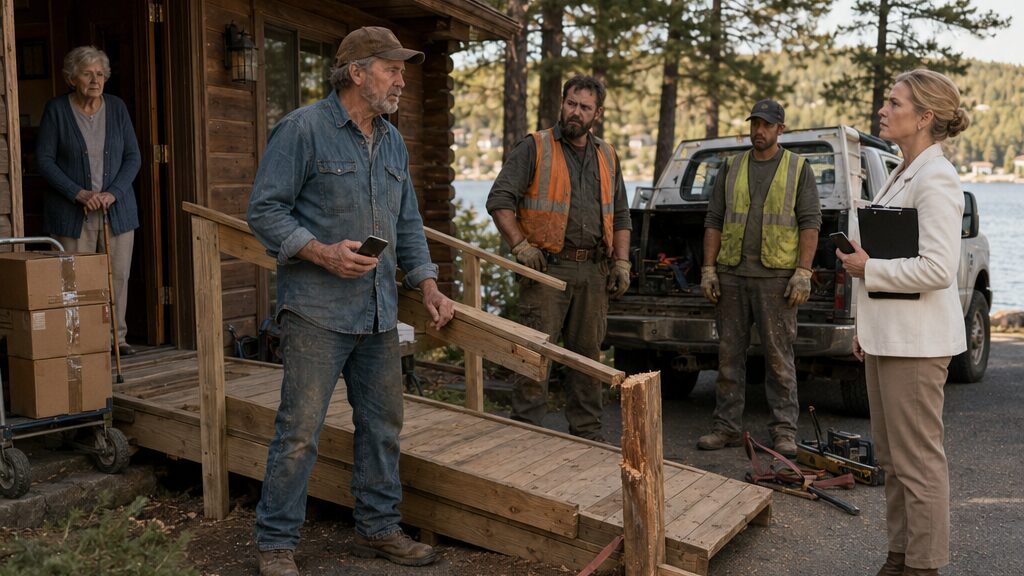
By the time he opened the front door, a man in a reflective vest was crouched beside the ramp support Kevin had set the day before.
“Stop,” George said.
The saw shut off.
Three workers stood in the access path. One held the saw. Another had already loosened a bracket and was carrying it toward a white crew truck parked half in George’s driveway, half on the lake road. The truck’s bed held orange cones, pry bars, a generator, and one of George’s cedar rails.
Sarah Carter stood near the mailbox with a clipboard tucked against her white jacket. No tennis visor this time. Today she wore dark slacks and low boots, dressed less for the court than for authority.
A man with broad shoulders and a short beard stepped away from the truck. “Mr. Walker?”
George came down one step, stopping before the damaged access path.
“I’m George Walker.”
“Jonathan Harris.” The man did not offer his hand. “We were hired to remove unapproved exterior materials.”
“That’s a medical access repair.”
Jonathan’s eyes flicked toward Sarah.
Sarah stepped forward. “It is an unapproved structure under active violation.”
George looked at the cut post. The saw had gone halfway through it at an angle, leaving pale raw wood exposed against the darker sealed surface. Yesterday, he had held that post steady while Kevin checked it with a level. Last night, he had touched it before going inside, making sure it would hold.
Now it leaned uselessly.
“Who authorized you onto my property?” George asked.
“The association has corrective authority under the governing documents,” Sarah said.
“I asked him.”
Jonathan shifted his weight. “We have a work order from Lakewood Estates HOA.”
“Court order?”
“No.”
“City order?”
“No.”
“Then put my materials back.”
One of the workers froze near the truck with the bracket still in his hand.
Sarah lifted her phone. “George, do not interfere with contracted enforcement.”
George took his own phone from his shirt pocket and began recording. His thumb shook once before he steadied it.
“Jonathan Harris,” he said, keeping the camera on the crew truck, the cut post, and Sarah’s clipboard, “you are on my property at 6:42 in the morning removing a medical access repair. You have just stated you have an HOA work order, not a court order and not a city order. Is that correct?”
Jonathan’s jaw tightened. “I’m not trying to get in the middle of—”
“You’re already in the middle of it.”
Sarah came closer. “This is exactly why the board acted quickly. Unapproved work creates liability.”
“Liability for whom?” George asked. “My wife trying to reach her own door?”
For the first time, one of the workers looked toward the house instead of the ramp.
Sarah’s mouth tightened. “You had an opportunity to submit a complete application.”
“I submitted it four weeks ago.”
“It was incomplete.”
“You didn’t say that until after you called the police on me.”
“You were confrontational.”
George almost laughed, but there was nothing funny enough in the morning for that.
“I moved boxes on my driveway.”
“You refused to identify the work.”
“Because my wife’s medical condition is not a neighborhood performance.”
The words hung there.
Sarah glanced at the phone in his hand, then at the nearest house, where blinds had opened in a second-floor window. She lowered her voice.
“If you had simply followed the process—”
George held up the notice taped to his door the day before. “Read it.”
Sarah blinked. “Excuse me?”
“Read the part that says you can send a crew before a hearing.”
“The notice is self-explanatory.”
“Then read it into the camera.”
Jonathan looked uncomfortable now. “Mr. Walker, maybe we should pause until—”
“No,” Sarah said. “The crew is here. The violation is active. The owner was notified.”
George moved one step lower, placing himself between the workers and the remaining rail. He did not touch the saw. He did not touch Jonathan. He simply stood where the next cut would have to go through him first.
“Read it,” George said again.
The generator clicked in the truck bed, then went silent. A pinecone dropped somewhere beyond the road, small and absurdly loud.
Sarah exhaled through her nose and took the paper from him.
“This notice informs the owner of unapproved exterior material storage and partial structure installation visible from common frontage,” she read, each word clipped. “Owner must remove all materials by 8:00 a.m. Failure to comply may result in corrective action.”
“What time is it?” George asked.
Sarah looked at him.
Jonathan checked his watch. “6:45.”
George kept the camera steady. “So your corrective action started before the removal deadline.”
Sarah’s face changed. Not much. Just a tightening around the eyes.
“The crew arrived early to stage equipment.”
“They cut the post.”
Jonathan looked down at the saw.
One of the workers quietly set the bracket on the ground instead of the truck bed.
Sarah’s voice cooled. “George, you are obstructing enforcement. I am calling the police.”
“Good,” he said. “Ask them to send the same officer.”
That struck her harder than he expected.
Her phone was already in her hand. She turned away, speaking low but fast. “This is Sarah Carter, Lakewood Estates HOA president. We have a noncompliant resident physically obstructing authorized removal work…”
George kept recording until she finished.
Jonathan stepped closer, lowering his voice. “I didn’t know there was a medical issue.”
“It was in the application.”
“I don’t see applications. I get work orders.”
“Then ask who sent it.”
Jonathan looked at Sarah.
“She did,” George said.
The police cruiser arrived twelve minutes later, tires crunching lightly on the edge of the drive. It was not the same officer. This one was older, with a careful walk and the expression of someone who expected everybody to leave unhappy.
Sarah reached him first.
“Officer, thank you. The HOA is executing a corrective action under its governing authority. Mr. Walker has placed himself in the work zone and is refusing to allow the crew to proceed.”
The officer looked past her at George. “Sir, are you refusing to move?”
“I’m refusing to let them remove a medical access repair before the deadline printed on their own notice.”
“That is misleading,” Sarah said.
George held out the paper. “Notice says 8:00 a.m. They started cutting at 6:42.”
The officer read it.
Jonathan cleared his throat. “That time sounds right.”
Sarah turned toward him. “Jonathan.”
He did not look at her. “We were told to start at first light.”
The officer looked at Sarah. “Do you have the removal authorization?”
Sarah slid a document from her clipboard so quickly it seemed she had been waiting for that question.
George recognized the Lakewood Estates logo at the top, but not the form beneath it.
It was not the notice from his door. It was not the email. It was not anything Kevin had shown him.
The officer took it.
George felt something in the morning shift.
Sarah’s grip on the clipboard relaxed, as if this paper, whatever it was, finally put the scene back where she wanted it.
The officer read the first lines, then looked at George.
“Mr. Walker,” he said, “have you seen this order before?”
George looked at Sarah.
“No,” he said. “I haven’t.”
Chapter 4: The Form That Arrived Too Late
The notice Sarah handed to the officer had a timestamp George could not stop looking at.
7:18 a.m.
Not yesterday afternoon, when she taped the violation to his door. Not sometime overnight, when he might have had a chance to read it, call someone, file something, stop the saw before it touched the cedar. It had been generated thirty-six minutes after Jonathan’s crew started cutting into the post.
The officer held the form between two fingers, eyes narrowing over the Lakewood Estates logo.
“Mrs. Carter,” he said, “this corrective action authorization was printed this morning.”
Sarah’s grip tightened around her clipboard. “The violation was active yesterday.”
“That wasn’t what I said.”
George stood beside the damaged ramp, phone still recording, one boot planted near a scatter of cedar shavings. The cut post leaned toward the porch like a broken bone that had not yet fallen.
Sarah’s voice softened into something more official. “Officer, the association has authority to correct exterior violations that remain unresolved. Mr. Walker was informed.”
“He was informed to remove materials by eight,” the officer said. “Your crew started before eight.”
Jonathan looked at the ground.
George watched Sarah decide whether to blame him. He could almost see the calculation pass over her face: crew scheduling, insurance report, visible frontage, resident resistance, board authority. None of it included Anna trying to step through the door.
“Can I have a copy of that?” George asked.
Sarah turned. “It’s an internal enforcement document.”
“It has my name on it.”
“It concerns your violation.”
“Then I want a copy.”
The officer lowered the paper. “That’s reasonable.”
Sarah did not move.
George thought of the old folder in his desk, the one with the survey and the access language, the one he had told himself he would not use unless someone pushed far enough. He could have walked inside and brought it out. He could have changed the whole shape of the morning. Instead, he stood in the yard and let Sarah keep narrowing the conflict to forms she controlled.
That was his mistake, and he felt it while he made it.
“I will email it to the address on file,” Sarah said.
“Now,” George said.
Her eyes flicked up.
“Email it now, while the officer is here.”
The officer looked at her. Jonathan looked at her. Across the road, two neighbors pretended to check a mailbox that had already been checked.
Sarah removed her phone from her jacket pocket and began tapping.
The email came through one minute later. George opened it with his thumb. The authorization form was attached, a clean PDF with checkboxes and a signature block.
Violation type: unapproved exterior structure.
Owner response: noncompliant.
Corrective action: removal of partial installation and visible material storage.
The field marked Medical or Safety Exception Reviewed had been checked N/A.
George felt his hand close around the phone.
“She marked it not applicable,” he said.
Sarah lowered her clipboard. “Because the application was incomplete.”
“You had the medical attachment.”
“I had an attachment labeled Clinic Note, submitted through a contractor, without a completed accommodation request form.”
“It said she cannot safely navigate the front entrance without rail support.”
“You cannot expect the board to process medical claims through a construction email.”
George looked at the cut post, then back at her. “You processed removal through one.”
Jonathan exhaled quietly.
The officer stepped between them before Sarah could answer. “This is civil. I’m not authorizing anyone to keep cutting while there’s a dispute about notice. I suggest everybody pause and sort this through the association or court.”
Sarah’s lips pressed thin. “The board will meet.”
“Good,” the officer said.
He did not sound like he meant it as praise.
The crew packed slowly. Jonathan told his workers to set George’s bracket back on the porch, but the rail already in the truck stayed there until George pointed at it and said, “That belongs to me.” Jonathan carried it back himself.
“I’m sorry,” Jonathan said under his breath, placing it near the sawhorses.
George did not answer. He wanted to, but every polite word felt like it might release Sarah from what had already happened.
When the police cruiser left, Sarah remained at the edge of the driveway.
“The emergency board meeting is at four,” she said. “Until then, no further work. No installation. No additional materials. Nothing visible from the road.”
“Anna comes home this afternoon.”
“I understand this is inconvenient.”
George looked at her so sharply she stopped.
“Inconvenient,” he repeated.
Sarah lifted her chin. “Lakewood Estates has an insurance review next week. We have already had one unauthorized deck extension create a liability inquiry. If I let every owner build first and explain later, I put the entire community at risk.”
That was the first time she sounded less like a person guarding status and more like a person afraid of losing control.
George should have heard it. Part of him did. But the cut post stood between them, and the word inconvenient had already done its damage.
“I submitted four weeks ago,” he said.
“Then bring everything to the meeting.”
“You already had everything.”
Sarah’s gaze shifted toward the porch, where the medical packet was visible through the open door on the kitchen table.
“No,” she said. “I had pieces.”
She got into her SUV and backed out without turning around.
By noon, George was at the HOA office with printed copies tucked under one arm and his phone in his shirt pocket. The office sat beside the clubhouse, all glass, stone, and lake-facing confidence. A framed aerial photo of Lakewood Estates hung above the front desk, the homes arranged around the water like they had grown there by agreement.
The clerk behind the desk looked pained when George asked for the full records packet.
“I can give you the violation file,” the clerk said. “Board deliberation materials require approval.”
“Who approves them?”
“Sarah usually does.”
George placed the printed notice on the desk. “Sarah printed an authorization this morning after the crew had already started. I need the timeline.”
The clerk hesitated.
A door opened behind her before she could answer.
Pamela Torres stepped out holding a binder and a travel mug. George knew her from annual meetings and from the way she always asked about dues before she asked about people. She stopped when she saw the papers in his hand.
“George,” she said. “I heard there was an incident.”
“A saw is an incident now?”
Her face tightened. “That’s not what I meant.”
“I need the application record.”
Pamela looked toward the clerk, then back at George. “Sarah called the meeting because your file was incomplete.”
“My contractor sent the medical note with the plans.”
Pamela frowned. “Medical note?”
George pulled the copy from his folder and slid it across the desk.
Pamela read the first lines. Her expression changed slowly, not with sympathy first, but with recognition of a missing page.
“This wasn’t in the packet,” she said.
The clerk looked down.
George waited.
Pamela flipped to the second page, then the third. “The board packet had the drawing, materials list, and photos of the boxes from yesterday. It did not have this.”
“It was attached to the same email.”
Pamela’s mouth opened, then closed.
From behind another office door, Sarah’s voice carried faintly through the wall. She was on the phone, controlled and clipped.
“The concern is precedent,” Sarah was saying. “If we do not act before the insurance walkthrough, we appear to waive enforcement.”
Pamela looked toward the sound.
George saw then that Sarah had not invented all her fear. She was trying to hold a wall upright with both hands. The trouble was, Anna was on the other side of it.
Pamela handed the medical note back more carefully than she had taken it.
“I’ll ask why it wasn’t included,” she said.
“Ask before four.”
“I will.”
George gathered the papers, but he did not take out the old folder. It was in his truck, under the seat, wrapped in a faded rubber band. The survey. The access strip. The language his father had explained years ago with one finger on the county map: They can build around us, but they can’t erase the road.
George left it there.
By three-thirty, the cut cedar post had begun to split where the saw mark weakened it. Kevin came by and braced it with scrap lumber, muttering under his breath about people who could read bylaws but not a level.
At four-ten, the HOA emailed its temporary order.
No exterior repair, installation, ramp adjustment, material staging, or modification to the front access path could continue until emergency board review concluded. Any violation would trigger further corrective action and fines.
George read it standing on the porch.
At four-thirty, the medical transport van brought Anna home.
The driver lowered the step and offered an arm. Anna refused it once, accepted it the second time, then stood at the bottom of the path staring at the damaged post and the temporary plywood angle that no longer had a safe rail beside it.
George came down to meet her.
“I can help,” he said.
She looked at the cut cedar, the loose bracket, the orange chalk mark Jonathan’s crew had left on the ground.
“She did this today?”
“They paused it.”
“That wasn’t what I asked.”
George put one hand under her elbow. Anna’s fingers closed around his wrist harder than he expected.
They took the first step together. The plywood shifted slightly under her shoe.
Anna stopped breathing for one sharp second.
George caught her before she could fall, but not before her shoulder hit the doorframe and the clinic packet slid from under his arm, spilling across the porch boards.
Across the road, a curtain moved.
Anna kept her eyes down until she was steady.
George looked at the papers scattered at his feet, then at the broken post beside the door.
For the first time all day, the old folder in his truck felt less like a last resort and more like something he had waited too long to open.
Chapter 5: The Board Called It A View Problem
Sarah began the meeting by playing George’s video without George’s voice in it.
On the clubhouse wall, the clip showed him standing in front of Jonathan’s crew, his shoulders squared, one hand raised, the cut ramp post behind him. The sound started only after he had already said medical access repair. What remained was Sarah’s voice, clean and firm, saying, “George, do not interfere with contracted enforcement.”
Several neighbors shifted in their chairs.
Anna sat in the back row with her cane across her knees. George had asked if she wanted to stay home. She had looked at him as if he had suggested leaving the front door behind.
The room smelled of coffee, floor polish, and lake dampness trapped in wool jackets. Through the tall windows behind the board table, the water looked calm enough to be accused of nothing.
Sarah paused the video on George blocking the path.
“This is the issue before us,” she said. “Not whether Mr. Walker has personal circumstances. Not whether the board is sympathetic. The issue is whether exterior modifications may be installed first and justified later.”
George sat three rows from the front with his folder on his lap and a cedar bracket in his jacket pocket. He had brought it because Kevin told him people understood metal better when they had to look at it.
Pamela sat at the board table, flipping through the packet with a pen held tight in one hand. She had not looked at Sarah since the meeting began.
Sarah continued. “Lakewood Estates has protected sightline and exterior uniformity standards. The front approach of Lot Twelve is visible from the common lake road and from three neighboring properties. The submitted materials did not include color matching, elevation visibility, or compatibility review. The association cannot ignore that.”
A board member leaned toward the microphone. “And the insurance inspection?”
Sarah nodded. “Next week. Our carrier has already flagged prior unauthorized exterior work. If we appear lax, the entire community may face increased premiums or coverage restrictions.”
There it was. The room reacted to that more than it had reacted to Anna’s cane.
George heard the small murmur pass through the chairs. Premiums. Coverage. Property value. Words that made people sit straighter.
Sarah knew it too.
She looked at George. “Mr. Walker may now speak.”
George stood slowly. His knee cracked, loud enough for the nearest row to hear. He took the cedar bracket from his pocket and placed it on the small table reserved for resident comments.
It made a dull, solid sound.
“This is not decorative,” he said.
He did not look back at Anna. If he did, he might say too much or too little.
“This bracket holds a rail. The rail keeps my wife from falling at the front door. The post your crew cut yesterday was part of that rail. I submitted plans four weeks ago through Kevin Ramirez. The medical note was attached.”
Sarah folded her hands. “The note was not in the board packet because it was not submitted through the proper accommodation channel.”
Kevin stood from the side aisle before George could answer. “I submitted it to the address listed on the HOA website for exterior modification requests. Same email as the plans.”
Sarah’s jaw set. “Contractors do not file accommodation requests on behalf of residents.”
George turned slightly. “He filed plans. I filed the need.”
Pamela lifted her head. “I have the original email receipt.”
Sarah’s eyes moved to her.
Pamela held up a printed page. “Timestamped four weeks ago. Four attachments. The packet sent to the board for preliminary review had three.”
A quiet pressure entered the room.
Sarah kept her voice even. “The fourth attachment was not labeled as an accommodation request.”
“It was labeled Clinic Note,” Pamela said.
“Which could mean many things.”
Anna’s cane tapped once against the floor.
Not loudly. Not for attention. Just the small sound of her hand tightening.
George placed his palm flat on the comment table.
“I’m not asking for a deck,” he said. “I’m not asking for a sunroom. I’m asking to replace a rotten rail and set a ramp angle my wife can use.”
A man in the front row muttered, “No one wants anyone hurt.”
Sarah heard it and turned toward the room. “No one here wants that. But emergency work still requires review. A structure facing the lake road affects more than one household.”
George took a breath. “A doorway affects the household that has to use it.”
Sarah’s expression flickered, but she did not bend.
The board asked questions. Some practical. Some not. What color would the cedar dry to? Would the traction strips reflect headlights? Would the ramp angle be visible from the Carter property? Could the handrail be moved to the inside path? Could Anna use the side entrance?
George answered until the side entrance came up.
“The side entrance has three steps and no landing,” he said.
“Could that be modified instead?” a board member asked.
“Not before she needs to enter the house.”
Sarah slid a paper forward. “There may be a temporary compromise. The board can allow the replacement of the rotten handrail in the existing footprint, provided Mr. Walker removes the extended ramp angle and resubmits for full aesthetic review.”
Kevin made a frustrated sound behind him.
George stared at the paper.
It sounded reasonable in the way bad compromises often did. It used words like temporary and allow. It gave the room something to approve. It would let Sarah say she had not denied safety, only structure.
But without the ramp angle, Anna would still face the same rise at the porch threshold. The rail alone would give her something to clutch while the step betrayed her.
George looked back at Anna.
Her face was calm. Too calm. She knew exactly what the paper meant.
“Can she get through the door with that?” Pamela asked.
Sarah did not answer immediately.
George did. “No.”
The room went still.
Sarah leaned toward her microphone. “The board cannot certify individual medical use from this table.”
“Then don’t pretend this is approval,” George said.
A sharper murmur moved through the room.
Sarah’s cheeks colored. “Mr. Walker, I understand this is emotional for you, but the board has a responsibility to the whole community.”
George almost reached for the old folder then.
It sat inside the larger brown one on his lap, yellowed survey folded small, county seal visible at one corner. His fingers found the edge. He felt the old paper give under his thumb.
He could open it. He could show them the road language, the access strip, the part of Lakewood Estates they had treated as common frontage even though common was never the right word. He could watch Sarah’s meeting slide sideways.
Anna looked at him from the back row.
She shook her head once.
Not fear of Sarah. Not exactly. He knew that look. It was the same look she had given him years ago when a neighbor wanted to fight over dock boundaries and George had said he could settle it with one survey. We have to live here after you win, she had told him.
George let the old folder close.
Pamela noticed.
Sarah did too.
The vote happened ten minutes later. Temporary denial pending aesthetic review, with permission only for repairs within the existing footprint. No ramp extension. No additional exterior materials staged outside. Fines suspended until the review deadline, provided George did no further work.
The motion passed by one vote.
Pamela abstained.
Sarah gathered her papers as if procedure had restored order, but her hand brushed the microphone and sent a brief hum through the room.
George picked up the cedar bracket from the comment table.
Anna waited for him near the aisle. She leaned on her cane with both hands, her eyes on the folder tucked under his arm.
“You almost did it,” she said.
“Yes.”
“I’m sorry.”
George looked at her. “For what?”
“For making you choose.”
He wanted to tell her there was no choice. That he would burn every rule in Lakewood Estates before he let her fall at their door. But she was not asking for heat. She was asking whether home would become something everyone whispered about when she passed.
Outside, the lake wind moved through the pines and lifted the corner of the old folder under his arm.
Sarah came out of the clubhouse behind them, talking quietly to a board member. Her eyes dropped to the folder, then lifted to George.
She had seen just enough to know there was something else.
George slid the folder under his jacket.
Anna’s hand found his sleeve.
“Not yet,” she whispered.
He closed his fingers over the old paper and walked her carefully toward the car, carrying the thing that could change the road while leaving unanswered why using it felt like breaking something they had spent years trying to keep peaceful.
Chapter 6: The Road Under Their Rules
The yellowed survey split along an old crease the moment George unfolded it on the kitchen table.
Anna made a small sound from the doorway.
George froze with both palms hovering over the paper, as if the map were skin and he had hurt it. The kitchen light shone through thin places where the folds had worn soft. County markings ran in faded blue ink. Lot lines, road curves, easement arrows. A narrow strip cut under Lakewood Estates’ private road and along the front of their property, labeled in a hand older than the HOA itself.
WALKER ACCESS.
Anna stood with one hand on the counter and the other on her cane. “You said that was only for emergencies.”
“I said that because I wanted it to be true.”
“You said your father never wanted to fight over it.”
“He didn’t.” George smoothed the corner with two fingers. “He also said never let anyone pretend the road grew there by itself.”
The house was quiet except for the map crackling under his hand. Outside, the broken ramp post waited in the dark. The board’s denial lay beside the salt shaker, polite and useless.
Anna came closer, slow step by slow step. George started to move toward her, but she raised one hand. Let me.
He stayed where he was.
She reached the chair and lowered herself carefully, face tightening only when her knee bent too far. George pretended not to notice. That was one of the small lies they still allowed each other.
She looked at the map.
“If you use this,” she said, “they’ll say we trapped them.”
“They sent a crew before eight in the morning.”
“They’ll still say it.”
George nodded because she was right.
The first time his father had shown him the survey, Lakewood Estates was not yet Lakewood Estates. It was a rough lake road, three older cabins, and developers walking around in clean boots pointing at trees they did not own yet. The Walkers had kept the access strip because the old county road had crossed their land before the development wrapped around it. Later, when the HOA formed, everyone acted as if the road belonged to the association because association sounded cleaner than permission.
George had let them act that way. It kept the peace. It kept him from being the man at every meeting saying, actually, under that asphalt is still a piece of my family’s ground.
Now peace had a saw mark in it.
Anna touched the label with one fingertip. “I don’t want to be the reason everyone turns on you.”
“You’re not.”
“You know what I mean.”
George looked at the old survey, then at the clinic packet, then at the board’s denial.
“Yes,” he said. “I know.”
By morning, he was at the county records office before the clerk unlocked the inner door. The building had low ceilings and old tile, the opposite of the Lakewood clubhouse, and nobody there cared what color cedar dried to in view of the road.
A clerk scanned the survey and typed the parcel number into a terminal.
George waited with his hat in his hands.
The clerk called over the city inspector, a narrow man with reading glasses hanging from a cord and a paper cup of coffee gone cold. He reviewed the map, the deed language, and the photos George had printed of the cut post.
“This access strip was reserved,” the inspector said.
“That’s what I read.”
“It predates the HOA.”
“That’s what my father said.”
The inspector tapped the screen. “The association may have maintenance obligations by agreement, but I don’t see authority for them to remove a safety-related access improvement from this footprint without proper civil process. Especially if you have a medical need tied to entry.”
George heard the words, but did not let himself relax.
“What does that mean today?”
“It means an HOA work order isn’t enough for demolition if the location is disputed and the work is tied to access. They can challenge. They can review materials. They can ask for code compliance. But send a crew to cut first and sort rights later?” The inspector shook his head. “That’s asking for trouble.”
George looked down at the copy of the map.
The phrase came to him from the video Sarah had made of him, from the way she had stood in his driveway like she could edit him out of the place.
I own this block.
But the truth was not that simple. It was not boastful. It was old, narrow, recorded, inconvenient. He did not own the neighborhood. He owned just enough of the road under their rules to make their certainty dangerous.
The inspector printed certified copies and stamped them with a force that made the counter tremble.
“If this goes back to the HOA,” he said, “keep it factual. Don’t threaten. Don’t embellish. The map is enough to raise a serious jurisdiction issue.”
George almost smiled. “People keep telling me documents are enough.”
The inspector looked at him over his glasses. “Documents are enough only if someone is willing to stand behind them.”
George carried that sentence back to the truck.
At the lake road, he parked near the mailbox and sat for a moment with the certified survey on the passenger seat. The road curved past his house, smooth and dark, paid for by dues, swept by crews, named by the HOA, driven by everyone. Under it, the old access strip remained, invisible until someone tried to deny what it was for.
His phone rang.
Kevin.
George answered. “I have the map.”
“Good,” Kevin said, but his voice was tight. “Because Jonathan just called me.”
George sat straighter.
“Why?”
“He didn’t want to say much. He asked if I was on-site tomorrow.”
“Tomorrow?”
“He said Sarah scheduled his crew to finish removal at sunrise. Full removal this time. Ramp, temporary plate, posts, stored materials. He sounded like he regretted telling me.”
George turned the key in the ignition, then stopped.
“He called you, not me?”
“Maybe he didn’t want his name on it.”
George looked toward the porch. From the road, the damaged post was visible only if someone cared to look. Sarah cared.
“What time?” George asked.
“First light.”
George thanked him and hung up.
The certified survey lay beside him. The clinic packet sat under it. The board denial was folded behind both. For years, he had believed the best way to stay at peace in Lakewood Estates was to keep the strongest paper in the drawer and live quietly enough that no one forced him to unfold it.
The saw had already answered that belief.
Inside, Anna was at the kitchen table when he came in, the old map still open under a coffee mug. She looked at his face and did not ask if the records office confirmed it.
“They’re coming back,” he said.
“When?”
“Sunrise.”
Anna’s hand tightened around the mug.
George placed the certified copies beside the old survey. New white paper beside old yellow paper. Same road. Same line. Same truth, finally refusing to stay folded.
Anna looked at the documents, then at the front door.
“You’re going to use it,” she said.
George stood beside the table until the light outside began to thin. “I should have used it before you had to climb over a cut post.”
“That isn’t fair.”
“No,” he said. “But it’s true.”
His phone buzzed again.
This time, the message came from an unknown number.
Mr. Walker, this is Jonathan Harris. I was told to be on-site at 6:00 a.m. I don’t know what paperwork she has now. I thought you should know before my truck is in your driveway.
George read it twice, then set the phone beside the survey.
Outside, the lake road darkened over the strip marked Walker Access, and for the first time in years, George stopped thinking of the old folder as a weapon.
By sunrise, it would hav
Chapter 7: I Want The Order In Writing
The crew hooked straps under the last ramp section while Anna watched from inside the doorway.
George saw her through the glass pane, one hand on the doorframe, the other wrapped around the cane she hated using. She had dressed before sunrise, though she had nowhere to go, as if refusing to be found in a robe would preserve one small piece of authority over her own house.
Jonathan’s truck idled in the driveway. The generator sat ready in the bed. Two workers stood near the damaged post, avoiding George’s eyes.
Sarah Carter was beside the mailbox with a new clipboard.
This time, a police cruiser was already parked behind her SUV.
George stepped onto the porch carrying the brown folder under his arm and his phone in his hand. The certified county survey rested against his ribs, stiff and new inside the old paper cover.
Jonathan looked up first.
“George,” he said quietly.
Sarah cut across him. “Mr. Walker, please remain clear of the work area. The board voted. You were notified.”
George came down the steps slowly, stopping before the ramp section where the straps crossed over the unfinished surface like a restraint.
“I want the order in writing.”
Sarah lifted the packet on her clipboard. “You have it.”
“No. I want the order that gives this crew authority to remove an access structure from disputed property after the medical accommodation was withheld from the board packet.”
The officer turned toward Sarah.
She did not look at him. “That is a mischaracterization.”
George opened his phone and started recording.
Sarah’s face hardened when she saw it. “We are beyond performance now.”
“I agree.”
The word landed oddly. Even Jonathan looked at him.
George moved past the first worker and stood beside the ramp section, close enough that no one could lift it without asking him to move. He did not touch the strap. He did not touch the machine. He simply stood where Anna would need to pass.
“Jonathan,” he said, “what paperwork do you have today?”
Jonathan swallowed. “Final corrective action order from Lakewood Estates HOA.”
“Court order?”
“No.”
“City order?”
“No.”
“County authorization?”
Jonathan looked at Sarah.
“No,” George said for him. “You don’t.”
Sarah’s voice snapped. “The HOA is not required to obtain county permission to enforce its own exterior standards.”
George took the certified survey from the folder.
The paper was too white in the morning light, too new for something that carried an old truth. He unfolded it on the hood of the police cruiser because it was the flattest place available and because everyone present would have to see him do it.
The officer stepped closer.
Sarah’s eyes moved over the map, then away, too fast.
“This is a private property matter,” she said.
“It became one when you sent men with saws,” George said.
The officer leaned over the map. George placed one finger on the marked strip.
“Walker Access,” he said. “Reserved before Lakewood Estates was incorporated. The road crosses it. The front access path sits within it. County records confirmed yesterday that the HOA does not have unilateral removal authority over a disputed medical access improvement on this footprint.”
Sarah laughed once, but the sound came out thin. “That is not what that means.”
“Then show your document that says otherwise.”
She opened her clipboard and removed the board order, the same clean language as before: visible structure, aesthetic review, corrective authority. No county seal. No court stamp. No reference to Walker Access.
The officer held out his hand.
Sarah hesitated, then gave it to him.
He compared the two papers on the cruiser hood. The crew stood silent. The straps hung slack under the ramp section.
From the doorway, Anna opened the door wider.
George heard the faint scrape of her cane on the threshold and turned just enough to see her stop at the broken point where the rail should have been. Her face was calm, but her knuckles were white.
Sarah saw her too.
For half a second, the whole argument became smaller and more difficult to hide from.
Then Sarah looked back at the officer. “This structure was installed without approval.”
“Partially installed,” George said. “After an application was submitted four weeks earlier.”
“Incomplete application.”
“Because you took out the medical attachment.”
Sarah turned sharply. “I did not take anything out. It was not processed through the correct channel.”
Pamela Torres’s voice came from the road. “Sarah.”
Everyone turned.
Pamela had parked behind the cruiser and was walking up with a binder clutched against her coat. She looked as if she had not slept.
Sarah’s face tightened. “This is not a board meeting.”
“No,” Pamela said. “It’s worse.”
She stopped beside the cruiser hood and opened the binder. “I reviewed the packet history. The email came in with four attachments. The clinic note was visible in the intake log. It was not included in the board packet.”
Sarah’s jaw worked once. “Because it was misfiled.”
“You were copied on the intake flag.”
Sarah stared at her.
Pamela did not look pleased to be saying it. She looked like a person stepping onto thin ice because the shore behind her had caught fire.
“The board voted without seeing the medical note,” Pamela said. “I voted without seeing it. That matters.”
Sarah lowered her voice. “Pamela, we have an insurance inspection in six days. If we lose control of exterior enforcement—”
“We already lost control when we sent a crew before the deadline.”
The officer straightened. “I’m going to be clear. I am not deciding your property dispute. But I am telling this crew not to proceed with removal while there is a documented jurisdiction issue and a disputed medical accommodation. If someone wants this removed, they need proper civil authority.”
Jonathan turned to his workers. “Unhook it.”
Sarah stepped toward him. “Jonathan, you are under contract.”
“And I’m not cutting another board until someone above both of us tells me I’m allowed to,” he said.
For the first time since George had met him, Jonathan looked directly at Sarah and did not wait for permission.
The workers loosened the straps.
The ramp section settled back onto its supports with a soft wooden thud.
Sarah stood still, color high in her face. Her phone was not in her hand now. There was no easy angle to film from.
“This is exactly what I warned the board about,” she said. “Old documents used as leverage. Exceptions becoming loopholes. One owner deciding rules don’t apply because he can out-paper the association.”
George folded neither map nor voice.
“I followed your process,” he said. “You ignored the part that made it human. I stayed quiet because I didn’t want this road turned into a fight. That was my mistake.”
Sarah’s eyes flashed. “You’re weaponizing a technicality.”
George looked at the road, at the asphalt everyone used without thinking, at the cedar post cut before its deadline, at Anna waiting in a doorway that had become a test she never asked to take.
“No,” he said. “I’m naming the line you crossed.”
The officer returned Sarah’s order and nodded toward the crew. “Pack up.”
Sarah looked at Pamela. “The board will answer for this.”
Pamela closed her binder. “The board already is.”
George gathered the survey, but he did not put it away. Not yet.
Sarah’s expression shifted when she saw that. Something like fear came through the anger, not fear of him exactly, but of what could no longer be contained inside her forms.
“George,” she said, quieter, “you could have brought this to the board before.”
He looked at her for a long moment.
“I could have,” he said. “And you could have stopped when you saw the word clinic.”
Anna’s cane tapped once behind him.
George turned toward the house. She had stepped one foot onto the damaged threshold and stopped there, unable to go farther without help, unable to retreat without admitting the door had beaten her.
He went to her, leaving the survey open on the cruiser hood for everyone else to stare at.
Sarah said his name again, but this time it did not sound like an accusation.
George took Anna’s hand, then looked back across the driveway, past the crew, past the officer, to Sarah standing beside the road she had thought belonged entirely to her rules.
“Sarah,” he said, “I didn’t come here to fight the neighborhood. I came to fix the door my wife can’t get through.”
Chapter 8: The Ramp Back To The Door
Kevin set the final rail into the same post hole the crew had cut apart.
He worked slowly, not because the repair was difficult, but because George watched every movement like a man listening for a second saw. The new cedar post sat beside the old damaged one, which lay on the porch with the diagonal cut still visible across its grain. Kevin had asked if George wanted it hauled away.
“Not yet,” George had said.
Now the rail slid into place with a clean wooden knock. Kevin checked it with a level, tightened the bracket, then put his full weight against it. The rail held.
Across the road, a neighbor paused during a morning walk, looked toward the porch, and kept moving.
No phone raised. No golf cart stopped. No one called out.
George found the quiet almost harder to trust.
A week had passed since the crew unhooked the straps. In that week, Pamela called an emergency closed session, then an open one. The board withdrew the removal order first, the violation second. The wording of the withdrawal was careful: pending clarified jurisdiction, corrected packet review, and reasonable accommodation procedure.
It was not an apology. George had not expected one.
The HOA also agreed to a revised repair plan. Same angle. Same function. Cedar stained to match the porch. Traction strips in a darker finish. A final city inspection after installation, not before Anna could enter her home.
Practical. Imperfect. Enough.
Kevin stepped back from the rail. “Try it.”
George wrapped his hand around the cedar.
Solid.
He nodded once.
Kevin began folding the empty cardboard boxes flat beside the porch. RAIL. BRACKETS. STRIPS. FRONT POST. The labels Sarah had photographed as evidence now looked almost foolish in the morning light. Not suspicious. Not defiant. Just work waiting to be done.
A white SUV slowed near the mailbox.
Kevin looked toward it. “You want me to stay?”
George watched Sarah Carter step out with a folder in one hand.
“No,” he said. “Keep working.”
Sarah came up the driveway without the clipboard this time. No visor. No phone raised. She wore a pale jacket, practical shoes, and the expression of someone who had rehearsed several versions of a sentence and trusted none of them.
Pamela walked behind her, carrying a binder.
George met them at the bottom of the ramp, not on the porch. He did not want Sarah looking up at him, and he did not want Anna watching him look down.
Sarah held out the folder.
“Formal withdrawal,” she said. “Violation removed. Fines voided. The board record will show the medical accommodation attachment was not included in the review packet.”
George took the paper but did not open it.
Pamela looked at the newly set rail. “The revised emergency accommodation rule passed last night. Temporary safety modifications can’t be removed before medical review, even if aesthetics are still pending.”
Kevin stopped folding boxes for one second, then kept going.
George looked at Pamela. “You pushed that?”
“I should have asked better questions earlier.”
There was no speech in her voice. No performance. It made the admission easier to hear.
Sarah stared at the ramp surface.
“The insurance inspector will still need documentation,” she said.
George almost smiled. “I have documentation.”
“I know.”
The words sat between them.
George opened the folder. Sarah’s signature was at the bottom of the withdrawal notice. Pamela’s too. The language was dry enough to leave no mark on anyone who had not lived through it, but one sentence held his eye.
The association acknowledges that immediate removal was not appropriate while accommodation and property authority questions remained unresolved.
Not sorry.
But true.
Sarah looked toward the porch. “I believed I was protecting the association.”
George folded the paper back into the folder. “You protected the association from a rail.”
Her mouth tightened, but she did not defend herself.
Behind George, the front door opened.
Anna stepped out with her cane in one hand. She paused at the top of the ramp, her other hand hovering above the new rail.
George turned, ready to move.
She shook her head.
Not this time.
Her fingers closed around the cedar. She tested it once, then placed her foot on the ramp. The traction strip held under her shoe. One step. A pause. Another. Her shoulders remained stiff, but she did not reach for George. She came down the ramp slowly, with everyone pretending not to stare and everyone staring anyway.
At the bottom, she looked at Sarah.
“This was all I needed,” Anna said.
Sarah’s face changed more at that than it had at the survey.
“I understand that now,” she said.
Anna let go of the rail. “No. You understand it after it was cut.”
Pamela looked down.
Sarah accepted the sentence without answering.
George expected satisfaction. He found none. Only the dull awareness of how close the house had come to becoming unusable while people argued over whether the danger had the right form attached.
Anna turned to him. “It feels steady.”
Kevin smiled from the porch. “It is steady.”
Sarah opened her folder again. “The board is prepared to discuss reimbursement for the damaged materials and labor.”
George looked at the old cut post lying beside the steps.
He had thought about this part during the long nights after sunrise. He could demand everything: money, sanctions, Sarah’s resignation, a public statement sent to every homeowner. Some of it might even be fair.
But the thing he wanted most was already under Anna’s hand.
“I want Kevin paid for the replacement work,” he said. “I want the damaged materials covered. I want the new accommodation rule sent to every resident. And I want the record to say the crew started before the notice deadline.”
Sarah swallowed. “That can be included.”
“I don’t need a show.”
Pamela nodded once, as if she had expected him to ask for more and was relieved he had not.
Sarah looked at him then, really looked, past the hat and work shirt and boots. “Why didn’t you use the survey sooner?”
George glanced toward the lake road.
A delivery truck rolled over the asphalt, right across the old Walker Access strip, leaving no sign on the surface of what lay beneath it.
“Because I thought keeping it folded kept the peace,” he said.
“And now?”
He watched Anna climb back up the ramp, hand steady on the rail, Kevin standing near but not helping unless asked.
“Now I think peace that depends on silence is just waiting for a saw.”
Sarah closed her folder.
She did not apologize again. Maybe she knew better than to spend the morning trying to clean up her own discomfort. She and Pamela walked back down the driveway, slower than they had come.
Kevin finished packing his tools after lunch. George helped him fold the last of the empty boxes and stack them near the recycling bin. The porch looked strange without them, open and ordinary, as if the house had never been the center of a fight.
When the final inspection sticker was placed inside the doorframe, Anna made coffee.
She carried her mug to the porch herself. George pretended not to watch every step. She pretended not to notice him pretending.
The old survey lay on the kitchen table where he had left it that morning. The certified copy was in the brown folder with the withdrawal notice, the medical packet, the submission receipt, and the photographs of the cut post.
George opened the folder one last time.
He touched the line marked Walker Access, then closed the cover.
Outside, Anna’s hand rested on the finished rail while she looked toward the lake. The cedar caught the afternoon light, new against the old porch, not invisible but belonging.
George slid the old survey back into the folder and placed it in the drawer.
The ramp stayed where it was.
The story has ended.