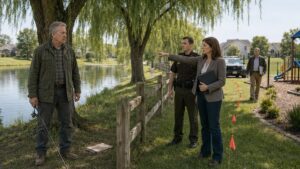
The HOA Called His Weather Station an Eyesore Until the Neighborhood Lost Its Warning
Chapter 1: The Poles Everyone Could See
“An eyesore,” Debra Clark said, stepping around the black mast as though it had grown overnight from contaminated soil. “That is the only honest word for it.”
Brian Walker had not yet managed a greeting.
He stood beside his open garage with a coil of irrigation tubing in one hand and watched Debra cross the edge of his lawn. Her shoes sank slightly into the damp grass. Above her, three white wind cups turned in air too mild for anyone else to notice.
Debra pointed at the mast. “It looks like something behind a warehouse.”
“It measures wind speed.”
“I know what you call it.”
Brian set the tubing down. The station stood sixteen feet high near the side of his house, clear of the roofline and the maple trees. A rain gauge sat lower on a narrow post. A temperature shield, pale and ribbed, faced away from the afternoon sun. Every cable had been run through black conduit and secured close to the frame.
Nothing leaned. Nothing rattled. Nothing crossed the property line.
Debra looked at it as if precision made the offense worse.
“The architectural standards require exterior additions to be consistent with the residential character of the neighborhood,” she said. “This is not consistent.”
“It isn’t an addition to the house.”
“That’s not the distinction you think it is.”
Brian glanced up. The cups made another slow rotation. The wind had shifted southwest.
Debra followed his eyes. “Do you stand out here watching it all day?”
“No.”
“Then why does it need to be in the front half of the lot?”
“Clear exposure.”
“There’s a backyard.”
“With trees, a fence, and two roof wakes.”
Her mouth tightened. Brian knew the expression. Debra wore it at board meetings when someone introduced a fact that complicated a rule she had already decided how to apply.
She folded her arms. “No reasonable homeowner needs equipment like this.”
Brian could have told her about the low section near the creek where wind accelerated between two rows of houses. He could have explained how official readings came from an airport thirteen miles away, across flatter ground. He could have said that a county-wide warning did not tell an elderly resident whether a gust front was already crossing their subdivision.
Instead, he said, “It’s a weather station.”
Debra gave a small, humorless laugh. “That explains what it is. It doesn’t explain why it belongs here.”
A phone sounded inside Brian’s garage: two short notes, a pause, then one lower tone.
Debra turned toward the sound.
Brian did not move quickly. He wiped his hand on his jeans, entered the garage, and checked the wall-mounted tablet. The pressure graph showed a shallow drop. Nothing urgent. A routine advisory had gone to twelve numbers reminding residents that heat index values would rise after noon.
When he returned, Debra was standing closer to the rain gauge.
“Was that connected to this?”
“Yes.”
“Who receives it?”
“People who asked.”
“How many people?”
Brian picked up the coil of tubing again. “Enough.”
“That is not an answer.”
“It’s the one I’m giving.”
For the first time, Debra’s certainty faltered. Not much. Only a slight pause before she reached into the leather folder tucked beneath her arm.
She removed four glossy photographs.
The first showed the weather mast from the street. The second had been taken from the sidewalk in front of Jacob Moore’s house. The third framed the station between Brian’s mailbox and his front windows. The fourth had been enlarged until the wind cups filled most of the page.
The photographs were dated two days earlier.
“You already opened a complaint,” Brian said.
“I documented a potential violation.”
“Before asking me about it.”
“I’m asking now.”
“No. You came with pictures.”
Debra aligned the pages against the folder. “We had a situation last year with an unauthorized pergola. The board delayed enforcement because the owner claimed the rule was unclear. By the time the matter reached counsel, the association had spent thousands of dollars, and half the neighborhood thought we were playing favorites.”
“This isn’t a pergola.”
“That owner said the same thing. Everyone believes their exception is different.”
Brian looked past her toward the street. A delivery truck turned at the far corner, its tires whispering over warm pavement. Across the road, a curtain moved in an upstairs window.
“Did someone complain?” he asked.
Debra hesitated half a second too long.
“So this is yours.”
“My responsibility is to notice violations whether or not someone files a report.”
“You called it an eyesore before you asked what it did.”
“I can understand what it does and still consider it inappropriate.”
Brian nodded once. That answer, at least, was honest.
Debra returned the photographs to the folder. “You can submit an architectural request. Measurements, installation details, power source, intended use, any communications function, and a proposal for screening or relocation.”
“The readings would be unreliable behind a screen.”
“Then relocation.”
“The backyard won’t work.”
“That may mean the project cannot be approved.”
Project. The word reduced years of adjustments, replaced sensors, midnight checks, and terse warning messages to a line on a form.
Brian lifted the tubing, then lowered it again.
“Is this an informal conversation,” he asked, “or notice that the board intends to act?”
Debra’s posture changed. She had expected irritation, perhaps an argument about property rights. His precision forced her into the language she preferred only when she controlled when it began.
“It is notice that I will request expedited review.”
“When?”
“Tonight.”
“And until the review?”
“That will be determined by the property manager.”
The anemometer turned faster. Leaves trembled along the curb, though the air at ground level still felt motionless.
Brian watched the cups complete three rotations.
Debra looked up again. “What are you seeing?”
“A boundary moving through.”
“What boundary?”
“Drier air.”
She waited for more. When he gave her none, she closed the folder.
“You make this difficult, Brian.”
“I answered every question about the equipment.”
“Except why you need it.”
“That wasn’t your first question.”
She stared at him, then walked back across the lawn. At the sidewalk she stopped.
“If the board orders temporary disconnection, refusing could lead to daily fines.”
Brian rested the coil against his leg.
“Then the order should say exactly what must be disconnected.”
Debra’s expression hardened, but something uncertain remained beneath it. She left without another word.
At 7:18 that evening, Brian’s computer chimed.
The message came from the property-management office with the association president copied. It cited the architectural guidelines, the board’s emergency enforcement authority, and a hearing scheduled for Thursday morning.
Until then, it said, all data transmission and automated notification functions associated with the unapproved exterior installation were to be suspended.
Brian read the sentence twice.
Then he looked through the window above his desk. Against the darkening sky, the white wind cups kept turning.
Chapter 2: Three Phones Sound at Once
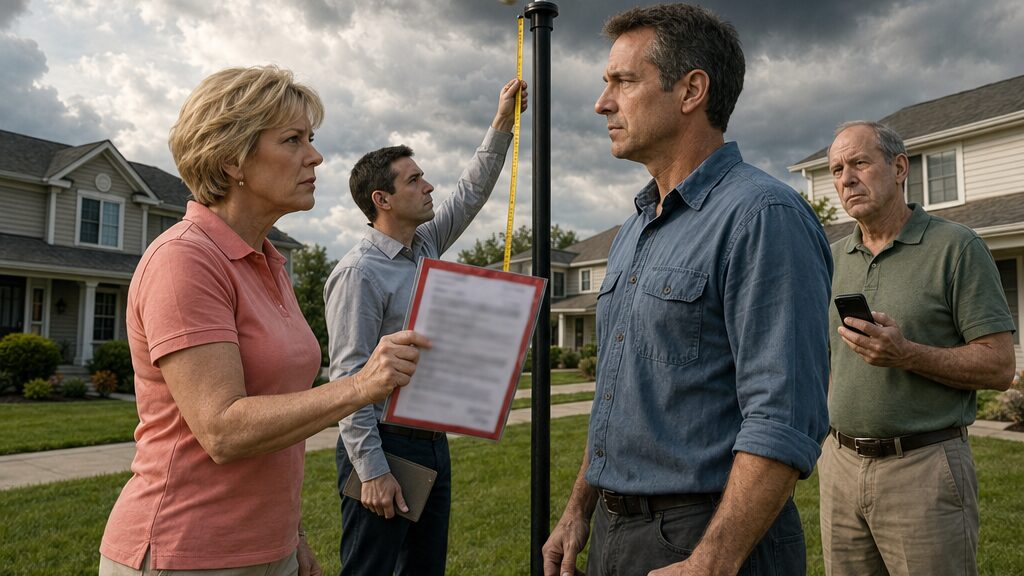
The property manager began measuring the mast before anyone spoke to Brian.
He stretched a yellow tape from the base plate to shoulder height, marked the figure on a clipboard, then asked one of the committee members to hold the end while he extended it upward.
Brian stood near the garage with his hands loose at his sides.
“Sixteen feet, two inches,” the manager said.
“Sixteen feet,” Brian corrected. “The top two inches are the lightning finial.”
The manager glanced down at his clipboard. “Total installed height is what matters.”
“To which rule?”
Debra Clark arrived behind the two architectural-review members carrying a red-bordered violation notice inside a clear sleeve.
“Good morning, Brian.”
It was the kind of greeting used after a conversation had already become official.
The wind cups above them were moving faster than they had on Monday. The sky remained bright, but thin clouds dragged across it from the west. Brian had watched the pressure fall since before sunrise.
Debra handed him the notice.
It described the station as an unapproved utility structure, a possible communications installation, and a visual obstruction inconsistent with the neighborhood’s design standards.
“Industrial clutter,” one committee member murmured while looking up.
Debra did not correct him.
Brian slid the notice back into its sleeve. “The mast is powder-coated aluminum. The sensors are residential-grade.”
“That doesn’t make it residential in appearance,” Debra said.
“What would?”
“Something smaller. Less visible. Preferably screened.”
“A screened wind sensor measures the screen.”
The second committee member smiled briefly before noticing Debra’s expression.
The property manager moved to the rain gauge. “Does this transmit beyond your property?”
“It sends measurements to a local receiver.”
“And from there?”
“My home network.”
“And from there?”
Brian looked at Debra. “You have my written response.”
“Your response says the system distributes automated advisories to participating residents. It does not identify them.”
“They didn’t authorize me to identify them.”
Debra’s jaw shifted. “You are operating a neighborhood notification service through an unapproved installation. The board needs to know who is affected.”
“They can tell you themselves.”
“Have they?”
Brian said nothing.
That silence had protected the subscribers when the alerts were small and private: heat reminders, hard-freeze notices, wind advisories before trash bins began rolling into the street. Now it made the system look secretive because it was.
Debra raised the violation notice. “This equipment has become more than a personal weather hobby. That changes the liability question.”
“It was never a hobby.”
The words came out sharper than Brian intended.
Everyone looked at him.
The cups turned above them with a dry mechanical whisper.
Debra lowered the notice. “Then explain what it is.”
Brian could have named the elderly resident who needed extra time to move to an interior room. He could have pointed across the street toward Samantha Roberts’s house, where Amy checked each alert before a storm. He could have said Jacob Moore kept a battery radio beside his chair because Brian’s messages reminded him when to turn it on.
Instead, Brian looked at the tablet in his hand.
Pressure had fallen another two-tenths.
A narrow outflow boundary was moving ahead of a line of thunderstorms still outside the county. The official forecast mentioned only a chance of scattered storms after lunch. Brian’s station showed the local air changing sooner.
His thumb hovered over the alert screen.
Debra noticed. “Are you sending something now?”
“Yes.”
“After being instructed to suspend notifications?”
“The suspension is part of this hearing.”
“This is an inspection.”
“Then the instruction is not final.”
The property manager stopped writing.
Brian pressed send.
His phone emitted two short notes, a pause, and one lower tone.
A second phone sounded from inside the property manager’s jacket.
Then the first committee member’s phone made the same sound.
A third tone came from Debra’s leather bag.
For several seconds, no one moved.
The committee member pulled out his phone first. The message read:
LOCAL WIND SHIFT DETECTED. SECURE LIGHT ITEMS BEFORE NOON. LOW CONFIDENCE OF DAMAGING WIND. MONITOR OFFICIAL SOURCES.
The property manager looked at his own screen, then at Brian.
Debra removed her phone more slowly. “Why am I receiving this?”
“You subscribed last spring.”
“I did not.”
“You replied YES after the hailstorm.”
Her face changed as she remembered. Brian could see the exact moment: the cracked skylight, the roofing contractor who had warned residents of another possible storm, the group message Jacob had circulated with Brian’s number.
“That was temporary,” she said.
“The system doesn’t know temporary unless you reply STOP.”
The second committee member checked his colleague’s screen. “You use these?”
“Sometimes,” the man admitted. “For my wife. She works nights.”
The property manager cleared his throat. “I believe my office number was added during the freeze in January.”
Debra looked from one phone to another. The violation notice in her hand suddenly seemed less conclusive.
Brian felt no satisfaction. Only exposure.
The network had worked because people could receive its messages without publicly choosing sides. Now their quiet dependence stood in the middle of his lawn with them.
“How many subscribers?” Debra asked.
“Eighteen active numbers.”
Her eyes narrowed. “You told me ‘enough.’”
“It was accurate.”
“Are all eighteen residents?”
“Sixteen. Two are property-management contacts.”
“Do you charge anyone?”
“No.”
“Is the equipment certified?”
“The individual components meet manufacturer specifications.”
“That is not what I asked.”
Brian looked up at the mast.
A stronger gust passed over the houses. The cups accelerated, while a loose corner of the red notice tapped against its plastic sleeve.
“No,” he said. “The network is not a certified public warning system.”
Debra breathed in slowly.
The partial reversal vanished from her face, replaced by something steadier.
“Who verifies your thresholds?”
“I do.”
“Who covers the system when you’re away?”
“I can access it remotely.”
“That wasn’t the question.”
“No one else operates it.”
“And if a sensor fails?”
“The software flags inconsistent readings.”
“Has that ever happened?”
Brian’s grip tightened around the tablet.
The first committee member looked between them. “Has it?”
“Yes.”
Debra’s voice softened, which made it more dangerous. “Did a failed sensor ever trigger an alert?”
Brian remembered the March gust report, the damaged bearing, and the message that sent three families dragging patio furniture into garages beneath a clear sky.
“One alert was higher than conditions justified.”
“How much higher?”
“I would need the log.”
“You have the log.”
“Yes.”
“Then we need all of it.”
The property manager resumed writing.
Brian felt the shame arrive before anyone accused him of anything. It was not shame over the faulty reading. Systems failed. The shame came from having hidden the failure while allowing neighbors to trust the next message.
Debra placed the violation notice against his chest. He took it before it slid.
“The board will continue the hearing next week,” she said. “Before then, provide the complete alert history, maintenance records, subscriber disclosures where legally permitted, and every documented false or overstated notification.”
“I won’t provide names without consent.”
“Then obtain consent.”
The committee members began walking toward the sidewalk. The property manager paused to photograph the base plate one last time.
Debra remained beneath the spinning cups.
“You asked me Monday whether the order should say exactly what had to be disconnected,” she said. “Now I understand why.”
Brian waited.
“You knew this was bigger than the mast.”
“Yes.”
“And you intended to let us discover it one piece at a time.”
“No. I intended to keep other people out of it.”
“That decision may be the reason they’re in it now.”
She walked away.
Brian looked down at the notice. Beneath the bold violation heading, the plastic sleeve reflected the turning anemometer in warped white circles.
His tablet chimed with a new email before the inspection group reached the corner.
The subject line read: REQUEST FOR COMPLETE ALERT HISTORY, INCLUDING ERRONEOUS EVENTS.
Chapter 3: The Warning That Came Too Early
Debra played the alert timestamp before Brian entered the meeting room.
The wall-mounted screen showed a message sent at 4:12 p.m. on March 18:
DAMAGING WIND POSSIBLE WITHIN 20 MINUTES. MOVE VEHICLES FROM TREES. TAKE SHELTER IF CONDITIONS WORSEN.
Below it, the station log showed a peak gust of fifty-eight miles per hour.
The official airport record for the same hour showed twenty-one.
Samantha Roberts sat at the end of the conference table with the minutes template open on her laptop. She had seen the message in March. She had moved two porch chairs into the garage and called Amy home from a friend’s house.
The storm had never arrived.
“Was there any reported damage in the neighborhood?” the HOA president asked.
“No,” Debra said. “Because the reading was wrong.”
“Or because the gust was isolated,” one committee member offered.
Debra clicked to the next slide.
A maintenance photograph showed one of the white wind cups locked at an angle. The small bearing beneath it was dark with rust.
“The sensor was damaged,” she said. “Brian replaced it the following morning.”
The door opened.
Brian entered carrying a thin binder and a laptop. He looked at the screen, then at the faces around the table.
“You started.”
“We had a quorum,” Debra said.
Samantha watched him take the empty chair across from her. His expression remained controlled, but he placed the binder too carefully on the table.
The property manager joined by video. A representative from the association’s insurance agency appeared in a second window, his face washed pale by office lighting.
The HOA president folded his hands. “Brian, we are not here to decide whether weather information is useful. We are here to determine whether the association can permit an unapproved installation that distributes safety-related messages.”
Brian opened his binder. “The March reading was faulty.”
“What caused it?” Debra asked.
“A bearing partially seized. The sensor reported erratic rotation during a gust.”
“And the software interpreted that as fifty-eight miles per hour?”
“Yes.”
“Did you retract the alert?”
“I sent a correction thirty-one minutes later.”
Debra displayed that message next. It described a probable sensor error and advised residents to continue monitoring official forecasts.
Thirty-one minutes.
Samantha remembered Amy standing in the hallway with shoes on, asking whether they should drive somewhere safer. Samantha had told her no. Then she had spent half an hour refreshing radar while pretending not to be worried.
“How often are your messages wrong?” the insurance representative asked.
“That depends on what you mean by wrong. Forecast confidence changes. Local conditions vary.”
“How often have you issued an alert based on faulty equipment?”
“Once.”
“That you know of,” Debra said.
Brian looked at her. “Once identified through the diagnostic record.”
The representative made a note. “Is the system redundant?”
“The rain gauge and pressure sensor cross-check broader conditions. Wind speed has no duplicate sensor.”
“Backup power?”
“Battery-supported receiver and router.”
“Secondary operator?”
“No.”
“Formal calibration schedule?”
“I test monthly and after severe weather.”
“Documented?”
Brian hesitated. “Not consistently.”
The room changed around that pause.
Samantha saw Debra straighten, not with triumph but relief. A clean procedural weakness was easier to manage than eighteen residents quietly depending on the man across the table.
The representative spoke plainly. “Our concern is not the mast by itself. It is perceived endorsement. If the association permits a system used for warnings, residents may assume the board has validated its accuracy.”
“The messages tell them to monitor official sources,” Brian said.
“That disclaimer helps. It does not eliminate reliance.”
Samantha looked at the alert tone icon beside the March message. Amy called it the three-note knock. She had never asked where it came from.
The HOA president turned to Samantha. “You receive these alerts?”
Every face shifted toward her.
She could have answered only yes. It would have been accurate and safe.
Instead, she closed her laptop halfway.
“My daughter does.”
Debra’s eyes narrowed slightly.
Samantha continued. “Amy gets anxious during storms. The county alerts cover the entire region, and sometimes they arrive when nothing is happening near us. Brian’s messages tell her when conditions are actually changing here.”
“Did you know the system was operated solely by Brian?” the president asked.
“I assumed it pulled automatically from an official source.”
Brian looked down.
The admission hurt him. Samantha saw it, and that made her defensive.
“You never explained otherwise,” she said.
“No,” he replied.
Debra folded her hands. “That is exactly the problem.”
“It’s part of the problem,” Samantha said.
Debra turned toward her.
Samantha reopened her laptop but did not look at the minutes. “The county warning area is too broad for some residents. We have elderly people who need more time. We have parents deciding whether to call children home. Pretending there is no need because the system is informal does not remove the need.”
The insurance representative nodded once. “That may be true. It still does not make this system insurable as currently operated.”
A small silence followed.
Brian opened his laptop and displayed two maps. One showed the county warning polygon from the previous summer. It stretched nearly forty miles. The other plotted wind measurements from his station against the airport record.
“The official system is designed for regional coverage,” he said. “It is not defective. It serves a different scale.”
“And yours?” Debra asked.
“Serves this scale.”
He tapped the cluster of neighborhood streets.
The explanation was calm and exact. For a moment Samantha understood why people trusted him. He did not promise certainty. He showed distance, timing, and limits.
Then the insurance representative asked, “Would you submit the system to county review and allow trained backup operators?”
Brian’s face closed.
“I can provide data.”
“That was not the question.”
“I built it for local use.”
“Shared operation would reduce single-person dependency.”
“I maintain it.”
Debra leaned back. “So the board should accept the risk, but no one else should have control.”
Brian shut the map window. “That is not what I said.”
“It is what you keep arranging.”
Samantha watched his silence harden. His strongest argument was collapsing beneath the one thing he would not discuss: why control mattered more to him than approval.
The meeting ended without a vote. The insurer promised written guidance. The board postponed final enforcement until that arrived.
At home that evening, Samantha found Amy at the kitchen counter doing homework beside her phone.
“Did you know Mr. Walker sends those weather alerts himself?” Samantha asked.
Amy stopped writing. “Like, personally?”
“Yes.”
“I thought it was a county thing.”
“So did I.”
Amy picked up her phone. “Are they shutting it down?”
“I don’t know.”
“You told them I use it?”
Samantha heard the accusation in her daughter’s voice.
“I had to explain why it mattered.”
“You didn’t have to use me.”
Samantha sat across from her. “You called me from school during the tornado watch in April.”
“Because the sirens went off.”
“You asked whether Brian’s alert had come.”
Amy looked away.
Samantha softened her voice. “Why?”
“Because his usually comes before the trees start moving.”
The answer stayed between them.
Samantha’s laptop chimed on the counter.
The insurer’s written recommendation had arrived. It advised the HOA not to endorse or permit continued automated warnings without formal review, documented calibration, redundant operation, and an emergency disclaimer approved by counsel.
Attached beneath it was a county forecast update.
A line of severe thunderstorms was expected Friday afternoon, with the strongest wind window between two and five.
Samantha checked the board calendar.
The contractor had been scheduled to disconnect Brian’s station at nine that same morning.
Chapter 4: What Brian Never Told Them
Jacob Moore found the backup battery humming beneath Brian’s workbench before Brian could close the garage door.
“What’s that feeding?” Jacob asked.
Brian stood with one hand on the door track. “Nothing yet.”
The battery sat inside a gray metal housing, wired to a charge controller and a small inverter. Two labeled cables ran toward the wall where the weather receiver, router, and alert computer were mounted. A third cable disappeared into conduit beneath the floor.
Jacob crouched and read the handwritten tag.
SECONDARY RELAY.
“You told the board there was one receiver.”
“There is.”
“This says relay.”
“It repeats the data if the main connection drops.”
Jacob looked up. “And you didn’t mention it because?”
“Because they asked what was active.”
“That is the kind of answer people give right before lawyers arrive.”
Brian reached past him and switched off the test load. The fan inside the housing slowed.
Outside, the anemometer clicked through uneven gusts. The cups would spin quickly for several seconds, hesitate, then move again. The forecast window was still two days away, but the air had begun changing.
Jacob stood. “Samantha told me the contractor is coming Friday morning.”
“I know.”
“And the county review?”
“I sent the data package.”
“That isn’t what I asked.”
Brian removed a voltmeter lead and coiled it around his palm.
Jacob leaned against the bench. “You keep answering the exact sentence so you don’t have to answer the question.”
“The county liaison offered to review the equipment.”
“And?”
“And put it under a shared operating agreement.”
“That sounds useful.”
“It requires additional operators.”
“Also useful.”
“It requires remote access.”
Jacob waited.
Brian placed the voltmeter in a drawer harder than necessary.
“You want eighteen people trusting this thing,” Jacob said, “but you don’t want one other person touching it.”
“They don’t need eighteen operators.”
“They need more than one.”
“I can maintain it.”
“You can get sick. You can get stuck across town. You can lose power. You can make a mistake.”
“I know.”
Jacob’s voice softened. “Then why are we still arguing?”
Brian opened another drawer looking for a cable tie he did not need. Beneath a stack of manuals lay a white plastic wind cup, its edge chipped and yellowed. He moved to cover it with the manuals.
Jacob saw it first.
“What happened to that one?”
“Old damage.”
“From when?”
Brian closed the drawer.
Jacob did not move away from the workbench. “Was that from the March failure?”
“No.”
The garage seemed to contract around the single word.
Jacob looked toward the open door. Beyond it, the station stood against a pale sky, clean and upright. “Then what storm?”
Brian turned back to the battery. “Drop it.”
“No.”
“I said drop it.”
“And I said no.” Jacob’s bluntness sharpened, but he did not raise his voice. “You are about to let them shut down a system half the block uses because you would rather lose it than explain why no one else can have a password.”
Brian pressed both hands against the bench.
The wood still bore shallow scratches from a much smaller station he had assembled six years earlier. He had measured the mounting bracket there, cut the first cable there, and tested the crude wind cups with a box fan until his wife complained that every receipt in the garage had blown under the cabinets.
She had been smiling then.
The memory did not arrive as a picture. It came as the dry flutter of paper across concrete.
Jacob followed his gaze to the scratches.
“Was this hers?” he asked.
“No.”
“Then what?”
Brian let out a breath through his nose.
“The first station was in her hospital room.”
Jacob said nothing.
Brian opened the drawer again and lifted out the damaged cup. A crack ran from the center fitting to the rim.
“The storm that hit six years ago moved faster than the forecast,” he said. “The county warning came through after the line was already on us.”
Jacob’s face changed. Everyone in the neighborhood knew Brian’s wife had died after a long recovery from injuries, but Brian had never offered details.
“She called me from the car,” Brian continued. “She said the sky looked wrong. I checked the airport feed and told her the severe line was still west of town.”
He rubbed his thumb across the crack in the cup.
“It was west of the airport. It was already south of us.”
Jacob glanced at the station outside.
“She pulled into a pharmacy parking lot,” Brian said. “A branch came through the windshield before she got inside.”
The garage fan clicked as its metal casing cooled.
“She survived that storm,” Jacob said carefully.
“For nineteen months.”
Brian placed the cup on the bench. “Surgeries. Infection. More surgery. She lost strength every time they put her under.”
“That was not because you failed to build a weather station.”
“I told her she had time.”
“You used the information you had.”
“I knew the coverage gap existed.”
“You worked communications. You didn’t control the weather.”
“I knew the airport reading did not represent this side of the county.”
“And you still weren’t responsible for a tree.”
Brian’s jaw tightened. “She asked me if she should stop. I said no.”
There it was. Not technical failure. Not an imperfect forecast. A sentence spoken with confidence to someone who trusted him.
Jacob pulled out the old chair beside the workbench and sat.
Brian remained standing.
“I started assembling the first sensors while she was in rehabilitation,” he said. “Something I could place close to home. Pressure. Rain. Wind. Nothing complicated.”
“In her room?”
“The first receiver. The mast was behind the house.”
Jacob picked up the damaged cup but did not turn it over. “Did she want this?”
“She wanted me to sleep.”
“That isn’t the same thing.”
“No.”
“Did she blame you?”
Brian looked away.
Jacob set the cup down. “That means no.”
“She didn’t have to.”
The alert computer emitted a quiet confirmation tone as the backup relay completed its test cycle.
Jacob listened to it. “So every message you send is the answer you wish you had given her.”
Brian did not respond.
“And if someone else operates the system,” Jacob continued, “then it stops being yours to fix.”
“It needs consistency.”
“It needs another human being.”
“It needs someone who understands the thresholds.”
“Teach me.”
Brian finally looked at him.
Jacob pointed toward the battery. “I wired commercial buildings for thirty-four years. I can learn a login.”
“This isn’t about wiring.”
“I know. That is why you are making it harder.”
Brian walked to the garage opening. The anemometer turned above the roofline. A crow landed on the fence, reconsidered as a gust arrived, and lifted away.
“The county wants control over message wording,” Brian said.
“They want clear warnings.”
“They want disclaimers long enough that no one reads them.”
“They want you not to carry liability alone.”
“I didn’t ask them to endorse it.”
“You asked people to trust it.”
Brian turned. “I tell them to verify with official sources.”
“And Amy waits for your tone before she believes the trees.”
That stopped him.
Jacob stood and took his phone from his pocket. “Samantha told me. She is angry at herself for not saying something sooner. Debra is angry because she thinks silence means deception. You are angry because they want paperwork around something you built for your wife.”
“I didn’t build it for her.”
“You built it because of her.”
The distinction landed with more force than accusation.
Brian looked at the old cup on the bench. Its crack had once seemed like proof that no device was permanent. He had kept it because throwing it away felt careless.
Now it looked like evidence of how long he had confused care with possession.
His computer chimed.
A new message appeared from the property-management office.
Jacob read Brian’s face. “What is it?”
Brian opened the email.
The association had approved the contractor’s scope. At nine the next morning, power and data connections to the exterior station would be isolated pending final review. The mast itself would remain standing until the board determined whether removal was required.
A final paragraph warned that interference with the contractor could result in immediate fines and referral to counsel.
Jacob read over Brian’s shoulder.
“They moved it up,” he said.
Brian checked the timestamp. Debra had sent the authorization six minutes earlier.
On the wall screen, the pressure line bent downward.
Chapter 5: The Morning the Signal Stopped
Debra arrived twenty-three minutes before the contractor because she did not trust herself to let someone else carry the order.
Brian’s yard was still wet from overnight mist. The black mast stood behind a strip of orange utility flags placed by the contractor the previous evening. Its white cups rotated slowly, then stopped, then moved again.
Debra parked at the curb and remained in the driver’s seat long enough to read the enforcement packet twice.
The rules were clear. The insurer’s warning was clear. The board president had approved the temporary disconnection. Counsel had confirmed that the association could act while review continued.
None of that explained why Debra’s hands felt cold.
Across the street, two residents stood near a mailbox pretending to discuss a recycling bin. Jacob Moore sat on his porch with a coffee cup untouched beside him. Samantha Roberts’s blinds were open.
The neighborhood was watching.
Brian opened his garage at 8:45.
He wore a faded blue work shirt with the sleeves rolled to his forearms. He did not look toward the street. He switched on the wall tablet, checked the battery housing, and walked out to inspect the mast base.
Debra crossed the lawn.
“Brian.”
He looked at her.
“The contractor will isolate the system, not remove the mast.”
“I read the scope.”
“If the county review is favorable, the board can reconsider.”
“The county review requires shared access.”
“Yes.”
He returned his attention to the base plate.
Debra held the folder against her ribs. “You could agree to that.”
“I could.”
“But you haven’t.”
“No.”
“Why?”
Brian tightened a conduit fitting with two fingers. “That is not part of today’s order.”
She nearly answered sharply. Then she heard the echo of every conversation they had had: his exact language, her exact rules, two people using precision to avoid the part that hurt.
“The board has received objections,” she said.
“How many?”
“Enough.”
He looked at her then. The borrowed answer was deliberate.
Debra accepted it.
The contractor’s truck turned onto the street at nine. A roofing company logo had been covered with a magnetic sign identifying the worker as a subcontracted electrical technician. The property manager followed in a sedan.
Residents began coming outside.
The elderly resident from the corner stopped beside Samantha at the sidewalk. One of the architectural committee members stood farther back with his hands in his pockets. No one carried signs. No one shouted. Their silence felt less manageable than anger.
The property manager greeted Debra and handed the contractor a printed scope.
Jacob left his porch. “Before you touch anything, has anyone confirmed the backup alert arrangement?”
Debra answered. “Official county notifications remain available.”
“That wasn’t the question.”
Brian looked at Jacob but said nothing.
The contractor opened the exterior disconnect box. “Who has the key?”
Brian reached into his pocket.
A murmur moved along the sidewalk.
Debra expected him to resist. She had prepared language about compliance, fines, and the board’s duty. Instead, Brian placed a small brass key in her palm.
The metal was warm from his hand.
“You authorize the work?” she asked.
“I acknowledge the order.”
“That is not the same thing.”
“No.”
The contractor waited.
Brian looked at the mast, then at the residents near the sidewalk.
“If I interfere,” he said, “you turn this into a fight about me. Do the work.”
Jacob stepped forward. “Brian—”
“Not now.”
The restraint in his voice stopped everyone.
Debra gave the key to the contractor.
He unlocked the box and tested the circuits. The weather receiver remained active for another minute, powered by the internal battery. The anemometer continued turning while the tablet in the garage displayed live wind readings.
Then the contractor opened the data relay enclosure.
“Secondary line,” he said.
Debra turned toward Brian. “You did not disclose a secondary line.”
“It repeats the data locally. It doesn’t send messages unless the main system fails.”
“Is it active?”
“It is charged.”
The property manager looked alarmed. “That should be included in the isolation.”
Brian met Debra’s eyes. “The order says all data transmission and automated notification functions.”
She heard the choice beneath the words. She could narrow the order to the main system and leave a practical backup. She could also create the exact selective exception she had spent a year trying to avoid.
Last summer’s pergola dispute surfaced in her mind: neighbors accusing the board of favoring friends, legal invoices passed around in screenshots, a meeting where someone had called her corrupt because she allowed a fourteen-day extension.
She had promised never again to enforce half a rule.
“Isolate the relay,” she said.
Jacob swore under his breath.
Brian’s face did not change, but his right hand closed once at his side.
The contractor disconnected the main supply. The tablet display shifted to battery mode. He removed the relay fuse and placed it in a labeled evidence bag for the property manager.
At 9:17, the alert computer went dark.
The wind cups continued turning above them, disconnected from every person who had learned to listen.
Residents drifted away in small groups. No one confronted Debra directly. That made the burden heavier. Samantha paused near the driveway.
“You knew how many people subscribed,” she said.
Debra kept her voice low. “I saw the list after the inspection.”
“You told the board there were several informal users.”
“That was accurate.”
“You didn’t say eighteen.”
“Names were not formally authorized for disclosure.”
“You could have disclosed the number.”
Debra glanced toward the property manager. “And then what? The board delays because residents use it. The pergola owner asks why his structure did not receive the same courtesy. Counsel tells us we are enforcing based on popularity.”
“This is not a pergola.”
“That sentence cost the association twelve thousand dollars last year.”
Samantha stared at her. “So you hid the dependence because it made enforcement inconvenient.”
“I withheld an unverified list until the hearing.”
“You kept it from the full board.”
Debra did not deny it.
Samantha’s disappointment was quieter than accusation. “Neutrality was my excuse. Procedure is yours.”
She walked away.
By noon, the sky remained bright. The contractor’s truck was gone. The mast stood motionless for several minutes at a time in the heavy air, then turned when a stray gust reached it.
Debra returned home and opened the county weather page on her laptop.
The severe line had accelerated.
A special weather statement appeared for western portions of the county, still outside their immediate area. Radar showed a bowing segment forming beyond the river.
Her phone stayed silent.
At 1:38, she checked Brian’s old alert thread. The last message was from the previous week.
At 1:46, she opened the subscriber list she had not shown the board. Eighteen numbers. Beside some, Brian had added brief notes: mobility concern, night shift, child home afternoons, backup generator manual start.
He had recorded needs, not names.
Debra closed the file.
At 2:03, the first gust struck the east side of her house hard enough to rattle the porch light.
She went to the window.
Leaves traveled sideways across the street. A trash lid lifted, rolled once, and slammed against the curb. The white cups on Brian’s mast spun rapidly, though no screen was recording what they measured.
Her phone sounded with an official county alert.
SEVERE THUNDERSTORM WARNING.
The timestamp read 2:05.
A message arrived from Samantha almost immediately.
It was a screenshot from Amy.
The teenager’s text read: The trees were already bending before this came. Can Mr. Walker turn his alerts back on?
Debra looked across the street at the dark garage, the silent relay box, and the anemometer racing above them all.
Chapter 6: When the Wind Reached the Houses
The tree limb hit the mast before Brian reached the disconnected panel.
It came from the maple near his driveway, torn loose by a gust that bent the upper branches almost flat. The limb struck the aluminum shaft six feet above the ground with a hollow crack, slid downward, and caught against the sensor cable.
The mast shuddered.
Brian ran through rain that had begun as scattered drops and turned heavy within seconds. He grabbed the limb with both hands, but another gust forced him against the base plate.
“Leave it!”
Jacob’s voice came from behind him.
Brian turned. Jacob crossed the lawn carrying a pair of insulated cutters and a coil of rope. Samantha followed in a rain jacket, one hand shielding her phone. Debra was behind them with the disconnect key.
“You should be inside,” Brian said.
“So should you,” Jacob answered. “Tell us what to do.”
The anemometer above them spun wildly, then jerked to a stop. One white cup hung lower than the others.
Brian looked toward the western end of the street. Rain obscured the houses beyond the curve. A patio umbrella tumbled across a driveway and lodged beneath a parked truck.
“The wind sensor is damaged,” he said.
“Can the pressure and rain equipment still transmit?” Samantha asked.
“Not without power.”
Debra held out the key. Water ran down her sleeve. “Restore it.”
Brian stared at the key but did not take it.
“The board order—”
“I issued the authorization,” she said. “I am suspending it under emergency conditions.”
“You cannot do that alone.”
“Then let them remove me Monday.”
Another gust pushed the broken limb harder against the conduit.
Jacob shoved the rope into Brian’s hands. “Argue after we keep the pole out of your window.”
They worked without elegance. Jacob looped the rope around the limb while Brian climbed onto the first rung of the service ladder. Samantha braced the ladder from below. Debra stood at the disconnect box, waiting for instructions.
“Main breaker first,” Brian called.
She unlocked the panel.
“Gray switch. Up.”
The receiver inside the garage came alive. Its backup battery had preserved the clock and local memory, but the screen showed no current wind value.
The familiar three-note alert tone sounded from the computer.
Samantha looked toward the garage. “Did it send?”
“No. That is a startup check.”
“Can I send one manually?”
Brian nearly said no.
For years, every message had passed through him. He checked the threshold, the language, the confidence line. He decided whether uncertainty justified interruption.
Rain struck his face as he climbed down.
Samantha held out her phone. “People are asking what to do.”
“You tell them to follow the county warning.”
“They already have it. They want to know whether the community room is open and whether the creek road is safe.”
“That is not weather data.”
“It is what they need.”
Brian looked at the stalled anemometer.
The system could measure pressure, rainfall, and temperature. It could not know who had opened the shelter or which street was blocked unless someone told it.
He had built an instrument and allowed people to treat it like a complete answer.
“Jacob,” he said, “the relay housing has a manual diagnostic port. Code is four-seven-two-nine.”
Jacob paused with the rope in his hands. “Say it again.”
Brian repeated it.
“Samantha, go to the computer. Open the alert console. The administrator password is Walker, then the year on the receiver label.”
She stared at him. “You are giving me access?”
“I am giving you responsibility. Do not send wind speed until we verify it.”
She ran into the garage.
Debra watched Brian. “What do I do?”
“Call the community-room manager. Confirm the shelter is unlocked. Then check the elderly resident at the corner.”
She nodded and moved toward the porch for cover.
Brian and Jacob pulled the limb away from the cable. The damaged cup remained bent, but the sensor shaft began rotating again.
Inside the garage, Samantha called out, “It says sixty-four miles per hour.”
Brian looked up. The mast was vibrating but not enough for sixty-four.
“Do not send it.”
“The airport says thirty-seven.”
“Pressure?”
“Twenty-nine point three and falling.”
“Rain rate?”
“Two point one inches per hour.”
Jacob connected the diagnostic lead. “The wind signal is spiking every third rotation.”
“Bent cup is loading the shaft,” Brian said. “It is false.”
A new gust arrived. This one carried the low roar of movement through trees before it reached the yard.
Multiple hands appeared at the mast without being asked. The committee member from down the street grabbed the rope beside Jacob. The property manager, still in office clothes beneath a raincoat, helped brace the lower section. A parent held a flashlight toward the diagnostic port though it was still afternoon.
Brian saw the station as they must have seen it that first day: black metal, white cups, cables, an object too strange for the lawn.
Now it stood only because five people were keeping it upright.
“Samantha,” he called, “send this exactly: Local sensor damage. Wind speed unreliable. Pressure falling rapidly. Community room open. Follow official warning and move to interior shelter.”
She typed.
“Add: Do not drive unless necessary.”
“Confidence?”
Brian hesitated.
The old instinct urged him to decide alone, to make the sentence clean enough that no one would see the uncertainty.
“State what we know,” he said. “Do not hide what we do not.”
Three notes sounded from the computer.
A second later, phones answered from porches and pockets up and down the street.
The tone no longer belonged to Brian’s garage. It moved through the neighborhood in uneven echoes.
Debra returned through the rain. “Community room is open. The elderly resident is with her neighbor. Creek road has standing water but is passable.”
Samantha added the update.
Jacob looked at Brian. “We need a second wind reading.”
Brian pointed toward the committee member. “There is a handheld meter in the top cabinet. Black case.”
The man ran inside and returned with it.
They measured from the sheltered side of the garage, then nearer the street, comparing three samples. Forty-two. Forty-five. Forty-four.
“Send forty to forty-five at ground level,” Brian said. “Label it manual.”
The damaged station still displayed sixty-seven.
Its usefulness and weakness stood side by side on the screen.
For the next hour, the network became something Brian had never designed it to be. Residents reported blocked drains, fallen limbs, and power flickers. Samantha organized the messages. Jacob monitored the relay. Debra verified the shelter list. Brian compared pressure trends and manual wind readings while the county feed provided the official storm track.
No single source was enough.
When the strongest gust passed, the mast leaned less than one degree. Rain continued, but the roar moved east.
Brian stood beneath the garage awning, soaked through, and watched Samantha send the all-clear message with a caution about downed branches.
She did not ask him to approve every word.
He read it anyway.
It was clearer than some of his.
Debra approached carrying the red-bordered violation notice inside its plastic sleeve. Water had seeped through one corner, staining the paper pink.
“The board president wants an emergency session tomorrow,” she said.
Brian looked at the damaged cup overhead.
“To decide whether to remove it?”
“To decide what we should have done before today.”
Jacob disconnected the diagnostic cable and handed it to Brian.
Debra continued, “They want you there as technical lead.”
Brian almost refused on instinct.
Then the alert computer sounded once more as Samantha logged the final status. Phones answered from several nearby houses.
He looked at Jacob, who now knew the access code, and Samantha, who still had the console open. Neither waited for him to take the work back.
“What time?” Brian asked.
Chapter 7: The Rule They Had to Rewrite
Brian began by listing everything his system had done wrong.
“The March wind alert was overstated,” he said. “The failed bearing should have been caught during inspection. Maintenance records were incomplete. Wind speed had no redundant sensor. The alert network depended on one operator, and residents were not told clearly enough that it was private.”
The HOA clubhouse had never been so full.
Folding chairs extended past the usual meeting rows. Residents stood along the back wall and near the refreshment counter. The repaired white wind cup rested on the table beside Brian’s laptop, its crack sealed with a thin line of epoxy. Next to it lay a draft policy with handwritten revisions crowding every margin.
Samantha sat beside the HOA president with the minutes open.
Brian remained standing at the end of the table. He had been introduced as technical lead, but he did not sound like someone defending a title. He sounded like a man inspecting damage.
“The station also provided useful local measurements,” he continued. “Its pressure and rainfall data were accurate during Friday’s storm. The manual wind readings and neighborhood reports helped supplement official information. Those facts do not erase the failures.”
A resident near the aisle raised a hand. “Nobody said it was perfect.”
“No,” Brian replied. “Some people acted as though it was official. That is a different problem.”
Amy sat beside Samantha, holding a printed copy of the revised alert template. Her foot bounced beneath the chair, but she watched Brian closely.
The county emergency-management liaison joined by video from a screen mounted on the wall. He had already reviewed the station logs, photographs, and relay records.
“The county does not certify private neighborhood warning systems,” he said. “We can provide technical guidance, training resources, and approved language directing residents to official warnings. We can also receive observational data if the equipment meets reporting standards.”
One board member leaned toward the microphone. “Would that protect the association from liability?”
The liaison paused. “It would reduce confusion. It would not eliminate responsibility.”
The room shifted at the answer. There would be no form, inspection, or official stamp that made uncertainty disappear.
Debra sat two chairs from Samantha. She had placed the red-bordered violation notice face down beneath her folder. Since the storm, she had spoken to Brian only about meeting logistics.
The HOA president turned to the proposed rule.
The draft allowed a weather mast under specific height, setback, maintenance, and screening standards. It required two trained operators, documented testing, backup power, clear disclaimers, annual board review, and immediate reporting of sensor failure. One sensor would have to move farther from the sidewalk. Brian would no longer hold the only administrator account.
A resident in the second row raised his hand.
“So after everything that happened, we are making him move part of it anyway?”
“The rain gauge,” Brian said before the board could answer. “Its current placement is convenient, not necessary. Moving it improves access and keeps it farther from lawn equipment.”
The resident frowned. “You agree with that?”
“Yes.”
Another voice came from the back. “What about the fines?”
The property manager looked toward the president.
“Suspended pending final action,” the president said.
“Suspended is not withdrawn,” Jacob called from beside the wall.
He stood with his arms crossed, his expression unchanged from the first inspection.
The president consulted the folder in front of him. “If the policy is adopted and the installation is brought into compliance, the enforcement action can be closed without fines.”
A few residents murmured approval.
Brian did not.
Samantha saw that he understood the bargain. The station could remain, but not as the thing he had built and controlled alone. The neighborhood was not accepting his private system. It was asking him to dismantle part of its meaning.
The county liaison continued through the operational requirements. Backup operators would complete basic training. Every alert would identify whether it came from automated data, manual observation, or a resident report. Official county warnings would remain primary. The local system could add timing and street-level information but could not contradict official instructions.
Amy leaned toward Samantha. “That is what I wrote.”
Samantha looked at the revised template:
LOCAL OBSERVATION—NOT AN OFFICIAL WARNING.
She had expected the sentence to make the messages weaker.
Instead, it made them more trustworthy.
Halfway through the discussion, the HOA president asked whether any board member had withheld information relevant to the original enforcement decision.
The question had appeared in the revised agenda that morning.
Samantha felt Debra go still beside her.
The president looked down the table. “We need a complete record before voting.”
Debra opened her folder.
“I received a subscriber list after the formal inspection,” she said.
The room quieted.
“It contained eighteen active numbers and limited notes about household needs. I did not circulate the full list because the residents had not authorized disclosure.”
“That was appropriate,” one committee member said.
Debra kept her eyes on the table. “I also did not circulate the total number before the disconnection vote.”
The committee member stopped speaking.
The HOA president’s expression tightened. “Why?”
“Because the number would have changed how the board viewed enforcement.”
“That was relevant information.”
“Yes.”
Debra lifted her head.
“Last year, the association delayed action against an unauthorized structure because several residents supported the owner. The delay created accusations of favoritism and cost the association legal fees. I believed allowing popularity to influence this case would repeat that mistake.”
A resident near the aisle said, “A weather warning is not a pergola.”
Debra looked toward him. “I know that now. I also knew it was different then. I did not trust the board to distinguish the cases without abandoning consistent enforcement.”
Samantha watched the admission move through the room. It was not an apology. It was worse for Debra and more useful to everyone else: a clear statement of the choice she had made.
The president asked, “Did you believe disconnection created an immediate safety risk?”
“I believed official alerts were sufficient.”
“And after the storm?”
Debra’s fingers rested on the face-down notice.
“I was wrong.”
No one applauded. No one rushed to relieve her of the sentence.
Brian looked at her for a long moment, then returned his attention to the policy.
“The failure was broader than that,” he said.
Several residents turned toward him.
“I let people rely on a system they did not understand. I accepted private trust because it allowed me to avoid public accountability. When the board challenged the station, I treated every question as an attempt to take it away.”
Debra met his eyes.
Brian touched the repaired wind cup with one finger. “Some questions were exactly that. Others should have been answered years ago.”
The tone in the room changed. The dispute no longer belonged to the simple arrangement people had brought with them: Brian as the useful neighbor, Debra as the unreasonable official. Both had used silence to preserve control. The rest of the neighborhood had benefited while allowing them to carry the conflict alone.
Jacob spoke from the wall. “And the rest of us took the messages without asking who checked the equipment.”
A parent added, “We complained about the mast, but not about getting the alerts.”
Samantha typed the sentence into the minutes before deciding whether it belonged there.
The final proposal came to the table near nine.
The station would remain under a renewable community-safety exception. The wind sensor would stay at its current height. The rain gauge would move. Jacob would serve as backup equipment monitor after training. Samantha would supervise message distribution with Brian for the first six months. Amy’s revised warning language would be tested with residents. The association would pay for a second calibrated wind sensor and backup router.
Brian read the access agreement.
The administrator section required three authorized accounts. His name appeared first, but not alone.
The pen waited beside the repaired wind cup.
“Do you accept the conditions?” the HOA president asked.
Brian looked toward Jacob, then Samantha and Amy. Debra sat without expression, the violation notice still hidden beneath her folder.
He signed.
The sound of the pen moving across paper seemed louder than it should have.
The president gathered the voting sheets. “We will proceed to closed ballot.”
Brian capped the pen and stood.
“You are entitled to remain,” Samantha said.
“I know.”
“You do not want to hear the vote?”
He looked at the cracked cup, the policy, and the three spaces for administrator names.
“I have heard enough people decide what this is,” he said. “They can decide what it becomes.”
He left the clubhouse before the first ballot was unfolded.
Chapter 8: The Sound Everyone Chose to Keep
The alert tone came from three houses before Brian’s own phone made a sound.
Two short notes, a pause, then the lower third tone traveled across the quiet street through open windows and screened porches. Brian stood beneath the smaller approved mast with a screwdriver in his hand and listened to the sequence return from different directions.
His phone sounded last.
SYSTEM TEST. LOCAL OBSERVATION NETWORK ACTIVE. NO HAZARDOUS CONDITIONS. OFFICIAL SOURCES REMAIN PRIMARY.
Beneath the text, a second line read:
Current confidence: high.
Amy had insisted on that line.
Six weeks had passed since the vote.
The board approved the policy by a wide margin, though not unanimously. The enforcement action was closed without fines. The association purchased a calibrated secondary wind sensor and a backup router. The county liaison reviewed the installation but signed no certificate declaring it infallible.
The mast now stood two feet shorter. The rain gauge had been moved nearer the side fence. Its new location was less convenient for Brian and easier for Jacob to inspect without crossing the front lawn.
A small weatherproof cabinet at the base contained three labeled access cards.
Brian tightened the final screw on the cabinet hinge.
“You are over-torquing it,” Jacob said.
Brian looked over his shoulder.
Jacob stood in the driveway wearing reading glasses and holding the maintenance checklist. He had taken backup-monitor training more seriously than anyone expected. Every inspection box was marked in block letters, with notes in the margins about cable strain and battery temperature.
“It was loose,” Brian said.
“It was designed to move.”
“It is a hinge.”
“Exactly.”
Brian released the screwdriver.
Jacob checked the box beside enclosure inspection. “Acceptable.”
“That is generous.”
“I am learning restraint.”
Samantha crossed the street carrying a tablet. Amy followed with her phone raised, reading replies from the test group.
“Fifteen confirmations,” Amy said. “Two people asked why they got the official county link if there is no storm.”
“Because they did not read the message,” Brian said.
“That is why messages have to work even when people skim.”
She tapped the screen. “I am changing ‘official sources remain primary’ to ‘For emergencies, follow county alerts.’”
“You cannot change approved language during a test.”
“I can propose it.”
Samantha smiled without looking up. “She already put it in the revision log.”
Brian had learned that Amy’s confidence in technology had changed since the storm. She trusted the messages less blindly now and read them more carefully. She had also become relentless about making uncertainty understandable.
The three-note tone sounded again from the elderly resident’s house.
“Delayed confirmation,” Samantha said. “Still within the test window.”
Brian nodded.
He did not reach for the tablet.
That was still the hardest part.
The system continued without waiting for his hands. Jacob checked the battery. Samantha managed the subscriber list. Amy reviewed wording. The county feed entered the dashboard automatically, but local observations required two confirmations before they could be sent as verified.
Brian remained an operator, not the operator.
At first, the difference had felt like losing the station one account at a time.
Now, standing beneath the turning cups, he could hear the network functioning without the old pressure settling behind his ribs.
A car door closed next door.
Debra crossed the grass carrying a clear plastic sleeve.
Brian recognized the red border before she reached the driveway.
Jacob looked up from the checklist but stayed where he was. Samantha and Amy moved toward the equipment cabinet, giving Brian and Debra privacy without pretending not to notice.
Debra stopped beside the mast.
“The test reached my phone,” she said.
“You are still subscribed.”
“I know how to reply STOP now.”
Brian waited.
She held out the sleeve.
The original violation notice remained inside, its lower corner wrinkled from rain. Across the enforcement stamp, someone had drawn two straight black lines. Beneath them, the property manager had written VOID—INSTALLATION APPROVED UNDER COMMUNITY SAFETY POLICY.
Brian took it.
“I thought you would want the record,” Debra said.
“It is already in the association file.”
“This one was delivered to you.”
He looked through the plastic at the words unapproved utility structure.
For weeks, he had imagined tearing the notice in half. Instead, it felt lighter than a page should.
“You could have mailed it,” he said.
“Yes.”
The anemometer turned above them in an ordinary breeze.
Debra looked toward the equipment cabinet. “The next quarterly inspection is Saturday.”
“I know.”
“I would like to attend.”
Brian studied her face.
She offered no sweeping apology. No promise that she had changed completely. Her posture remained formal, and she still glanced at the mast as if measuring how visible it was from the street.
“Why?” he asked.
“The policy requires a board observer.”
“The president can assign someone.”
“He did.”
Brian folded the sleeve once against his palm but did not bend it.
Debra continued, “I also want to understand what we are approving.”
The sentence echoed her first visit, when she had decided what the station meant before asking what it did.
Brian could have made her say more. He could have asked whether she regretted the disconnection, whether she understood what her choice had risked, whether “I was wrong” at the meeting was the closest thing to an apology he would receive.
Instead, he held out the maintenance checklist.
“Saturday at eight,” he said. “Jacob starts with the battery enclosure.”
Debra accepted the clipboard.
Jacob called from the driveway, “Seven fifty-five. People who arrive at eight miss the safety check.”
Debra glanced at him. “I will be here at seven fifty-five.”
“That is what everyone says.”
A faint smile touched her face, then disappeared.
Amy’s phone sounded.
“Final test response,” she said. “All active subscribers confirmed.”
Samantha closed the dashboard. “Test complete.”
The neighborhood settled around them. A garage door descended across the street. A sprinkler clicked on two houses down. Someone pulled a trash bin back from the curb.
Brian looked up.
The anemometer moved steadily above the approved mast, measuring air that carried no immediate danger. Once, every rotation had reminded him of the moment he had told his wife she had time. Later, it had become proof that he could prevent another mistake if he watched closely enough.
Now it turned while other people watched too.
Debra handed the checklist back to Jacob and returned toward her house. Samantha and Amy walked across the street, discussing whether the next test message should begin with the word TEST or display it on a separate line.
Jacob locked the cabinet and gave Brian one of the access cards.
“You keep this,” he said.
Brian placed it in his pocket.
The three-note test ended on every phone, leaving the street quiet again.
Above the roofs, the white wind cups continued their slow, ordinary turning.
The story has ended.